Quick Navigation:
| | | |
Rise of Dictatorships
Hello students! As your Class 10 History teacher, I have prepared this detailed, point-wise summary covering every single section of Chapter 11. Please review these points carefully to master the topic for your board exams.
Introduction to the Rise of Dictatorships
- In the decade following the First World War (1919 to 1929), democracy initially made progress but soon gave way to totalitarian dictatorships.
- Dictatorial regimes emerged in countries like Russia, Italy, Germany, and Spain.
- These regimes dictated the total behavior of their citizens and frequently threatened neighboring nations.
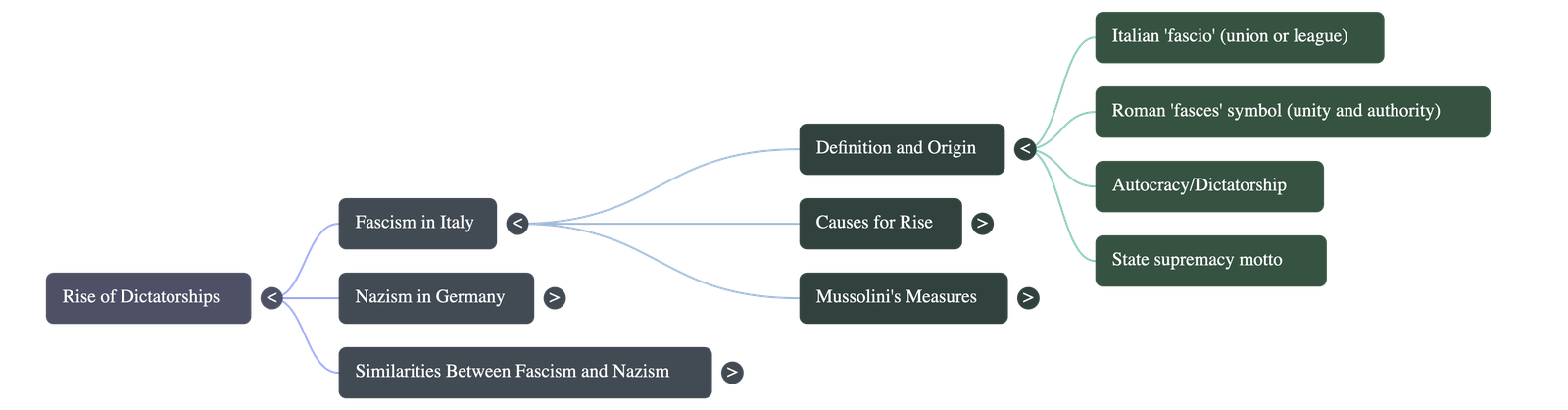
- The core philosophy of these totalitarian regimes was sacrificing the individual for the sake of the State. Their motto was: "everything for the State, everything within the State and nothing outside the State."
Meaning of Fascism
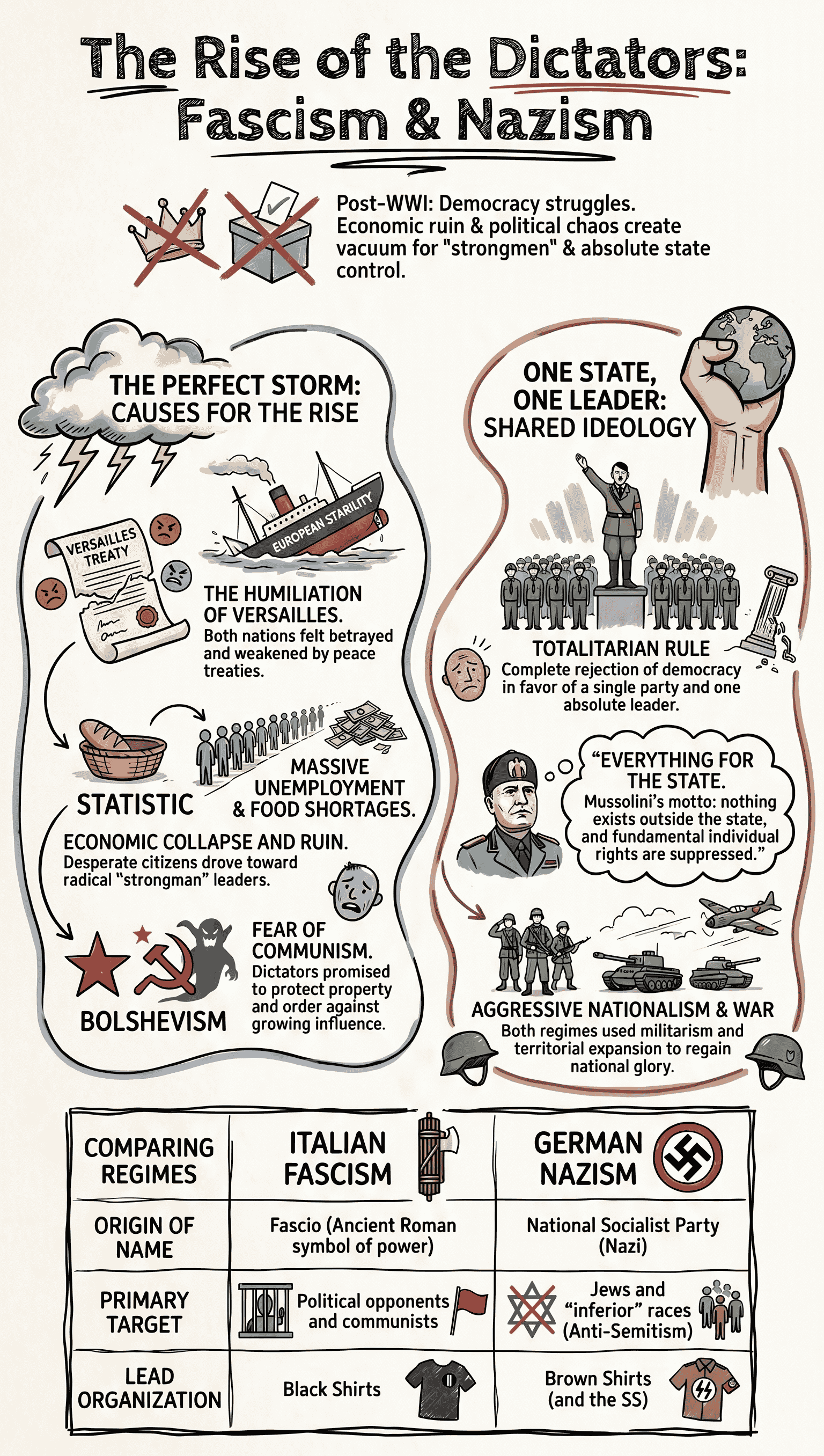
- The term 'Fascism' is derived from the Italian word fascio, which means a union or league.
- It refers to the ancient Roman symbol of power: the fasces, a bundle of sticks bound to an axe. This symbolized civic unity and the authority of Roman officials to punish wrongdoers.
- Fascism represents an autocracy or dictatorship where the entire power of the State is vested in one single man.
- It was an intensely nationalistic, anti-communistic, and anti-democratic movement.
Causes for the Rise of Fascism in Italy
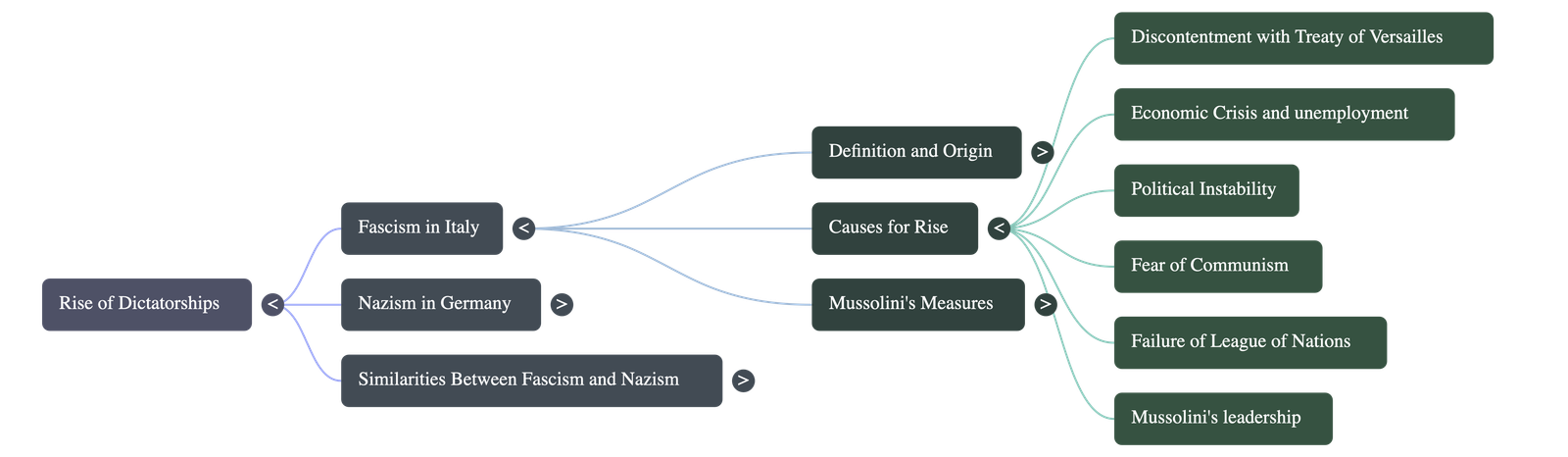
- Discontentment after the Treaty of Versailles: Italy joined the Allies in WWI to gain territories but was highly disappointed. While she received Southern Tyrol, Trentino, and coastal Dalmatia, Italy was denied any share of the German and Turkish colonial empires.
- Economic Crisis: Italy suffered heavy losses in life and property during WWI. Post-war, many soldiers faced unemployment, trade and commerce were ruined, and there was a severe shortage of food grains.
- Political Instability: Democracy was introduced in 1919, but elections failed to provide a clear majority. As a result, six weak coalition governments were formed, leading to administrative chaos.
- Growing Fear of Communism: The spread of communist ideas frightened the middle class and industrialists, paving the way for a dictator who promised to crush communism.
- Failure of the League of Nations: The League was too weak to check the rise of aggressive powers.
- Leadership of Mussolini: Benito Mussolini's charismatic leadership united the frustrated Italians.
Rise of Fascism and Mussolini's Reforms in Italy
- March to Rome: Mussolini led a massive march to Rome, prompting Emperor Victor Emmanuel III to invite him to form the new government. Mussolini eventually assumed dictatorial military and civil powers.
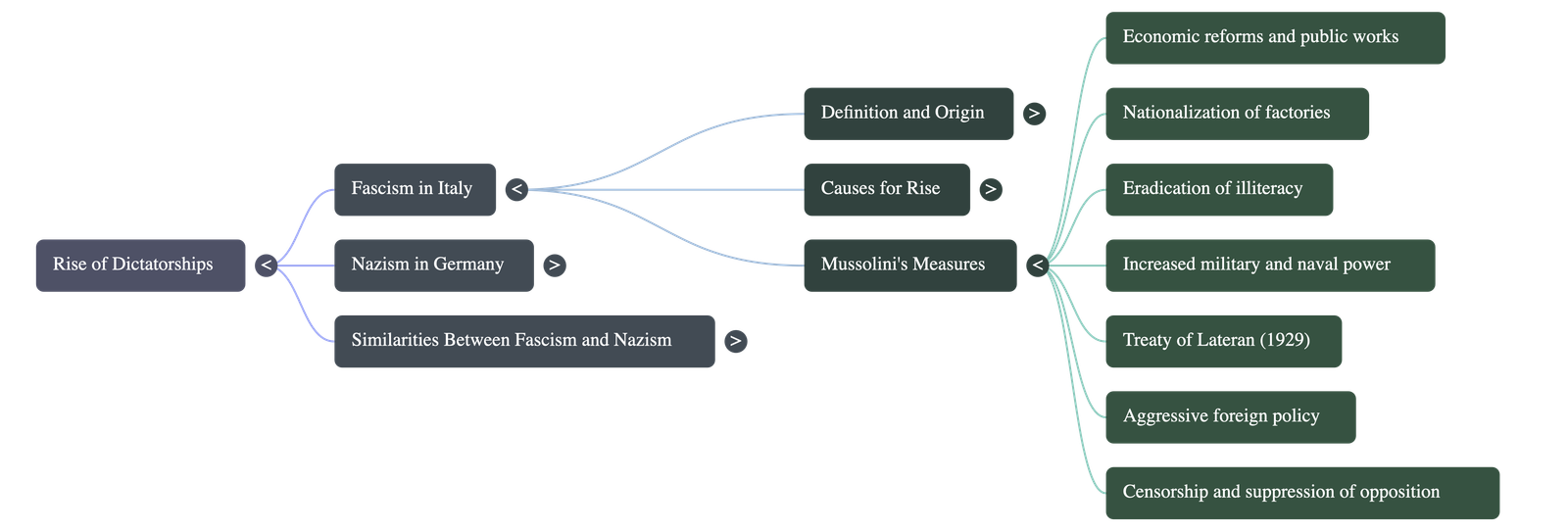
- Economic Measures: Hydroelectric power plants were set up to overcome coal shortages. More land was brought under cultivation, and the transport system was expanded.
- Employment and Industry: Factories and mills were nationalised. Syndicates were created to improve relations between capitalists and workers. An impressive public works program (roads, bridges, railways, schools) was launched to create jobs.
- Education: Elaborate provisions were made to eradicate illiteracy by opening many new schools, colleges, and libraries.
- Military Expansion: Military training was made compulsory. Italy's naval power was significantly enhanced to match France and Germany.
- Treaty of Lateran (1929): Mussolini signed a pact with the Pope. The Pope recognized the Italian government over Rome, and in return, the Pope retained control over the Vatican. Roman Catholicism was recognized as the state religion.
- Aggressive Foreign Policy: Mussolini embarked on an expansionist policy to revive the past glories of the Roman Empire.
Negative Impacts of Fascism
- All political freedom was heavily curbed.
- All political parties except the Fascist party were banned.
- The system of Jury was abolished, and special courts with military officers were set up to decide political cases.
- The press was strictly censored, and the freedom of speech and organizing meetings was prohibited. Opponents were brutally crushed.
Nazi Dictatorship in Germany: Background and Rise to Power
- Background: After Germany's defeat in WWI, Kaiser Wilhelm II was forced to abdicate. A democratic republic was established at Weimar in January 1919 with a new Constitution.
- Failure of the Weimar Republic: No single party could command a majority in the Reichstag (Parliament). Between 1919 and 1933, there were 21 Ministries headed by 12 Chancellors, leading to massive popular discontent, riots, and attempts to seize power.
- Adolf Hitler's Entry: Hitler, who fought in WWI as a corporal, joined the German Workers' Party in 1919. He soon became its leader and renamed it the National Socialist Party (Nazi party).
- Nazi Army: The party had two groups: "Brown shirts" to protect party members and disrupt opposition meetings, and "Black shirts" to protect party leaders.
- Mein Kampf: While jailed for an early attempt to capture power, Hitler wrote Mein Kampf (My Struggle), which outlined his dictatorial and racial ideas.
- Assumption of Power: In January 1933, President Hindenburg offered the Chancellorship to Hitler. After Hindenburg's death, Hitler abolished the Constitution, assumed the title of "Fuhrer" (The Leader), and became the absolute Dictator.
Causes for the Rise of Nazism in Germany
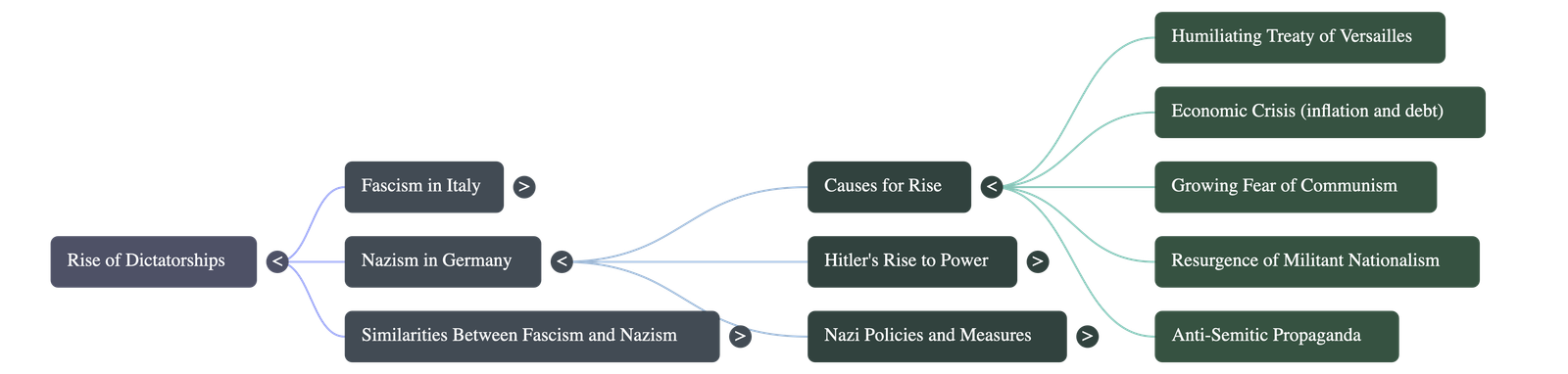
- Humiliating Treaty of Versailles: The Germans felt deeply humiliated by the treaty's harsh terms. Germany lost large chunks of territory, its overseas colonies were divided, it was forced to pay $33 billion in reparations, and its army was reduced to just one lakh soldiers. Hitler openly promised to tear up this treaty.
- Growing Fear of Communism: Following the Bolshevik Revolution in Russia, communist influence grew in Germany. Hitler warned Germans that they would become servants of Russian masters, persuading the public and capitalists that only Nazism could stop communism.
- Economic Crisis: Germany suffered severely from the loss of colonies and trade. High foreign tariffs, massive unemployment, and crushing farmer debts (up to $300 million) created widespread misery. The Nazis exploited this desperation, promising economic recovery.
- Resurgence of Militant Nationalism: Germans were frustrated with the weak democratic parliamentary system. They preferred prestige, glory, and a strong leader who could restore Germany's past greatness over democratic liberties.
- Anti-Semitic Propaganda: The Nazi party falsely blamed the Jewish population for Germany's defeat in WWI and for their current economic hardships, successfully using them as a scapegoat to rally support.
Domestic and Foreign Policies of Hitler
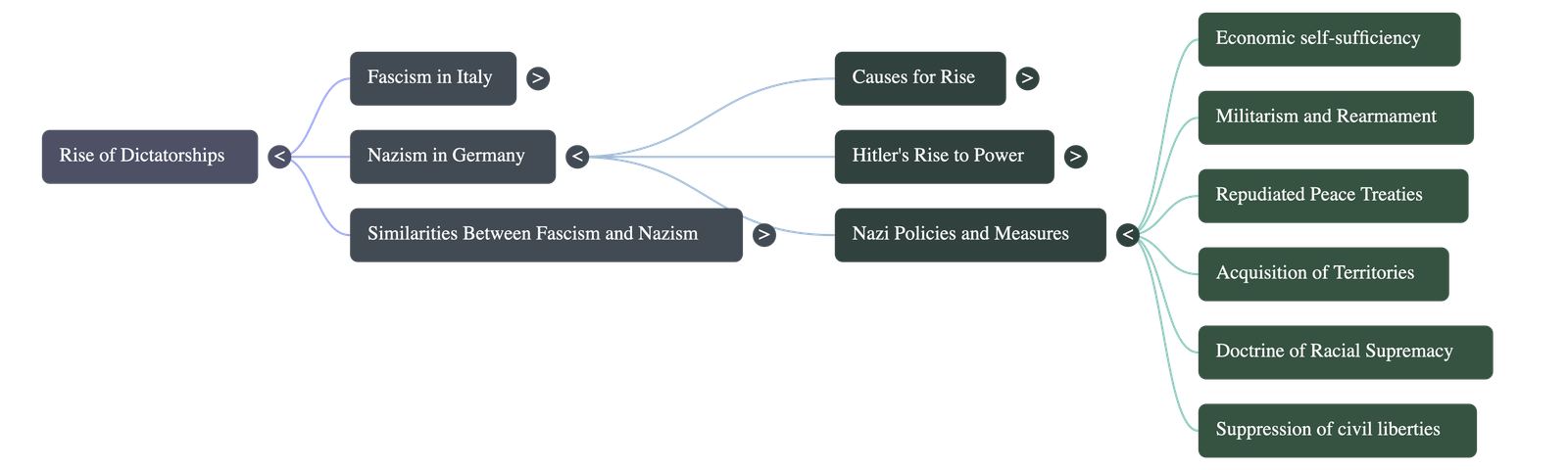
- Economic Reorganization: Factories were set up to eliminate unemployment. A Food Corporation was established to control production, distribution, and pricing. Public works (highways, stadiums, housing) were aggressively undertaken. Trade unions were dissolved and replaced by a single Nazi-controlled union. Strikes were banned.
- Militarism: Heavy armaments, aeroplanes, and naval ships were produced on a large scale. Military training was made compulsory. Hitler started massive rearmament in direct violation of the Treaty of Versailles.
- Repudiation of Treaties: Hitler openly condemned the Treaty of Versailles, refusing to pay war indemnities and pursuing rapid territorial expansion.
- Acquisition of Territories (Lebensraum): Hitler claimed Germany needed more "living space" for raw materials and food. He forcefully expanded into Eastern Europe. He signed a non-aggression pact with Poland (1934), reclaimed the Saar and Rhineland, annexed Austria (1938), and signed a pact with Russia.
- Doctrine of Racial Supremacy: Hitler propagated the dangerous myth that Germans were the "master race" destined to rule the world. This doctrine sought to "cleanse" Germany of Jews, Christians, and Communists.
- End of Civil Liberties: Similar to Mussolini, Hitler ruthlessly crushed opposition, imposed strict censorship on the press and cinema, and burned all anti-Nazi literature.
Fall of Hitler
- Hitler's aggressive expansion directly caused the outbreak of the Second World War.
- Germany was totally defeated by the Allied powers. With Hitler's death in 1945, the disastrous era of Nazism in Germany came to a sudden end.
Similarities Between Fascism and Nazism
A. Similarities in Causes
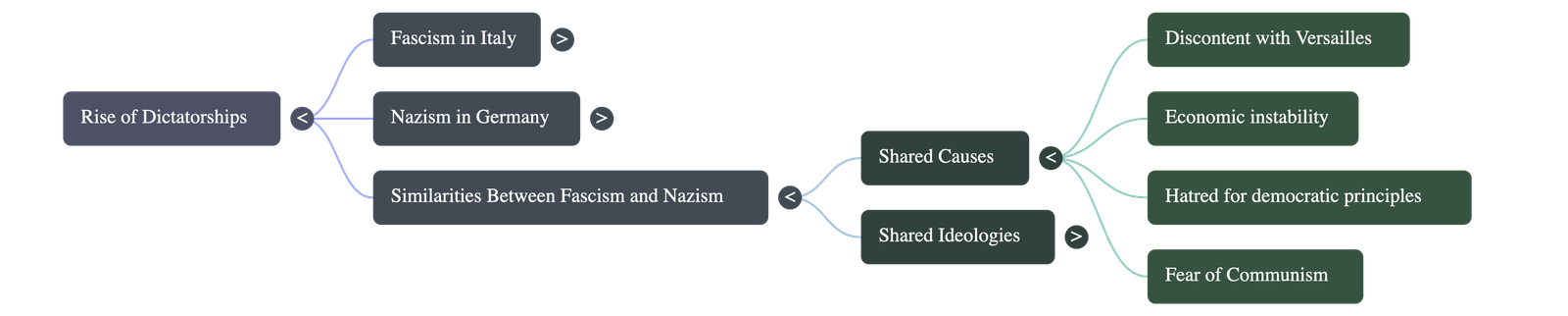
- Discontentment with the terms of the Treaty of Versailles.
- Severe economic crises causing massive unemployment and industrial decline.
- Hatred for democratic principles and a preference for a one-party, totalitarian system.
- Widespread fear among the middle class regarding the spread of Communism.
- Political instability and constant class conflict in both nations.
- The overarching failure of the League of Nations to maintain global stability.
- The emergence of highly charismatic leaders (Mussolini and Hitler).
B. Similarities in Ideologies
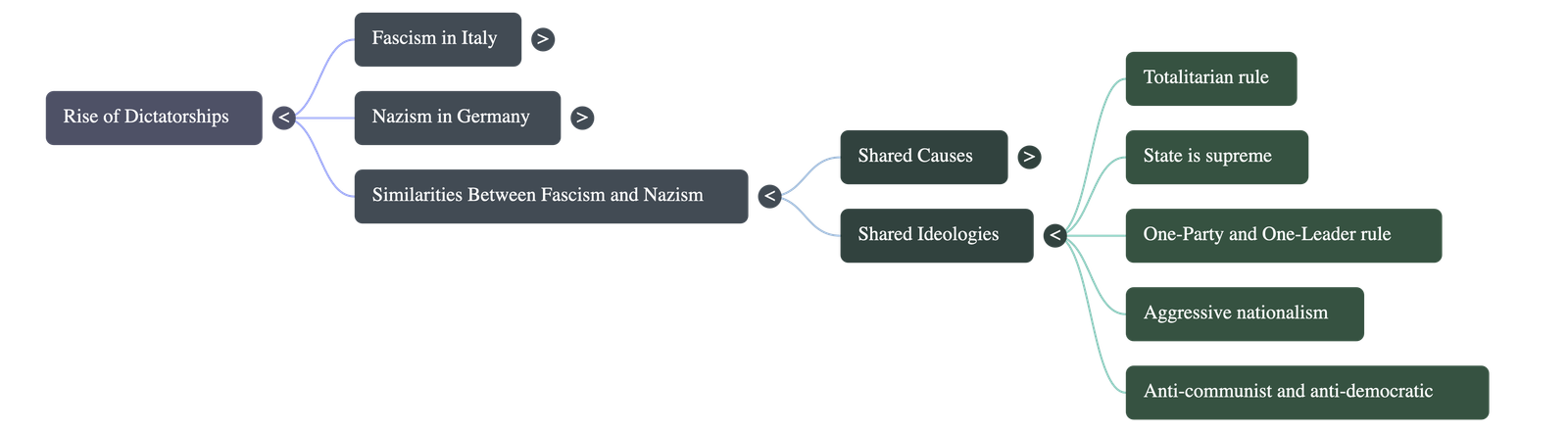
- Both ideologies firmly believed in absolute totalitarian rule.
- Both deeply despised democratic political systems.
- Both held that the State is supreme and could suppress all fundamental rights and freedoms of the individual.
- Both upheld the strict rule of One-Party and One-Leader.
- Both believed heavily in aggressive nationalism and imperialism.
- Both regarded war as a legitimate and necessary instrument for furthering national interests.
- Both established intensely nationalistic, anti-communist, and anti-democratic regimes.
Do checkout all questions & answers of this chapter.
Quick Navigation:
| | | |
1 / 1
Quick Navigation:
| | | |