Growth of Nationalism
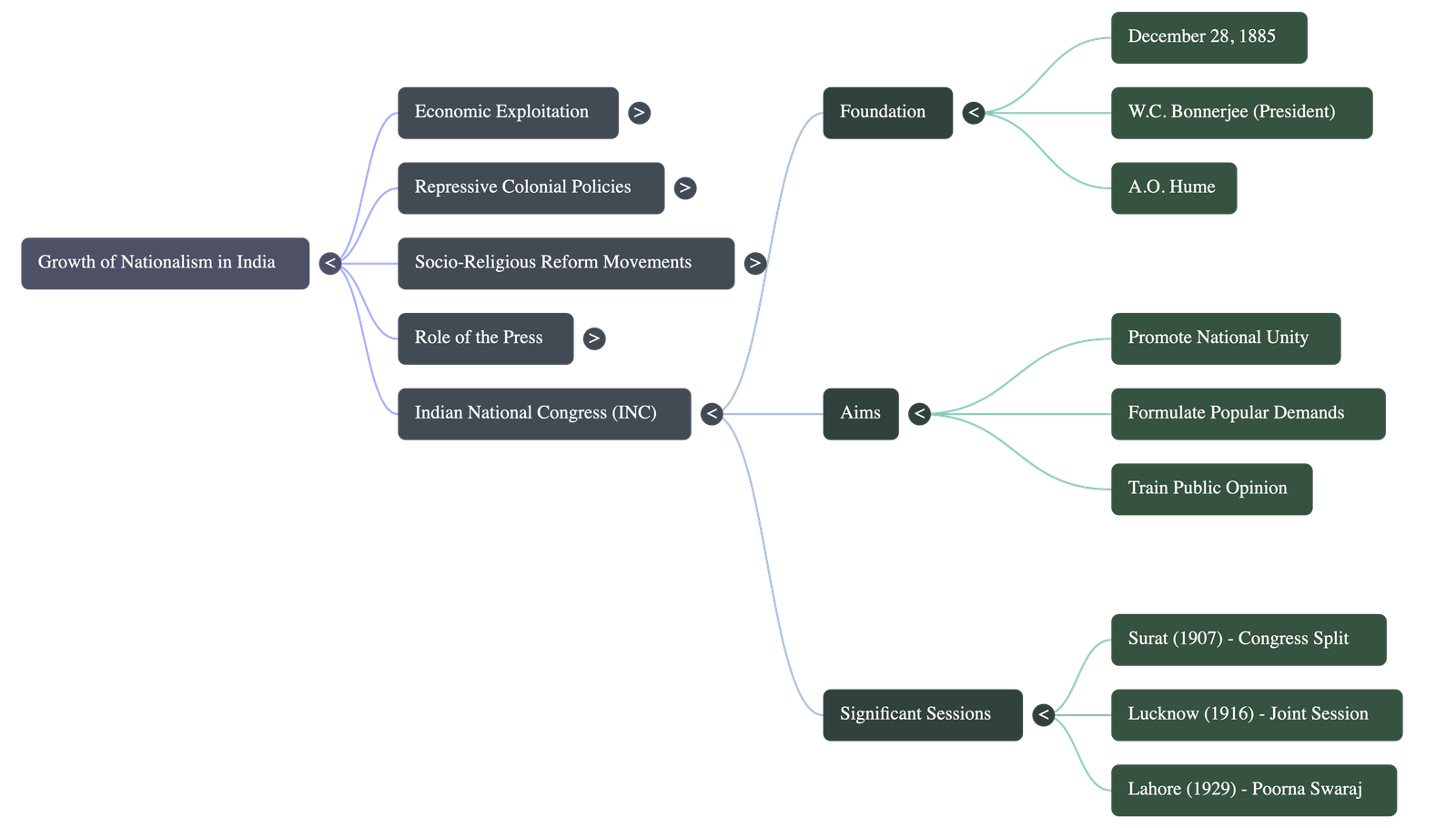
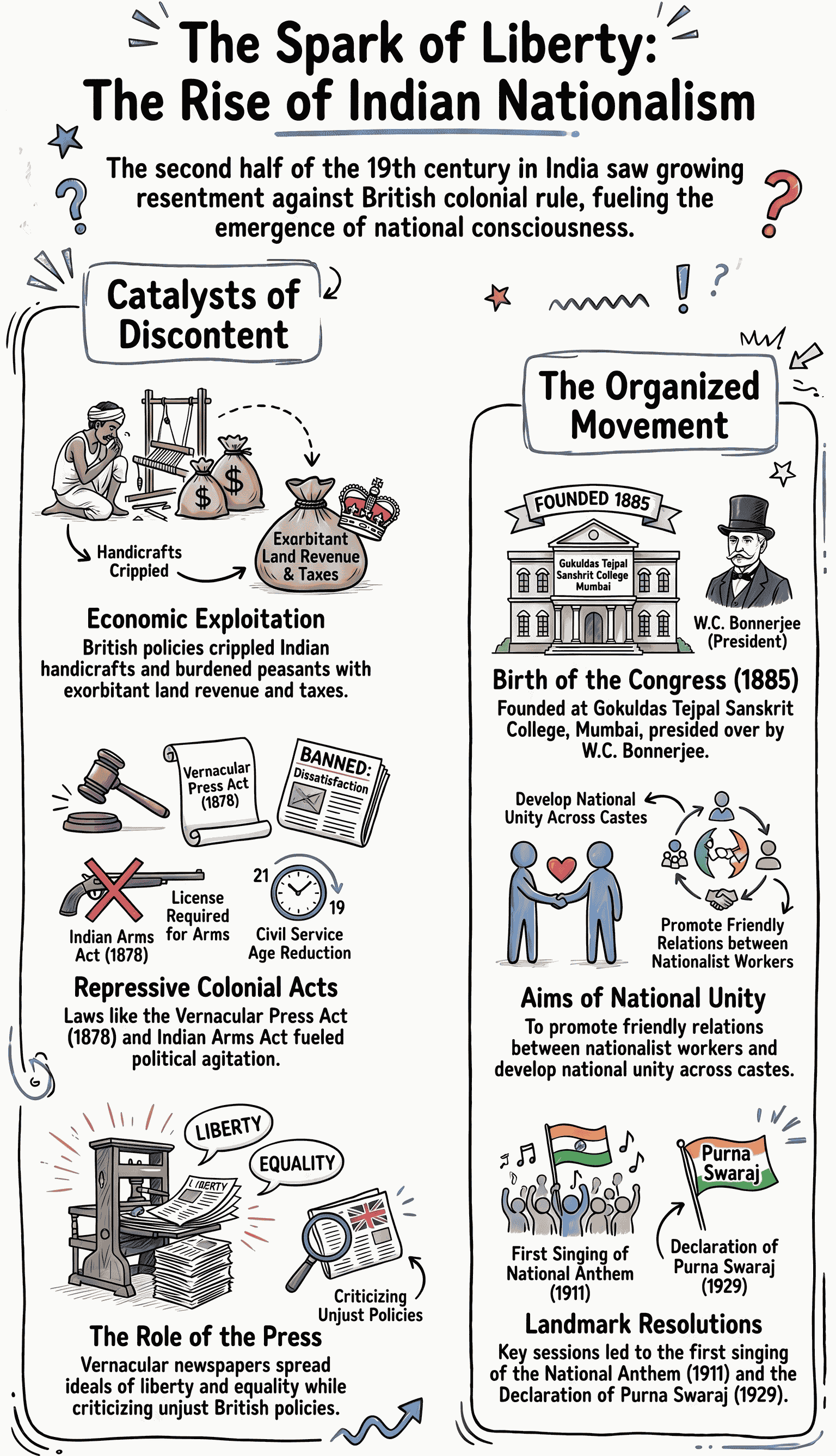
The second half of the 19th century witnessed the emergence of national political consciousness and a strong feeling of nationalism in India. The major factors contributing to this growth are detailed below.
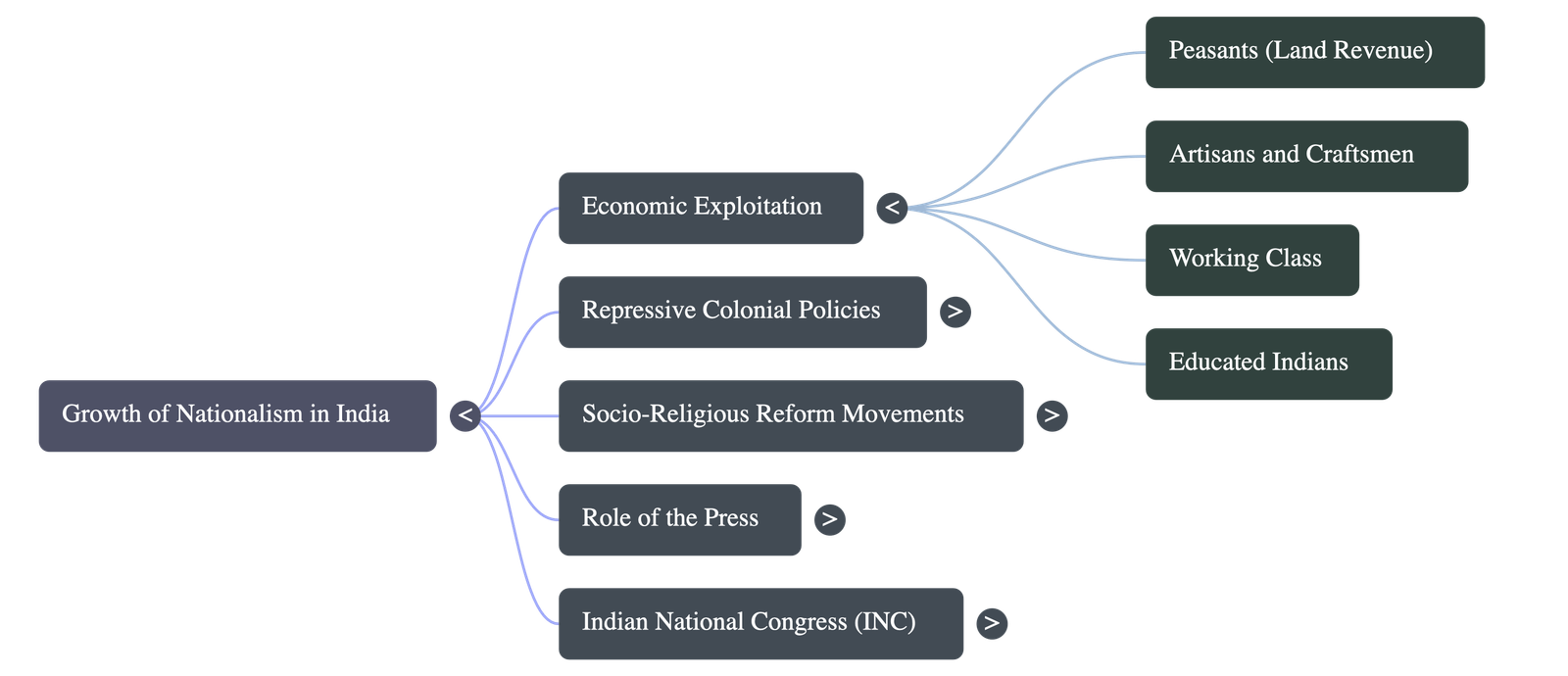
1. Economic Exploitation
The realization that British policies in India were designed to promote British interests at the cost of Indian welfare caused immense economic discontent among various sections of society:
- The Peasants: They were the main victims of colonial policies. The government extracted a large part of their produce as land revenue and taxes. These exorbitant taxes forced peasants into the vicious clutches of landlords and moneylenders.
- The Artisans and Craftsmen: The British used their political power to destroy Indian trade, handicrafts, and industry. India was reduced to a mere source of raw materials for British industries and a market for their finished goods. This crippled artisans and deprived them of their livelihood.
- The Working Class: The growth of modern industries created a new working class. They were heavily exploited by factory owners, who were mostly Englishmen. Despite their small numbers, they represented a broad, new social outlook covering all of India.
- The Educated Indians: The only employment available to educated Indians was government service, which had high competition and bleak promotion chances. They realized British policies were intentionally keeping India economically backward.
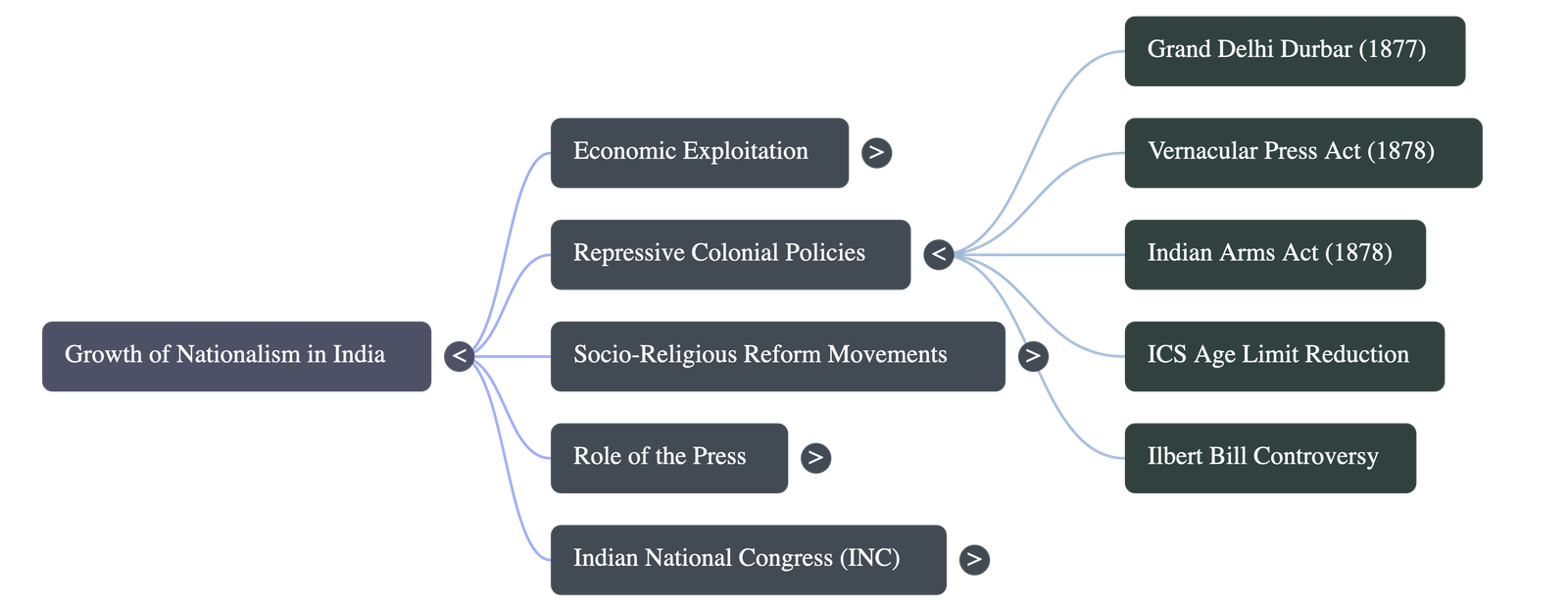
2. Repressive Colonial Policies
The British conquered India to promote their own interests and implemented policies to keep India subservient. These policies acted as a catalyst for the nationalist movement:
- Grand Delhi Durbar (1877): Organized by Lord Lytton to proclaim Queen Victoria as the Empress of India. Millions of rupees were wasted on the event while Indians were suffering from a massive famine.
- Vernacular Press Act (1878): Introduced by Lord Lytton, it forbade vernacular (regional language) papers from publishing any material that might incite dissatisfaction against the British Government. It did not apply to English newspapers. It was later repealed by Lord Ripon in 1882.
- Indian Arms Act (1878): Made it a criminal offence for Indians to carry arms without a license, but this rule did not apply to the British.
- Reduction in Age Limit for ICS: The maximum age for the Indian Civil Service examination was reduced from 21 to 19 years. Since the exam was held in London, this made it extremely difficult for Indians to compete.
- Removal of Import Duties: Lord Lytton removed import duties on British cotton textiles, benefiting British industries at the cost of the nascent Indian textile industry.
- The Ilbert Bill (1883): Prepared by Sir C.P. Ilbert (Law member of the Viceroy's Council) under Lord Ripon. It aimed to introduce equality by allowing Indian judges to try British or European persons. It was fiercely resented by the British who formed a Defence Association. The government withdrew the Bill, sparking counter-agitation by educated Indians and exposing deep-seated British racism.
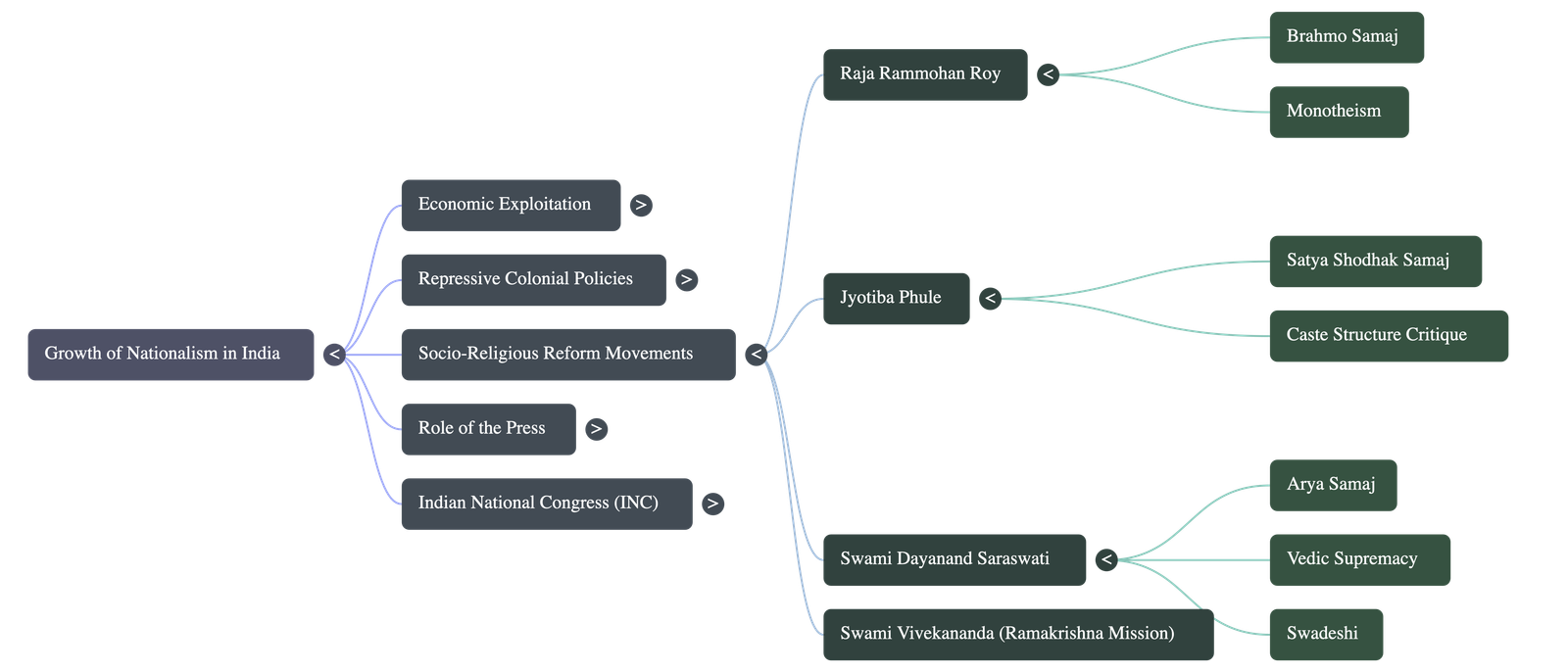
3. Socio-Religious Reform Movements
These movements were the pioneers of Indian nationalism. Western education led educated Indians to adopt a rational, humanitarian, and scientific approach, prompting them to reform Indian religion and society.
- Social Sphere: Worked for the abolition of the caste system, child marriage, dowry system, purdah system, sati, and infanticide.
- Religious Sphere: Combated religious superstitions, attacked idolatry, polytheism, and hereditary priesthood, fighting for individual liberty and equality.
Prominent Reformers and Organizations:
Raja Rammohan Roy (Brahmo Samaj)
- A great humanist and pioneer of the 19th-century reforms in Bengal.
- Stressed the unity of all religions. Studied Sanskrit, Hindu philosophy, the Quran, Persian, Arabic, and the Bible (in original Greek and Hebrew).
- Wrote Gift to Monotheists in Persian, arguing against polytheism and supporting the worship of a single God.
- Condemned the prevalent caste structure in India, calling it an epitome of slavery.
Jyotiba Phule (Satya Shodhak Samaj)
- Founded the Satya Shodhak Samaj (Society of Truth Seekers) in 1873.
- Aimed at securing social justice for the weaker sections of society and lower castes.
- Described the hardships and distress felt by lower castes in his famous book, Gulamgiri.
Swami Dayanand Saraswati (Arya Samaj)
- Original name was Mool Shankar. Founded the Arya Samaj in 1875 in Bombay.
- Authored Satyarth Prakash, containing the philosophy and social teachings of the Arya Samaj.
- Ideals of Arya Samaj:
- Supremacy of Vedas: His motto was "Go Back to the Vedas", fostering self-confidence and self-respect.
- Monotheism: Preached against idol worship and advocated faith in one God.
- Opposition to Social Evils: Disregarded the caste system and condemned child marriage.
- Shudhi Movement: Aimed to stop religious conversions and bring back Hindu converts from other religions.
- Equality of Women: Opposed purdah, encouraged widow-remarriage, advocated equal status, and started special schools/colleges for girls.
- Education: Encouraged the study of Sanskrit, Vedas, and modern education. Opened Dayanand Anglo-Vedic (D.A.V.) schools and colleges (the first in Lahore in 1866).
- Legacy: He was perhaps the first to preach "Swadeshi" and "India for the Indians".
Effects of Socio-religious Reform Movements on Nationalism:
- Proclaimed the superiority of Indian culture and civilization (especially by Swami Dayanand and Swami Vivekananda).
- Condemned untouchability and the caste system, attracting the so-called lower castes to ideas of brotherhood.
- Taught people not to ignore the importance of women, encouraging their participation in the national movement.
- Protested against British domination (e.g., the slogan 'India for the Indians').
- Created a consciousness of a new society devoid of privileges based on caste, creed, or religion.
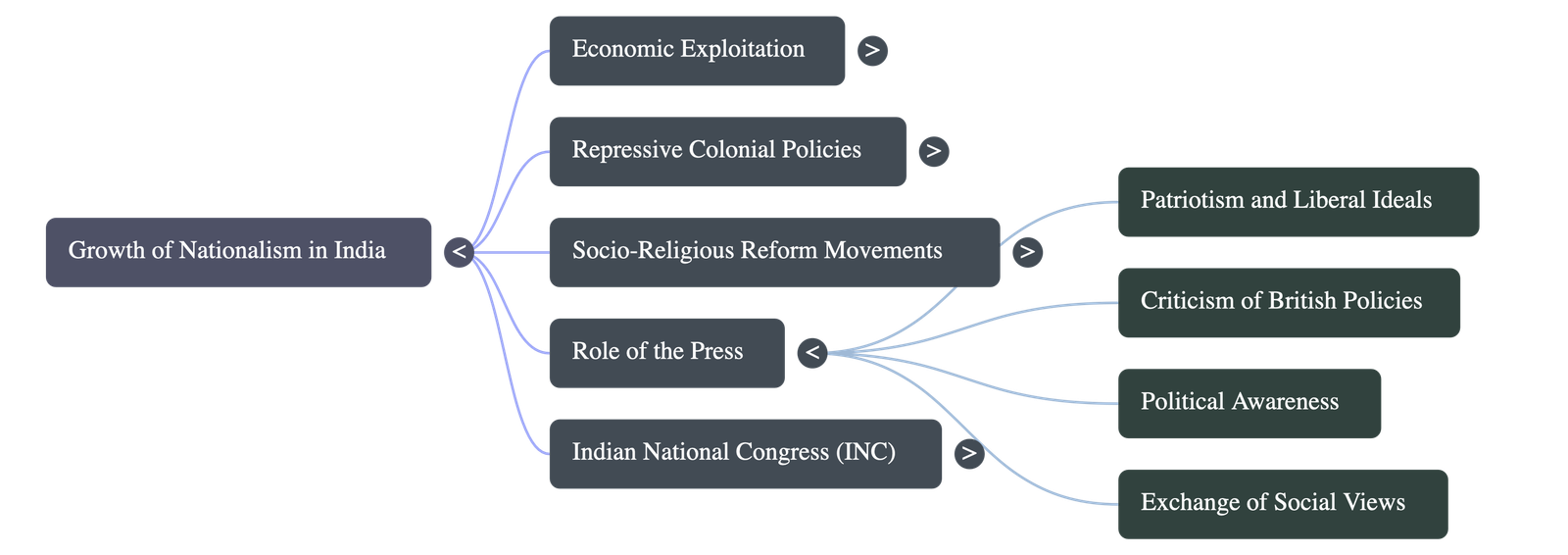
4. Role of the Press
In the later half of the 19th century, numerous newspapers emerged (e.g., Amrit Bazar Patrika, The Bengali, The Tribune, The Pioneer, The Times of India, The Hindu, The Statesman). They played a significant role in developing strong national sentiment by:
- Spreading messages of patriotism, liberty, freedom, equality, home rule, and independence.
- Carrying out daily criticism of unjust British policies and exposing the true nature of British rule in India.
- Making it possible for different social groups from various parts of the country to exchange views and organize political movements.
- Making Indians aware of global political and social developments, helping them shape their own policies and programmes.
5. Foundation of the Indian National Congress
By the late 19th century, Indians realized that the country could not be sovereign until British control over India's resources and people ended. This led to the formation of numerous political associations.
Early Political Associations:
- The first political association was the Landholders' Society in Kolkata (1838).
- Other forerunners included the Bengal British India Society, British Indian Association, Poona Sarvajanik Sabha, London Indian Society, and Indian Association.
- East India Association: Founded in London in 1866 by Dadabhai Naoroji (the 'Grand Old Man of India'). It provided information on Indian subjects to British citizens and Members of Parliament. It aimed to place the true state of affairs before the English people to resolve Indian problems. It had branches in Mumbai, Kolkata, and Chennai.
Birth of the Indian National Congress (1885):
- The first meeting was originally scheduled in Pune but was moved to Gokuldas Tejpal Sanskrit College, Mumbai.
- It was held from December 28 to 31, 1885, under the presidentship of Womesh Chandra Bonnerjee and attended by 72 delegates from all over India.
- Originally named the Indian National Union, it was changed to the Indian National Congress upon the suggestion of Dadabhai Naoroji.
- The Viceroy, Lord Dufferin, favored its formation as a 'safety-valve' for popular discontent to safeguard British interests. However, the Congress ultimately stood for the hopes and aspirations of the Indian people, achieving freedom in 1947.
Aims of the Indian National Congress:
Declared by W.C. Bonnerjee in his first presidential address:
- To promote friendly relations between nationalist political workers from different parts of the country.
- To develop and consolidate feelings of national unity irrespective of caste, religion, or province.
- To formulate popular demands and present them before the government.
- To train and organize public opinion in the country.
Important Sessions of the Congress:
The Congress held its sessions every year in December to chalk out programs. Delegates increased to thousands over time.
- 23rd Session (Surat, 1907): Split between the two wings of the Congress (Early Nationalists and Assertive Nationalists) due to disputes regarding agitation methods in Bengal.
- 26th Session (Kolkata, 1911): The National Anthem, Jana Gana Mana, was sung for the first time.
- 31st Session (Lucknow, 1916): Joint session with the Muslim League and signing of the Lucknow Pact. The two wings of the Congress also reunited here after nearly a decade.
- 39th Session (Belgaum, 1924): Mahatma Gandhi presided over this session.
- 44th Session (Lahore, 1929): Declaration of Poorna Swaraj and decision to launch the Civil Disobedience Movement.
- 51st Session (Haripura, 1938): Subhas Chandra Bose was elected as the President.
Do checkout all questions & answers of this chapter.