Quick Navigation:
| | | |
First Phase of the Indian National Movement
1. Beliefs of the Early Nationalists
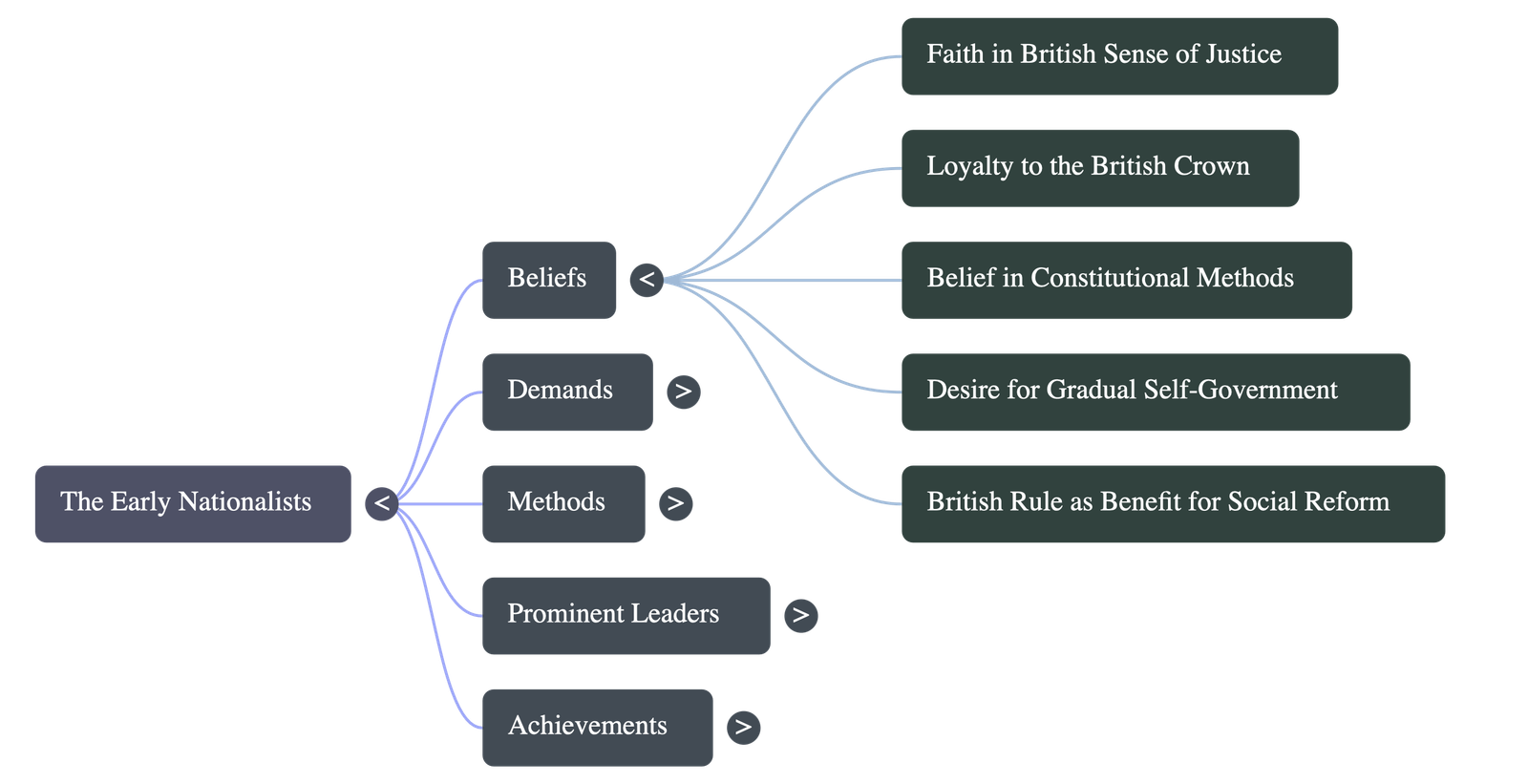
- Faith in British Justice: They firmly believed in the sense of justice, fair play, honesty, and integrity of the British.
- Hope for 'Home Rule': They relied on the solemn pledges made by the British government and hoped to be granted 'Home Rule'.
- Benefits of British Rule: They felt the British helped cleanse Indian society of social ills like sati, untouchability, and child marriage.
- Western Governance: They believed Britain would help Indians govern themselves according to modern western standards.
- Root Cause of Backwardness: They believed that India's social and economic backwardness was the main obstacle to progress, rather than British colonial rule itself.
- Peaceful Methods: They heavily relied on constitutional, peaceful methods, preferring patience and reconciliation over violence and confrontation.
2. Demands of the Early Nationalists
A. Constitutional Reforms
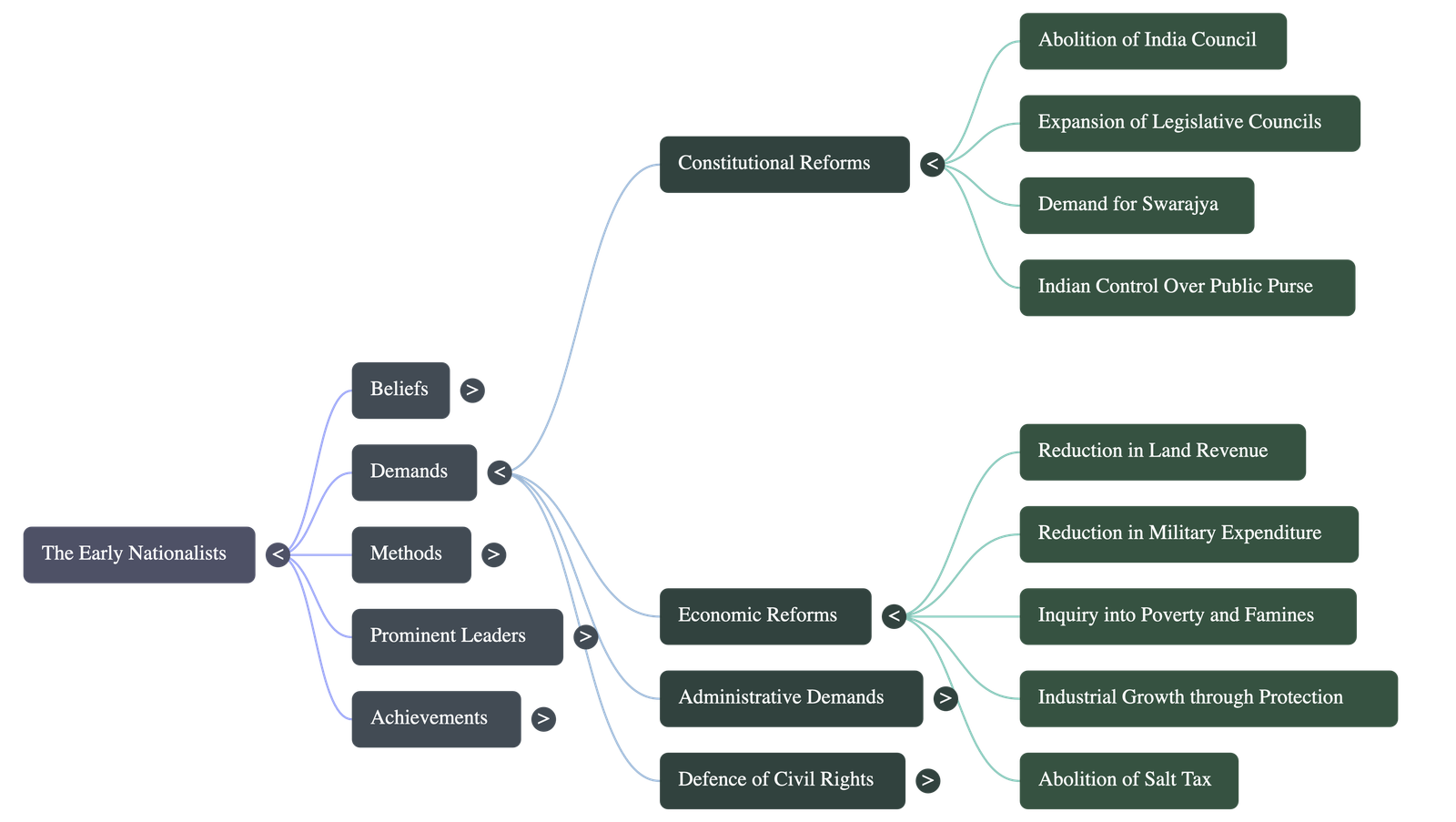
- Abolition of the India Council.
- Expansion of Legislative Councils (Centre and Provinces) with more elected Indian members.
- Indian control over the public purse, raising the slogan 'No taxation without representation'.
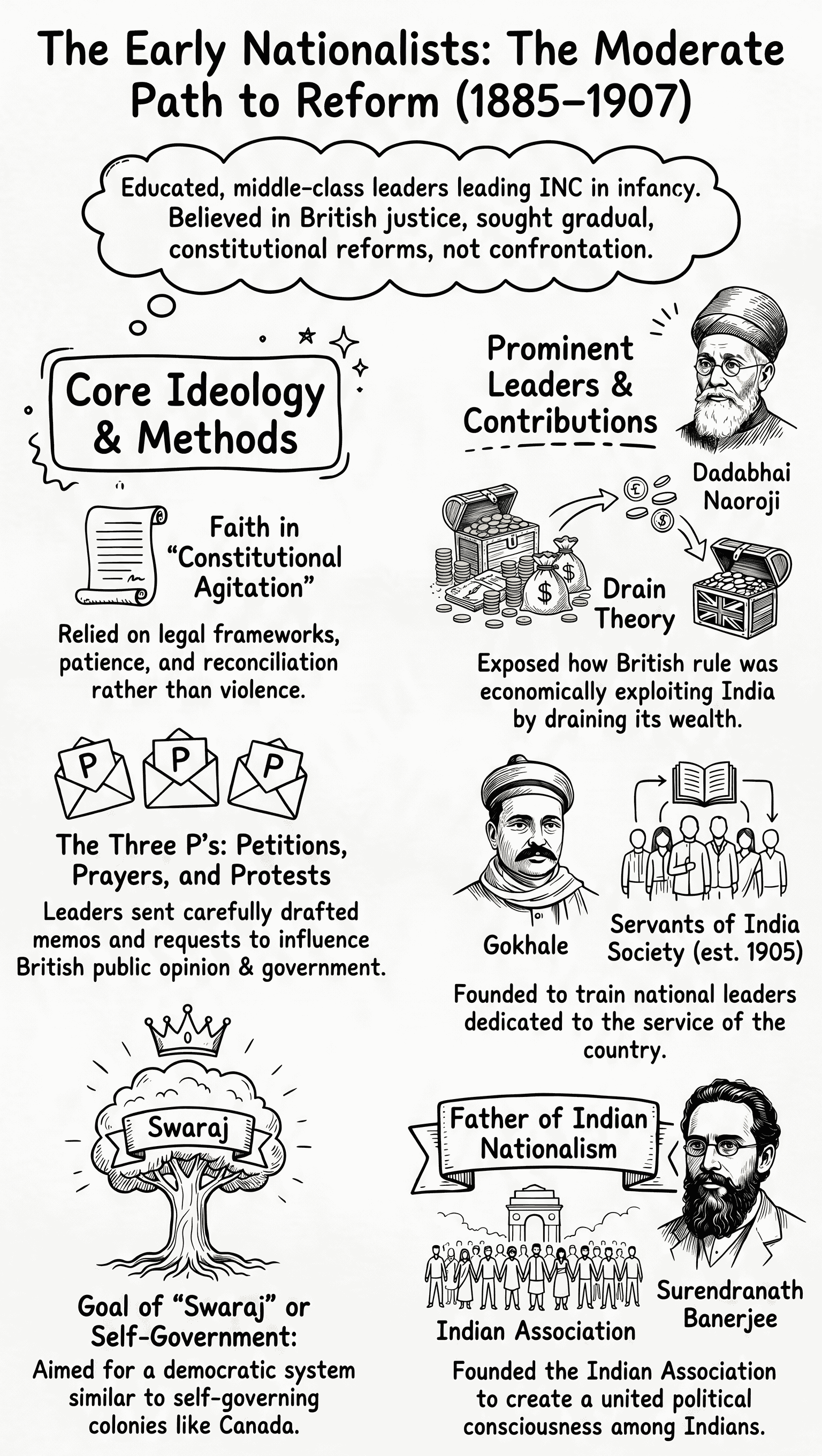
- Demand for Swarajya (self-government) within the British empire, similar to colonies like Canada and Australia.
- Adequate representation of Indians in the Executive Council of the Viceroy and Governors.
B. Economic Reforms
- Reduction in land revenue and protection of peasants from unjust zamindar demands.
- Reduction of massive army expenditure, redirecting funds to welfare, health, and education.
- Enquiry into India's growing poverty and famines.
- Availability of cheap credit for farmers via agricultural banks.
- Industrial growth through trade protection (heavy taxes on imported goods) and government loans for Indian industries.
- Total abolition of the Salt Tax and sugar duty.
C. Administrative Demands
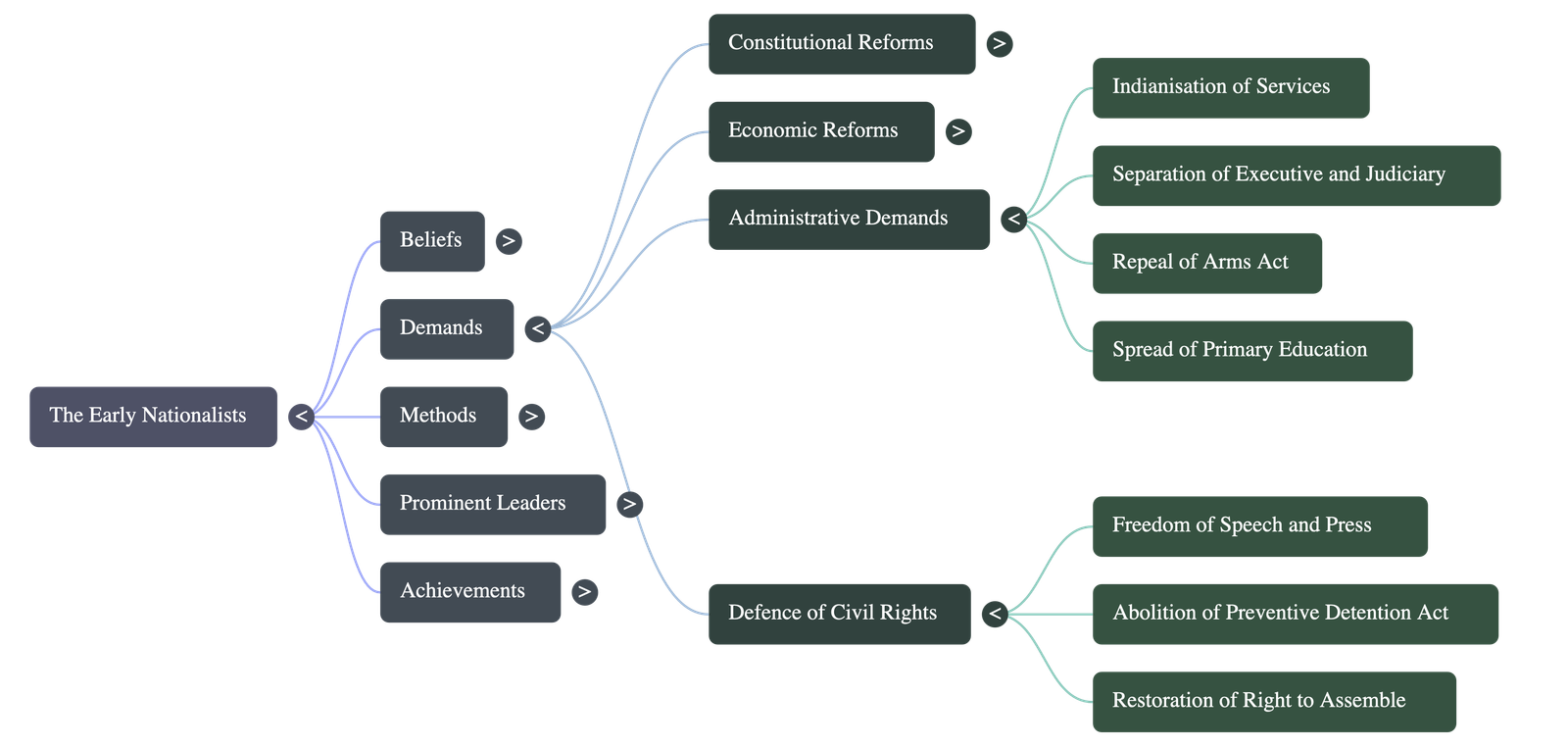
- Indianisation of services through simultaneous Indian Civil Service (ICS) exams in England and India.
- Complete separation of the executive and the judiciary to protect Indians from arbitrary police acts.
- Repeal of the Arms Act and Licence Act.
- Increase in powers of local municipal bodies and spread of primary education.
D. Defence of Civil Rights
- Removal of restrictions on freedom of speech and freedom of the press.
- Abolition of the Preventive Detention Act and restoration of individual liberties.
- Restoration of the right to assemble and form associations.
3. Methods of the Early Nationalists
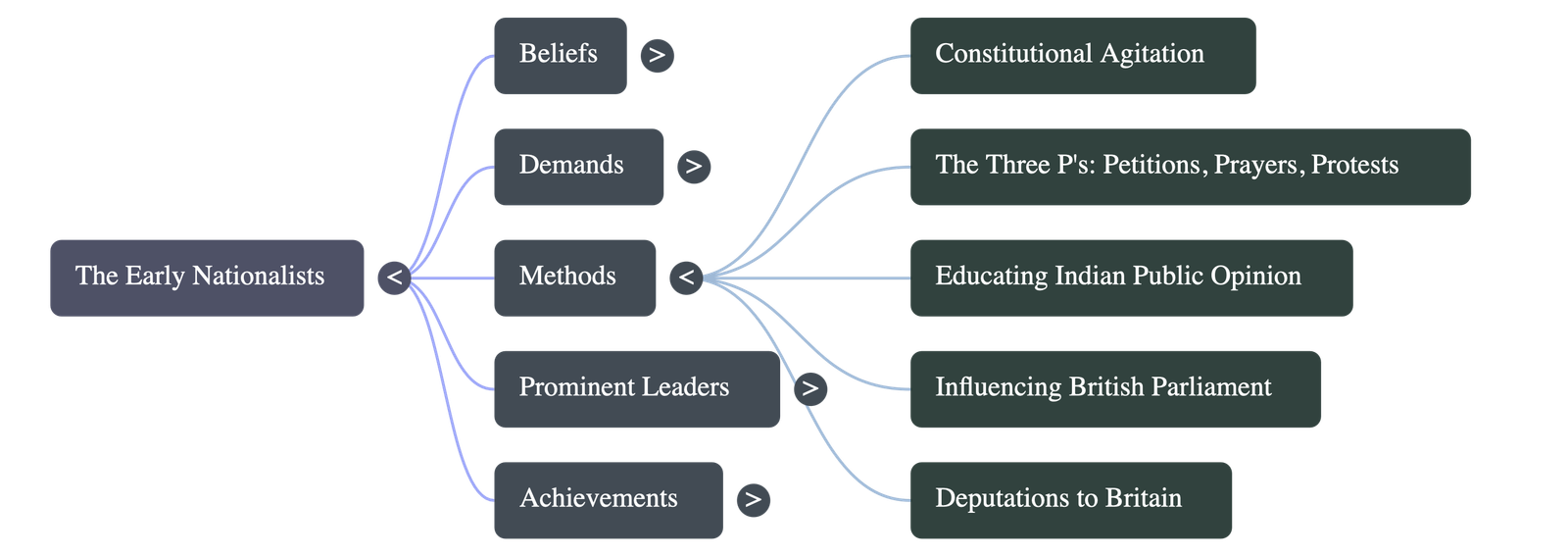
They were practical and aimed to win freedom through a gradual process ("Constitutional Agitation Method"). They worked on the lines of least resistance with two main objectives:
First Objective: Educate Indians & Arouse Political Consciousness
- Held meetings to pass resolutions for popular demands.
- Used the press effectively to criticize government policies.
- Drafted memorandums and petitions with solid facts and arguments to educate the Indian public.
Second Objective: Influence British Government & Public
- The 3 P's: Relied heavily on Petitions, Prayers, and Protests.
- Set up the British Committee of the Indian National Congress in London (1889) and published a weekly journal called India.
- Sent deputations of Indian leaders (like Dadabhai Naoroji) to Britain to spread awareness about the plight of Indians among British politicians and the public.
4. Attitude of the British Government
- The British realized the growing unity of Indians posed a major threat to their rule.
- They aggressively pushed a policy of 'Divide and Rule' to sow seeds of communalism between Hindus and Muslims.
- They encouraged loyalists and pro-British individuals (like Sir Sayyid Ahmad Khan) to start anti-Congress movements.
- They granted minor concessions to separatists to suppress nationalism, though their hostility ultimately made the Congress more powerful.
5. Prominent Early Nationalist Leaders
Dadabhai Naoroji (1825–1917)
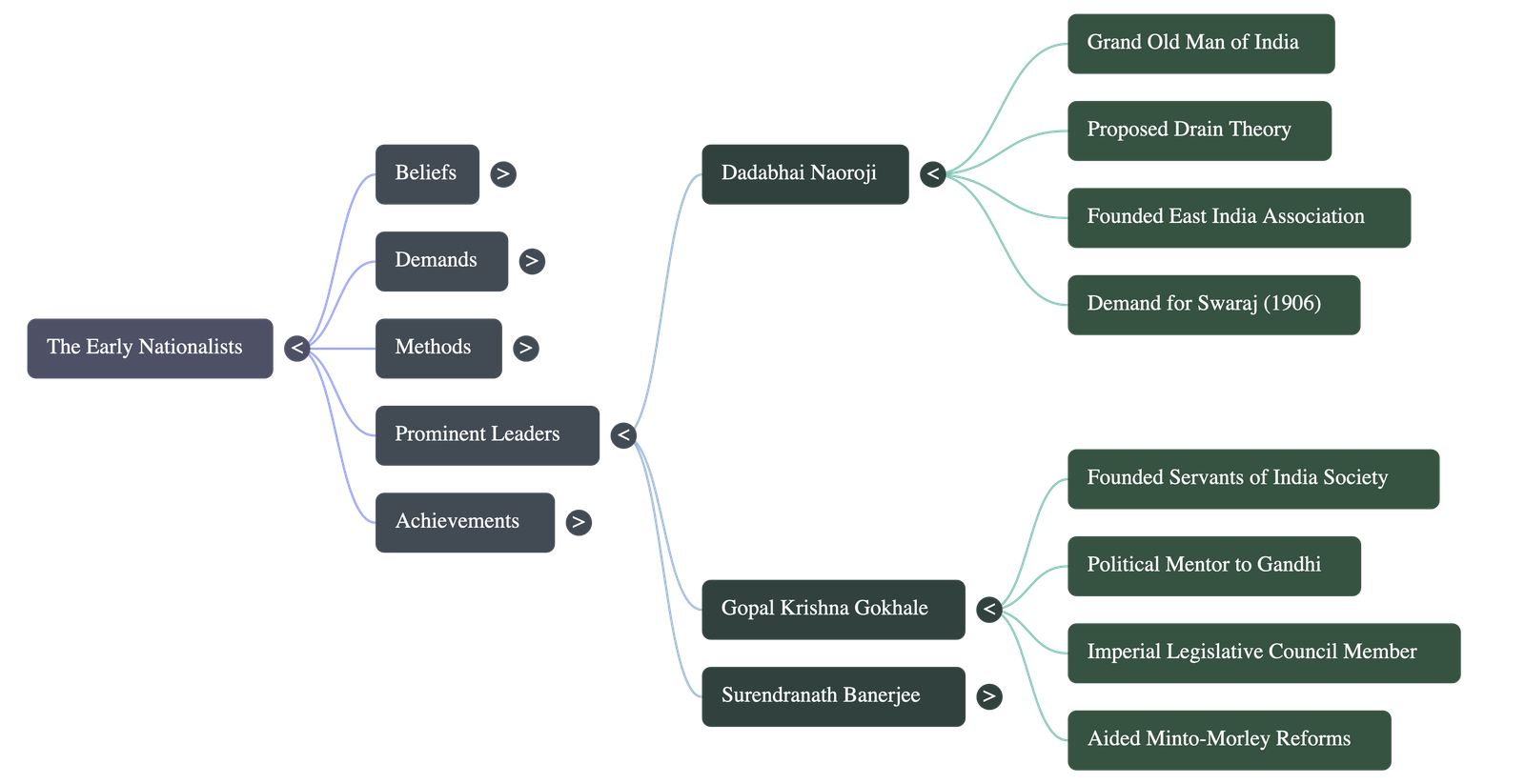
Popularly known as the 'Grand Old Man of India'.
- India's Unofficial Ambassador: Fought for India's cause in England. Founded the London India Society (1865) and the East India Association (1866).
- First Indian in British Parliament: Became a member of the British House of Commons and passed a resolution for simultaneous ICS exams (1893).
- Role in Congress: Thrice elected as President of the INC. In 1906, he was the first to demand Swaraj from the Congress platform.
- Drain Theory: Exposed British economic exploitation in his famous book 'Poverty and Un-British Rule in India', explaining how India's wealth was being drained to England.
Gopal Krishna Gokhale (1866–1915)
Known as the political mentor of Mahatma Gandhi.
- Persuaded the British for Reforms: Criticized the government for huge army expenditures, racial discrimination in appointments, and salt/cotton taxes.
- Servants of India Society: Founded this society in 1905 to train dedicated national leaders who would serve India.
- Imperial Legislative Council: As a member, he strongly pleaded for a reduction in salt duty and the abolition of excise duty on cotton. Played a key role in the Minto-Morley Reforms.
- Role in South Africa: Visited South Africa to help Gandhiji fight racial discrimination and persuaded him to return to Indian public life.
Surendranath Banerjee (1848–1925)
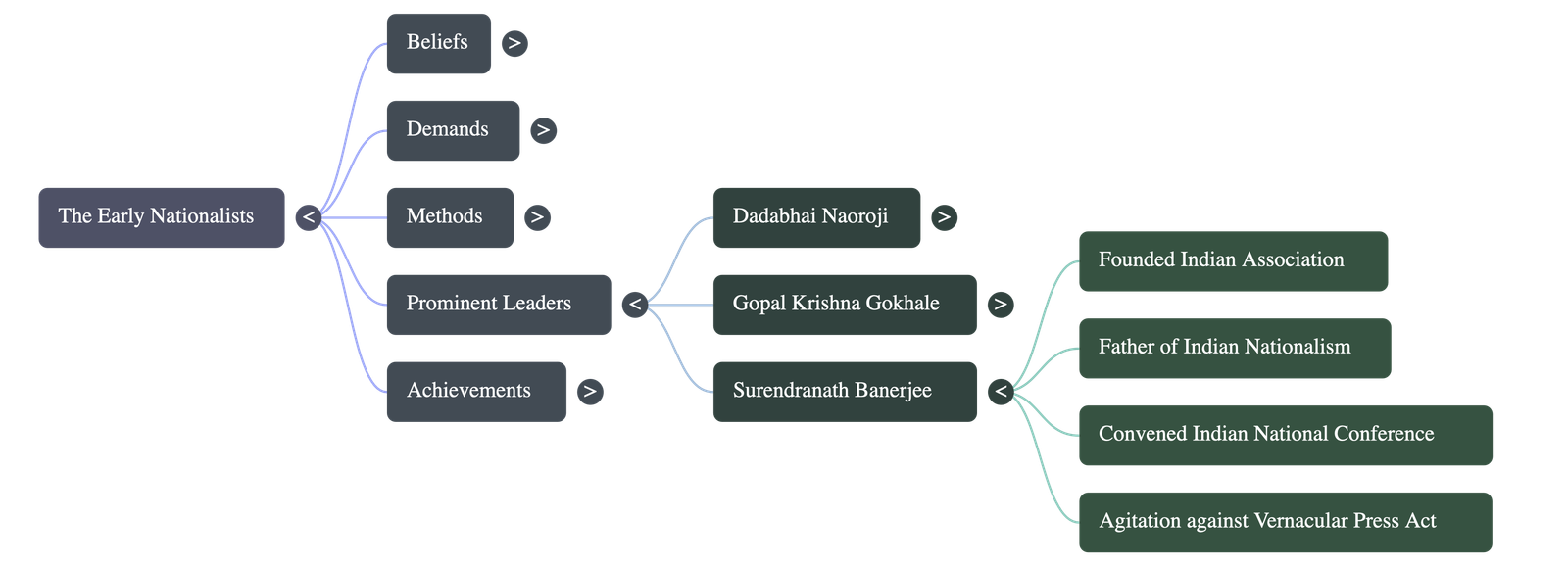
Popularly known as the 'Father of Indian Nationalism'.
- Civil Services: Qualified for the ICS but was dismissed for opposing racial discrimination.
- Established the Indian Association: Founded in 1876 to educate people, create strong public opinion, and arouse political unity.
- All-India Political Organization: Convened the Indian National Conference in 1883, which later merged with the Indian National Congress in 1886.
- Political Ideas & Journalism: Edited the newspaper 'Bengalee' and wrote the book 'A Nation in the Making'. Agitated against the Arms Act, Vernacular Press Act, lowering of ICS age, and the 1905 Partition of Bengal.
6. Achievements of the Early Nationalists
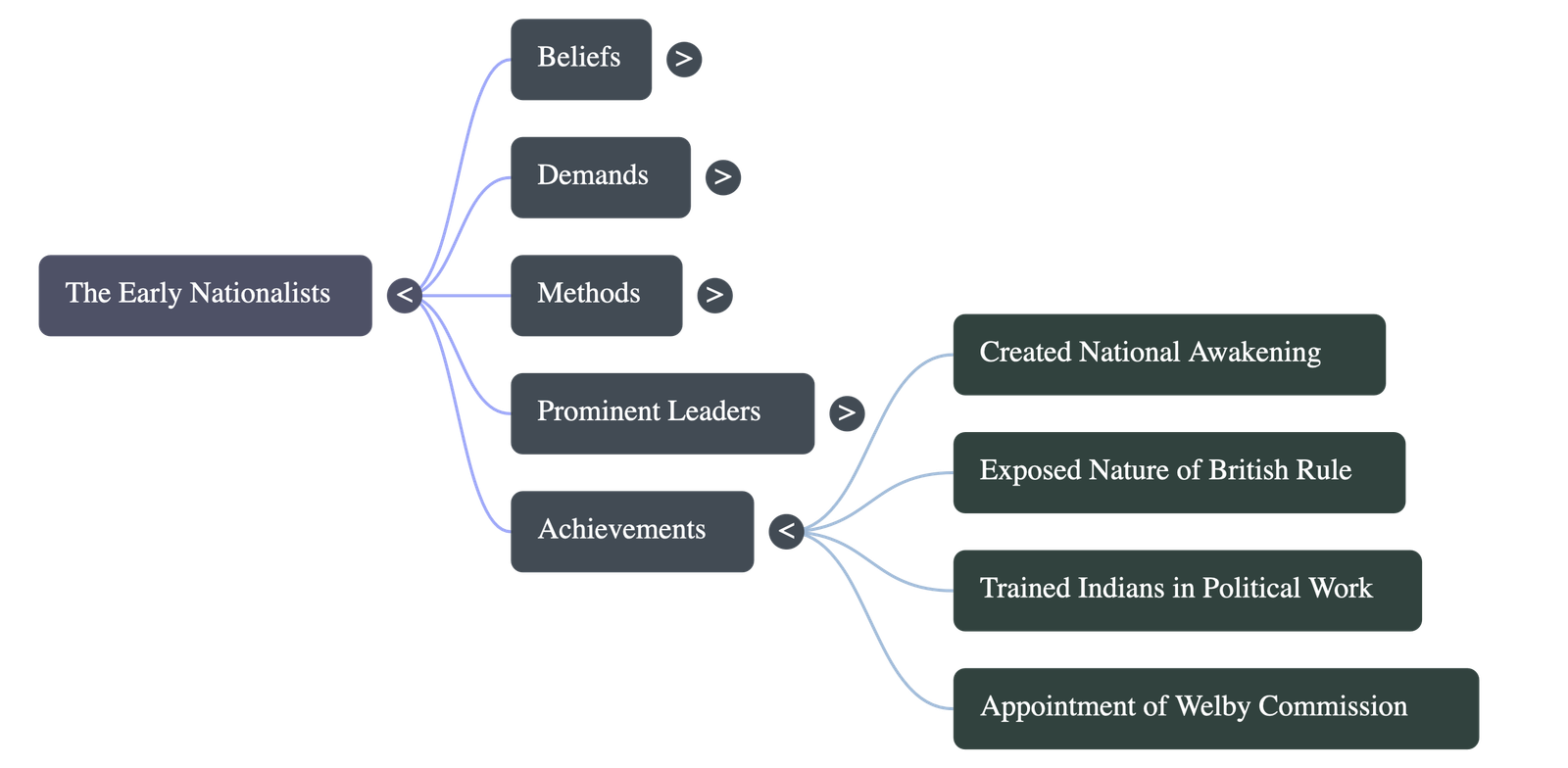
- Successfully aroused the feeling of belonging to one common nation among Indians.
- Trained Indians in the art of political work, public debate, and democratic principles.
- Exposed the true exploitative nature of British rule in India, destroying the myth of British benevolence.
- Pressurized the government to introduce critical reforms, such as the appointment of the Public Service Commission (1886), simultaneous ICS exams, and the appointment of the Welby Commission on Indian Expenditure.
Do checkout all questions & answers of this chapter.
Quick Navigation:
| | | |
1 / 1
Quick Navigation:
| | | |