Quick Navigation:
| | | |
Independence and Partition of India
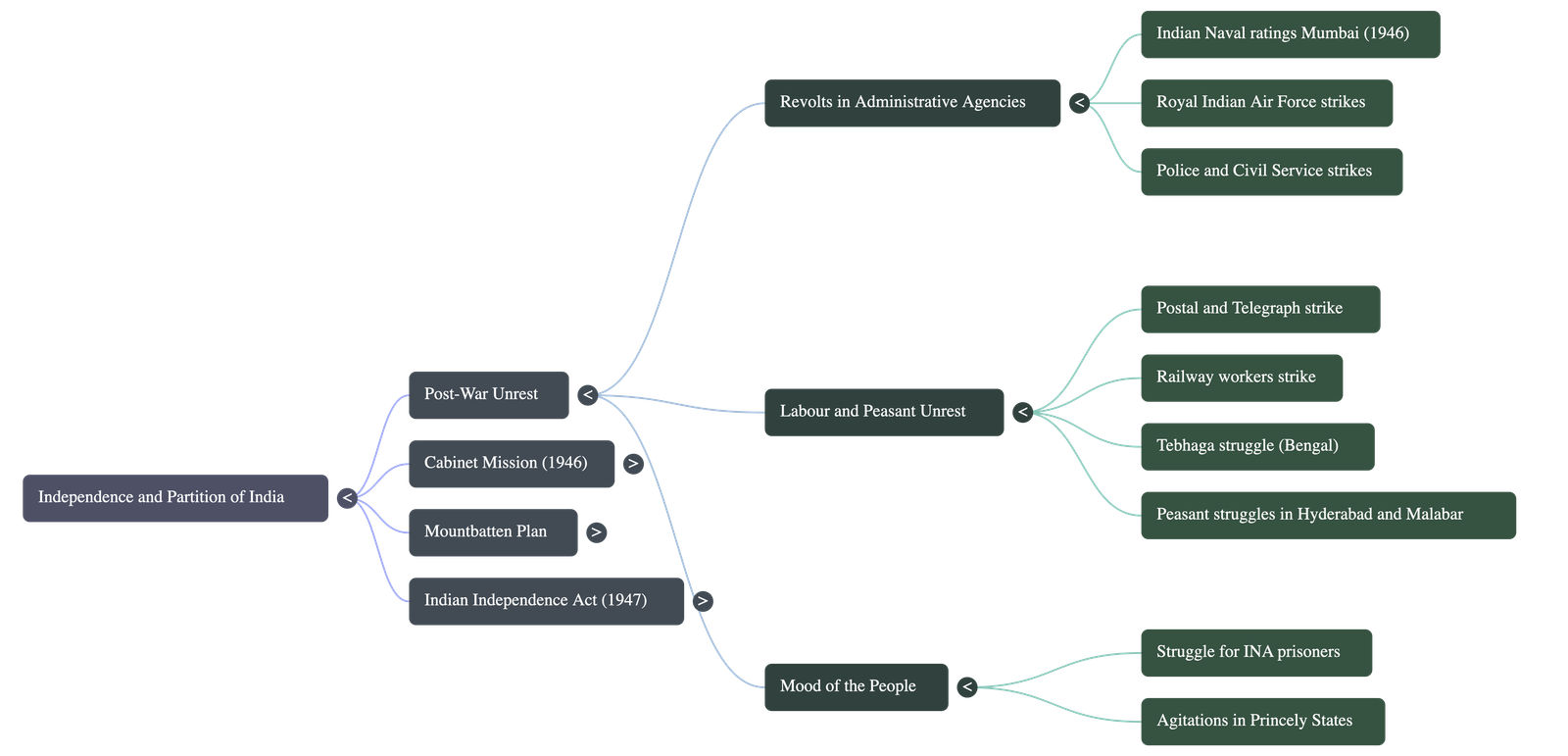
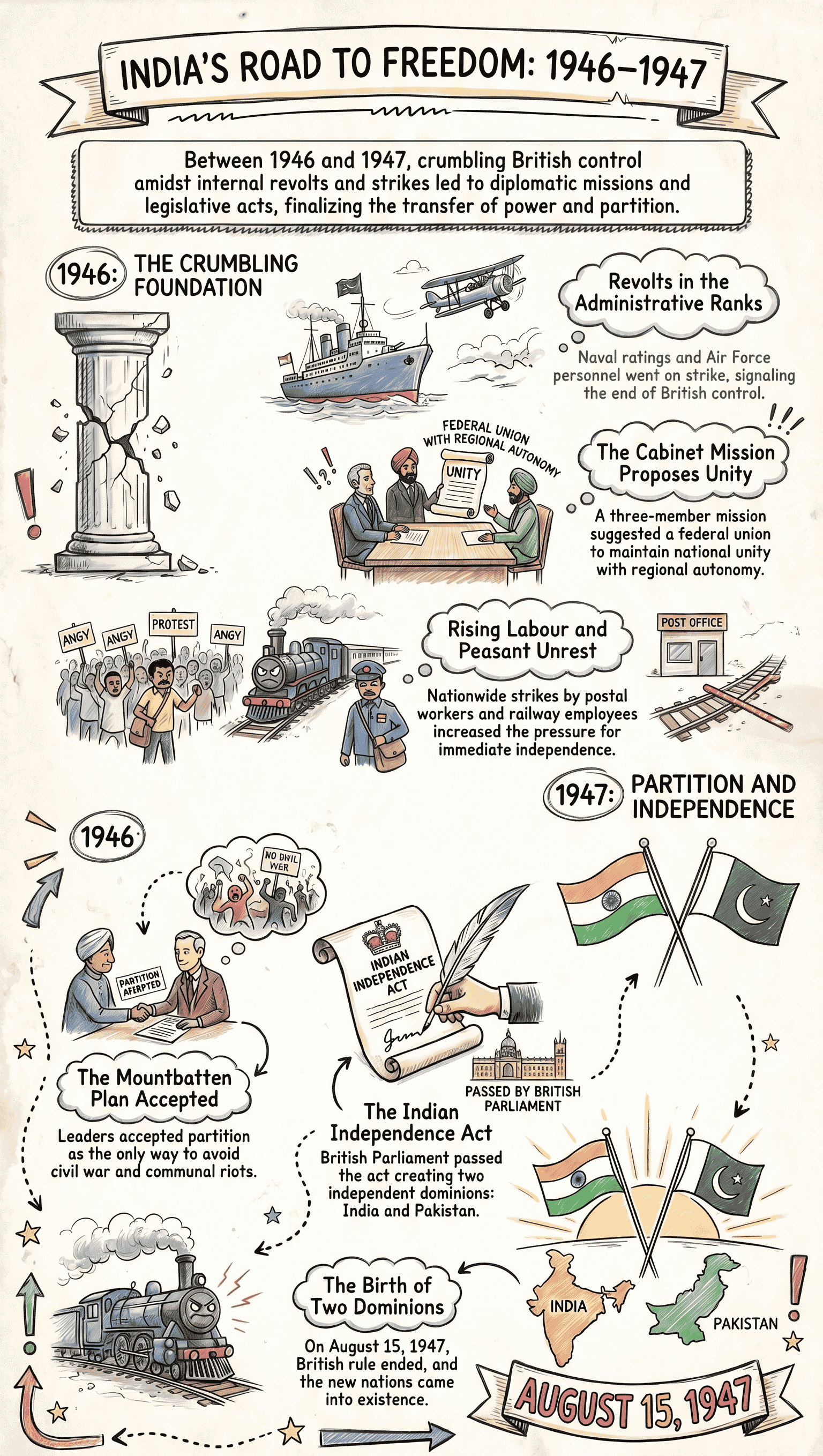
Revolts in the Administrative Agencies
- The British Government realized it could no longer rely on Indians within the civil administration or armed forces to suppress the ongoing National Movement.
- The Indian National Army (INA) demonstrated clearly that patriotic ideas had successfully penetrated the ranks of the Indian army.
- A major revolt by Indian Naval ratings took place in Mumbai in February 1946. The ratings fought a six-hour battle with the army and navy, surrendering only upon the strict advice of national leaders. Sympathetic naval strikes spread to other parts of the country.
- Widespread strikes were also observed in the Royal Indian Air Force, while the Indian Signal Corps went on strike at Jabalpur.
- Crucial pillars of British rule, such as the Police and the Civil Service, displayed defiance. For instance, police forces in Bihar and Delhi went on strike, proving they could not be safely used against the freedom struggle.
Mood of the Indian People
- Indians emerged in a highly confident and determined mood, completely refusing to tolerate the humiliation of foreign rule any longer.
- Throughout 1945–46, the nation witnessed numerous massive agitations, strikes, hartals, and demonstrations.
- These revolutionary protests were not limited to British India but also heavily impacted Princely States like Hyderabad, Travancore, and Kashmir.
Labour Unrest
- Large-scale labour unrest engulfed the entire country as workers demanded better conditions and freedom.
- In July 1946, an impressive all-India strike was executed by the postal and telegraph workers.
- Railway workers in South India organized a massive strike in August 1946.
- Peasant movements acquired fresh thrust and aggression after 1945. The most militant of these was the Tebhaga struggle in Bengal, where sharecroppers fiercely demanded one-third of the crop instead of the usual one-half to be given to landlords.
- Fierce struggles for land and campaigns against high rents also broke out in Hyderabad, Malabar, Bengal, U.P., Bihar, and Maharashtra.
Cabinet Mission in India & Its Plan
- Arrival & Purpose: British Prime Minister Clement Attlee announced on February 19, 1946, that a Cabinet Mission would be sent to India to facilitate the transfer of power and assist Indian leaders in deciding the future form of government.
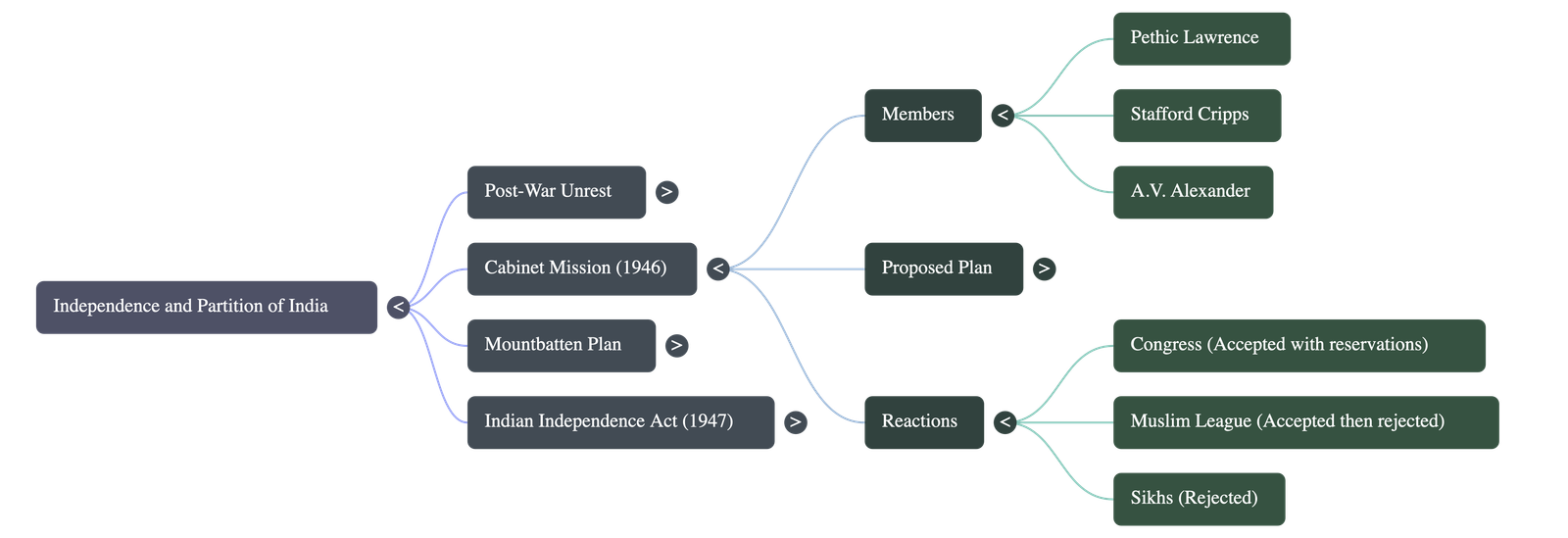
- Members: The mission consisted of Pethic Lawrence (Secretary of State), Sir Stafford Cripps (President of the Board of Trade), and A.V. Alexander (First Lord of Admiralty).
- The Cabinet Mission Plan: The mission proposed a two-tier federal plan designed to maintain national unity while granting maximum regional autonomy.
- Federal Union: A central union comprising British Provinces and Princely States would handle Foreign Affairs, Defence, and Communication, with powers to raise necessary finances.
- Union Powers: The Union Government would have its own executive and legislature made up of elected members from all Provinces.
- Provincial Autonomy: Provinces would hold full autonomy over all subjects not managed by the Union.
- Provincial Grouping: British Provinces were proposed to be divided into three groups (Group A, Group B, and Group C) largely based on religion.
- New Institutions: A Constituent Assembly was to be formed to draft the new Constitution, and an Interim Government was to be established at the Centre.
Reactions to the Cabinet Mission Plan
- The Congress: Accepted the scheme with certain reservations. They primarily agreed to the provisions dealing with constitution-making.
- The Muslim League: Accepted the plan, believing that the proposed grouping of Muslim-majority provinces was essentially a stepping stone toward the eventual creation of Pakistan.
- The Sikhs: Outrightly rejected the Plan because Punjab was forcefully placed in Group 'B' alongside Muslim-majority states.
Transfer of Power & The Mountbatten Plan
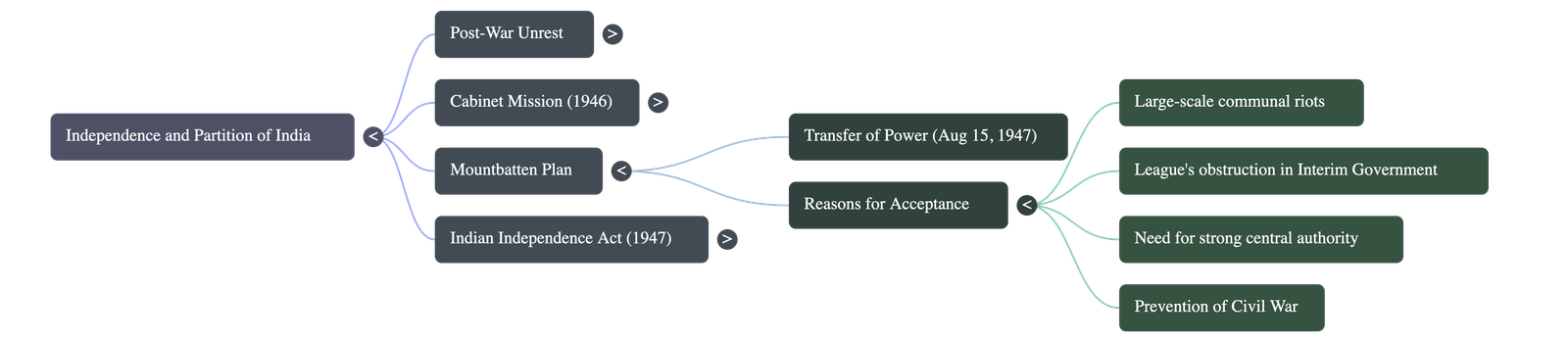
- The initial declaration scheduled the transfer of power for June 1948. However, recognizing the urgency, the British Parliament decided to expedite the process and transfer power before August 15, 1947.
- Key Provisions of the Plan:
- India was to be partitioned into two independent and Sovereign States: India and Pakistan, officially coming into existence on August 15, 1947.
- The plan included explicit provisions for the geographic partition of the provinces of Punjab and Bengal.
- Princely States were granted the independent choice of joining either India or Pakistan.
Acceptance of the Mountbatten Plan
- The historic pronouncement was received with mixed feelings. While nationalists deeply deplored the partition, the Muslim League accepted it (though dissatisfied with the exact borders of Pakistan).
- The All-India Congress Committee reluctantly accepted the plan, realizing there was no viable alternative. Their primary reasons included:
- Widespread, large-scale communal riots convinced leaders that partition was the only immediate solution to stop the bloodshed.
- The Muslim League's intentional obstructionism within the Interim Government proved that a joint, cooperative administration was completely impossible.
- Leaders concluded that a smaller, unified India with a strong central authority was vastly superior to a larger State plagued by a weak and constantly blocked Centre.
- Continuing British rule was viewed as a greater calamity, as the British were secretly instigating Princely States to remain independent. Partition became the inevitable price for immediate freedom.
- Any further delay in the transfer of power could have easily plunged the entire subcontinent into a catastrophic Civil War.
- Leaders strongly felt that Partition would finally rid India of separate electorates and undemocratic procedures, clearing the path to build a secular and democratic nation.
The Indian Independence Act, 1947
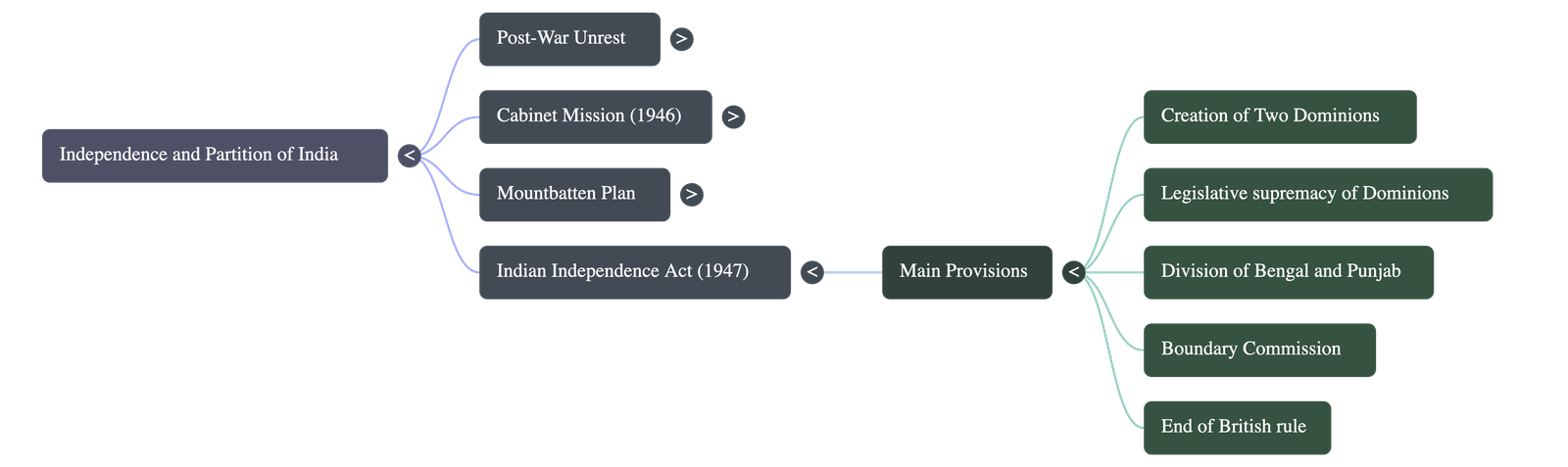
- Following the general acceptance of the Mountbatten Plan, the British Prime Minister introduced the Indian Independence Bill in the House of Commons. It received Royal Assent on July 18, 1947, effectively marking the end of British rule.
- Two New Dominions: The Act strictly provided for the partition of India into two completely independent Dominions—India and Pakistan—effective from August 15, 1947. Absolute legislative supremacy was granted to both Dominions.
- Territorial Division: Pakistan was mapped out to include Sind, British Baluchistan, North West Frontier Province, West Punjab, and East Bengal. The remaining territories of British India would constitute the Dominion of India. The precise borders were to be officially finalized by a Boundary Commission.
- Provisions of Partition: The Act detailed that both Bengal and Punjab would be divided if the local population so desired. Provincial Assemblies were required to meet in two separate parts (representing Hindu-majority and Muslim-majority districts) to decide on the division via a democratic majority vote.
Do checkout all questions & answers of this chapter.
Quick Navigation:
| | | |
1 / 1
Quick Navigation:
| | | |