Second Phase of the Indian National Movement
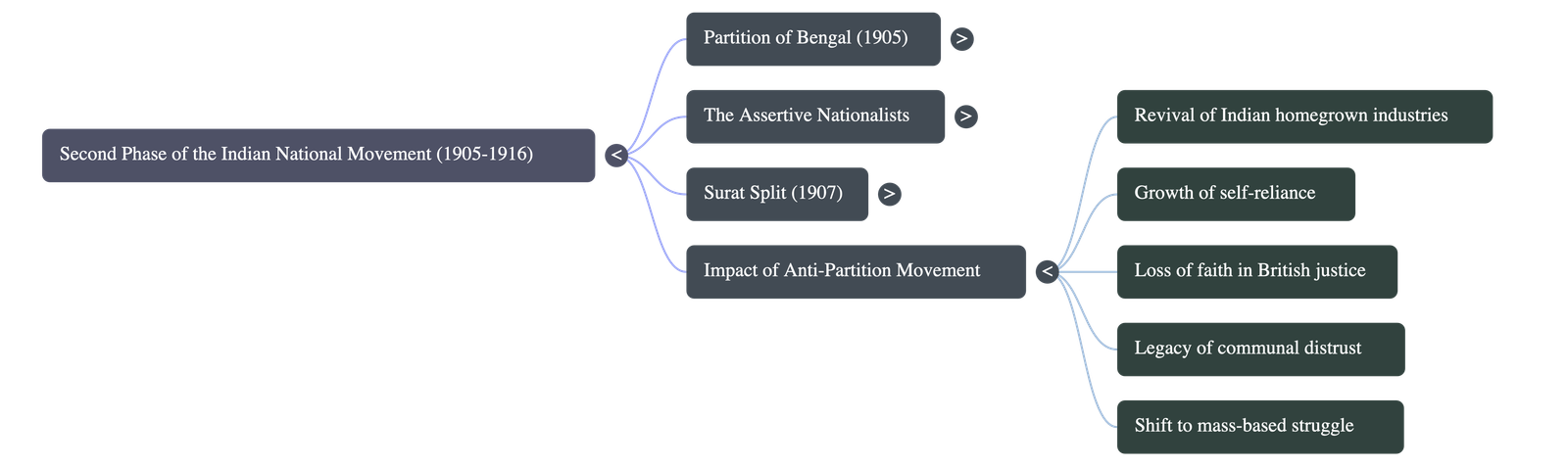
1. The Partition of Bengal (1905)
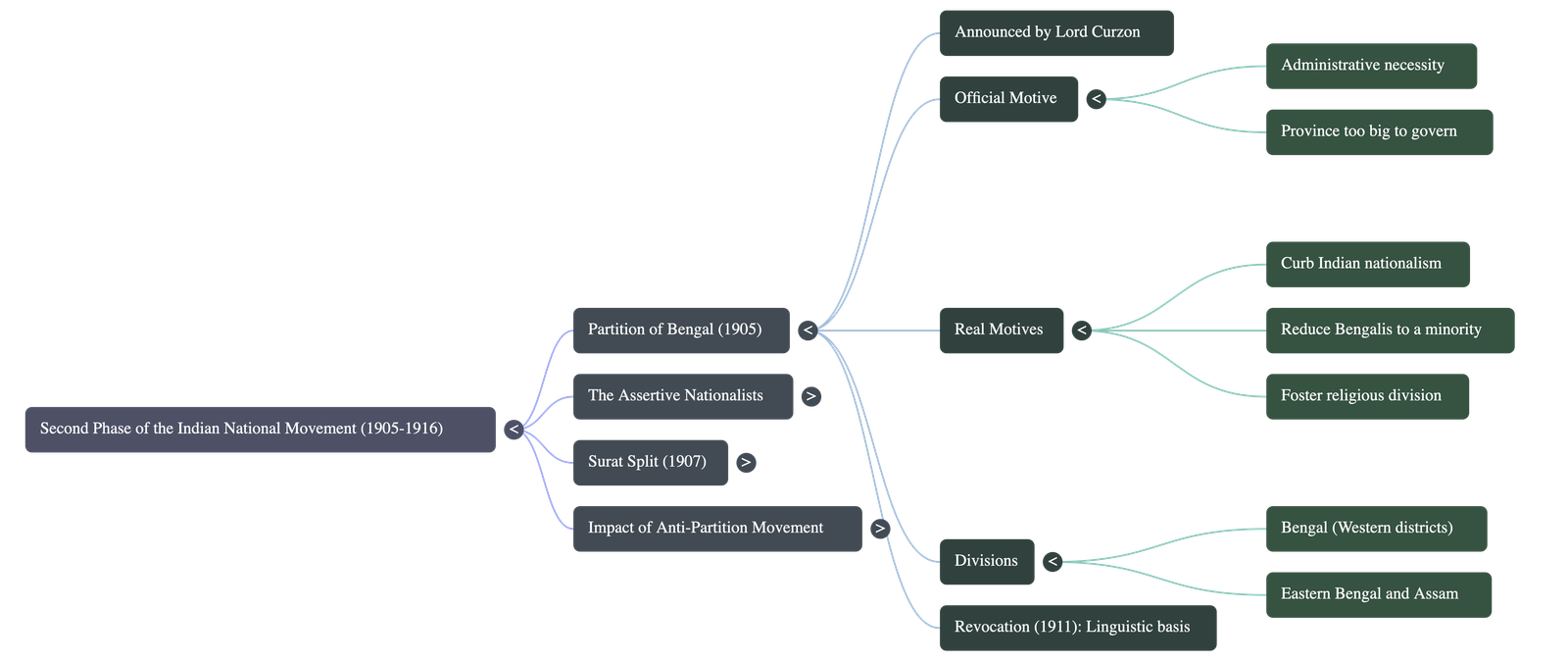
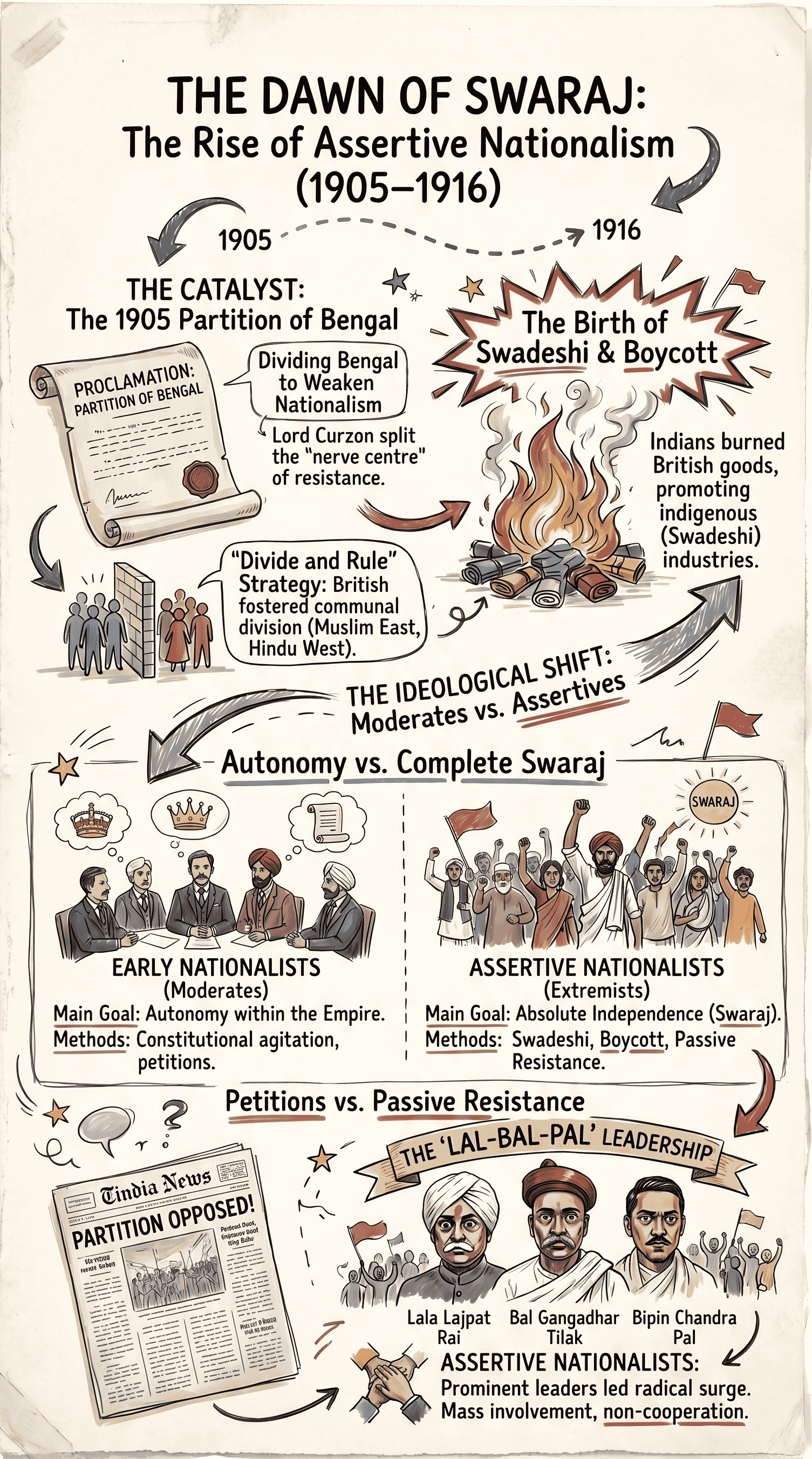
Announced by Lord Curzon on July 20, 1905, and implemented on October 16, 1905, Bengal was divided into two provinces: 'Bengal' (Western districts, Bihar, and Odisha) and 'Eastern Bengal and Assam'.
- Official Reason: The British claimed the province was too large (over 80 million people) to be efficiently administered by a single provincial government.
- Actual (Concealed) Motives:
- To stop the rising tide of nationalism, as Bengal was its nerve center.
- To reduce Bengalis to a minority in Bengal itself by placing them under two administrations.
- To foster division on the basis of religion (Divide and Rule). East Bengal became a Muslim-majority state, while West Bengal became a Hindu-majority state.
- Revocation: Due to massive anti-partition agitation, the partition was revoked in 1911 and reorganized on linguistic rather than religious grounds. The capital was also shifted from Kolkata to Delhi.
2. The Surat Split of 1907
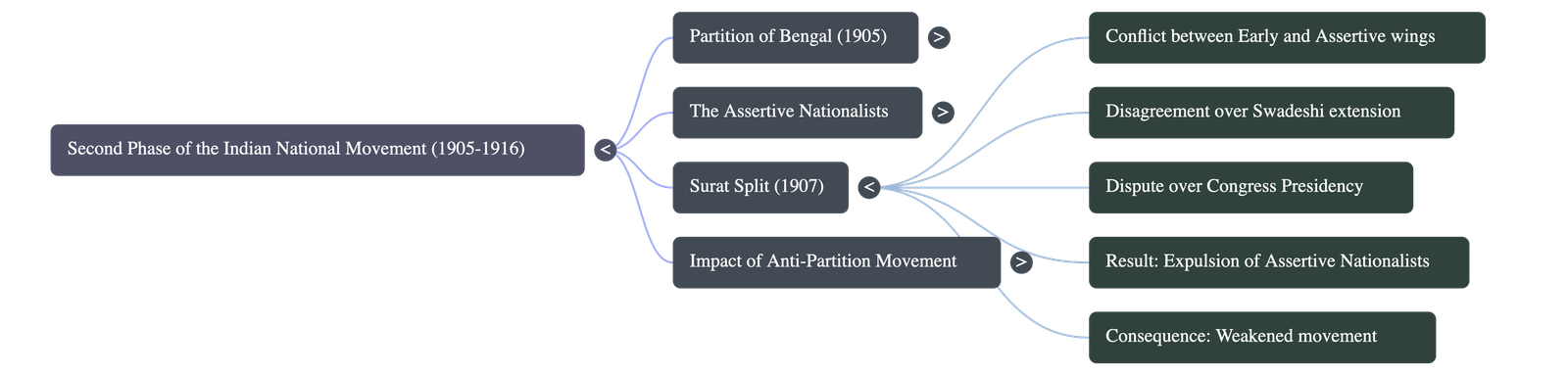
The anti-partition movement widened the gap between the Early Nationalists and the Assertive Nationalists, culminating in a split within the Congress.
- Core Disagreement: Assertive Nationalists wanted to spread the Swadeshi and Boycott movements to the rest of India as a full-fledged political mass struggle. Early Nationalists wanted to confine it to Bengal and opposed the boycott, favoring "petition and persuasion."
- The 1906 Compromise: A resolution on Swadeshi, Swaraj, and National Education was passed at the Calcutta session, and Dadabhai Naoroji (respected by both wings) was made President to prevent an immediate split.
- The Formal Split (1907): At the Surat session, disagreements erupted over the choice of President (Assertives proposed Lala Lajpat Rai; Early Nationalists proposed Rashbehari Ghosh). This led to utter confusion, resulting in the expulsion of the Assertive Nationalists from the Congress for nine years.
- British Response: The British exploited the split using a policy of 'concession and repression'—concessions for Early Nationalists and Muslims, and severe repression for Assertive Nationalists.
3. The Assertive Nationalists
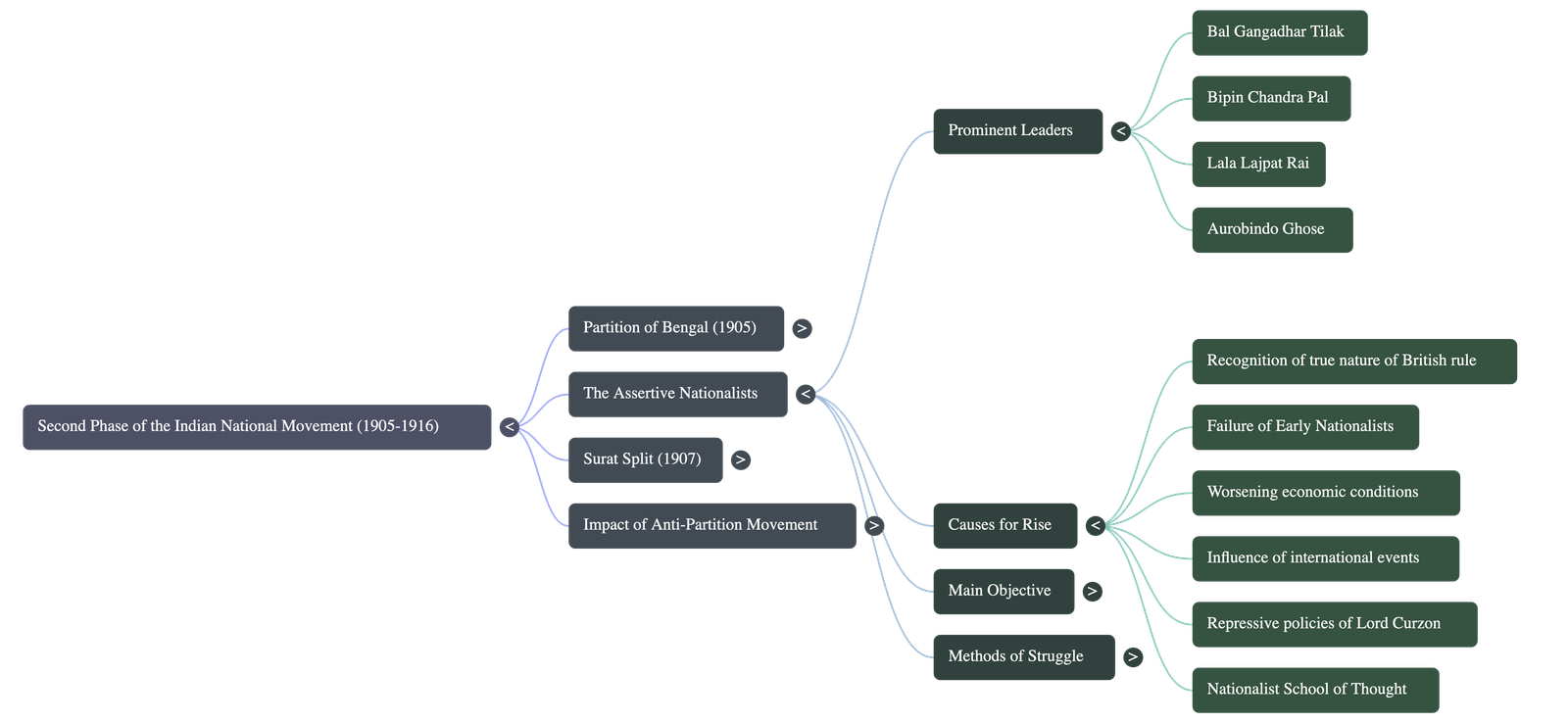
A younger group of leaders emerged who condemned British imperialism, rejected peaceful constitutional agitation, and advocated for active resistance and self-reliance. They were famously led by the Lal-Bal-Pal trio: Lala Lajpat Rai, Bal Gangadhar Tilak, and Bipin Chandra Pal.
Causes for the Rise of Assertive Nationalism:
- Recognition of British Rule's True Nature: Indians realized the British were responsible for India's economic ruin and were actively taking away existing rights.
- Failure of Early Nationalists: The younger elements felt the peaceful, petition-based methods of the Early Nationalists yielded no substantial results.
- Worsening Economic Conditions: Late 19th-century famines killed millions while the British government spent lavishly on Queen Victoria's Jubilee instead of helping the people.
- Growing Consciousness: Leaders taught people to rely on self-help and self-confidence rather than British goodwill.
- Need for Mass Action: Thinkers like Swami Vivekananda emphasized that freedom required immense sacrifices and mass involvement.
- Influence of International Events: Myths of European invincibility were shattered when Japan defeated Russia, Ethiopians defeated Italy, and the Boers fought the British in South Africa.
- Growth of Education and Unemployment: Educated Indians faced low pay and unemployment, leading to deep resentment against British rule.
- Ill-treatment of Indians Abroad: Severe racial discrimination against Indians in British colonies, especially South Africa, fueled anger.
- Repressive Policies of Lord Curzon: Curzon introduced harsh measures like the Act of 1898, the Calcutta Corporation Act (reducing Indian elected members), and the Indian Universities Act (imposing strict official control).
- Partition of Bengal: Provided the greatest immediate impetus, sparking widespread protests.
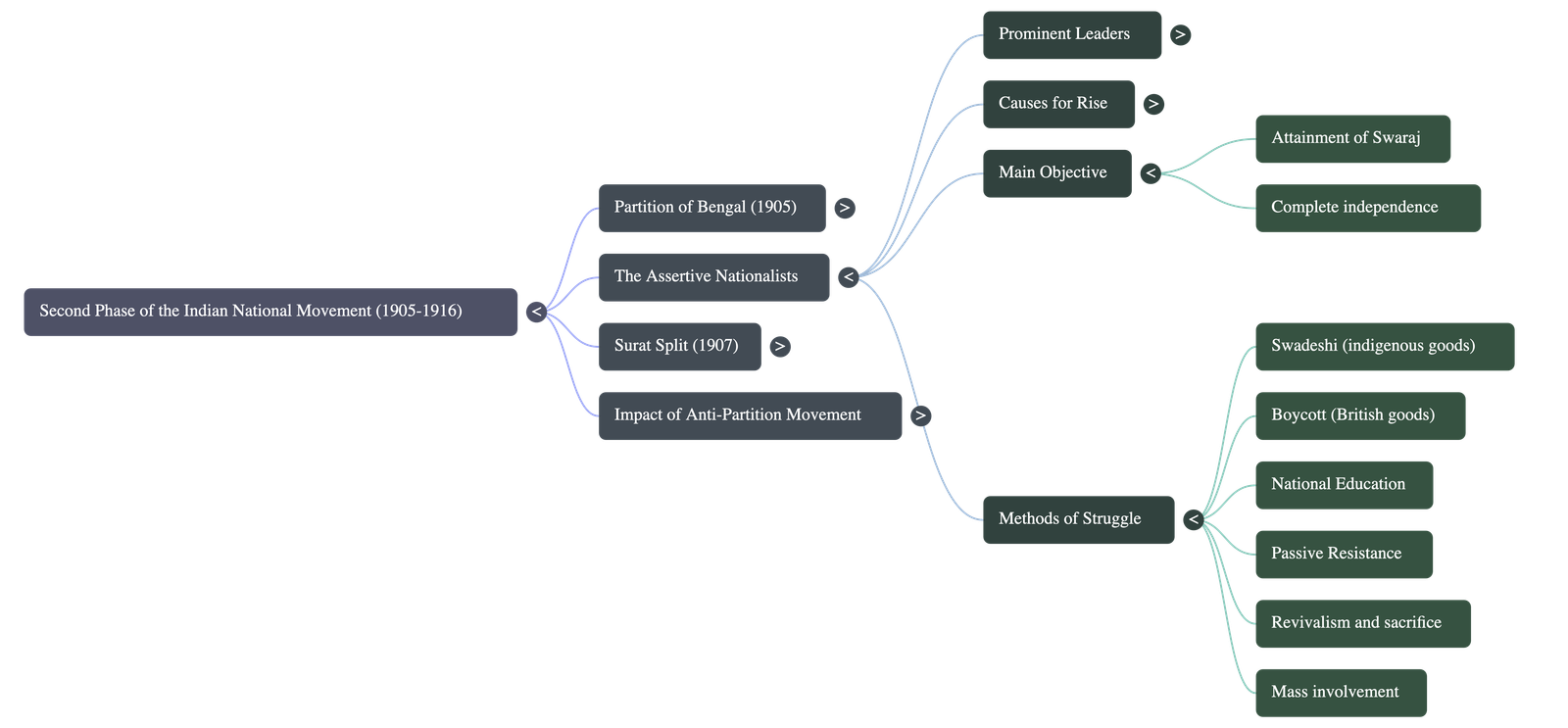
4. Objectives and Methods of Assertive Nationalists
Main Objective:
The immediate attainment of 'Swaraj'—which they defined as complete independence, not just self-government within the British Empire.
Key Methods:
- Swadeshi: Producing necessary items in one's own country and using them, avoiding dependence on imported goods. It revived traditional homegrown industries.
- Boycott: The economic boycott of British goods (like burning foreign cloth) to encourage Indian industries and harm British economic interests in India. Swadeshi and Boycott were considered two sides of the same coin.
- National Education: Establishing national schools and colleges (like the Bengal National College) free from government control to impart education with a national orientation.
- Passive Resistance: Refusing to cooperate with the government by boycotting government services, courts, schools, and colleges, alongside advocating non-violent resistance.
- Revivalism & Mass Involvement: Using India's past glory (like Tilak's revival of Ganapati and Shivaji festivals) to arouse self-respect and heavily involving the common masses in the struggle.
5. Comparison: Early vs. Assertive Nationalists
| Early Nationalists | Assertive Nationalists |
|---|---|
| Wanted autonomy within the Empire. | Aimed at nothing short of complete Swaraj. |
| Believed in constitutional methods (petitions/prayers). | Were assertive, adopting non-cooperation and boycott. |
| Had faith in the British sense of justice and fair play. | Rejected British rule, blaming it for India's poverty. |
| Drew support from the middle-class intelligentsia. | Drew their support directly from the masses. |
| Inspired by western philosophers. | Drew inspiration from India's past and culture. |
6. Prominent Leaders of Assertive Nationalism
-
Bal Gangadhar Tilak:
Made the Congress movement broad-based. Started newspapers Mahratta (English) and Kesari (Marathi). Revived Ganapati and Shivaji festivals to spread nationalist ideas. Started the Home Rule League in 1916. Imprisoned in Mandalay, Burma, for his anti-British activities. -
Bipin Chandra Pal:
Used journalism to spread nationalist ideas. Strongly believed in national education as the foundation for the freedom movement and worked passionately towards social and economic reforms. -
Lala Lajpat Rai:
A prolific writer who founded Punjabi, Vande Mataram, and People. Actively associated with the Arya Samaj movement and instrumental in expanding D.A.V. College. He later succumbed to injuries sustained from a British lathi charge while leading a peaceful protest against the Simon Commission in 1928.
Do checkout all questions & answers of this chapter.