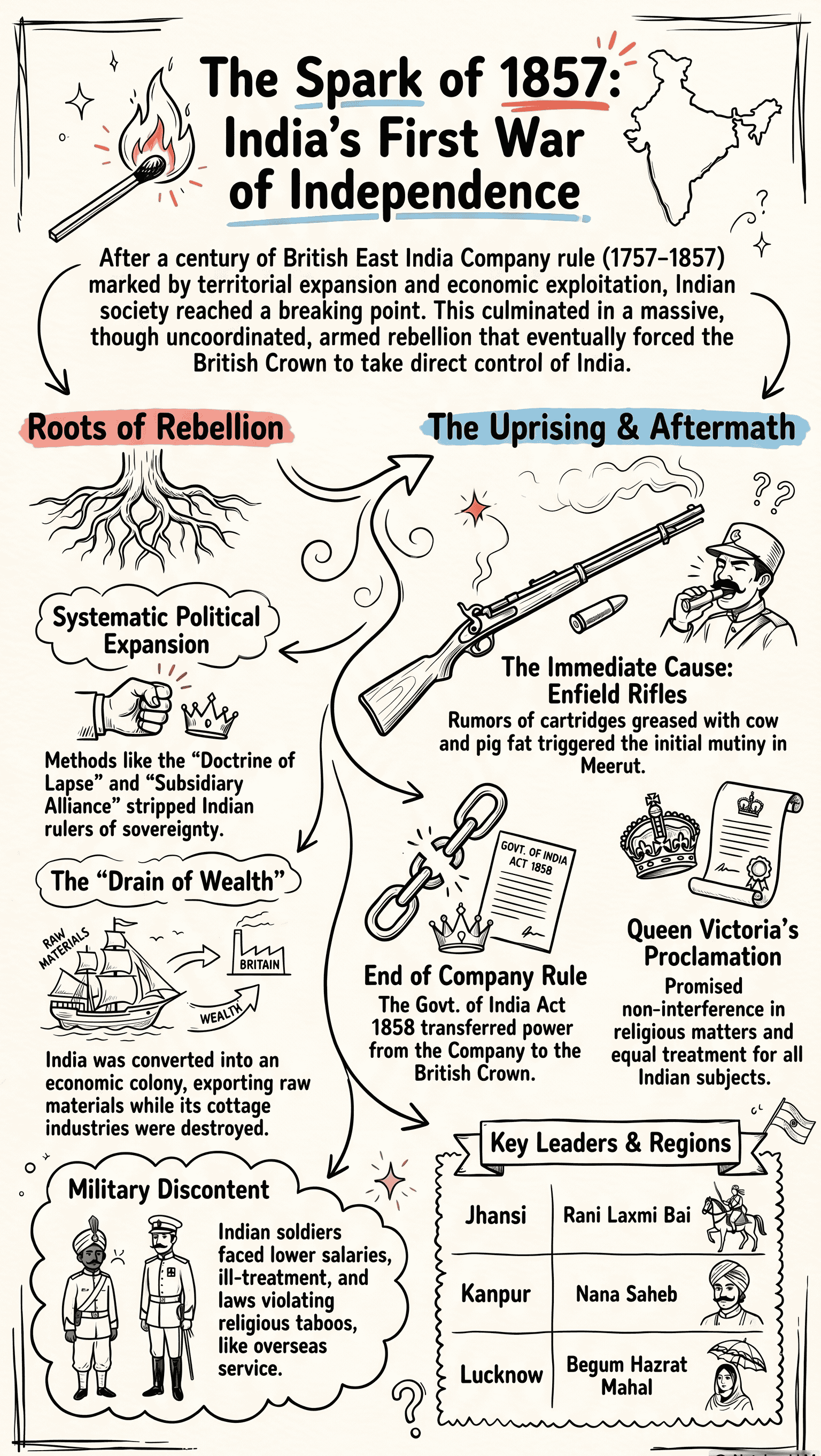
The First War of Independence, 1857
Introduction: The first hundred years of British rule in India (1757 to 1857) were marked by rapid territorial expansion and economic exploitation. This adversely affected all segments of Indian society—kings, peasants, artisans, and soldiers. The accumulated grievances culminated in the massive uprising of 1857, which shook the British government to its foundation.
1. Causes of the First War of Independence
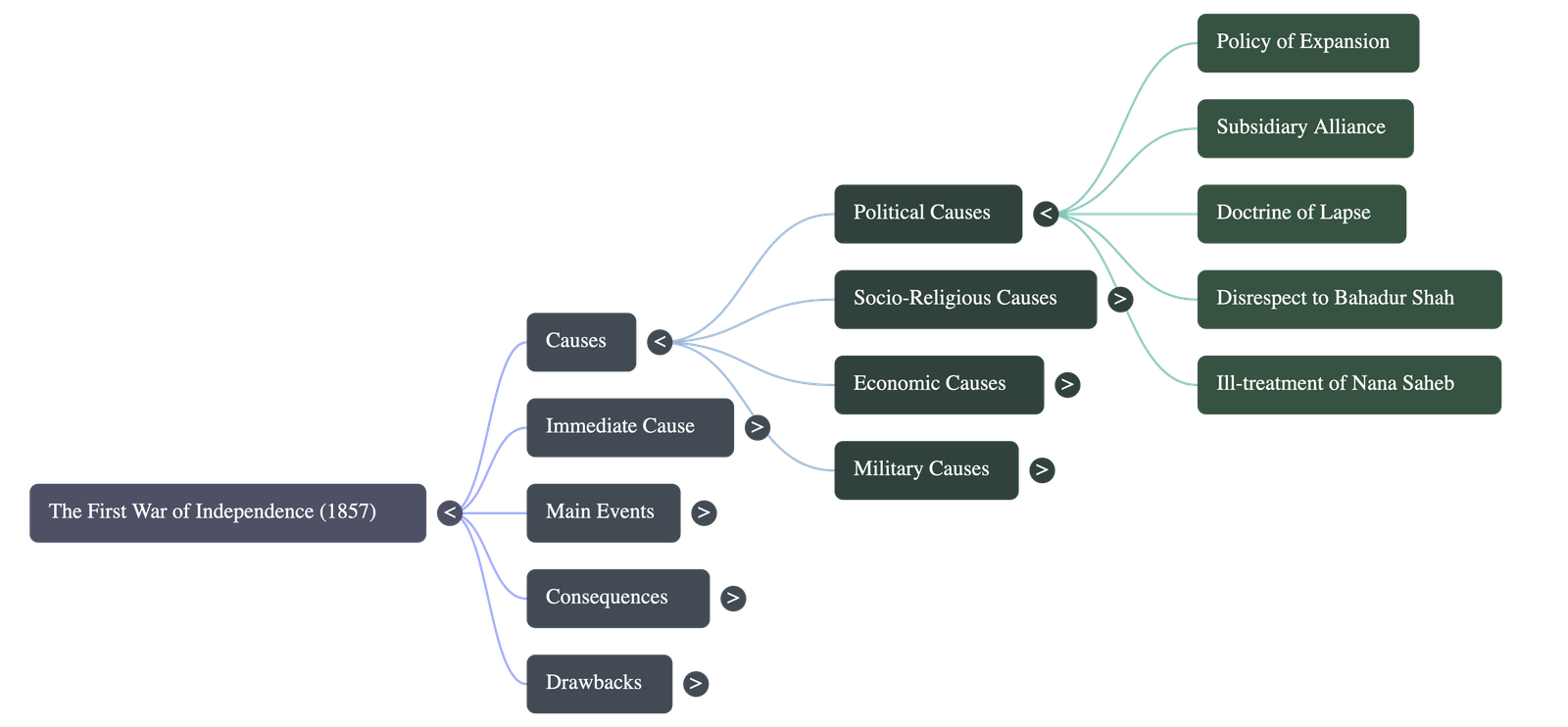
A. Political Causes
- Policy of Expansion: The British aggressively expanded their political power in India through various methods:
- Outright Wars: Conquering territories through battles like the Battle of Buxar, Anglo-Mysore Wars, Anglo-Maratha Wars, and defeating the Sikhs.
- Subsidiary Alliance: Introduced by Lord Wellesley. Indian rulers lost their sovereignty, had to maintain British troops at their own cost, and accept a British Resident (e.g., Awadh, Hyderabad).
- Doctrine of Lapse: Introduced by Lord Dalhousie. If an Indian ruler died without a natural male heir, his kingdom would "lapse" and be annexed by the British (e.g., Jhansi).
- Other Political Grievances: Disrespect shown to the Mughal Emperor Bahadur Shah, the unjust annexation of Awadh under the pretext of misrule, ill-treatment meted out to Nana Saheb and Rani Laxmi Bai, and the "Absentee Sovereignty" of the British (ruling India from England).
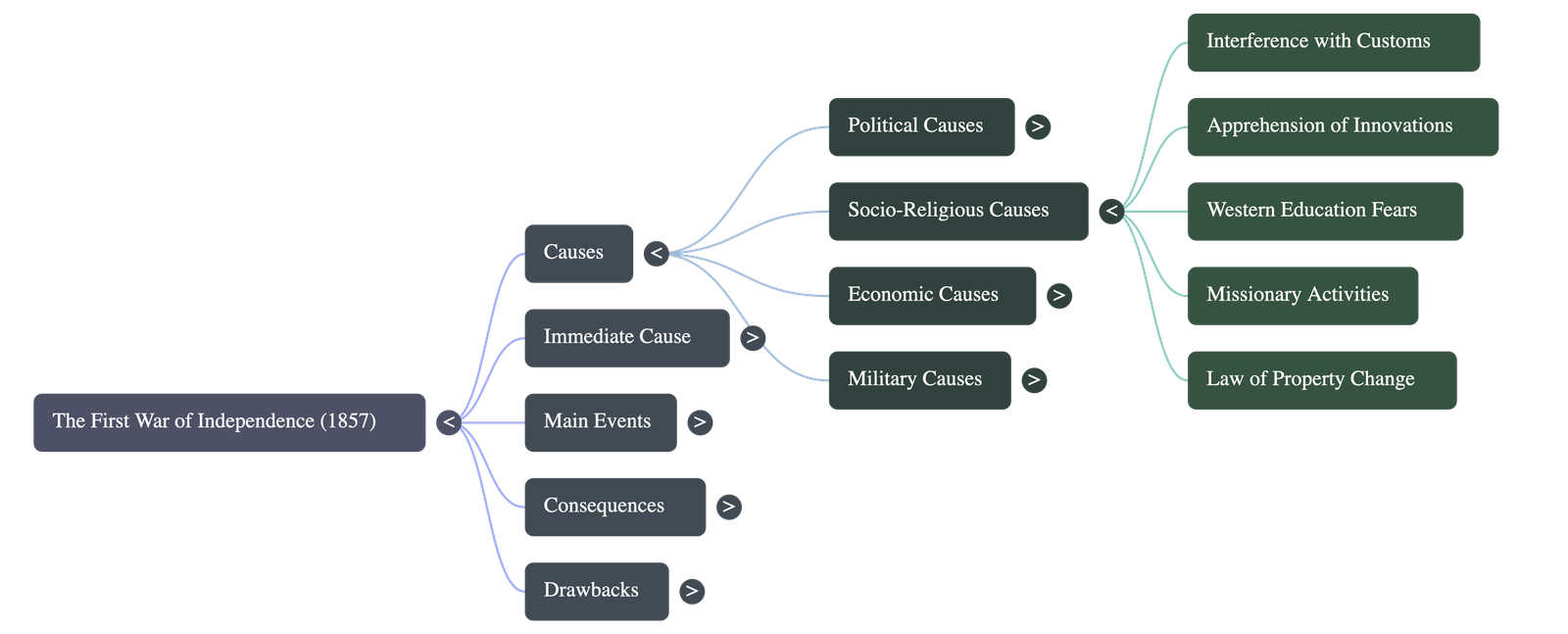
B. Socio-Religious Causes
- Fears Regarding Western Education: The introduction of Western education and English classes was seen as an attempt to discourage traditional Hindu and Islamic studies and promote Christianity.
- Taxing Religious Places: The British began taxing lands belonging to temples and mosques, which were previously exempted by Indian rulers.
- Law of Property: The Religious Disabilities Act of 1850 allowed a convert from Hinduism to inherit his ancestral property, which Indians saw as an incentive to give up their faith.
- Other Social Grievances: British interference with social customs, apprehensions about modern innovations (like railways), and severe racial discrimination against Indians.
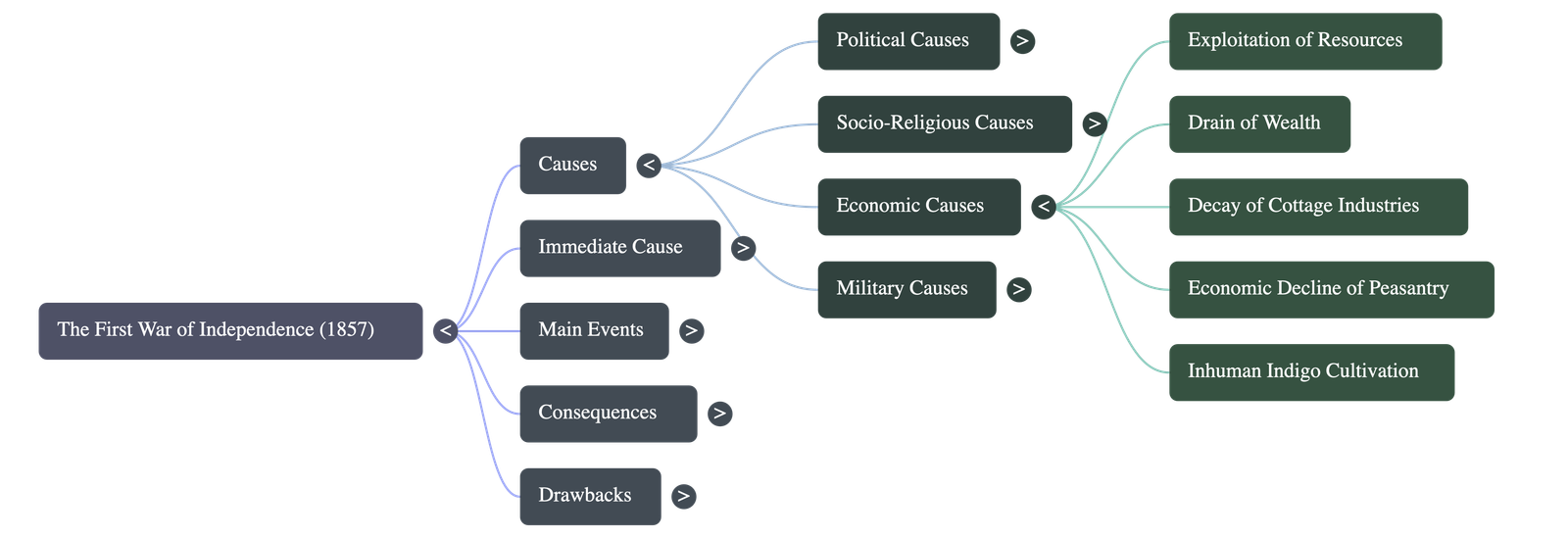
C. Economic Causes
- Exploitation of Resources: India was reduced to an agricultural colony forced to export cheap raw materials (cotton, raw silk) and import duty-free readymade British goods.
- Drain of Wealth: Huge transfers of wealth from India to England occurred without any proportionate economic return for India, used to pay British salaries and military expenses.
- Decay of Cottage Industries: Heavy duties on Indian textiles in Britain and the influx of cheap machine-made British goods destroyed traditional Indian handicrafts.
- Economic Decline of Peasantry: Exorbitant land revenue demands forced peasants into deep debt and landlessness, leaving them at the mercy of harsh moneylenders.
- Growing Unemployment: The decline of native rulers meant loss of patronage for scholars, artists, and soldiers, leading to mass unemployment.
- Inhuman Treatment of Indigo Cultivators: Peasants were forced to cultivate indigo under brutal and inhuman conditions for the profit of British planters.
- Decline of Landed Aristocracy: Hereditary landlords lost their estates if they failed to produce title deeds (e.g., via the Inam Commission), plunging them into poverty.
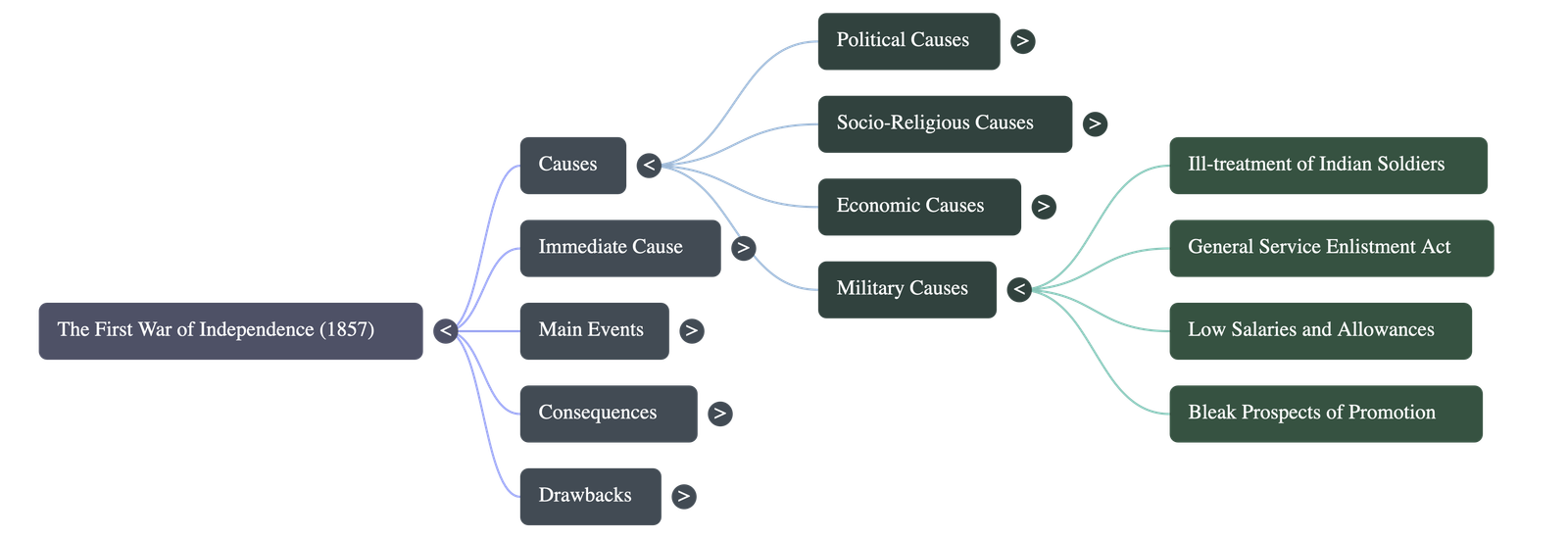
D. Military Causes
- Ill-treatment of Indian Soldiers: Sepoys were poorly paid, ill-fed, badly housed, and forbidden from wearing caste marks, beards, or turbans.
- General Service Enlistment Act (1856): Required Indian soldiers to serve overseas, which was considered a taboo that would lead to loss of caste for Brahmins.
- Bleak Prospects of Promotions: All higher military positions were strictly reserved for the British. An Indian soldier could never rise above the rank of a Subedar.
- Deprivation of Allowances: Soldiers were sent to serve in distant areas without extra payment (Bhatta), and their free postage privilege was withdrawn.
- Faulty Distribution of Troops: Strategic locations (like Delhi and Allahabad) were wholly held by Indian soldiers, giving them a strategic advantage while British troops were busy in foreign wars.
- Lower Salaries: British soldiers received more than eight times the salary of their Indian counterparts.
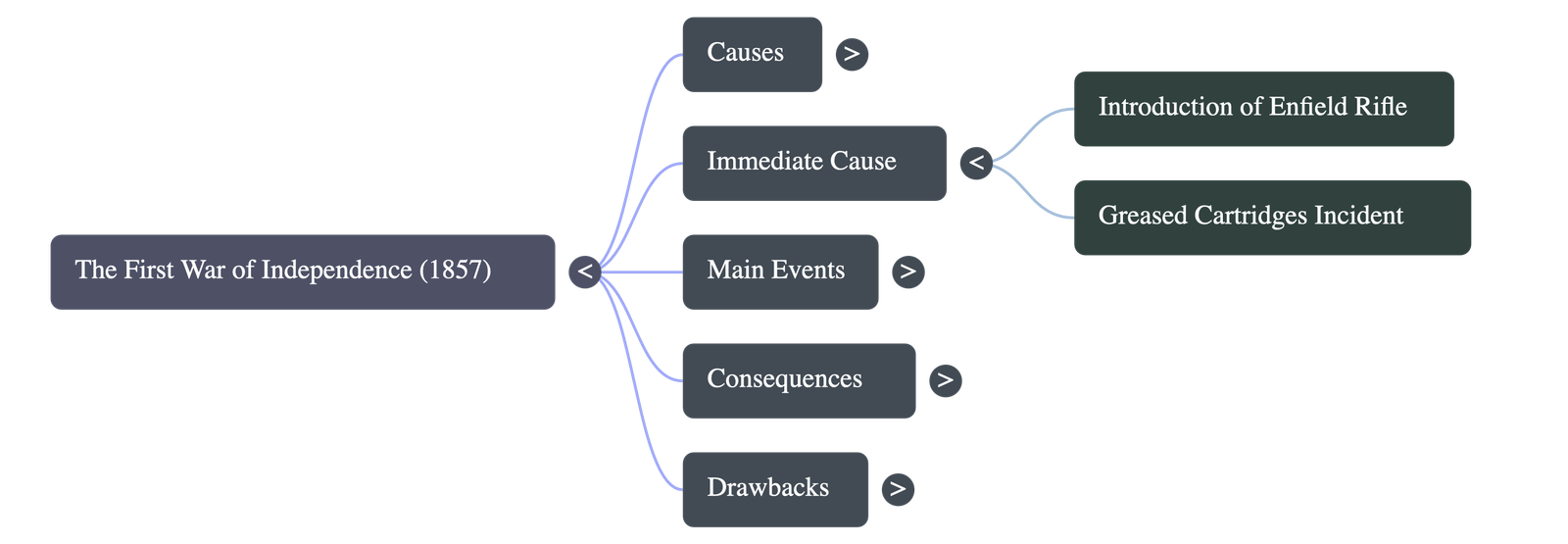
2. Immediate Cause: The Enfield Rifle
In 1856, the British introduced the new Enfield rifle. A rumor spread that the greased paper of the new cartridges, which had to be bitten off before loading, was coated with the fat of cows and pigs. This deeply outraged the religious sentiments of both Hindu and Muslim soldiers, who saw it as a deliberate move to defile their religions, sparking the mutiny.
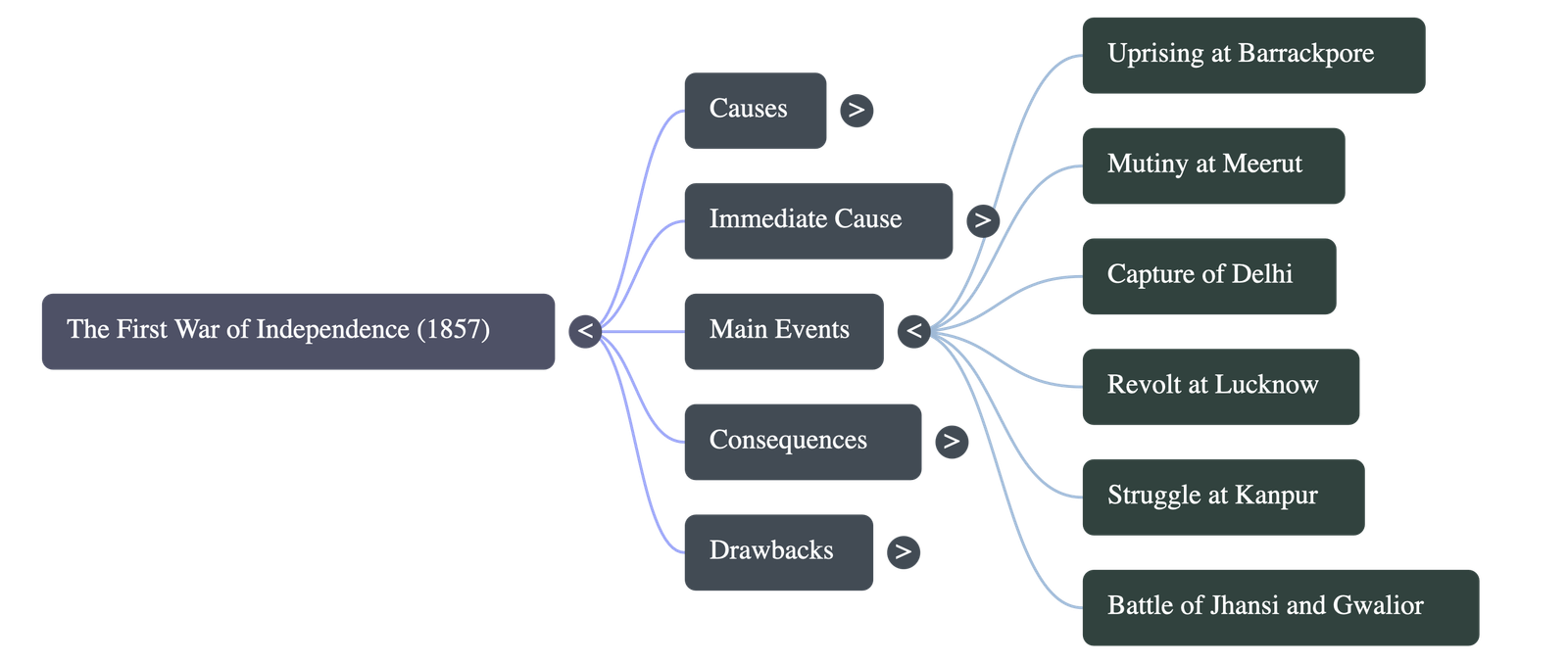
3. Beginning and Main Events of the Uprising
- The Spark: In February and March 1857, sepoys in Bengal refused to accept the cartridges. Mangal Pandey attacked a British officer at Barrackpore and was subsequently executed, becoming a martyr.
- Meerut (May 1857): 85 sepoys refused the cartridges and were imprisoned. Their comrades rebelled, freed them, and marched to Delhi.
- Delhi: The sepoys captured Delhi and proclaimed the old Mughal Emperor Bahadur Shah as the emperor of India. The British eventually recaptured it after a four-month siege.
- Lucknow: The uprising was passionately led by Begum Hazrat Mahal, wife of the Nawab of Awadh.
- Kanpur: Led by Nana Saheb and his brilliant general Tantia Tope.
- Central India (Jhansi and Gwalior): Rani Laxmi Bai offered fierce resistance. After Jhansi was betrayed, she captured Gwalior with Tantia Tope but died fighting bravely on the battlefield.
- Other Centres: The revolt also raged in Bareilly (Khan Bahadur), Bihar (Kunwar Singh), and Faizabad (Maulvi Ahmadullah).
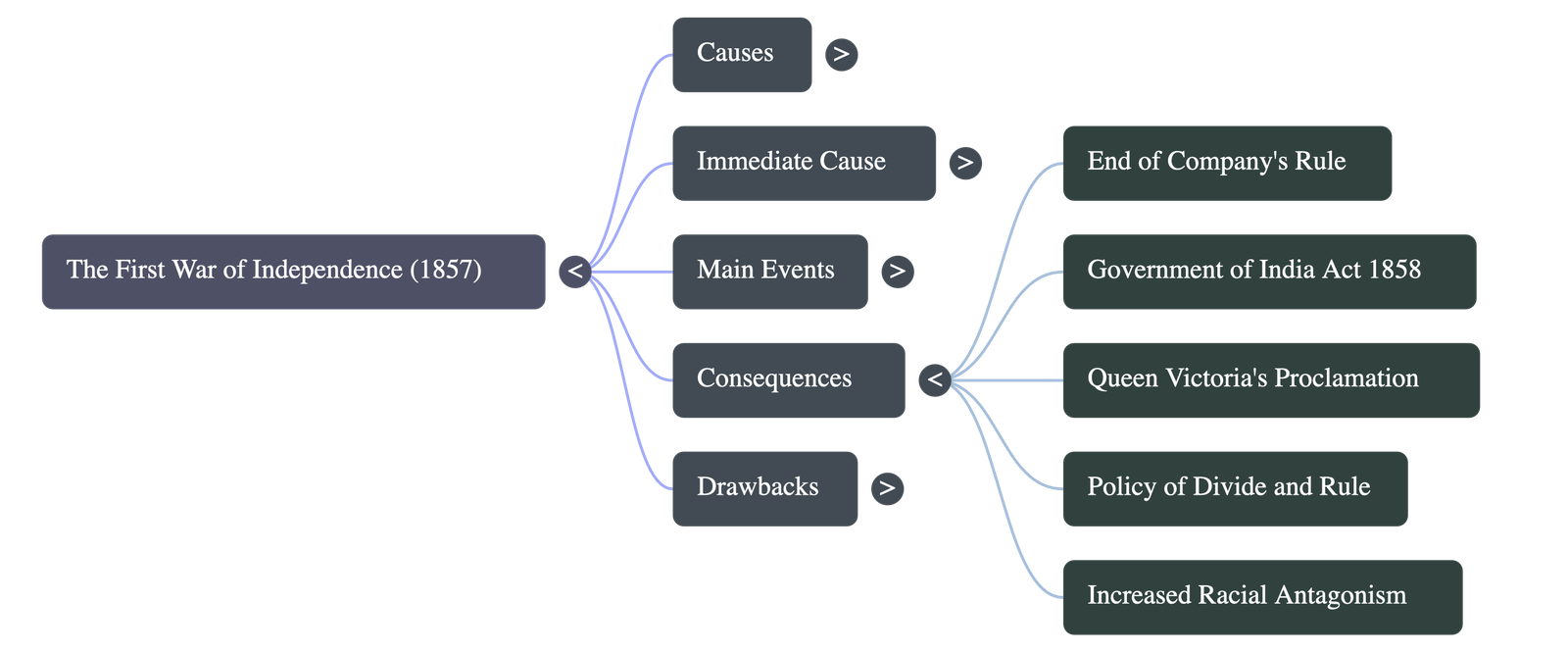
4. Consequences of the First War of Independence
- End of Company's Rule: The Government of India Act of 1858 transferred the power to govern India directly from the East India Company to the British Crown.
- Changes in Administration: The Board of Control and Court of Directors were abolished. A British Cabinet member was appointed as the Secretary of State for India. The Governor-General was given the title of Viceroy (Lord Canning became the first).
- Queen Victoria's Proclamation: Promised non-intervention in the social and religious matters of Indians, equal treatment of all subjects, and a general pardon for those not guilty of murdering British subjects.
- Policy of Divide and Rule: The British deliberately sowed seeds of dissension between Hindus and Muslims to prevent future united uprisings.
- Racial Antagonism: A massive increase in racial bitterness and distance between the British and Indians; the administration was remodelled on the idea of racial superiority.
- Economic Exploitation: India formally became a typical colonial economy, heavily taxed and burdened with paying for British capital investments and foreign wars.
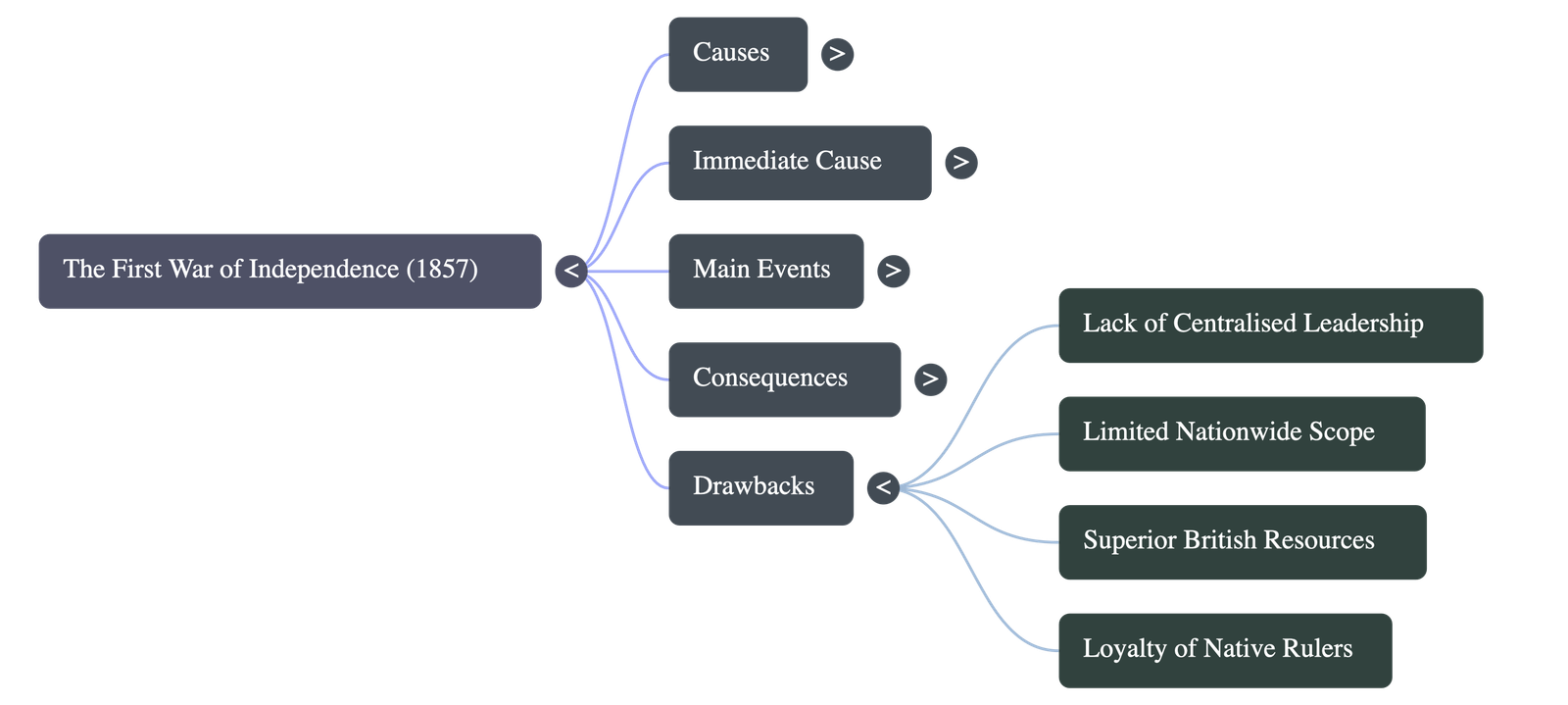
5. Drawbacks / Causes of Failure
- Lack of a common plan of military action or centralized leadership.
- Absence of a common goal, other than anti-foreign sentiments.
- The British Empire possessed vastly superior resources in terms of men, money, materials, and exceptional military generals.
- The uprising lacked nationwide dimensions; regions like South, East, and Western India largely remained quiet.
- Many native rulers, big zamindars, and educated Indians refused to join the movement or actively supported the British.
- The rebellion started disorganized and prematurely before the fixed date (May 31, 1857).
6. Nature of the War
Historians have debated the true nature of the uprising. V.D. Savarkar famously called it a "planned war of national independence." Regardless of differing views, it is universally hailed as the First War of Independence because it was the first mass uprising where multiple sections of Indian society united against a common enemy. The immense sacrifices of leaders like Rani Laxmi Bai, Nana Saheb, and Mangal Pandey paved the way for the modern Indian national movement.
Do checkout all questions & answers of this chapter.