Quick Navigation:
| | | |
Household Circuits
Hello Class 10 students! Here is your detailed, section-by-section revision summary for Chapter 9: Household Circuits. Use these points to master your fundamental concepts for the board exams.
(A) TRANSMISSION OF POWER AND HOUSE WIRING
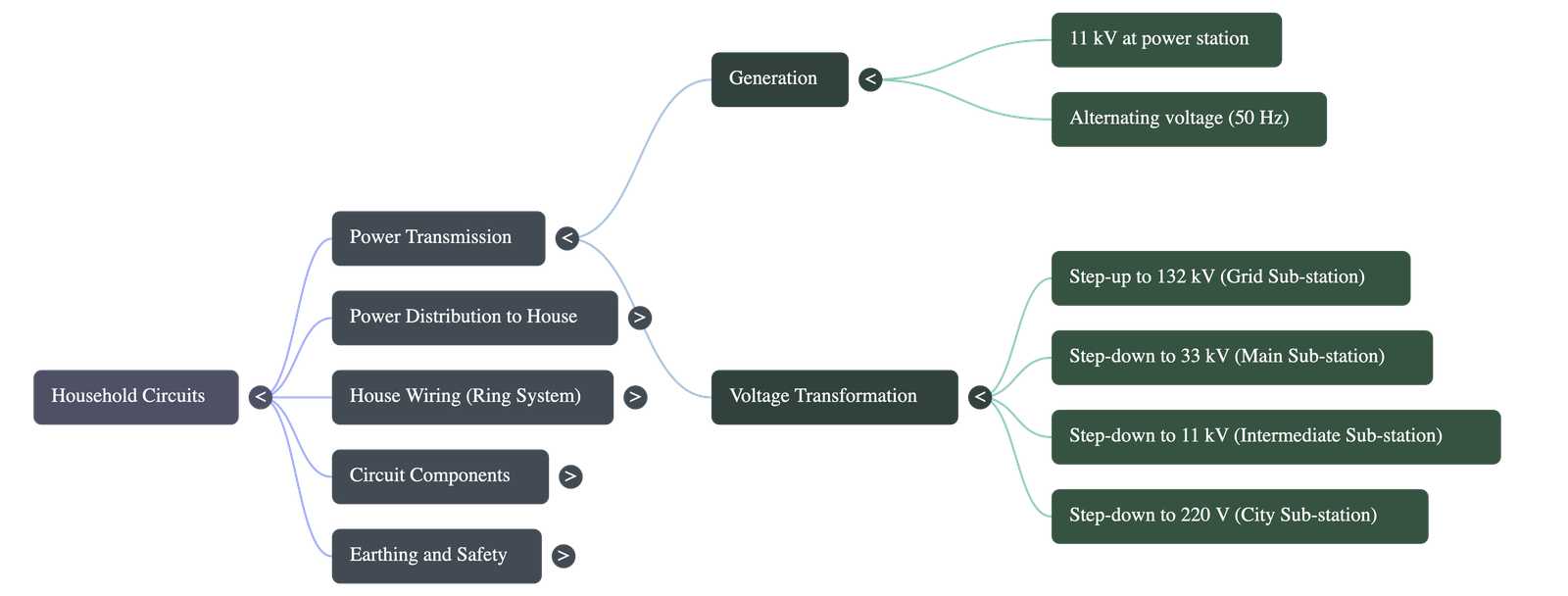
9.1 Transmission of Power from the Generating Station to the Consumer
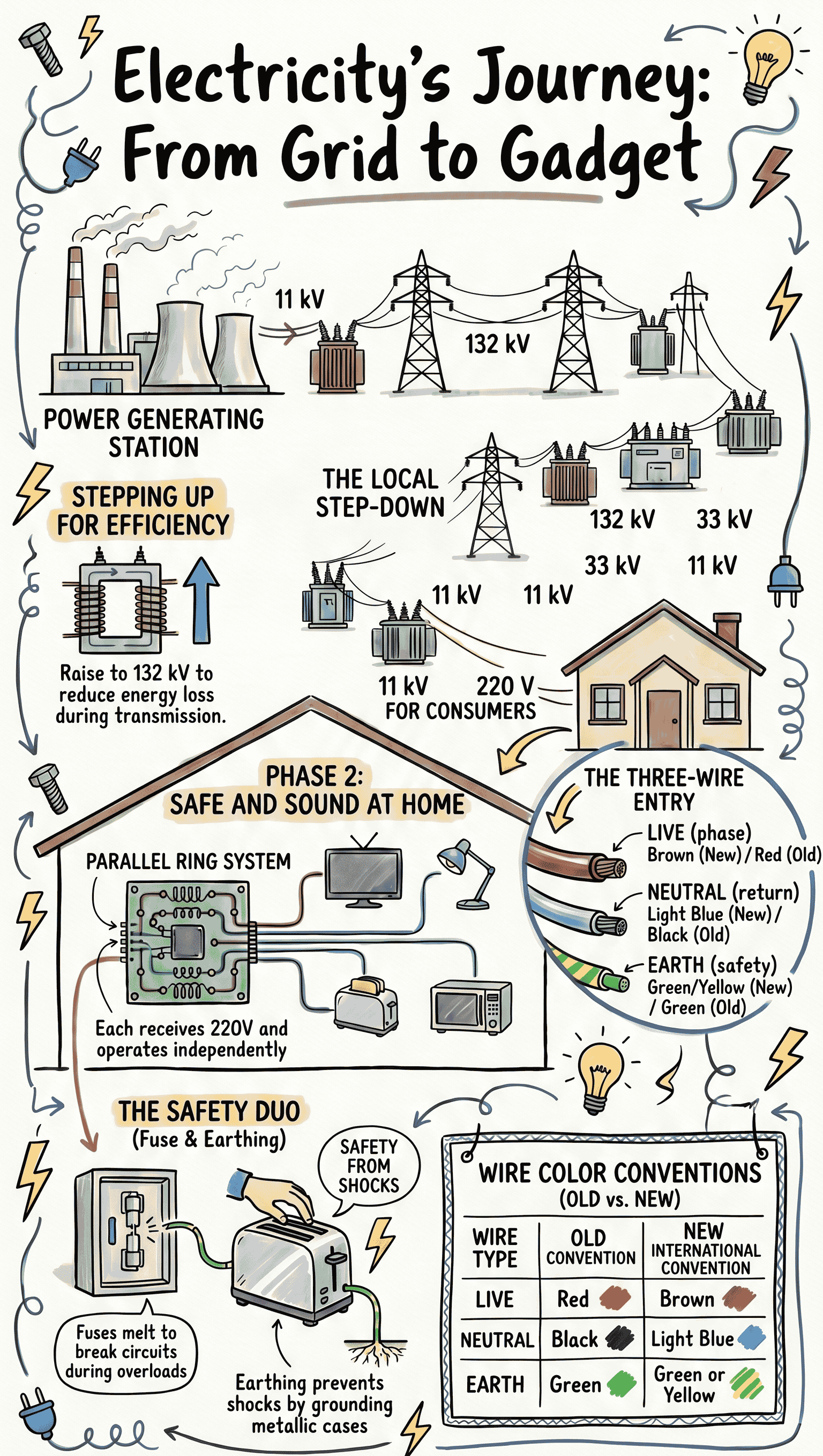
- Generation: Electric power is generated at 11 kV (at 50 Hz frequency). Generating above 11 kV causes insulation difficulties, while below 11 kV requires dangerously high currents.
- Step-Up for Transmission: Before transmission, the voltage is stepped up from 11 kV to 132 kV using a step-up transformer at the grid sub-station. This is done to reduce current, which heavily minimizes energy loss due to heating in the transmission lines.
- Step-Down Process:
- At the main sub-station: Stepped down from 132 kV to 33 kV (sent to heavy industry).
- At the intermediate sub-station: Stepped down from 33 kV to 11 kV (sent to light industry).
- At the city sub-station: Stepped down from 11 kV to 220 V for domestic household consumers.
9.2 Power Distribution to a House
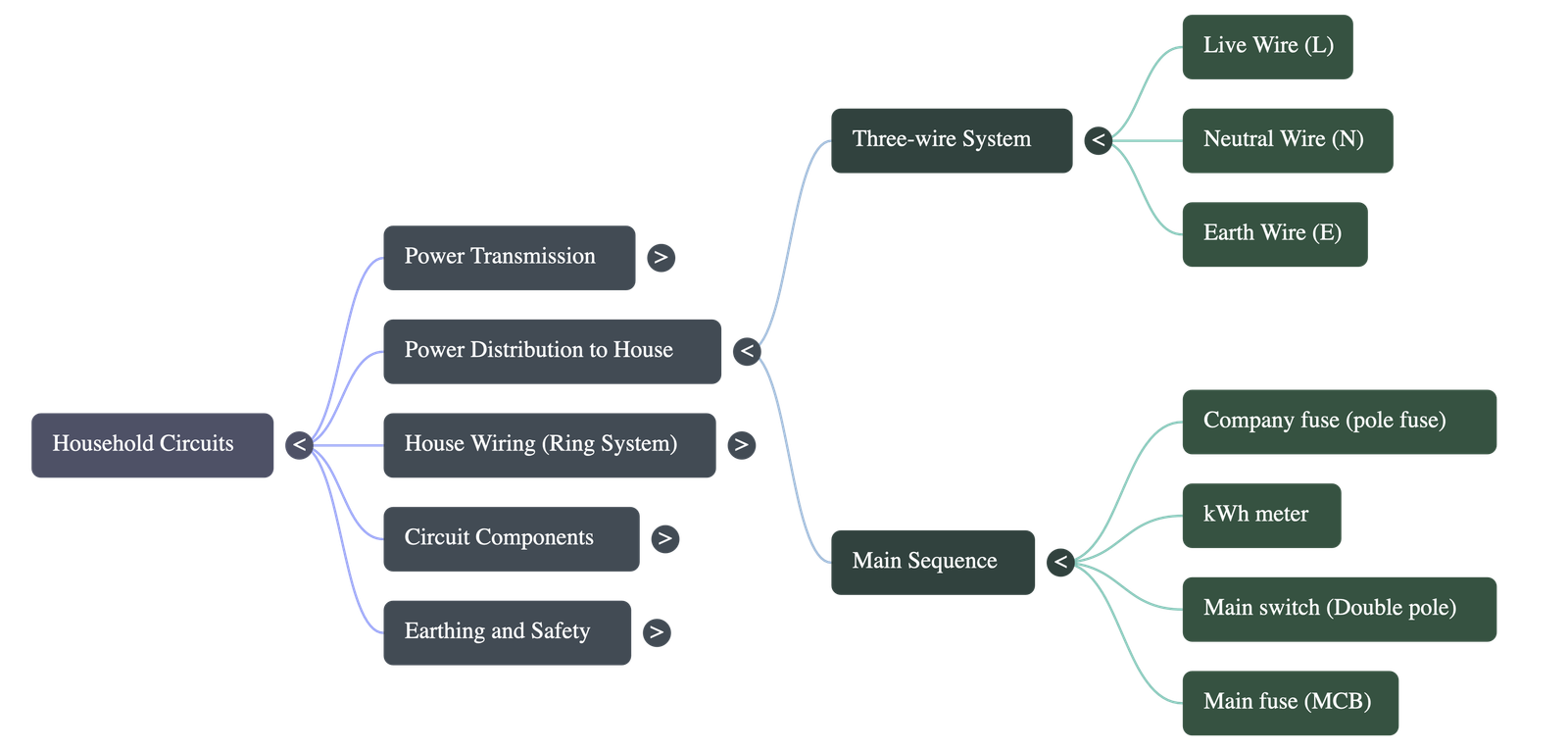
- The Three Wires: Power is supplied to houses via overhead cables or underground wires comprising three components: Live (Phase) Wire (L), Neutral Wire (N), and Earth Wire (E).
- Potentials: Neutral and Earth wires are connected together at the local sub-station and are at 0 V potential. The Live wire carries the current from the source and provides the 220 V potential difference.
- Connection Sequence into the House:
- Company Fuse: First connection point on the live wire; prevents excessive current from entering the house.
- kWh Meter: Records electricity consumption.
- Main Switch: A double pole switch that cuts off both live and neutral wires simultaneously for safety.
- Main Fuse / MCB / ELCB: Protects the entire internal wiring.
- Distribution Board: Branches out power to different parts of the house.
9.3 House Wiring (Ring System)
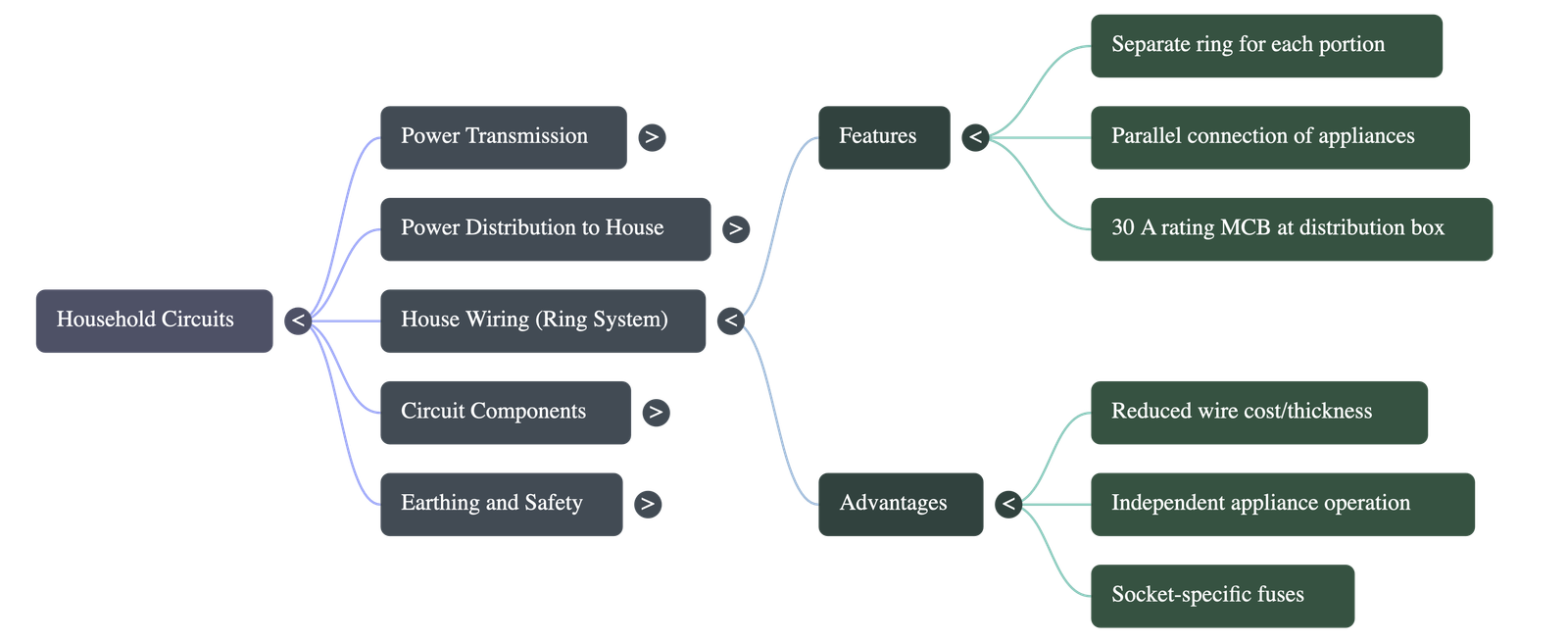
- The Ring System: Wires start from the distribution box, run around all rooms in a specific portion of the house, and return to the box forming a ring. Each room gets connections drawn from this common ring.
- Advantages of Ring System:
- Current reaches appliances through two separate paths, allowing thinner, lower-capacity wires (reduces cost).
- Each appliance has a separate fuse; a fault in one doesn't disrupt others.
- Plugs and sockets can be of the same size, with individual fuses.
- Easy to install new appliances directly to the existing ring.
- Connection in Parallel vs Series:
- Parallel (Used in homes): Every appliance gets the full 220 V. If one appliance is switched off or breaks, others continue working independently.
- Series (Not used in homes): Voltage gets divided across appliances. None can operate independently. If one stops working, the entire circuit breaks.
(B) SOME ESSENTIAL COMPONENTS OF HOUSE WIRING SYSTEM
9.4 Fuse
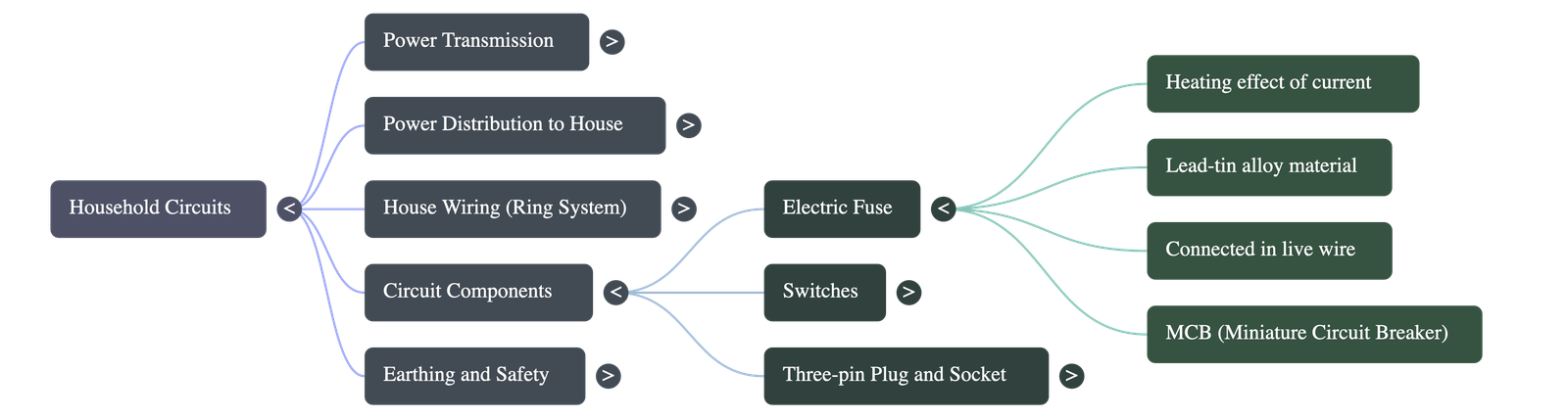
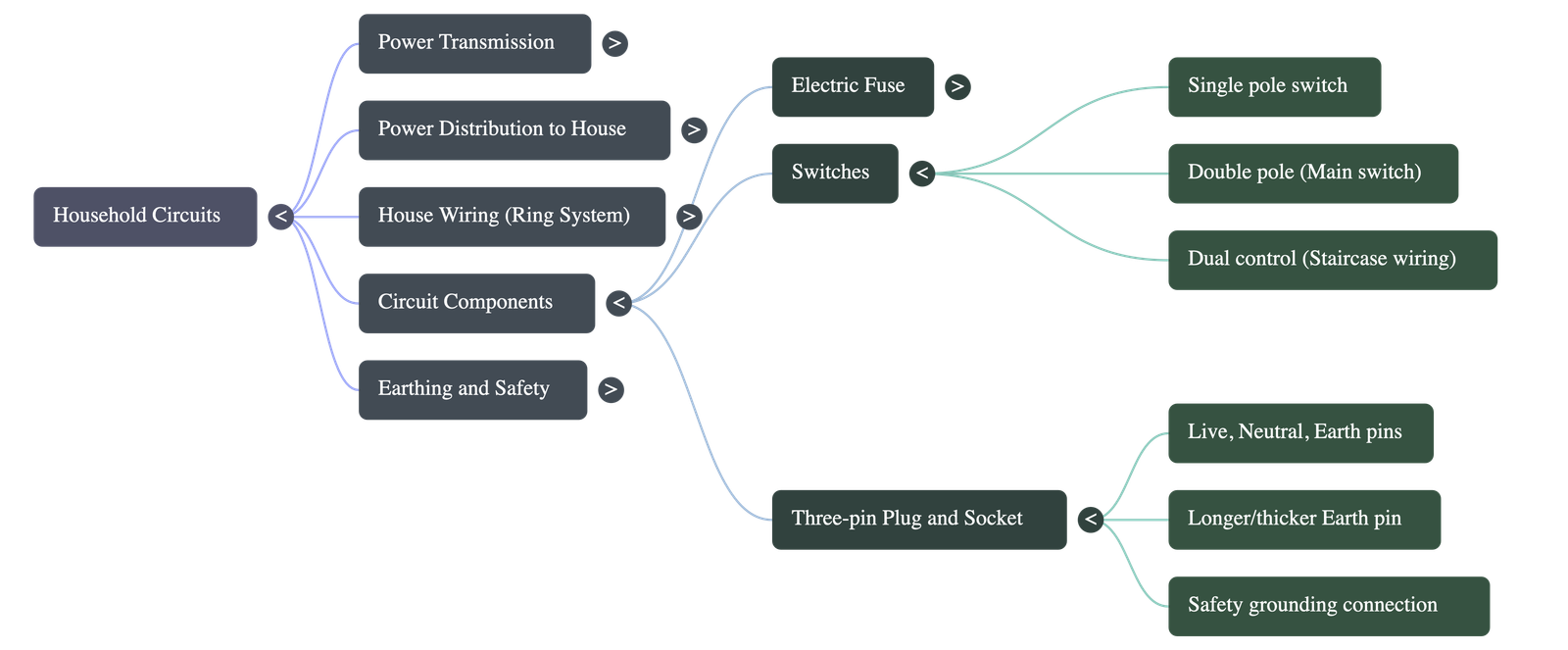
- Function & Principle: A safety device working on the heating effect of current. It melts and breaks the circuit if the current exceeds safe limits (due to short-circuiting or overloading).
- Material: Made of an alloy of lead and tin because it has a low melting point (approx. 250°C) and high resistance. Copper or aluminum are unsuitable as fuses due to their high melting points.
- Connection Rule: A fuse must always be connected in the live wire. If placed in the neutral wire, breaking it would stop the current, but the appliance would remain at a dangerous high potential.
- Miniature Circuit Breaker (MCB): Modern alternative to fuses. MCBs trip (fall down) instantly (approx. 25 milliseconds) when heavy current flows. They are more convenient because they can simply be switched back on after fixing the fault, without needing wire replacement.
9.5 Switches
- Function: An on/off device for current in a circuit.
- Types: Single pole switch (controls only live wire) and Double pole switch (disconnects both live and neutral wires simultaneously, used in the main switch).
- Connection Rule: Just like fuses, switches must always be connected in the live wire. If connected in neutral, an "off" switch leaves the appliance dangerously connected to the live 220 V potential.
- Safety Precaution: Never touch a switch with wet hands. Water is a conductor and can create a path for current to enter the body, causing a fatal shock.
9.6 Circuits with Dual Control Switches (Staircase Wiring)
- Concept: Allows a single appliance (like a staircase bulb) to be controlled (turned on or off) independently from two different places.
- Application: Typically used on staircases—one switch at the bottom and one at the top. Moving either switch completes or breaks the circuit regardless of the other switch's position.
9.7 Earthing (Grounding)
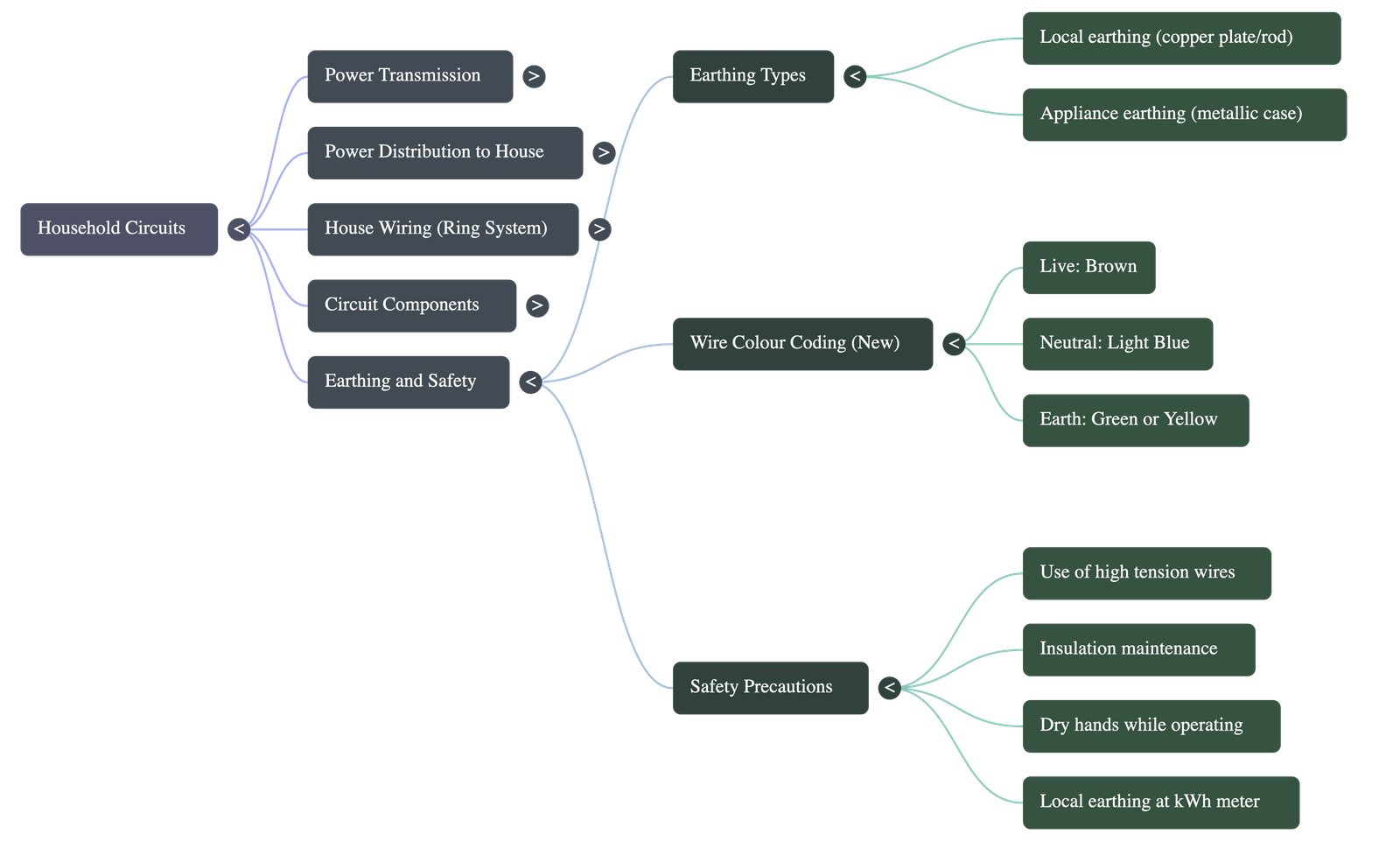
- Local Earthing: Done near the house meter. A thick copper rod/plate is buried deep in the ground, surrounded by a mixture of charcoal and salt to maintain dampness and conductivity. If excessive current flows, it is safely directed to the ground.
- Appliance Earthing: Essential for appliances we handle physically (refrigerators, irons, geysers). The earth wire connects the metallic case of the appliance to the ground.
- Safety Mechanism: If live wire insulation fails and touches the metallic body, the appliance acquires high voltage. With proper earthing, heavy current immediately rushes to the earth, blowing the fuse and saving the user from a fatal shock.
9.8 Three-Pin Plug and Socket
- The Plug: Has three split pins to provide a spring action for a tight fit.
- Top Pin (Earth): It is longer so that earthing connects first before the live current flows (safety first!). It is also thicker so it cannot be wrongly inserted into the live or neutral holes.
- Left Pin: Live wire connection.
- Right Pin: Neutral wire connection.
- The Socket: Top hole is Earth. Right hole is Live. Left hole is Neutral.
9.9 Colour Coding of Wires in a Cable
- Colour coding ensures appliances are connected correctly to switches and sockets.
- Old Convention: Live = Red, Neutral = Black, Earth = Green.
- New International Convention: Live = Brown, Neutral = Light Blue, Earth = Green or Yellow.
9.10 High Tension Wires
- Used to carry very high current safely.
- Instead of one thick solid wire, they are made by twisting a number of thin wires together.
- This provides a large surface area, allowing heat generated to radiate quickly to the surroundings, keeping resistance low and preventing fires.
9.11 Safety Precautions While Using Electricity
- Avoiding Fire: Fires are caused by overheating due to overloading or short-circuiting. To avoid this, always use proper current-carrying capacity wires.
- Avoiding Electric Shock: Shocks happen due to poor insulation, wet hands, or lack of earthing/fuses.
- Check wire insulation regularly.
- Never operate switches/appliances with wet hands.
- Ensure all metallic appliances are properly earthed.
- Always use correct rating fuses connected securely in the live wire.
Teacher's Tip: Electricity is incredibly useful but demands respect. Pay special attention to the difference between series and parallel circuits, and always remember why switches and fuses are exclusively placed on the LIVE wire! Keep up the good work and happy studying!
Do checkout all questions & answers of this chapter.
Quick Navigation:
| | | |
1 / 1
Quick Navigation:
| | | |