Quick Navigation:
| | | |
Calorimetry
Comprehensive Chapter Summary for Class 10 Physics
Part A: Heat Capacity, Specific Heat Capacity and its Measurement
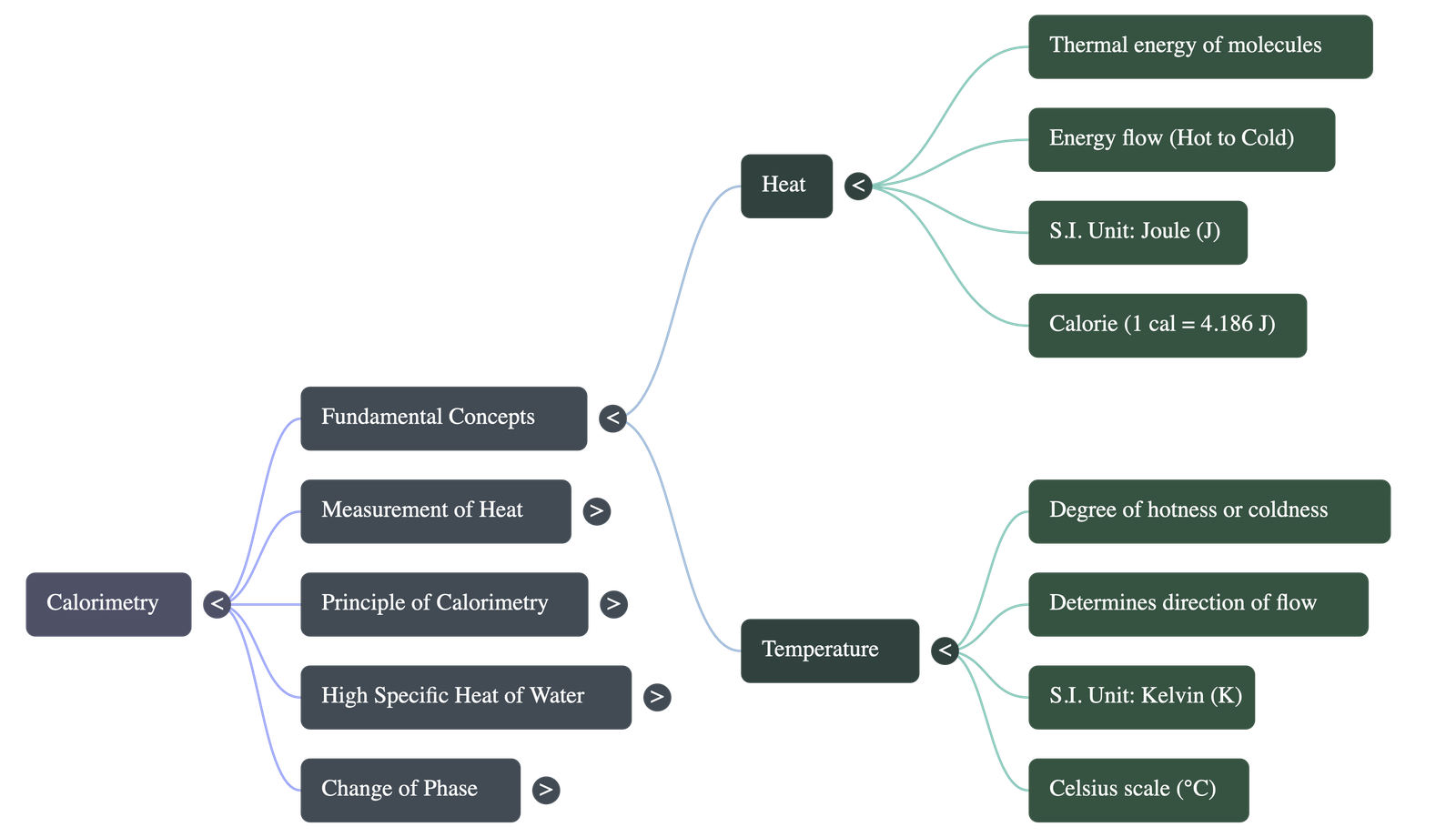
11.1 Concept of Heat
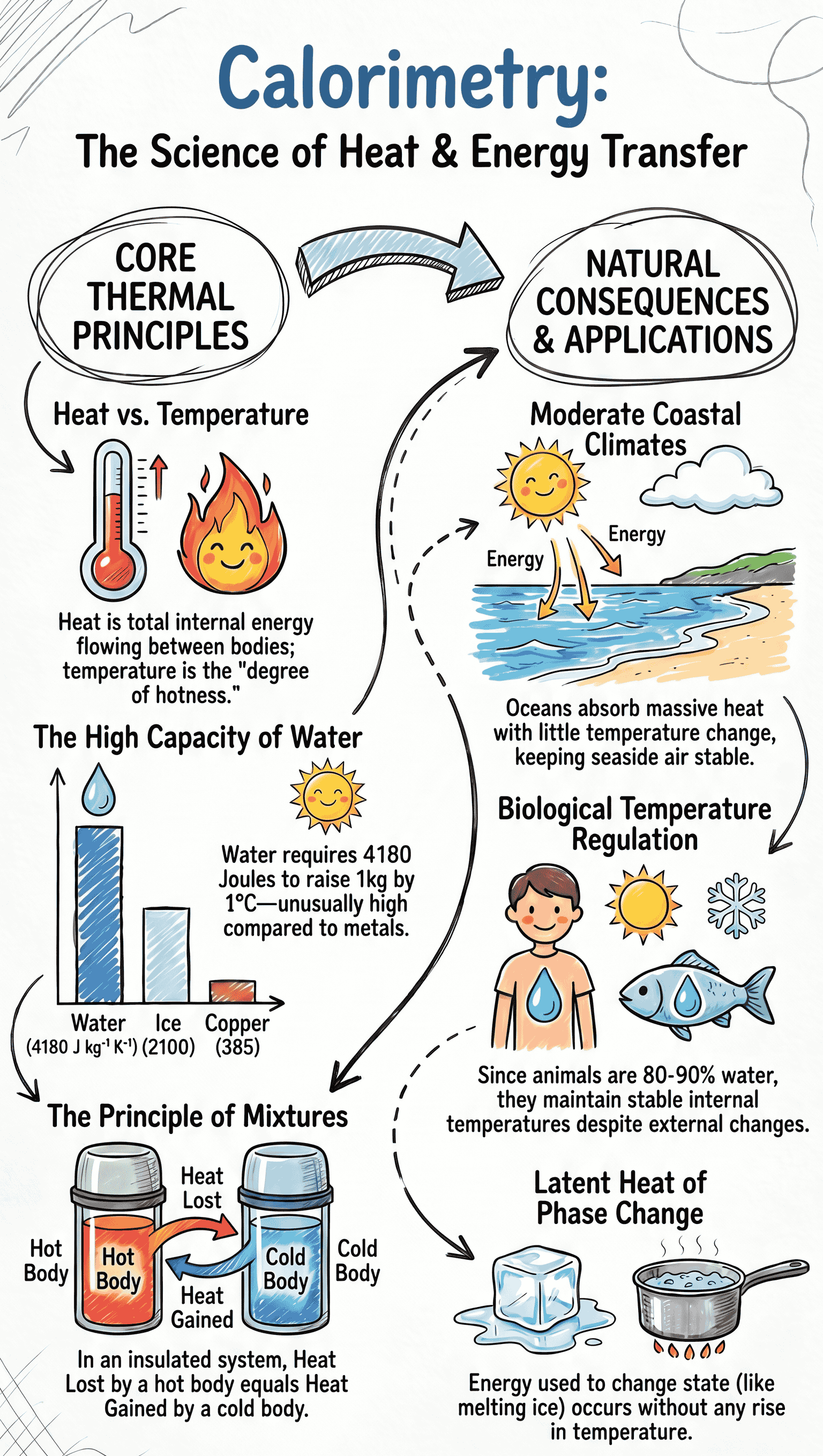
- Definition: Heat is the total internal energy of molecules in a substance, combining both their kinetic and potential energies.
- Flow: Heat energy always flows from a hot body to a cold body when they are placed in contact.
- Units: The S.I. unit is the Joule (J). A commonly used unit is the calorie (cal), where 1 calorie ≈ 4.2 Joules.
11.2 Concept of Temperature
- Definition: Temperature is a parameter that tells the thermal state of a body and determines the direction of heat flow.
- Units: The S.I. unit is Kelvin (K). The common unit is degree Celsius (°C).
- Conversion: T (Kelvin) = 273 + t (°C). A change in temperature is numerically identical on both scales (Δ°C = ΔK).
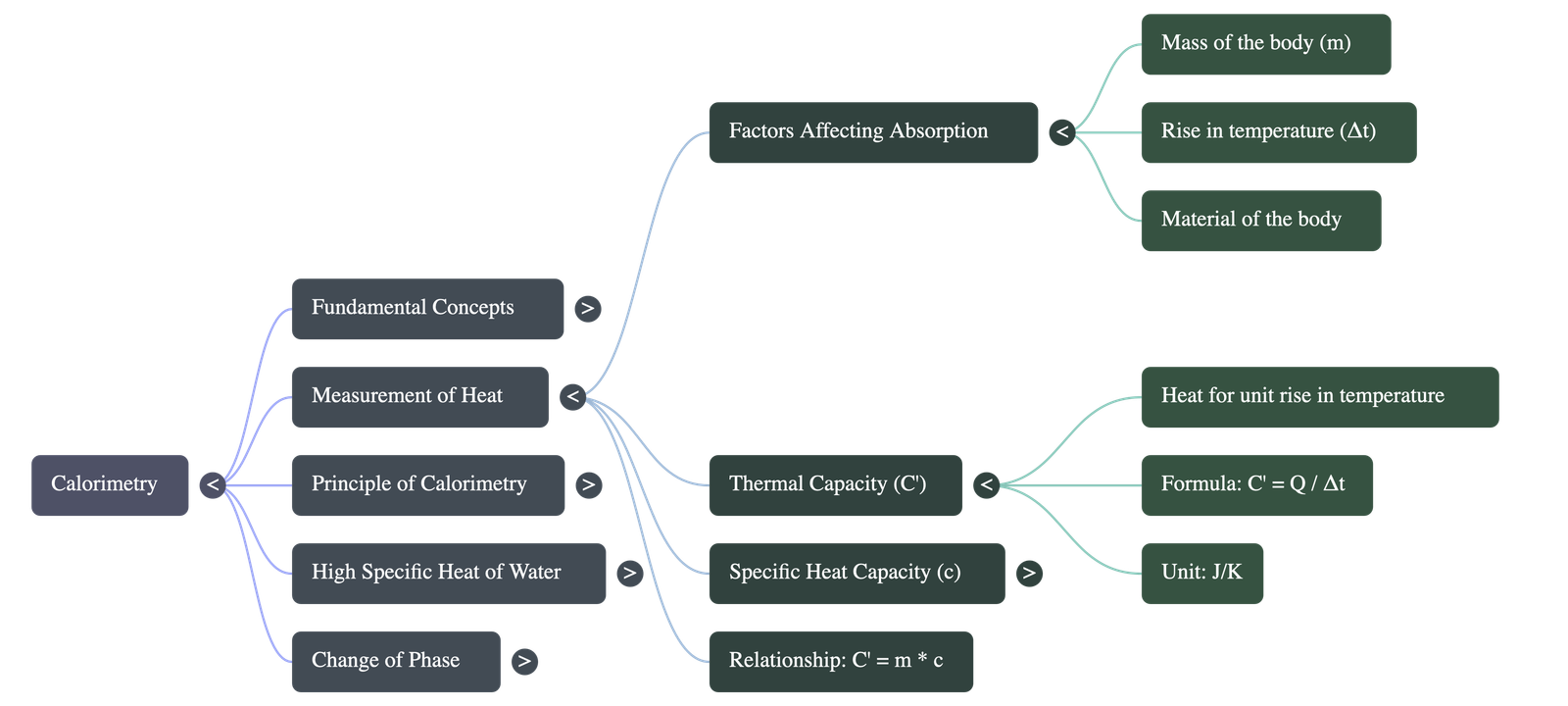
11.3 Factors Affecting the Quantity of Heat Absorbed
- The heat absorbed (Q) by a body to raise its temperature depends on three factors:
- The mass of the body (m).
- The increase in temperature (Δt).
- The material or substance of the body.
- Formula: Q = m × c × Δt.
11.4 Difference Between Heat and Temperature
- Nature: Heat is a form of energy; temperature is the thermal state or degree of hotness.
- Dependence: Heat depends on the mass and material; temperature depends on the average kinetic energy of molecules.
- Measurement: Heat is measured by the principle of calorimetry; temperature is measured by a thermometer.
11.5 Thermal (or Heat) Capacity (C')
- Definition: The amount of heat energy required to raise the temperature of the entire body by 1°C (or 1 K).
- Formula: C' = Q / ΔT.
- Unit: Joule per Kelvin (J/K) or J/°C.
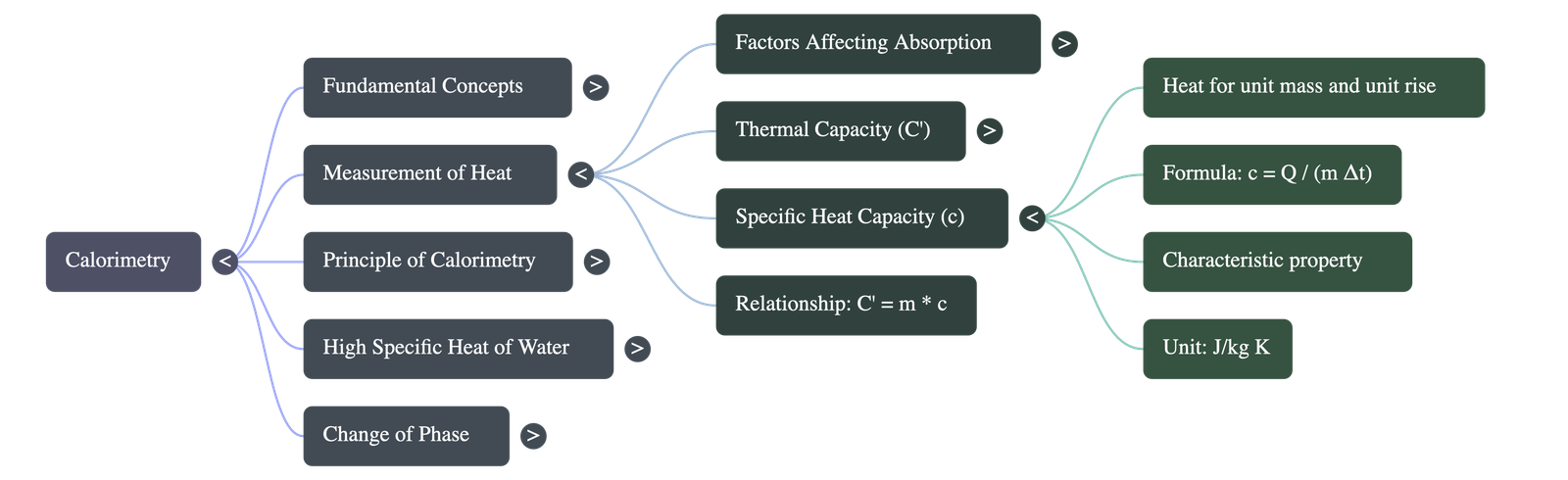
11.6 Specific Heat Capacity (c)
- Definition: The heat capacity per unit mass of a substance. It is the heat required to raise the temperature of 1 kg of a substance by 1°C.
- Formula: c = Q / (m × ΔT).
- Unit: Joule per kilogram per Kelvin (J kg⁻¹ K⁻¹).
11.7 Distinction Between Heat Capacity and Specific Heat Capacity
- Heat capacity applies to the entire body and varies with mass.
- Specific heat capacity applies to a unit mass and is a constant characteristic property of the material, independent of mass.
11.8 Specific Heat Capacity of Some Common Substances
- Good conductors of heat (like copper) have low specific heat capacities, meaning they heat up and cool down rapidly.
- Water has an unusually high specific heat capacity (4200 J kg⁻¹ K⁻¹), making it a very poor conductor but an excellent reservoir of heat.
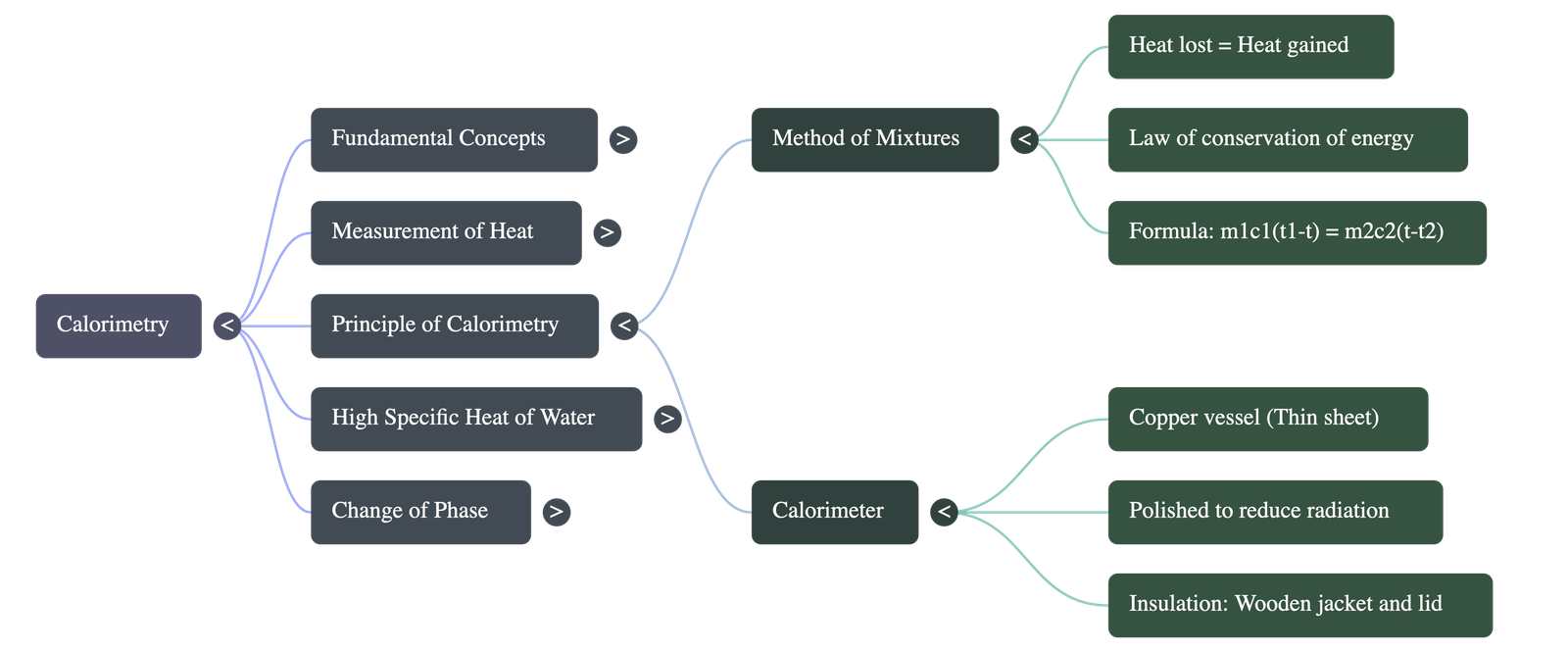
11.9 Calorimeter
- Design: A cylindrical vessel used to measure heat flow.
- Material: Made of thin sheet copper because copper has a low specific heat capacity (absorbing very little heat itself) and conducts heat quickly to ensure uniform temperature.
- Insulation: Placed in a wooden jacket with insulating materials (like wool or cotton) and highly polished to prevent heat loss by conduction, convection, and radiation.
11.10 Principle of Method of Mixtures (Principle of Calorimetry)
- Core Concept: Based on the law of conservation of energy. When bodies are mixed, heat flows until a uniform final temperature is reached.
- Formula: Heat lost by the hot body = Heat gained by the cold body (provided no heat is lost to surroundings).
- Equation: m₁c₁(t₁ - t) = m₂c₂(t - t₂).
11.11 Natural Phenomena & Consequences of High Specific Heat of Water
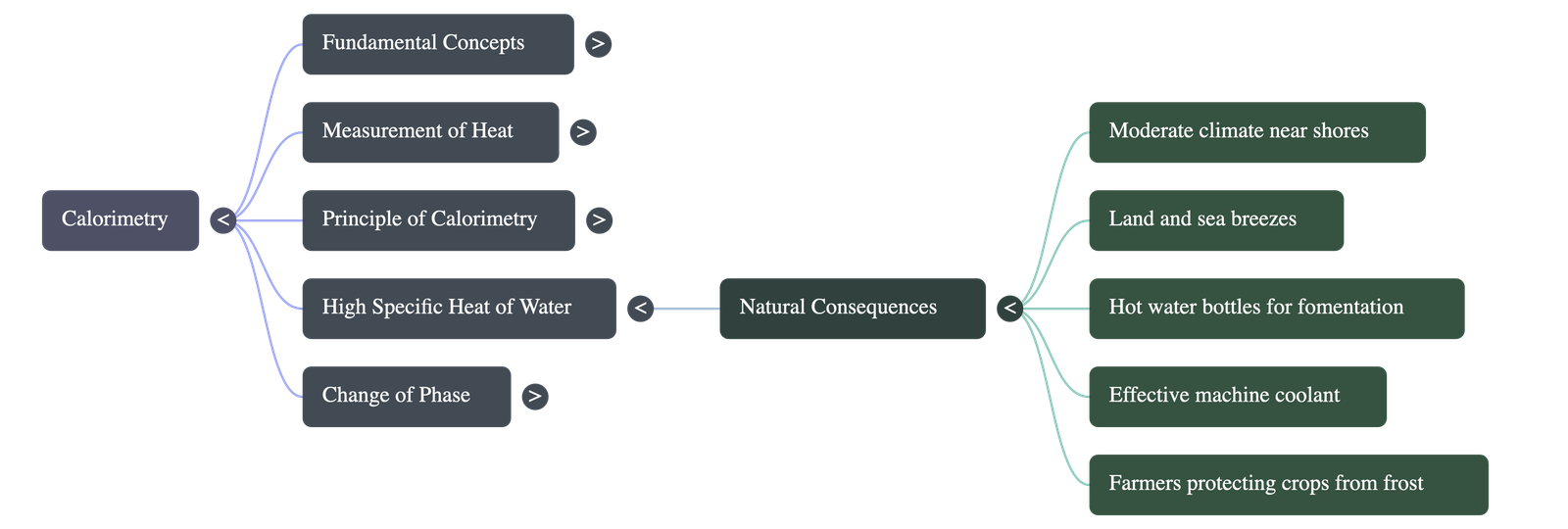
- Climate: Coastal areas enjoy moderate climates due to the slow heating and cooling of the ocean (forming land and sea breezes).
- Fomentation: Hot water bottles are highly effective because water retains heat for a very long time.
- Coolant: Used in car radiators because it can extract massive amounts of heat from engines without a significant rise in its own temperature.
- Agriculture: Farmers flood fields on cold winter nights to protect crops from frost, as cooling water releases significant heat, keeping temperatures above freezing.
11.12 Some Examples of High and Low Heat Capacity
- Cooking pans are made thick at the base (increasing heat capacity) so they heat food slowly and stay warm longer.
- Calorimeters are purposely made of thin material (lowering heat capacity) to minimally interfere with the thermal calculations.
Part B: Change of Phase (State) and Latent Heat
11.13 Change of Phase (State)
- Matter exists in solid, liquid, or gas phases.
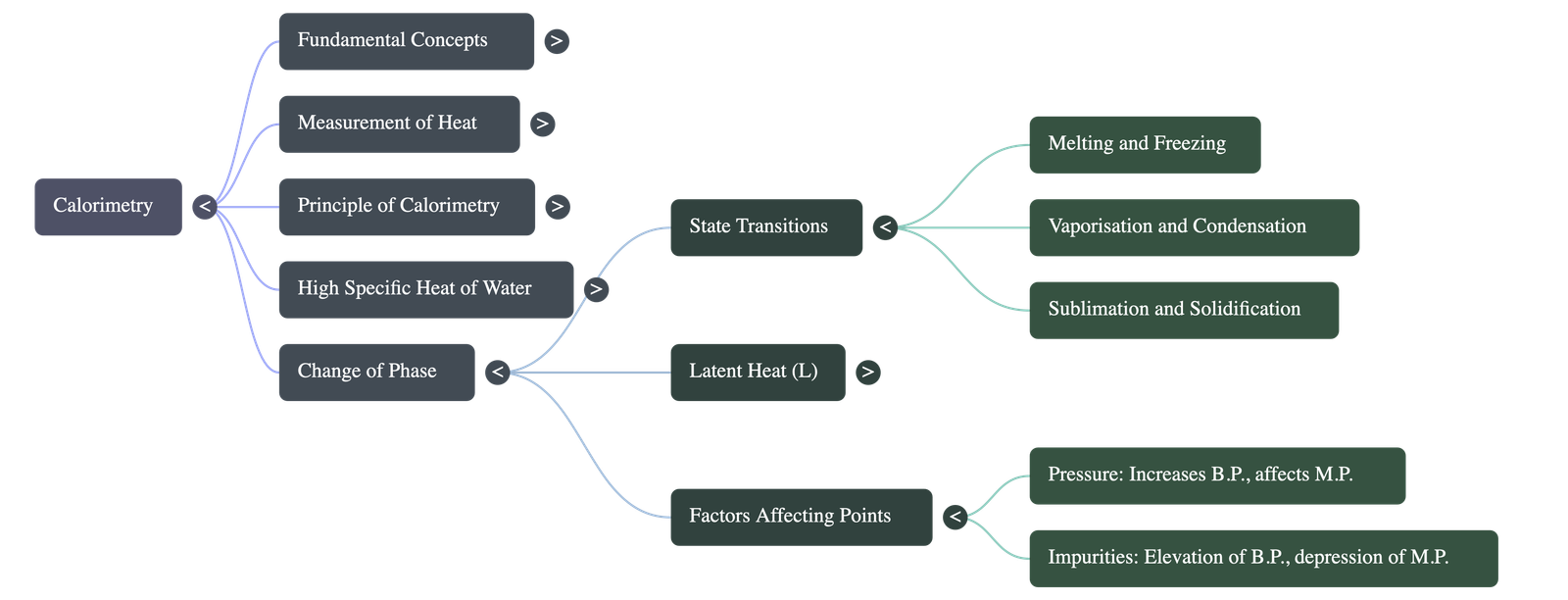
- A phase change occurs at a constant temperature by the exchange of heat. Processes include melting, freezing, vaporisation, condensation, and sublimation.
11.14 Melting and Freezing
- Melting: Solid changes to liquid upon absorbing heat at a constant temperature (melting point).
- Freezing: Liquid changes to solid upon releasing heat at a constant temperature (freezing point).
- For pure substances, the melting point and freezing point are identical.
11.15 Heating Curve of Ice During Melting
- When ice at 0°C is heated, the temperature does not rise until the entire block has completely melted into water. The graph flatlines during this phase.
11.16 Change in Volume on Melting
- While most substances expand when melting, ice contracts (along with bismuth and cast iron). For example, 1 cm³ of ice melts into slightly less than 1 cm³ of water.
11.17 Effect of Pressure on Melting Point
- For substances that contract upon melting (like ice), an increase in pressure decreases the melting point.
- For substances that expand upon melting (like wax), an increase in pressure increases the melting point.
11.18 Effect of Impurities on Melting Point
- The presence of impurities always decreases the melting point. This is why salt is mixed with ice to create freezing mixtures for making kulfis.
11.19 Vaporisation or Boiling
- The process of a liquid turning into a gas on absorbing heat at a constant temperature (boiling point). The reverse process is condensation.
11.20 Heating Curve for Water
- Temperature rises steadily to 100°C and then remains strictly constant as long as the water is boiling into steam.
11.21 Change in Volume on Boiling
- All liquids expand upon boiling. 1 cm³ of water expands massively to become approximately 1760 cm³ of steam.
11.22 Effect of Pressure on Boiling Point
- The boiling point of a liquid increases with an increase in pressure.
- Application: Pressure cookers prevent steam from escaping, increasing pressure, which raises the boiling point (up to ~125°C), allowing food to cook much faster. Conversely, cooking at high altitudes is difficult because low pressure decreases the boiling point.
11.23 Effect of Impurities on Boiling Point
- Adding impurities (like salt to water) increases the boiling point, providing more heat energy for cooking before boiling begins.
11.24 Latent Heat and Specific Latent Heat
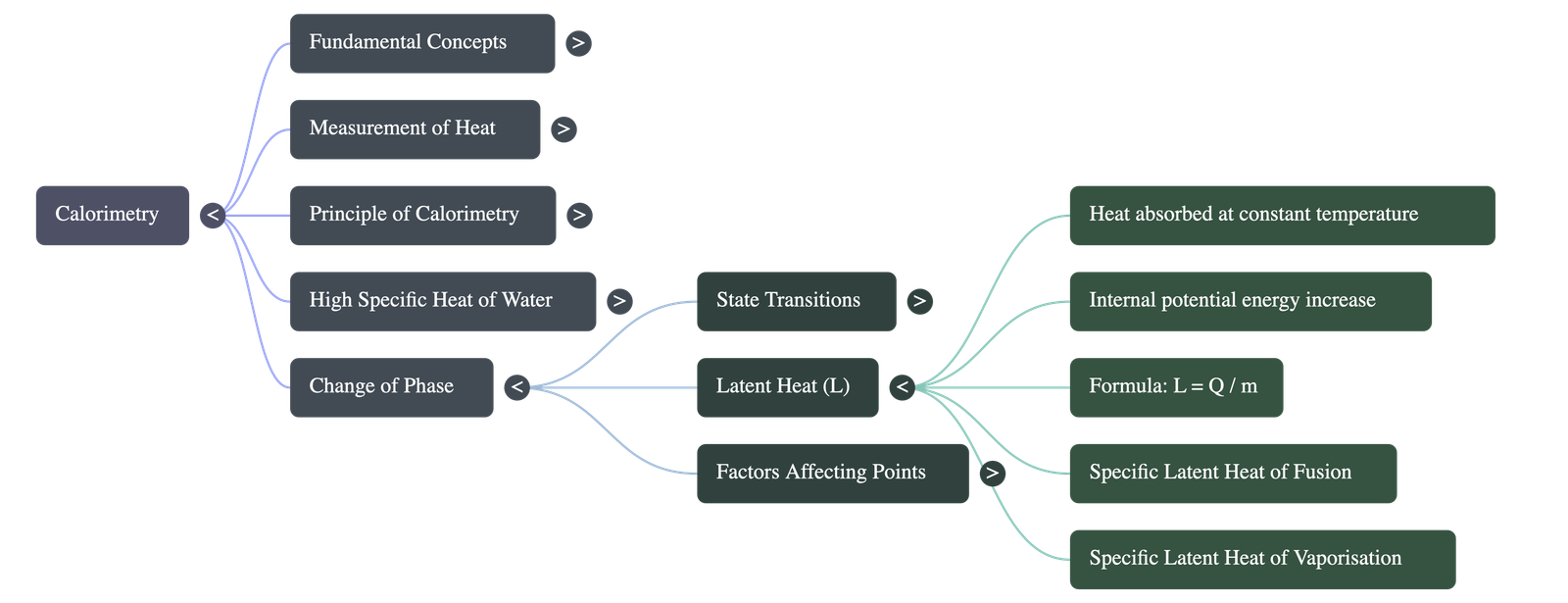
- Latent Heat: "Hidden" heat absorbed or liberated during a change of phase that is not registered by a thermometer (no temperature change).
- Specific Latent Heat (L): Heat energy required to change the phase of a unit mass of a substance at constant temperature.
- Formula: L = Q / m.
- Unit: Joules per kilogram (J kg⁻¹).
11.25 Specific Latent Heat of Fusion of Ice
- The heat required to melt 1 kg of ice at 0°C to water at 0°C is extraordinarily high: 336,000 J kg⁻¹.
11.26 Explanation of Latent Heat on the Basis of Kinetic Model
- During a phase change, the heat energy supplied is used exclusively to do work against intermolecular attractive forces, thus increasing the potential energy of the molecules.
- Because the average kinetic energy of the molecules does not increase, the temperature remains totally constant until the entire phase change is complete.
11.27 Natural Consequences of High Specific Latent Heat of Fusion of Ice
- Slow Snow Melting: Snow on mountains melts gradually because it requires an immense amount of heat to transition into water, preventing catastrophic flooding.
- Lake Freezing: Lakes in cold regions don't freeze instantly. The water must release huge amounts of latent heat to the atmosphere to solidify, which protects aquatic life.
- Cooling Drinks: Ice at 0°C cools drinks much more effectively than water at 0°C because melting ice actively extracts 336 J of heat energy per gram from the beverage.
- Hail-storms: The weather feels exceptionally cold immediately after a hail-storm because melting ice strongly absorbs the latent heat from the surrounding environment.
Do checkout all questions & answers of this chapter.
Quick Navigation:
| | | |
1 / 1
Quick Navigation:
| | | |