Quick Navigation:
| | | |
Current Electricity
Hello students! Welcome to our detailed, section-by-section summary of Chapter 8: Current Electricity. Read through these carefully curated points to master the concepts of charges, circuits, power, and everything in between!
Part A: Concept of Charge, Current, Potential, Difference and Resistance; Ohm's Law
8.1 Concept of Charge
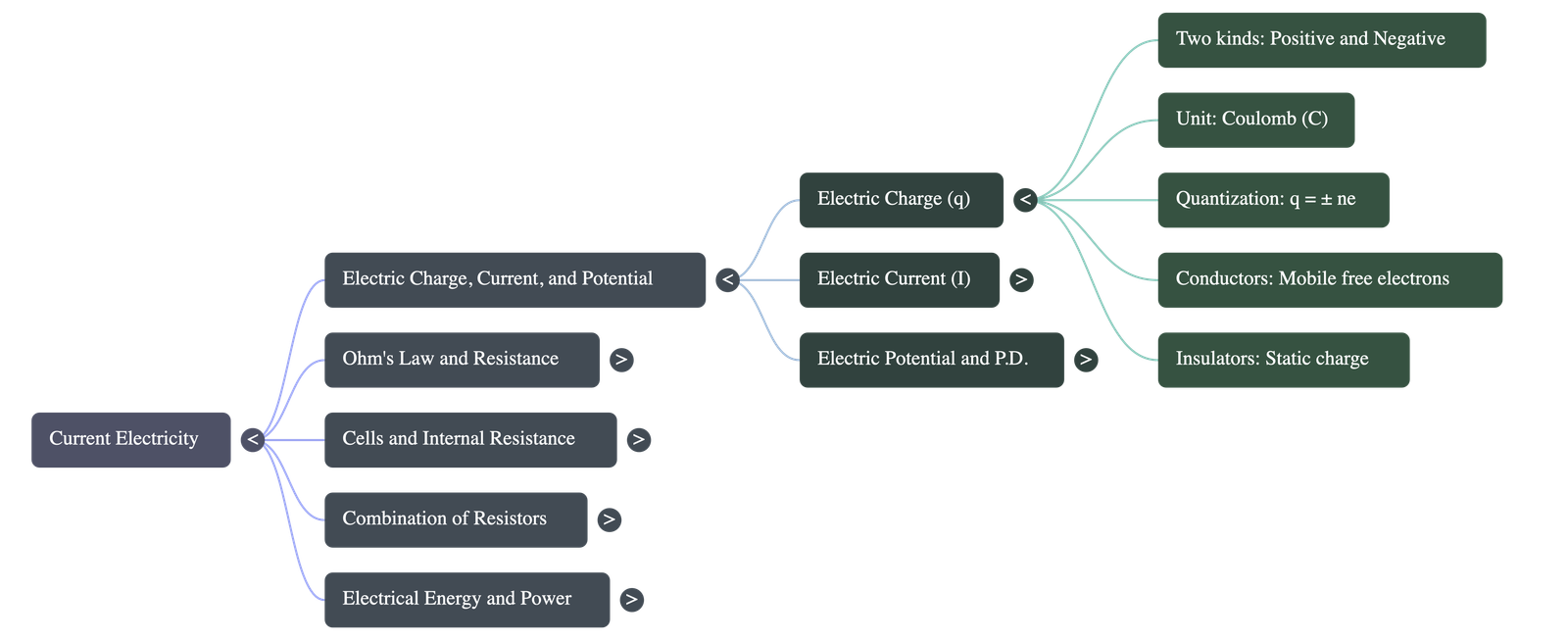
- Nature of Charges: There are two kinds of charges: positive and negative. Like charges repel, and unlike charges attract.
- Origin: Charge results from the transfer of electrons. A body in deficit of electrons becomes positively charged, while an excess of electrons makes it negatively charged.
- Quantization: Total charge on a body is always an integral multiple of the basic electron charge. Formula: q = ± ne.
- Units: The S.I. unit is the coulomb (C). One electron carries a charge of -1.6 × 10⁻¹⁹ C. Thus, 1 C of charge equates to roughly 6.25 × 10¹⁸ electrons.
8.2 Concept of Current
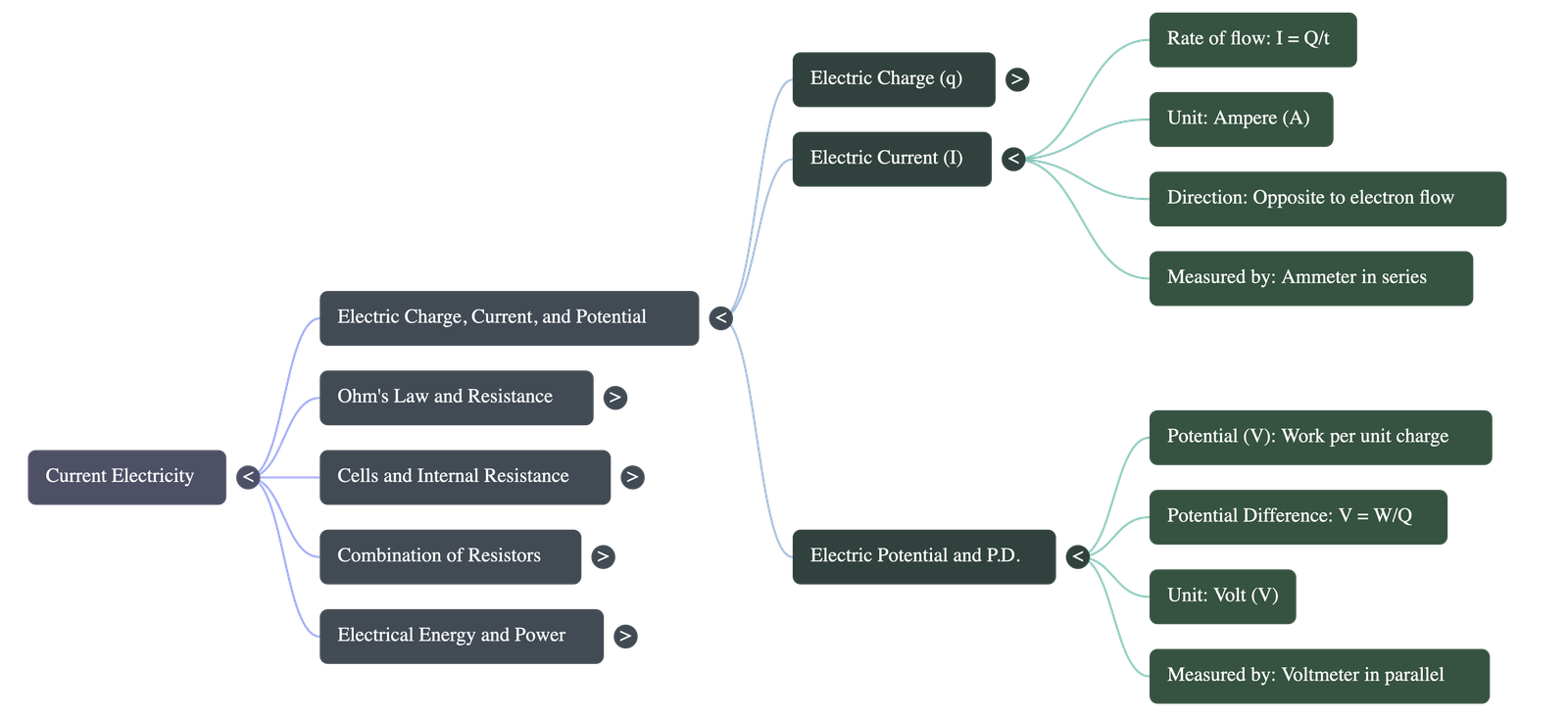
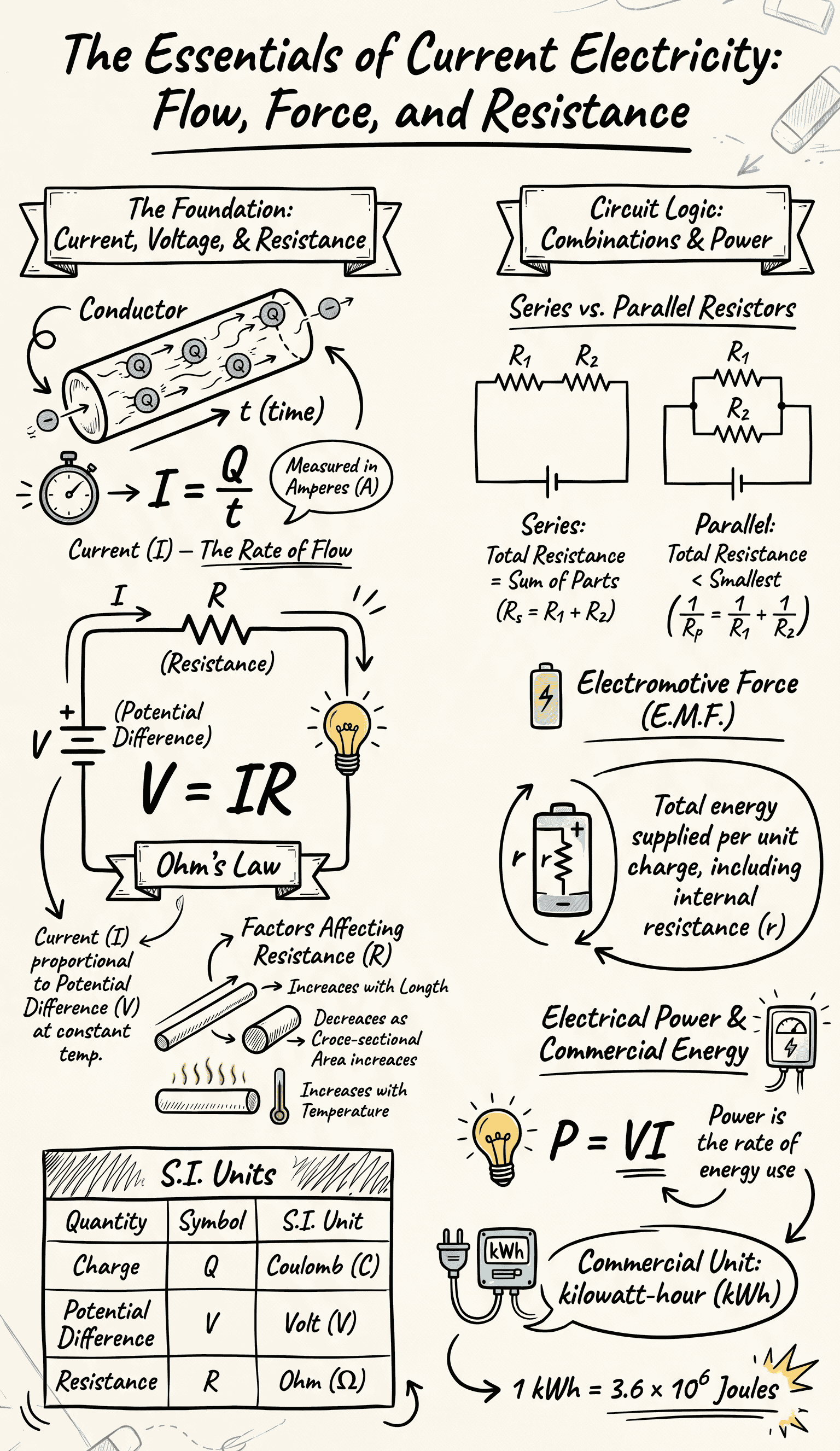
- Definition: Current is the rate of flow of electric charge across a cross-section of a conductor. Formula: I = Q / t = ne / t.
- Unit: S.I. unit is the ampere (A). 1 A = 1 C/s. Smaller units include milli-ampere (mA) and micro-ampere (μA).
- Measurement: Measured by an ammeter always connected in series with the circuit.
- Direction: It is a scalar quantity. Conventionally, current direction is taken as opposite to the flow of electrons.
- Carriers: In metals, free electrons flow; in electrolytes, both positive ions (cations) and negative ions (anions) flow.
8.3 Concept of Potential and Potential Difference (P.D.)
- Electric Potential: Work done per unit charge in bringing a positive test charge from infinity to a point. Formula: V = W / Q.
- Potential Difference: Work done per unit charge in moving a positive test charge from one point to another in a circuit.
- Unit and Measurement: S.I. unit is the volt (V). 1 V = 1 Joule / 1 Coulomb. It is measured by a voltmeter connected in parallel across the points.
8.4 Concept of Resistance
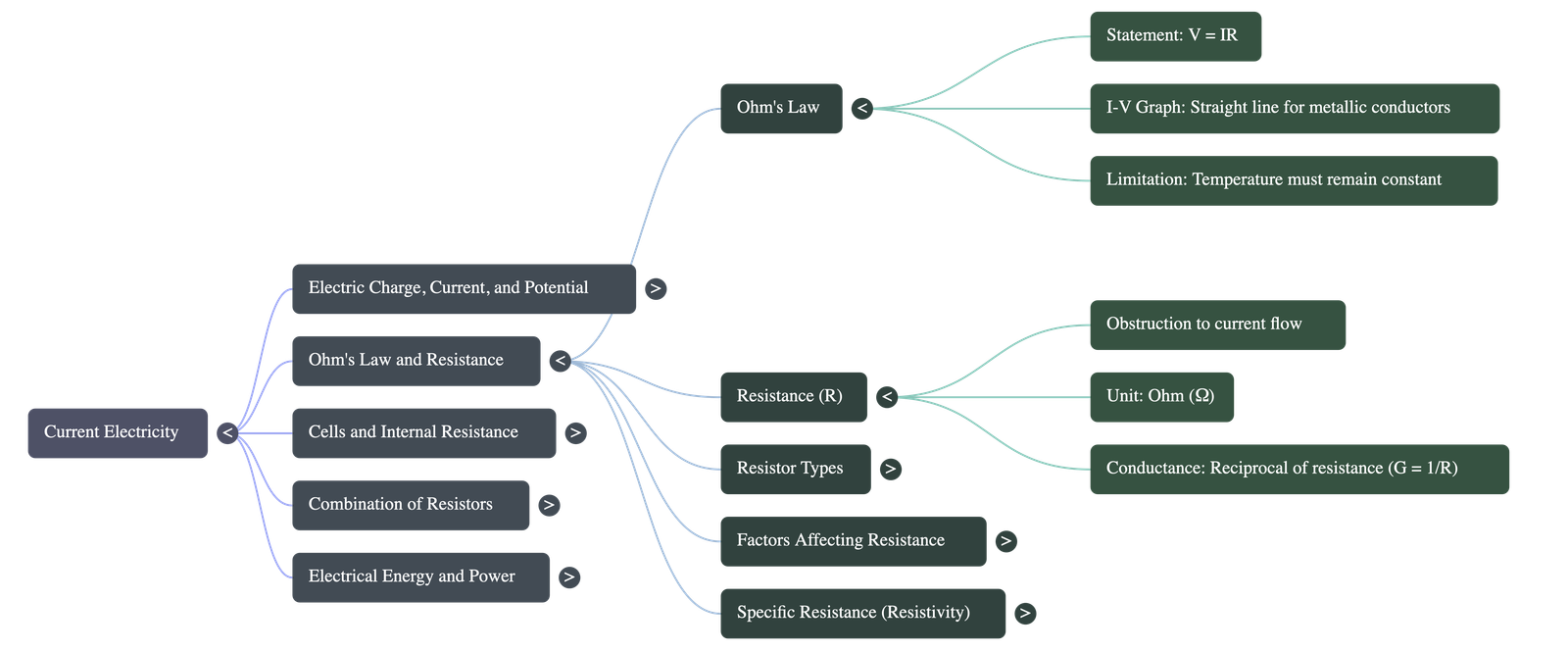
- Definition: The obstruction offered to the flow of current by a conductor is called its resistance.
- Cause: It is caused by the frequent collisions of the moving free electrons with the stationary positive ions in the metallic wire.
8.5 Ohm's Law (V = IR)
- Statement: The current flowing in a conductor is directly proportional to the potential difference applied across its ends, provided physical conditions and temperature remain constant.
- Formula: V = IR or R = V / I, where R is the constant resistance.
- Unit of Resistance: S.I. unit is the ohm (Ω). 1 Ω = 1 V / 1 A.
- Conductance: The reciprocal of resistance is conductance (G). Unit is ohm-1 or siemen (S).
8.6 Experimental Verification of Ohm's Law
- Setup: A circuit containing a battery, key, rheostat, ammeter (in series), and a voltmeter (in parallel with the unknown resistor).
- Procedure: The rheostat varies the current. Simultaneous readings of V and I are recorded.
- Graph: Plotting V on the Y-axis and I on the X-axis yields a straight line passing through the origin. The slope of this line (ΔV / ΔI) gives the resistance R.
8.7 Ohmic and Non-Ohmic Resistors
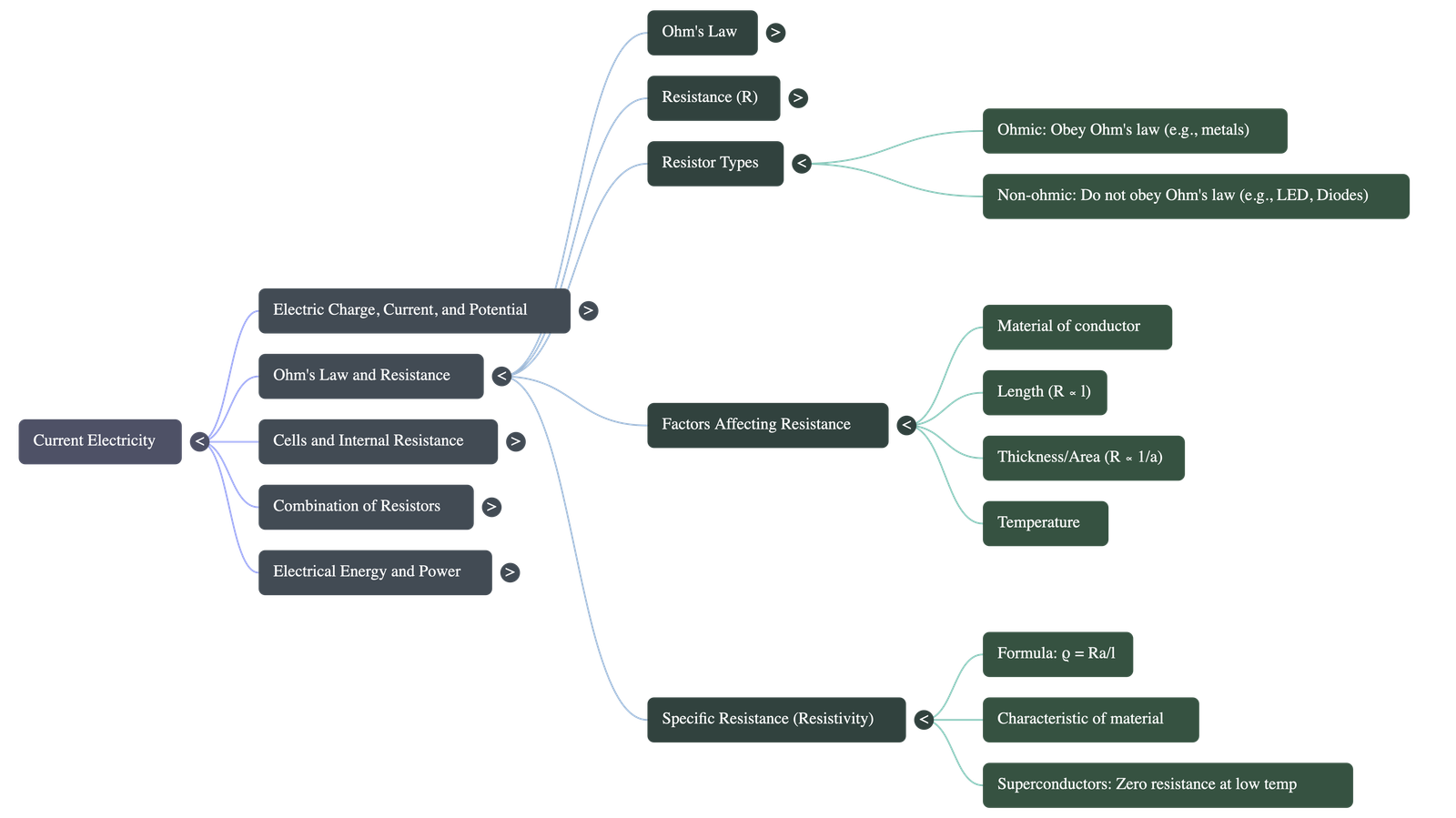
- Ohmic Resistors: Obey Ohm's law. V-I graph is a straight line through the origin. Examples: all metallic conductors (copper, silver) and dilute sulphuric acid.
- Non-Ohmic Resistors: Do not obey Ohm's law. V-I graph is a curve (dynamic resistance changes). Examples: LED, junction diode, solar cell, filament of a bulb.
8.8 Factors Affecting Resistance of a Conductor
- Material: Depends on the concentration of free electrons (metals have low resistance, insulators have high).
- Length (l): Directly proportional to length (R ∝ l).
- Area of Cross-section (a): Inversely proportional to the area (R ∝ 1/a). Thicker wires offer less resistance.
- Temperature: Resistance of pure metals increases with an increase in temperature due to increased collisions. Resistance of semiconductors decreases with rising temperature.
8.9 Specific Resistance (or Resistivity)
- Definition: The resistance of a wire of that material having unit length and unit area of cross-section. Formula: ρ = RA / l.
- Unit: ohm-metre (Ω m).
- Key Rule: Specific resistance is a characteristic property of the material. It depends only on the material and its temperature, NOT on length or thickness.
- Conductivity (σ): Reciprocal of specific resistance. S.I. unit is ohm-1 metre-1 or siemen metre-1.
8.10 Choice of Material of a Wire
- Connecting Wires: Copper or Aluminium (low specific resistance, negligible energy loss).
- Standard Resistors: Manganin or Constantan (high specific resistance, resistance barely changes with temperature).
- Fuse Wire: Lead-tin alloy (low melting point, higher specific resistance than copper).
- Electric Bulb Filament: Tungsten (high melting point, glows without melting).
- Heating Appliances: Nichrome (high specific resistance, doesn't oxidize easily at high temperatures).
8.11 Superconductors
- Definition: Substances whose resistance drops to absolutely zero at very low temperatures.
- Examples: Mercury below 4.2 K, lead below 7.25 K. Current in a superconductor persists indefinitely even without a potential difference.
Part B: Electro-Motive Force, Terminal Voltage, Internal Resistance & Combination of Resistors
8.12 Electro-Motive Force (E.M.F.) of a Cell
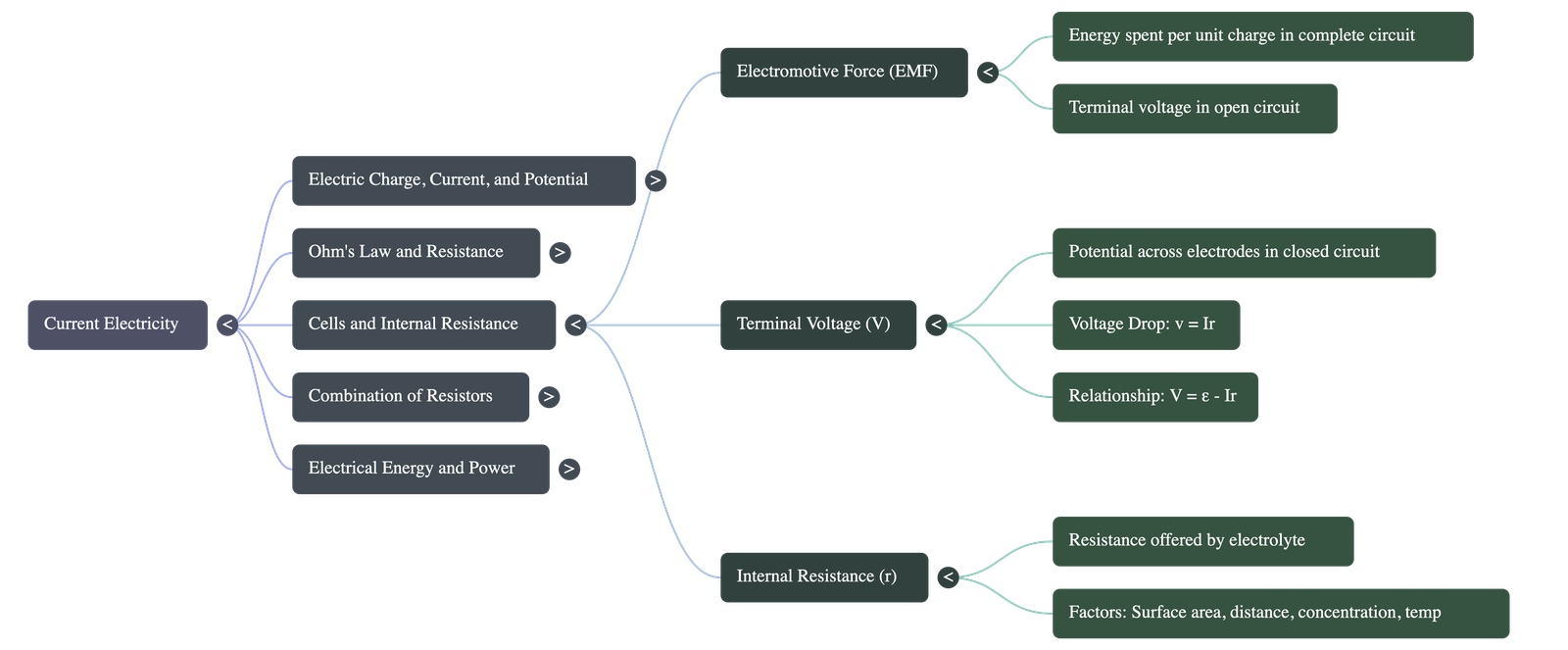
- Definition: The energy spent per unit charge in taking a positive test charge around the complete circuit (outside and inside the cell). Symbol: ε.
- Condition: It is measured when no current is drawn from the cell (cell is in an open circuit).
- Dependencies: Depends on the material of the electrodes and the electrolyte. It does not depend on the shape/size of electrodes or distance between them.
8.13 Terminal Voltage of a Cell
- Definition: The work done per unit charge in carrying a test charge around only the external circuit (when current is drawn). Symbol: V.
- Voltage Drop (v): Work done inside the cell to overcome internal resistance. v = W(inside) / q.
- Relation: ε = V + v. When discharging, Terminal Voltage (V) is always less than E.M.F. (ε).
8.14 Internal Resistance of a Cell
- Definition: The resistance offered by the electrolyte inside the cell to the flow of current. Symbol: r.
- Formula: v = Ir, leading to I = ε / (R + r) where R is external resistance.
- Factors affecting 'r': Increases with larger distance between electrodes. Decreases with larger electrode surface area, higher concentration of electrolyte, and higher temperature.
8.15 Combination of Resistors
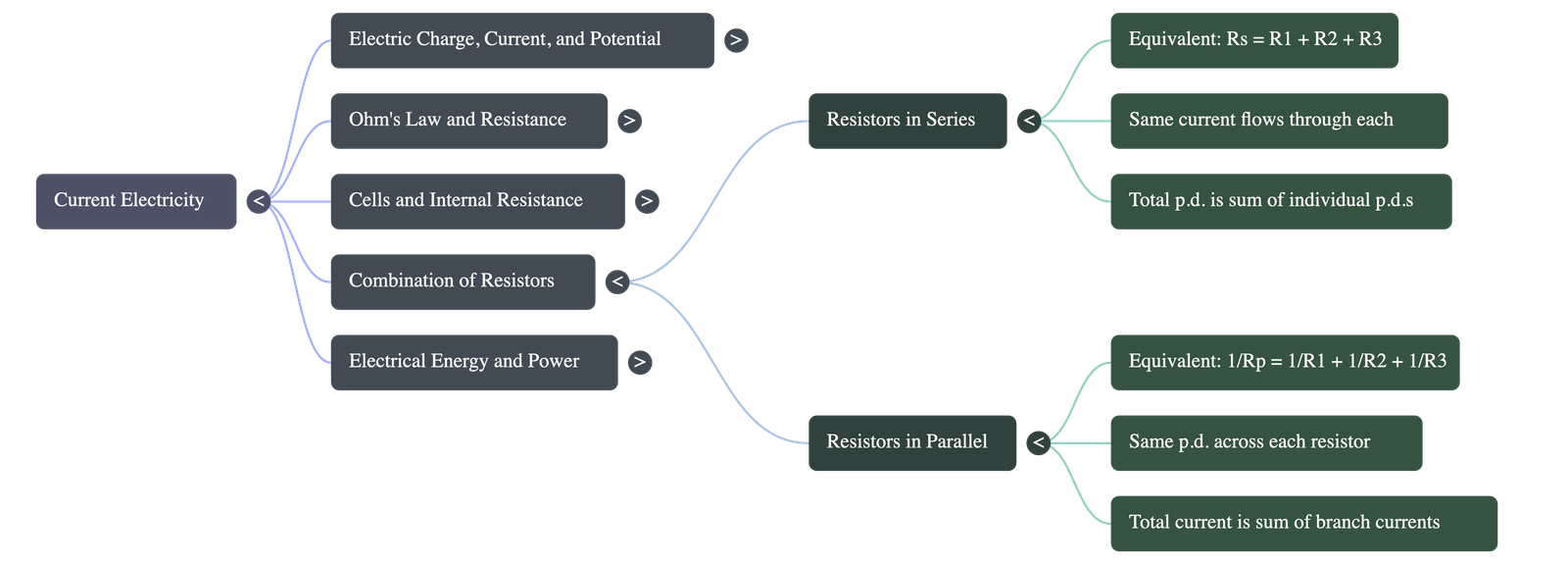
- Series Combination: Resistors connected end-to-end.
- Current (I) remains exactly the same through each resistor.
- Potential difference divides: V = V1 + V2 + V3...
- Equivalent Resistance: Rs = R1 + R2 + R3...
- Equivalent resistance is greater than the greatest individual resistance.
- Parallel Combination: One end of all resistors connects to one common point, the other ends to another common point.
- Potential difference (V) remains exactly the same across each resistor.
- Current divides: I = I1 + I2 + I3... (Inversely proportional to resistance).
- Equivalent Resistance: 1/Rp = 1/R1 + 1/R2 + 1/R3...
- Equivalent resistance is lesser than the smallest individual resistance.
Part C: Electrical Energy and Power
8.16 Electrical Energy
- Concept: Energy can be transformed but not created or destroyed. Electrical energy gets converted into heat (heater, bulb), mechanical (fan, motor), sound (loudspeaker), chemical (battery charging), and magnetic energy.
8.17 Measurement of Electrical Energy
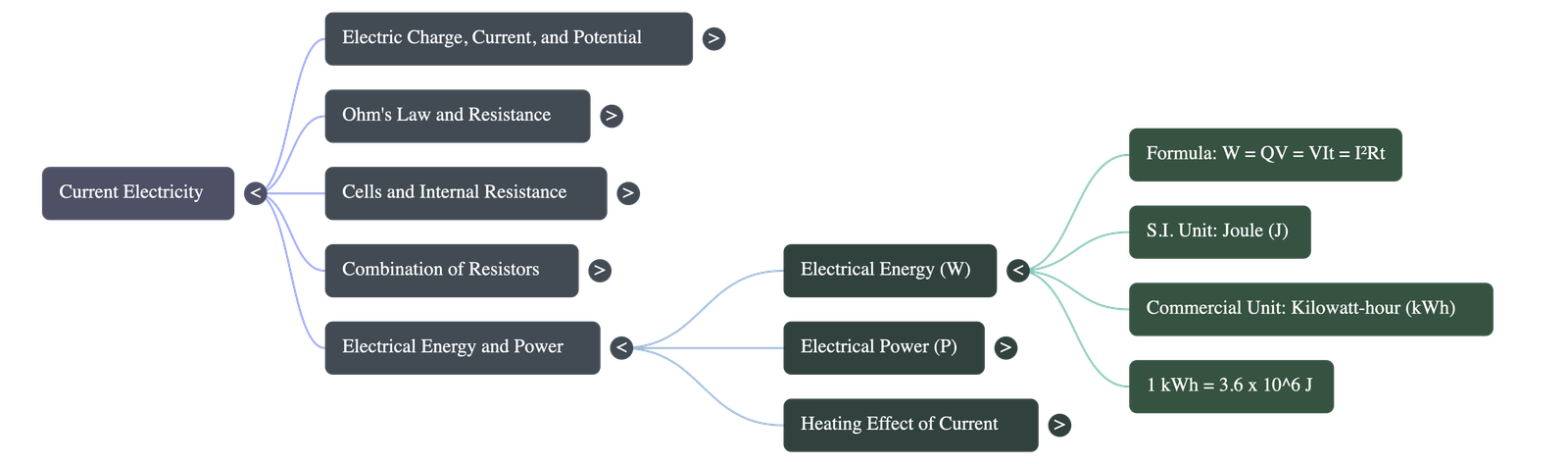
- Formulas: Work done (W) = QV = VIt = I²Rt = (V²/R)t.
- Unit: S.I. unit of electrical energy is the Joule (J).
8.18 Electrical Power and its Expressions
- Definition: Rate at which electrical energy is supplied by the source. Power = Energy / Time.
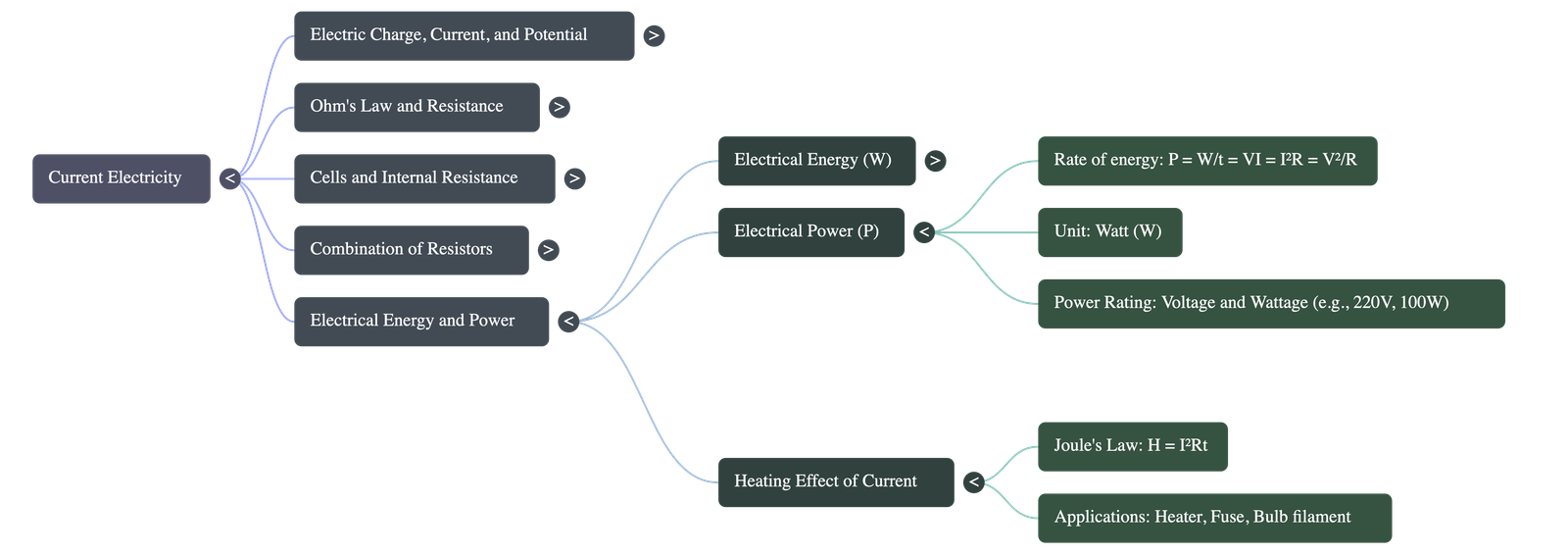
- Formulas: P = VI = I²R = V²/R.
- Unit: S.I. unit is the Watt (W). 1 W = 1 J/s = 1 Volt × 1 Ampere. Larger units include kilowatt (kW) and megawatt (MW).
8.19 Commercial Unit of Electrical Energy
- Kilowatt-hour (kWh): The energy consumed by an appliance of power 1 kilowatt when used for 1 hour.
- Conversion: 1 kWh = 3.6 × 10⁶ Joules. Often referred to simply as "1 unit" of electricity in meter readings.
8.20 Power Rating of Common Electrical Appliances
- Meaning: Appliances are labeled with power and voltage (e.g., 100 W, 220 V). It means if it's operated at 220V, it consumes 100 J of energy every second.
- Calculations from Rating:
- Resistance of the appliance: R = V² / P.
- Safe limit of current: I = P / V. If current exceeds this, the appliance may be damaged (e.g., bulb fusing).
8.21 Household Consumption of Electrical Energy
- Calculating Units: Energy (in kWh) = Power (in kW) × Time (in hours), or (V × I × t) / 1000.
- Cost: Total electrical cost = Total Energy in kWh × cost per kWh unit. For multiple appliances, you sum up their individual (kW × h) consumption.
8.22 Heating Effect of Current
- Joule's Law of Heating: The heat produced in a wire depends on:
- Amount of current: Directly proportional to the square of current (H ∝ I²).
- Resistance: Directly proportional to the resistance (H ∝ R).
- Time: Directly proportional to the time current flows (H ∝ t).
- Formula: H = I²Rt in joules. To express it in calories, use H = 0.24 I²Rt (since 1 calorie ≈ 4.18 Joules).
"Master these fundamentals of electricity, practice the formulas, and you will be ready to solve any circuit problem that comes your way. Happy studying!"
- Your Physics Teacher
- Your Physics Teacher
Do checkout all questions & answers of this chapter.
Quick Navigation:
| | | |
1 / 1
Quick Navigation:
| | | |