Quick Navigation:
| | | |
Spectrum
Chapter Overview: This chapter covers the behavior of light when passing through a prism, the formation of the visible and invisible electromagnetic spectrum, and the various natural phenomena caused by the scattering of light.
(A) Deviation, Dispersion and Spectrum
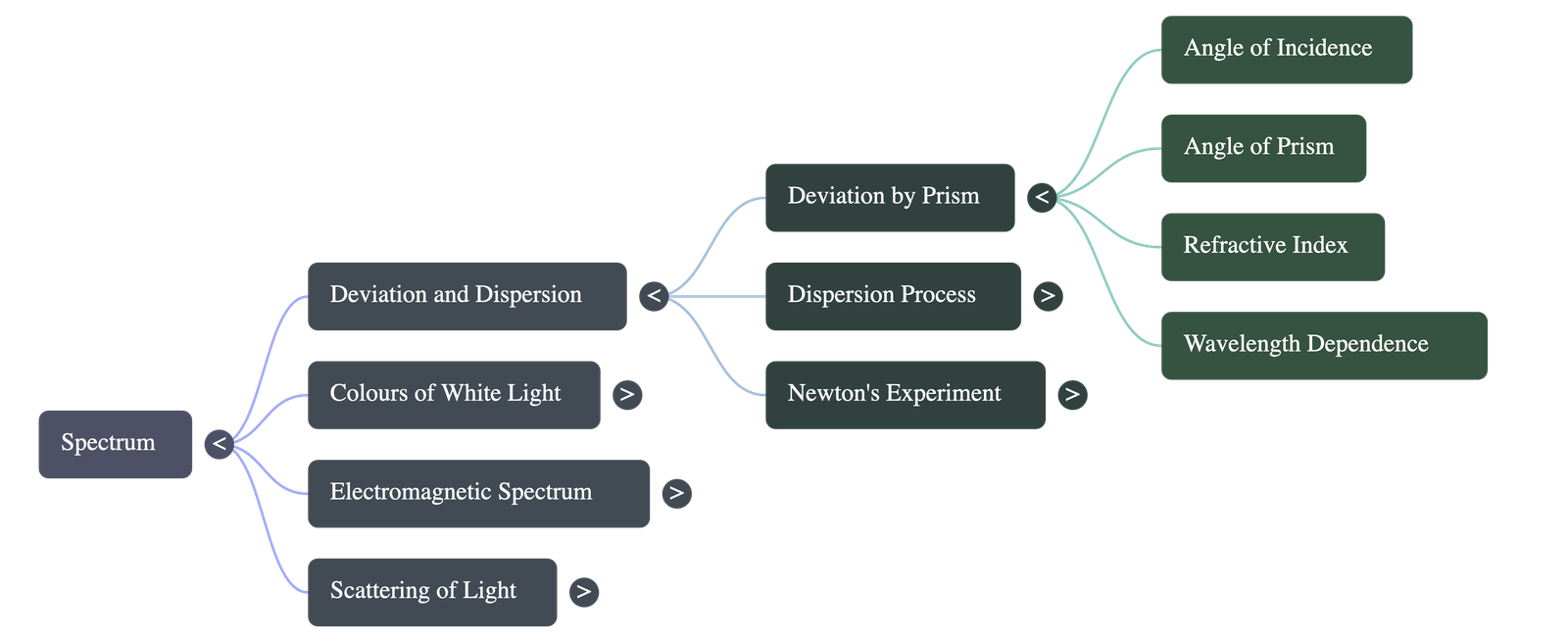
1. Deviation Produced by a Triangular Prism
- When a ray of single-color light enters a prism, it suffers deviation twice: first towards the base when entering the prism, and again towards the base when emerging into the air.
- Factors affecting deviation: The total angle of deviation depends on three factors:
- The angle of incidence at the first surface.
- The angle of the prism.
- The refractive index of the material of the prism.
- Dependence on Color/Wavelength: The speed of light of all colors is the same in air (or vacuum) but different in a medium like glass. In glass, red light travels the fastest and violet light travels the slowest.
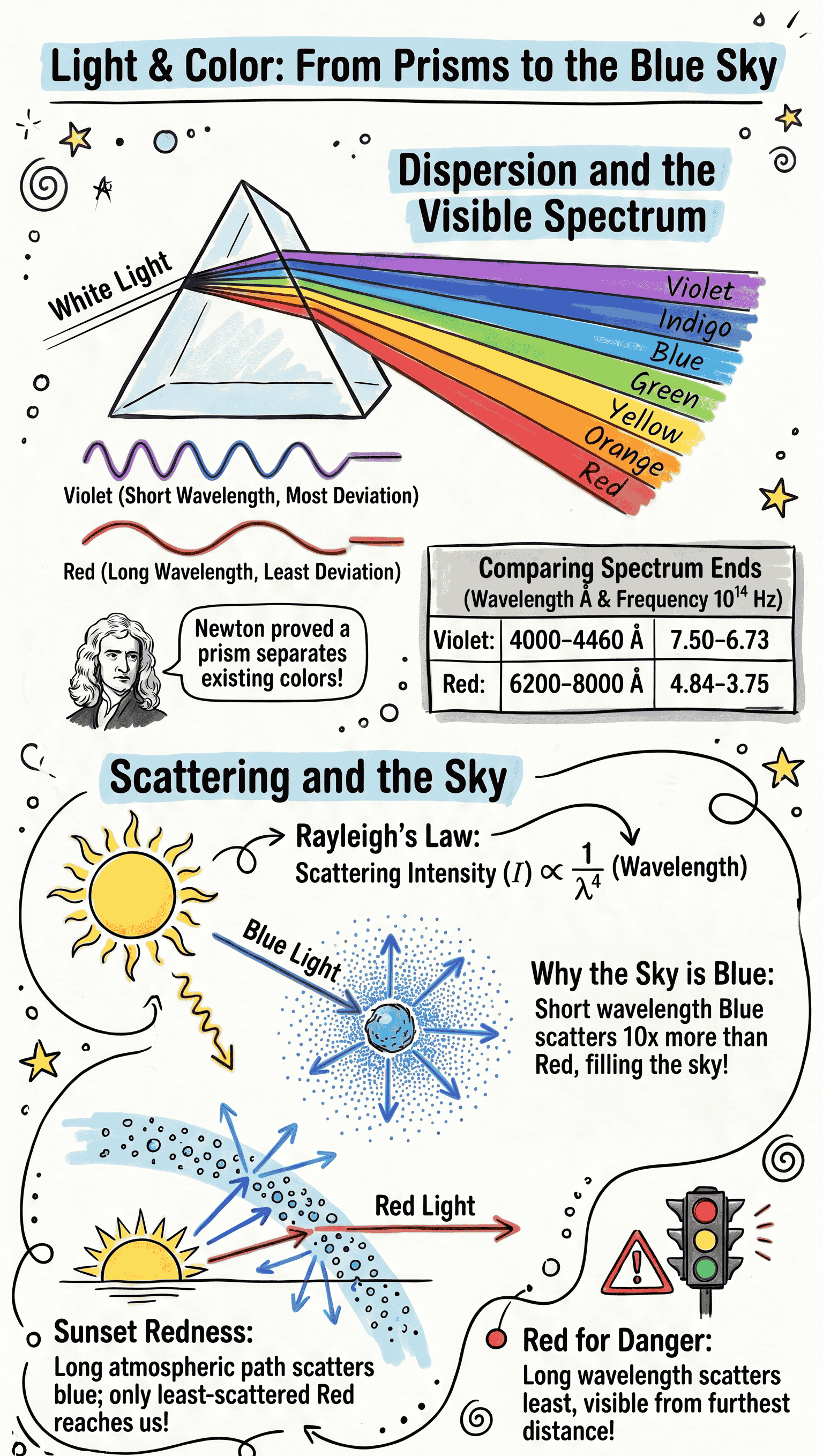
- Therefore, the refractive index of glass is minimum for red light and maximum for violet light. As a result, a prism deviates violet light the most and red light the least.
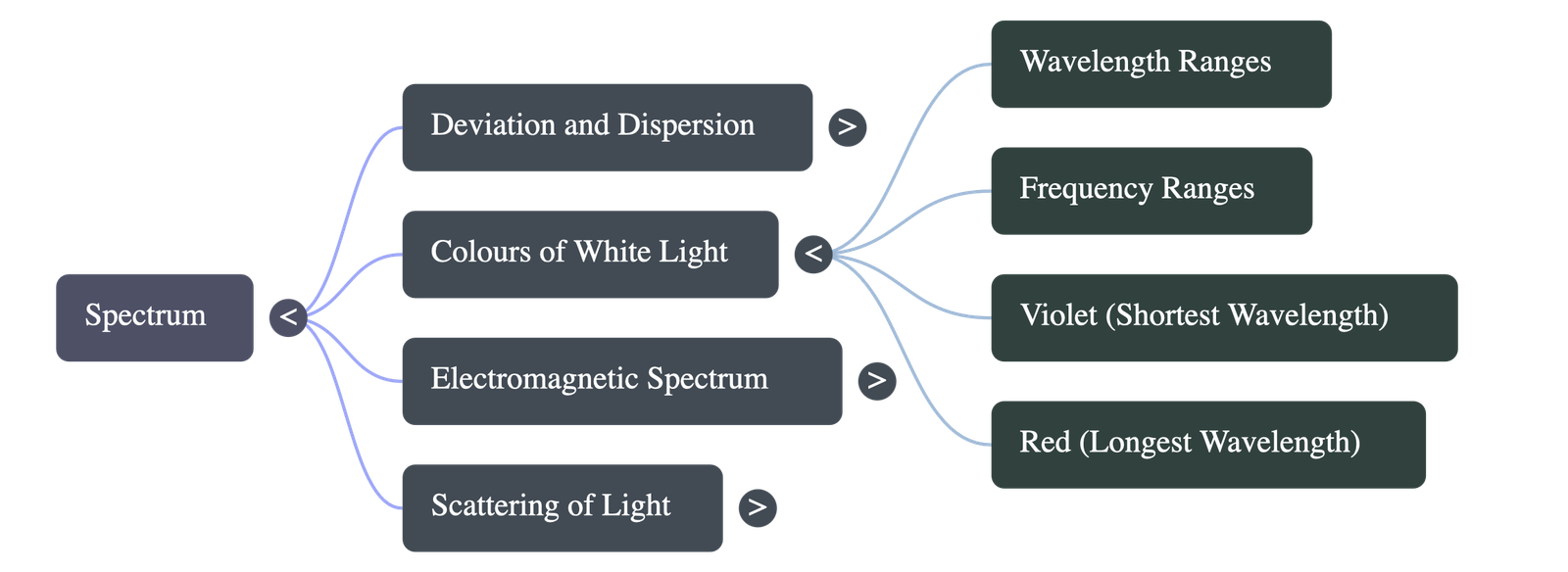
2. Colours in White Light: Wavelength and Frequency Range
- White light is a mixture of several colors. The sensation of different colors is produced by light of different wavelengths.
- Wavelength is the characteristic property of color.
- In the visible spectrum, the prominent colors are Violet, Indigo, Blue, Green, Yellow, Orange, and Red (VIBGYOR).
- Violet has the shortest wavelength (approx. 4000 Å or 400 nm) and the highest frequency.
- Red has the longest wavelength (approx. 8000 Å or 800 nm) and the lowest frequency.
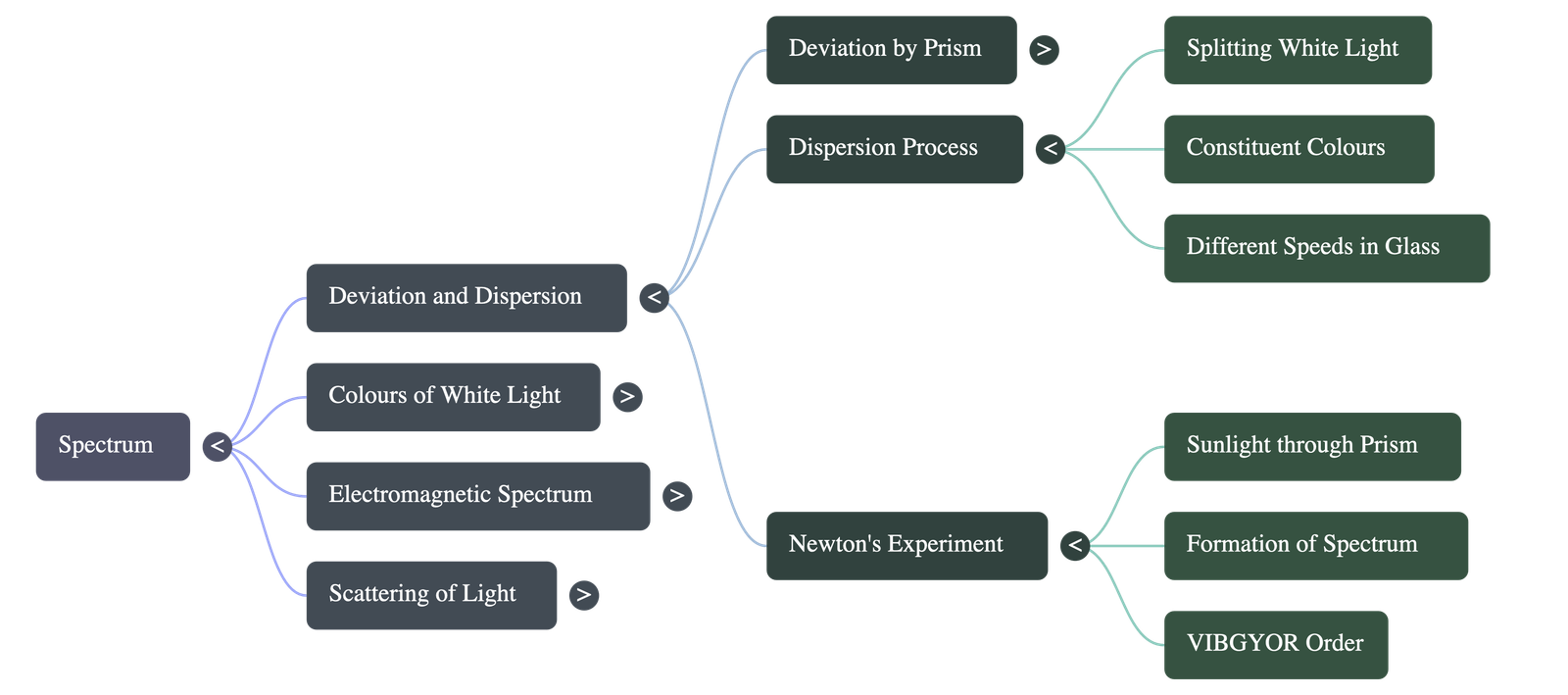
3. Dispersion of White Light and Spectrum Formation
- Dispersion: The phenomenon of splitting white light into its constituent colors on passing through a prism is called dispersion.
- Spectrum: The band of colors seen on a screen after white light passes through a prism is known as a spectrum.
- Newton’s Experiment: Sir Isaac Newton passed sunlight through a small aperture and a glass prism to obtain a colored patch on a screen. He concluded that white light is polychromatic (a mixture of many colors).
- Cause of Dispersion: Lights of different colors travel at different speeds in glass. Thus, they deviate by different angles at the first surface of the prism (where splitting actually occurs). The second surface only refracts the separated rays further, spreading them wider onto the screen.
(B) Electromagnetic Spectrum and Its Broad Classification
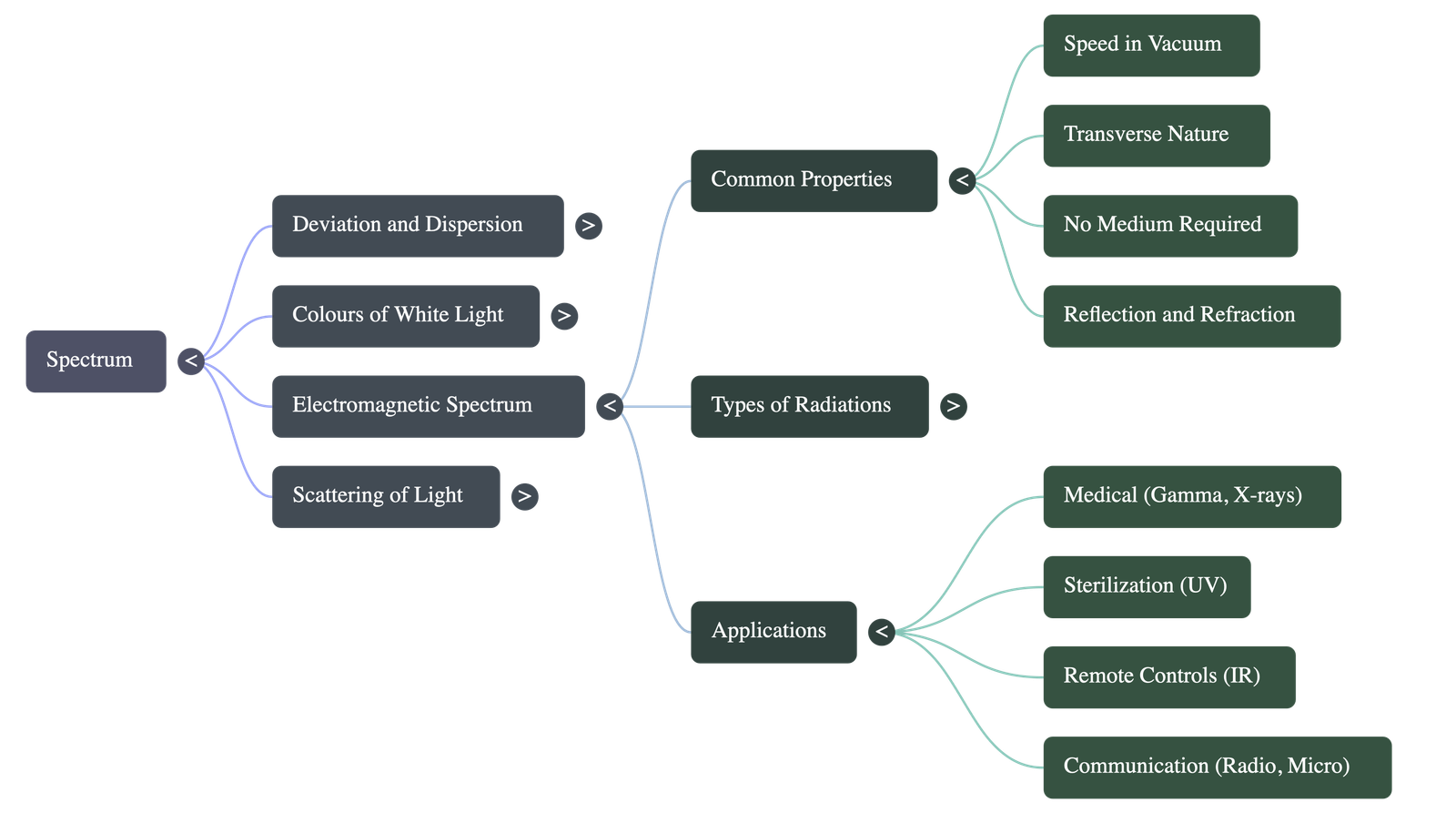
1. The Electromagnetic Spectrum
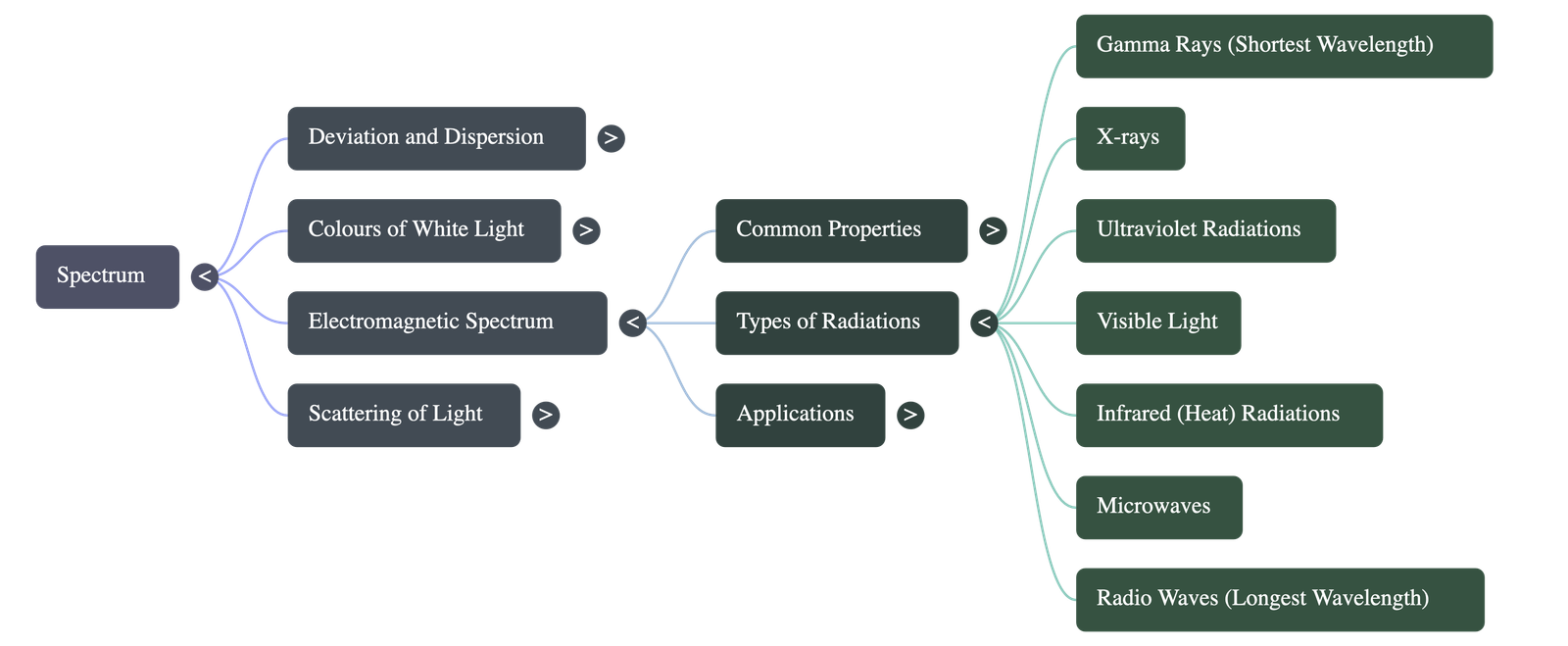
- The visible spectrum is just a small part of a much broader range of radiations called the electromagnetic spectrum.
- The portions beyond red (infrared, microwaves, radio waves) and beyond violet (ultraviolet, X-rays, gamma rays) are invisible to the human eye.
- The complete spectrum arranged in increasing order of wavelength is: Gamma Rays, X-Rays, Ultraviolet, Visible Light, Infrared, Microwaves, and Radio Waves.
2. Properties Common to All Electromagnetic Waves
- They do not require any material medium for propagation.
- They all travel with the same speed in vacuum or air (3 × 10⁸ m/s).
- They exhibit properties of reflection and refraction.
- They are transverse in nature and are not deflected by electric or magnetic fields.
3. Specific Properties and Uses of Radiations
- Gamma Rays:
- Most energetic; highly penetrating.
- Used in medical science to kill cancer cells (radiotherapy) and in industry to check welding.
- X-Rays:
- Obtained when high-energy electron beams strike a heavy metal target.
- Used in radiography to detect bone fractures, in CAT scans, and to study atomic arrangements in crystals.
- Ultraviolet (UV) Radiations:
- Produced by the Sun, electric arcs, and mercury vapor lamps.
- They pass through quartz but are strongly absorbed by regular glass (which is why UV prisms are made of quartz).
- They are chemically very active, affect photographic plates strongly, and cause fluorescence on zinc-sulphide screens.
- Detection: Turns silver chloride solution from white to violet, then dark brown/black.
- Uses: Sterilizing air/surgical equipment, detecting purity of gems/eggs, and naturally producing Vitamin D in plants/animals.
- Harmful Effects: Prolonged exposure causes health hazards like skin cancer. The ozone layer protects us from most solar UV rays.
- Visible Light:
- Wavelengths from 4000 Å to 8000 Å. Essential for vision, photography, and photosynthesis.
- Infrared (IR) Radiations:
- Obtained from all red-hot bodies (like fire, heated iron, the Sun).
- They produce a strong heating effect and do not affect ordinary photographic film.
- Absorbed by glass but pass through rock-salt (thus, rock-salt prisms are used to obtain IR spectra).
- Detection: By a thermometer with a blackened bulb (shows a rapid temperature rise) or a thermopile.
- Uses: Because they scatter very little due to their long wavelength, they can penetrate deep fog and mist. Used in night-vision photography, darkrooms, TV remote controls, and therapeutic heating.
- Harmful Effects: High doses can cause severe skin burns.
- Microwaves & Radio Waves:
- Microwaves: Used for satellite communication, radar, and microwave cooking.
- Radio Waves: Longest wavelengths, used heavily in radio and television transmission.
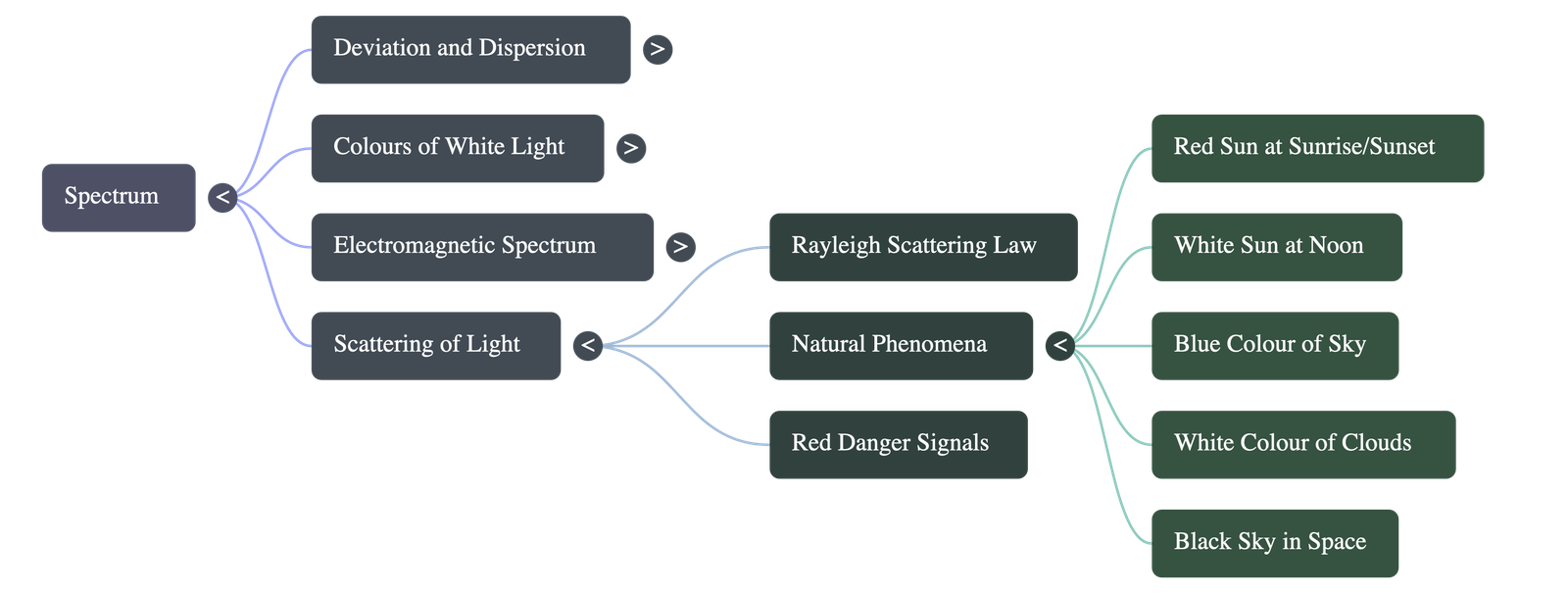
(C) Scattering of Light and Its Applications
1. Concept of Scattering
- Definition: Scattering is the process of absorption and subsequent re-emission of light energy by dust particles and air molecules present in the atmosphere.
- Rayleigh’s Law of Scattering: The intensity of scattered light (I) is inversely proportional to the fourth power of its wavelength (λ).
Formula: I ∝ 1 / λ⁴ - Because violet and blue light have the shortest wavelengths, they are scattered the most. Red light has the longest wavelength and is scattered the least.
2. Natural Phenomena Based on Scattering
- Red Colour of the Sun at Sunrise and Sunset:
During sunrise and sunset, light from the Sun travels the longest distance through the Earth's atmosphere. Short-wavelength blue light gets scattered away. The longer-wavelength red light is scattered the least and reaches our eyes, making the Sun appear red. - White Colour of the Sky at Noon:
At noon, the Sun is directly overhead and light travels the shortest distance through the atmosphere. All colors scatter very little, reaching our eyes together, making the Sun and sky appear white. - Blue Colour of the Sky:
As sunlight travels through the atmosphere, air molecules scatter the shorter wavelengths (blue and violet) much more strongly than red light. The scattered blue light reaches our eyes from all directions, causing the sky to appear blue. - Black Colour of the Sky in the Absence of Atmosphere:
If the Earth had no atmosphere (or to an astronaut in space/on the Moon), there are no particles to scatter sunlight. Consequently, no scattered light reaches the eyes from other parts of the sky, making it appear entirely black. - White Colour of Clouds:
Clouds consist of large dust particles and water droplets that are much bigger than the wavelength of visible light. These large particles scatter all wavelengths of incident white light equally. As a result, the scattered light merging together appears white. - Use of Red Light for Danger Signals:
Since red light has the longest wavelength in the visible spectrum, it is scattered the least by air molecules, fog, or smoke. This allows red signals to penetrate far distances and remain visible without weakening, making it ideal for danger warnings.
Do checkout all questions & answers of this chapter.
Quick Navigation:
| | | |
1 / 1
Quick Navigation:
| | | |