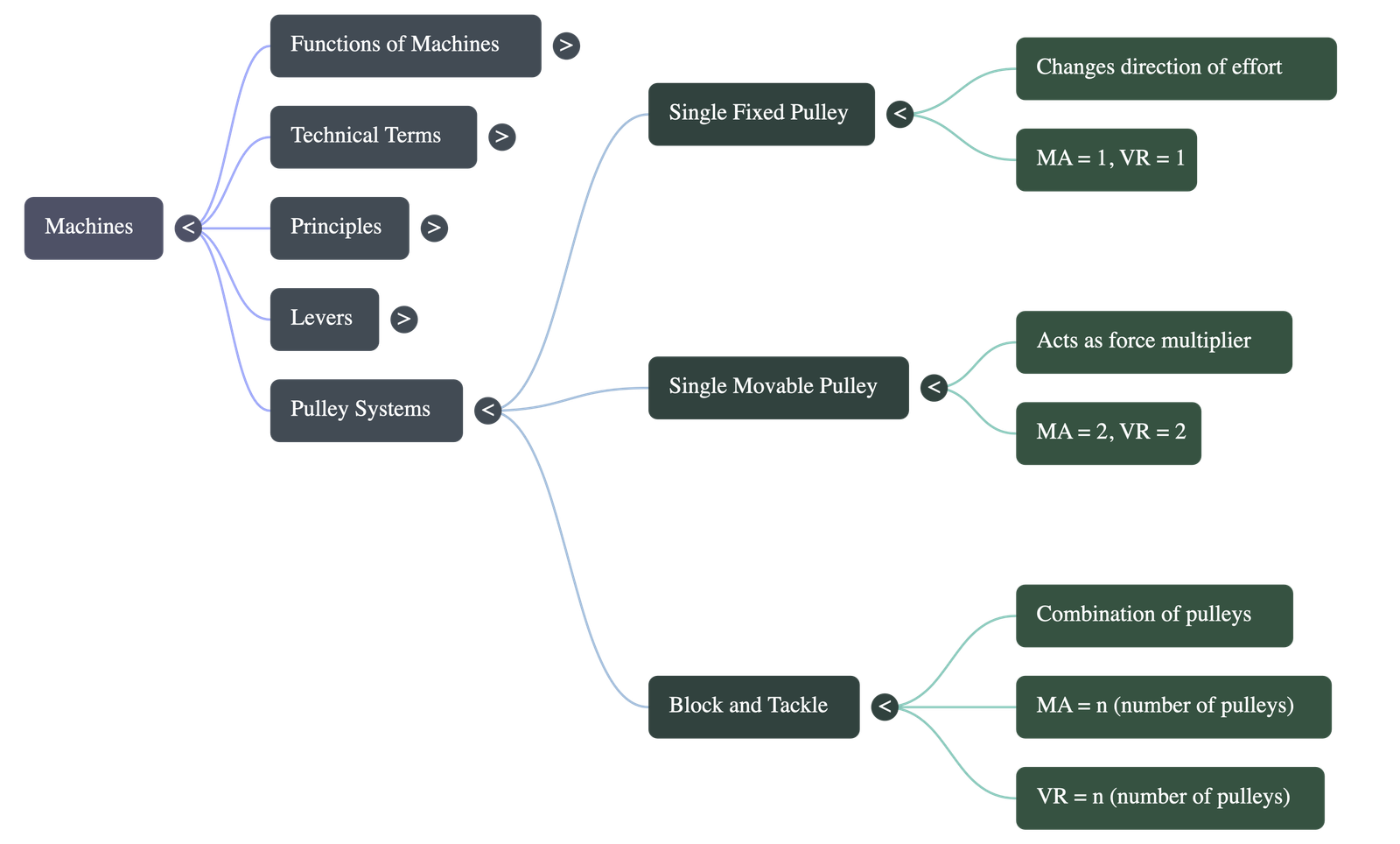
Quick Navigation:
| | | |
Machines
A Comprehensive Summary for Class 10 Physics Students
3.1 Machines
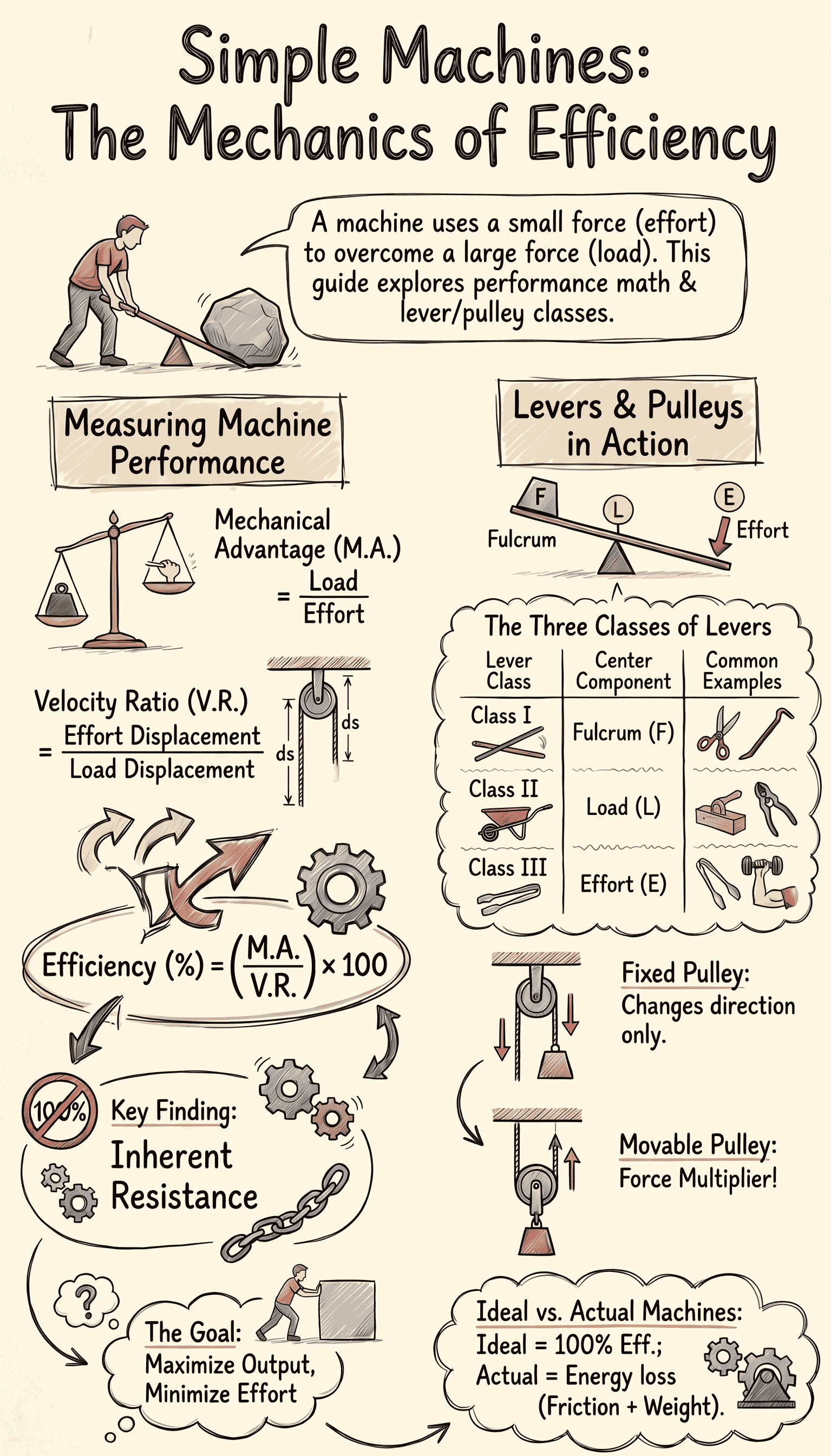
- Definition: A machine is a device by which we can either obtain a gain in speed or overcome a large resistive force (load) at some point by applying a small force (effort) at a convenient point and in a desired direction.
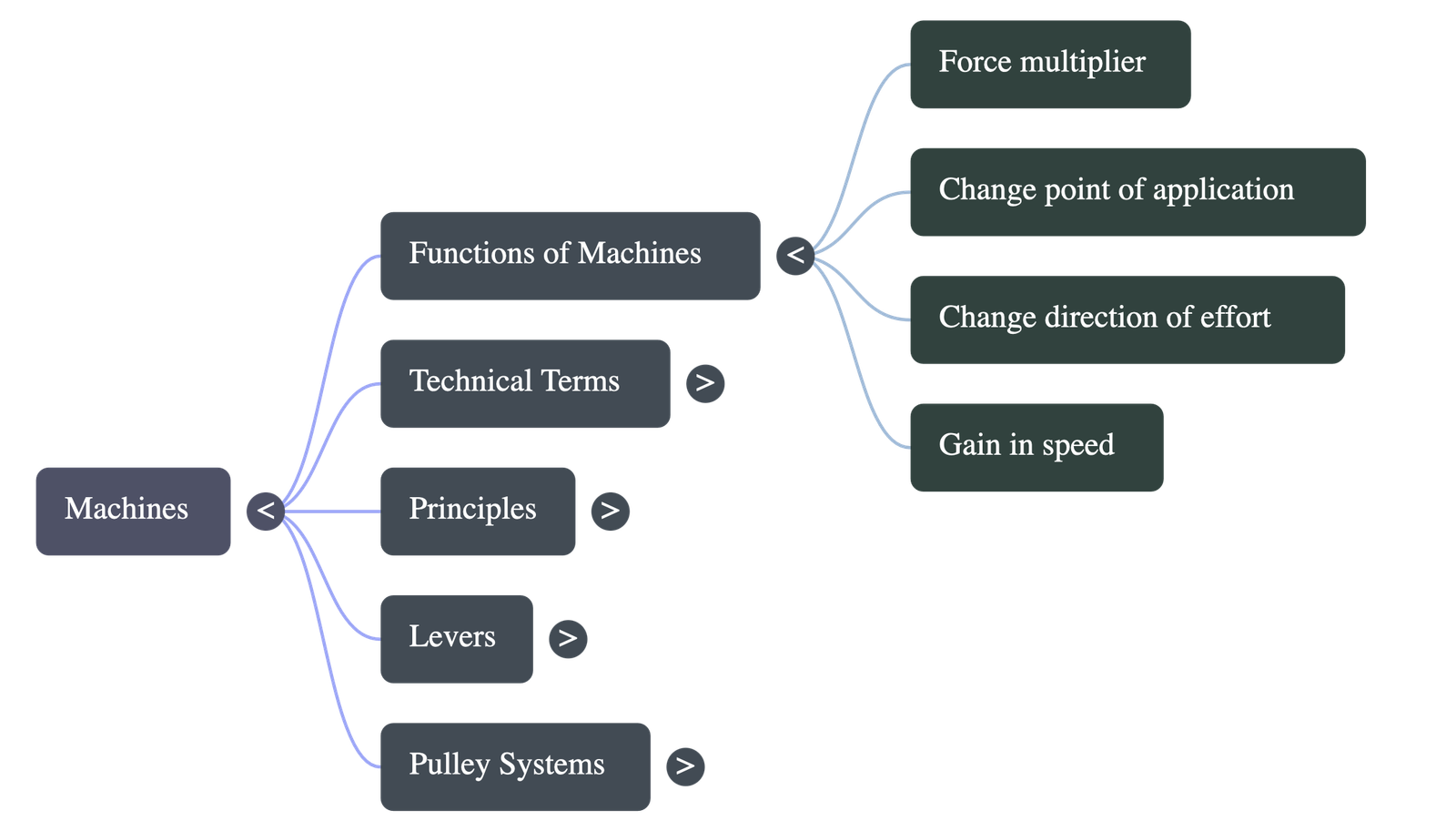
- Four Main Functions:
- As a force multiplier: Lifting a heavy load with less effort (e.g., using a jack to lift a car or a crowbar to shift a heavy stone).
- Changing the point of application of effort: Applying effort at a more convenient point (e.g., rotating the rear wheel of a cycle by applying effort to the pedals).
- Changing the direction of effort: Making the effort application more convenient (e.g., using a single fixed pulley to pull water from a well downwards rather than lifting upwards).
- Obtaining a gain in speed: Achieving a greater movement of load by a smaller movement of effort (e.g., the blades of a pair of scissors move more than its handles).
- Note: A machine cannot act as both a force multiplier and a speed multiplier simultaneously.
3.2 Technical Terms Related to a Machine
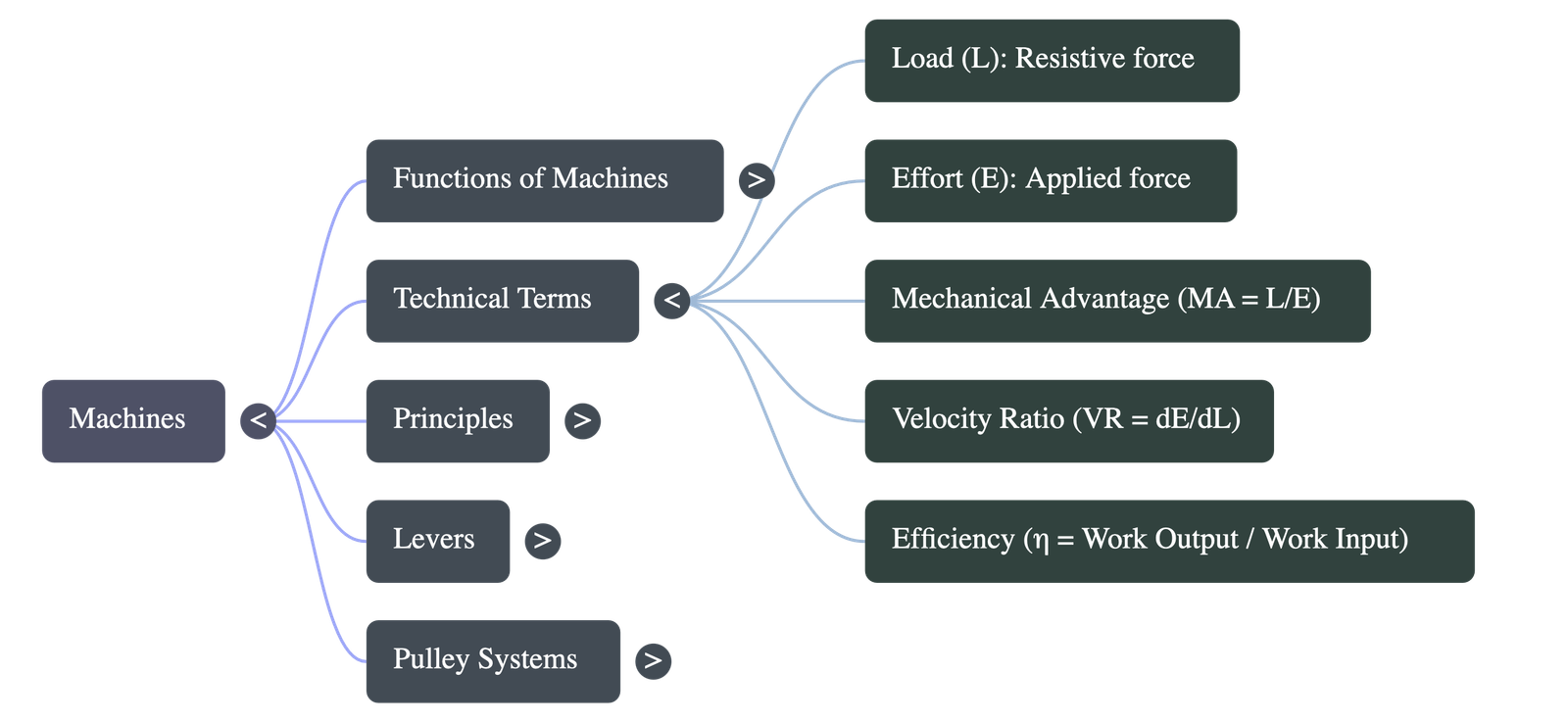
- Load (L): The resistive or opposing force that the machine needs to overcome.
- Effort (E): The external force applied to the machine to overcome the load.
- Mechanical Advantage (M.A.): The ratio of load to effort (M.A. = Load / Effort). It is a pure ratio and has no unit.
- If M.A. > 1: Machine is a force multiplier.
- If M.A. < 1: Machine gives a gain in speed.
- If M.A. = 1: Machine is used to change the direction of effort.
- Velocity Ratio (V.R.): The ratio of the velocity of effort to the velocity of load. Also defined as the ratio of displacement of effort to displacement of load (V.R. = Velocity of effort / Velocity of load = Displacement of effort / Displacement of load). It also has no unit.
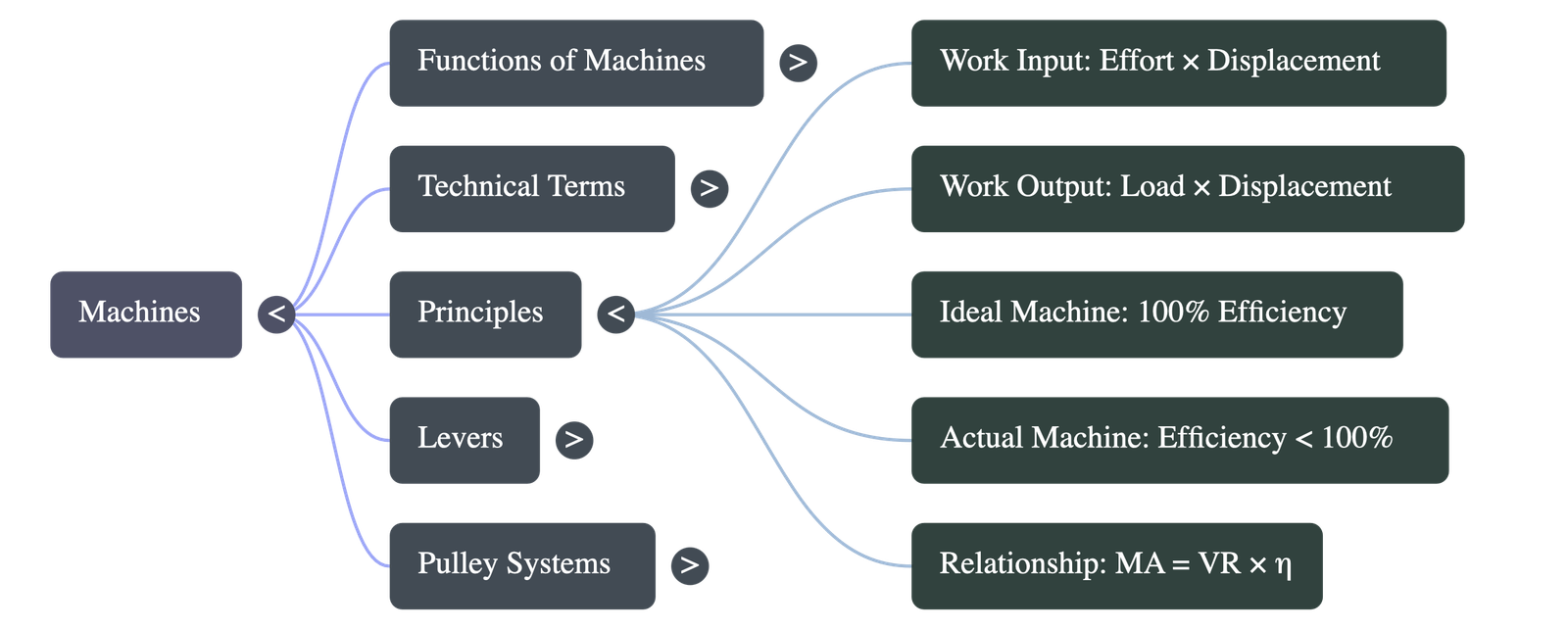
- Work Input: The work done on the machine by the effort (Work Input = Effort × displacement of effort).
- Work Output: The work done by the machine on the load (Work Output = Load × displacement of load).
- Efficiency (η): The ratio of useful work done by the machine (output) to the total work put into the machine (input). It is generally expressed as a percentage. Efficiency has no unit.
3.3 Principle of a Machine
- When effort is applied, the point of application is the effort point, and where energy is obtained is the load point.
- Ideal Machine: A machine with no loss of energy. Work output equals work input, meaning its efficiency is 100%.
- Actual Machine: Work output is always less than work input (efficiency < 100%). Energy loss occurs because:
- Moving parts are not perfectly smooth (friction).
- Strings used are not perfectly elastic.
- Different parts of the machine are not perfectly rigid.
- The most prominent energy loss is overcoming friction, which appears as heat.
3.4 Relationship between Efficiency, M.A., and V.R.
- By taking the definition of efficiency (Work Output / Work Input) and expanding it using M.A. and V.R., we get a fundamental formula: Mechanical Advantage (M.A.) = Velocity Ratio (V.R.) × Efficiency (η)
- For an ideal machine, η = 1, therefore M.A. = V.R. In practical machines, due to friction, η < 1, which means M.A. is always less than V.R. The velocity ratio generally remains constant for a specific design, but M.A. decreases due to friction.
3.5 Levers
- Definition: A rigid, straight or bent bar which is capable of turning about a fixed axis called the fulcrum (F).
- Arms: The distance from fulcrum to effort is the effort arm. The distance from fulcrum to load is the load arm.
- Principle of a Lever: Based on the principle of moments. In equilibrium, Clockwise moment of load = Anticlockwise moment of effort. Therefore: Load × Load Arm = Effort × Effort Arm.
M.A. of a lever = Effort Arm / Load Arm
3.6 Kinds of Levers
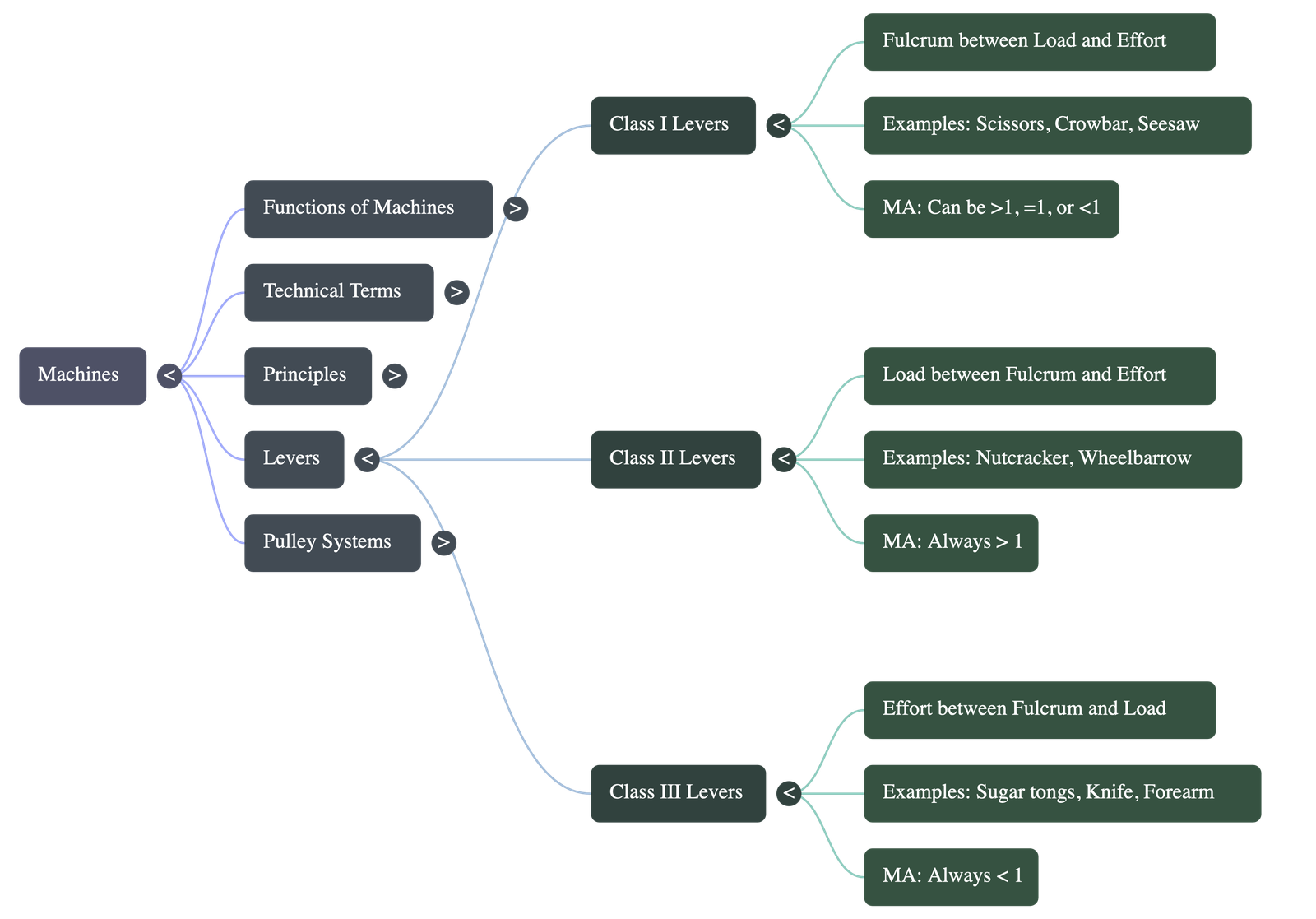
- (1) Class I Levers:
- Position: The Fulcrum (F) is in between the Effort (E) and Load (L).
- Properties: M.A. and V.R. can be greater than 1, equal to 1, or less than 1, depending on the length of the effort arm compared to the load arm.
- Examples: Seesaw, pair of scissors, crowbar, claw hammer, pliers, water pump handle.
- (2) Class II Levers:
- Position: The Load (L) is in between the Fulcrum (F) and Effort (E).
- Properties: The effort arm is always longer than the load arm. Hence, M.A. and V.R. are always greater than 1. These levers always act as force multipliers.
- Examples: Nut cracker, wheel barrow, bottle opener, lemon crusher, paper cutter.
- (3) Class III Levers:
- Position: The Effort (E) is in between the Fulcrum (F) and Load (L).
- Properties: The effort arm is always shorter than the load arm. Hence, M.A. and V.R. are always less than 1. These levers are used to obtain a gain in speed.
- Examples: Sugar tongs, foot treadle, knife, fishing rod, a spade used to lift soil.
3.7 Examples of Each Class of Levers as Found in the Human Body
- Class I: Nodding action of the head. (Spine acts as the fulcrum F, load L is at the front part, effort E is at the rear part).
- Class II: Raising the weight of the body on toes. (Fulcrum F is at the toes, load L is in the middle, and effort E is applied by muscles at the other end).
- Class III: Raising a load by the forearm. (Elbow joint acts as fulcrum F, biceps exert effort E in the middle, and load L is on the palm).
3.8 Pulley & 3.9 Single Fixed Pulley
- Pulley: A metallic or wooden disc with a grooved rim through which a string or rope is passed. It rotates about an axle.
- Single Fixed Pulley: A pulley whose axis of rotation remains stationary in position.
- Characteristics:
- Ideal M.A. = 1, V.R. = 1. Efficiency = 100%.
- In an actual setup, efficiency is less than 100% due to friction and the weight of the string.
- Purpose: It provides no mechanical advantage or gain in speed. Its sole purpose is to change the direction of effort to a more convenient downward direction (so one can even use their own body weight as effort).
3.10 A Single Movable Pulley
- Definition: A pulley whose axis of rotation is movable (not fixed in space). The load is attached to the axle of the pulley.
- Characteristics:
- Ideal M.A. = 2, V.R. = 2. Efficiency = 100%.
- It acts as a force multiplier (effort required is ideally half the load).
- In reality, actual M.A. is less than 2 due to friction and the weight of the pulley itself, reducing efficiency below 100%.
- With a Fixed Pulley: Because pulling upwards with a single movable pulley is inconvenient, it is almost always combined with a fixed pulley to change the direction of effort downward, maintaining the M.A. of 2.
3.11 Combination of Pulleys
To lift very heavy loads (requiring M.A. > 2), single movable pulleys are not enough. We use combinations in two common ways:
- (1) Using one fixed pulley and several movable pulleys:
- Each movable pulley uses a separate string.
- If there are n movable pulleys, V.R. = 2n and Ideal M.A. = 2n.
- (2) Block and Tackle System:
- Consists of two blocks of pulleys: an upper fixed block and a lower movable block. One continuous string is used.
- The number of pulleys in the lower block is equal to or one less than the upper block.
- If n is the total number of pulleys in both blocks, V.R. = n. The load is supported by n segments of the string.
- Ideal M.A. = n. Ideal Efficiency = 100%.
- Effect of Weight of Lower Block: In reality, the movable lower block has a weight (w). The M.A. becomes n - (w / Effort), and efficiency reduces to 1 - (w / nE).
- To maximize efficiency: The lower block should be as light as possible, and friction in the bearings must be minimized using lubricants. Pulleys are mere force multipliers; there is no gain in energy (Work input = Work output in ideal scenarios).
Prepared carefully for Class 10 Physics studies. Keep up the great work studying Machines!
Do checkout all questions & answers of this chapter.
Quick Navigation:
| | | |
1 / 1
Quick Navigation:
| | | |