Quick Navigation:
| | | |
Force
(A) Moment of a Force and Equilibrium
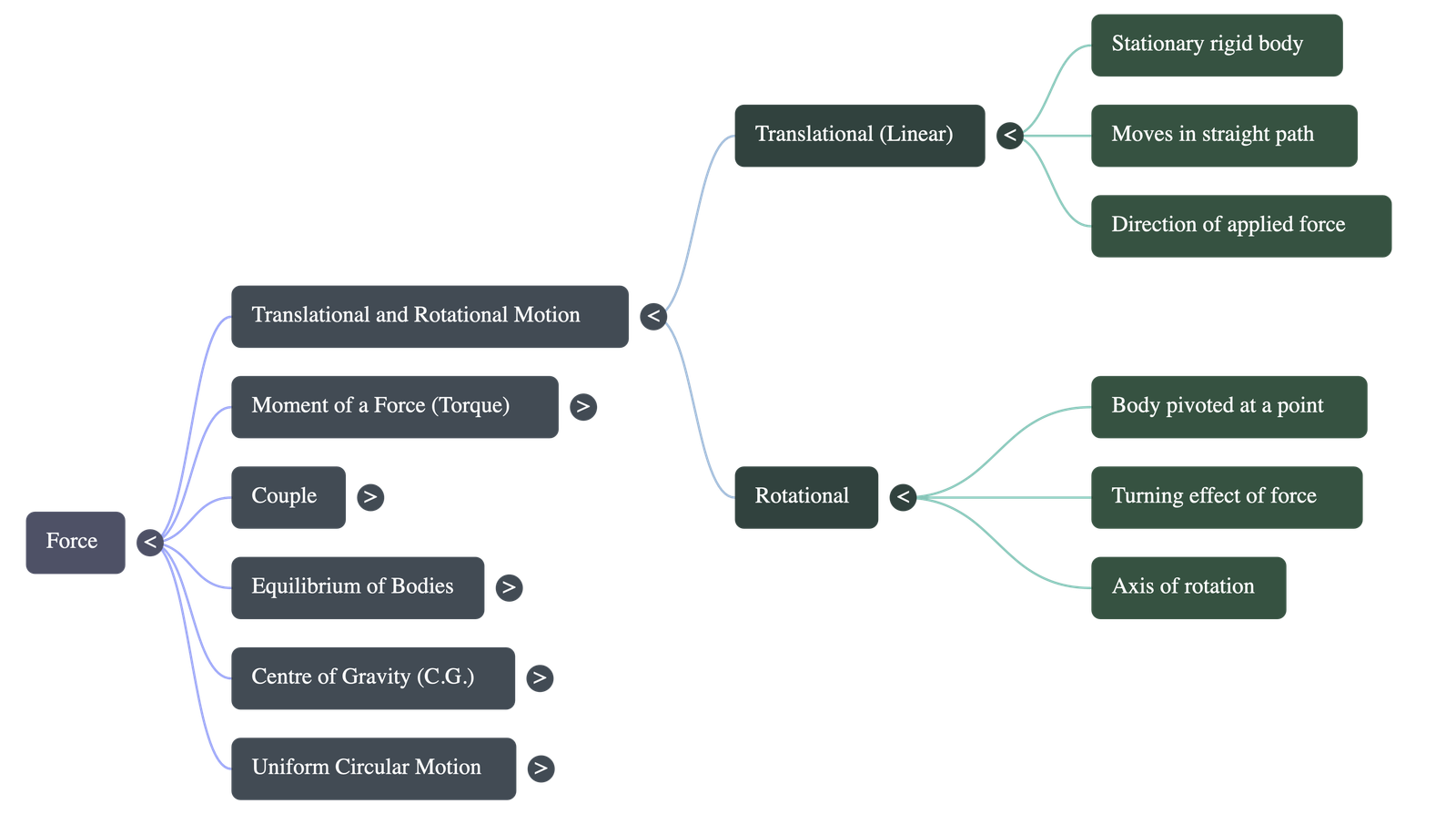
1.1 Translational and Rotational Motions
- Translational Motion: When a force acts on a stationary rigid body that is free to move, it moves in a straight line in the direction of the applied force.
- Rotational Motion: When a body is pivoted at a point and a force is applied at a suitable place, it rotates the body about the axis passing through the pivot.
1.2 Moment (Turning Effect) of a Force or Torque
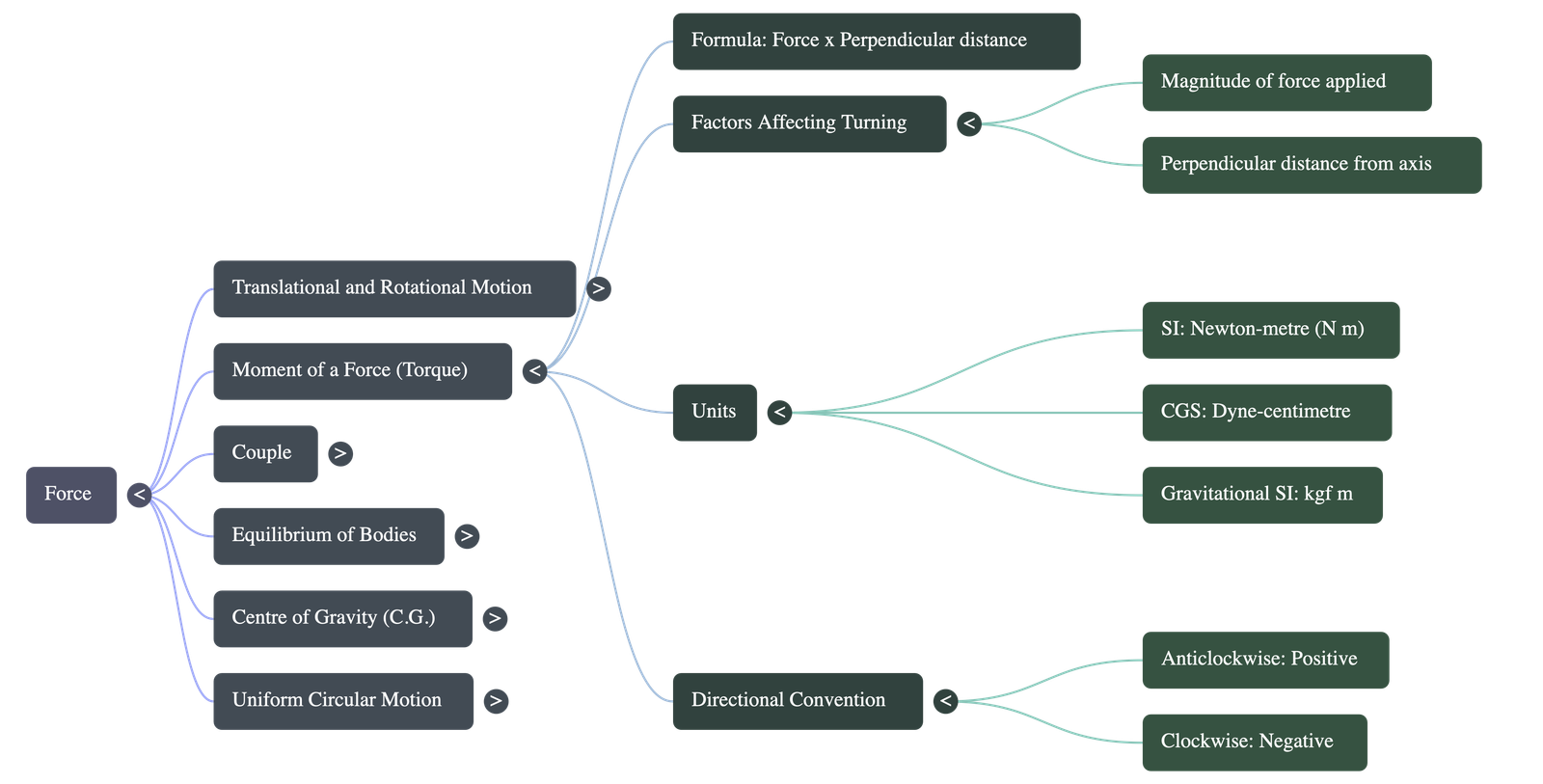
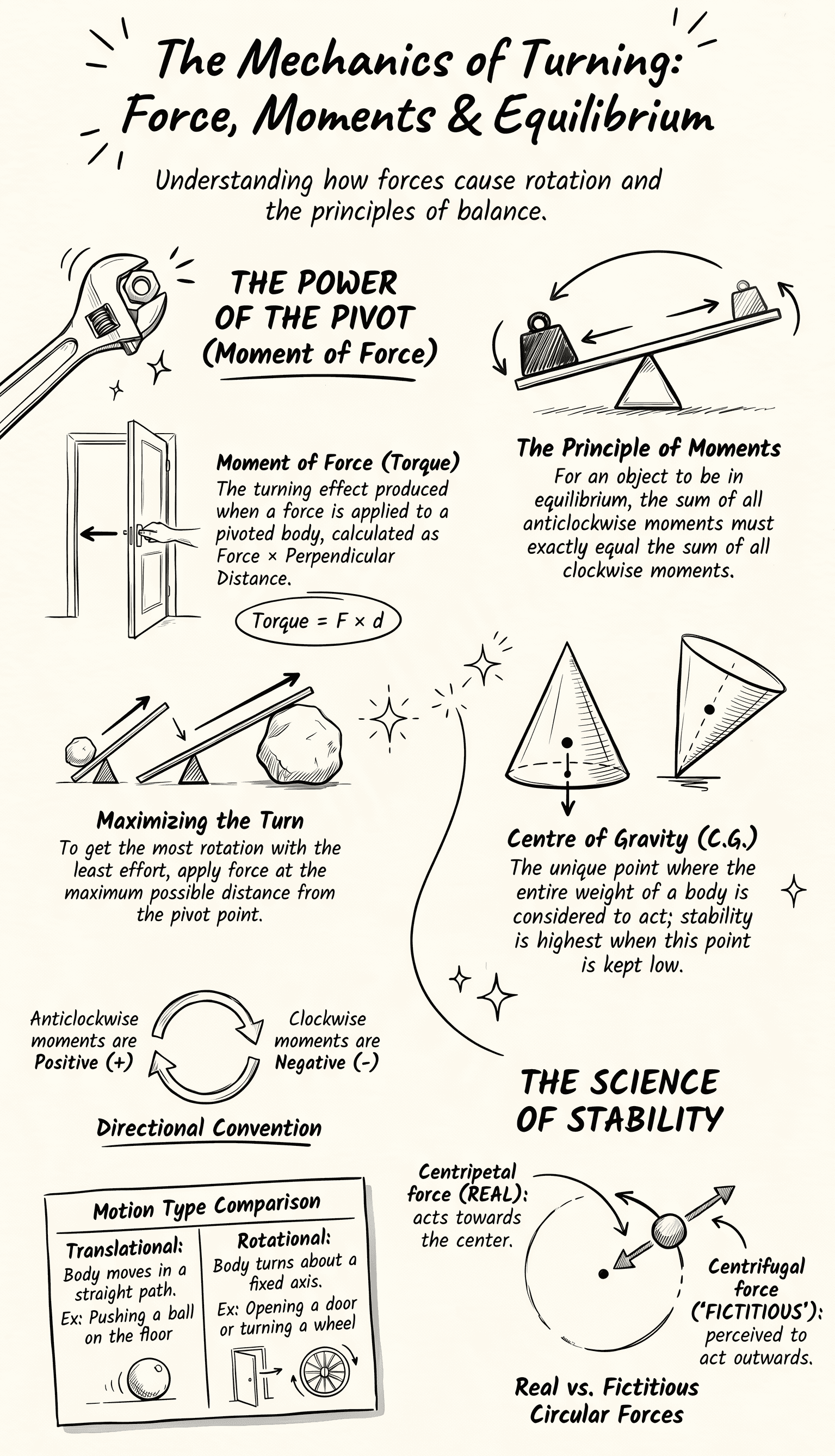
- Definition: The turning effect of a force on a body about an axis is called the moment of force or torque.
- Formula: It is equal to the product of the magnitude of the force and the perpendicular distance from the axis of rotation to the line of action of the force.
- Units: The S.I. unit is Newton-metre (N m). The C.G.S. unit is dyne cm.
- Direction: Anticlockwise moments are conventionally taken as positive, while clockwise moments are taken as negative.
- Examples: Opening a door requires less effort if the handle is placed near the free end (maximizing perpendicular distance). Other examples include turning a steering wheel or using a spanner to loosen a nut.
1.3 Couple
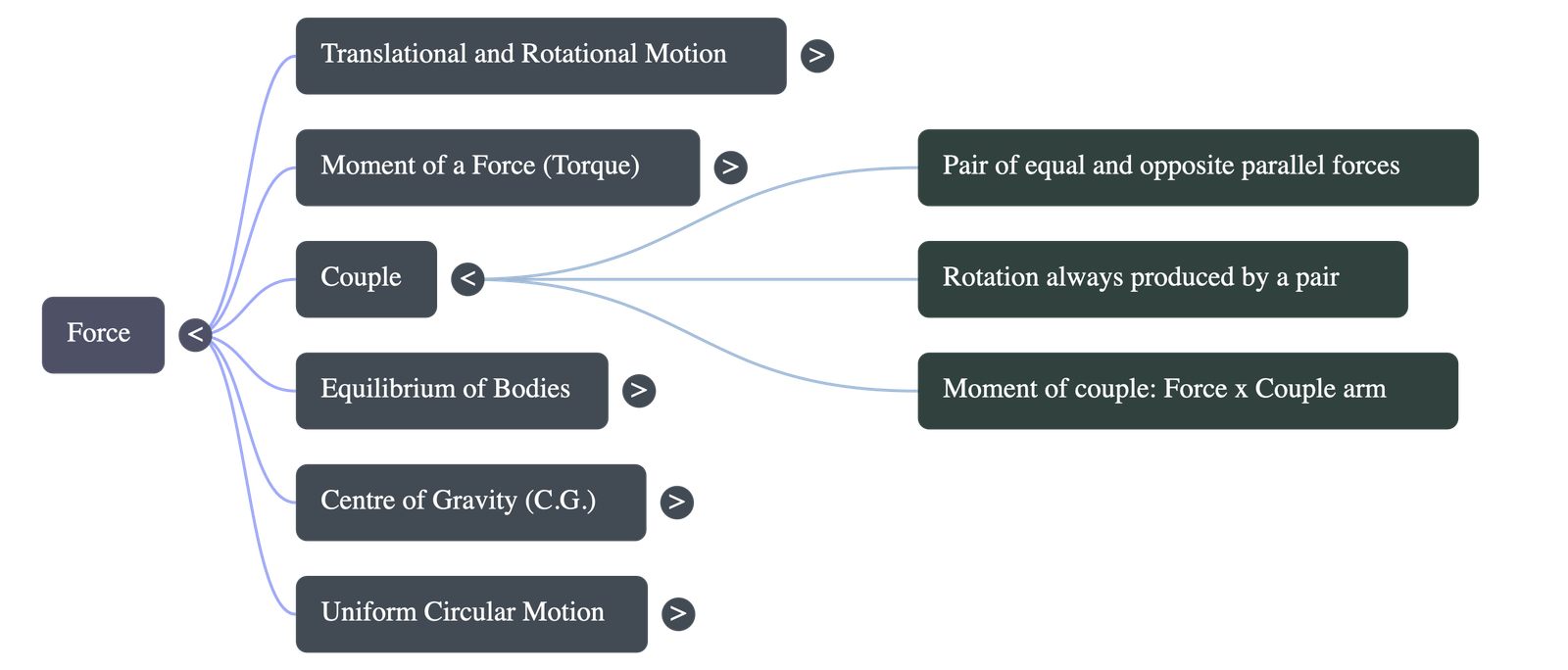
- A single force alone does not cause rotation; rotation is always produced by a pair of forces.
- Definition: Two equal and opposite parallel forces, not acting along the same line, form a couple.
- Moment of a Couple: Calculated as the product of either force and the perpendicular distance between the two forces (called the couple arm).
- Examples: Turning a water tap, tightening the cap of an inkpot, or winding a clock.
1.4 Equilibrium of Bodies
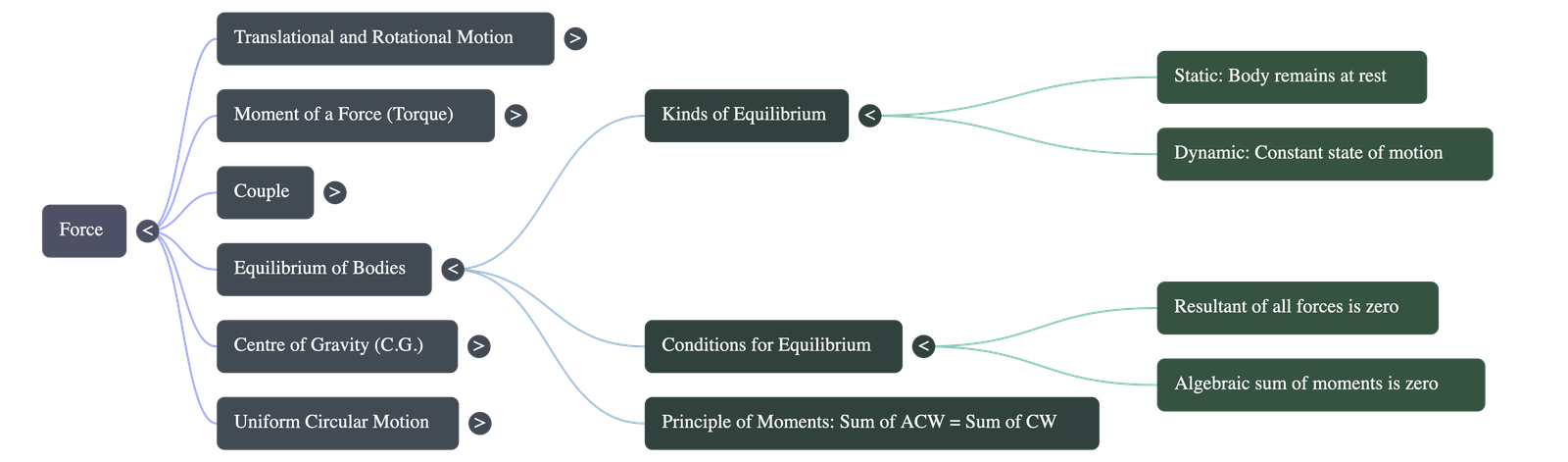
- When multiple forces act on a body but produce no change in its state of rest or motion, the body is in equilibrium.
- Conditions for Equilibrium: (i) The resultant of all forces must be zero. (ii) The algebraic sum of moments of all forces about the point of rotation must be zero.
- Static Equilibrium: The body remains in a state of rest (e.g., a book lying on a table).
- Dynamic Equilibrium: The body remains in the same state of motion (e.g., a raindrop falling with constant velocity).
1.5 Principle of Moments
- According to this principle, if a body is in equilibrium under the action of several forces, the algebraic sum of the clockwise moments equals the algebraic sum of the anticlockwise moments.
- A physical balance (beam balance) works based on the principle of moments.
(B) Centre of Gravity
1.6 Centre of Gravity
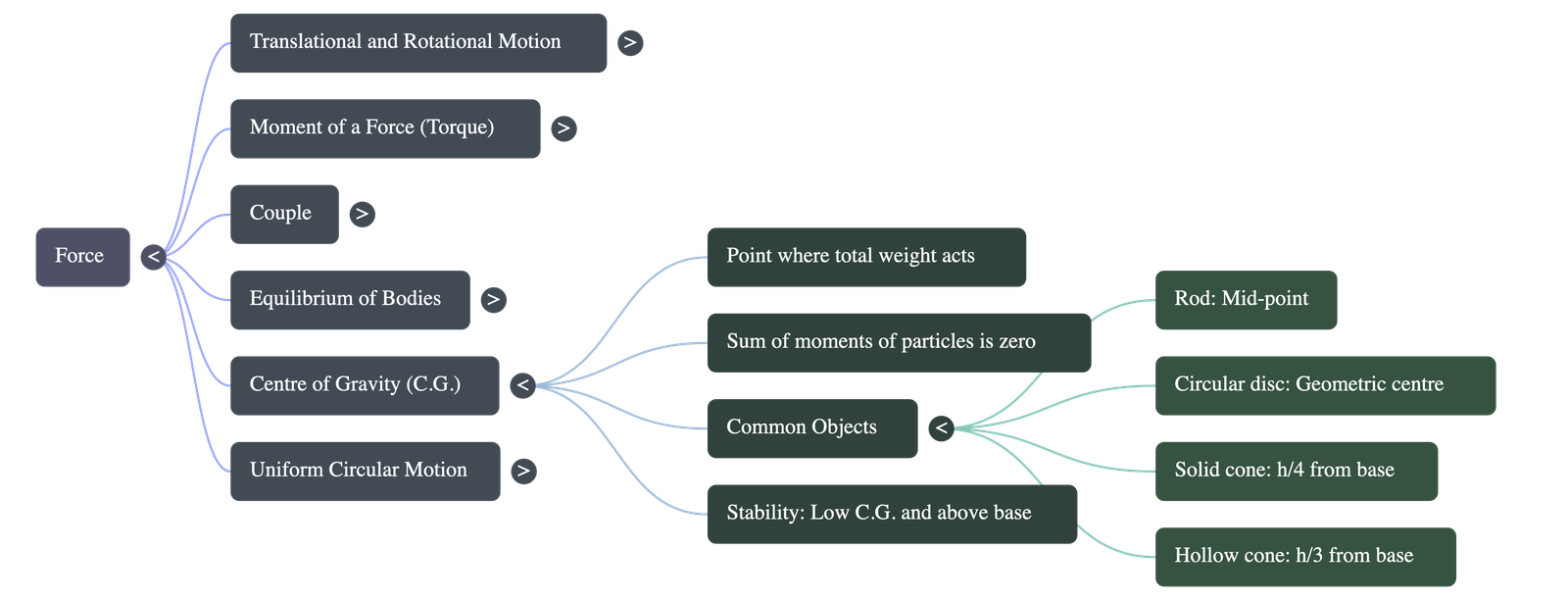
- Definition: The point about which the algebraic sum of moments of weights of all the particles constituting the body is zero. The entire weight of the body is considered to act at this point.
- The position of the centre of gravity depends on the shape and distribution of mass of the body.
- It is not necessary for the centre of gravity to be within the material of the body (e.g., the C.G. of a hollow ring lies at its empty centre).
- C.G. of Regular Objects:
- Rod: Mid-point
- Circular disc / Sphere: Geometric centre
- Triangular lamina: Intersection of medians
- Rectangle / Square: Intersection of diagonals
- Determination: For an irregular lamina, the centre of gravity can be determined using the plumb line method by suspending it from three different holes.
(C) Uniform Circular Motion
1.7 Uniform Circular Motion
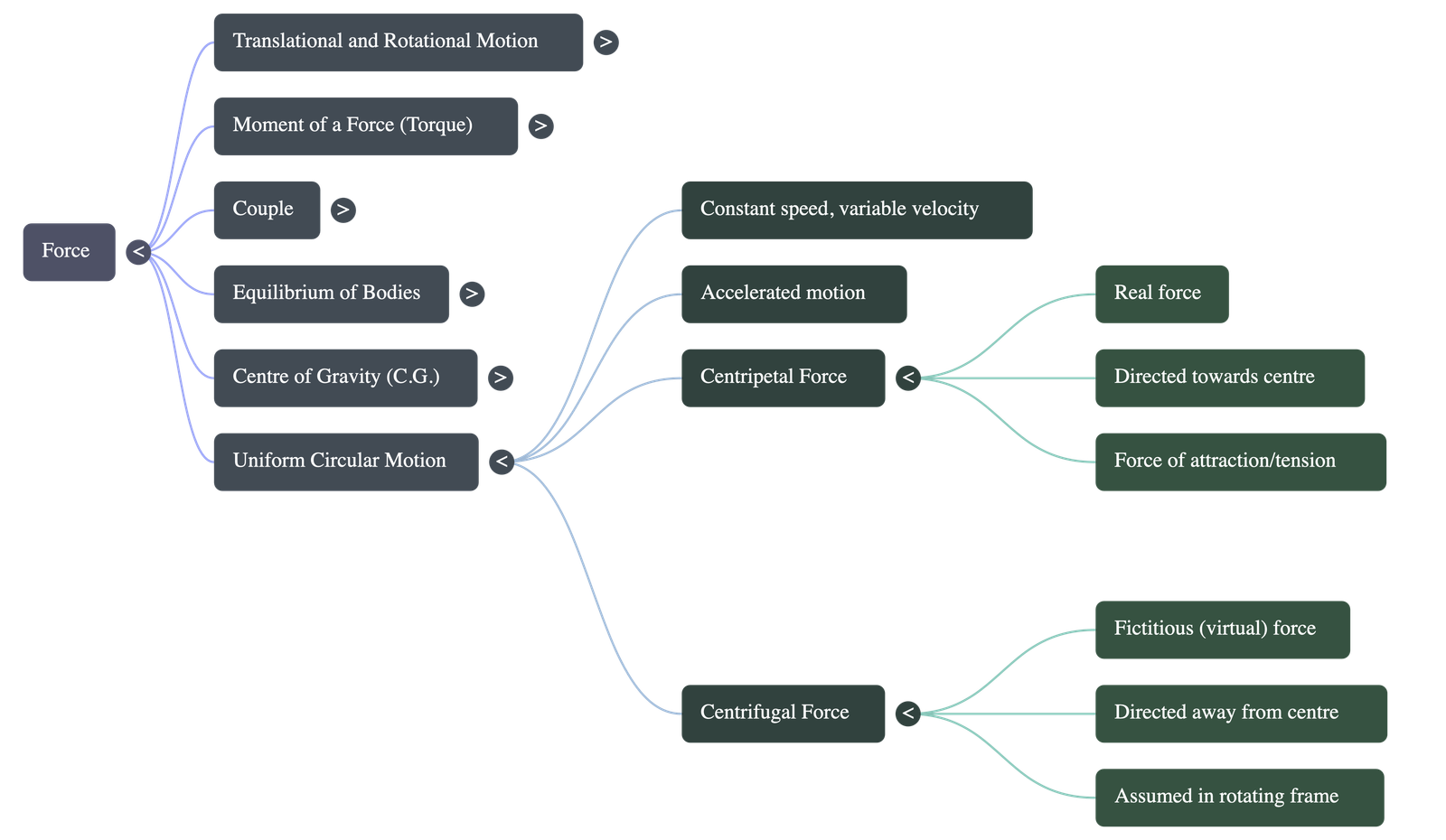
- Definition: When a particle moves with a constant speed in a circular path, its motion is called uniform circular motion.
- Variable Velocity: Even though the speed is constant, the direction of motion changes at every point (directed along the tangent). Because velocity depends on direction, the velocity is non-uniform (variable).
- Consequently, uniform circular motion is always an accelerated motion.
1.8 Centripetal and Centrifugal Force
- Centripetal Force: This is the force acting on a body moving in a circular path, directed towards the centre of the circle. It is a real force required to keep the body in circular motion (e.g., electrostatic force in an atom, gravitational force for planets).
- Centrifugal Force: A fictitious (or virtual) force assumed by an observer moving with the body, acting in a direction away from the centre. It is not a real force but is used to explain observation in a rotating reference frame.
- If the centripetal force ceases (e.g., a string breaking), the body will move in a straight line along the tangent at that point.
Do checkout all questions & answers of this chapter.
Quick Navigation:
| | | |
1 / 1
Quick Navigation:
| | | |