Quick Navigation:
| | | |
Refraction of Light at Plane Surfaces
A comprehensive point-wise study guide for Class 10 Physics students.
Section A: Refraction, Laws of Refraction and Refractive Index
1. Refraction of Light
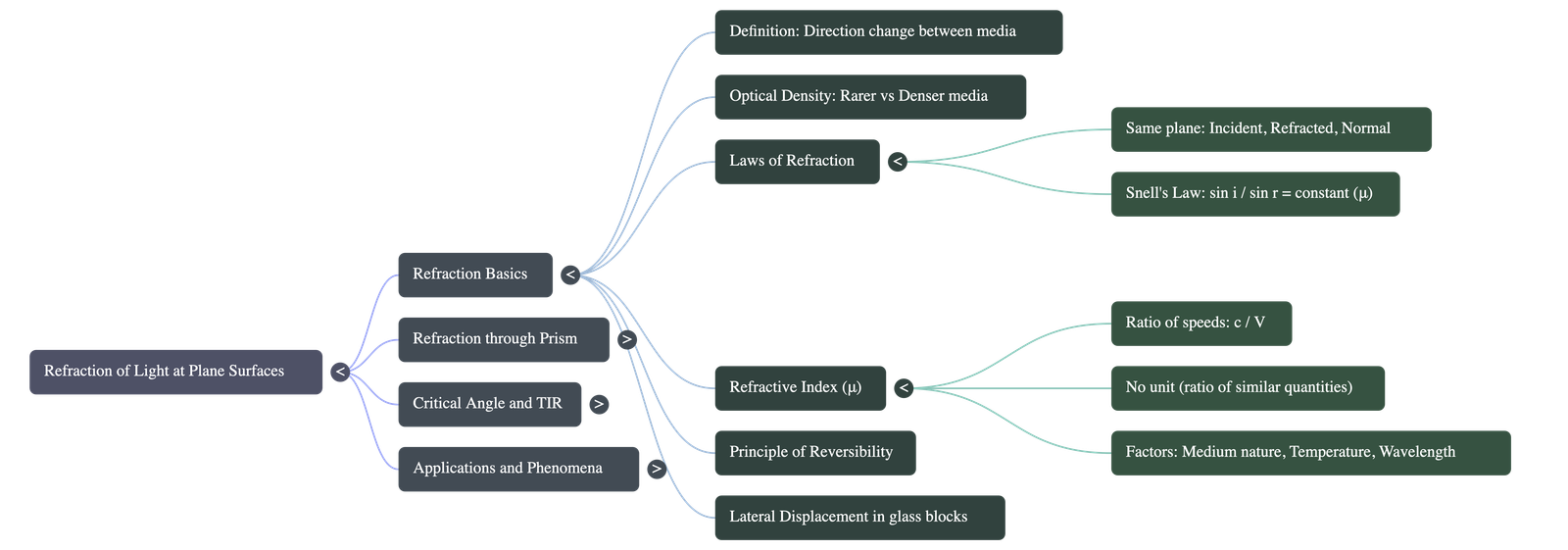
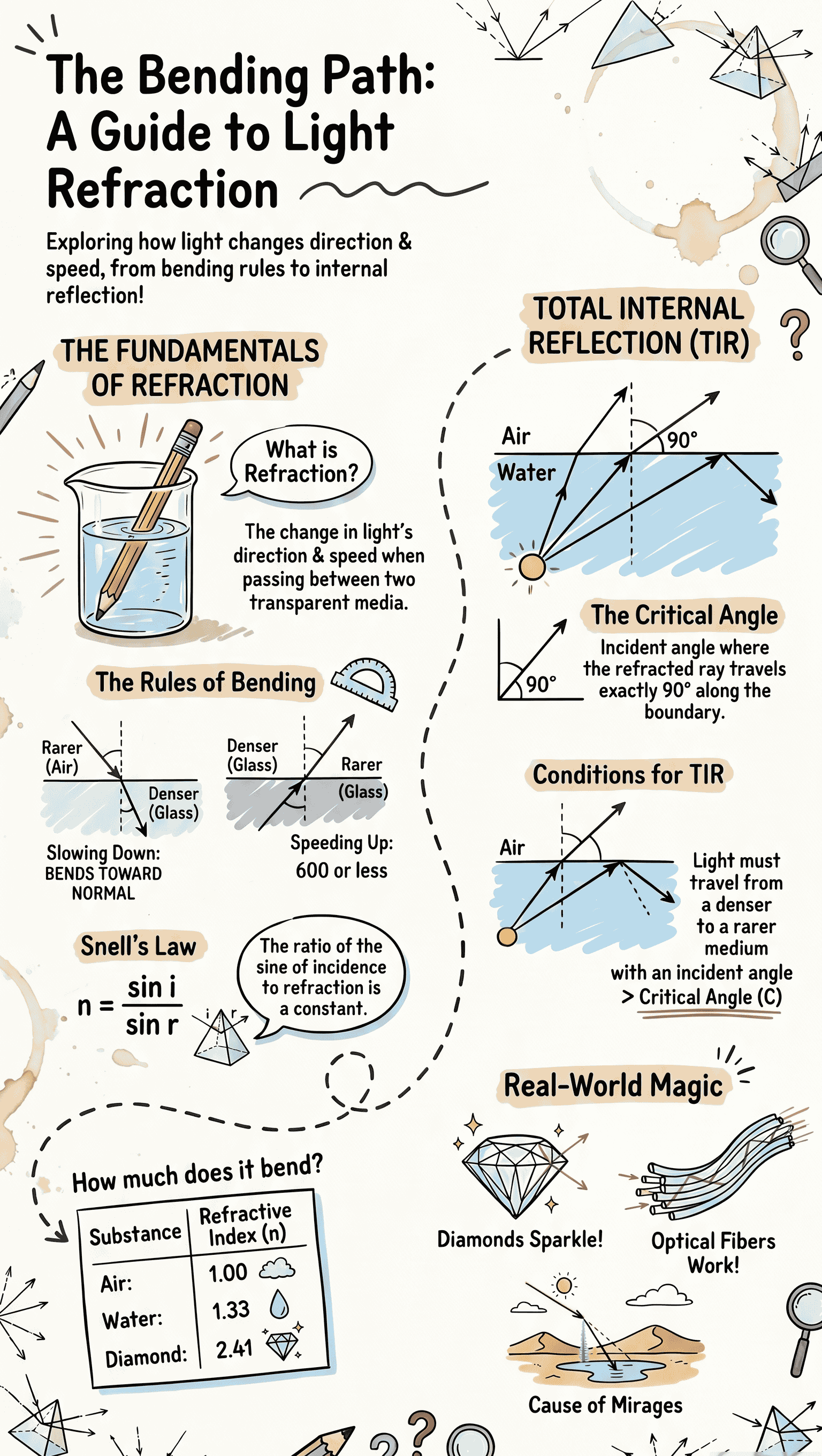
- Definition: The change in the direction of the path of light when it passes from one transparent medium to another is called refraction. It is essentially a surface phenomenon.
- Cause of Refraction: Refraction occurs because the speed of light changes when passing from one transparent medium to another.
- Optically Rarer vs Denser Mediums:
- If light slows down in the second medium, it is optically denser than the first (e.g., glass is denser than air).
- If light speeds up in the second medium, it is optically rarer than the first (e.g., air is rarer than water).
- Direction of Bending:
- From rarer to denser medium: The light ray bends towards the normal.
- From denser to rarer medium: The light ray bends away from the normal.
- Normal Incidence: If a ray of light is incident normally on the surface (angle of incidence = 0°), it passes undeviated (angle of refraction = 0°).
2. Laws of Refraction
- The incident ray, the refracted ray, and the normal at the point of incidence all lie in the same plane.
- Snell's Law: The ratio of the sine of the angle of incidence (i) to the sine of the angle of refraction (r) is constant for a given pair of media. (sin i / sin r = constant).
3. Refractive Index (μ)
- Definition: The absolute refractive index of a medium is the ratio of the speed of light in vacuum or air (c) to the speed of light in that medium (V). (μ = c / V).
- It has no unit since it is a ratio of two similar quantities.
- Effect on Light Properties: When light refracts, its speed and wavelength change, but its frequency remains completely unchanged because frequency depends only on the source of light.
- Factors affecting Refractive Index:
- Nature of the medium: Depends on the speed of light in the medium.
- Physical conditions (Temperature): As temperature increases, the refractive index decreases.
- Colour/Wavelength of light: Refractive index is maximum for violet light and minimum for red light.
4. Principle of Reversibility & Refraction through a Glass Block
- Principle of Reversibility: The path of a light ray is always reversible. Therefore, the refractive index of medium 1 with respect to medium 2 is the reciprocal of the refractive index of medium 2 with respect to medium 1.
- Rectangular Glass Block: Light undergoes refraction twice (air to glass, then glass to air). The emergent ray is parallel to the incident ray but is shifted sideways.
- Lateral Displacement: The perpendicular distance between the path of the incident ray and the emergent ray. It increases with:
- Increased thickness of the glass block.
- Increased angle of incidence.
- Increased refractive index (more for violet light than red light).
- Multiple Images in a Thick Mirror: When viewing an object in a thick mirror, multiple virtual images are formed due to multiple reflections and refractions inside the glass. The second image is always the brightest because it is formed by a strong first reflection from the silvered back surface.
Section B: Refraction of Light Through a Prism
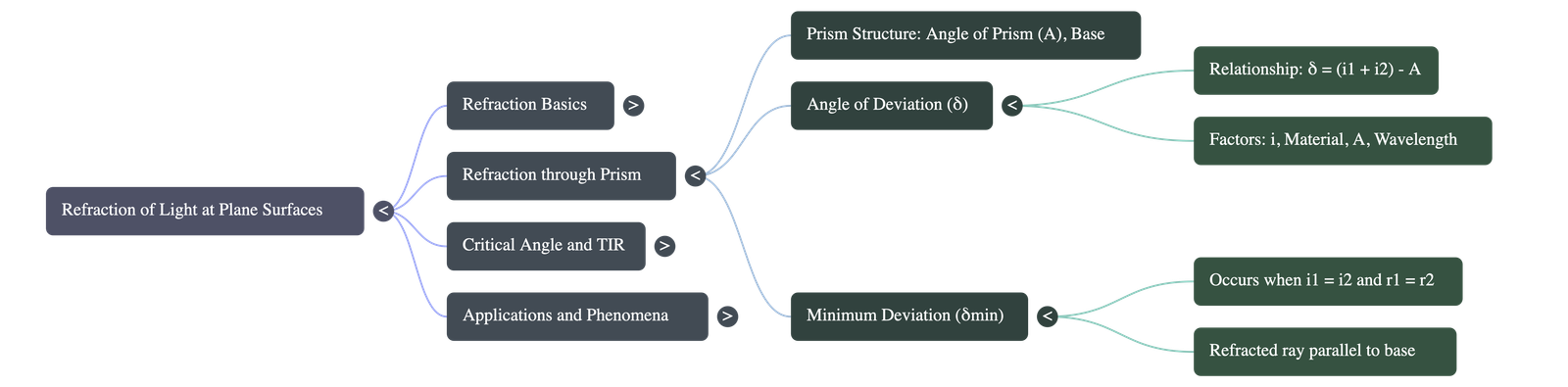
- What is a Prism? A transparent medium bounded by five plane surfaces: two opposite identical triangular faces and three rectangular faces inclined to each other.
- Refraction Behavior: When light passes through a prism, it suffers refraction at two inclined faces. In both refractions, the light ray bends towards the base of the prism.
- Angle of Deviation (δ): The angle between the direction of the incident ray (produced forward) and the emergent ray (produced backward).
- Equation: The angle of deviation (δ) is related to the angles of incidence (i), emergence (e), and the angle of the prism (A) by the formula: δ = (i + e) - A
- Factors Affecting the Angle of Deviation:
- Angle of Incidence: As the angle of incidence increases, the angle of deviation first decreases, reaches a minimum value (δmin), and then increases (forms a U-shaped i-δ curve).
- Material of Prism: A higher refractive index produces a greater deviation (e.g., flint glass deviates light more than crown glass).
- Angle of the Prism (A): Deviation increases with an increase in the angle of the prism.
- Colour/Wavelength of Light: Violet light deviates the most (highest refractive index) and red light deviates the least.
- Position of Minimum Deviation: At the minimum deviation position, the angle of incidence equals the angle of emergence, and the refracted ray inside the prism travels parallel to its base.
Section C: Simple Applications of Refraction of Light
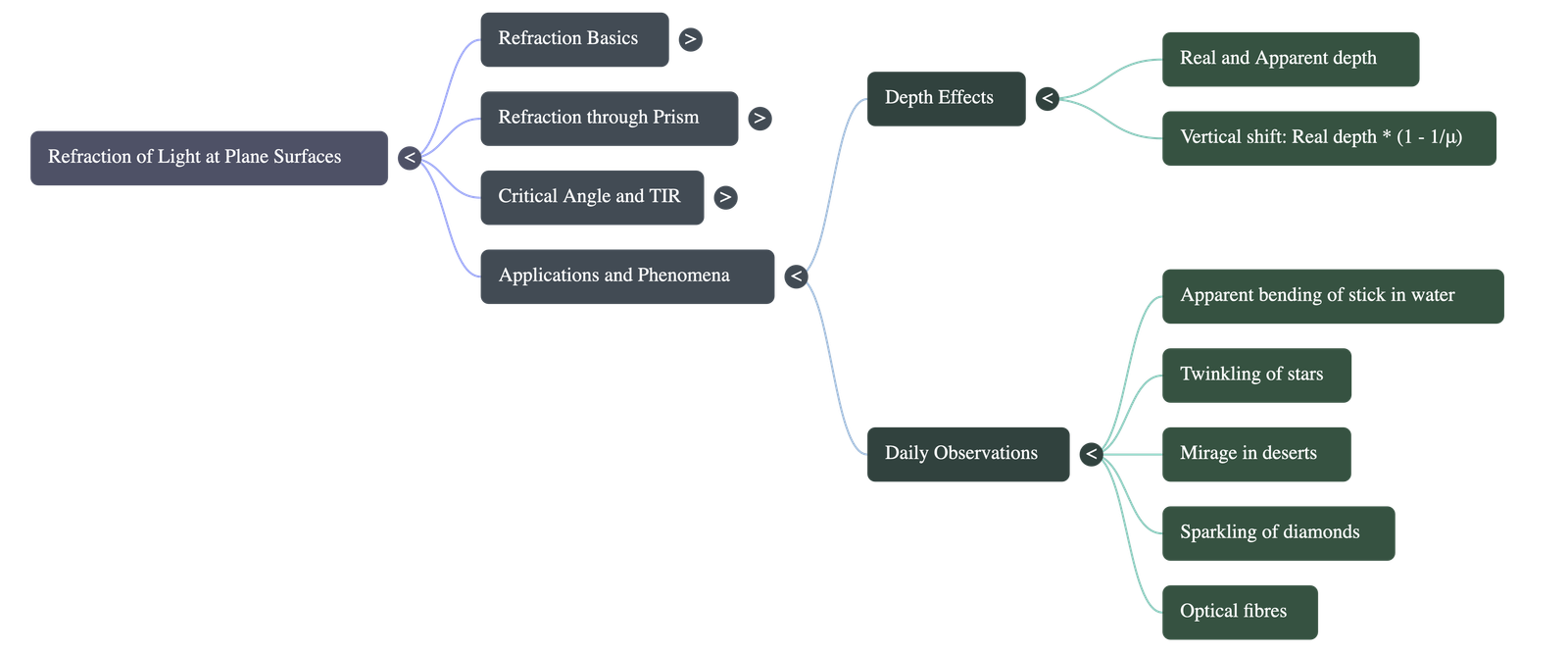
- Real and Apparent Depth: An object placed in a denser medium (like water or glass), when viewed from a rarer medium (air), appears to be at a lesser depth than its real depth.
Refractive Index (μ) = Real Depth / Apparent Depth - Shift: The apparent rise of the object is called shift. Shift = Real depth - Apparent depth. The shift increases with higher refractive index, greater thickness of the denser medium, and shorter wavelength (shift is more for violet than red).
- Apparent Bending of a Stick: A straight stick partially immersed in water appears bent at the surface and raised because rays of light coming from the submerged tip bend away from the normal when passing from water to air.
- Common Consequences in Daily Life:
- Twinkling of stars: Due to atmospheric refraction caused by fluctuation in the refractive index of air with temperature.
- Early sunrise and delayed sunset: The sun is seen a few minutes before it rises and after it sets because of the atmospheric refraction of light.
- A coin kept in a vessel out of sight becomes visible when water is poured in.
- Print on paper appears raised when a glass slab is placed over it.
- A water tank appears shallower than its actual depth.
Section D: Critical Angle and Total Internal Reflection
1. Critical Angle
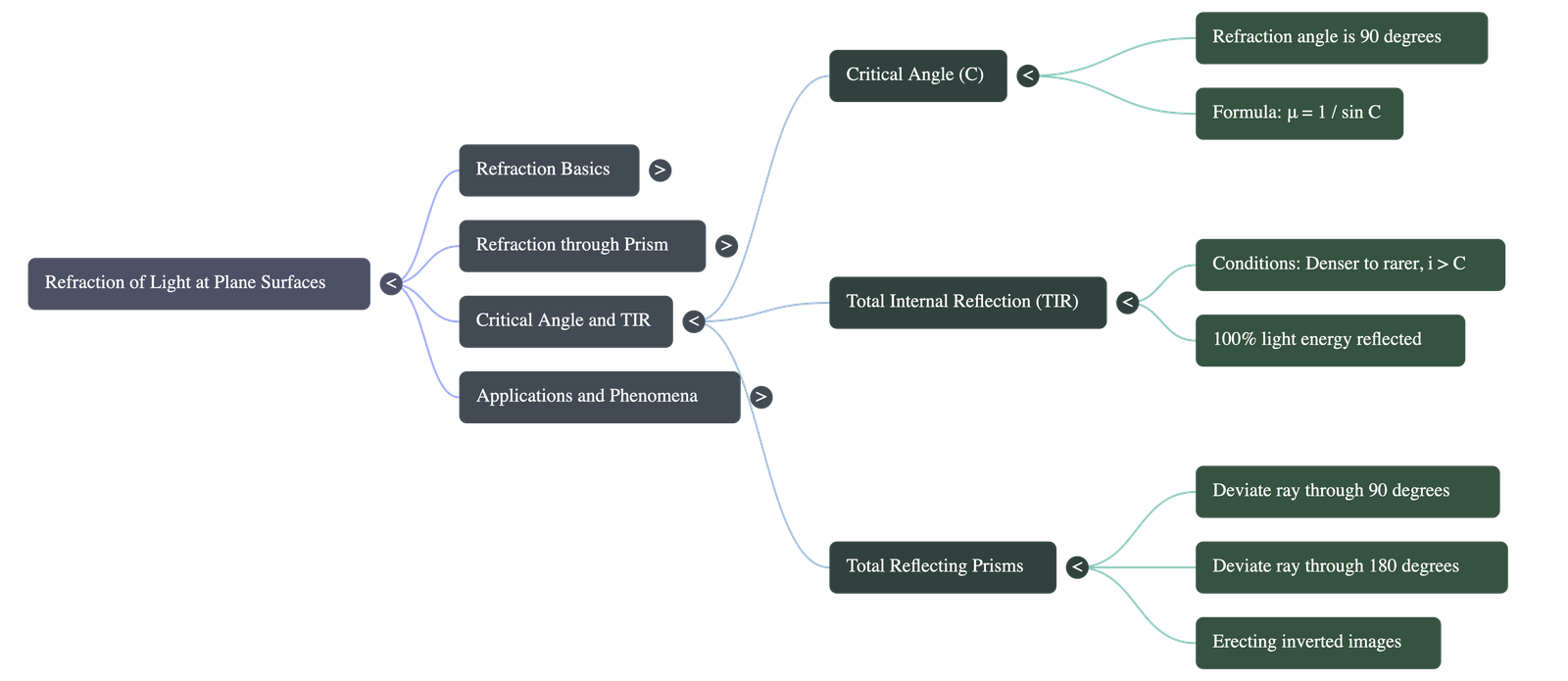
- Definition: When light travels from a denser to a rarer medium, the angle of incidence in the denser medium for which the angle of refraction in the rarer medium becomes exactly 90° is called the Critical Angle (C).
- Relationship with Refractive Index: The sine of the critical angle is the reciprocal of the refractive index of the denser medium with respect to the rarer medium. (sin C = 1 / μ).
- Factors affecting Critical Angle:
- Colour of light: Critical angle increases with an increase in wavelength (Critical angle for red is greater than for violet).
- Temperature: As temperature increases, the refractive index decreases, which causes the critical angle to increase.
2. Total Internal Reflection (TIR)
- Definition: When a ray of light travelling in a denser medium is incident at the surface of a rarer medium at an angle of incidence greater than the critical angle, it is totally reflected back into the denser medium. No light is refracted.
- Two Essential Conditions for TIR:
- The light must travel from a denser medium to a rarer medium.
- The angle of incidence must be greater than the critical angle for the given pair of media.
3. Applications of TIR in Prisms
- Total Reflecting Prism: A right-angled isosceles prism (angles 90°, 45°, 45°) is used to achieve total internal reflection because the critical angle for glass-air is approx 42°. Since the incident angle inside the prism becomes 45° (which is > 42°), TIR occurs.
- Uses of Total Reflecting Prisms:
- To deviate a ray of light through 90° (used in periscopes).
- To deviate a ray of light through 180° (used in binoculars and cameras to invert the image without intensity loss).
- To erect an inverted image without deviation (used in slide projectors).
- Prisms vs Plane Mirrors: Prisms are preferred over plane mirrors because TIR reflects 100% of the light with no energy loss (making the image brighter), whereas mirrors absorb some light and degrade over time.
4. Natural Consequences of Total Internal Reflection
- Mirage: An optical illusion seen in deserts on hot days due to TIR occurring in atmospheric layers of varying temperatures.
- Empty Test Tube in Water: It shines like a mirror when viewed at certain angles due to TIR happening at the glass-air interface inside the tube.
- Cracks in Glass: A crack in a glass vessel shines due to TIR occurring at the boundary of glass and air inside the crack.
- Sparkling of Diamond: Diamond has a very low critical angle (approx 24°). Light entering it suffers multiple total internal reflections before exiting, causing brilliant sparkling.
- Optical Fibres: Used to transmit light signals over long distances without energy loss through repeated total internal reflection.
Best of luck with your studies, Class 10! Keep exploring the magic of physics.
Do checkout all questions & answers of this chapter.
Quick Navigation:
| | | |
1 / 1
Quick Navigation:
| | | |