Quick Navigation:
| | | |
Work, Energy and Power
(A) Work, Energy and Power, Their Measurements and Units
2.1 Work
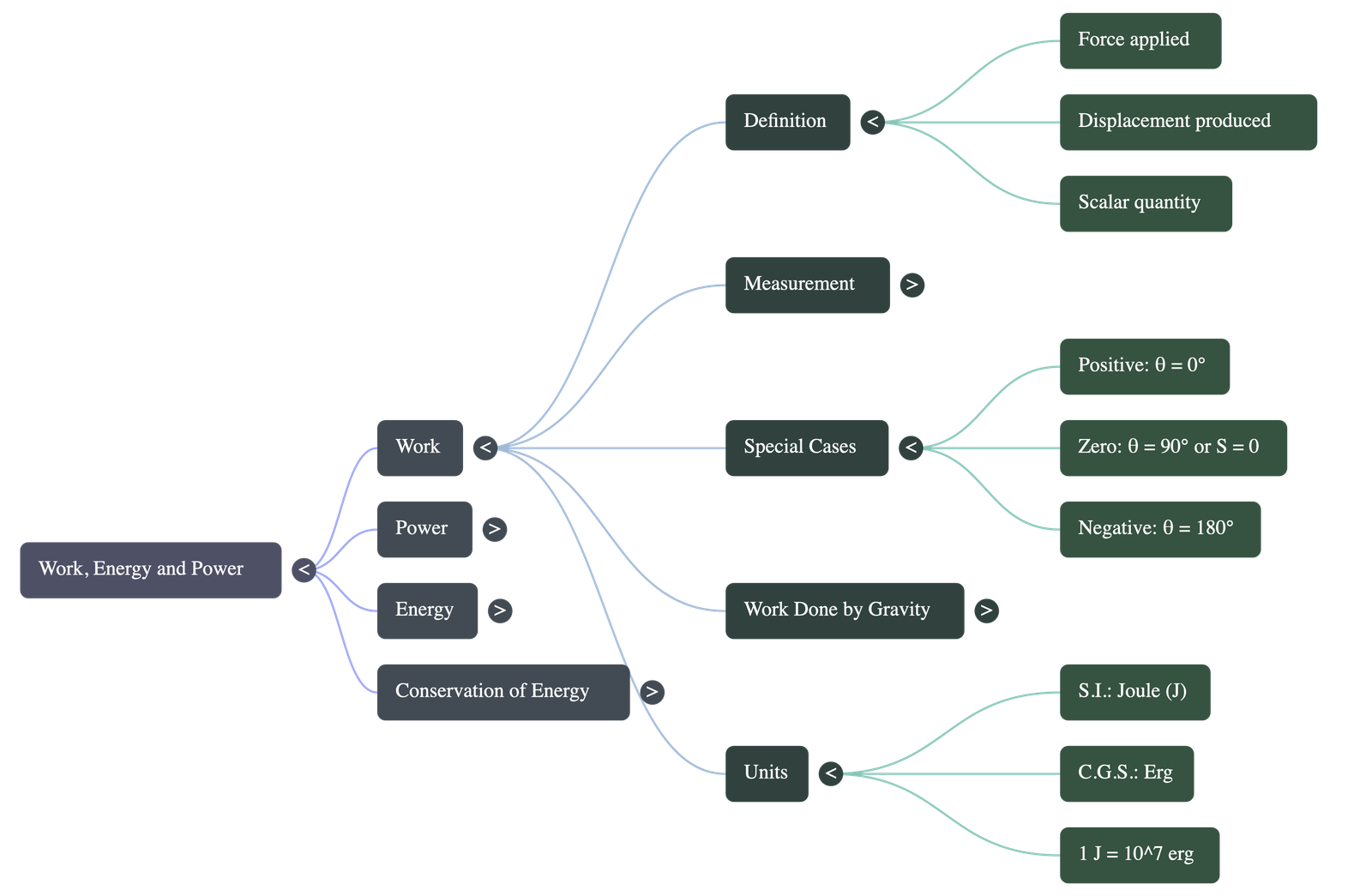
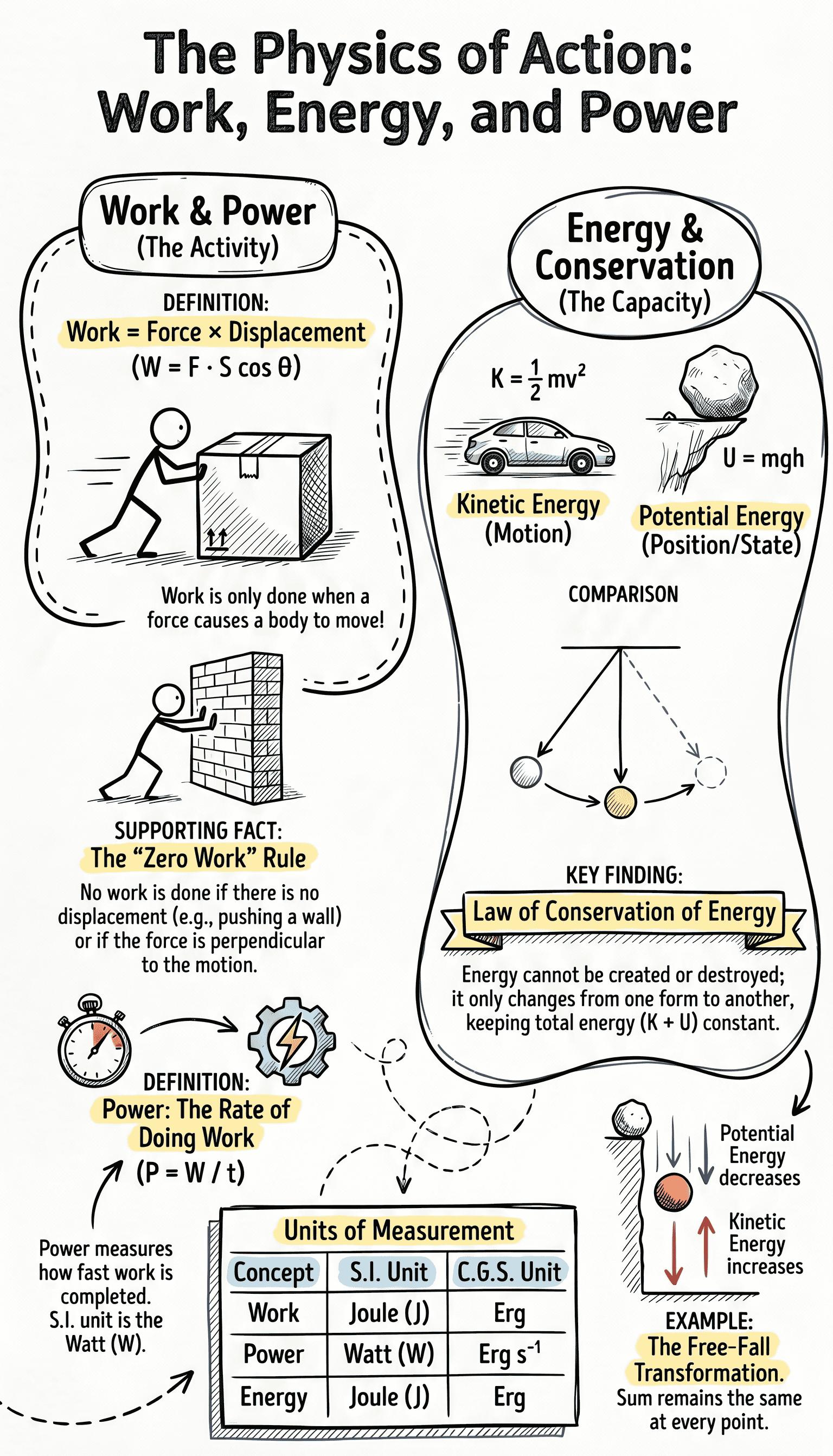
- In physics, work is said to be done only when a force applied on a body makes the body move (i.e., there is a displacement).
- If there is no displacement, no work is done. For example, a man pushing a rigid wall or a coolie standing still with a heavy load does zero work scientifically.
2.2 Measurement of Work
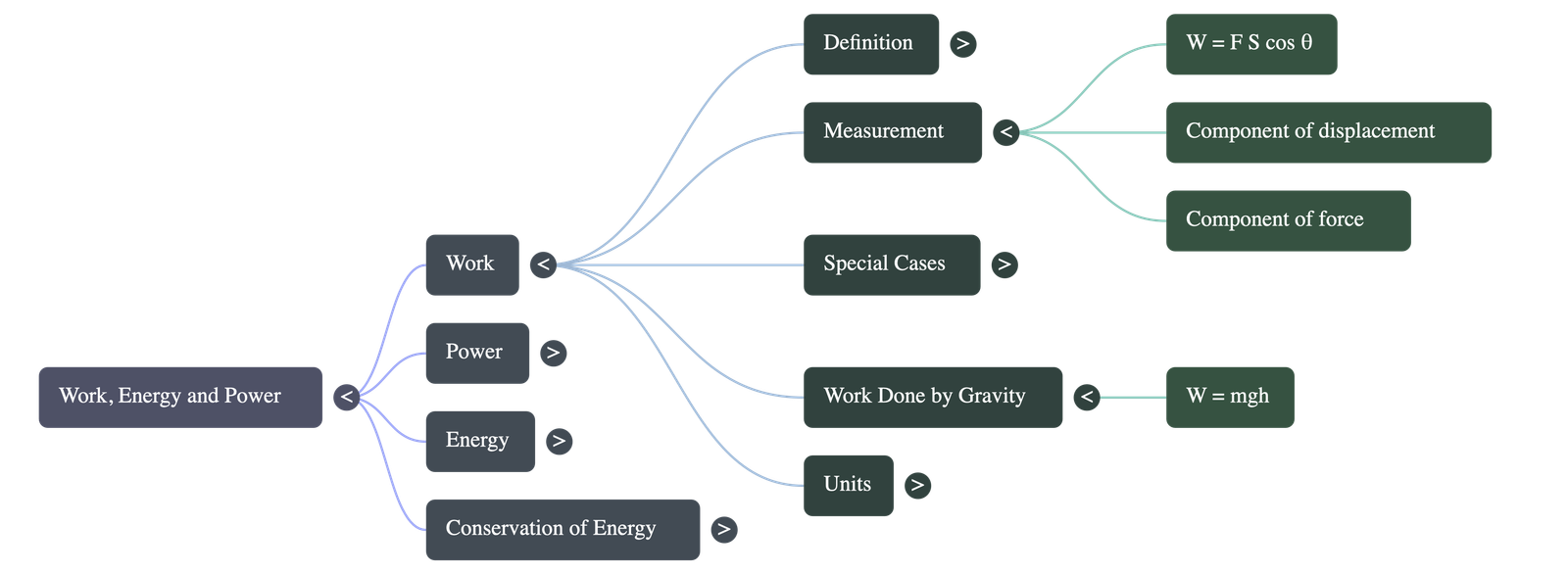
- The amount of work depends on two factors: the magnitude of the applied force and the magnitude of the displacement.
- If the force and displacement are in the same direction, work done is calculated as: W = F × S.
- Work is a scalar quantity (it is the dot product of force and displacement vectors).
- If force acts at an angle θ to the displacement, the formula is: W = F S cos θ.
- Special Cases:
1) Positive Work: When displacement is in the direction of force (θ = 0°, cos 0° = 1).
2) Zero Work: When displacement is normal to the force (θ = 90°, cos 90° = 0), like a body moving in a circular path.
3) Negative Work: When displacement opposes the force (θ = 180°, cos 180° = -1), like friction stopping a rolling ball.
2.3 Work Done by the Force of Gravity
- When a body of mass m moves down through a vertical height h, the work done by gravity is: W = mgh.
- The work done by gravity remains the same regardless of whether the body drops straight down, slides down a slope, or goes down stairs.
2.4 Units of Work
- S.I. Unit: Joule (J). 1 joule is the work done when a force of 1 newton displaces a body by 1 metre in its own direction.
- C.G.S. Unit: Erg. 1 erg is work done by 1 dyne displacing a body by 1 cm.
- Relationship: 1 joule = 107 erg.
2.5 Power
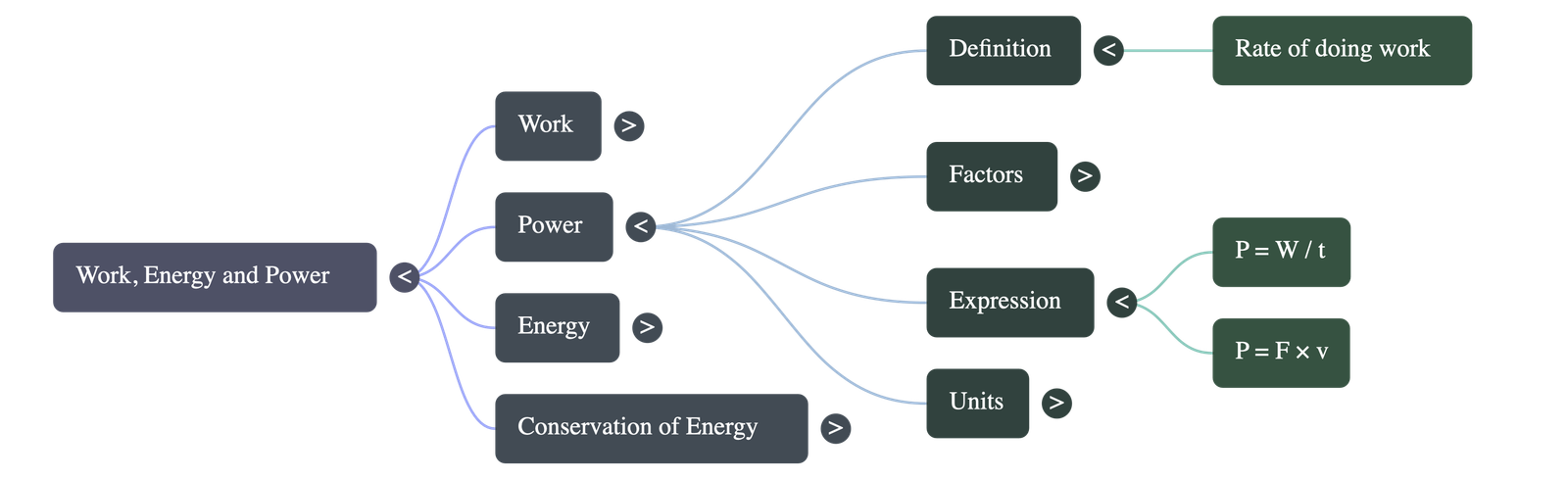
- Power is defined as the rate of doing work.
- Formula: P = W / t.
- Power can also be expressed as the product of force and average speed: P = F × v.
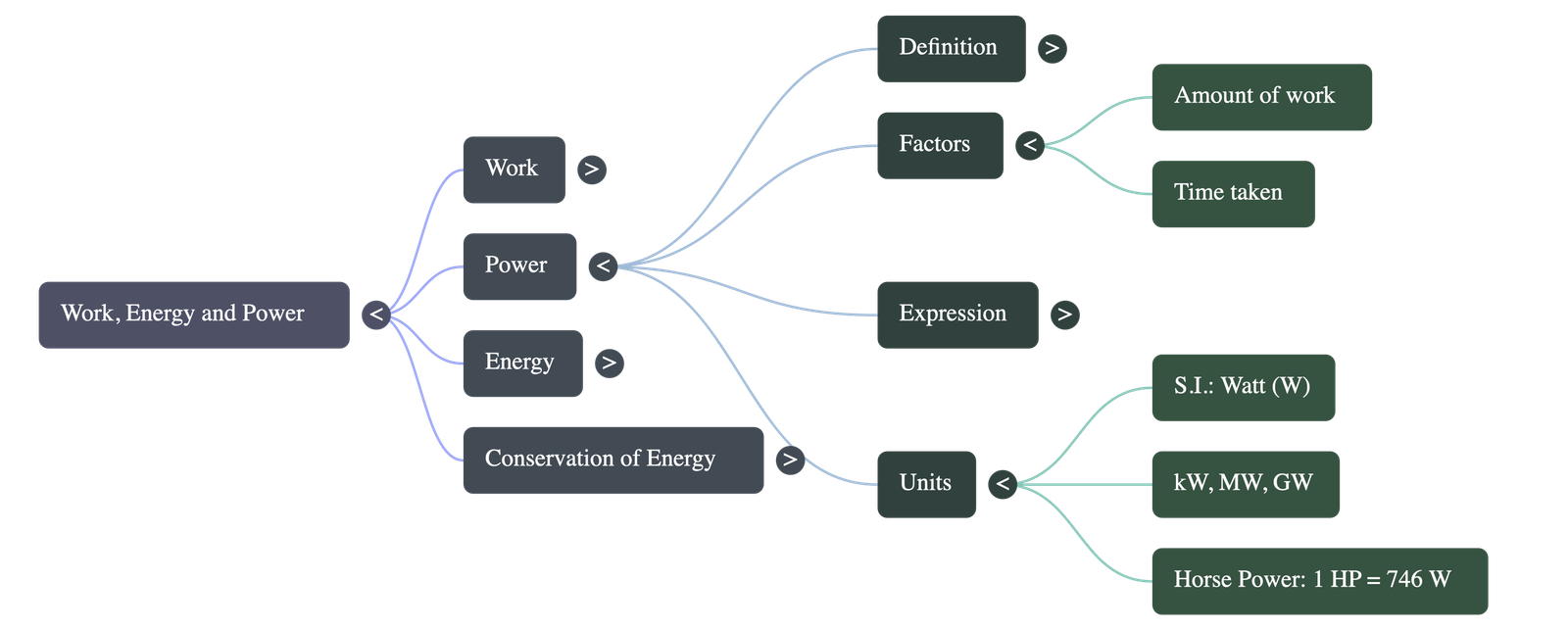
- Power depends on the amount of work done and the time taken. It is a scalar quantity.
2.6 Units of Power
- S.I. Unit: Watt (W). 1 watt = 1 joule per second.
- Bigger units include kilowatt (kW), megawatt (MW), and gigawatt (GW).
- In mechanical engineering, Horse Power (H.P.) is commonly used. 1 H.P. = 746 W.
2.7 Energy
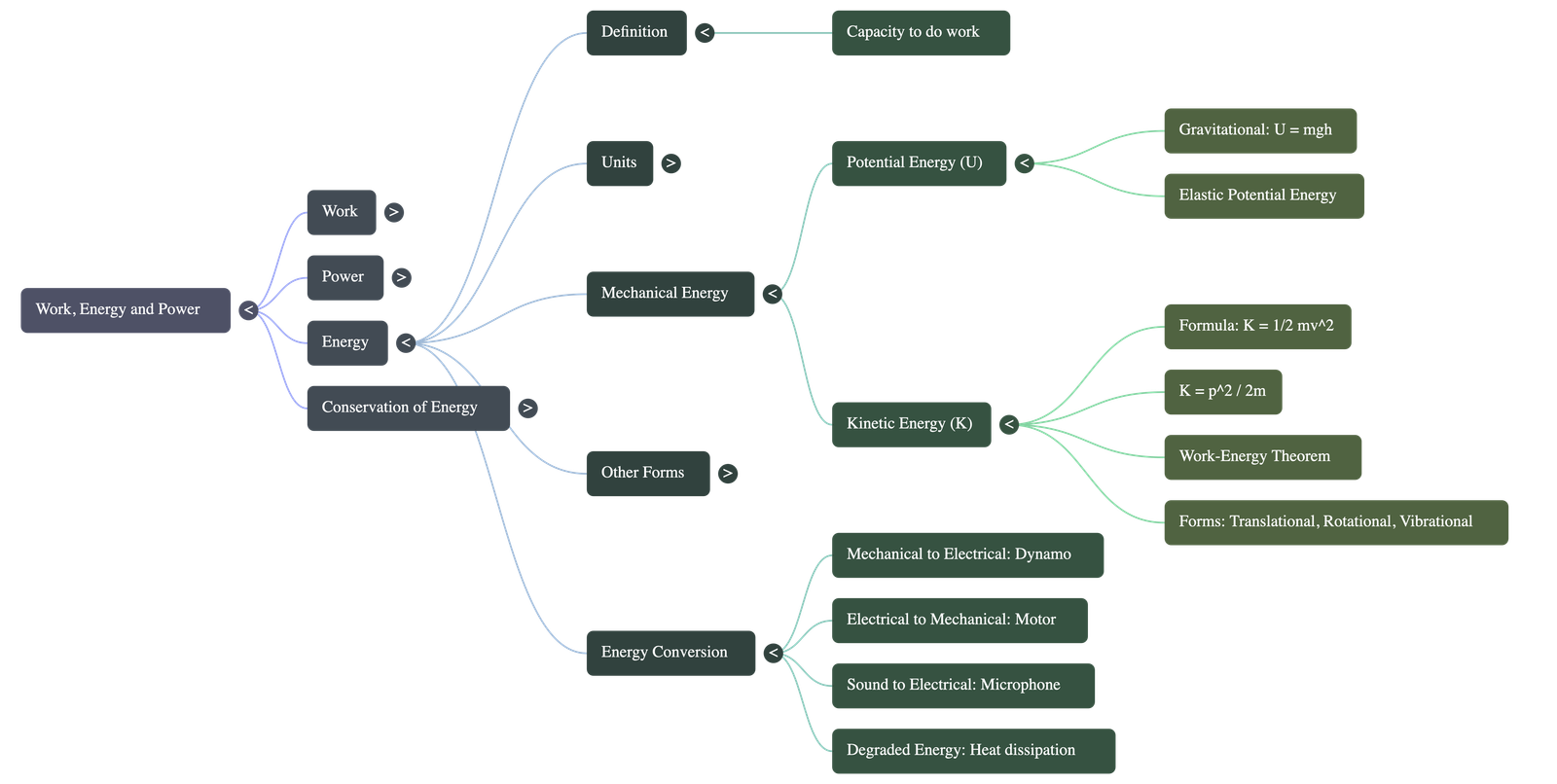
- Energy is a body's capacity to do work.
- Whenever work is done on a body, its energy increases, and when the body does work, its energy decreases.
- Energy is a scalar quantity.
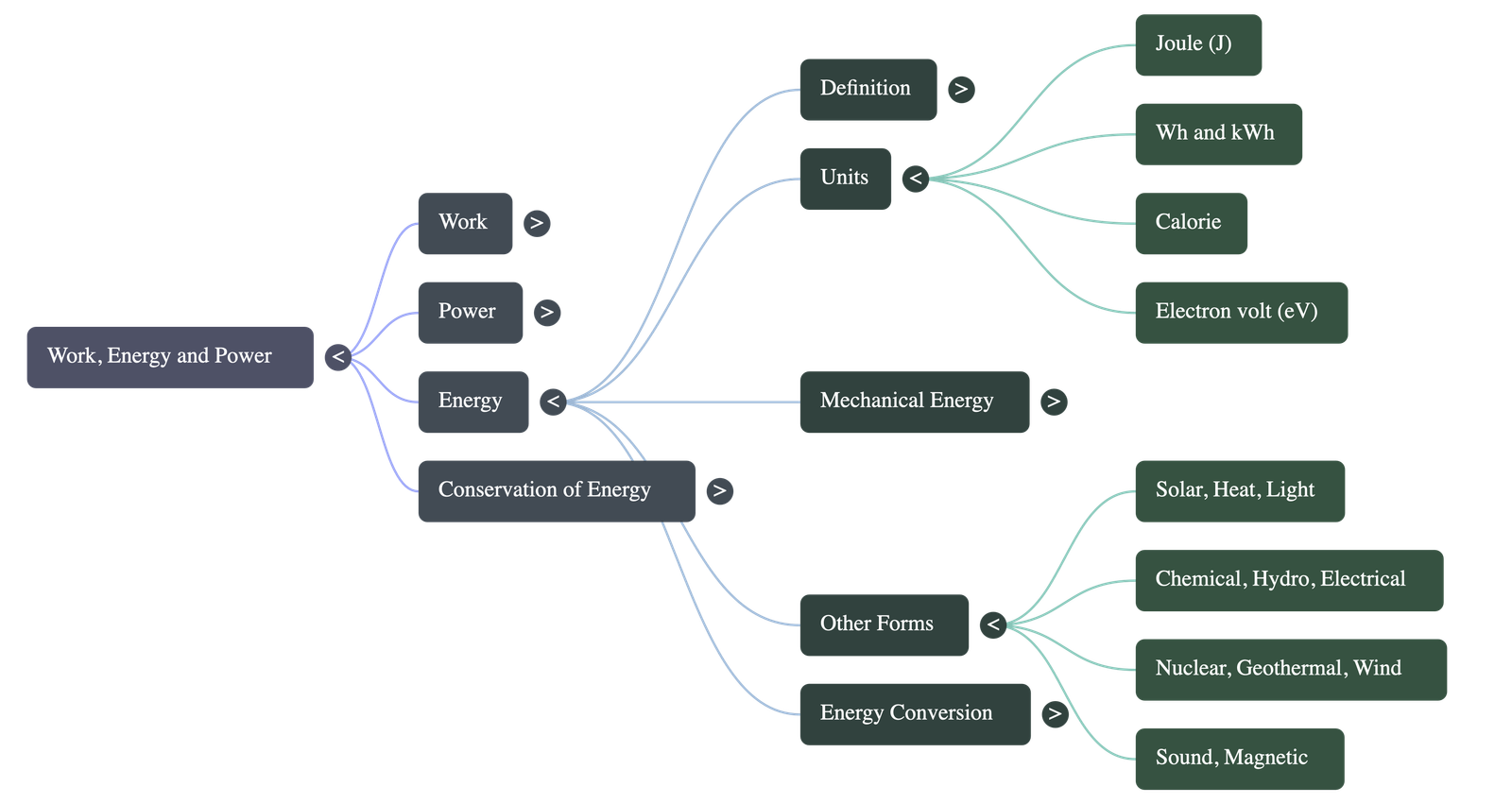
2.8 Units of Energy
- The S.I. unit is the Joule (J) and the C.G.S. unit is the Erg.
- Larger commercial units are Watt hour (Wh) and Kilowatt hour (kWh). 1 kWh = 3.6 × 10⁶ J.
- Heat energy is often measured in calories (1 calorie = 4.18 J).
- Energy of atomic particles is measured in electron volt (eV) (1 eV = 1.6 × 10⁻¹⁹ J).
(B) Different Forms of Energy
2.9 Mechanical Energy and its Different Forms
- The energy possessed by a body due to its state of rest or motion is called mechanical energy.
- It exists in two forms: Potential Energy and Kinetic Energy. Total mechanical energy is their sum.
2.10 Potential Energy (U)
- Energy possessed by a body at rest due to its position or size and shape.
- Gravitational Potential Energy: Energy due to a body's elevated position against Earth's gravity.
- Elastic Potential Energy: Energy stored in a deformed object (like a compressed spring or stretched bow) due to changes in its size and shape.
2.11 Gravitational Potential Energy at a Height
- The work done in lifting a body of mass m to a vertical height h is stored as potential energy.
- Formula: U = mgh.
2.12 Kinetic Energy (K)
- The energy possessed by a body due to its state of motion.
- Formula: K = ½ mv2.
- Relationship with Momentum (p): p = √(2mK) or K = p2 / 2m.
- Work-Energy Theorem: The increase in kinetic energy of a moving body is exactly equal to the work done on it by a force acting in the direction of motion.
- Forms of Kinetic Energy: Translational (moving in a straight line), Rotational (spinning around an axis), and Vibrational (to and fro motion).
2.13 Conversion of Potential Energy into Kinetic Energy
- Potential energy changes into kinetic energy whenever it is put to use.
- Examples include a hammer falling on a nail, a wound-up watch spring unwinding to move clock hands, or a stretched bow releasing an arrow.
2.14 Different Forms of Energy
- Nature provides energy in various forms: Solar, Heat, Light, Chemical (or fuel), Hydro, Electrical, Nuclear, Geo-thermal, Wind, Sound, Magnetic, and Mechanical energy.
2.15 Conversion of One Form of Energy into the Other Form
- Energy seamlessly converts between forms. For example: A generator converts mechanical energy into electrical energy, while a motor converts electrical energy into mechanical energy.
- Degraded Energy: Whenever energy converts from one form to another, a part of it is lost to the surroundings (usually as heat due to friction). This non-useful energy is called degraded energy.
(C) Conservation of Energy
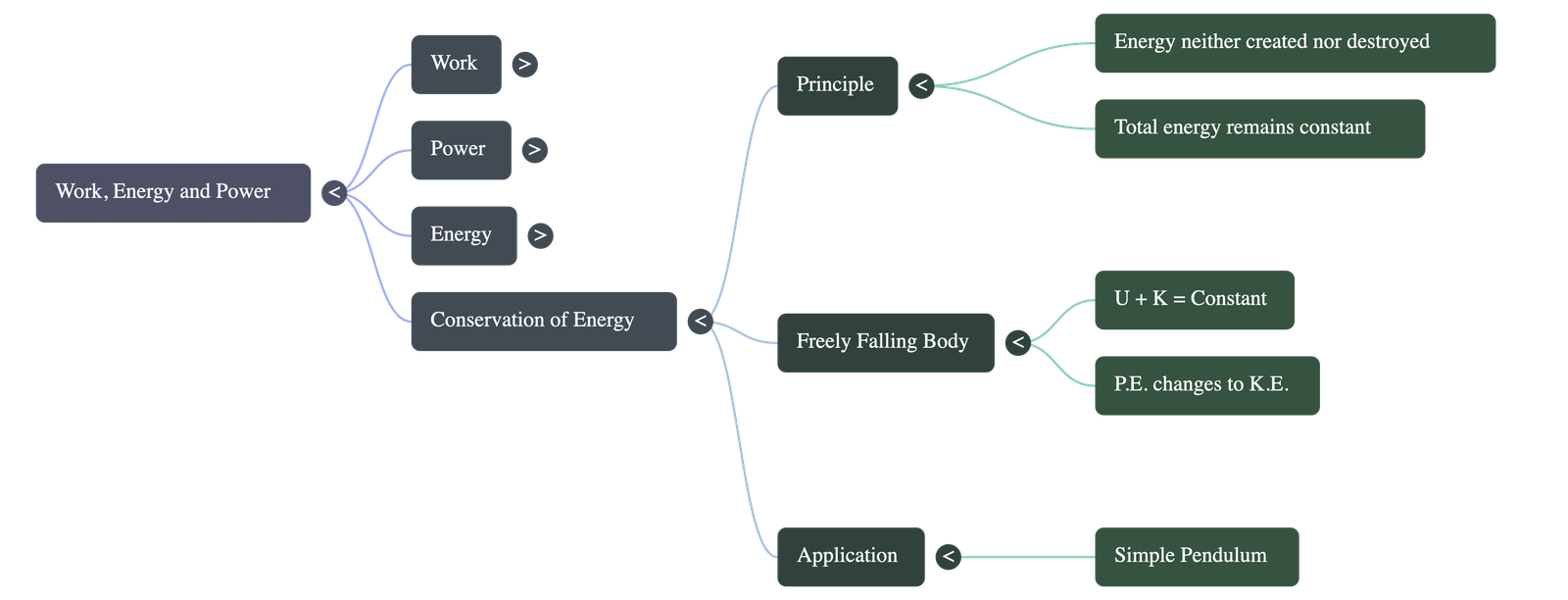
2.16 Principle of Conservation of Energy
- The fundamental principle states that energy can neither be created nor destroyed. It only changes from one form to another.
- The total energy of the universe remains constant. Any loss in one form is completely accounted for as a gain in another form.
2.17 Theoretical Verification of K + U = Constant for a Freely Falling Body
- When a body of mass m falls freely from a height h, its mechanical energy is conserved throughout the fall.
- At the top: Kinetic Energy (K) = 0, Potential Energy (U) = mgh. Total Energy = mgh.
- During the fall (middle): Potential energy decreases, and kinetic energy increases by an exactly equal amount. Total Energy remains mgh.
- At the bottom (just before hitting the ground): Potential Energy = 0, Kinetic Energy becomes maximum (mgh). Total Energy = mgh.
2.18 Application of Principle of Conservation of Energy to a Simple Pendulum
- When a simple pendulum swings, it constantly exchanges potential and kinetic energy.
- At the extreme positions, its velocity is zero, meaning kinetic energy is zero, and potential energy is at its maximum.
- At the mean (resting) position, it reaches its lowest point, so potential energy is zero (or minimum), and it possesses maximum kinetic energy.
- At any intermediate position, the bob possesses both kinetic and potential energy, and their sum remains strictly constant (assuming no air friction).
Do checkout all questions & answers of this chapter.
Quick Navigation:
| | | |
1 / 1
Quick Navigation:
| | | |