Quick Navigation:
| | | |
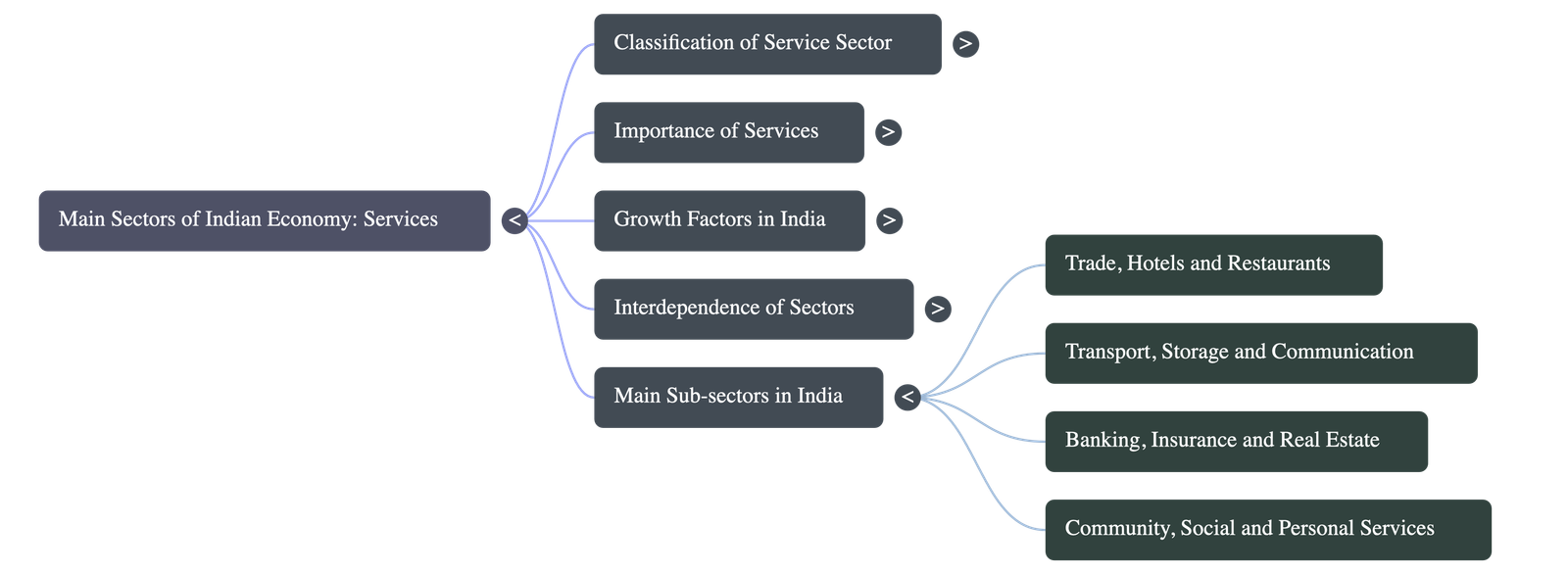
Main Sectors of Indian Economy: Services
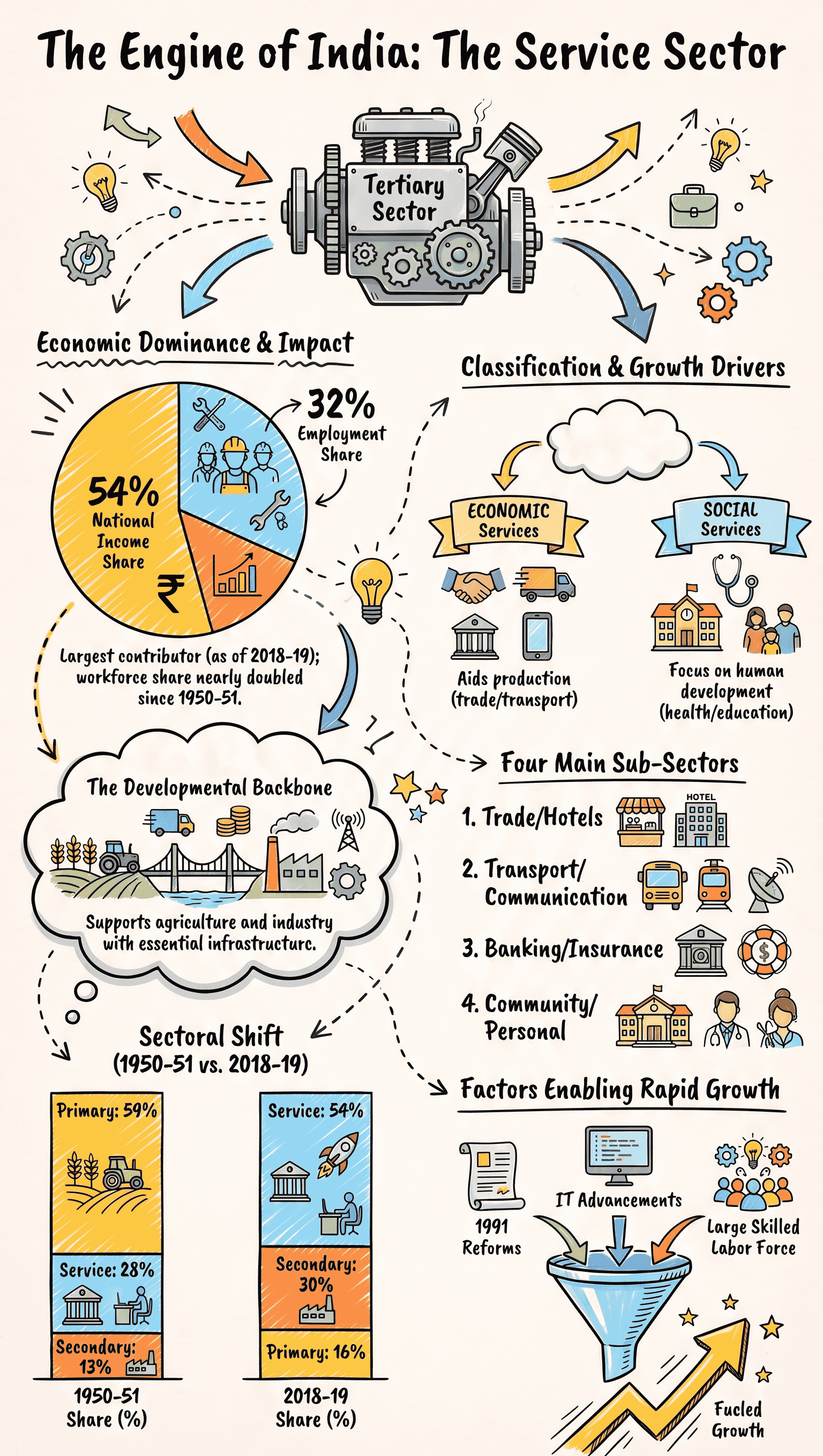
Introduction: The service sector (also known as the tertiary sector) produces services instead of physical goods. It is a vital part of the economy that provides non-physical products that the public needs, such as transport, healthcare, education, and banking.
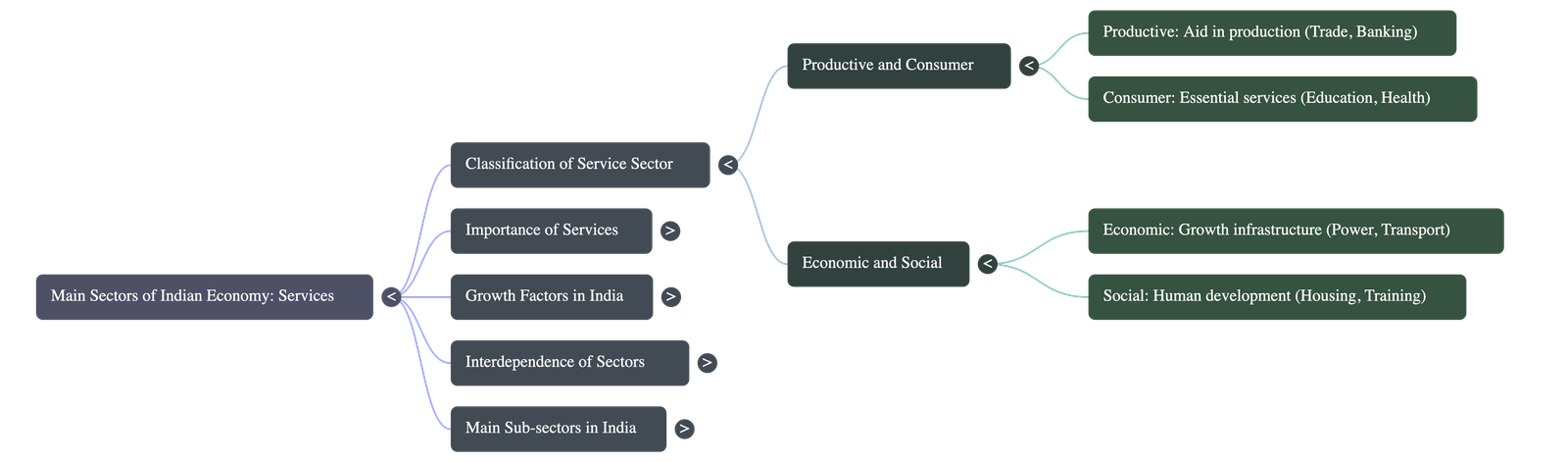
1. Classification of Service Sector
- Productive and Consumer Services:
- Productive Services: These activities act as an aid to the production process (e.g., trading, transportation, banking, communication).
- Consumer Services: These are essential services that satisfy human wants directly but may not directly help in producing goods (e.g., education, health services, services of domestic helpers).
- Economic and Social Services:
- Economic Services: Infrastructural facilities that directly support economic growth from the inside (e.g., trade, transport, power, irrigation, banking).
- Social Services: Infrastructural facilities that help the economic system from the outside by focusing on human development and improving labor efficiency (e.g., health, education, housing).
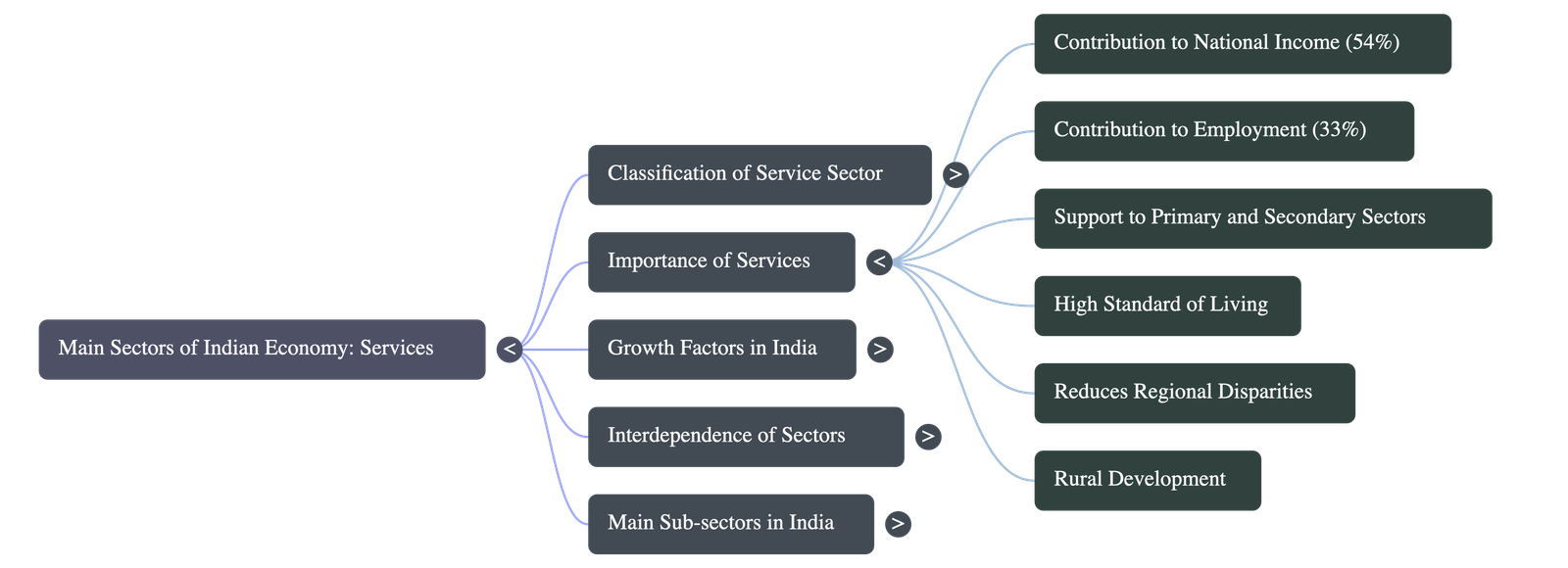
2. Importance of Services
The service sector forms the backbone of a nation's socio-economic development. Its importance can be judged from the following points:
- Largest Contribution to National Income: It is presently the largest sector in the Indian economy. Its share in the national income grew from 28% in 1950-51 to a massive 54% in 2018-19.
- Huge Contribution to Employment: It employs about 33% of the working population (up from 17% in 1950-51). It gives jobs to people directly linked to services (like transport workers) and indirectly linked professionals (like IT workers, doctors, teachers).
- Develops Primary and Secondary Sectors: Services like transportation, banking, and insurance are absolutely essential for moving raw materials and finished goods, and for providing loans to agriculture and industry.
- Improves Standard of Living: A well-developed social infrastructure (health, education) provides personal and public services that directly improve the quality of life and efficiency of the people.
- Reduces Regional Disparities: Expanding services like transport and communication into backward regions helps bring equality in economic growth across different areas of the country.
- Promotes Rural Development: Villages cannot progress without a good system of electrification, transport, health, and education.
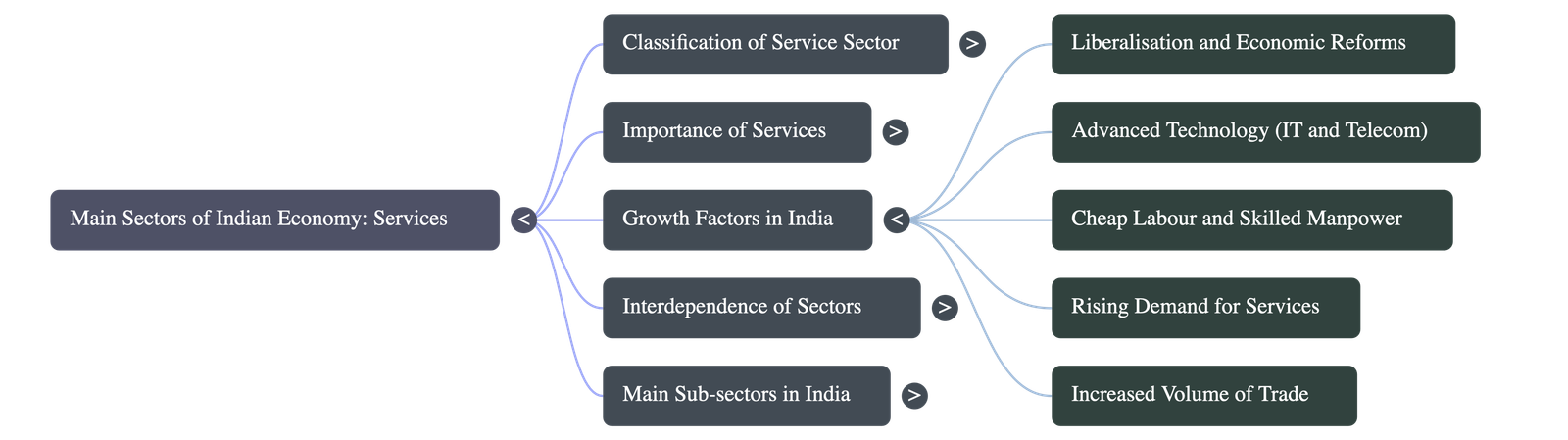
3. Factors Enabling High Growth of Service Sector in India
- Liberalisation and Economic Reforms (1991): Removing restrictions on labor and capital allowed a massive inflow of Foreign Direct Investment (FDI) and outsourcing to India.
- Advanced Technology: The boom in the IT sector, internet, telecommunications, and electronic transactions greatly fueled the sector's growth.
- Cheap Labour and Skilled Workers: Because India has a large pool of reasonably skilled workers available at lower wages, developed countries found India to be a highly profitable destination for outsourcing.
- Rising Demand for Services: As people's income levels have grown, they demand more services like private hospitals, educational institutions, tourism, shopping, and eating out.
- Increased Volume of Trade: Lowering tariff and non-tariff barriers on imports has boosted the volume of trade, which in turn demands more services.
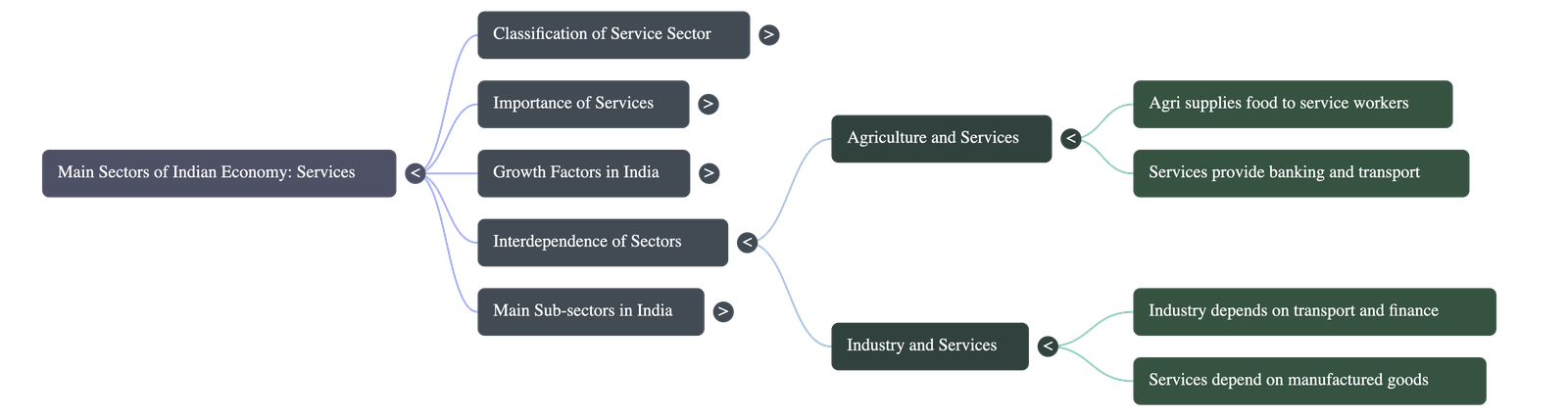
4. Interdependence Among Various Sectors
The three broad sectors (Primary/Agriculture, Secondary/Industry, and Tertiary/Services) heavily depend on one another.
4.1 Between Agricultural and Service Sectors
- Agriculture relies on the service sector for banking, trading, education, health, and transport of agricultural goods.
- The service sector relies on agriculture for food supplies for urban workers and for the supply of unskilled and skilled labor coming from rural areas. Railways and roadways also get a bulk of their business by transporting farm products.
4.2 Between Industrial and Service Sectors
- Industries depend on services for transportation of goods, banking, financial services, education, and health services for their workforce.
- The service sector depends heavily on industries to provide manufactured goods like computers, printers, vehicles, air-conditioners, and paper, which are essential to run service businesses.
5. Service Sector in India (Main Categories)
In India, service sector activities are broadly grouped into four main categories:
- Trade, Hotels and Restaurants: Includes both internal trade (within the country) and external trade (between countries). It involves public enterprises (like State Trading Corporation) and private enterprises, as well as hospitality services.
- Transport, Storage and Communication:
- Transport: Railways, roadways, airways, and water transport.
- Storage: Cold storage and warehousing provided by government bodies like Food Corporation of India (FCI) and private companies.
- Communication: Postal and telecommunication services provided by public (BSNL, India Post) and private (Airtel, Vodafone Idea) sectors.
- Banking, Insurance, Real Estate and Business Services: Includes the Reserve Bank of India (RBI), commercial banks (SBI, HDFC), and insurance providers (LIC). Also covers real estate (buying and selling property) and business services mainly run by private enterprises.
- Community, Social and Personal Services: Mostly provided by public sector organizations for the greater benefit of the people. Includes defense, police, education, healthcare, safe drinking water, and sanitation. Personal services include the work of doctors, lawyers, engineers, and chartered accountants.
Do checkout all questions & answers of this chapter.
Quick Navigation:
| | | |
1 / 1
Quick Navigation:
| | | |