Quick Navigation:
| | | |
Consumer Awareness
1. The Consumer in the Market Place
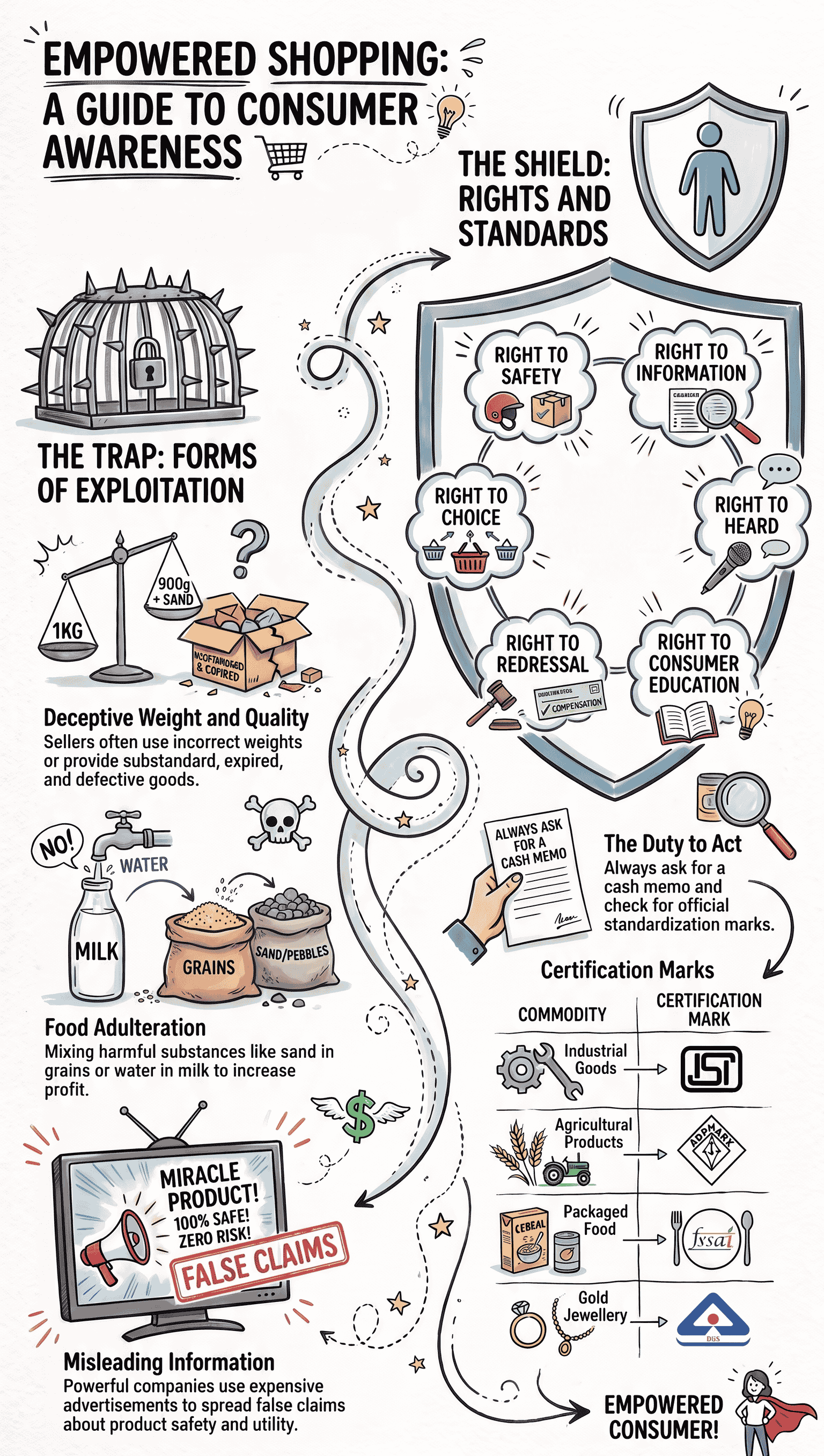
- Who is a Consumer? A consumer is a person or a group of people (like a household) who are the final users of goods or services.
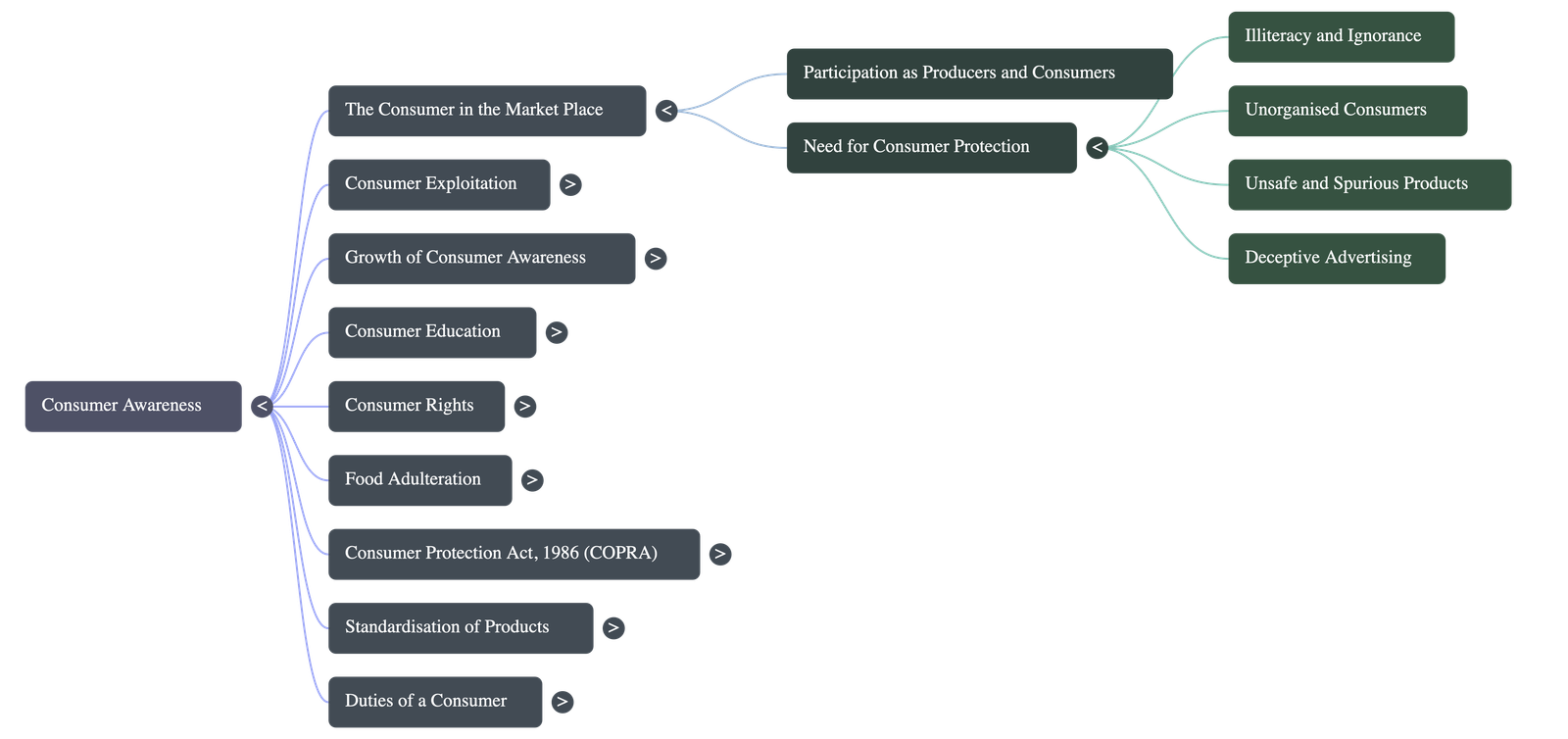
- Participation: We participate in the market both as producers (working in agriculture, industry, or services) and as consumers (purchasing goods and services).
- Need for Protection: Historically, consumers were left to protect themselves. Today, protection is essential because consumers often face:
- Illiteracy: Many consumers do not understand their rights.
- Unorganised Status: Consumers are scattered, whereas producers and traders are organised and powerful.
- Unsafe Products: The market has products dangerous to health and welfare.
- Spurious Goods: Increasing supply of fake or duplicate products makes it hard to distinguish original from fake.
- Deceptive Advertising: Misleading information about quality, safety, and utility traps innocent buyers.
2. Consumer Exploitation
- Meaning: Consumer exploitation happens when a consumer is cheated or provided with false information by the producer or seller.
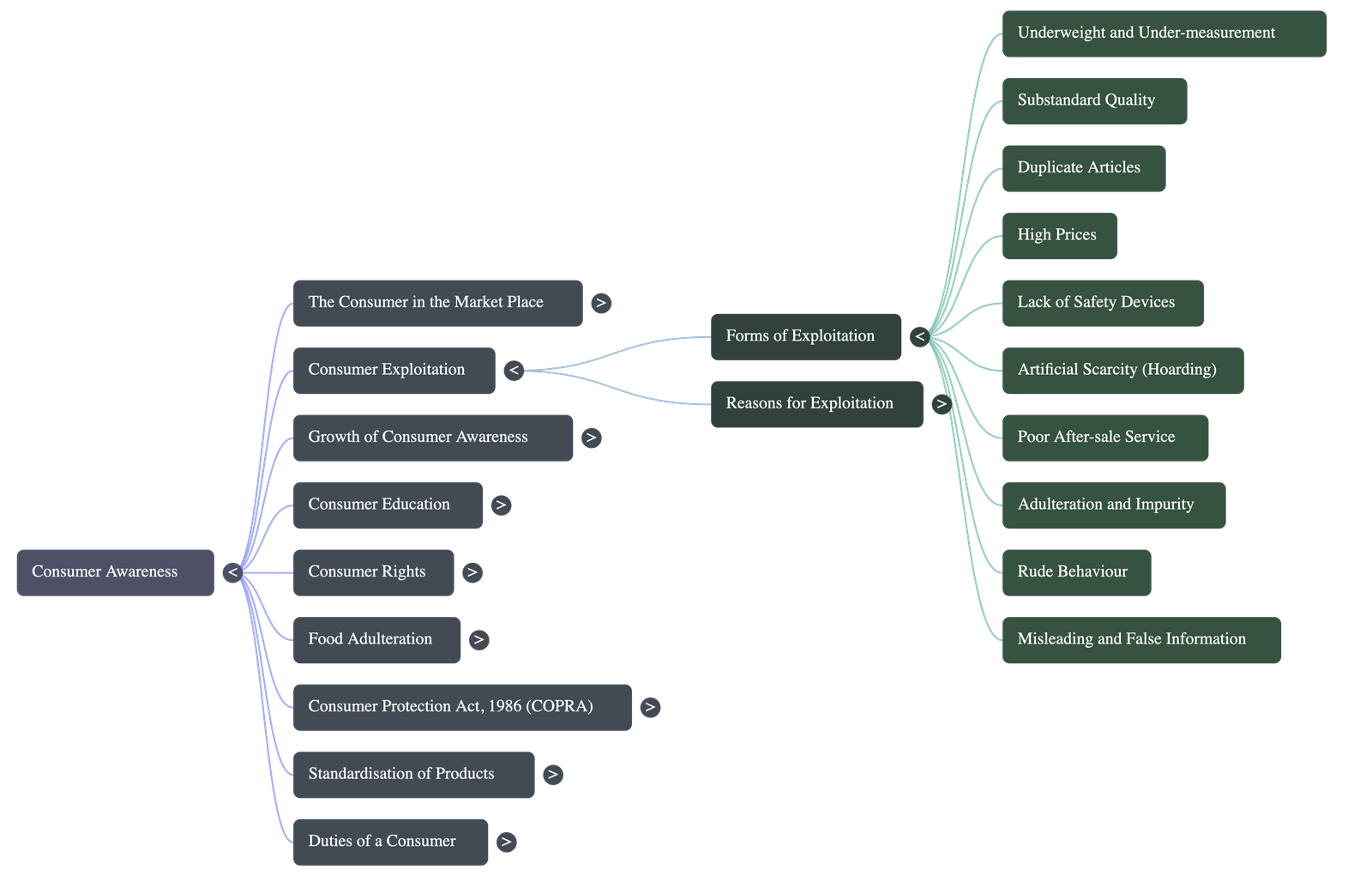
- Common Forms of Exploitation:
- Underweight and Undermeasurement: Goods are not weighed or measured accurately.
- Substandard Quality: Selling defective home appliances or medicines past their expiry dates.
- Duplicate Articles: Selling fake items under the name of genuine brands.
- High Prices: Charging higher than the prescribed retail price.
- Lack of Safety Devices: Producing poor quality electrical/electronic goods without caring for safety norms.
- Artificial Scarcity: Hoarding goods to create a fake shortage, only to sell them later at higher prices.
- Poor After-Sale Service: Failing to provide satisfactory services for high-cost durable items after purchase.
- Adulteration and Impurity: Mixing cheaper items (like stones in foodgrain, water in milk) to earn higher profits, risking consumer health.
- Rude Behaviour and Undue Conditions: Harassing consumers or putting unfair conditions (e.g., forcing a consumer to buy a stove when getting a gas connection).
- Misleading Information: Large companies spending heavily on advertisements to spread false claims and manipulate the market.
3. Reasons for Consumer's Exploitation
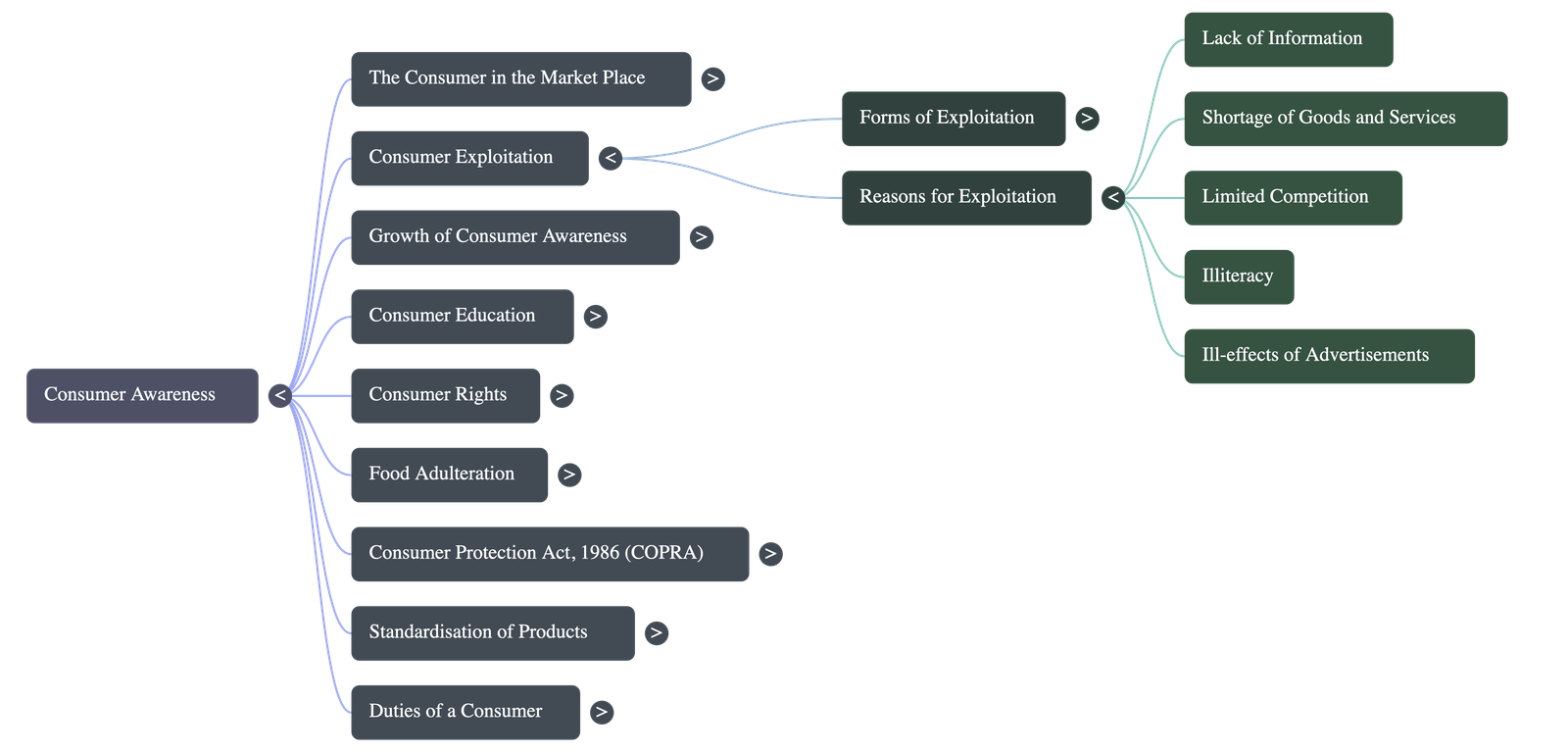
- Lack of Information: Consumers often make wrong decisions and lose money because they lack complete and correct information about product price, quality, composition, and terms of purchase.
- Shortage of Goods and Services: Limited supply compared to high demand leads to hoarding and price increases.
- Limited Competition: When a single producer or a small group (monopoly) controls the supply, they can easily manipulate prices and availability.
- Illiteracy: Low literacy levels directly affect a consumer's awareness about products, markets, and their own rights.
- Ill-effects of Advertisements: Consumers are often blindly attracted by flashy advertisements and buy items in a hurry without verifying the quality.
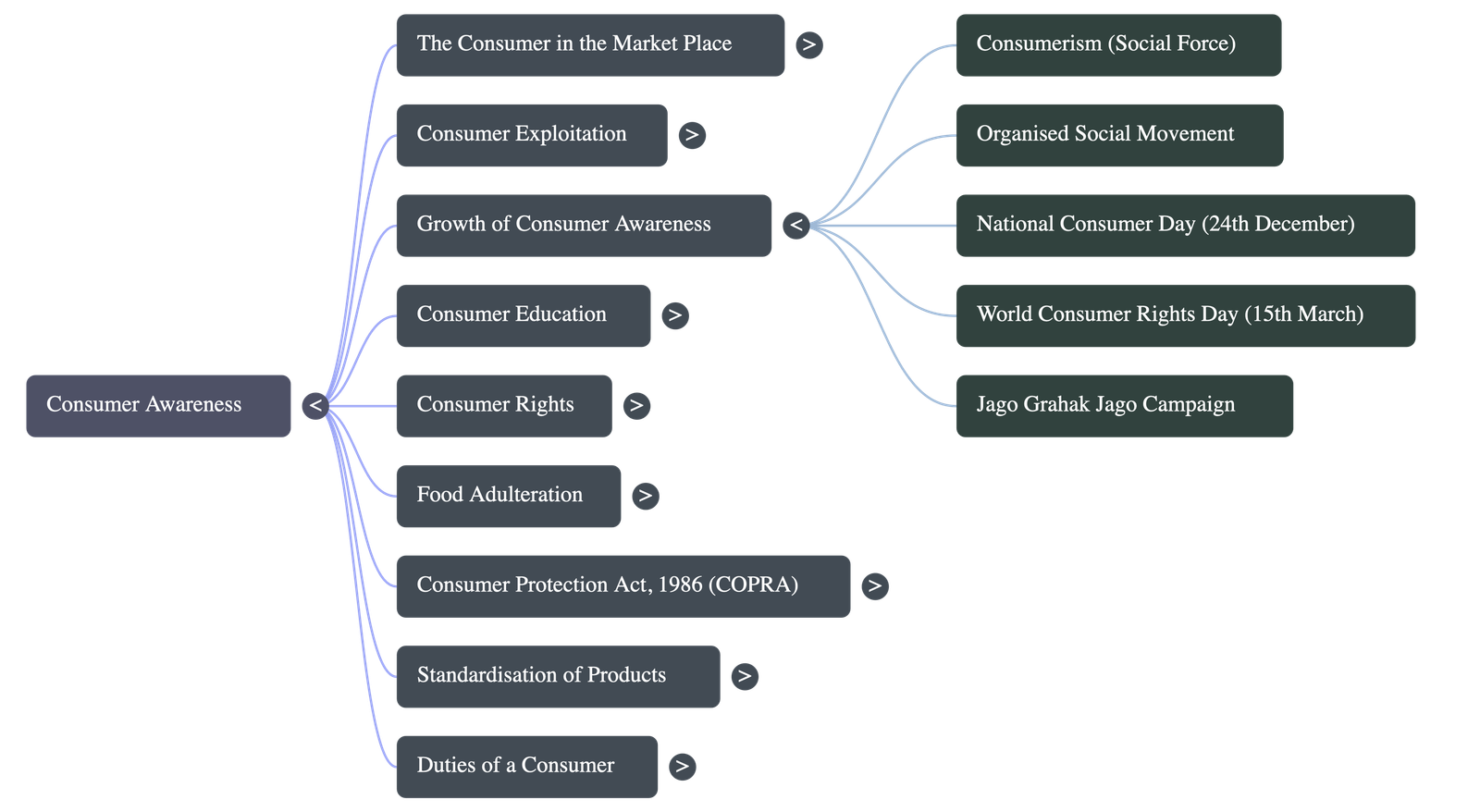
4. Growth of Consumer Awareness
- Meaning: Consumer awareness is the act of ensuring that a buyer is completely informed about products, services, and consumer rights.
- Consumer Movement: It refers to organized efforts by consumers to raise their voices and demand better products. It is needed to protect consumer interests, safeguard rights, prevent unfair trade, and ensure proper legislation.
- Consumerism in India: Began as a 'social force' in the 1960s and 1970s due to widespread dissatisfaction with food shortages, hoarding, and adulteration.
- Important Milestones:
- National Consumer Day: Celebrated in India on 24th December (the day the Consumer Protection Act, 1986 received the President's assent).
- Jago Grahak Jago: A massive multimedia awareness campaign launched in 2005 by the Department of Consumer Affairs (DCA) to educate citizens about fraudulent practices.
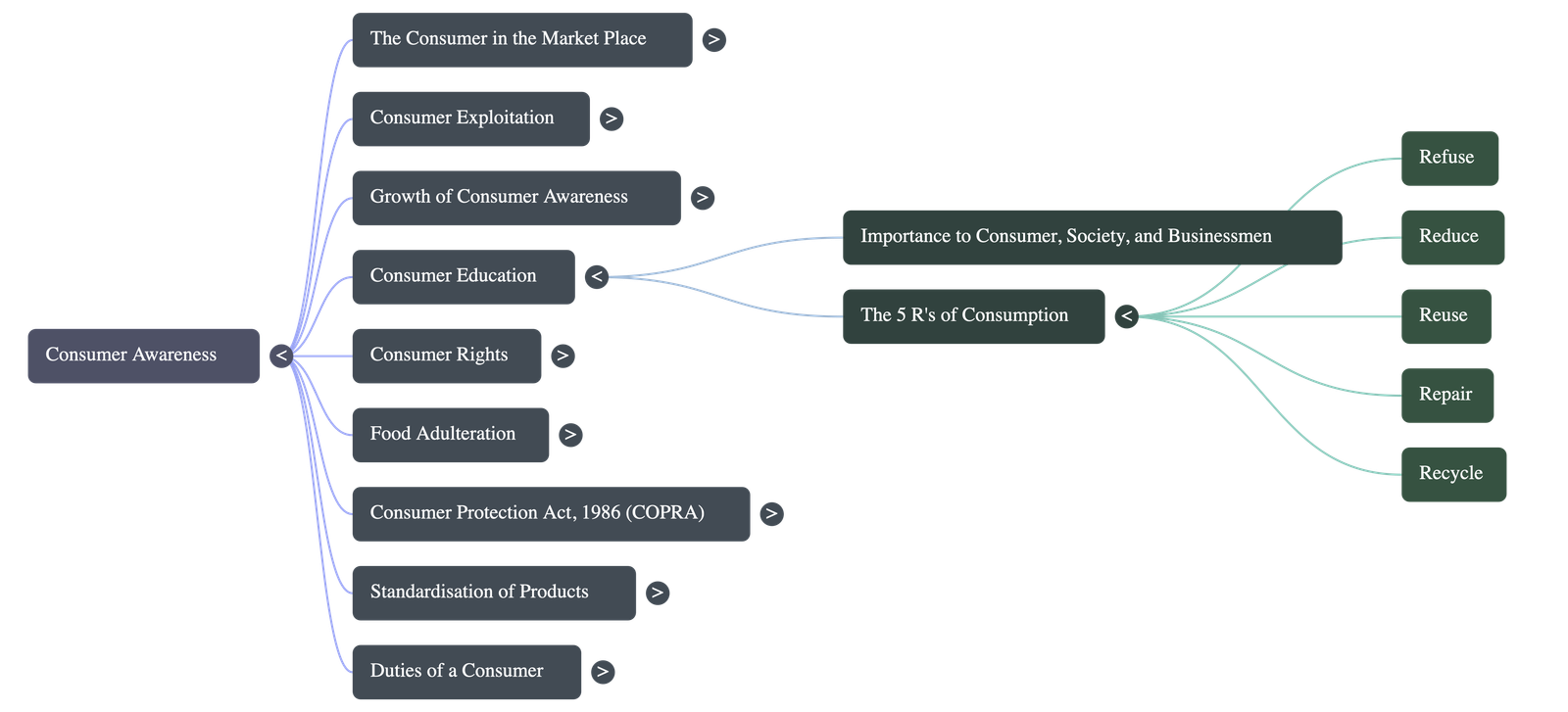
5. Consumer Education
- Meaning: It means making consumers aware of their rights and duties, and sharing key information about specifications, brands, and pricing.
- Importance:
- To Consumers: Protects from malpractices and helps make fact-based decisions.
- To Society: Enhances citizen awareness and promotes a stable society.
- To Businessmen: Satisfied, educated consumers actually help increase sales for honest businesses.
- The 5 R's of Consumption: Educated consumers protect the environment by adopting:
- Refuse: Avoid buying unnecessary goods (e.g., refusing plastic bags for cloth bags).
- Reduce: Try to lower the consumption of goods and electricity to save resources.
- Reuse: By reusing goods, demand for new products decreases, saving natural resources.
- Repair: Fixing old goods is cost-effective and eco-friendly.
- Recycle: Processing used goods (like paper) so they can be used again.
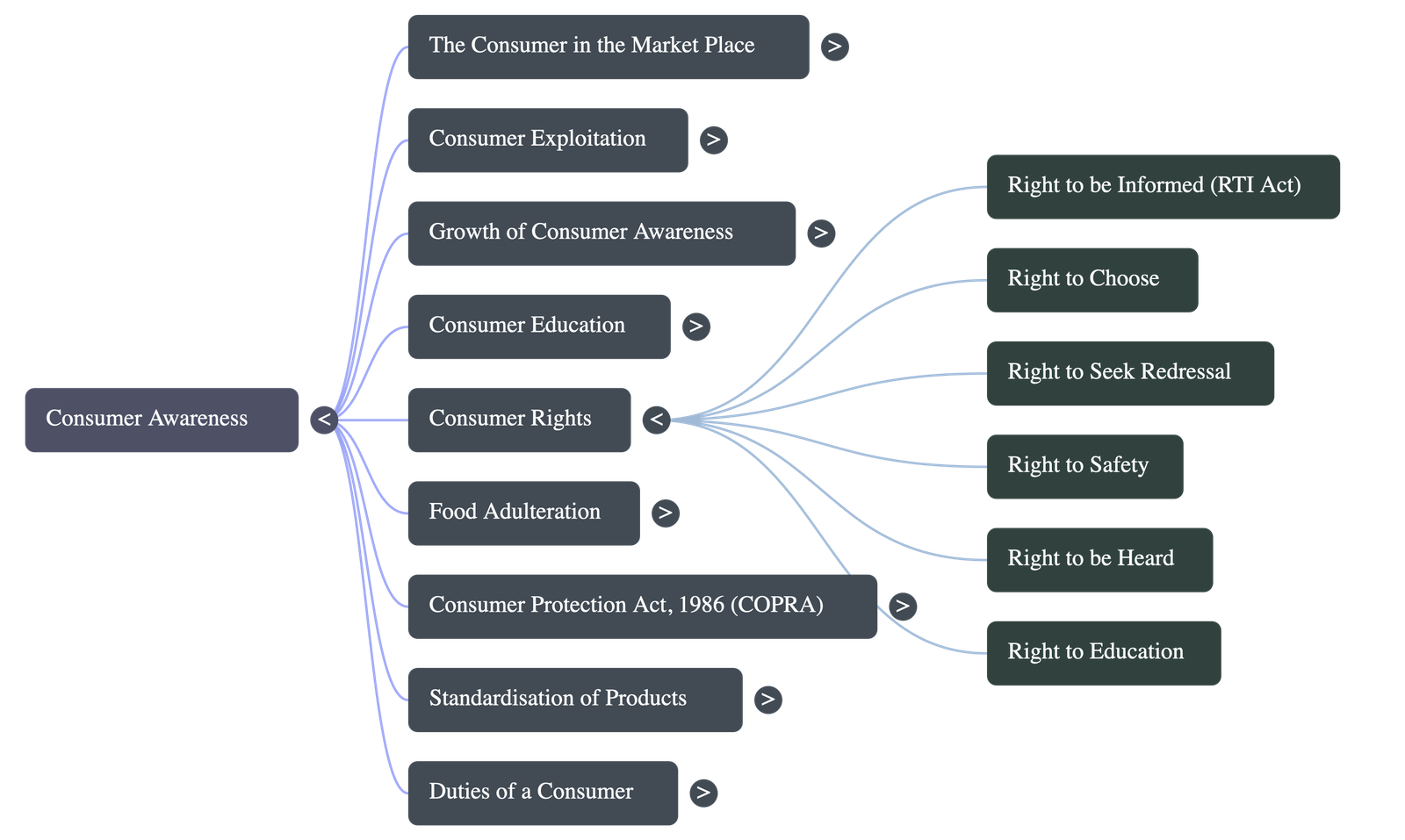
6. Consumer Rights
World Consumer Rights Day is celebrated on March 15 globally. Ralph Nader is considered the Father of the Consumer Movement.
- Right to be Informed: The right to know about the quality, quantity, potency, purity, standard, and price of goods. (Further expanded in India by the Right to Information/RTI Act of 2005).
- Right to Choose: The right to be assured of access to a variety of goods and services at competitive prices. A seller cannot force a buyer to purchase items they do not want.
- Right to Seek Redressal: The right to seek compensation or a remedy against unfair trade practices and exploitation. If a product is defective, the consumer can demand a replacement or refund.
- Right to Safety: The right to be protected against the marketing of goods and services that are hazardous to life, health, and property.
- Right to be Heard: The assurance that consumers' interests will receive due consideration at appropriate forums. Consumers can represent themselves in consumer courts without necessarily hiring a lawyer.
- Right to Education: The right to acquire the knowledge and skills necessary to be an informed consumer throughout life.
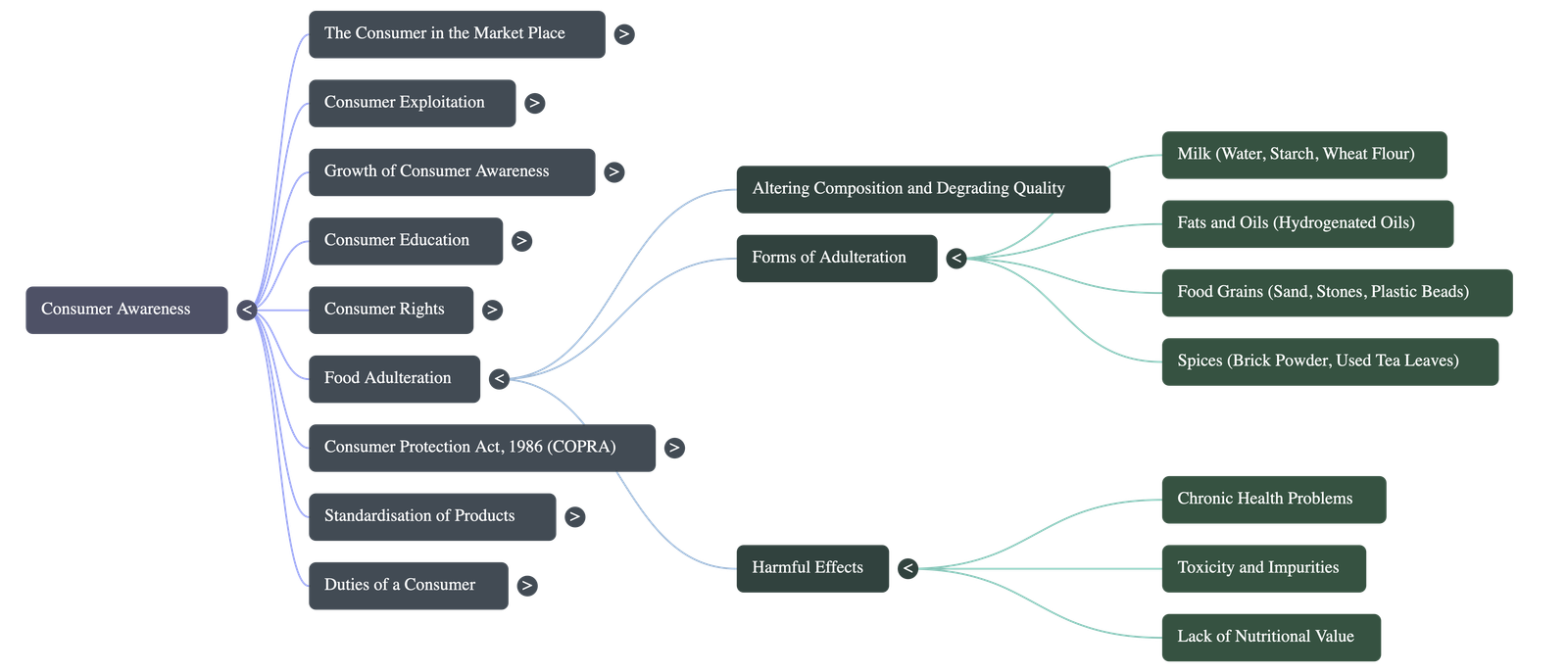
7. Food Adulteration
- Meaning: It is the act of altering food composition, which degrades its quality. This involves adding harmful/inferior substances or removing beneficial ones.
- Forms of Adulteration:
- Milk: Adding water, starch, or wheat flour and removing beneficial fats.
- Fats and Oils: Mixing ghee with animal fats or hydrogenated oils; adding synthetic colours.
- Food Grains: Mixing sand, crushed stones, or plastic beads that resemble grains; spraying water to increase weight.
- Other Items: Mixing brick powder in chilli powder or used tea leaves in fresh tea.
- Harmful Effects:
- Chronic Health Problems: Adulterants can cause toxicity leading to paralysis, liver damage, allergies, kidney disorders, or even heart failure.
- Increases Impurity: Makes food imperfect for consumption, leading to short-term or long-term side effects.
- Lack of Nutritional Value: Poor quality ingredients ruin the taste and strip the food of its necessary nutrients.
8. Consumer Protection Act, 1986 (COPRA)
- Overview: Passed by the Indian government to protect consumer rights. Came into force on July 1, 1987.
- Main Features:
- Applies to all goods and services across public, private, and co-operative sectors (including online transactions).
- Provides the legal framework for basic consumer rights.
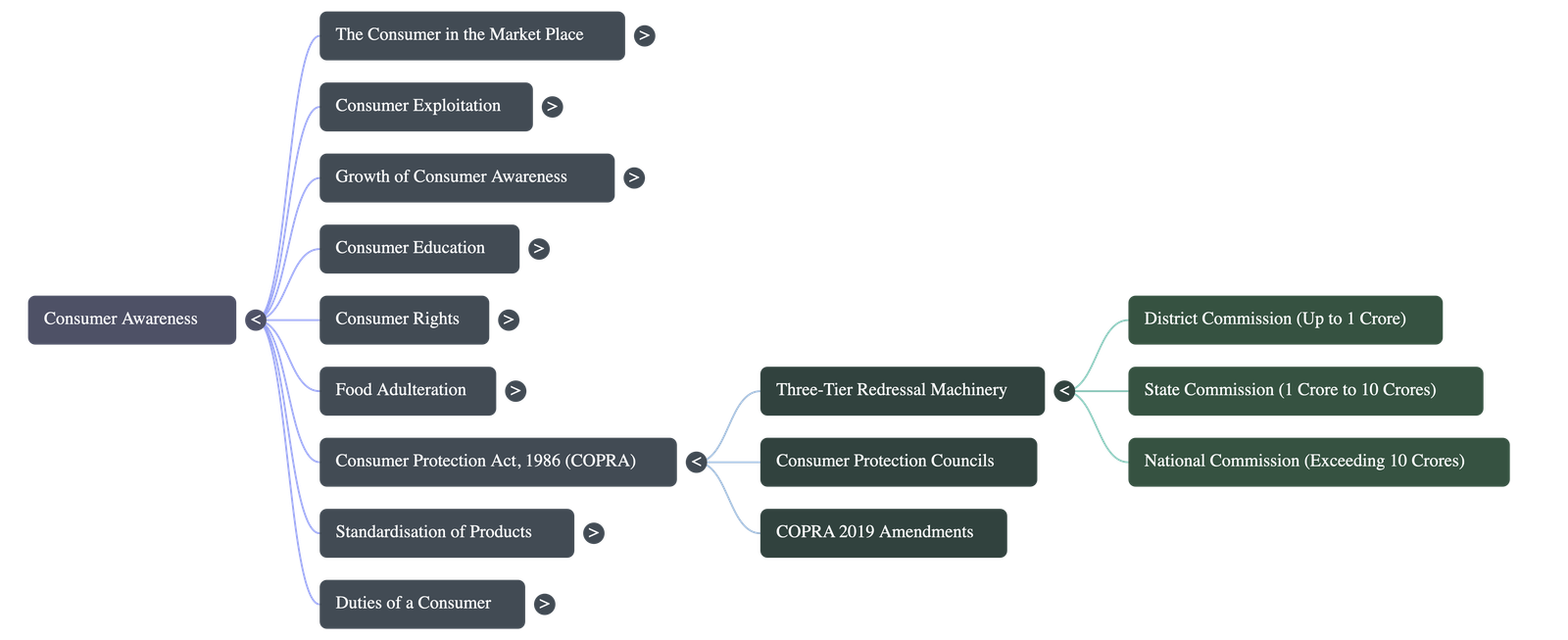
- Sets up a Three-Tier Quasi-Judicial Machinery for redressal:
- District Commission: Deals with claims up to ₹1 crore.
- State Commission: Deals with claims between ₹1 crore and ₹10 crore.
- National Commission (Apex body in Delhi): Deals with claims exceeding ₹10 crore. Appeals against this can be filed in the Supreme Court.
- Consumer Protection Councils: Groups working as a social force to guide consumers, represent them in courts, and create awareness (they do not have legal status).
- Other Measures:
- Administrative Measures: The Public Distribution System (PDS) ensures essential food grains are sold at fair prices to the poorest sections, preventing hoarding and black marketing.
9. Duties of a Consumer
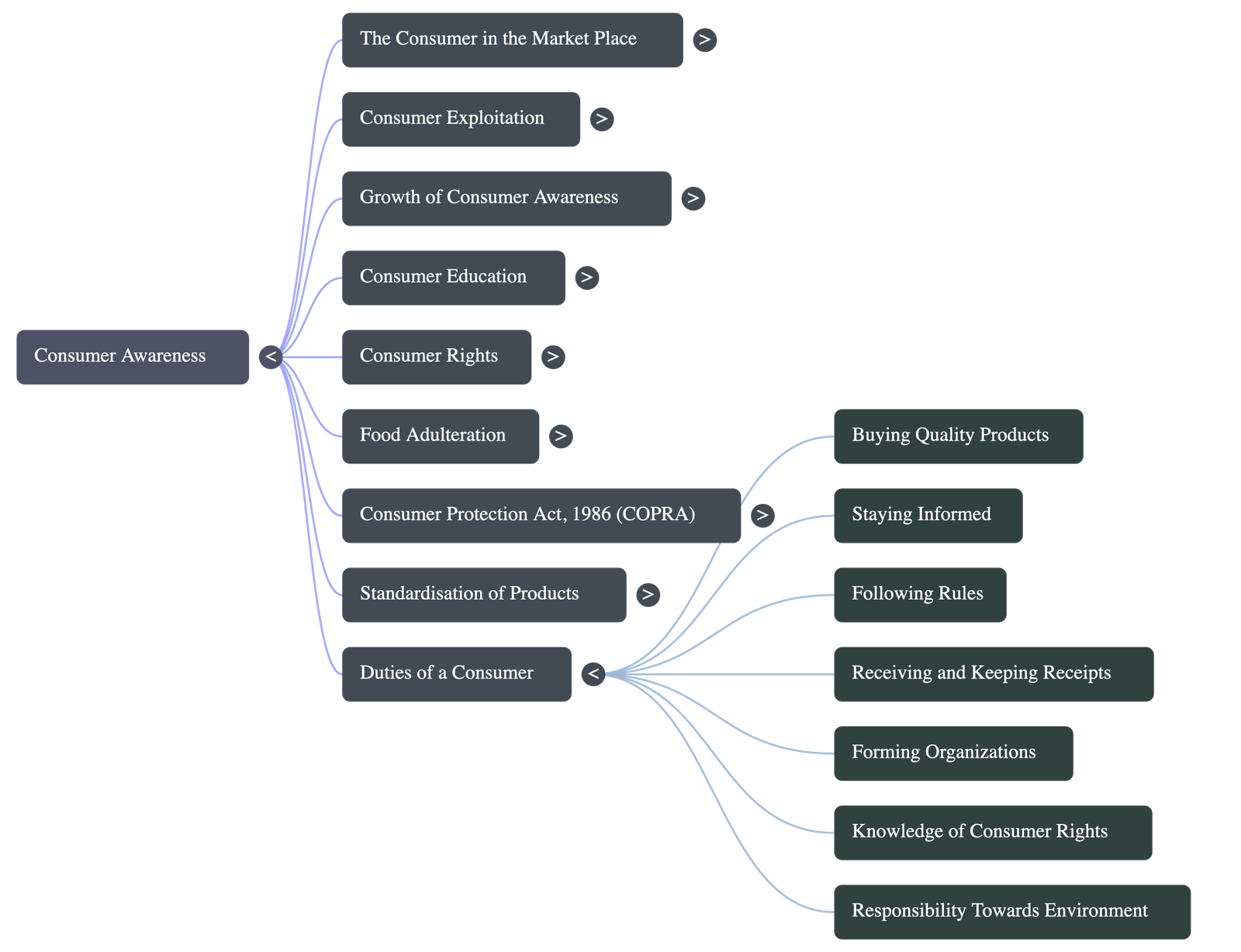
A good consumer not only knows their rights but also fulfills their responsibilities:
- Buying Quality Products: Always look for standardisation marks like ISI, Hallmark, AGMARK, or FSSAI when purchasing.
- Duty to Stay Informed: Gather complete information about the products and services before buying.
- Duty to Follow the Rules: Do not break rules or exploit loopholes to get an unfair advantage while purchasing.
- Duty to Receive a Receipt: Always ask for a cash memo or bill. It serves as crucial evidence in case of a future dispute.
- Duty to Form an Organisation: Consumers should form groups to give a united voice to their grievances and demands.
- Knowledge of Consumer Rights: Lodge a formal complaint rather than remaining a silent spectator if cheated by a seller.
- Duty to Be Responsible Towards Environment: Consume mindfully to avoid harming the environment and natural resources.
10. Standardisation of Products
- Meaning: It is the process of implementing and developing technical standards to ensure product quality and consumer safety. It saves consumers from malpractices and assures high quality.
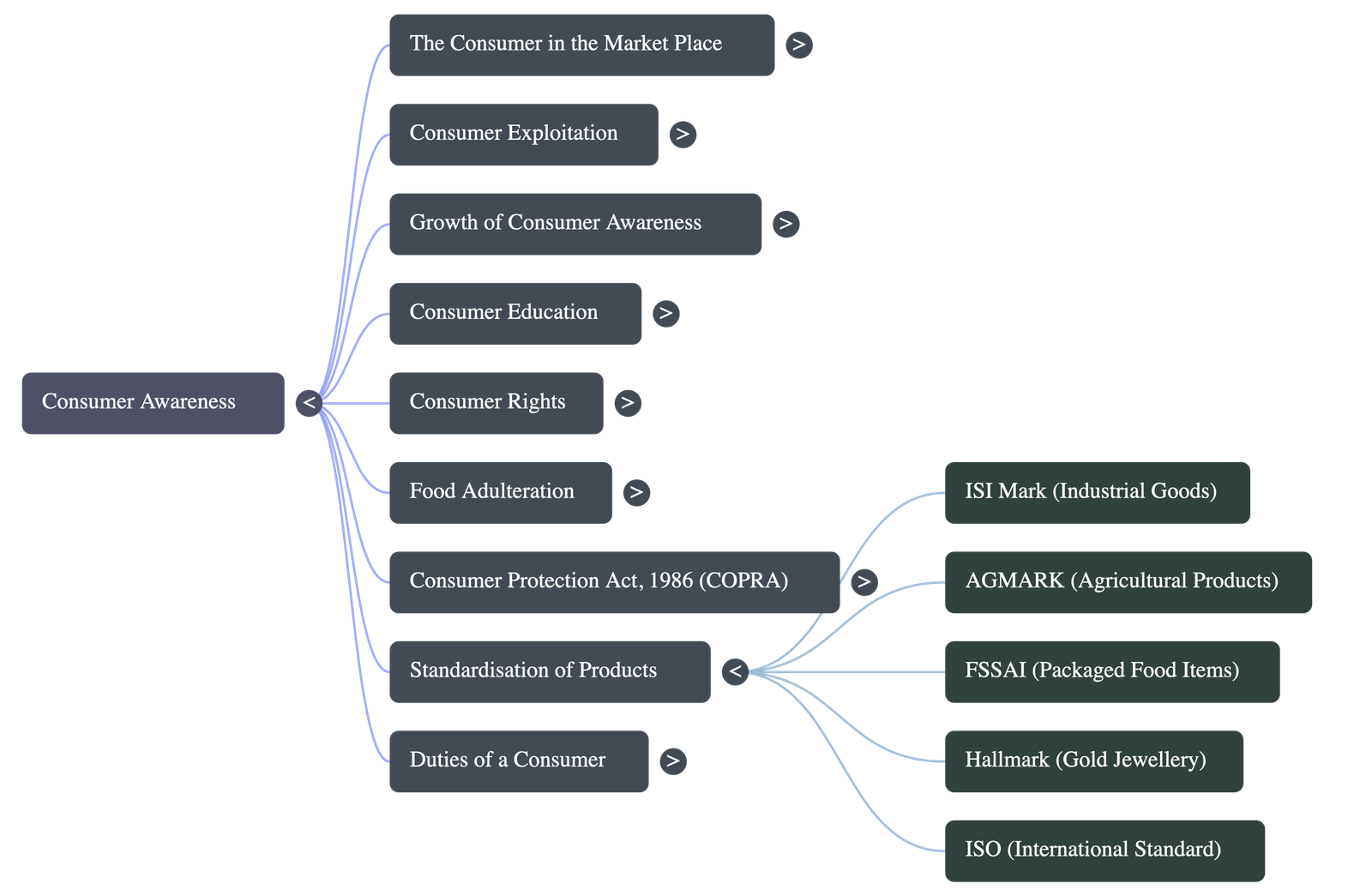
- Important Standardisation Marks in India:
- ISI Mark: Issued by the Bureau of Indian Standards (BIS). Used for certifying industrial and consumer goods (e.g., electrical appliances).
- AGMARK: Run by the Directorate of Marketing and Intelligence (DMI). It is the grade standard for agricultural produce (e.g., honey, ghee, spices).
- FSSAI Mark: Provided by the Food Safety and Standards Authority of India for packaged food items.
- Hallmark: A voluntary certification started in April 2000 to assure the purity and quality of Gold Jewellery.
- International Standard: The ISO (International Organisation for Standardisation) provides global standards (like ISO 9000). Products with the ISO mark can be easily sold in international markets.
- Benefits: Standardisation helps producers improve their image and easily sell goods. It benefits consumers by giving them guaranteed quality and eliminating the fear of being cheated.
Do checkout all questions & answers of this chapter.
Quick Navigation:
| | | |
1 / 1
Quick Navigation:
| | | |
Quick Navigation:
| | | |