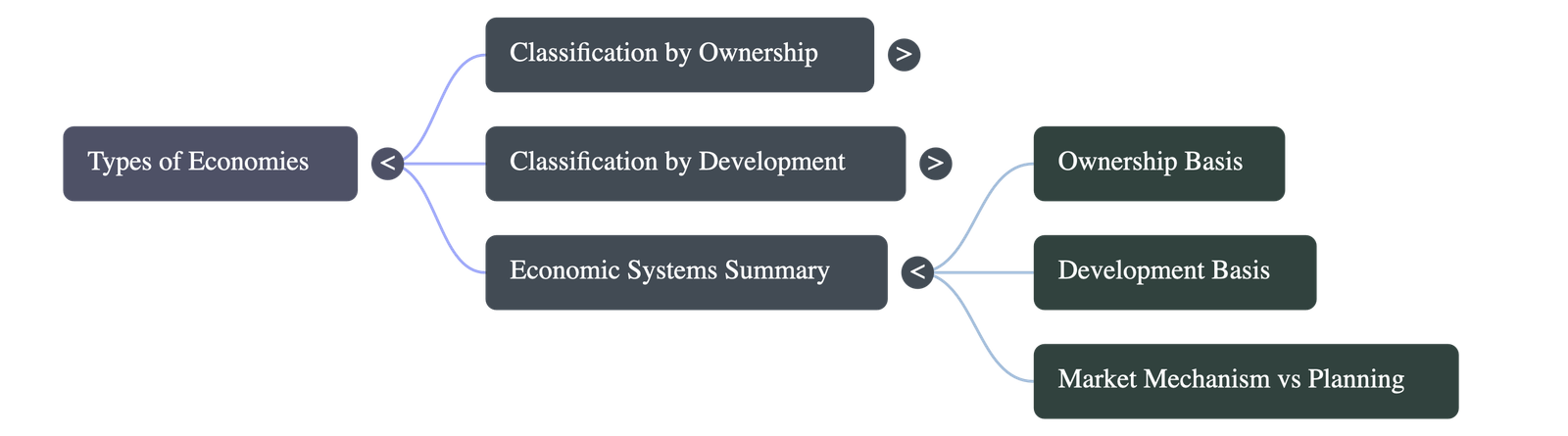
Types of Economies
Introduction: An economic system is the way a nation organizes the production, distribution, and consumption of goods and services. Economies can be classified in two main ways: On the Basis of Ownership and On the Basis of Level of Development.
1. Classification on the Basis of Ownership
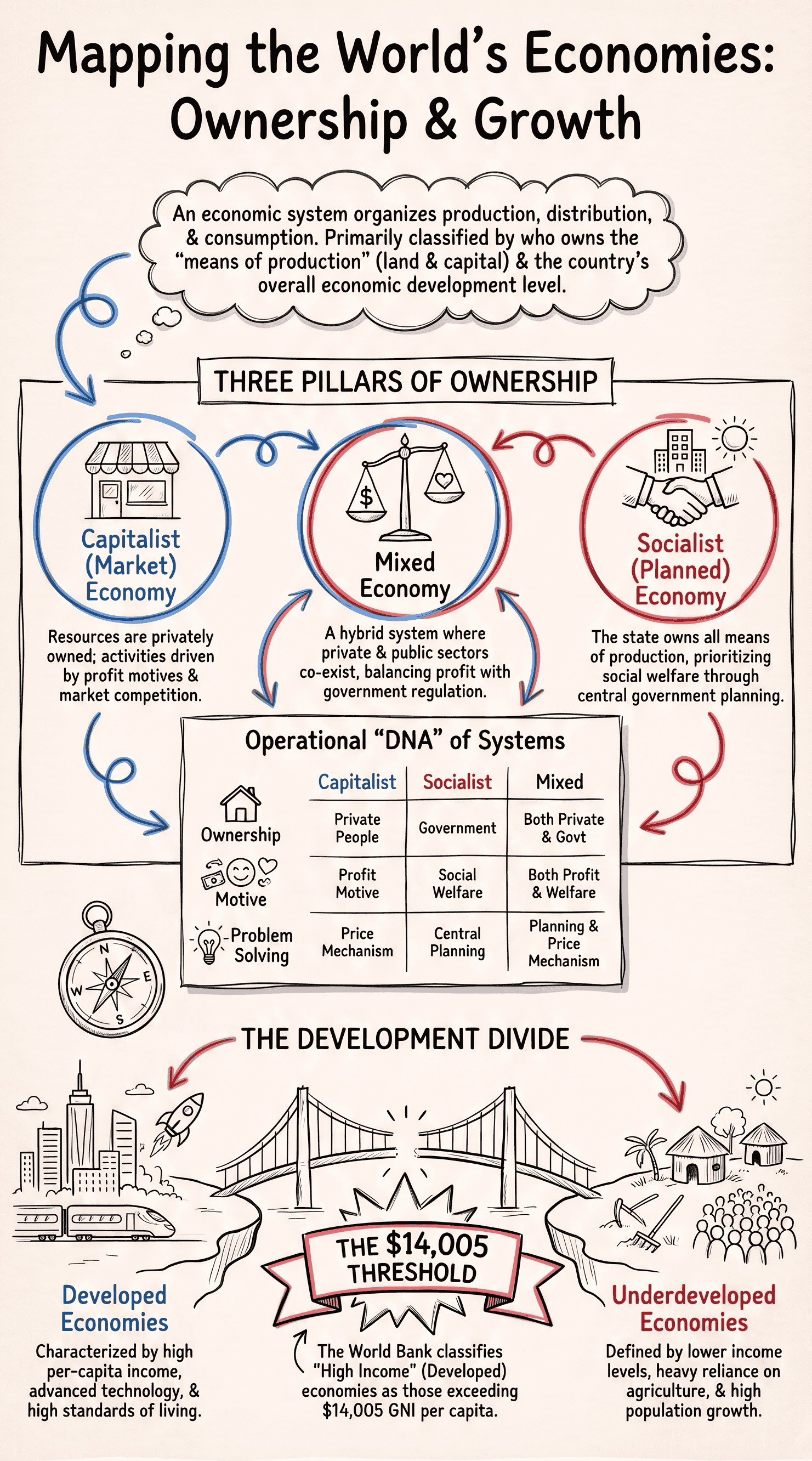
Based on who owns the means of production, economies are divided into three types: Capitalistic, Socialistic, and Mixed.
1.1 Capitalistic Economy (Market Economy)
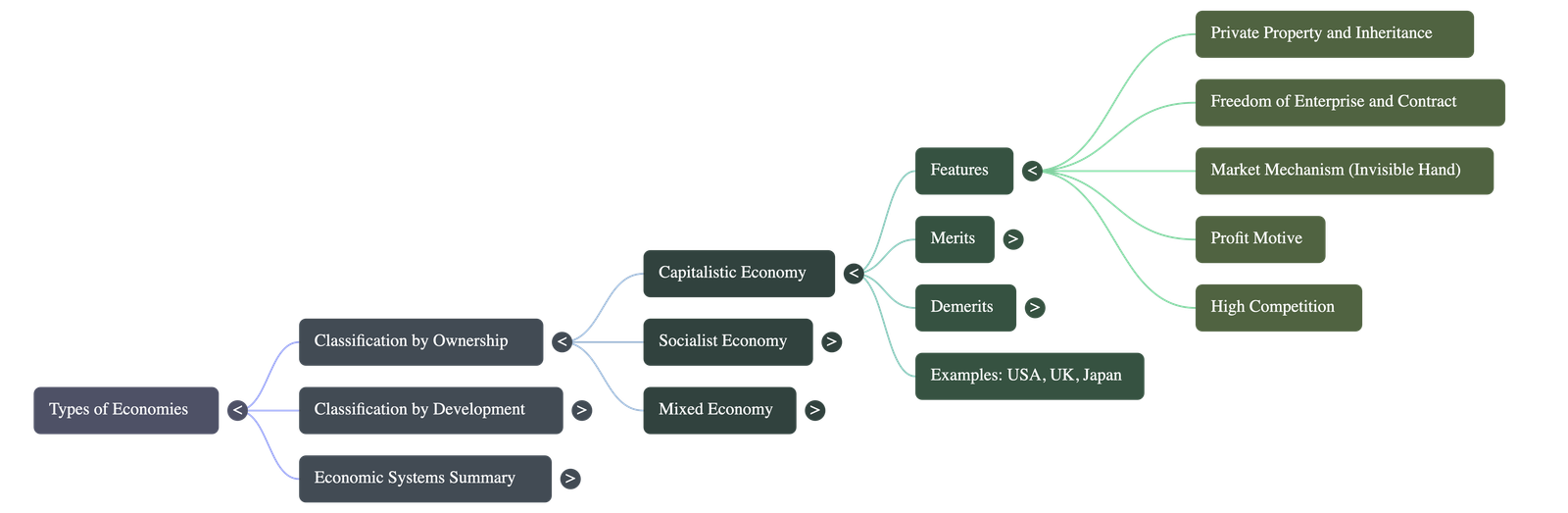
Meaning: It is an economic system where the means of production (land, capital) are owned by private individuals. The government does not interfere in economic activities, which is why it is also called a free economy or laissez-faire economy. Everything is driven by demand, supply, and the profit motive.
Key Features:
- Private Property and Inheritance: Individuals have the right to acquire private property and pass it on to their heirs.
- Freedom of Enterprise and Contract: Everyone is free to start any legal business of their choice.
- Freedom of Consumption: Consumers are treated as "kings" and can consume goods according to their choice.
- Market Mechanism: Prices are determined by market forces (demand and supply), functioning as an "invisible hand."
- Profit Motive: The main goal of producers is to maximize their profits.
- Competition: There is high competition among producers, ensuring only efficient firms survive.
Merits (Advantages):
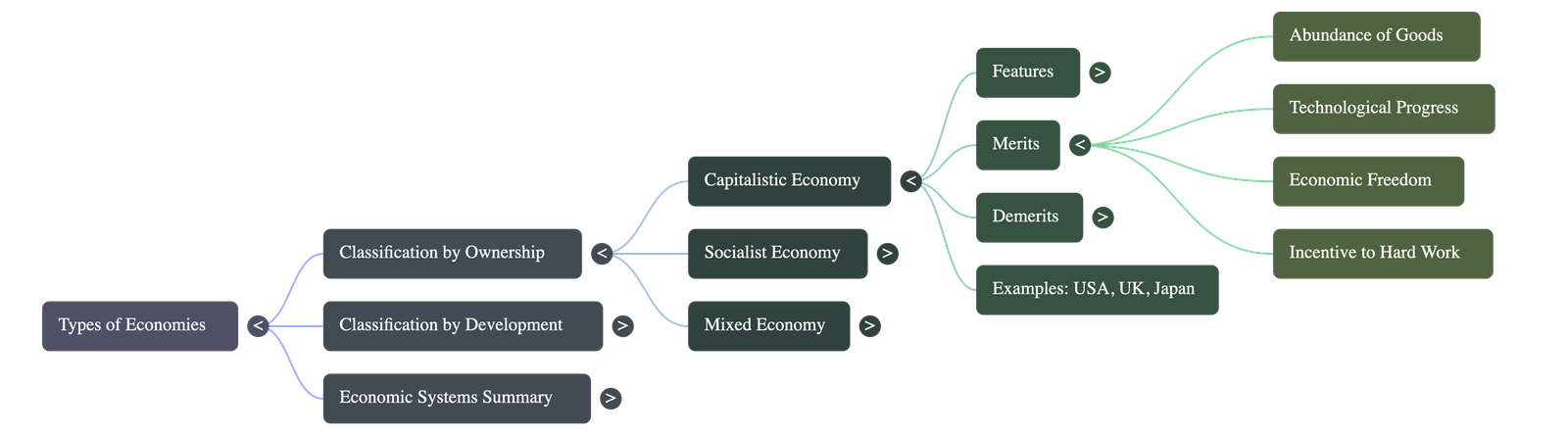
- Abundance of Goods: Producers make items highly demanded by consumers.
- Best Resource Utilization: Factors of production are used efficiently because everyone works for their own interest.
- Technological Progress: Competition forces producers to invent new techniques and products.
- Cheap and Best Goods: Large-scale production and competition lead to high-quality goods at lower costs.
- Incentive to Hard Work: Entrepreneurs work harder to earn more profits.
- Economic Freedom: Complete freedom for both producers and consumers.
- High Standard of Living: Leads to increased production and national income (e.g., USA, UK, Japan).
Demerits (Disadvantages):
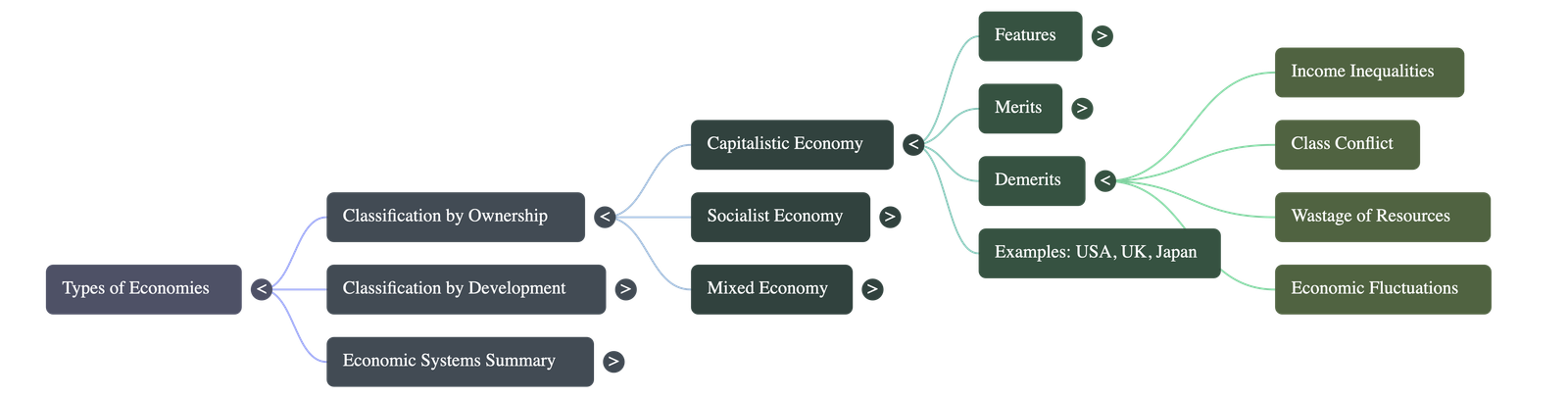
- Income Inequalities: Wealth accumulates in the hands of a few; the rich get richer, and the poor get poorer.
- Class Conflict: Society is divided into the "haves" and "have-nots," leading to strikes and unrest.
- Unemployment: Unplanned production can lead to over-production and job losses.
- Exploitation: Capitalists exploit the working class by taking away a major portion of the wealth.
- Wastage of Resources: Resources are diverted to luxury goods instead of necessary goods for the poor.
- Economic Fluctuations: Price instability and market uncertainty are common.
- Self-interest over Social Welfare: Social welfare is completely ignored.
- Unbalanced Development: Only profitable regions are developed, causing regional imbalances.
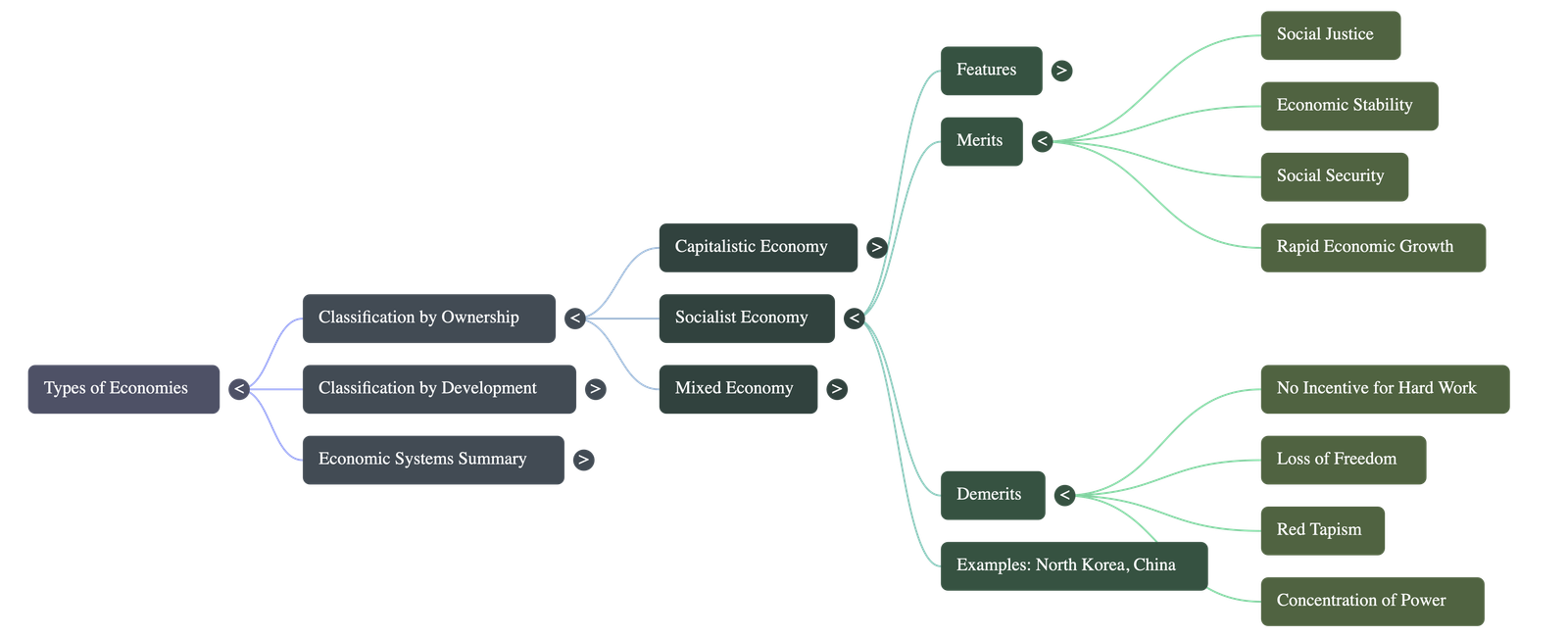
1.2 Socialist Economy
Meaning: It is an economic system where the means of production are owned and managed by the whole community (the state/government). All economic activities are planned by a central authority for the benefit of the whole society, aiming to remove exploitation. (e.g., Cuba, China, Vietnam).
Key Features:
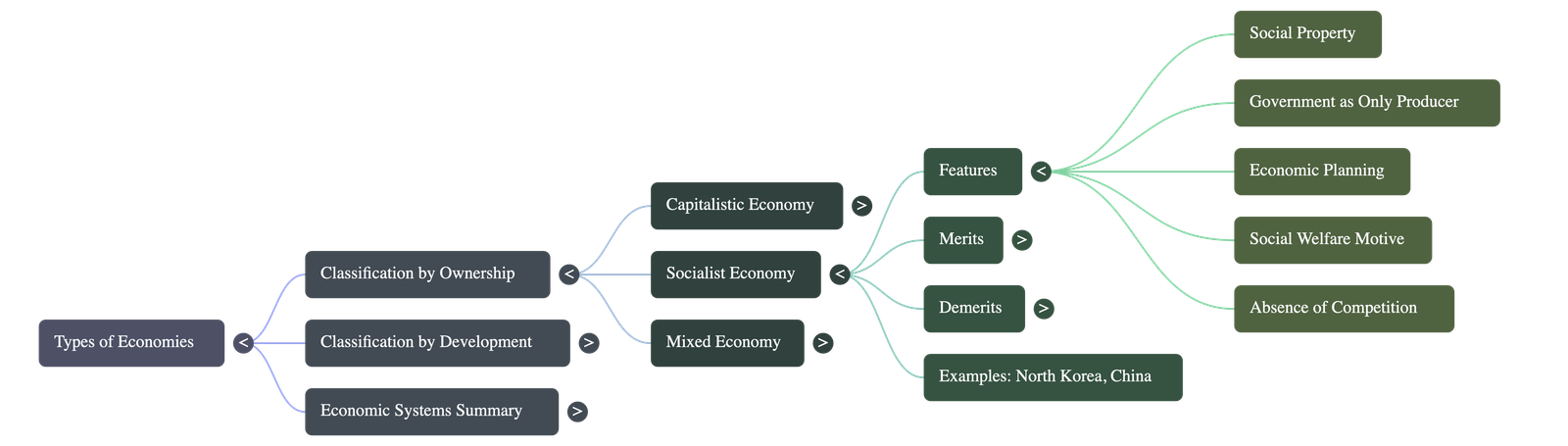
- Social Property: Private property is abolished; land, mines, and factories belong to the state.
- Government is the Only Producer: The government controls the production of all commodities.
- Social Welfare: The profit motive is replaced by the aim to maximize social welfare.
- Economic Planning: All development is carried out according to a Central Plan.
- Economic Equalities: Aims to provide equal employment opportunities and fair distribution of wealth.
- Absence of Competition: Since the government is the sole producer, there is no competition, only mutual cooperation.
Merits (Advantages):
- Better Allocation of Resources: Resources are allocated rationally for social welfare, with no wasteful spending on advertising.
- Social Justice: Inequalities are minimized, and exploitation of man by man is eliminated.
- Economic Stability: Planned economy prevents over-production, price fluctuations, and unemployment.
- Social Security: The government guarantees housing, education, health, and old-age pensions to everyone.
- Rapid Economic Growth: Planned use of resources eliminates wastage and raises saving/investment rates.
Demerits (Disadvantages):
- No Incentive for Hard Work: Since jobs are protected and dictated by the state, people lose the motivation to be efficient.
- Loss of Freedom: Consumers cannot choose what they want, and people lack basic civil and political freedoms.
- Loss of Efficiency: Bureaucrats running the production units are not as efficient or motivated as private entrepreneurs.
- Red Tapism: Heavy government involvement causes severe delays and wastage of time in decision-making.
- Concentration of Power: The government holds absolute authority, which can lead to political dictatorship.
Note on Equality of Income in Socialism: While socialism aims for equality, it does not mean everyone gets the exact same income. Skilled workers earn more than unskilled workers to maintain incentives. However, income inequality from inherited wealth does not exist.
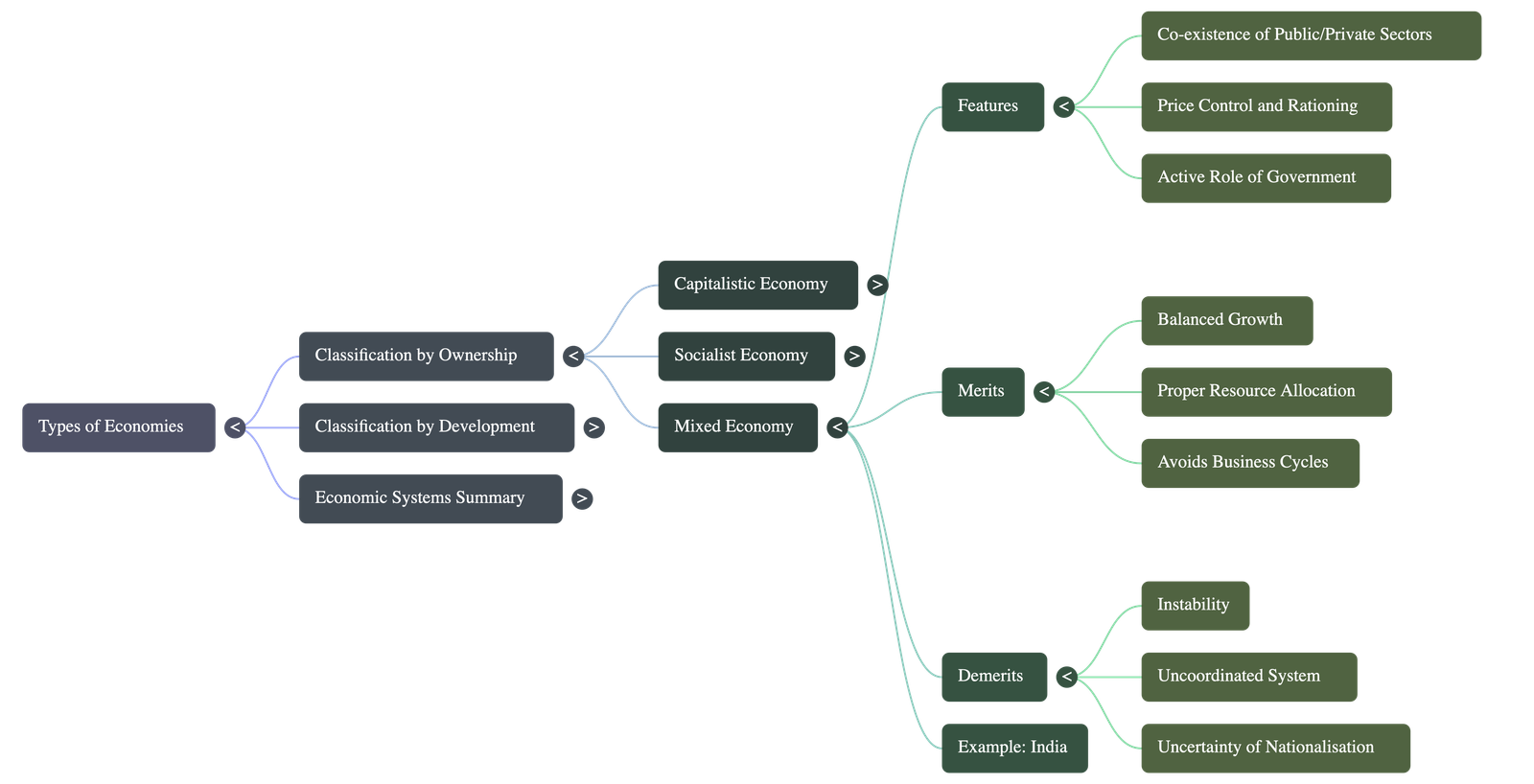
1.3 Mixed Economy
Meaning: An economic system that combines the best aspects of both capitalism and socialism. It features the coexistence of private enterprise and government control to achieve social aims without entirely sacrificing economic freedom. (e.g., India).
Key Features:
- Co-existence of Private and Public Sectors: Defense and basic industries are run by the government, while agriculture and consumer goods are run by private individuals.
- Co-existence of Price System and Planning: Both market mechanisms and central planning operate simultaneously.
- Price Control and Rationing: The government controls prices of essential goods to protect consumers.
- Role of the Government: The government actively regulates the private sector to promote overall social welfare.
- Reduction of Inequality: The state uses progressive taxation and other policies to reduce the gap between rich and poor.
Merits (Advantages):
- Proper Allocation of Resources: Keeps the overall interest of the economy in mind.
- Avoids Business Cycles: The government intervenes to prevent severe inflation or depression.
- Suitable for Less Developed Countries: The public sector builds large infrastructure, while the private sector develops agriculture and services.
- Social Interest and Welfare: Essential utilities are kept in the public sector to prevent harm to society.
- Good Compromise: Balances personal gain with social responsibility.
- Balanced Growth: The government invests in backward regions ignored by private enterprises.
- Flexible: Industries can be moved between public and private sectors depending on the country's needs.
Demerits (Disadvantages):
- Instability: Constantly faces the risk of complete nationalization or private sector non-cooperation.
- Uncoordinated System: Lacks the singular direction found in pure capitalism or pure socialism.
- Economic Fluctuations: The private sector is still prone to short-term demand and supply shocks.
- Uncertainty: Private industries operate under the constant fear of heavy government regulation or takeover.
- Loss of Efficiency: The public sector suffers from irresponsibility, while the private sector is slowed down by government permits and licenses.
1.4 Distinction Between the Three Economies
- Ownership: Capitalism is private; Socialism is government; Mixed is both.
- Motive: Capitalism is driven by self-interest; Socialism by social welfare; Mixed by both.
- Consumer Sovereignty: High in Capitalism; absent in Socialism; restricted/limited in Mixed.
- Competition: High in Capitalism; absent in Socialism; low degree in Mixed.
2. Classification on the Basis of Level of Development
The World Bank groups countries based on Per Capita Income into low, lower-middle, upper-middle, and high-income groups. Broadly, they are classified into two categories: Developed and Underdeveloped (Developing).
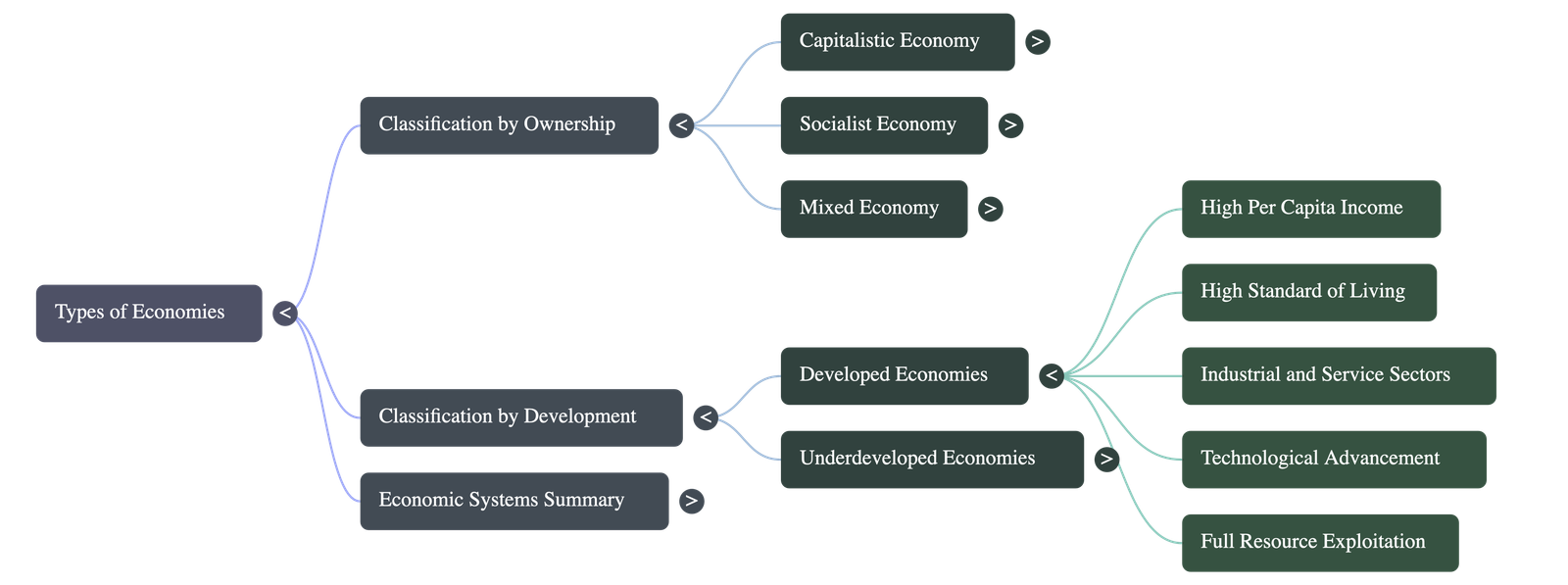
2.1 Developed Economies
Meaning: Economies that enjoy a high level of per capita income and a very high standard of living. Examples include the USA, Canada, UK, Japan, and Germany.
Key Features:
- High Per Capita Income: National and average individual incomes are extremely high.
- High Standard of Living: Citizens enjoy advanced healthcare, education, and nutrition.
- Predominance of Industrial and Service Sectors: Agriculture is a minor occupation (e.g., only 2% in the UK); most wealth comes from industries and services.
- Full Exploitation of Resources: Natural and human resources are optimally utilized, resulting in full employment.
- Technological Advancement: Production techniques are highly complex, modern, and highly productive.
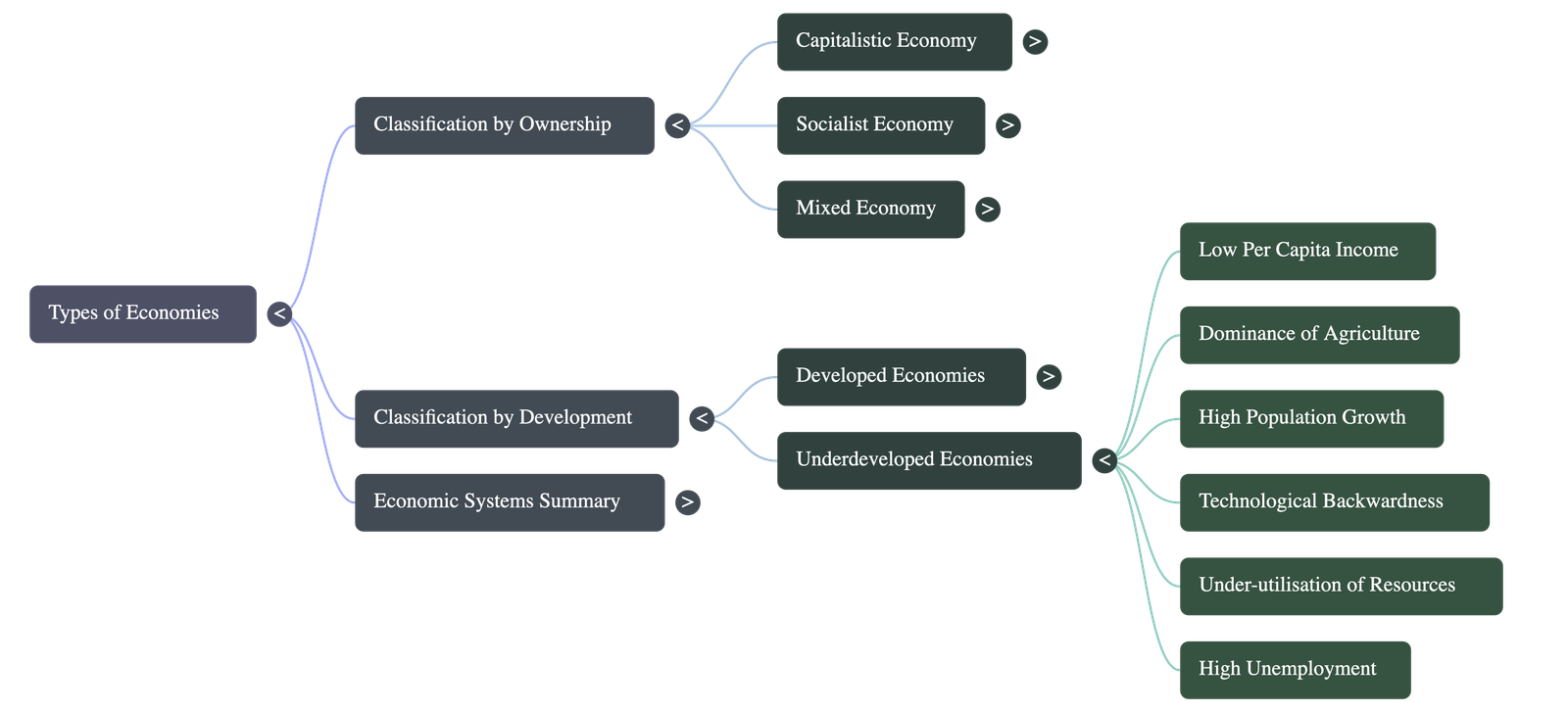
2.2 Underdeveloped (or Developing) Economies
Meaning: Economies with very low per capita income where the population lives in miserable conditions. They are passing through a process of growth and development. Examples include India, Pakistan, Myanmar, Sri Lanka, and Brazil.
Key Characteristics:
- Low Per Capita Income: Most people live below the poverty line due to low productivity and outdated technology.
- Low Level of Living: High rates of ill-health and malnutrition; very poor Human Development Index (HDI).
- High Population Growth Rate: Better medical facilities have reduced death rates, but birth rates remain extremely high, causing overpopulation.
- Dependence on Agriculture: Agriculture is the main occupation (employing 70-85% of people) but suffers from low productivity. Exports are mostly raw materials.
- Unequal Distribution of Income: A massive gap exists between the very rich and the extremely poor.
- Unemployment and Under-employment: Chronic job shortages due to rapid population growth and defective education systems.
- Low Productivity: Output per worker is minimal due to poor health, lack of incentives, and lack of inputs.
- Technological Backwardness: Lack of capital forces the use of old, inefficient technology.
- Under-utilisation of Resources: Abundant natural and human resources sit idle or are wasted.
- Underdeveloped Infrastructure: Severe shortages of transport, communication, and regular power supply.
2.3 Distinction Between Developed and Underdeveloped Economies
- Income & Poverty: Developed economies have high income and low poverty; Underdeveloped have low income and widespread poverty.
- Occupation: Developed rely on industry/services; Underdeveloped rely heavily on agriculture.
- Technology & Productivity: Developed use advanced tech and have high labor productivity; Underdeveloped use outdated tech with very low productivity.
- Population: Developed have low population growth; Underdeveloped suffer from overpopulation.
- Human Capital: Developed have highly educated and healthy populations; Underdeveloped struggle with illiteracy and poor health facilities.
Do checkout all questions & answers of this chapter.