Economic Infrastructure
1. Introduction
- Infrastructure is highly significant for the prosperity of an economy.
- The development of agriculture and industry depends heavily on basic facilities like transport, communications, banking, and power.
- For example, transport moves materials and people, communication connects buyers and sellers, and power runs factories and farms.
2. Meaning and Components of Infrastructure
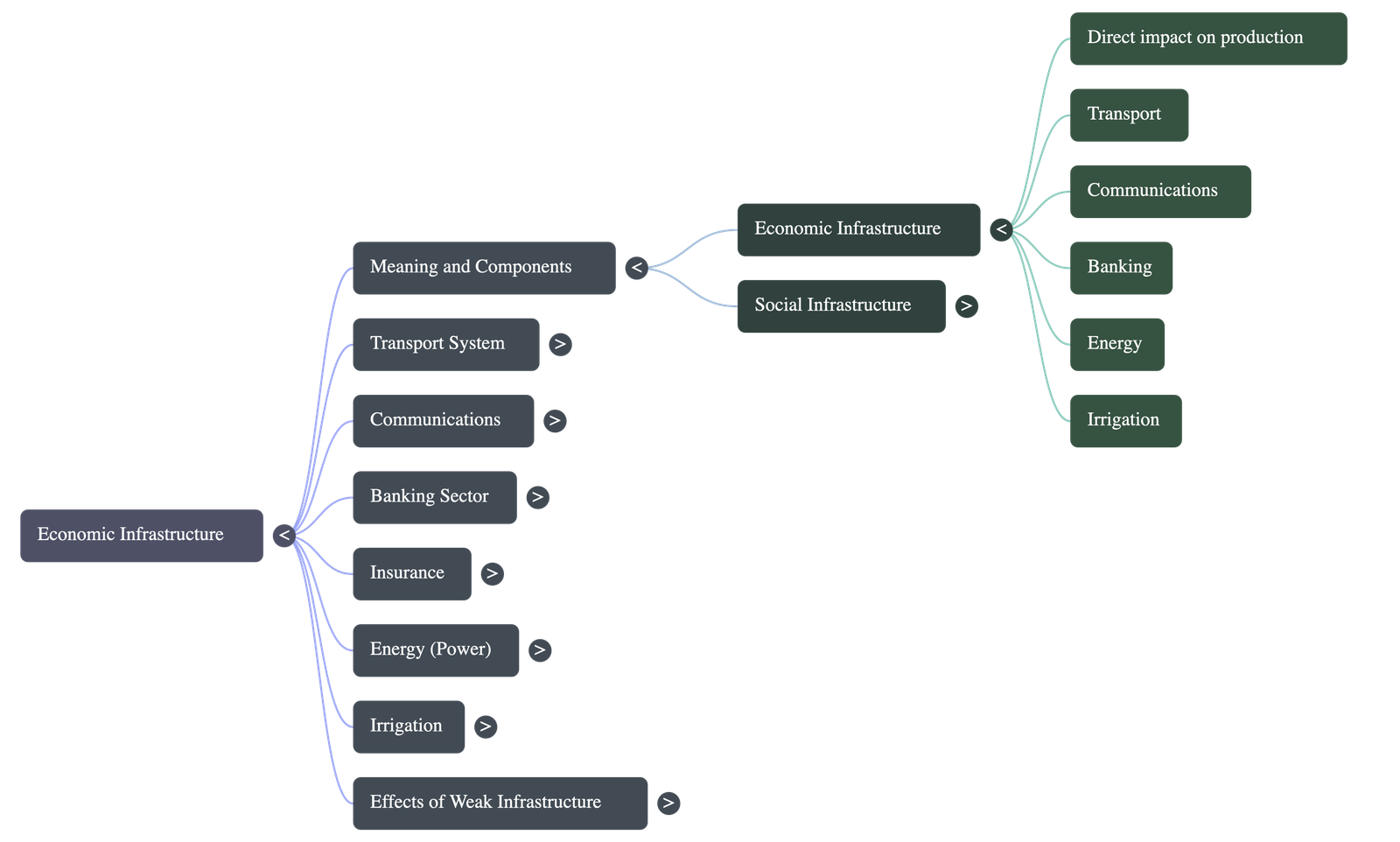
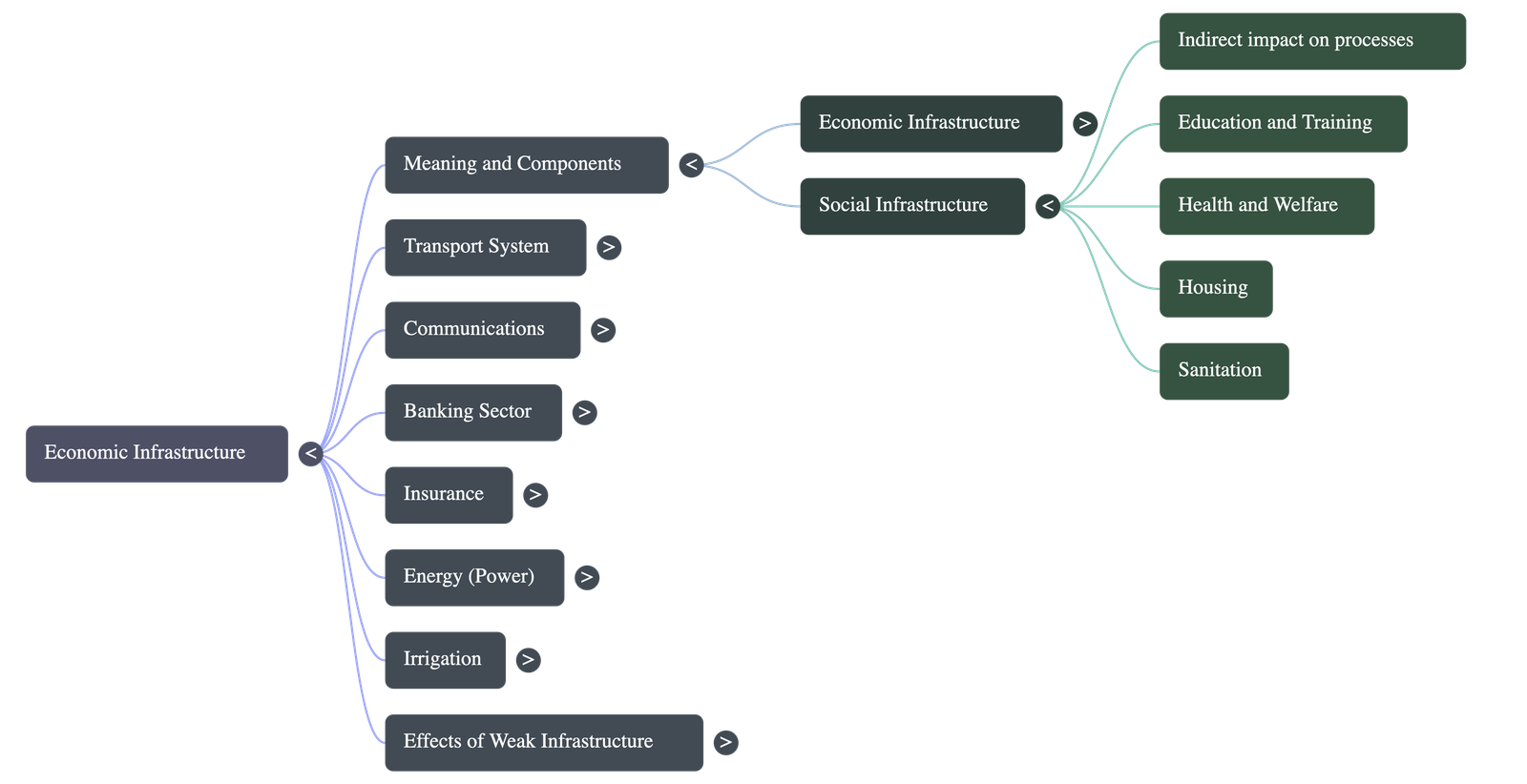
Infrastructure is broadly divided into two main categories:
- Economic Infrastructure: Facilities that directly affect the production and distribution system (e.g., Transport, Communications, Energy). These are located within the system of production.
- Social Infrastructure: Facilities that contribute to the economic processes indirectly from outside the system (e.g., Education, Health and Family Welfare, Housing, Civic Amenities).
3. Economic Infrastructure of the Indian Economy
- It consists of basic facilities entirely necessary for economic growth.
- The main pillars include: Transport, Communications, and Energy (Power).
- These facilities have a direct, visible impact on the production of goods and services.
4. Transport System
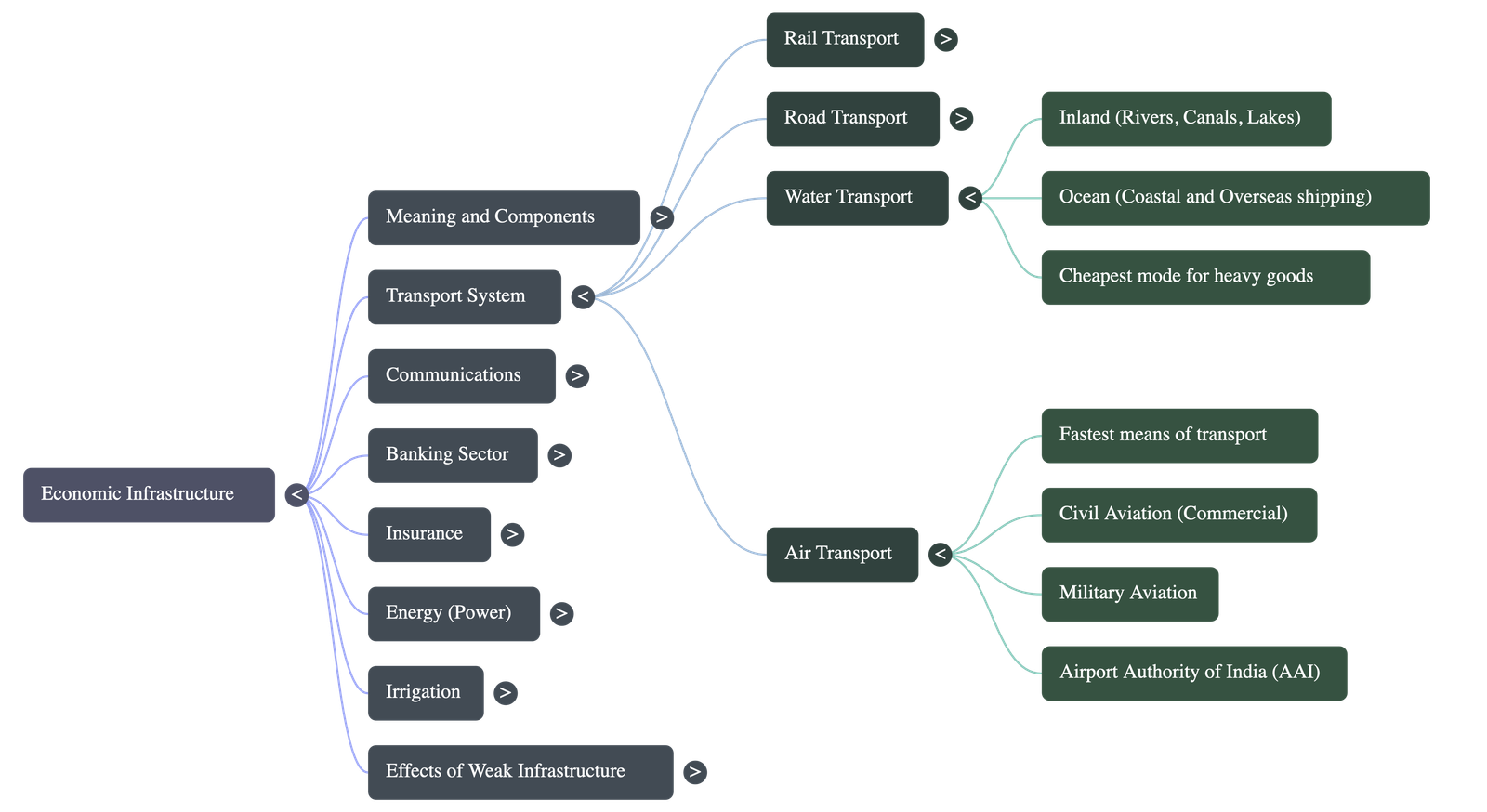
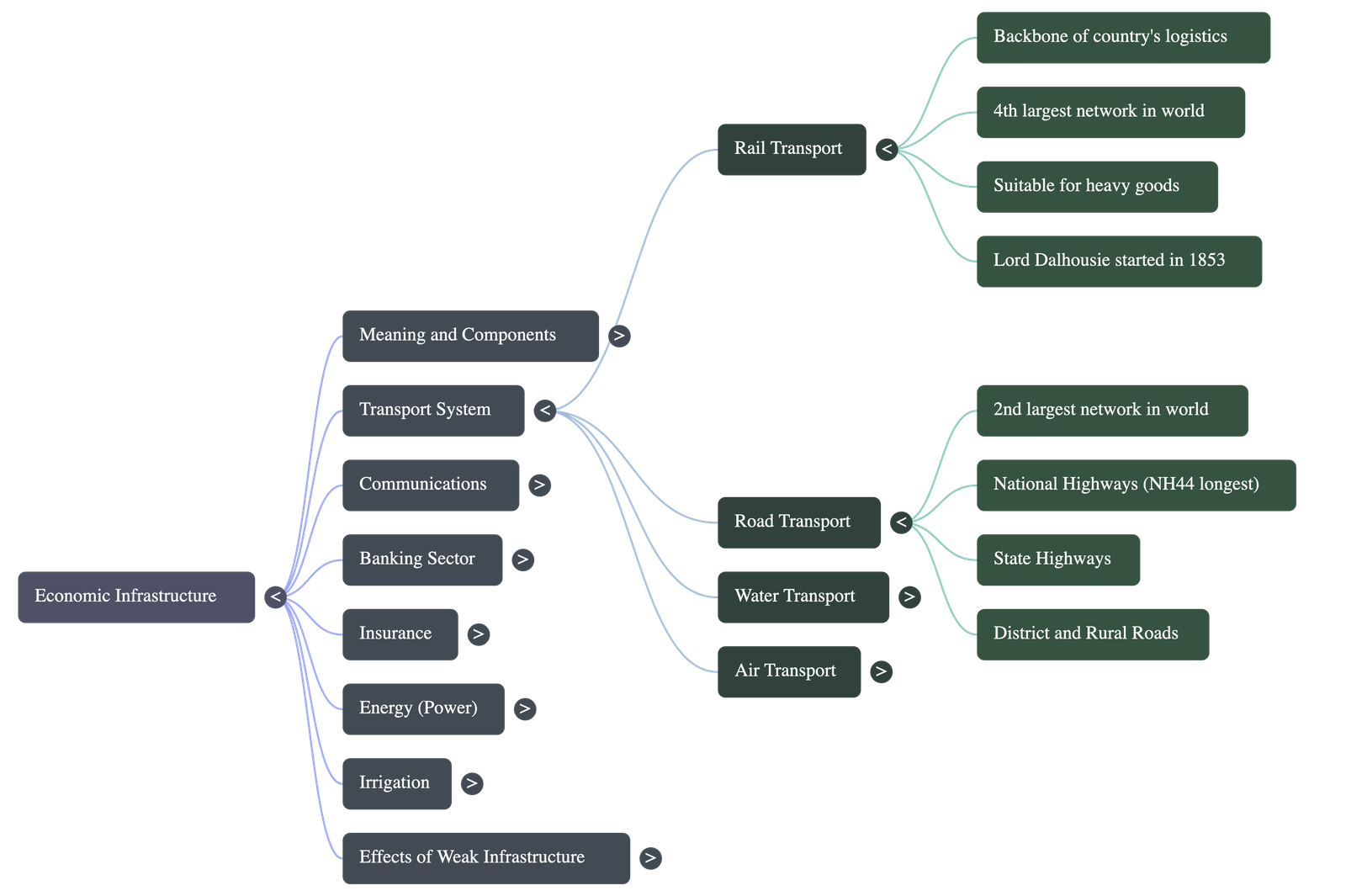
Transport is considered the "body and bones" of the economy. It helps expand markets, removes distance barriers, raises standard of living, provides employment, and encourages tourism. The major means are:
4.1 Rail Transport
- Importance: Best for carrying heavy, bulky goods over long distances. Highly economical and a massive source of employment. Played a key role in minimizing famines by quickly transporting grain.
- Facts: India has the second-largest rail network in Asia. It began in 1853 (Bombay to Thane). It employs over 1.2 million people.
- Problems: Faces challenges like hilly terrains, the need for a huge number of bridges, and difficulty laying tracks on sandy or swampy areas.
4.2 Road Transport
- Importance: Ideal for India's agrarian economy to connect villages to markets. Generates employment, offers convenient doorstep delivery, and complements the railways.
- Growth: India has the second-largest road network globally. It comprises National Highways (e.g., NH44 is the longest), State Highways, District Roads, and Rural/Village roads.
- Problems: Poor road conditions, traffic jams, pollution, accidents, lack of wayside amenities (first aid, clean toilets), and missing connections to remote villages.
4.3 Water Transport
- Importance: The cheapest means of transport. Crucial for heavy cargo and expansion of foreign trade. It requires very low maintenance and remains reliable during natural calamities like floods when roads and rails fail.
- Types: Inland waterways (rivers, canals) and Oceanic/Shipping waterways. Around 95% of India's foreign trade by volume moves through ocean routes.
4.4 Air Transport (Civil Aviation)
- Importance: The fastest transport mode, free from geographical barriers (mountains, oceans). Excellent for long distances, perishable goods, and crucial during natural disasters (relief operations) or national defense.
- Progress: Began in 1920. Nationalised in 1953 (Air India, Indian Airlines). Now controlled by the Airports Authority of India (AAI), regulating domestic and international flights.
5. Communications
Communication is the exchange of information. It accelerates economic growth by bringing buyers and sellers together.
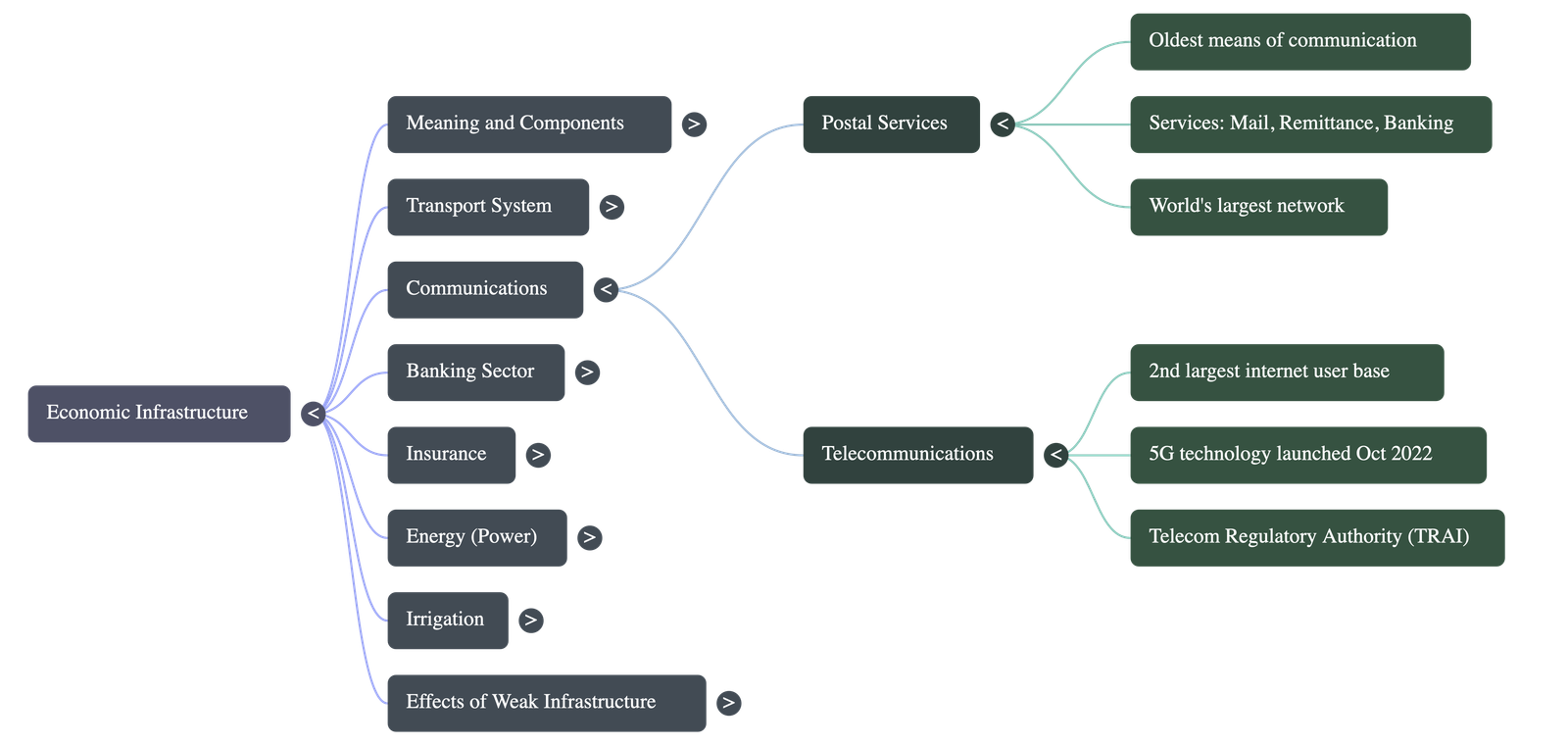
5.1 Postal Services
- The oldest communication means in India, introduced in 1837.
- Provides services like mail delivery, remittances (money orders), banking (small savings schemes), and insurance (Postal Life Insurance).
- Highly affordable, allowing people in remote areas to stay connected and enabling distant learning. India Post is the most widely distributed postal system in the world.
5.2 Telecommunications
- Includes telephone, internet, and television. India is the second-largest telecommunication market in the world.
- Importance: Bridges the rural-urban digital divide, generates immense employment, and enables mass education.
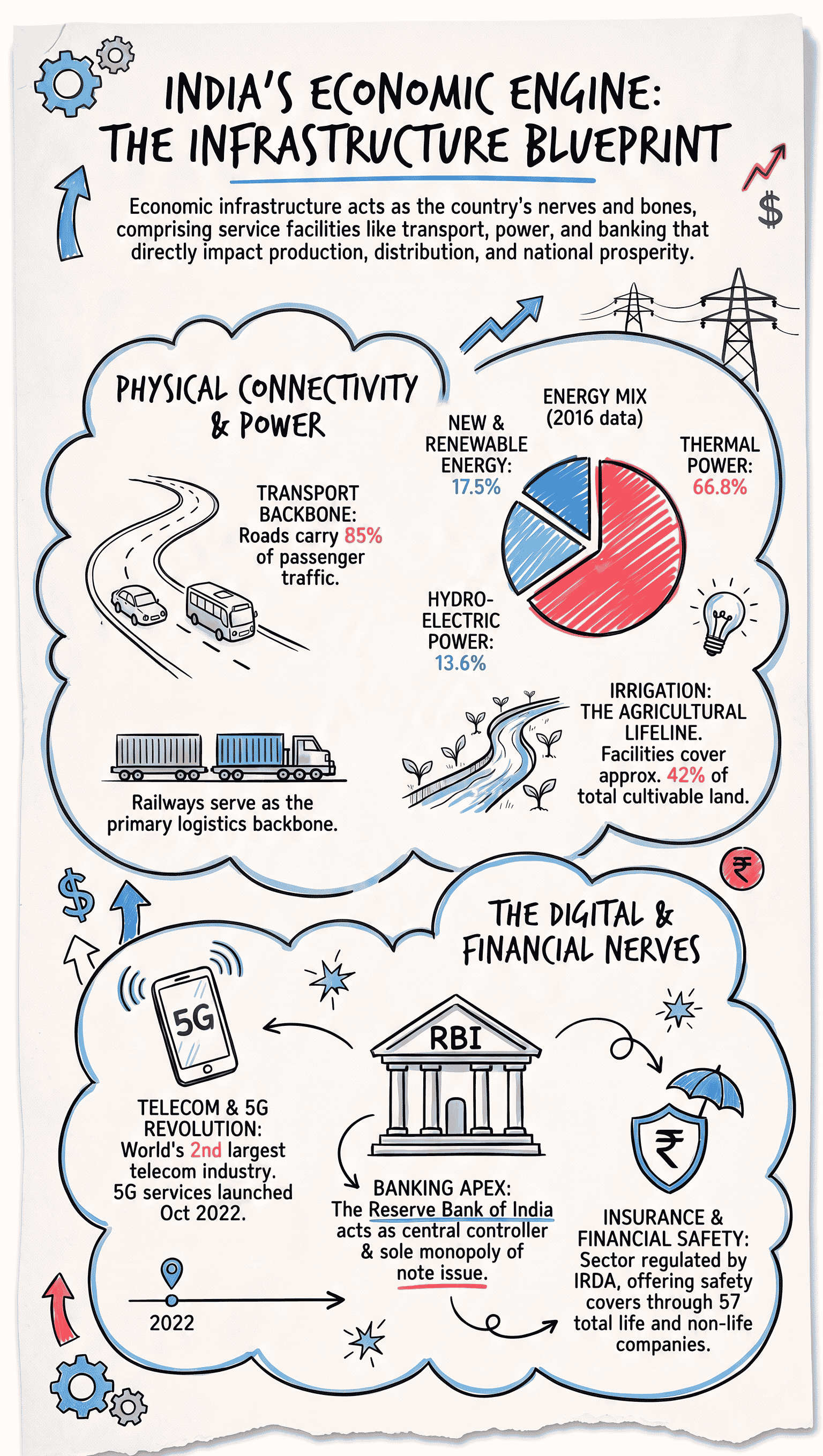
- Advancement: 5G services were successfully launched in October 2022 by players like Airtel and Jio, boosting speed and digital transformation.
6. Banking Sector in India
Banks are essential for accepting deposits, lending money, and facilitating secure transactions.
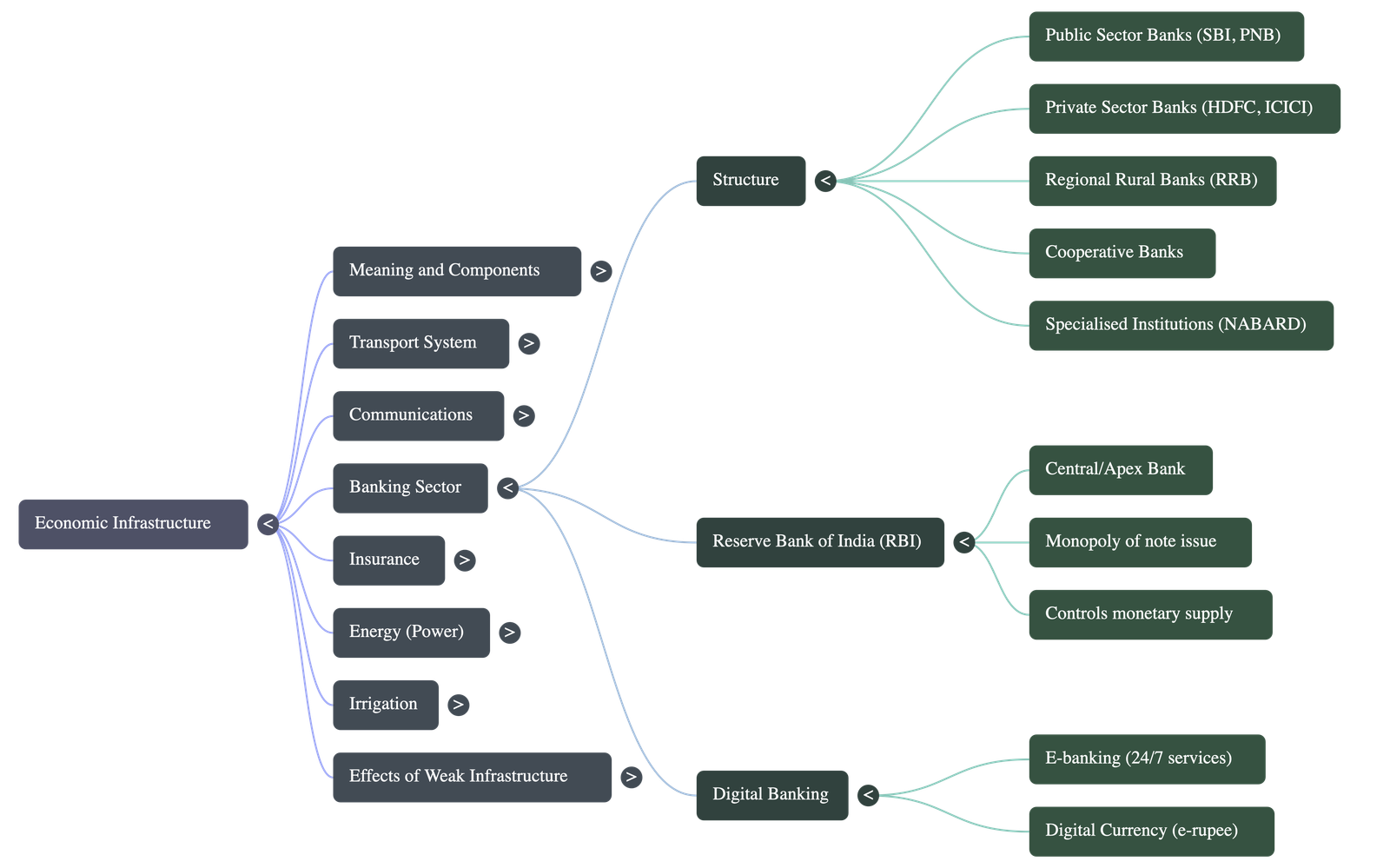
- Structure: Comprises Public Sector Banks (e.g., SBI), Private Sector Banks (e.g., HDFC, ICICI), Regional Rural Banks, Cooperative Banks, and Specialized Institutions (like NABARD).
- Importance: They supply institutional credit to farmers and industries, distribute surplus capital to backwards regions, promote capital formation, and assist weaker sections of society.
- Reserve Bank of India (RBI): The central and apex bank of India. Established in 1935. It is the controller of money supply and holds the sole monopoly of note issue.
- E-banking: Electronic banking reduces branch load, offers 24/365 services, lowers costs, and promotes total financial transparency.
- E-rupee: A Central Bank Digital Currency (CBDC) launched by the RBI in December 2022. It is a digital token functioning similarly to paper currency but cannot be torn or lost physically.
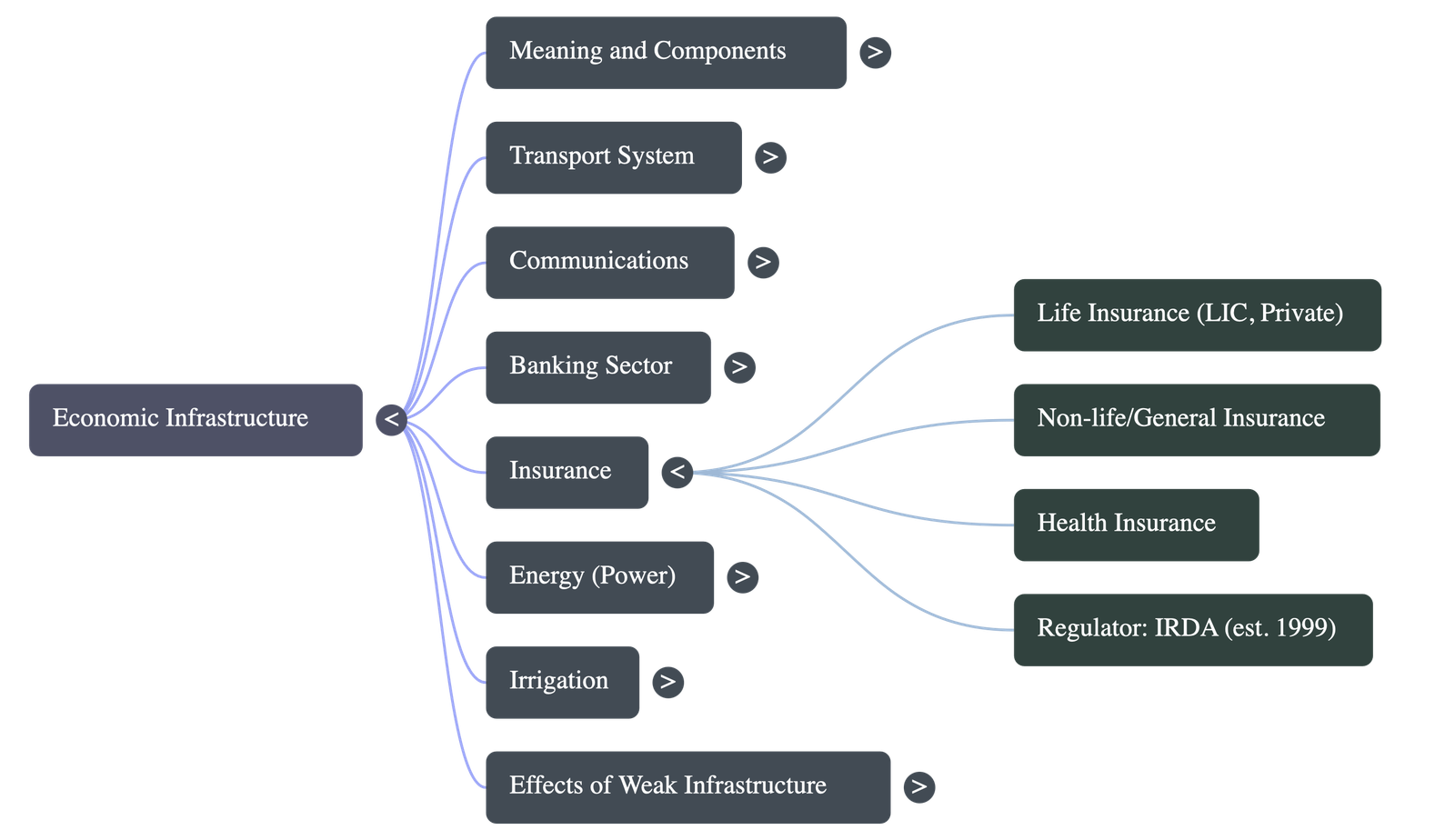
7. Insurance
Insurance is a financial safety net that helps recover from sudden losses (accidents, fire, death).
- Life Insurance: Covers life risks and provides financial support to the family after death or after the policy matures. LIC is the sole public sector life insurance company.
- General Insurance: Covers non-life risks such as health, car, and fire insurance. Generally renewed annually.
- Role in Economy: It promotes savings, pools massive funds for capital markets, and heavily funds large infrastructure projects.
- Regulation: Regulated by IRDA (Insurance Regulatory and Development Authority of India), established in 1999.
8. Energy (or Power)
There is a direct relationship between per capita energy consumption and a country's economic development.
- Importance: Increases national output (agriculture and industry), allows efficient utilization of natural resources, and helps expand the services (IT, banking) sector.
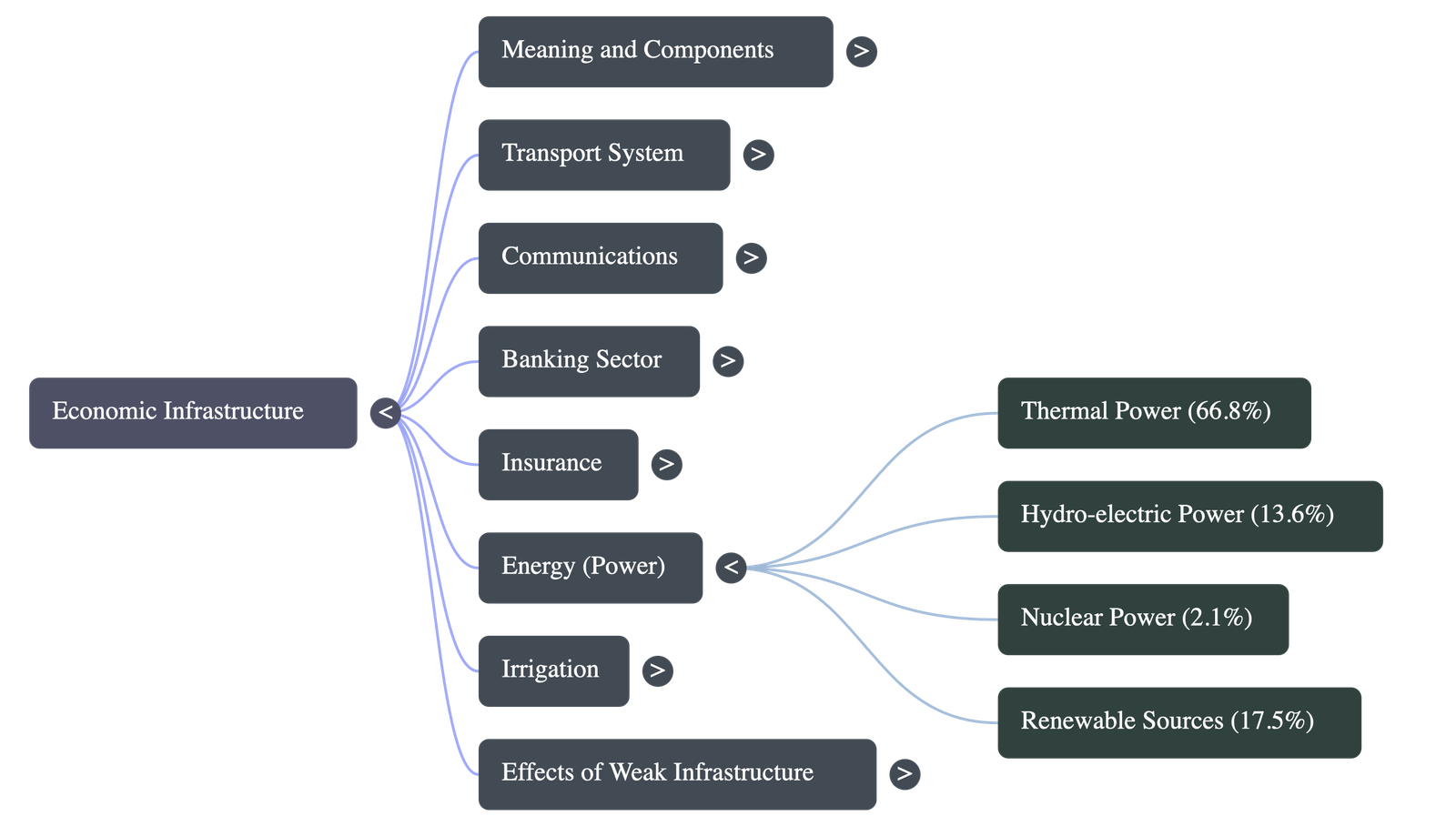
- Sources of Power:
- Thermal Power: Generated from coal and oil. The largest source in India (approx. 66.8%).
- Hydro-Electric Power: Generated from fast-flowing water/dams (approx. 13.6%).
- Nuclear Power: Generated from radioactive elements like uranium (approx. 2.1%).
- Renewable Energy: Non-conventional sources like solar and wind power, which are becoming increasingly crucial (approx. 17.5%).
9. Irrigation
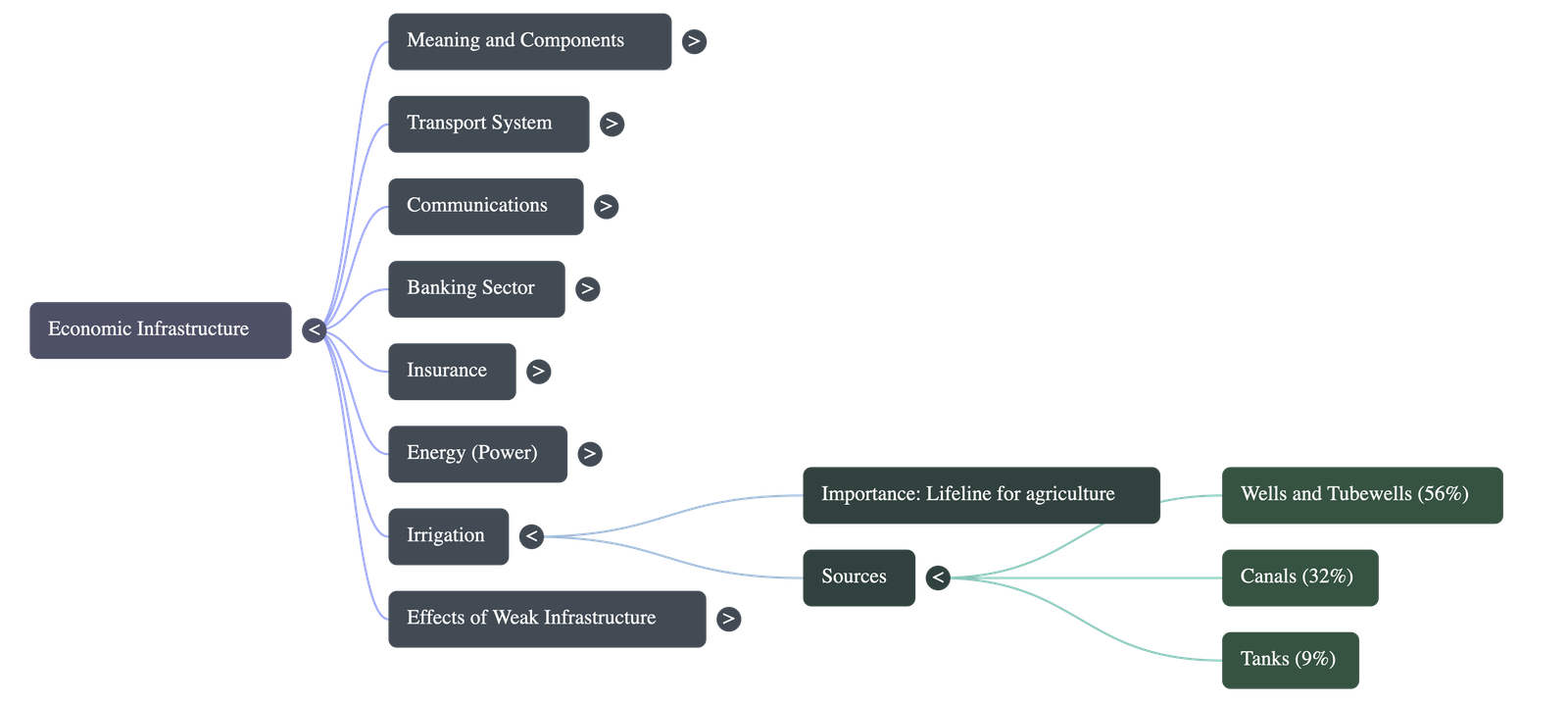
Since India is an agricultural economy, artificial supply of water (irrigation) is vital.
- Importance: Rainfall in India is uncertain and unequally distributed. Irrigation allows for multiple cropping (2-3 crops a year), is essential for High-Yielding Variety (HYV) seeds, controls floods and famines, and creates new employment on farms.
- Sources: Wells and tube wells form the largest source (56%), followed by Canals (32%), and Tanks (9%).
- Progress: Government schemes like the Command Area Development Programme (CADP), Rural Infrastructure Development Fund (RIDF), and Accelerated Irrigation Benefits Programme (AIBP) have significantly increased irrigation capacity since 1951. Micro-irrigation (drip and sprinkler) is also being promoted to save water.
10. Effects of Weak Economic Infrastructure
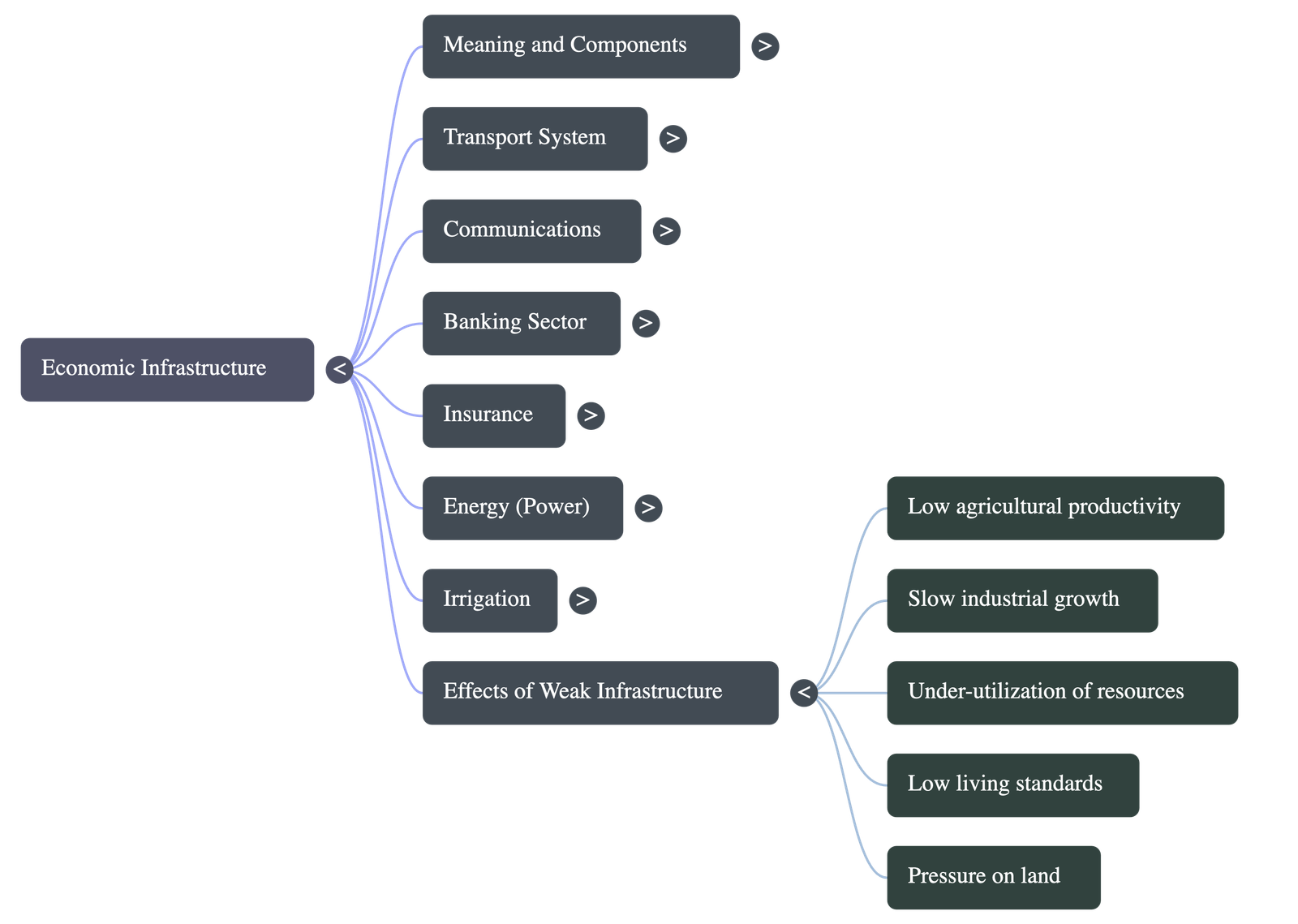
Inadequate infrastructure severely handicaps the progress of an economy:
- Low Agricultural Productivity: Lack of permanent irrigation restricts farmers from growing multiple crops, keeping yields lower than in developed nations.
- Slow Industrial Growth: Shortages in power, transport, and banking slow down industrialization and fail to attract foreign investment.
- Under Utilisation of Resources: Vast natural resources remain unexploited due to a lack of facilities to process or transport them.
- Low Living Standard: Inadequate power and clean facilities mean the quality of life remains poor for citizens.
- Heavy Pressure on Land: Because infrastructure is mostly in urban areas, rural people lack employment opportunities, increasing the burden on cultivable land.
- Pressure on Transport System: Limited railway tracks and poor roads cause immense overcrowding, slow speeds, heavy vehicle pollution, and fatal accidents.
Do checkout all questions & answers of this chapter.