Quick Navigation:
| | | |
Basic Problems of An Economy
A Comprehensive Chapter Summary
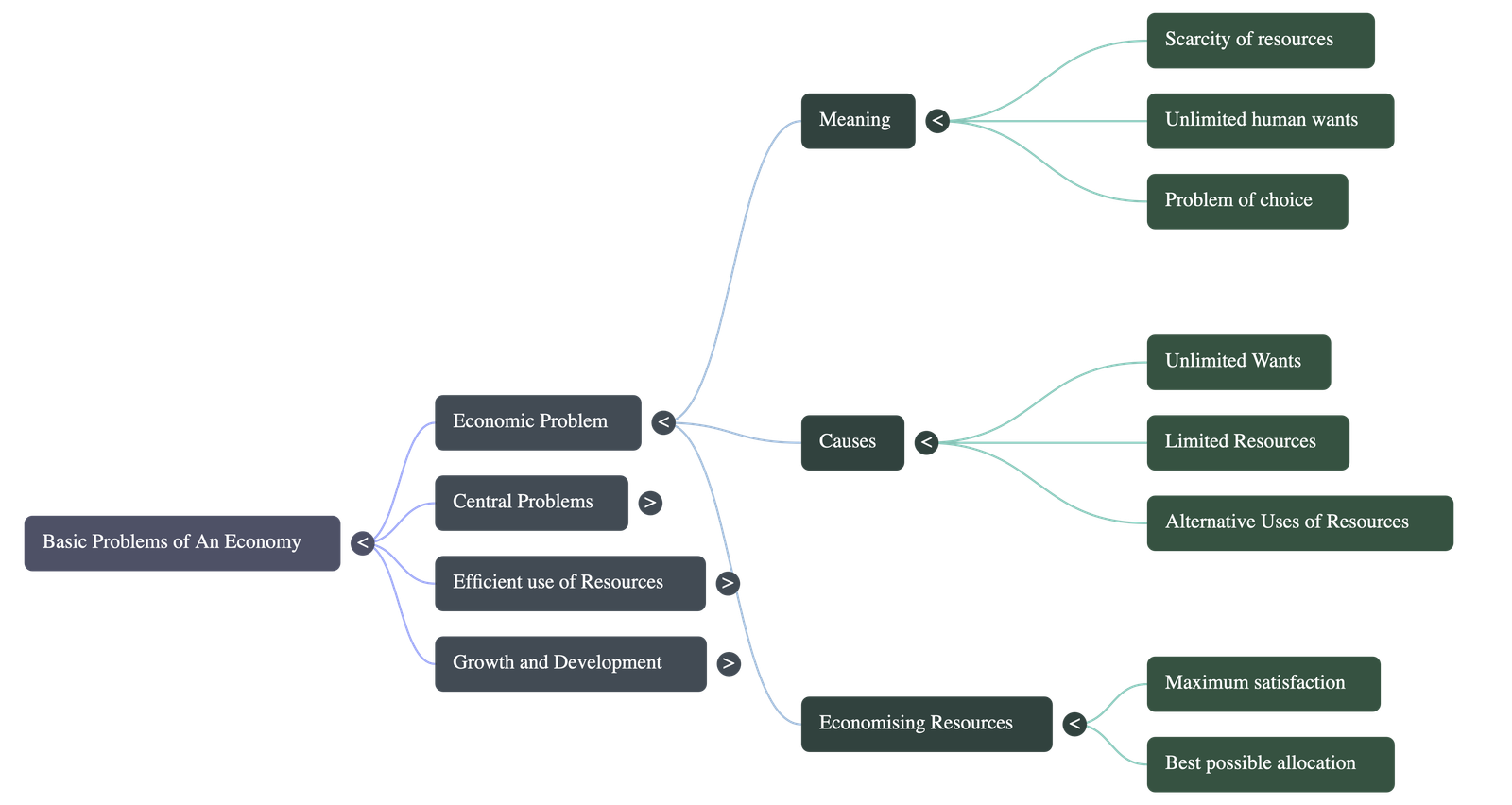
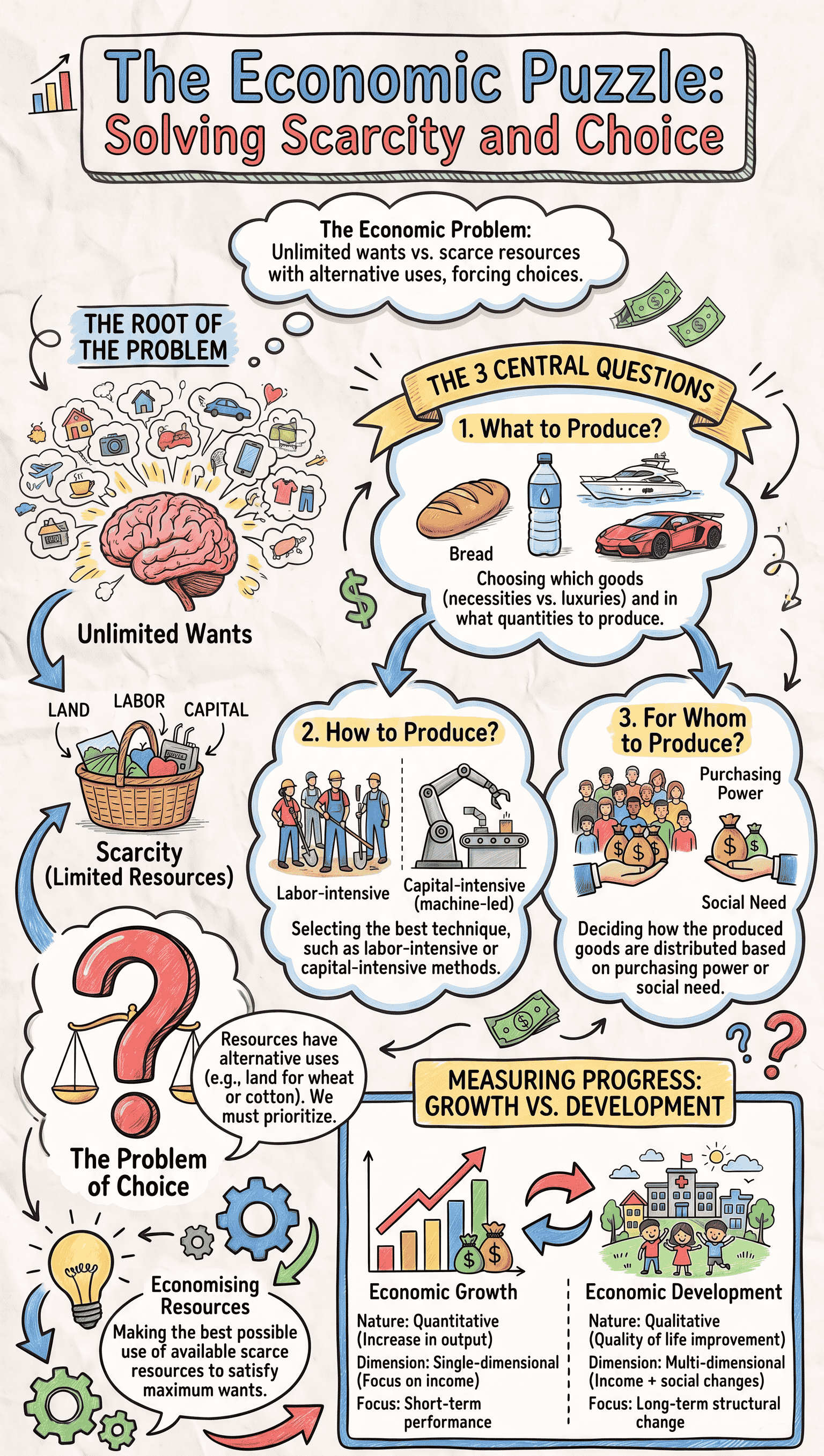
1. Economic Problem
1.1 Meaning
- An economic problem is fundamentally a problem of making choices.
- It arises because human wants are unlimited, but the resources required to satisfy these wants are scarce (limited).
- Scarcity means the demand for goods and resources is greater than their available supply.
1.2 Causes of Economic Problem
The economic problem exists primarily due to three main reasons:
- Unlimited Wants: Human desires never end. When one want is satisfied, a new one takes its place. Wants also multiply with the growth of education, civilization, and technology.
(Note: A "need" is essential for survival like food, whereas a "want" is something desirable but not necessary.) - Limited Resources: The means to satisfy wants (factors of production like land, labour, capital, and enterprise) are strictly limited in supply.
- Alternative Uses of Resources: A single resource can be put to multiple uses. For example, a piece of land can be used to grow wheat or build a factory. This forces society to make a choice.
Conclusion: The compulsion to make the best possible use of available scarce resources is known as Economising of Resources.
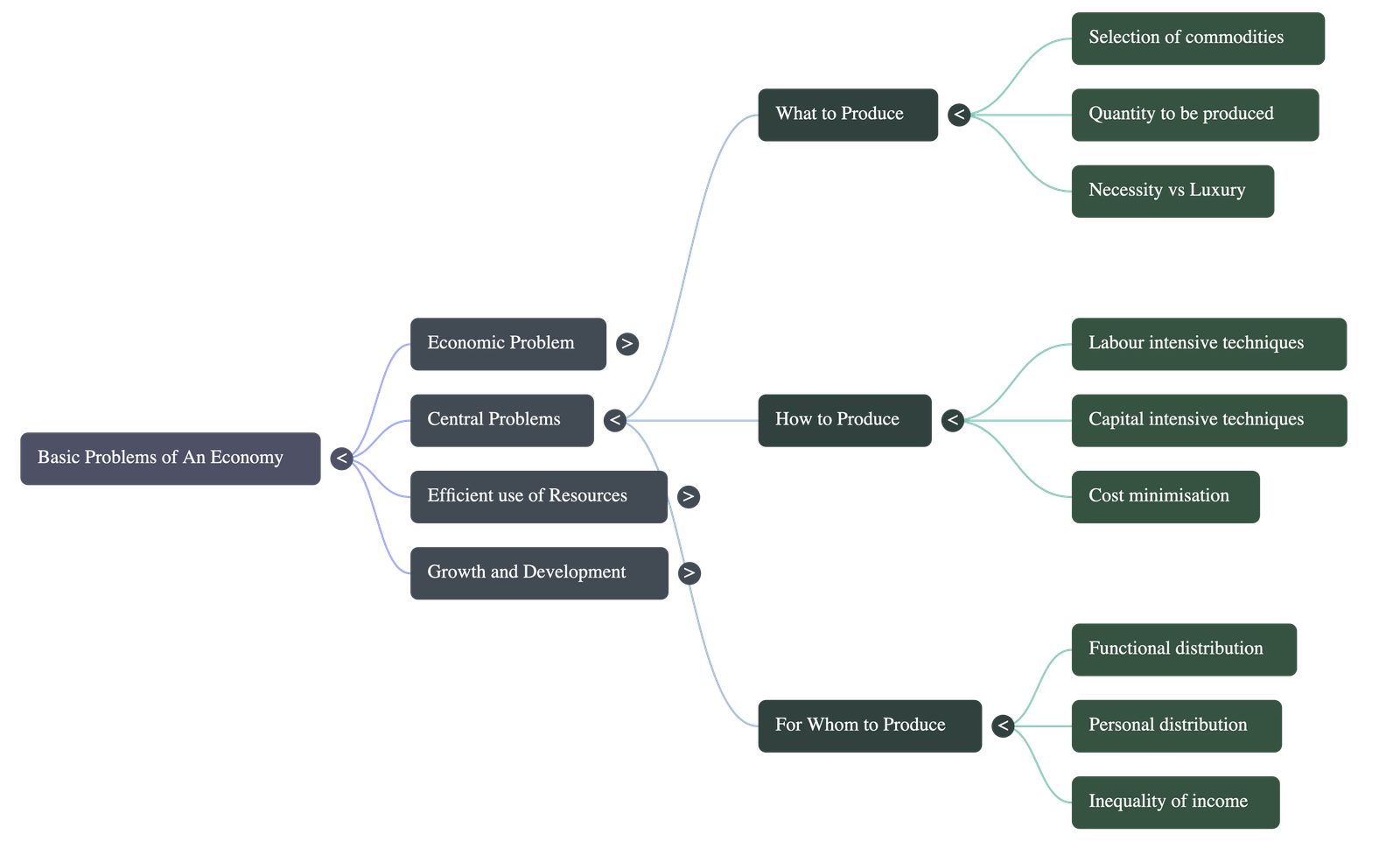
2. Central Problems of an Economy
Because resources are scarce and have alternative uses, every economy (whether rich or poor) faces three fundamental or "central" problems:
2.1 What to Produce and in What Quantities?
- An economy must decide which goods and services to produce (e.g., consumer goods like clothes and food vs. capital goods like machinery, or civil goods vs. war goods).
- Once the goods are chosen, it must decide the quantity to be produced for each.
- Guiding Principle: Resources should be allocated in a way that gives the maximum aggregate satisfaction to society.
2.2 How to Produce?
- This refers to the problem of choosing the technique of production.
- Labour Intensive Technique: Uses more manual labour and less capital/machinery. It helps in creating employment.
- Capital Intensive Technique: Uses more machinery and less labour. It promotes efficiency and faster growth.
- Guiding Principle: Produce the maximum output at the minimum cost using the least possible scarce resources.
2.3 For Whom to Produce?
- This is the problem of distribution of the produced goods and national income among the people in the society.
- Functional Distribution: How income is shared among the factors of production (rent for land, wages for labour, interest for capital, profits for entrepreneurs).
- Personal Distribution: How income is distributed among individual households (addressing the problem of inequality).
- Guiding Principle: Ensure that the urgent wants of each productive factor are fulfilled to the maximum extent.
Decisions in Different Economic Systems:
- Capitalist Economy: Produces what is profitable and demanded; uses cost-saving techniques; distributes based on purchasing power.
- Socialist Economy: Produces what society needs; uses labour to maximize employment; distributes based on people's needs.
- Mixed Economy: A combination of both market forces (private sector) and government intervention (public sector).
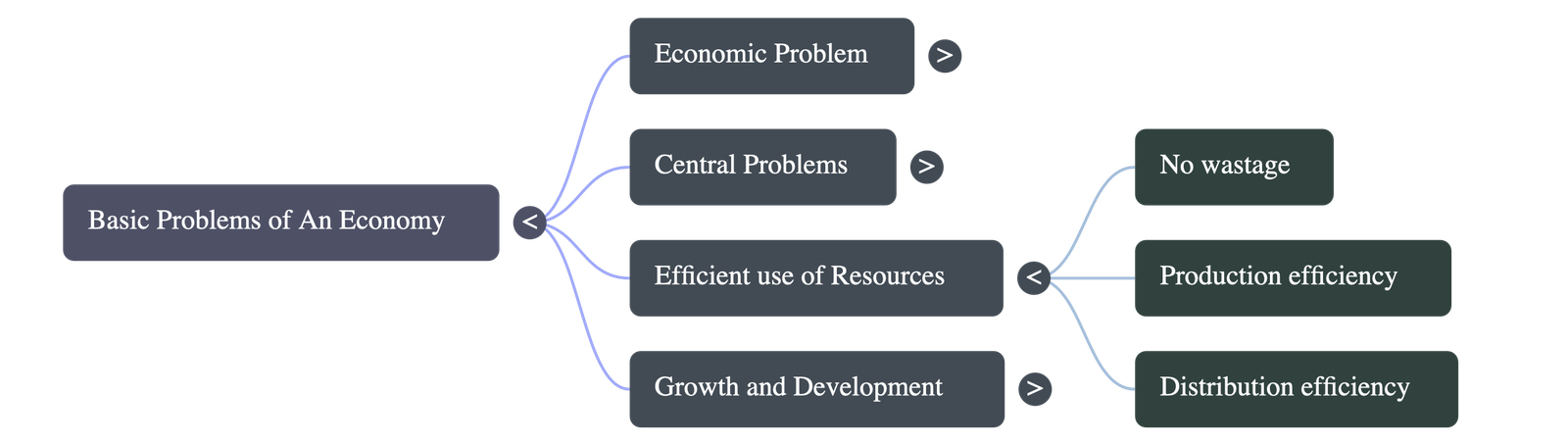
3. Efficient Use of Resources
- Once an economy decides what, how, and for whom to produce, it must ensure resources are utilized efficiently without any wastage.
- Efficiency in Production: Achieved when it is impossible to produce more of one good without decreasing the output of another good.
- Efficiency in Distribution: Achieved when goods are distributed such that no one person can be made better off without making someone else worse off.
- Idle or misused resources directly result in slower economic development.
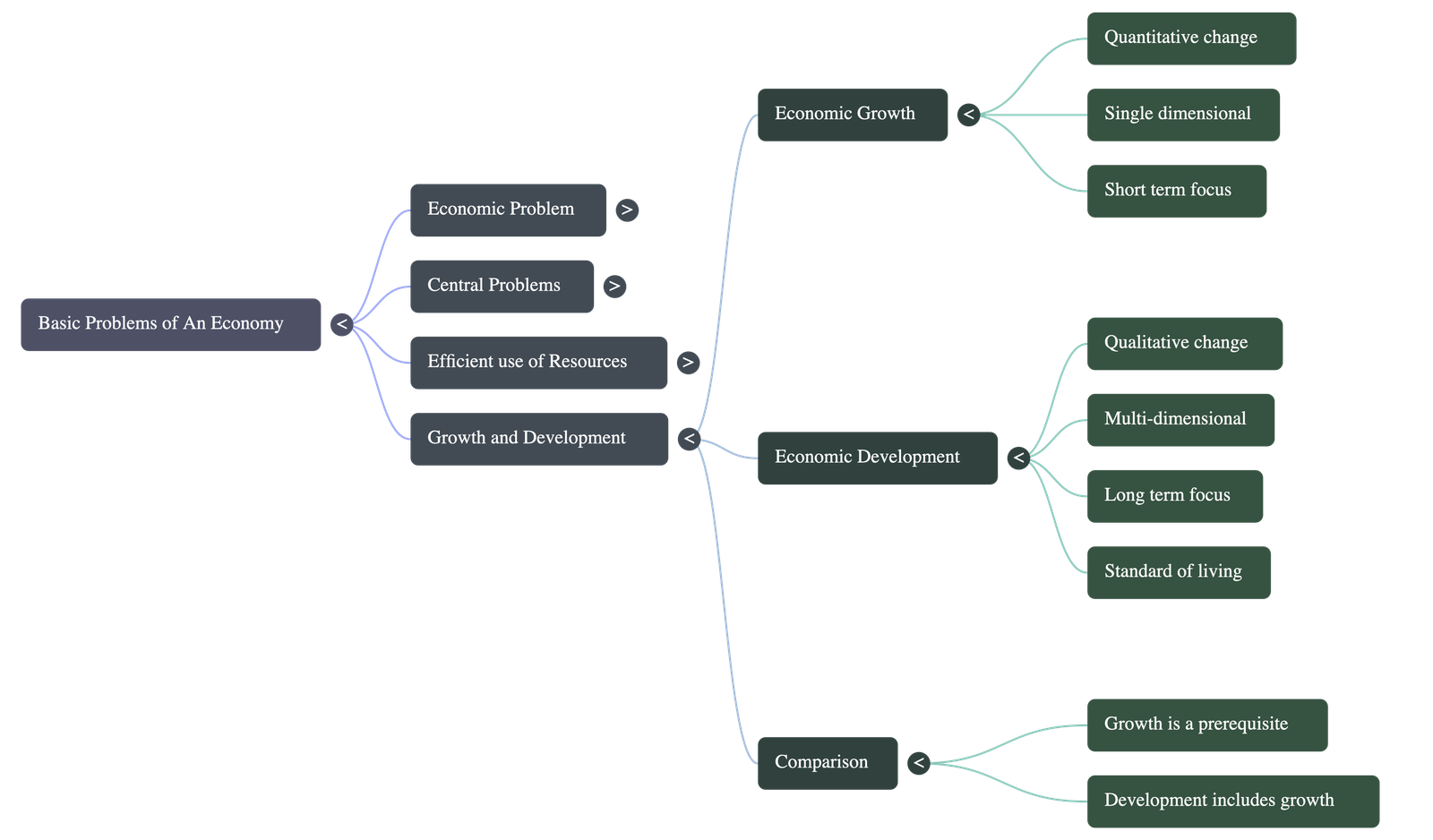
4. Economic Growth vs. Economic Development
4.1 Economic Growth
- Refers purely to an increase in the actual output of goods and services in an economy over time.
- It is a quantitative and single-dimensional concept (it only looks at the increase in national and per capita income).
- It focuses heavily on short-term performance and increasing the productive capacity of the economy.
4.2 Economic Development
- Refers to economic growth plus a positive change in the quality of life and standard of living.
- It is a multidimensional and qualitative concept. It tracks reductions in poverty, illiteracy, unemployment, and wealth inequality.
- Development comes after economic growth (growth is a necessary prerequisite for development).
Key Differences at a Glance:
- Scope: Growth is a narrow concept; Development is a broad concept.
- Nature: Growth is strictly quantitative (numbers/GDP); Development is both quantitative and qualitative (well-being/health/education).
- Timeframe: Growth has a short-term focus; Development requires a long-term focus.
- Distribution: Growth ignores how income is distributed; Development actively focuses on reducing inequalities.
Do checkout all questions & answers of this chapter.
Quick Navigation:
| | | |
1 / 1
Quick Navigation:
| | | |