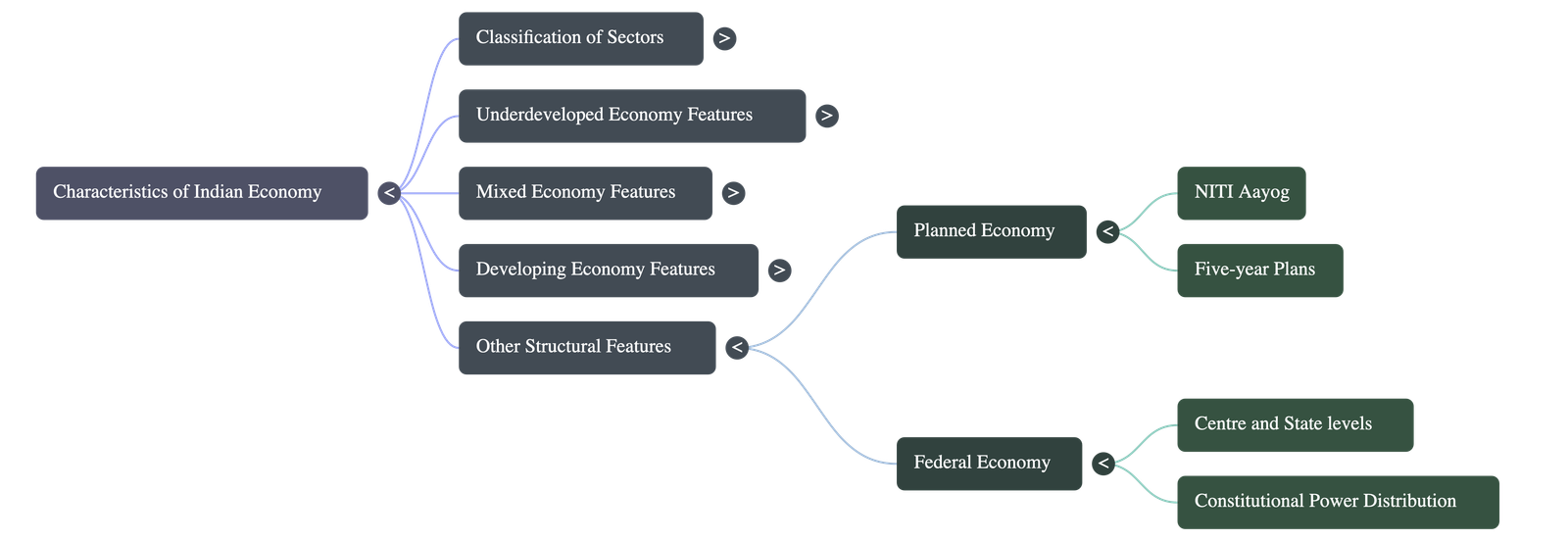
Characteristics of Indian Economy
1. What is Indian Economy?
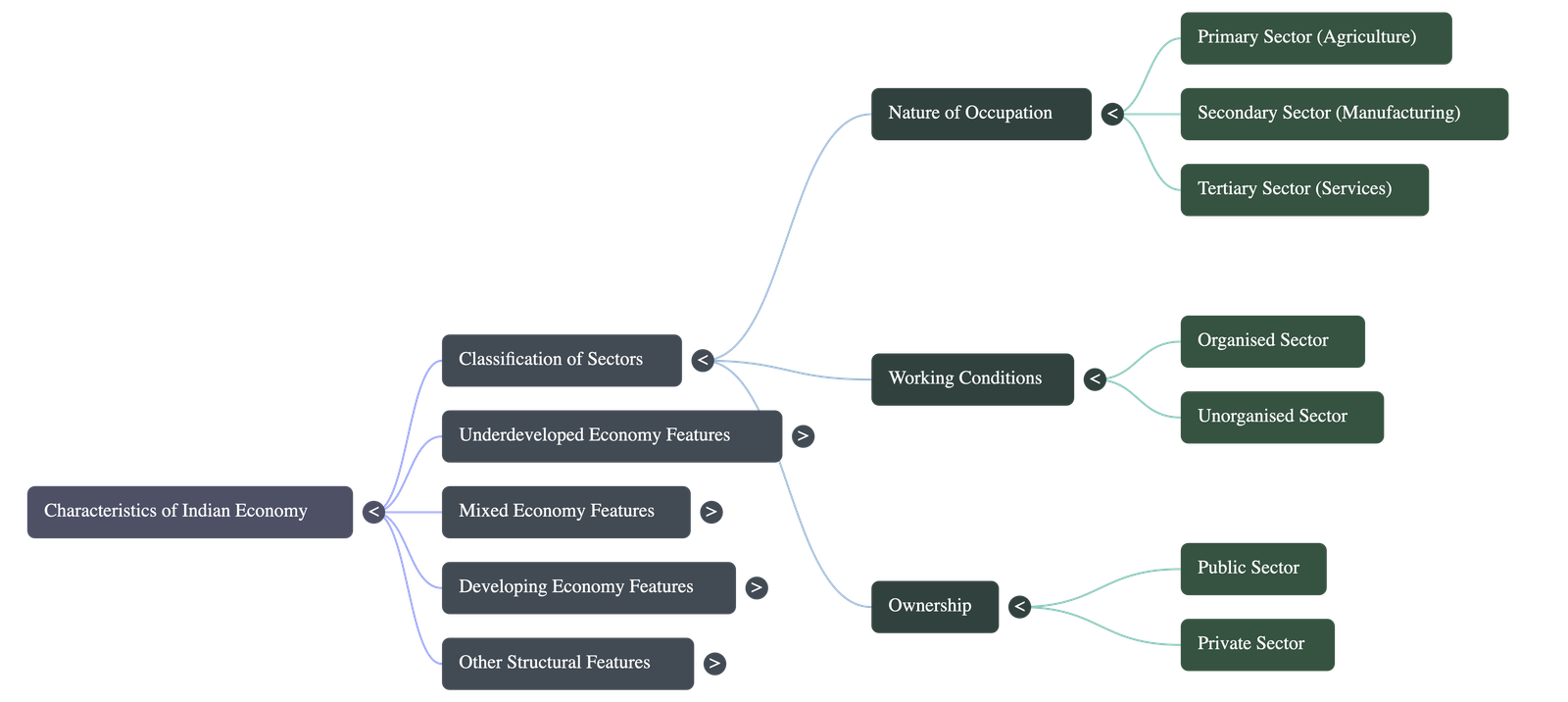
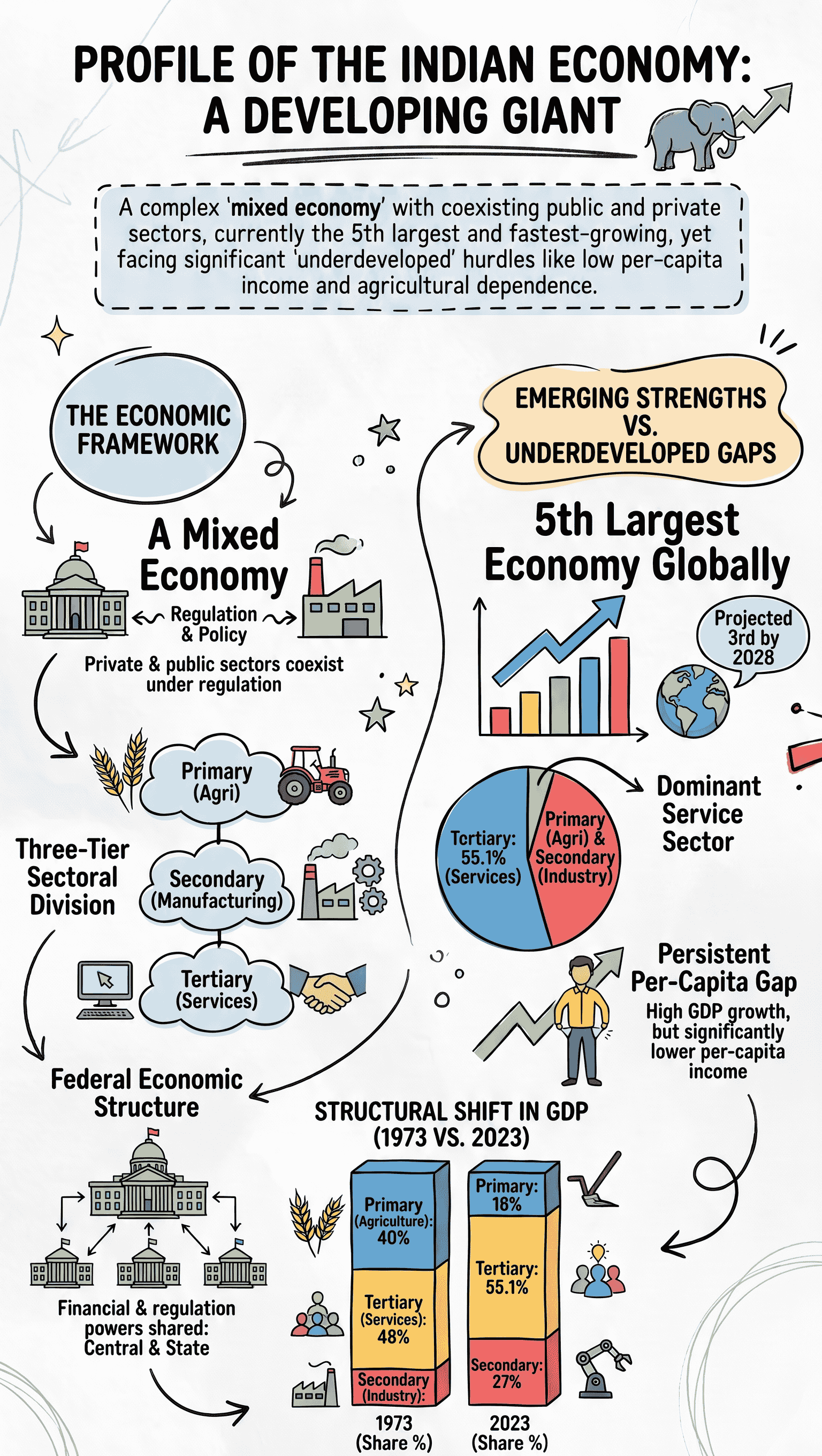
The Indian economy consists of all production units (like farms, factories, banks, schools, and hospitals) that provide employment to people and produce the goods and services they need. The economy is classified in three main ways:
- On the basis of Nature of Occupations (Sectors):
- Primary Sector: Includes activities directly dependent on nature like agriculture, mining, fishing, and forestry.
- Secondary Sector: Includes manufacturing and construction industries where goods are produced.
- Tertiary Sector: Service-related activities like transportation, banking, communication, and insurance.
- On the basis of Working Conditions: Divided into the Organised Sector (follows strict government rules and offers job security) and the Unorganised Sector (small businesses that generally do not follow government regulations).
- On the basis of Ownership: Divided into the Public Sector (owned and run by the government) and the Private Sector (owned by private individuals or companies).
2. Characteristics of Indian Economy
Even after many decades of independence, the Indian economy exhibits various complex features. It can be studied under several distinct headings.
2.1 India — An Underdeveloped Economy
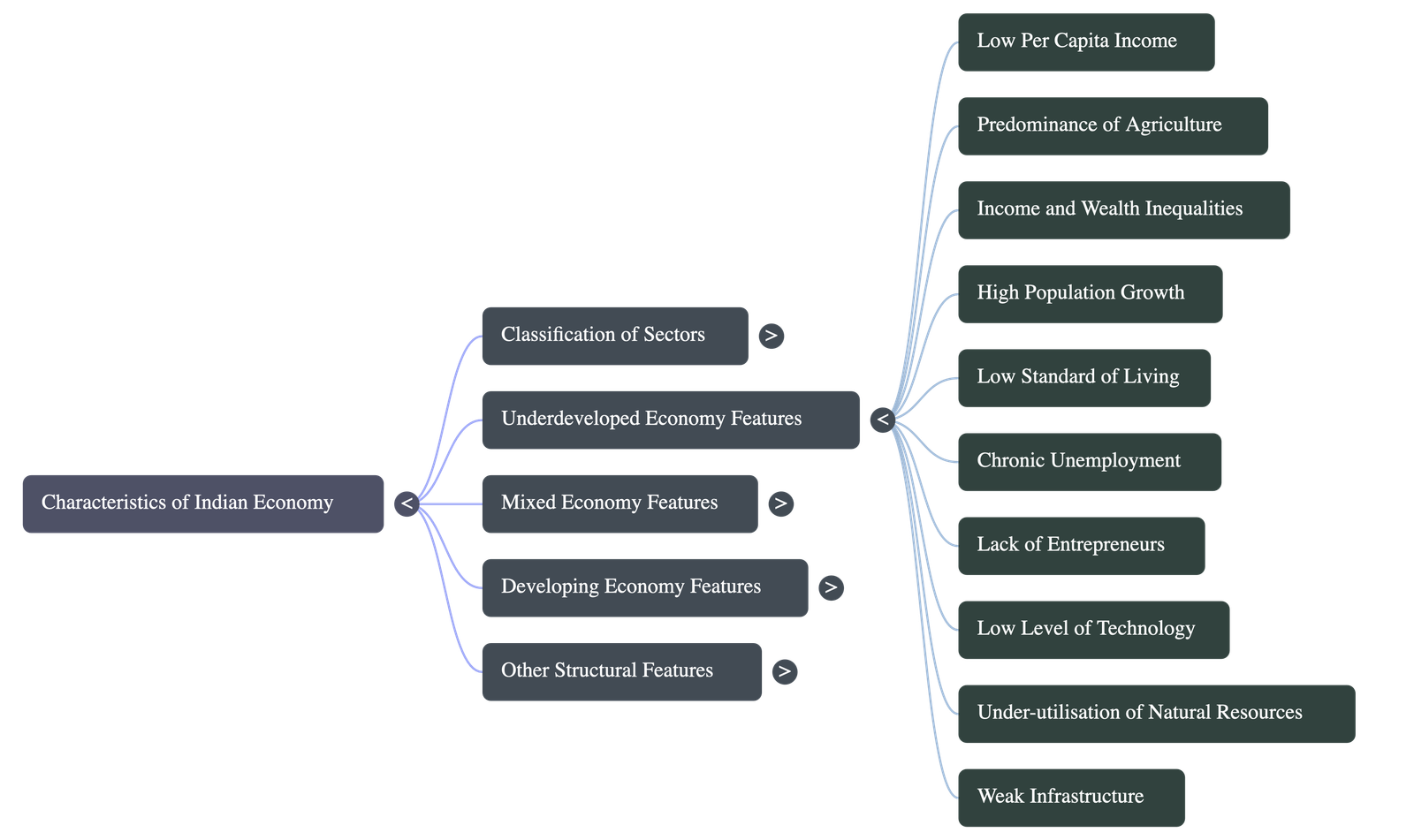
An underdeveloped economy suffers from low living standards, poverty, low income, and poor health services. India shows several of these features:
- Low Per Capita Income: The average income of an Indian is very low compared to developed countries (e.g., $1940 for India compared to $59,532 for the USA in 2017).
- Predominance of Agriculture: About 42% of India's labour force depends on agriculture, yet it contributes poorly to the overall economy. This over-dependence limits growth.
- Income and Wealth Inequalities: Wealth is highly concentrated. A small fraction of rich people hold the majority of the wealth, while the poorest have very little.
- High Population Growth: With over 1.43 billion people, India is the most populous country, putting immense pressure on resources.
- Low Standard of Living: Many Indians suffer from low calorie intake and malnutrition. A large percentage of children and mothers do not get adequate nutrition.
- Unemployment and Underemployment: Due to a rapidly growing population and insufficient growth in industries, a large mass of people lack adequate or full-time jobs.
- Lack of Entrepreneurs: There are very few people willing to take big business risks for long-term industrial growth; many focus only on quick profits.
- Low Level of Technology: Outdated production techniques are still widely used in agriculture and industries due to lack of money and trained workers.
- Under-utilisation of Natural Resources: India is rich in land, water, minerals, and forests, but poor transport, lack of funds, and old technology prevent their full use.
- Weak Infrastructure: Facilities like roads, railways, electricity, healthcare, and education are still inadequate to support massive growth.
2.2 India — A Mixed Economy
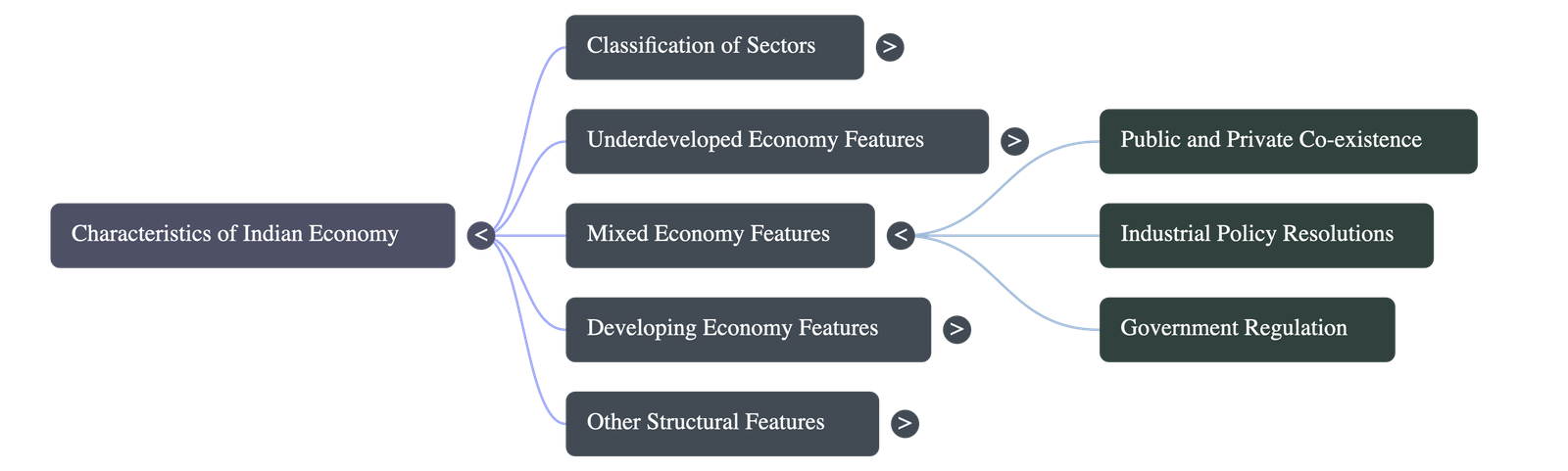
India combines the features of both capitalist and socialist economies:
- Co-existence of Sectors: Both the public (government) sector and the private sector function side by side.
- Government Control: While private companies have freedom, the government regulates them through laws like the Industries Regulation Act of 1951 to ensure public welfare.
- Economic Planning and Market Mechanism: Both national planning by the government and open market forces guide economic activities.
2.3 India — A Developing Economy
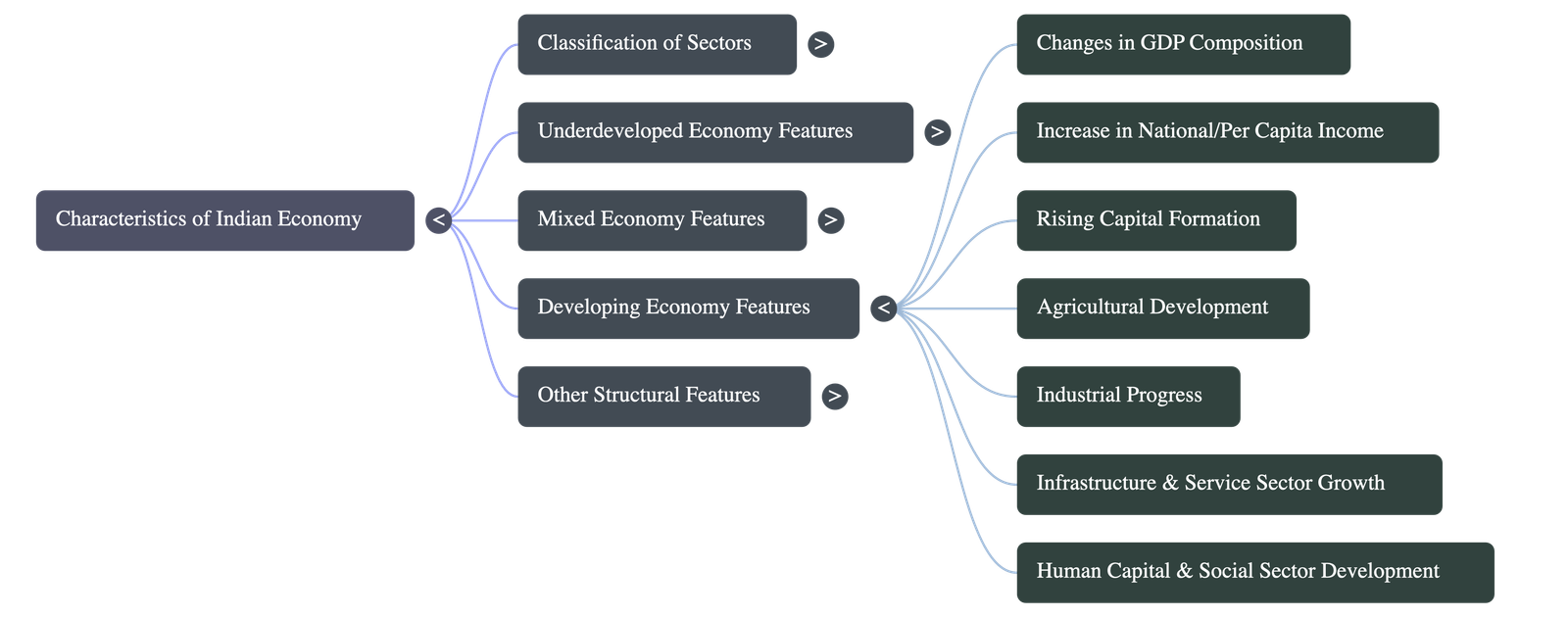
A developing economy is one that is making steady progress. Indicators that India is developing include:
- Changes in GDP Composition: The contribution of agriculture to the country's income is dropping, while the service and manufacturing sectors are growing rapidly.
- Rising Income: National income and per capita income have steadily increased, breaking historical periods of stagnation.
- Capital Formation: Savings and investments have significantly increased to build national wealth.
- Agricultural Development: Crop yields per hectare have massively increased (e.g., wheat production). India is now a top global producer of milk, vegetables, and fruits.
- Industrial & Infrastructure Progress: Heavy industries have diversified, the country is self-sufficient in consumer goods, and power, roads, and telecommunications have heavily expanded.
- Booming Service Sector: The IT, BPO, and E-commerce sectors are booming, employing many youths and contributing over 55% to the GDP.
- Social Development: Healthcare and education have improved, resulting in lower death rates and a sharp rise in the literacy rate.
2.4 India — A Planned Economy
India uses systematic planning to achieve economic goals. The Planning Commission (replaced by NITI Aayog in 2015) creates development plans and sets targets. While we are shifting toward a free market, planning remains essential to fight poverty and unemployment.
Strengths
- Key role of agriculture
- Fastest-growing & 5th largest economy
- Availability of skilled manpower
- Large foreign exchange reserves
- Emerging destination for foreign investors
Weaknesses
- Agriculture employs many but pays little
- Low per capita income & poverty
- High unemployment rate
- Low worker productivity
- High population pressure & wealth inequality
2.5 India — A Federal Economy
The Indian Constitution divides economic powers between two levels of government:
- Central Government: Handles large-scale national matters like Indian Railways, Posts, and Atomic Power.
- State Governments: Handle regional matters like education, health, electricity, and irrigation.
Conclusion
The Indian economy is a mixed, middle-income, developing social market economy. It is currently the world's fifth-largest economy and is rapidly growing, projected to become the third-largest soon. With a massive consumer market, liberal foreign investment policies, and untapped natural resources, India has become a top choice for global investors.
Do checkout all questions & answers of this chapter.