Quick Navigation:
| | | |
How do Organisms Reproduce?
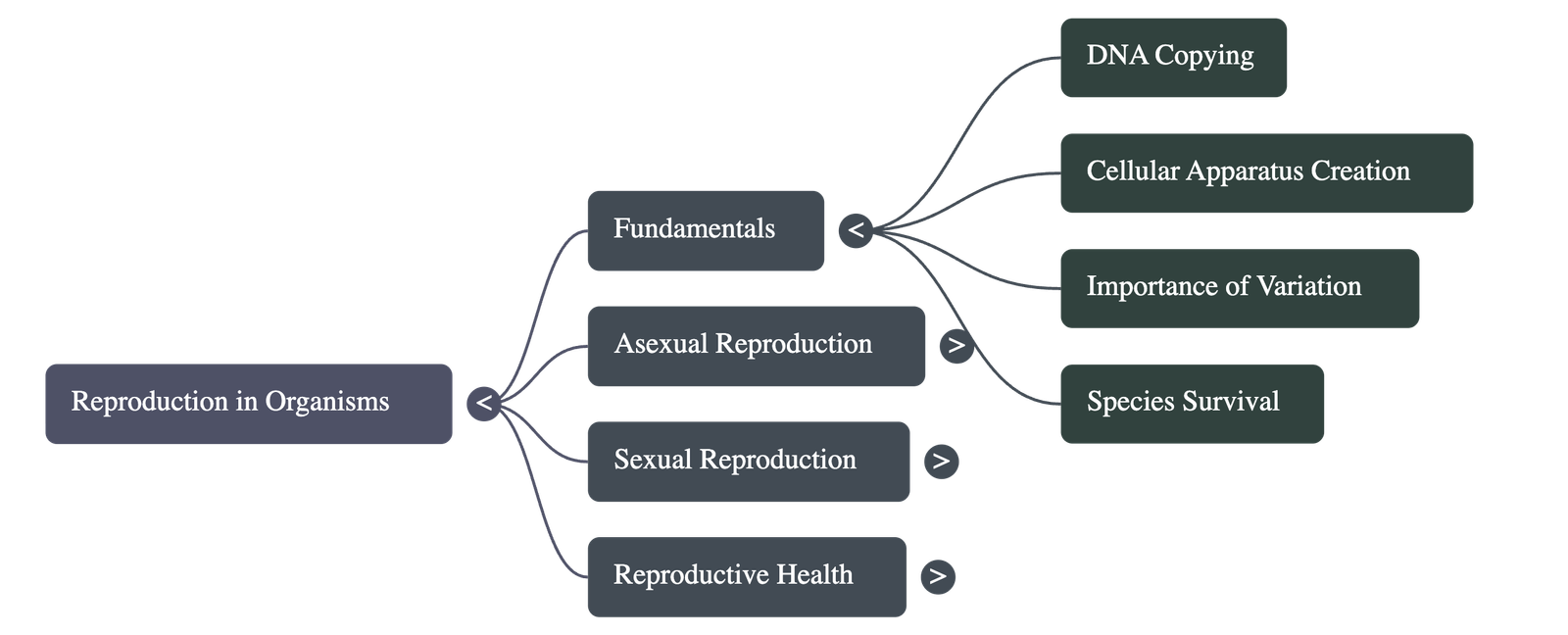
1. The Importance of Reproduction and Variation
- Purpose: Reproduction is not essential for the survival of an individual but is vital for the continuation of a species.
- DNA Copying: The basic event in reproduction is the creation of a DNA copy. Cells use chemical reactions to build copies of their DNA.
- Variation: DNA copying is not absolutely accurate. These inaccuracies lead to subtle variations in the DNA copies.
- If variations are too drastic, the new cell dies.
- Mild variations allow surviving cells to be similar but not identical.
- Evolutionary Significance: Variations are beneficial for species survival. If an ecosystem changes drastically (e.g., temperature rise), a population with variations has a better chance that some individuals will survive and repopulate.
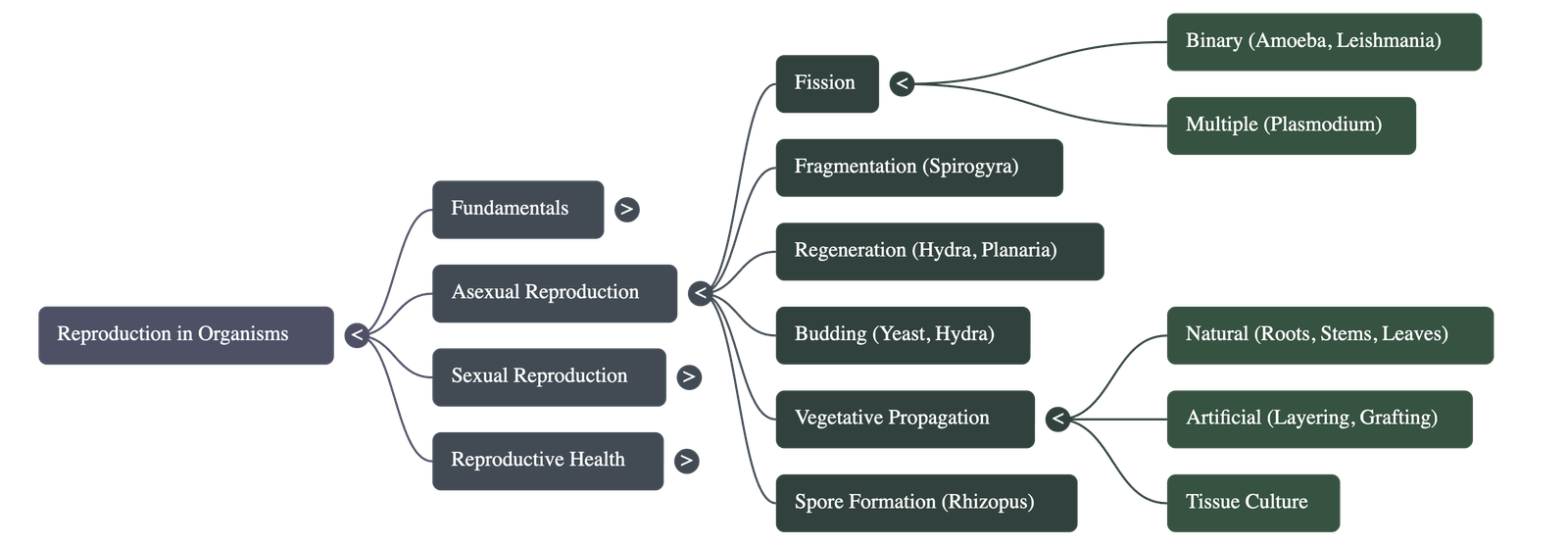
2. Modes of Asexual Reproduction
Asexual reproduction involves a single parent and creates genetically similar offspring.
2.1 Fission
- Binary Fission: The parent cell divides into two equal halves (e.g., Amoeba, Leishmania). In Leishmania, division occurs in a definite orientation due to its whip-like structure.
- Multiple Fission: The parent cell divides into many daughter cells simultaneously (e.g., Plasmodium).
2.2 Fragmentation
- Simple multicellular organisms break into smaller pieces upon maturation.
- Each fragment grows into a new individual (e.g., Spirogyra). This only works for organisms with relatively simple body organization.
2.3 Regeneration
- If an organism is cut or broken, specialized cells proliferate and differentiate to regrow the missing parts or form a complete organism.
- Examples: Hydra and Planaria.
- Note: Regeneration is generally not a primary reproductive method but a survival mechanism.
2.4 Budding
- A bud develops as an outgrowth due to repeated cell division at a specific site.
- The bud matures and detaches from the parent to become an independent individual (e.g., Hydra, Yeast).
2.5 Vegetative Propagation
- New plants are obtained from vegetative parts like roots, stems, and leaves.
- Natural Examples: Buds produced in the notches of Bryophyllum leaves fall on soil and grow.
- Artificial Methods: Layering, grafting, and tissue culture (used for sugarcane, roses, grapes).
- Advantages: Plants can bear flowers/fruits earlier; allows propagation of plants that have lost the capacity to produce seeds (banana, jasmine); ensures genetic similarity.
2.6 Spore Formation
- Structures called sporangia (blobs-on-a-stick) contain cells called spores.
- Spores are covered by thick walls to protect them until they find moist conditions to grow (e.g., Rhizopus/Bread mould).
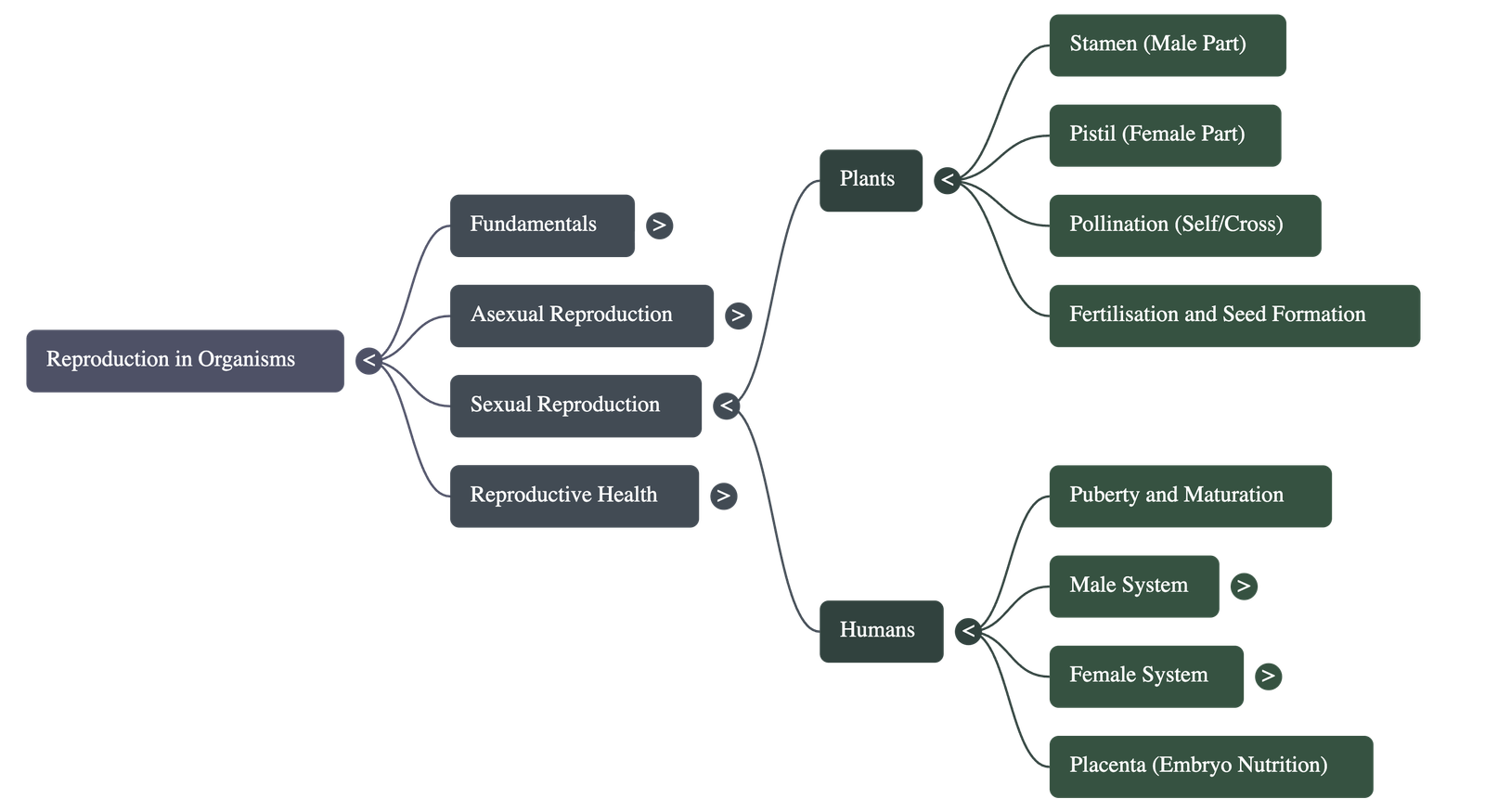
3. Sexual Reproduction
- Significance: Combines DNA from two individuals, generating greater variation which aids survival and evolution.
- Mechanism: To prevent the DNA amount from doubling in every generation, specialized germ-cells (gametes) are formed via meiosis, containing half the number of chromosomes.
- Gametes: Usually, the male gamete is motile and small, while the female gamete is larger and stores food.
3.1 Sexual Reproduction in Flowering Plants
- Reproductive Parts: Located in the flower.
- Stamen (Male): Produces pollen grains.
- Pistil (Female): Consists of Stigma (sticky top), Style (tube), and Ovary (swollen base containing ovules).
- Pollination: Transfer of pollen from stamen to stigma. Can be Self-pollination (same flower) or Cross-pollination (different flower via wind, water, animals).
- Fertilisation: A pollen tube grows through the style to the ovary. The male germ-cell fuses with the female germ-cell inside the ovule to form a zygote.
- Post-Fertilisation:
- Zygote divides to form an embryo.
- Ovule develops a tough coat and becomes a seed.
- Ovary ripens to form a fruit.
- Petals, sepals, and stamens fall off.
- Germination: The seed contains the future plant (embryo) which develops into a seedling under appropriate conditions.
4. Reproduction in Human Beings
4.1 Puberty
- The period during adolescence when reproductive tissues begin to mature.
- Common Changes: Hair growth in armpits/genital area, oily skin, pimples.
- Girls: Breast enlargement, darkening of nipple skin, onset of menstruation.
- Boys: Facial hair growth, voice cracking, enlargement of the penis.
4.2 Male Reproductive System
- Testes: Located in the scrotum (outside the body to maintain lower temperature for sperm formation). Produce sperms and the hormone testosterone.
- Vas Deferens: Tube that delivers sperm from testes.
- Glands (Prostate & Seminal Vesicles): Add secretions to make sperm transport easier and provide nutrition.
- Urethra: Common passage for both sperm and urine.
- Penis: Organ used to transfer sperms.
4.3 Female Reproductive System
- Ovaries: Produce eggs (one released per month) and hormones.
- Fallopian Tube (Oviduct): Carries the egg from the ovary to the womb; site of fertilisation.
- Uterus (Womb): Elastic bag-like structure where the baby develops. Opens into the vagina via the cervix.
4.4 Fertilisation and Development
- Sperms enter through the vagina and reach the fallopian tube to fuse with the egg.
- The fertilised egg (zygote) divides to form an embryo which implants in the uterus lining.
- Placenta: A disc-shaped tissue embedded in the uterine wall. It provides a large surface area for glucose and oxygen to pass from the mother to the embryo and removes waste from the embryo.
- Gestation: Development takes approximately nine months.
4.5 Menstruation
- If the egg is not fertilised, the thick and spongy uterus lining is not needed.
- The lining breaks and comes out through the vagina as blood and mucus.
- This cycle occurs roughly every month and lasts 2–8 days.
5. Reproductive Health
- Sexually Transmitted Diseases (STDs):
- Bacterial: Gonorrhoea, Syphilis.
- Viral: Warts, HIV-AIDS.
- Prevention: Use of condoms helps prevent transmission to some extent.
- Contraception (Methods to avoid pregnancy):
- Mechanical Barriers: Condoms, cervical caps (prevent sperm from reaching egg).
- Chemical Methods: Oral pills (change hormonal balance to prevent egg release; may have side effects).
- Intra-Uterine Contraceptive Devices (IUCD): Copper-T, loops placed in the uterus (can cause side effects/irritation).
- Surgical Methods: Vasectomy (blocking vas deferens in males) or Tubectomy (blocking fallopian tubes in females).
- Social Issues:
- Illegal sex-selective abortion (female foeticide) leads to a declining child sex ratio.
- Population size affects the standard of living.
Summary based on Chapter 7: How do Organisms Reproduce?
Do checkout all questions & answers of this chapter.
Quick Navigation:
| | | |
1 / 1
Quick Navigation:
| | | |