Quick Navigation:
| | | |
Chapter 6: Control and Coordination
Introduction to Movement and Control
- Movement as a Sign of Life: Visible movements in organisms are associated with life. Some movements are result-driven by growth (e.g., a seedling pushing through soil), while others are non-growth related responses (e.g., a cat running, buffaloes chewing cud).
- Response to Stimuli: Movements are often responses to changes in the environment. Organisms move to protect themselves or take advantage of changes (e.g., moving away from heat, plants growing towards sunlight).
- Need for Control: These movements must be carefully controlled and coordinated. Specialized tissues are required to recognize events in the environment and elicit the appropriate movement.
Animals – Nervous System
In animals, control and coordination are handled by nervous and muscular tissues.
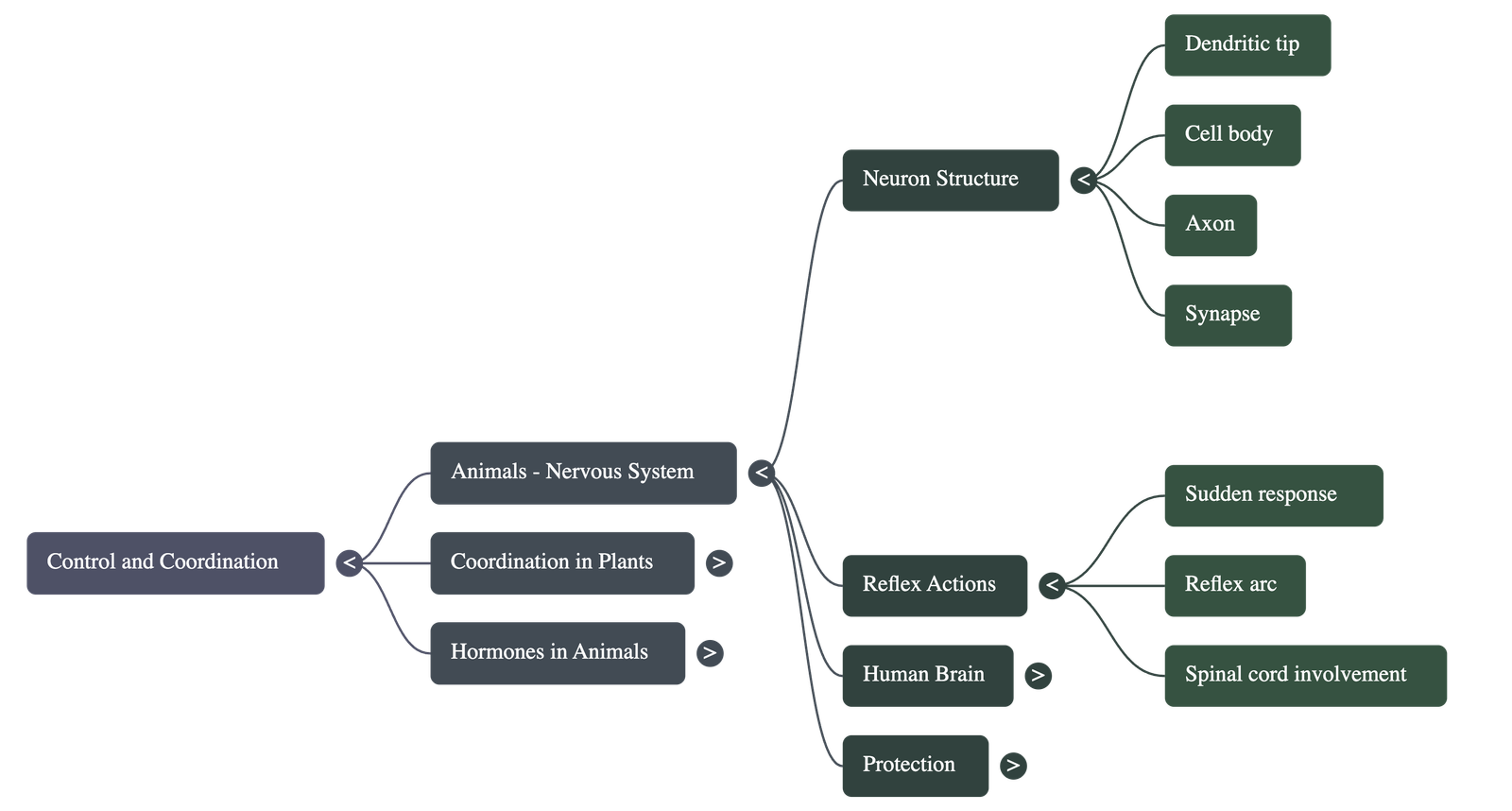
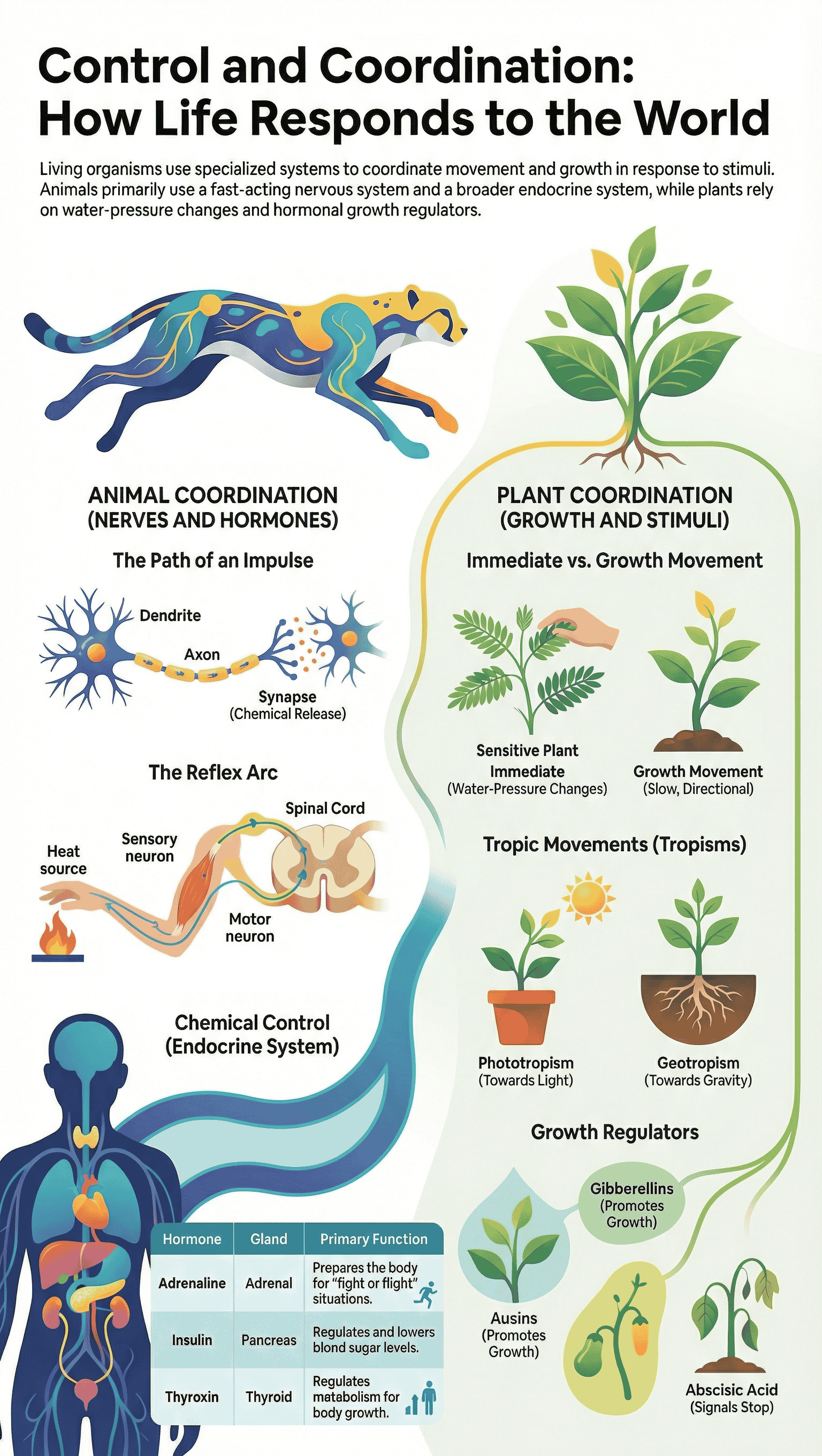
The Neuron (Nerve Cell)
- Structure: The functional unit of the nervous system.
- Reception: Information is detected by specialized tips called receptors located in sense organs (e.g., gustatory receptors for taste, olfactory receptors for smell).
- Transmission:
- Information acquired at the dendritic tip creates an electrical impulse.
- The impulse travels from the dendrite to the cell body and then along the axon.
- At the nerve ending, the electrical impulse triggers the release of chemicals.
- Synapse: The gap between two neurons. Chemicals released at the nerve ending cross this gap to start a fresh electrical impulse in the dendrite of the next neuron.
Reflex Actions
- Definition: Sudden, unconscious, and involuntary actions in response to a stimulus (e.g., pulling a hand away from a hot object).
- Reflex Arc: The pathway taken by nerve impulses in a reflex action.
- To ensure speed, input nerves meet output nerves directly in the spinal cord before the information reaches the brain.
- Although the brain eventually receives the sensory input, the immediate response occurs at the spinal cord level to save time and prevent injury.
The Human Brain
The brain constitutes the main coordinating center of the body. Together with the spinal cord, it forms the Central Nervous System (CNS).
Regions of the Brain
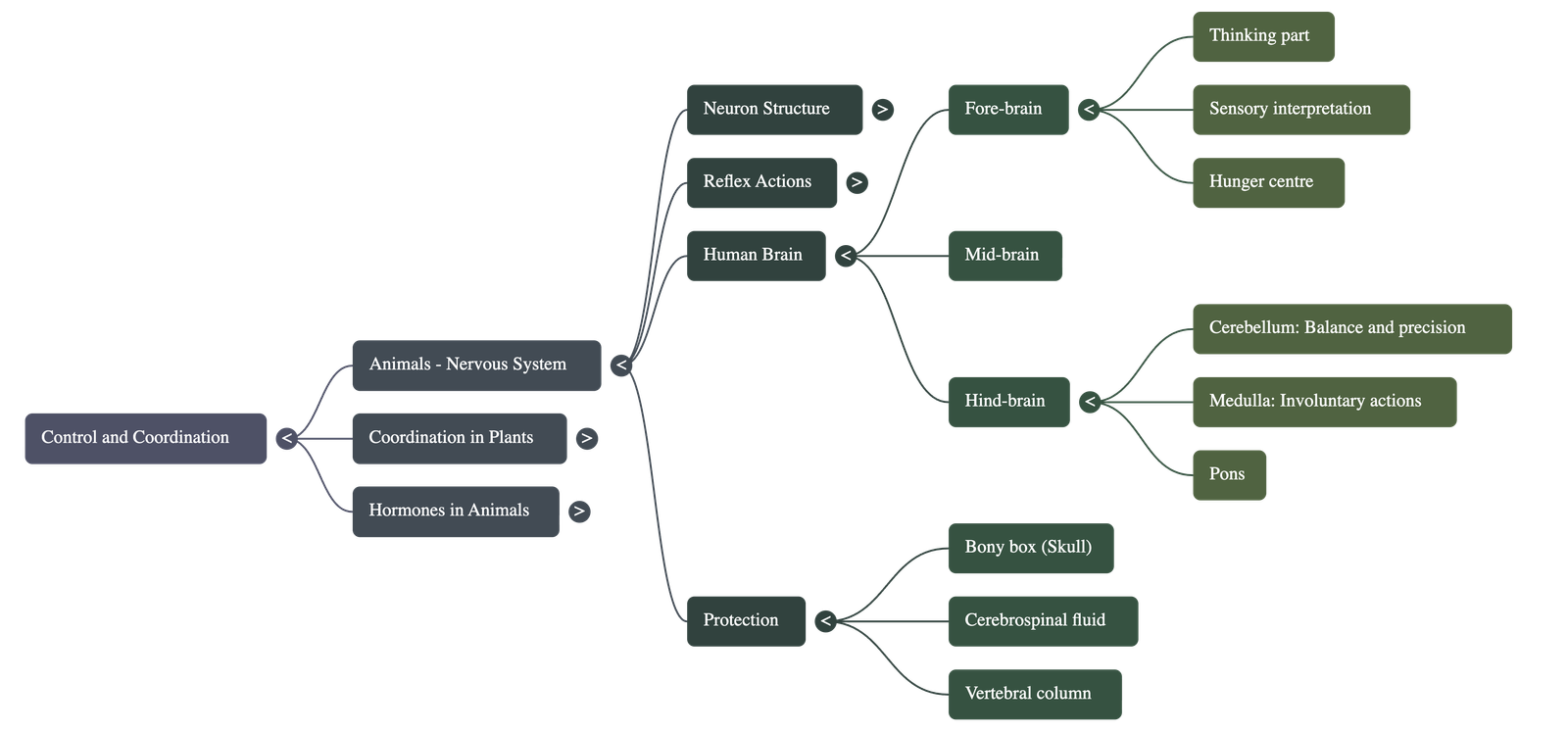
- Fore-brain: The main thinking part of the brain.
- Receives and integrates sensory information from various receptors.
- Responsible for voluntary actions and complex mental processes.
- Contains separate areas for hearing, smell, sight, etc.
- Includes the center associated with hunger.
- Mid-brain and Hind-brain: Control involuntary actions.
- Medulla (Hind-brain): Controls involuntary functions like blood pressure, salivation, and vomiting.
- Cerebellum (Hind-brain): Responsible for the precision of voluntary actions and maintaining body posture and balance (e.g., riding a bicycle, walking in a straight line).
Protection and Action
- Protection: The brain acts inside a bony box (cranium) and is contained within a fluid-filled balloon (cerebrospinal fluid) for shock absorption. The spinal cord is protected by the vertebral column (backbone).
- Muscle Action: The final response involves muscle movement. Muscle cells change shape and shorten due to special proteins that rearrange in response to nervous electrical impulses.
Coordination in Plants
Plants lack a nervous system and muscles but still respond to stimuli through two types of movements.
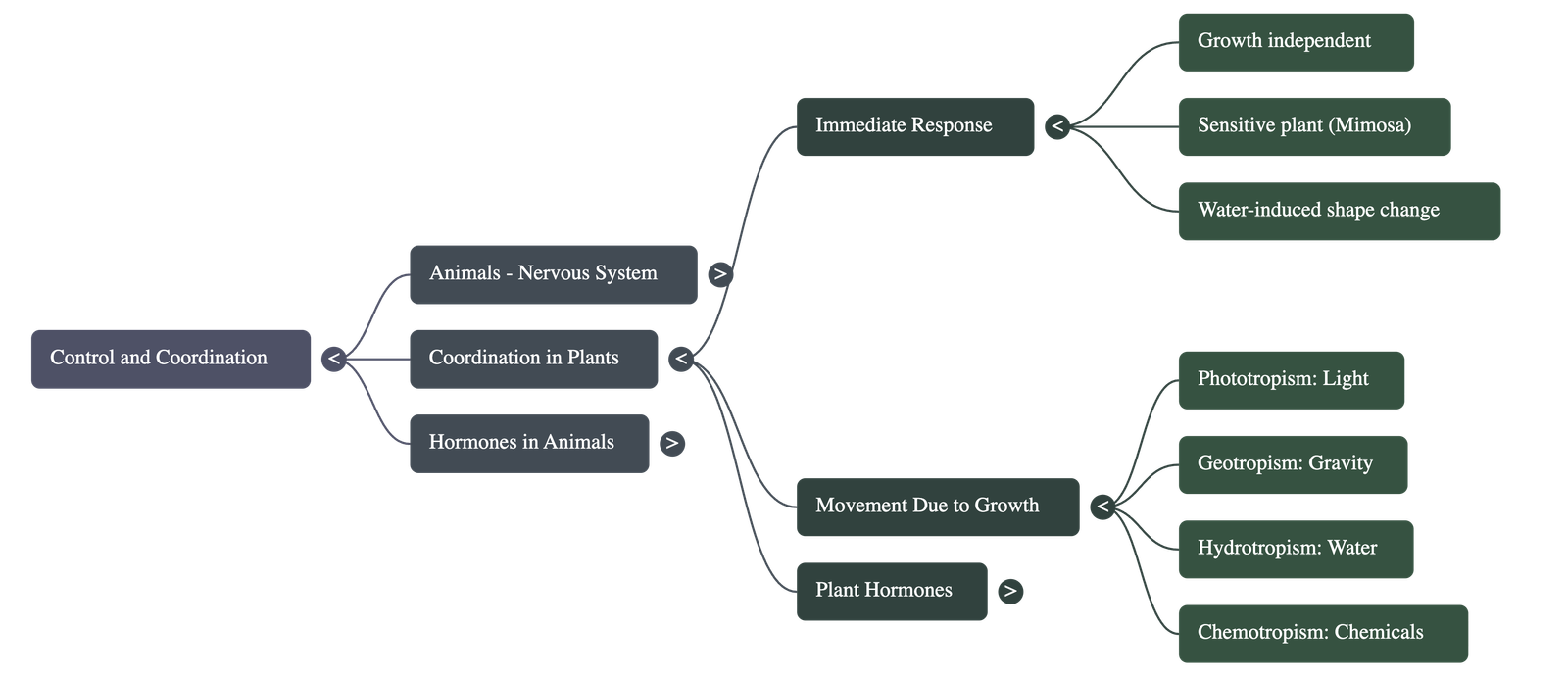
1. Movement Independent of Growth
- Immediate Response: Seen in plants like the "sensitive plant" (Mimosa pudica).
- Mechanism: Plants use electrical-chemical means to convey information from cell to cell.
- Action: Plant cells change shape by altering the amount of water they hold (swelling or shrinking), causing leaves to fold or droop.
2. Movement Dependent on Growth (Tropisms)
Directional movements in response to environmental triggers. The direction can be towards or away from the stimulus.
- Phototropism: Response to light. Shoots bend towards light, roots bend away.
- Mechanism: A hormone called auxin is synthesized at the shoot tip. When light comes from one side, auxin diffuses to the shady side, stimulating cells on that side to grow longer, causing the plant to bend towards the light.
- Geotropism: Response to gravity. Roots grow downwards (positive), shoots grow upwards (negative).
- Hydrotropism: Growth response to water.
- Chemotropism: Growth response to chemicals (e.g., growth of pollen tubes towards ovules).
- Thigmotropism: Response to touch (e.g., tendrils circling an object to climb).
Plant Hormones (Phytohormones)
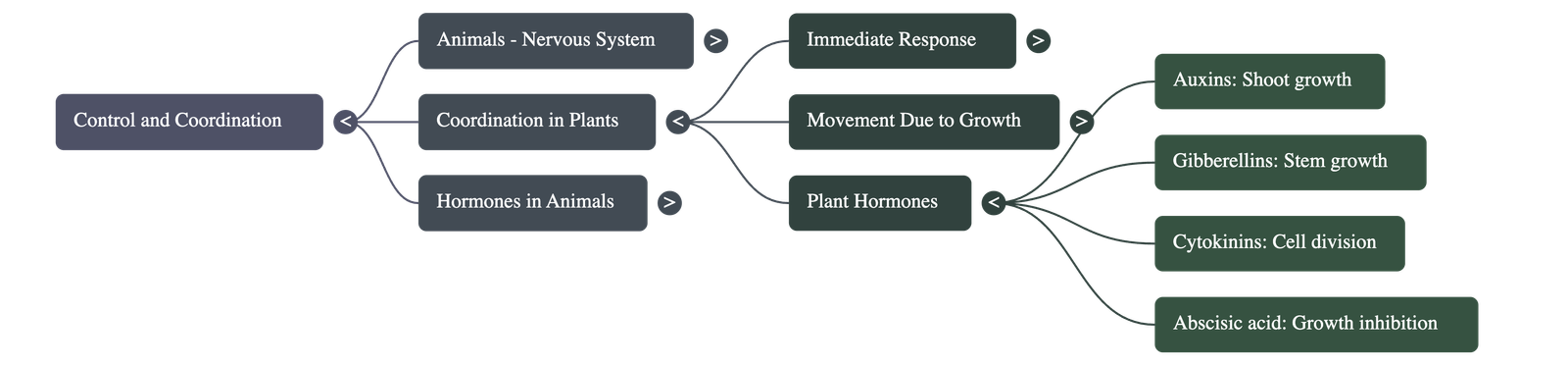
- Auxins: Promote growth (cell elongation).
- Gibberellins: Help in the growth of the stem.
- Cytokinins: Promote cell division (abundant in fruits and seeds).
- Abscisic Acid: Inhibits growth; responsible for effects like the wilting of leaves.
Hormones in Animals (Chemical Coordination)
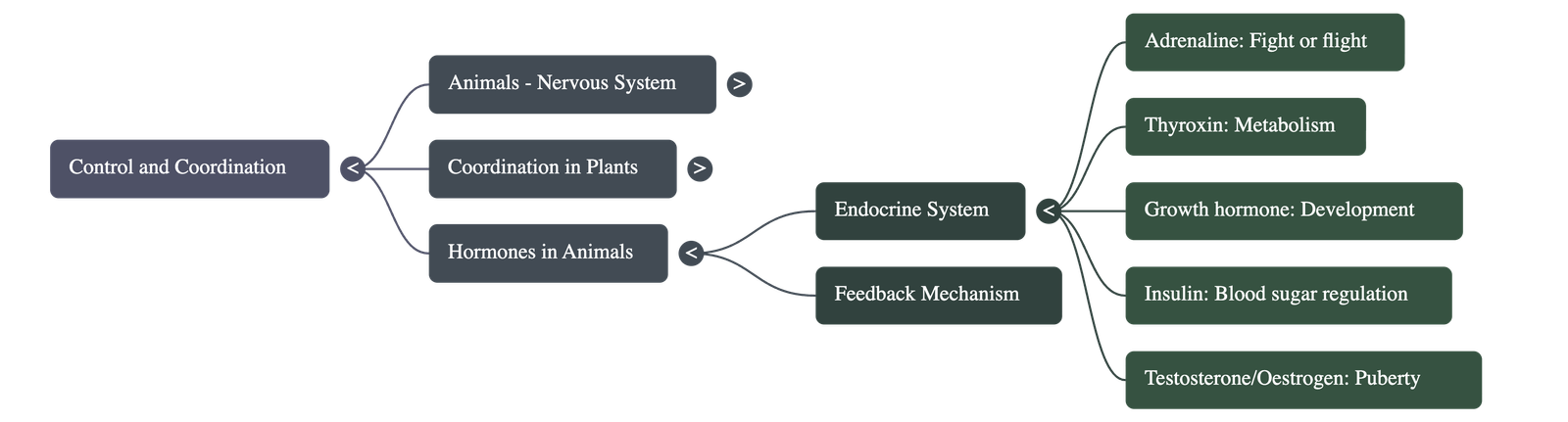
The endocrine system uses chemical messengers called hormones to provide control and coordination, complementing the nervous system.
Why Chemical Coordination?
- Electrical impulses affect only cells connected by nervous tissue.
- Cells take time to reset after generating an impulse.
- Chemical signals can diffuse to all cells and provide persistent, wide-ranging changes.
Key Hormones and Glands
| Hormone | Gland | Function |
|---|---|---|
| Adrenaline | Adrenal Gland | Prepares body for emergency (fight or flight). Increases heart rate, diverts blood to muscles, increases breathing rate. |
| Thyroxin | Thyroid Gland | Regulates carbohydrate, protein, and fat metabolism. Iodine is essential for its synthesis (deficiency causes Goitre). |
| Growth Hormone | Pituitary Gland | Regulates growth and development. Deficiency causes dwarfism; excess causes gigantism. |
| Testosterone | Testes (Males) | Controls changes associated with puberty in males. |
| Oestrogen | Ovaries (Females) | Controls changes associated with puberty in females. |
| Insulin | Pancreas | Regulates blood sugar levels. Deficiency leads to Diabetes. |
Feedback Mechanism
- Hormone secretion is regulated by feedback mechanisms to ensure precise timing and quantity.
- Example: If blood sugar rises, pancreatic cells detect it and produce more insulin. As sugar levels fall, insulin production is reduced.
Do checkout all questions & answers of this chapter.
Quick Navigation:
| | | |
1 / 1
Quick Navigation:
| | | |