Quick Navigation:
| | | |
Chapter 11: Electricity
1. Electric Current and Circuit
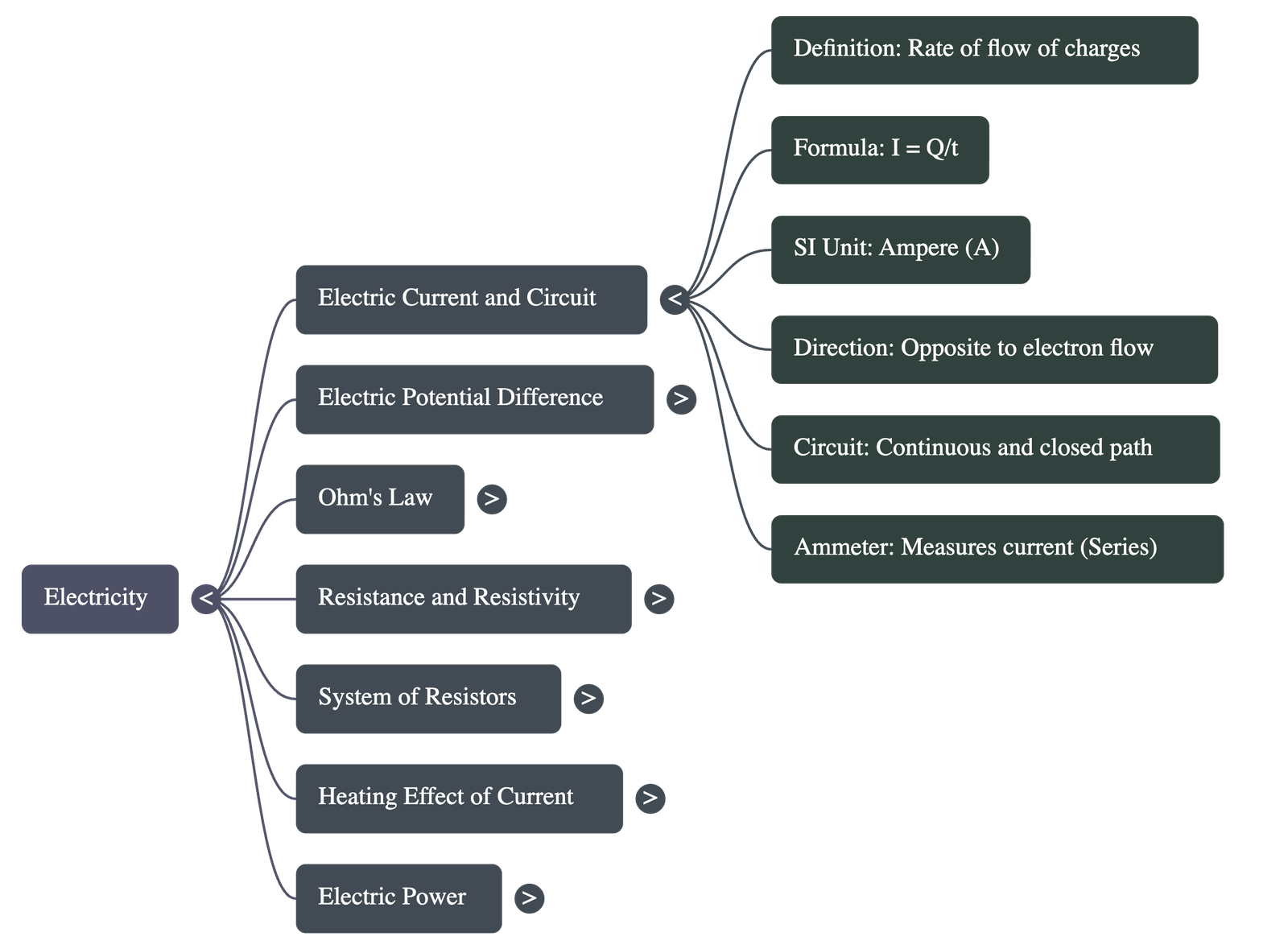
- Electric Current: Defined as the rate of flow of electric charges. It constitutes the flow of charge through a particular area per unit time.
- Formula: If a net charge Q flows across a cross-section of a conductor in time t, the current I is given by:
I = Q / t - SI Unit: The SI unit of electric charge is the coulomb (C) (equivalent to the charge of approx. 6 × 10¹⁸ electrons). The unit of current is the ampere (A).
- Definition of Ampere: One ampere is the flow of one coulomb of charge per second (1 A = 1 C/s).
- Direction: Conventionally, the direction of electric current is taken as opposite to the direction of the flow of electrons (negative charges).
- Measurement: Current is measured by an instrument called an ammeter, which is always connected in series in a circuit.
- Electric Circuit: A continuous and closed path of an electric current.
2. Electric Potential and Potential Difference
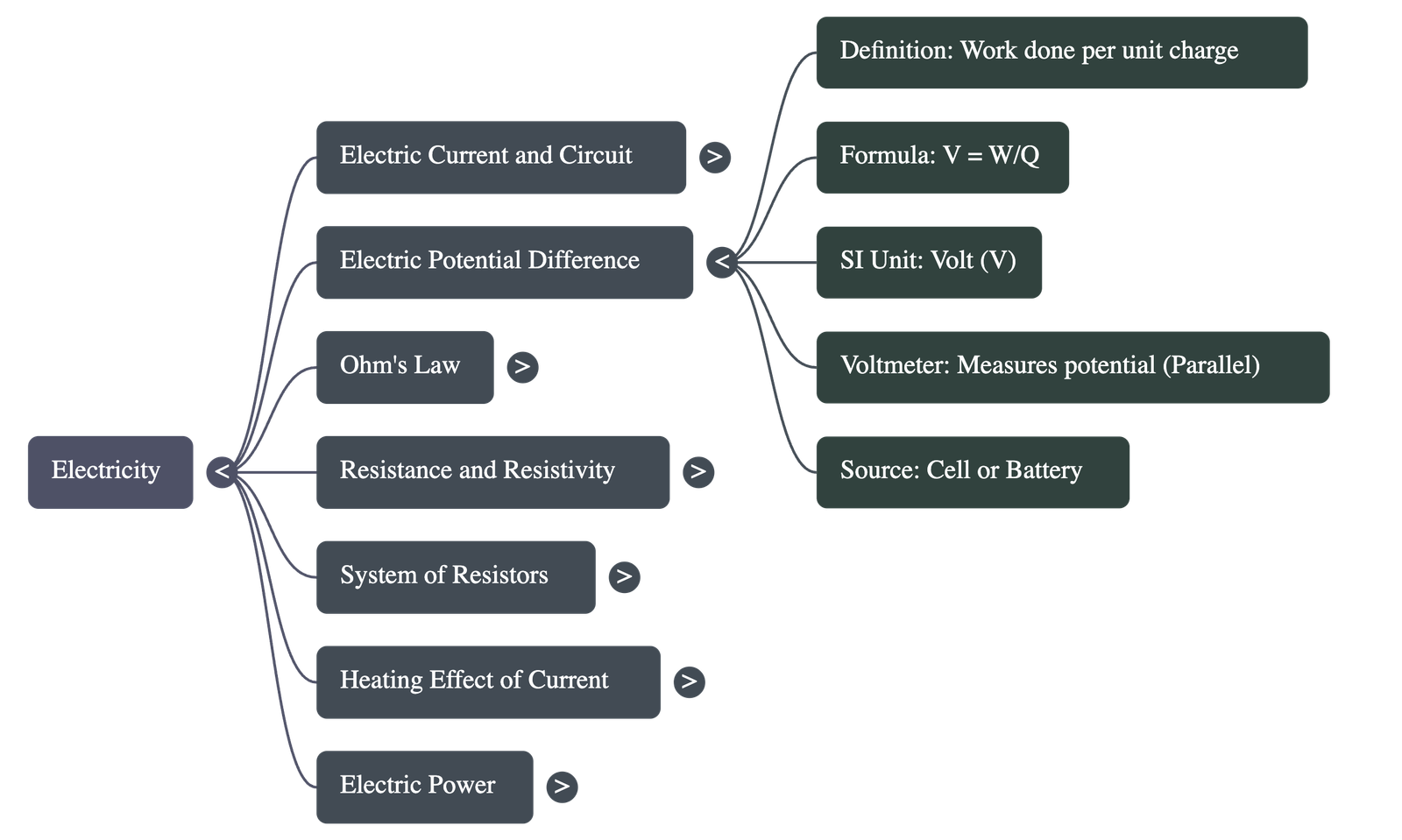
- Concept: Electrons move only if there is a difference of electric pressure, called potential difference, typically produced by a battery or cell.
- Definition: The potential difference between two points in an electric circuit is the work done to move a unit charge from one point to the other.
- Formula:
V = W / Q (Where V is potential difference, W is work done, and Q is charge). - SI Unit: The unit is the volt (V). One volt is the potential difference when 1 joule of work is done to move a charge of 1 coulomb (1 V = 1 J/C).
- Measurement: Potential difference is measured by a voltmeter, which is always connected in parallel across the points to be measured.
3. Ohm’s Law
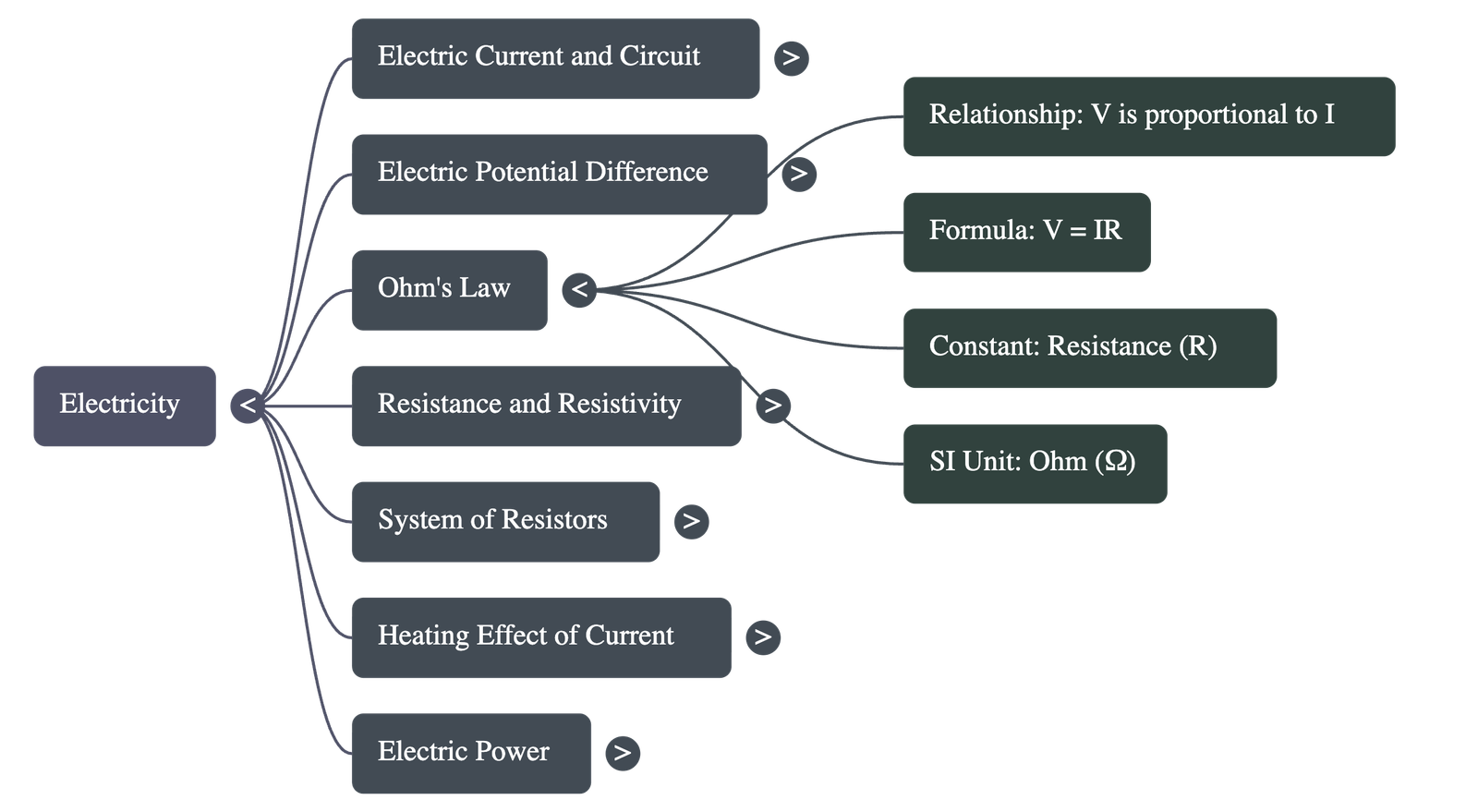
- Statement: The potential difference, V, across the ends of a given metallic wire in an electric circuit is directly proportional to the current flowing through it, provided its temperature remains the same.
- Formula: V = IR
- Resistance (R): The constant of proportionality. It is the property of a conductor to resist the flow of charges through it.
- SI Unit of Resistance: Ohm (Ω). If V = 1 volt and I = 1 ampere, then R = 1 ohm.
- Rheostat: A device used to regulate current by changing the resistance in the circuit without changing the voltage source.
4. Factors Affecting Resistance
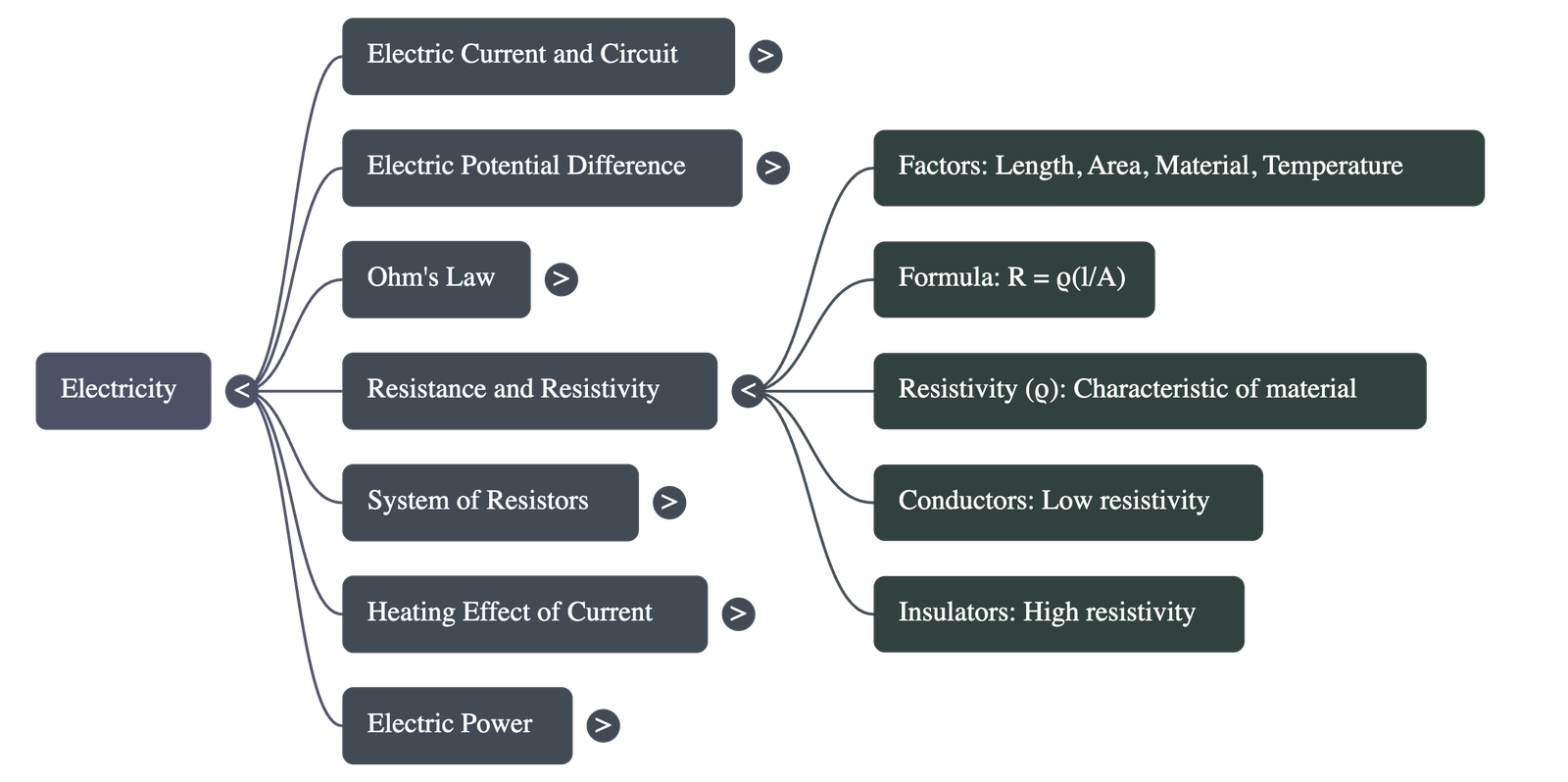
The resistance of a uniform metallic conductor depends on:
- Length (l): Resistance is directly proportional to length (R ∝ l).
- Area of Cross-section (A): Resistance is inversely proportional to the area of cross-section (R ∝ 1/A).
- Nature of Material: Depends on the material's resistivity.
Formula: R = ρ (l / A)
Resistivity (ρ): The constant of proportionality is called electrical resistivity. Its SI unit is Ω m. Metals and alloys have very low resistivity (good conductors), while insulators like rubber and glass have very high resistivity.
5. Resistance of a System of Resistors
Resistors in Series
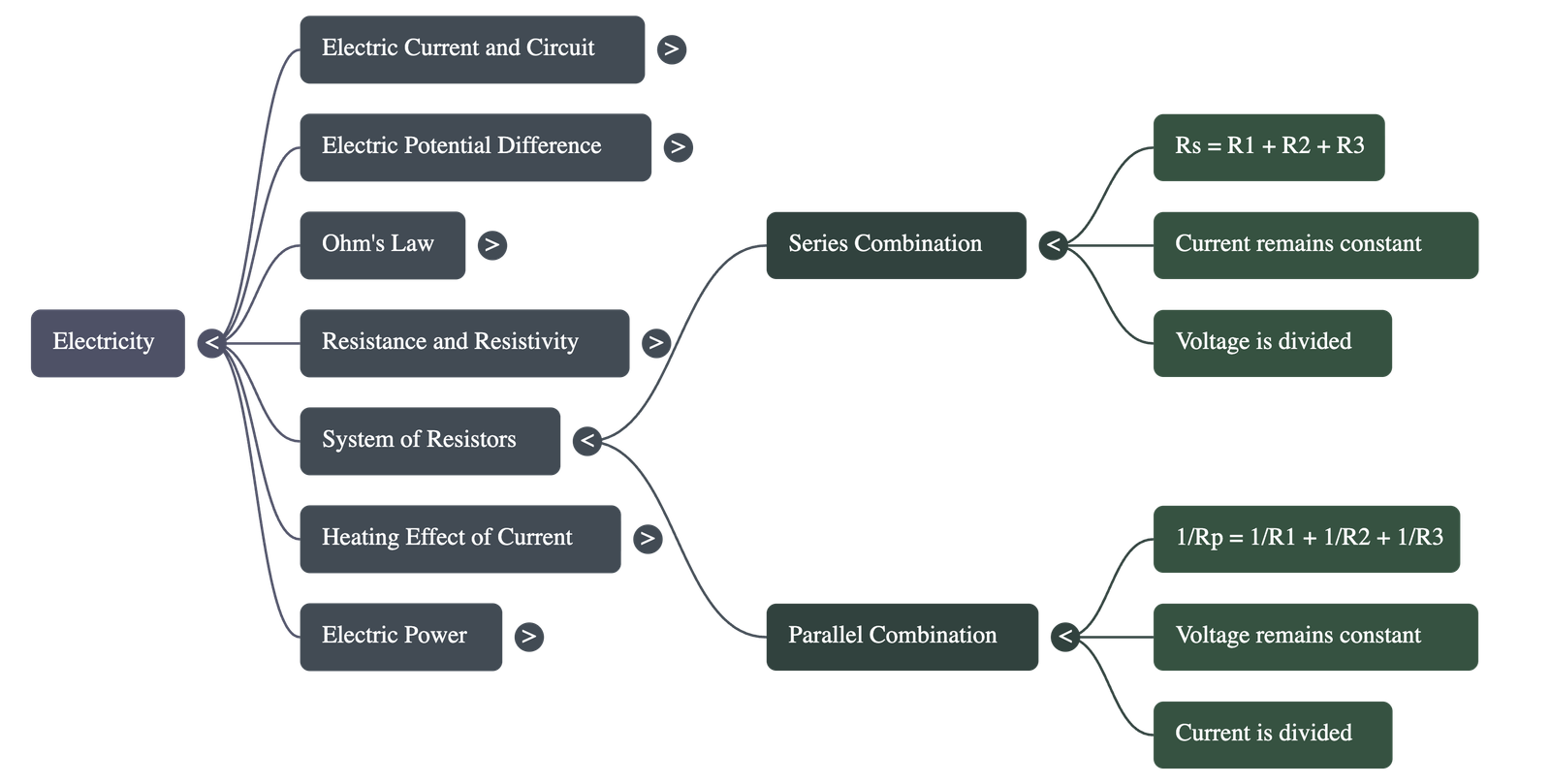
- Current is the same in every part of the circuit.
- Total potential difference is the sum of potential differences across individual resistors (V = V1 + V2 + V3).
- Equivalent Resistance (Rs): Equal to the sum of individual resistances.
Rs = R1 + R2 + R3 - Disadvantage: If one component fails, the circuit breaks, and none work.
Resistors in Parallel
- Potential difference is the same across each resistor.
- Total current is the sum of currents through each branch (I = I1 + I2 + I3).
- Equivalent Resistance (Rp): The reciprocal of the equivalent resistance is the sum of the reciprocals of individual resistances.
1/Rp = 1/R1 + 1/R2 + 1/R3 - Advantage: Useful when gadgets have different resistances and require different currents to operate properly.
6. Heating Effect of Electric Current
- Mechanism: When electric current flows through a purely resistive circuit, the source energy is dissipated entirely as heat.
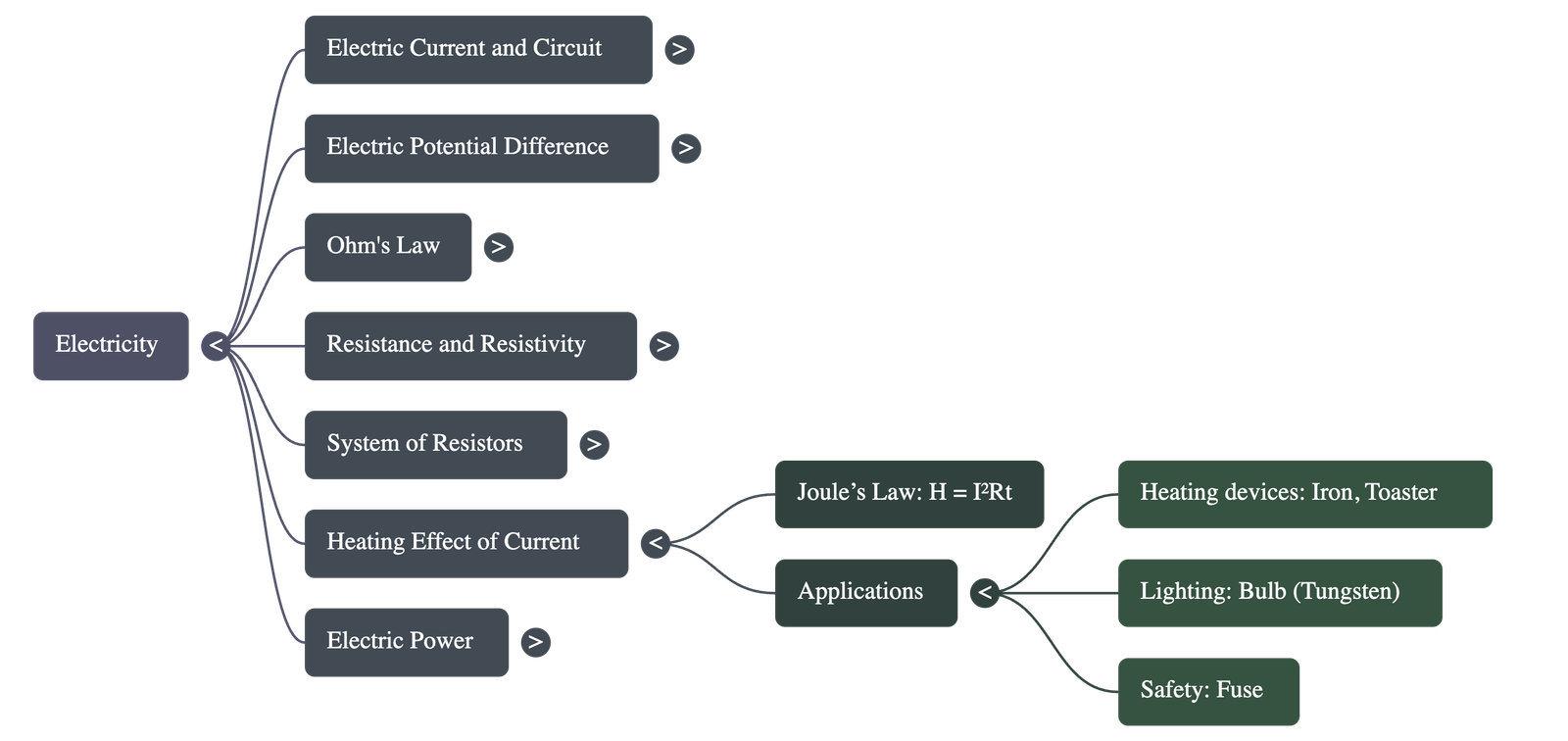
- Joule’s Law of Heating: The heat produced in a resistor is:
- Directly proportional to the square of current (I2).
- Directly proportional to resistance (R).
- Directly proportional to the time (t) the current flows.
- Formula: H = I2Rt
Practical Applications
- Heating Appliances: Devices like electric irons, toasters, and heaters use alloys (like Nichrome) because they have high resistivity and do not oxidize easily at high temperatures.
- Electric Bulb: Uses a tungsten filament (high melting point of 3380°C) to retain heat and emit light. It is filled with inactive gases (nitrogen/argon) to prolong filament life.
- Electric Fuse: A safety device placed in series. It consists of a wire with an appropriate melting point (e.g., lead, copper). If current exceeds a safe value, the wire melts and breaks the circuit, protecting appliances.
7. Electric Power
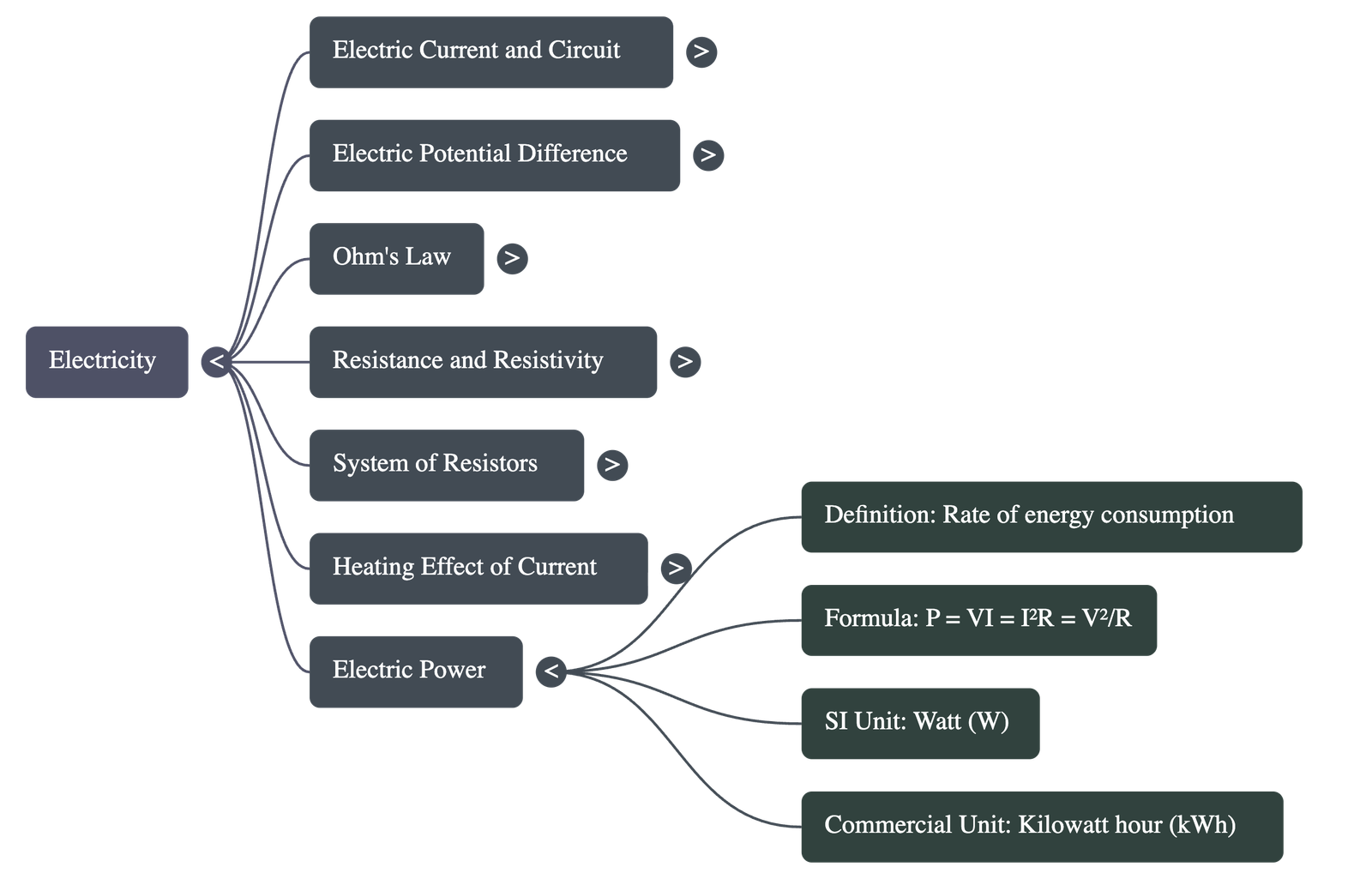
- Definition: The rate at which electric energy is dissipated or consumed in an electric circuit.
- Formulas:
P = VI
P = I2R
P = V2 / R - SI Unit: Watt (W). 1 Watt is the power consumed when 1 A of current flows at a potential difference of 1 V.
- Commercial Unit of Energy: Kilowatt-hour (kWh), commonly known as a "unit".
1 kWh = 3.6 × 10⁶ joules.
Do checkout all questions & answers of this chapter.
Quick Navigation:
| | | |
1 / 1
Quick Navigation:
| | | |