Quick Navigation:
| | | |
Chapter 13: Our Environment
1. Ecosystem and Its Components
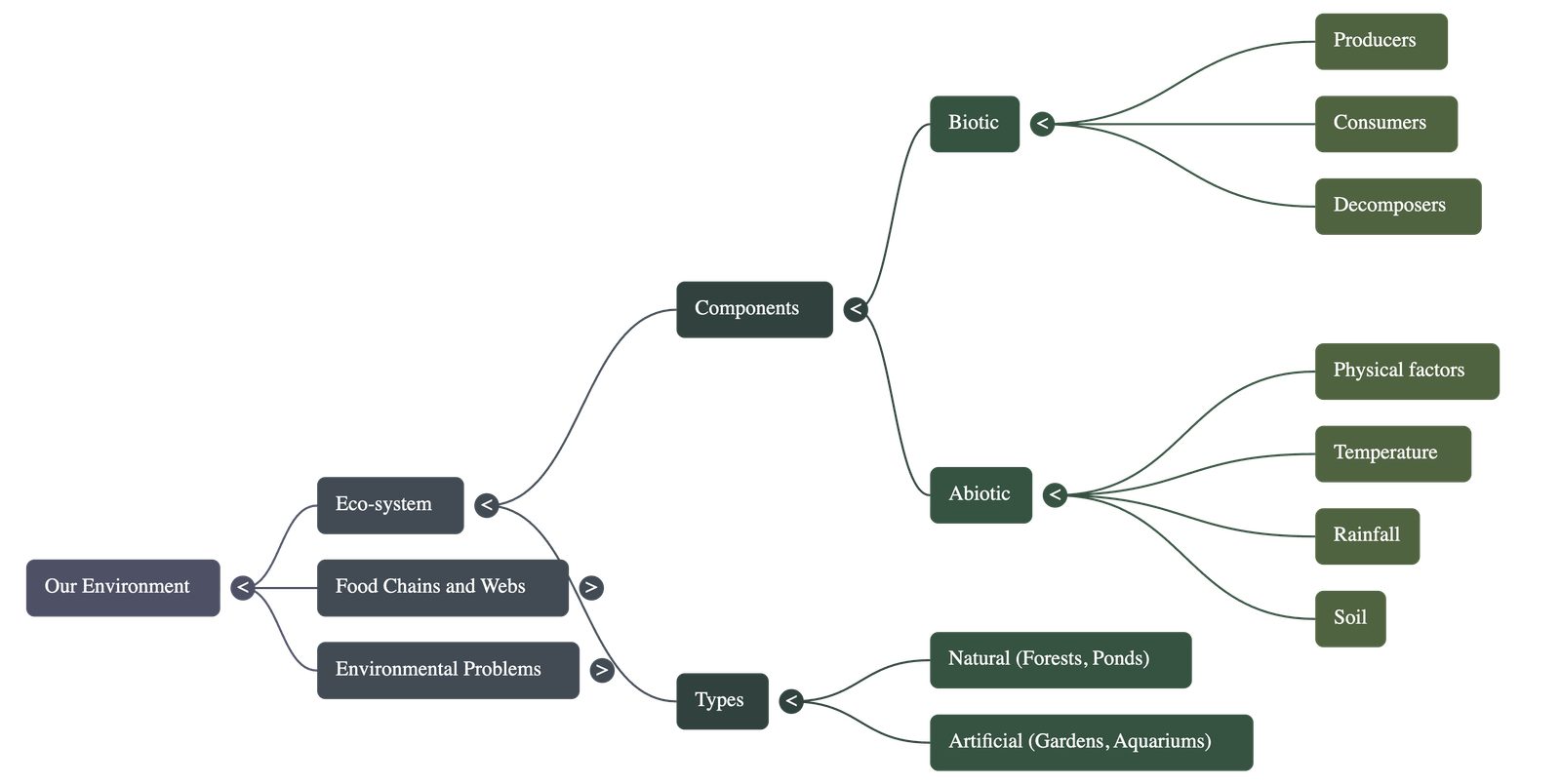
- Definition: An ecosystem consists of all interacting organisms (biotic components) in an area together with the non-living constituents (abiotic components) of the environment.
-
Components:
- Biotic: Living organisms such as plants, animals, and microorganisms.
- Abiotic: Physical factors like temperature, rainfall, wind, soil, and minerals.
-
Types of Ecosystems:
- Natural: Forests, ponds, and lakes.
- Artificial (Human-made): Gardens, crop-fields, and aquariums.
-
Organism Categories based on Sustenance:
- Producers: Organisms that produce food using radiant energy (sunlight) and chlorophyll (e.g., green plants, certain bacteria).
- Consumers: Organisms dependent on producers directly or indirectly. They include herbivores, carnivores, omnivores, and parasites.
- Decomposers: Microorganisms (bacteria and fungi) that break down dead remains and waste products. They replenish the soil by converting complex organic substances into simple inorganic substances.
2. Food Chains and Webs
- Food Chain: A series of organisms feeding on one another, where energy is transferred from one organism to the next.
-
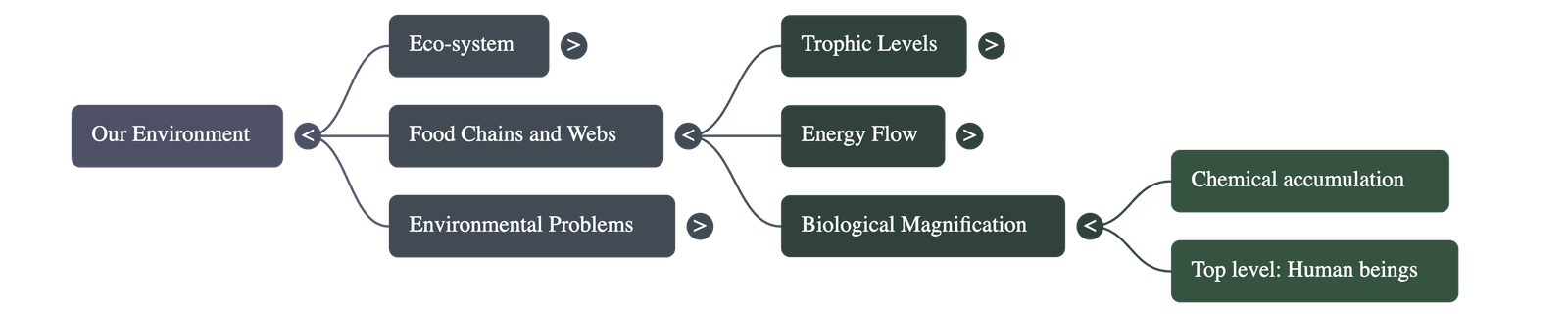
Trophic Levels: Each step in a food chain represents a trophic level:
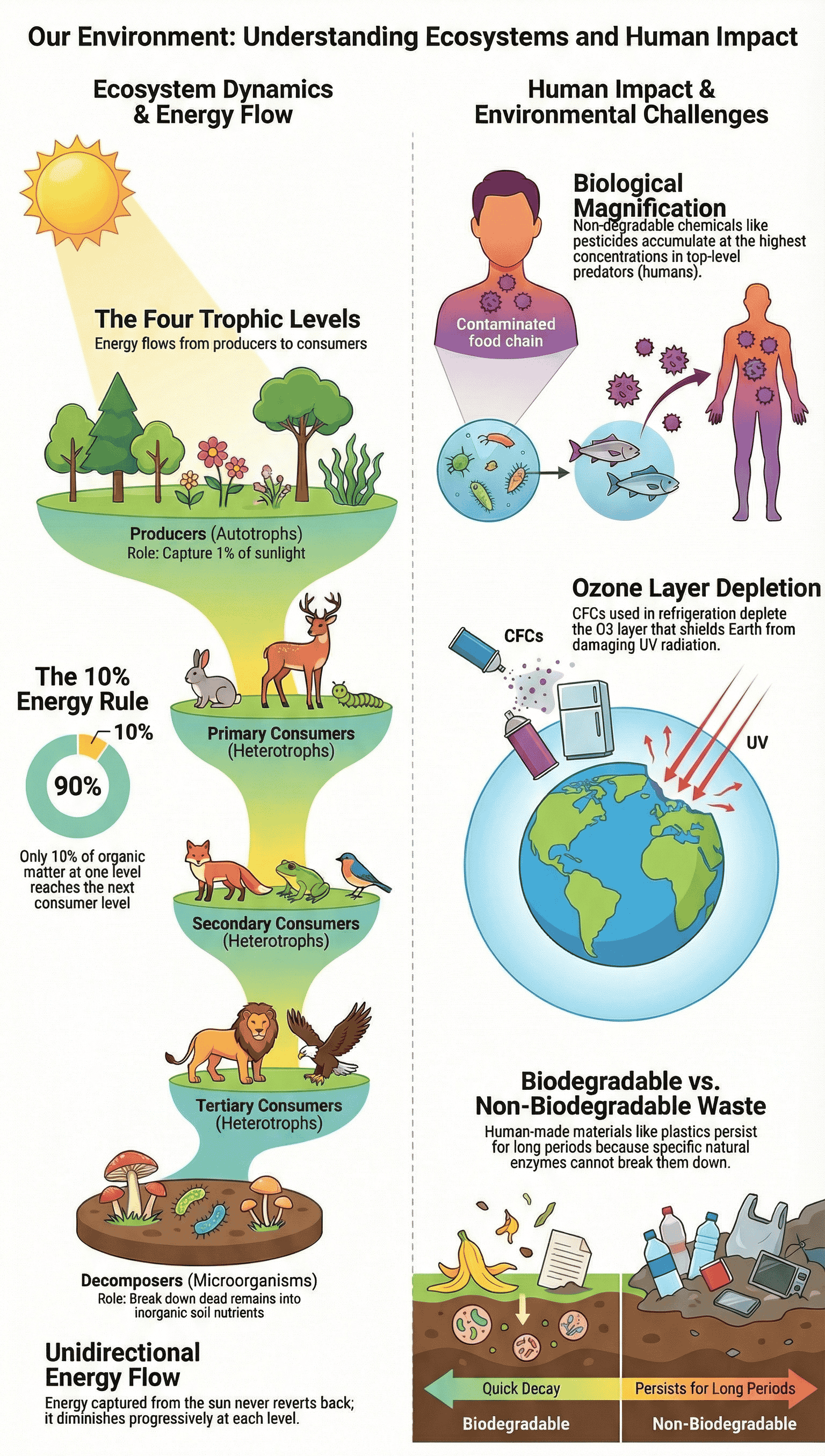
- 1st Level: Producers (Autotrophs).
- 2nd Level: Primary Consumers (Herbivores).
- 3rd Level: Secondary Consumers (Small Carnivores).
- 4th Level: Tertiary Consumers (Larger Carnivores).
- Food Web: A network of branching food chains. Since each organism is generally eaten by two or more other kinds of organisms, relationships are better represented as a web rather than a straight line.
3. Energy Flow in an Ecosystem
- Unidirectional Flow: Energy flows in one direction only (Sun → Producers → Consumers). It does not revert to the previous level.
- Energy Loss: At each trophic level, a significant amount of energy is lost to the environment as heat (for digestion, work, growth, etc.).
-
Key Energy Statistics:
- Green plants capture approximately 1% of the sunlight falling on their leaves.
- 10% Law: Only about 10% of food energy is turned into body mass and passed on to the next trophic level.
- Limitation of Chains: Due to high energy loss, food chains usually have only 3 to 4 steps. Very little usable energy remains after the fourth level.
4. Biological Magnification
- Definition: The phenomenon where harmful, non-degradable chemicals accumulate progressively at each trophic level.
- Process: Pesticides and chemicals washed into soil or water bodies are absorbed by plants and aquatic animals. These chemicals enter the food chain and cannot be removed or degraded.
- Impact on Humans: As humans occupy the top level of most food chains, the maximum concentration of these chemicals accumulates in human bodies.
5. Ozone Layer Depletion
- Ozone (O₃): A molecule formed by three atoms of oxygen. Unlike normal oxygen (O₂), ozone is a deadly poison but essential at higher atmospheric levels.
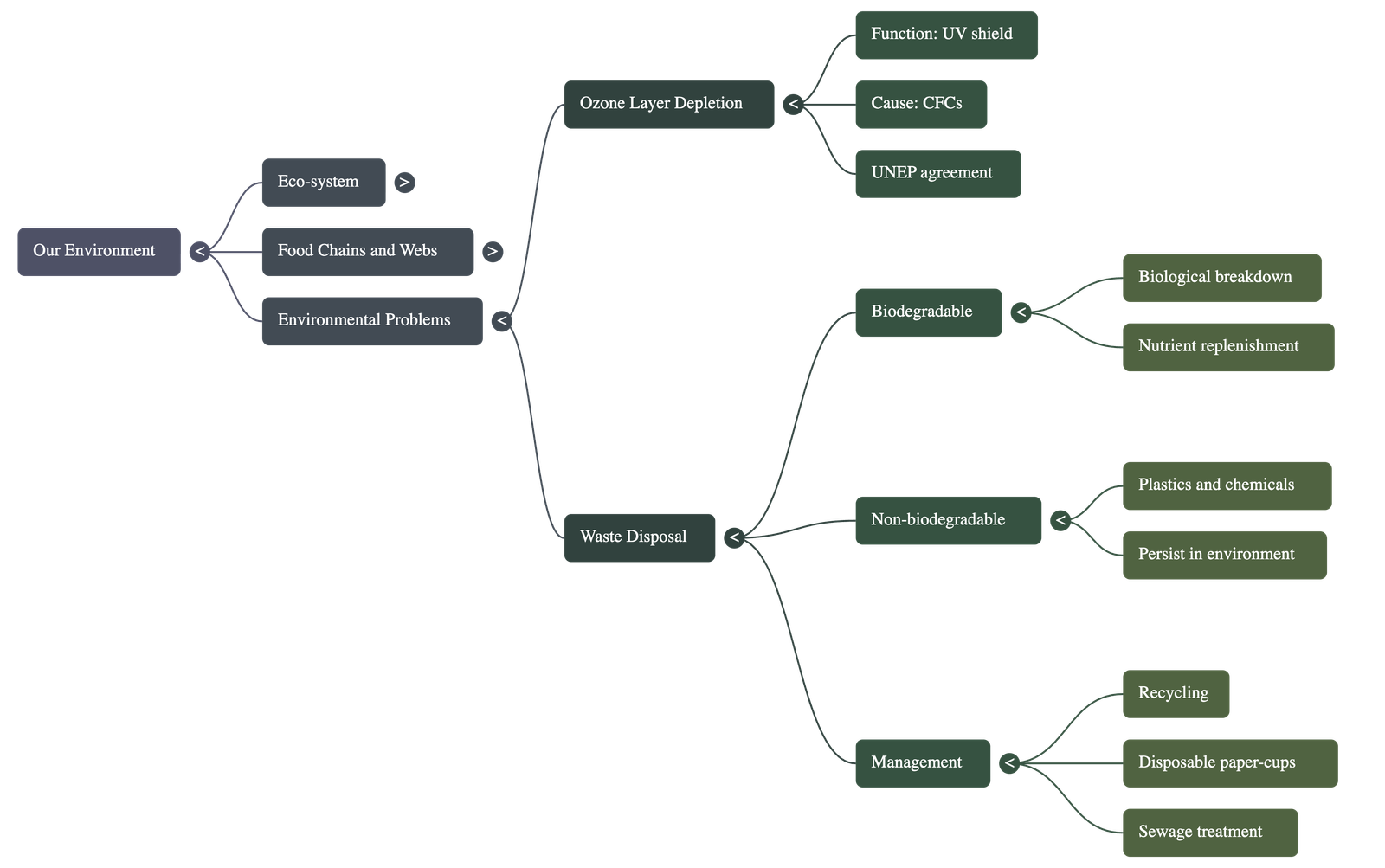
- Function: It shields the Earth from harmful ultraviolet (UV) radiation from the Sun, which is known to cause skin cancer in humans.
- Formation: UV radiation splits molecular oxygen (O₂) into free oxygen atoms (O), which then combine with molecular oxygen to form ozone.
- Cause of Depletion: Synthetic chemicals like chlorofluorocarbons (CFCs), used in refrigerants and fire extinguishers, are linked to the sharp drop in ozone levels since the 1980s.
- Global Action: In 1987, the United Nations Environment Programme (UNEP) forged an agreement to freeze CFC production at 1986 levels.
6. Managing Garbage
- Biodegradable Wastes: Substances that can be broken down by biological processes (e.g., action of bacteria/saprophytes).
- Non-biodegradable Wastes: Substances that cannot be broken down by biological processes (e.g., plastics). They persist in the environment for long periods due to heat and pressure, often harming the ecosystem.
-
Lifestyle Impacts:
- Increased waste generation due to lifestyle improvements.
- Shift towards disposable items and non-biodegradable packaging.
- Evolution of cups in trains: From plastic (hygiene concerns) to clay "kulhads" (top-soil loss concerns) to disposable paper cups.
Do checkout all questions & answers of this chapter.
Quick Navigation:
| | | |
1 / 1
Quick Navigation:
| | | |