Quick Navigation:
| | |
Chapter 9: Gravitation
1. The Universal Law of Gravitation
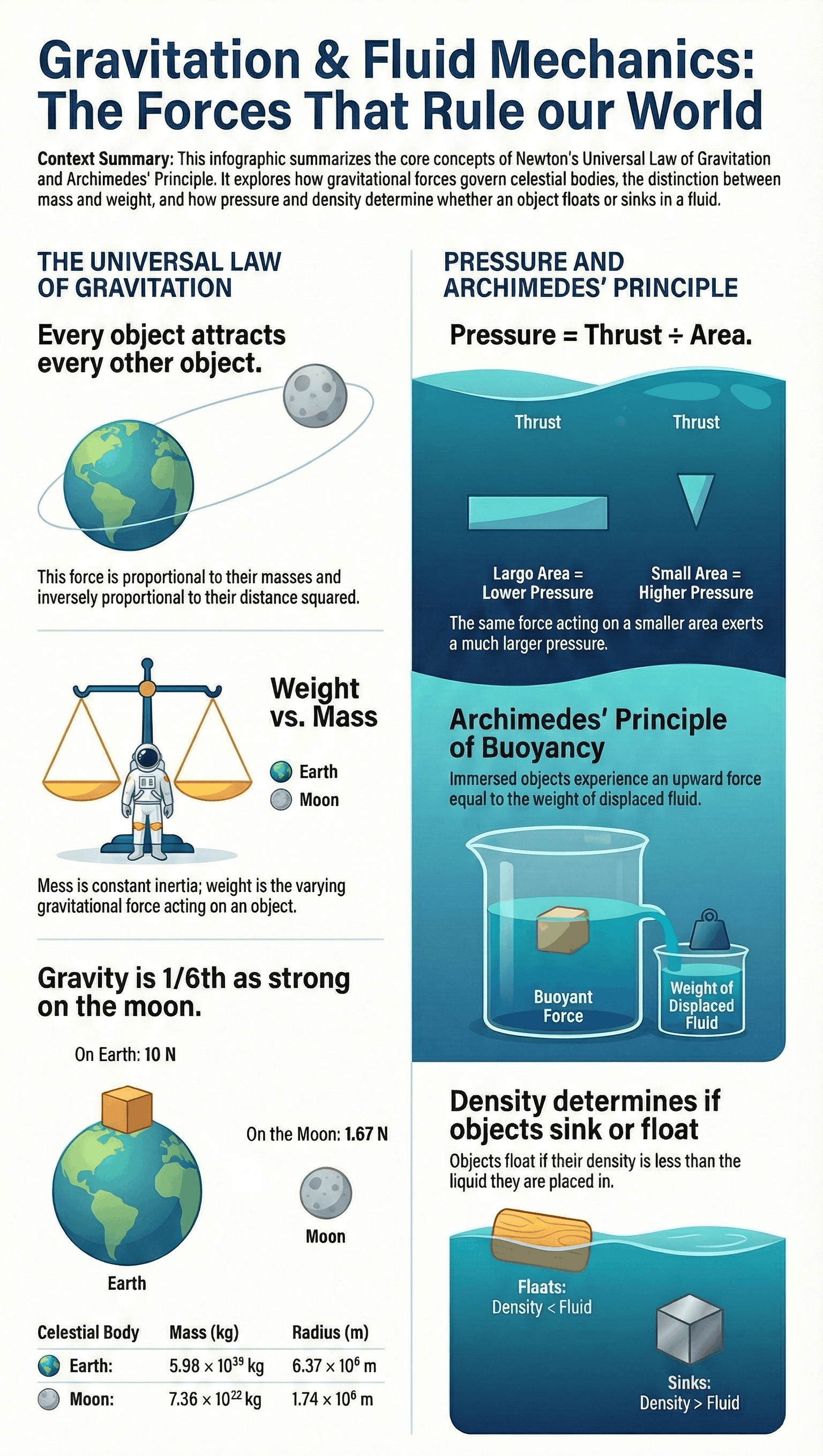
- Fundamental Concept: Every object in the universe attracts every other object with a force. Isaac Newton deduced that the force responsible for an apple falling is the same force keeping the moon in orbit around the earth.
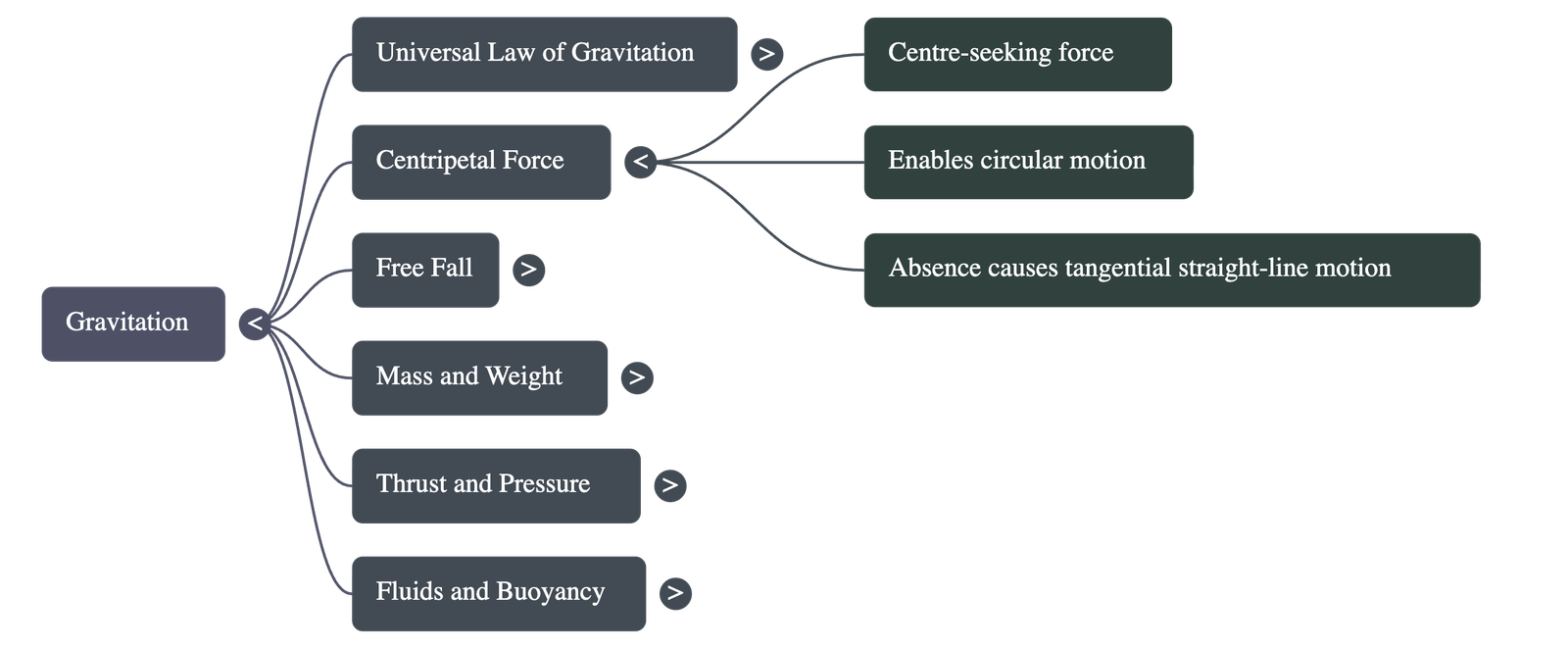
- Centripetal Force: The moon moves in a circular path due to a force acting towards the centre of the earth. This centre-seeking force is called centripetal force. Without it, the moon would fly off in a straight straight line (tangent to the circle).
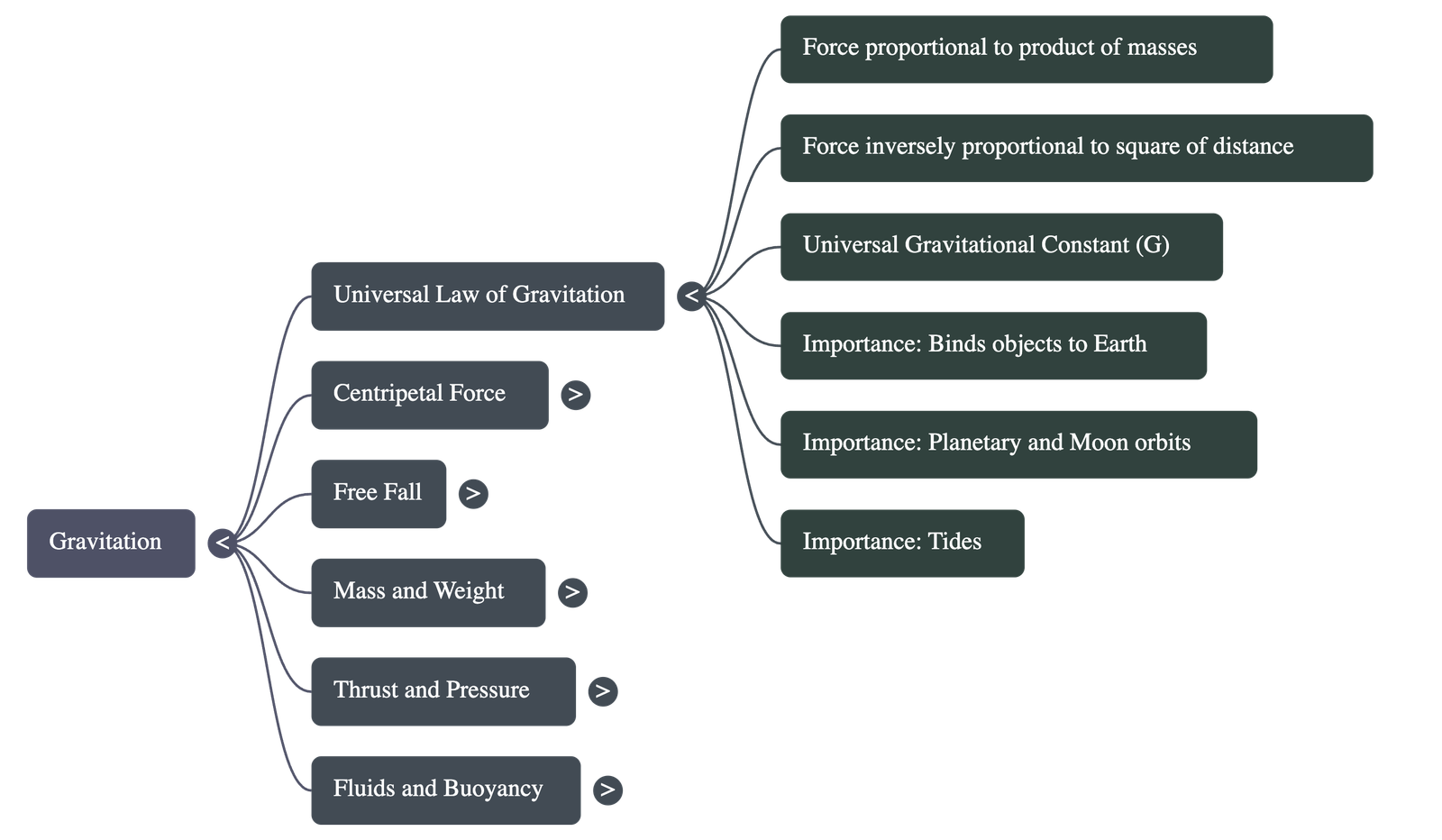
- The Law: The force is directly proportional to the product of the masses of the objects and inversely proportional to the square of the distance between them.
- Mathematical Formula: F = G × (M × m) / d², where G is the proportionality constant.
- Universal Gravitation Constant (G): The accepted value of G is 6.673 × 10⁻¹¹ N m² kg⁻².
- Importance: This law explains phenomena such as the force binding us to earth, the motion of the moon and planets, and the tides caused by the sun and moon.
2. Free Fall
- Definition: When objects fall towards the earth under the influence of gravitational force alone, they are said to be in free fall.
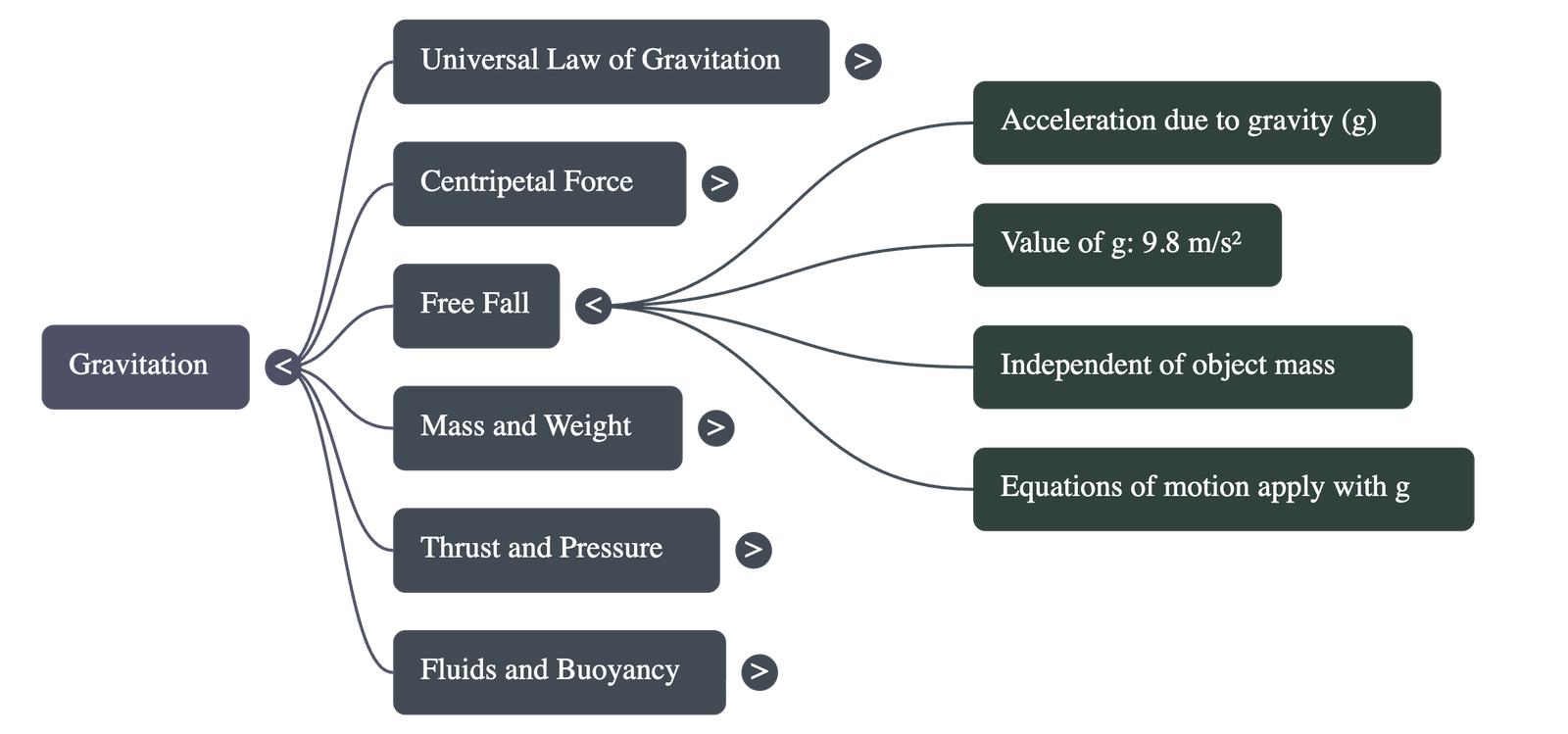
- Acceleration due to Gravity (g): Falling involves a change in velocity magnitude, creating acceleration. This is denoted by g.
- Relation to Mass: The acceleration experienced by an object is independent of its mass. All objects (hollow, solid, big, or small) fall at the same rate in a vacuum.
- Value of g: On Earth, the value is approximately 9.8 m s⁻². The earth is not a perfect sphere; g is greater at the poles than at the equator.
- Equations of Motion: For objects falling under gravity, the standard equations of motion apply, replacing acceleration a with g:
- v = u + gt
- s = ut + ½ gt²
- v² = u² + 2gs
3. Mass vs. Weight
| Mass (m) | Weight (W) |
|---|---|
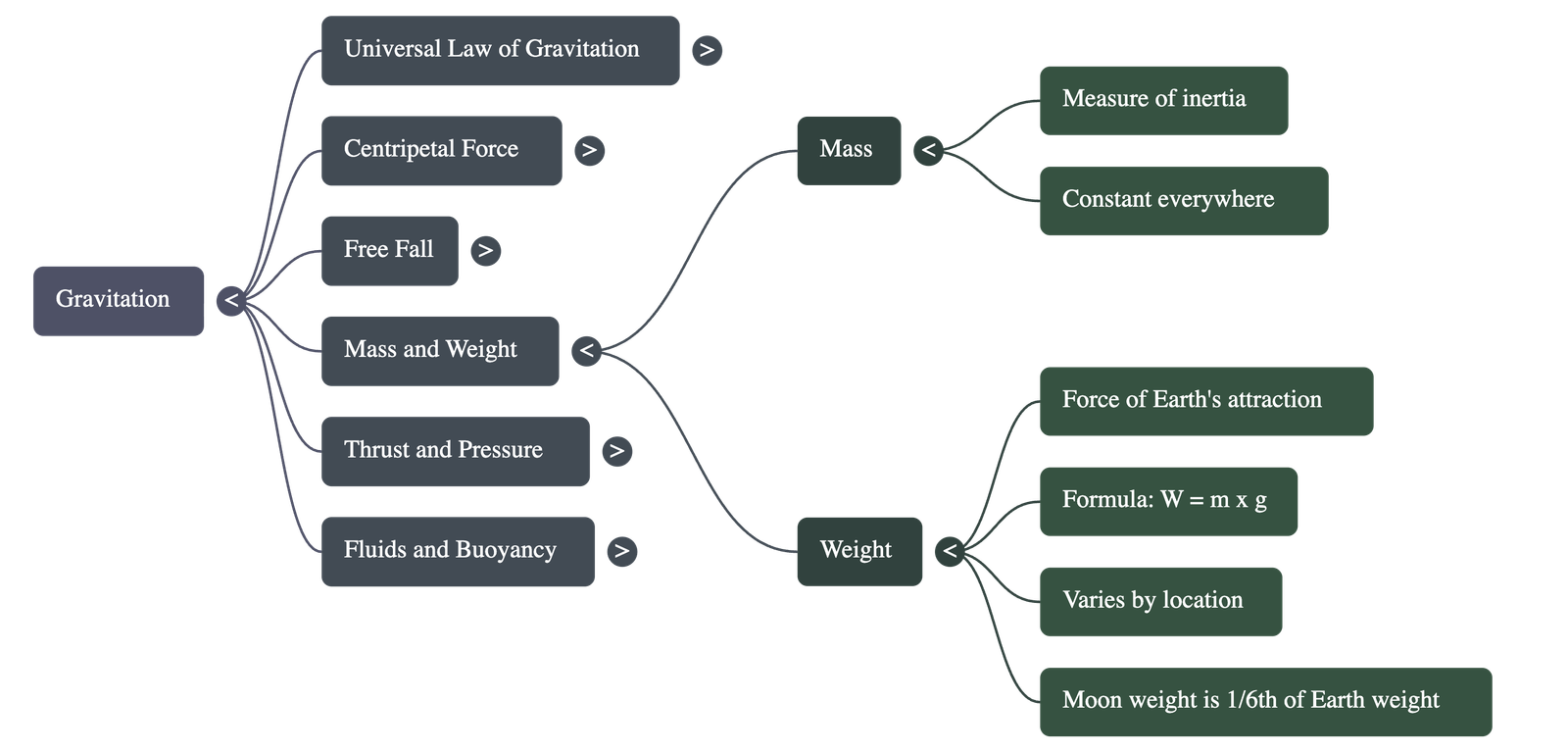
| A measure of inertia (resistance to change in motion). | The force with which the earth attracts an object. |
| Constant everywhere in the universe. | Varies depending on location (depends on g). |
| Scalar quantity (magnitude only). | Vector quantity (magnitude and direction downwards). Formula: W = m × g. |
Note: The weight of an object on the moon is 1/6th its weight on the earth because the moon's mass (and thus its gravitational force) is lower.
4. Thrust and Pressure
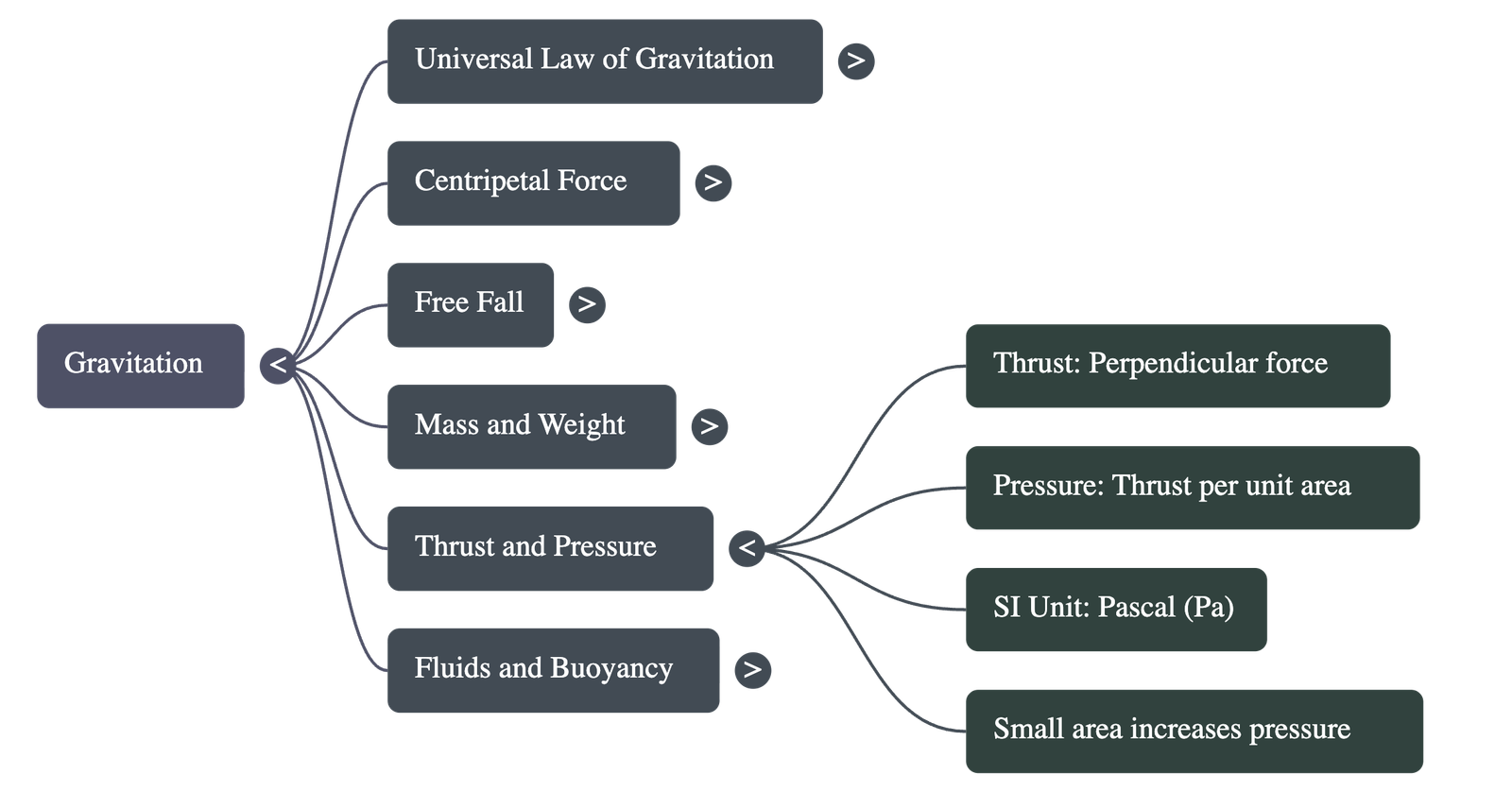
- Thrust: The force acting on an object perpendicular to the surface.
- Pressure: The thrust acting on a unit area.
Pressure = Thrust / Area - SI Unit: The unit of pressure is the pascal (Pa), equivalent to N m⁻².
- Effect of Area: The same force acting on a smaller area exerts a larger pressure. This explains why nails have pointed tips, knives have sharp edges, and army tanks use wide chains (to reduce pressure on the ground).
5. Buoyancy and Archimedes’ Principle
- Pressure in Fluids: Fluids (liquids and gases) exert pressure in all directions on the walls of their container.
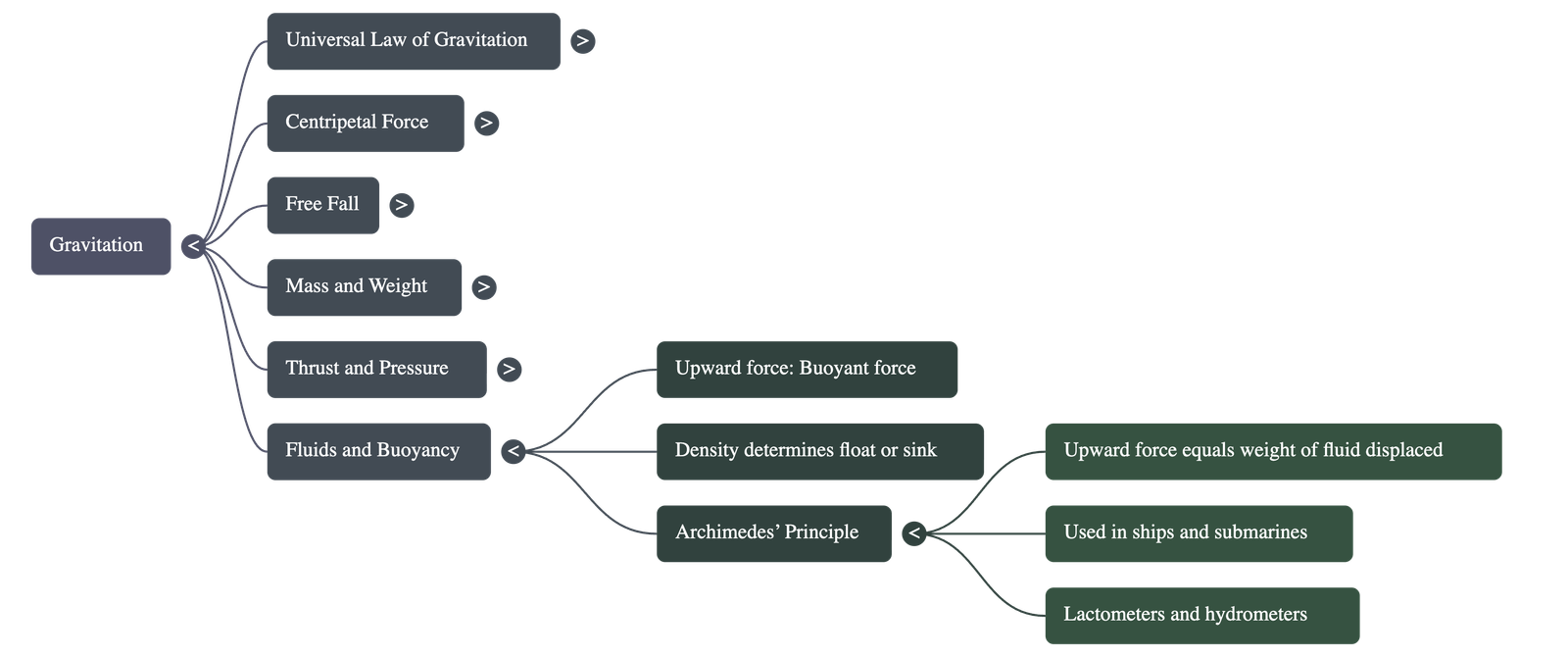
- Buoyancy (Upthrust): When an object is immersed in a fluid, the fluid exerts an upward force on it. This is called the buoyant force.
- Floating and Sinking:
- If the density of an object is less than the fluid, it floats.
- If the density of an object is greater than the fluid, it sinks.
- Archimedes’ Principle: When a body is immersed fully or partially in a fluid, it experiences an upward force that is equal to the weight of the fluid displaced by it.
- Applications: This principle is used in designing ships and submarines, lactometers (for testing milk purity), and hydrometers (for determining liquid density).
Do checkout all questions & answers of this chapter.
Quick Navigation:
| | |
1 / 1
Quick Navigation:
| | |