Quick Navigation:
| | |
Chapter 11: SOUND
1. Introduction to Sound
- Nature of Sound: Sound is a form of energy that produces a sensation of hearing in our ears.
- Conservation of Energy: Like other forms of energy, sound adheres to the law of conservation of energy; it is neither created nor destroyed but changed from one form to another.
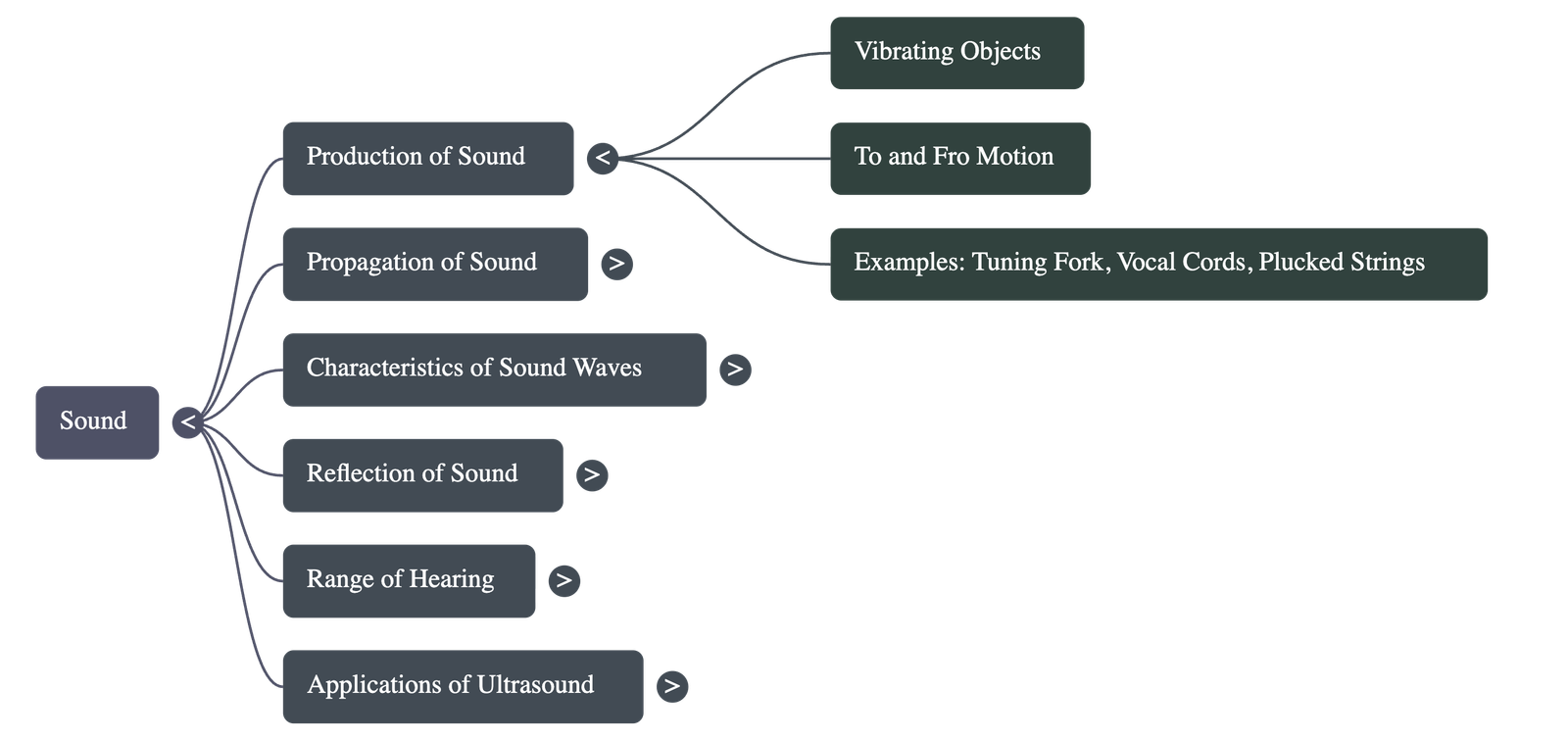
- Production: Sound is produced by vibrating objects. Vibration refers to a rapid to-and-fro motion of an object.
- Examples: Plucking a rubber band, the vibration of vocal cords in humans, flapping of bird wings, or striking a tuning fork.
2. Propagation of Sound
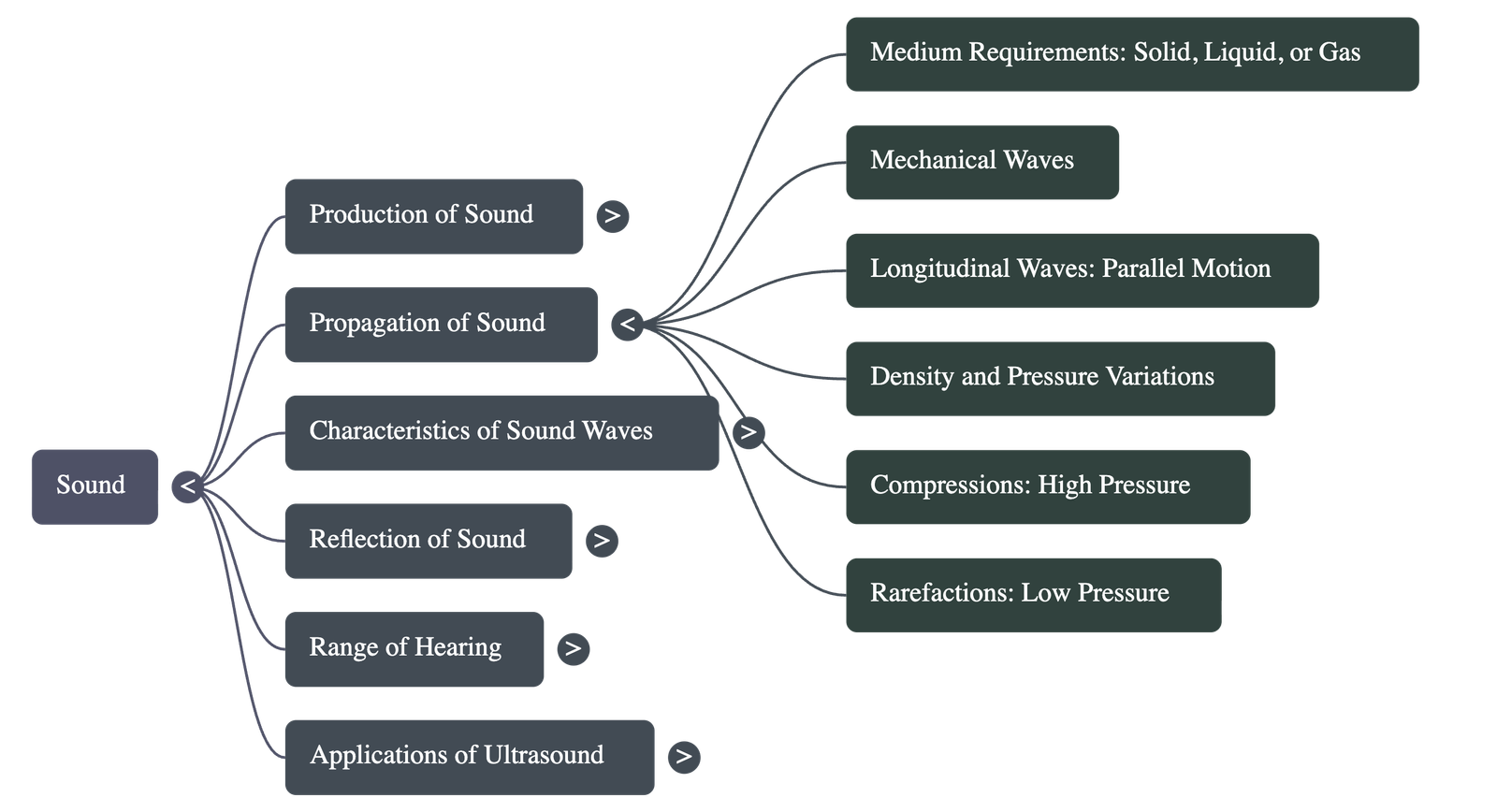
- Requirement of a Medium: Sound is a mechanical wave and requires a material medium (solid, liquid, or gas) to travel. It cannot travel through a vacuum.
- Mechanism of Travel: Particles of the medium do not travel from the source to the listener. Instead, a vibrating object sets adjacent particles into motion. These particles displace their neighbours and then return to their original positions. This process continues until the sound reaches the ear.
-
Compressions and Rarefactions:
- Compression (C): A region of high pressure and high density created when a vibrating object moves forward, pushing the air.
- Rarefaction (R): A region of low pressure and low density created when a vibrating object moves backward.
- Sound propagates as a series of these compressions and rarefactions.
- Longitudinal Waves: Sound waves are longitudinal. This means the individual particles of the medium oscillate back and forth parallel to the direction of the propagation of the disturbance. This is different from transverse waves (like light), where oscillation is perpendicular to the direction of propagation.
3. Characteristics of a Sound Wave
A sound wave is described by its frequency, amplitude, and speed.
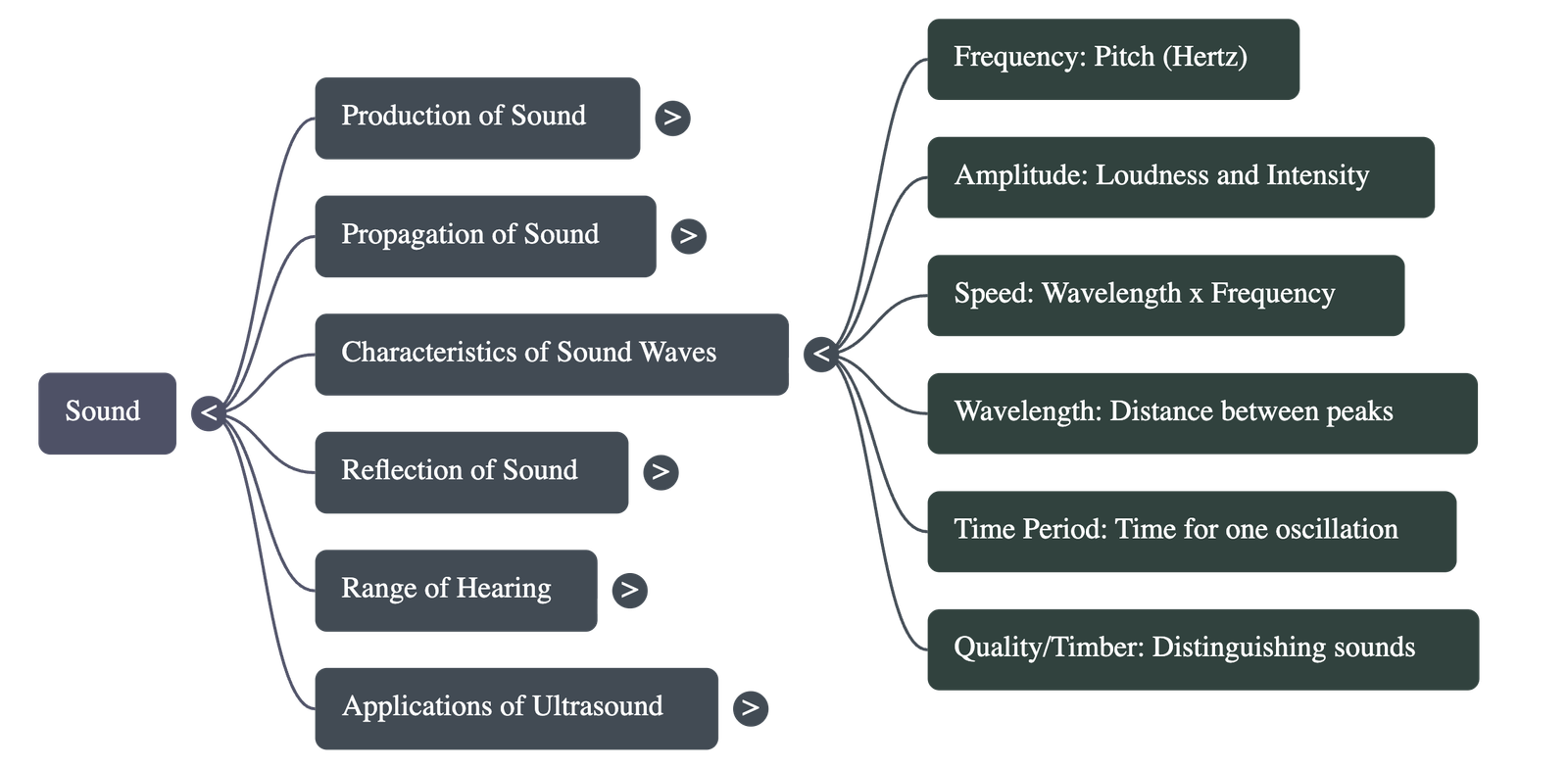
- Wavelength (λ): The distance between two consecutive compressions or two consecutive rarefactions. The SI unit is the metre (m).
- Frequency (ν): The number of complete oscillations per unit time. It determines the pitch of the sound.
- SI Unit: Hertz (Hz).
- Higher frequency = Higher pitch (shrill sound).
- Lower frequency = Lower pitch (flat sound).
- Time Period (T): The time taken for one complete oscillation. It is the inverse of frequency ($T = 1 / \nu$).
- Amplitude (A): The magnitude of the maximum disturbance in the medium on either side of the mean value. It determines the loudness of the sound.
- Larger amplitude = Louder sound.
- Smaller amplitude = Softer sound.
- Speed (v): The distance a point on a wave travels per unit time.
Formula: Speed = Wavelength × Frequency ($v = \lambda \nu$). - Quality (Timbre): The characteristic that allows us to distinguish between sounds of the same pitch and loudness. A sound of a single frequency is a tone; a mixture of frequencies is a note.
4. Speed of Sound in Different Media
- Finite Speed: Sound travels at a finite speed, which is much slower than the speed of light (evident when seeing lightning before hearing thunder).
- Dependence on State: The speed of sound decreases as we go from solid to gaseous states. It is fastest in solids, slower in liquids, and slowest in gases.
- Dependence on Temperature: The speed of sound increases as the temperature of the medium increases. (e.g., in air: 331 m/s at 0ºC vs 344 m/s at 22ºC).
5. Reflection of Sound
Sound bounces off solid or liquid surfaces following the same laws of reflection as light:
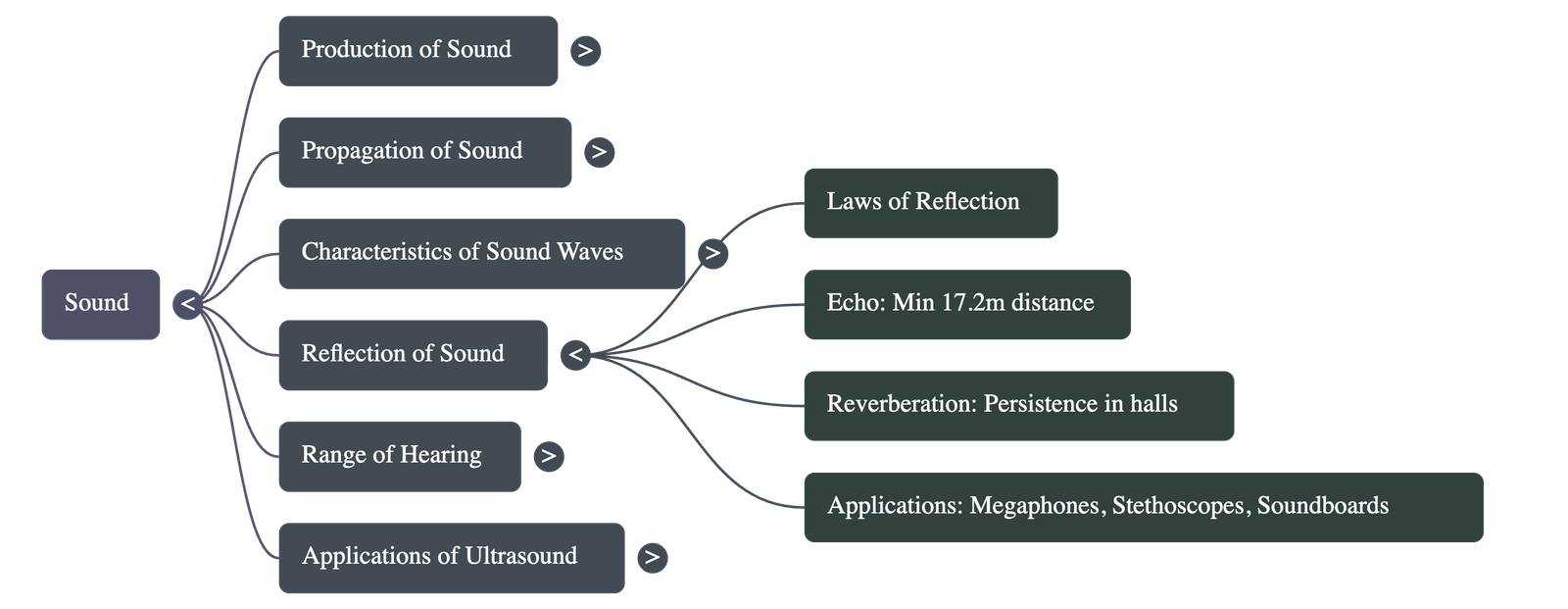
- The angle of incidence equals the angle of reflection.
- The incident sound, reflected sound, and the normal point of incidence all lie in the same plane.
Phenomena related to Reflection:
- Echo: A distinct reflected sound heard after the original sound. To hear a distinct echo, the time interval must be at least 0.1 seconds. In air at 22ºC, the minimum distance to the obstacle must be approximately 17.2 metres.
- Reverberation: The persistence of sound in a big hall due to repeated reflections. Excessive reverberation is undesirable and is reduced using sound-absorbent materials (compressed fibreboard, rough plaster, draperies) on walls and ceilings.
Practical Applications:
- Megaphones and Horns: Designed to send sound in a particular direction without spreading.
- Stethoscope: Uses multiple reflections to guide sound from a patient's heart/lungs to the doctor's ears.
- Curved Ceilings: Used in concert halls so that sound reflects and reaches all corners of the audience evenly.
6. Range of Hearing
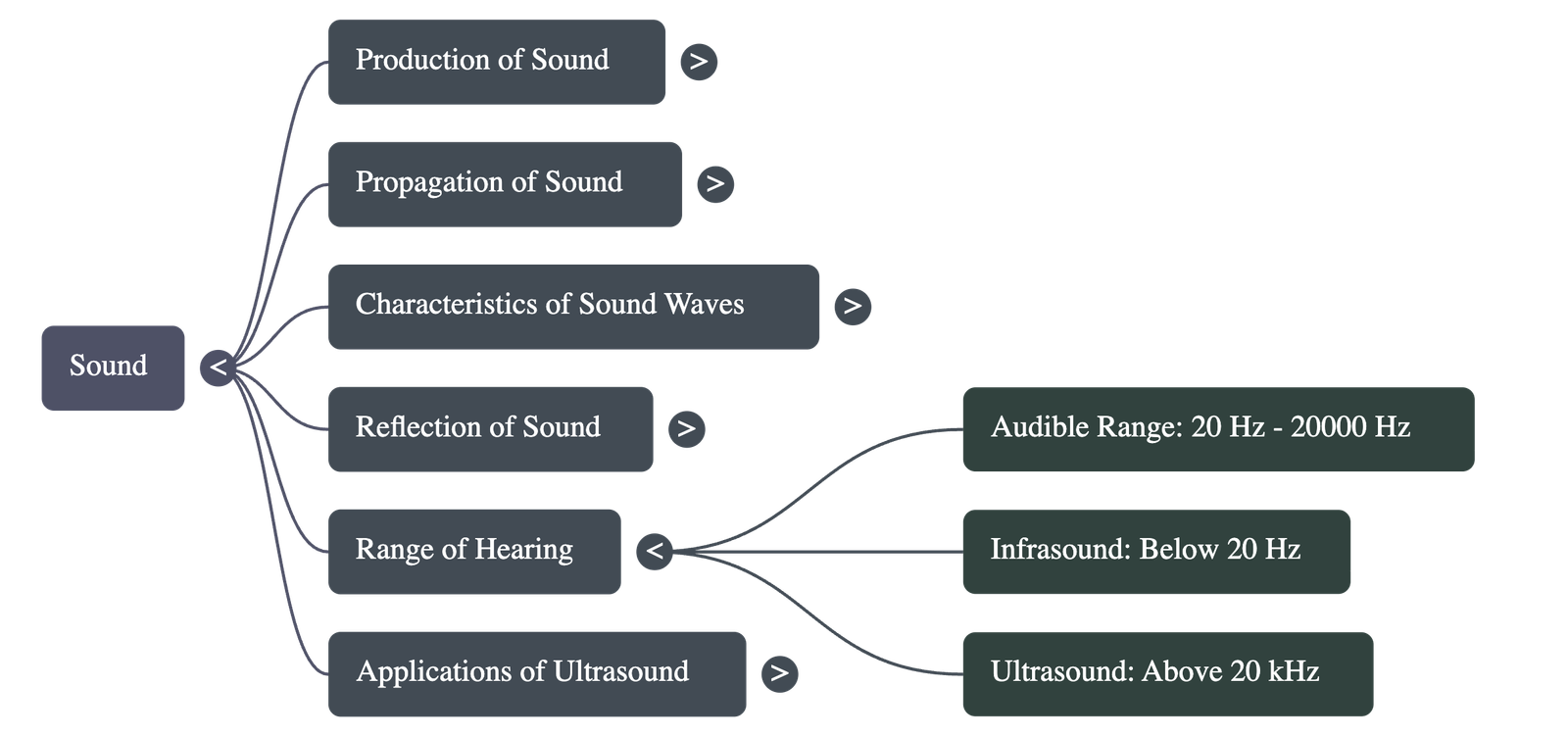
- Audible Range: For average human beings, the range is 20 Hz to 20,000 Hz (20 kHz).
- Infrasound: Sounds with frequencies below 20 Hz.
- Produced by earthquakes, whales, elephants, and rhinoceroses.
- Earthquakes produce infrasound before main shockwaves, alerting some animals.
- Ultrasound: Sounds with frequencies higher than 20 kHz.
- Produced by dolphins, bats, and porpoises.
- Bats use ultrasonic squeaks for navigation and hunting.
7. Applications of Ultrasound
Ultrasounds are high-frequency waves that can travel along well-defined paths even with obstacles. They are widely used in industry and medicine.
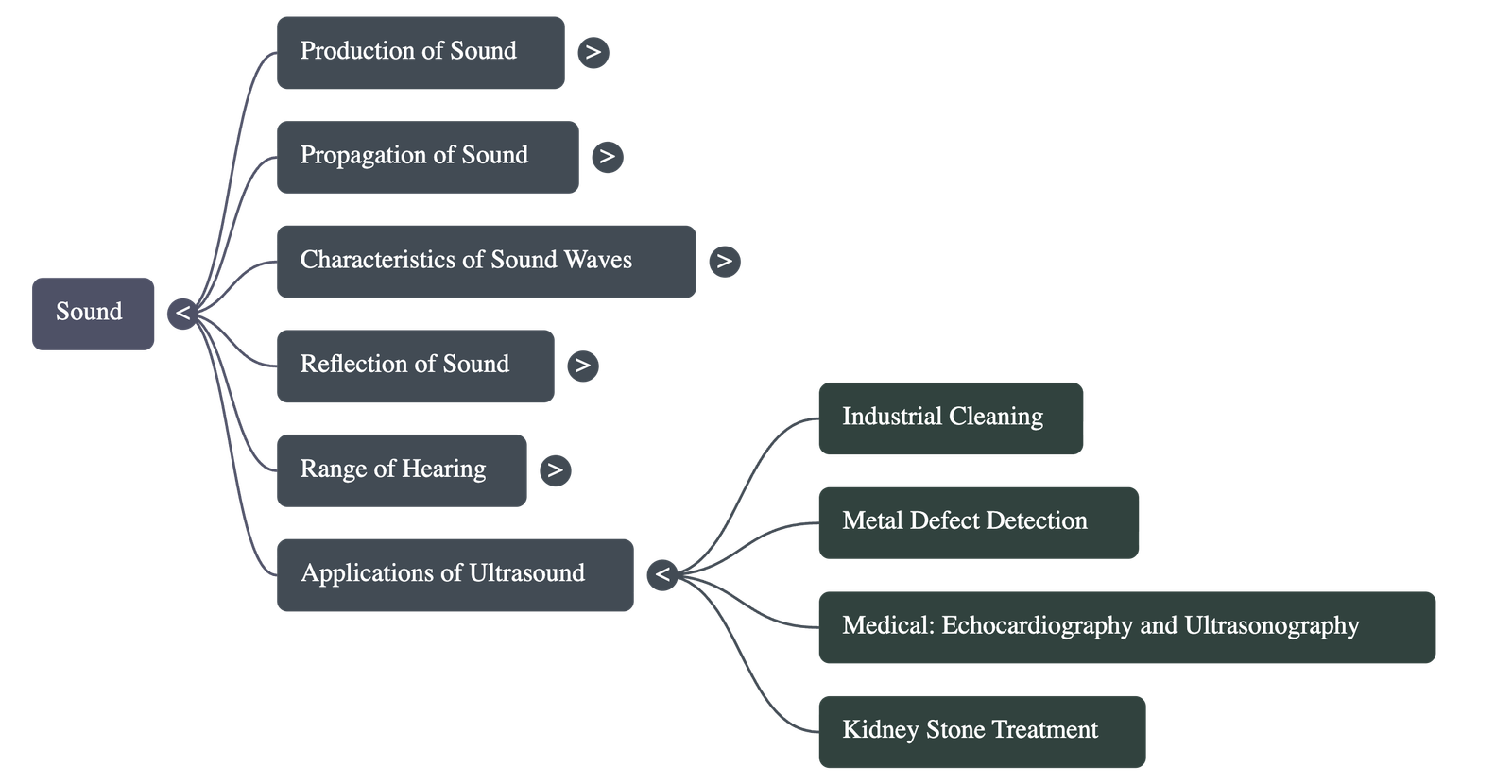
- Cleaning: Used to clean parts in hard-to-reach places (e.g., spiral tubes, electronic components). The high-frequency vibrations detach dust and grease.
- Flaw Detection: Used to detect invisible cracks or voids in metal blocks used for construction. If a flaw exists, the ultrasound reflects back to the detector.
- Echocardiography: Ultrasonic waves reflect from the heart to form an image of the organ.
- Ultrasonography (Ultrasound Scanners): used to image internal organs (liver, kidneys, uterus) to detect abnormalities like stones or tumours. It is also used to examine the foetus during pregnancy.
- Surgical Use: Ultrasound is employed to break kidney stones into fine grains so they can be flushed out with urine.
Do checkout all questions & answers of this chapter.
Quick Navigation:
| | |
1 / 1
Quick Navigation:
| | |