Quick Navigation:
| | |
Chapter 8: Force and Laws of Motion
1. Introduction to Force
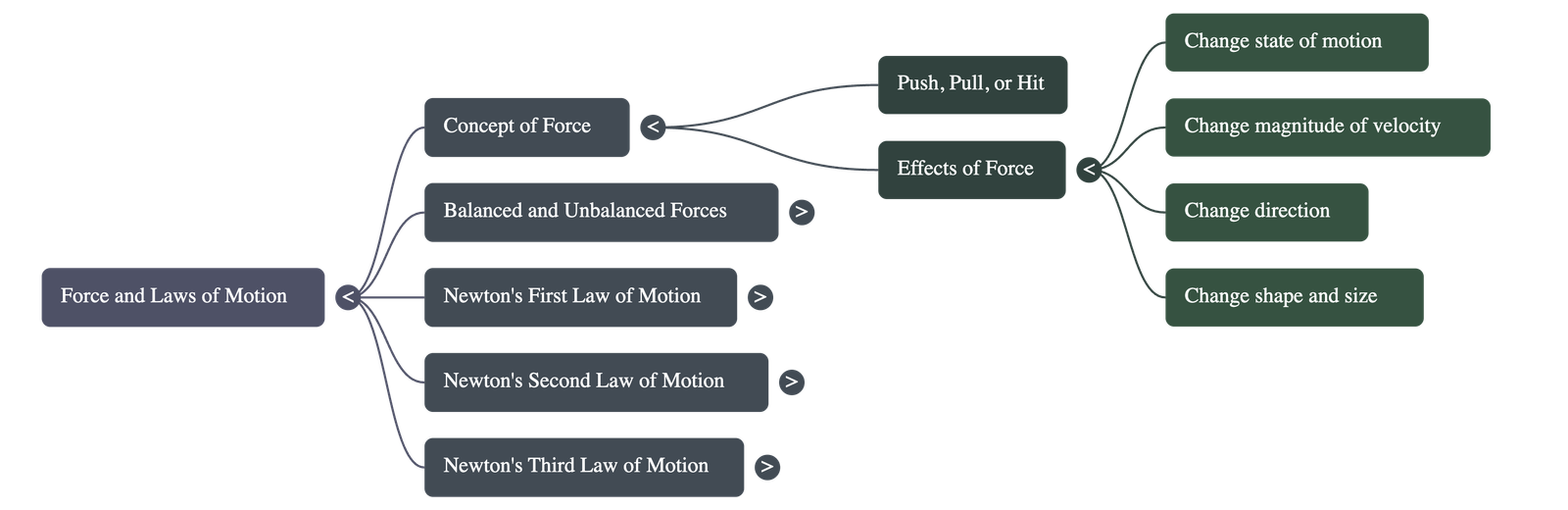
- Definition: Force is an effort (push, hit, or pull) required to change the state of motion of an object.
- Effects of Force: It can change the magnitude of velocity (speed up or slow down), change the direction of motion, or alter the shape and size of an object.
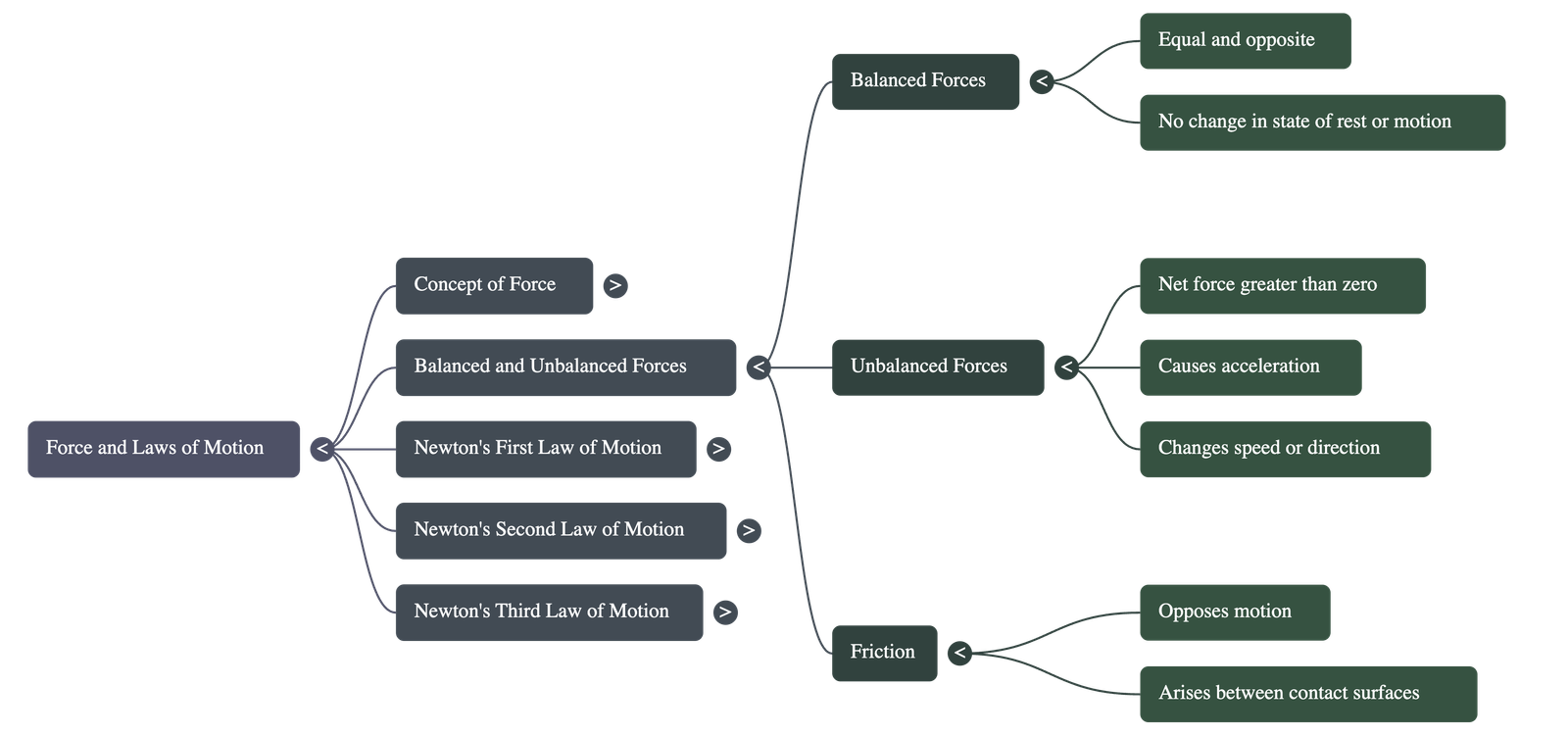
- Balanced Forces: When equal and opposite forces act on an object, the net force is zero. These forces do not change the state of rest or motion.
- Unbalanced Forces: When forces of unequal magnitude act on an object, a non-zero net force exists. This unbalanced force is required to accelerate an object (change its speed or direction).
- Friction: A force that always opposes motion, acting between two surfaces in contact. To keep an object moving uniformly, the applied force must balance the frictional force.
2. First Law of Motion (Law of Inertia)
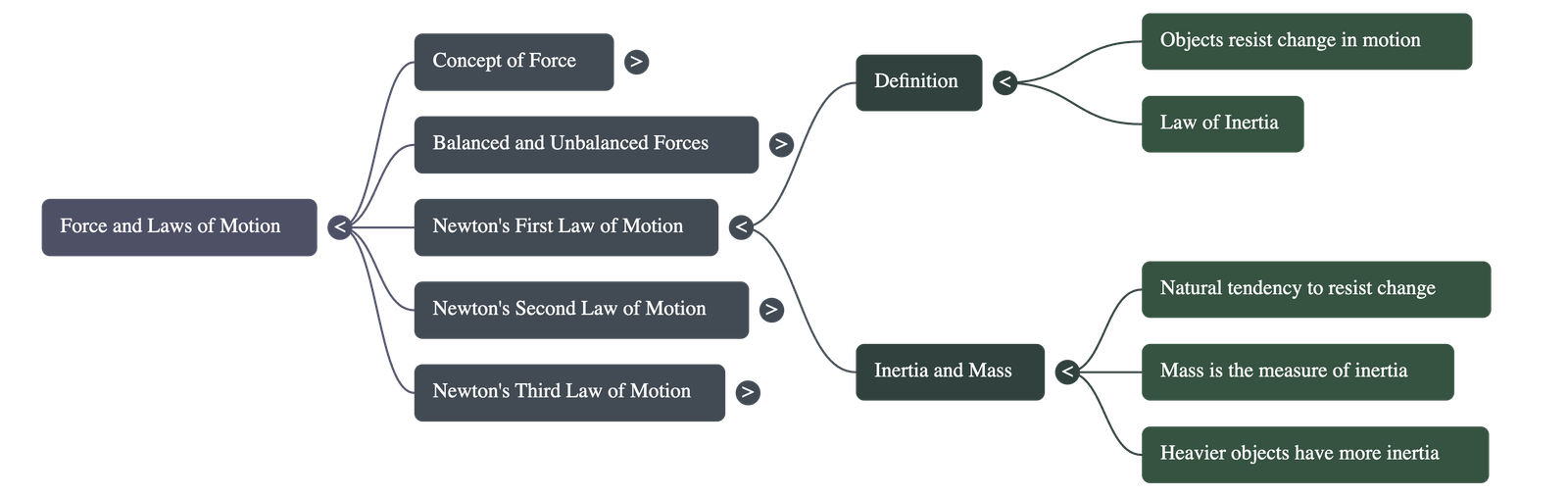
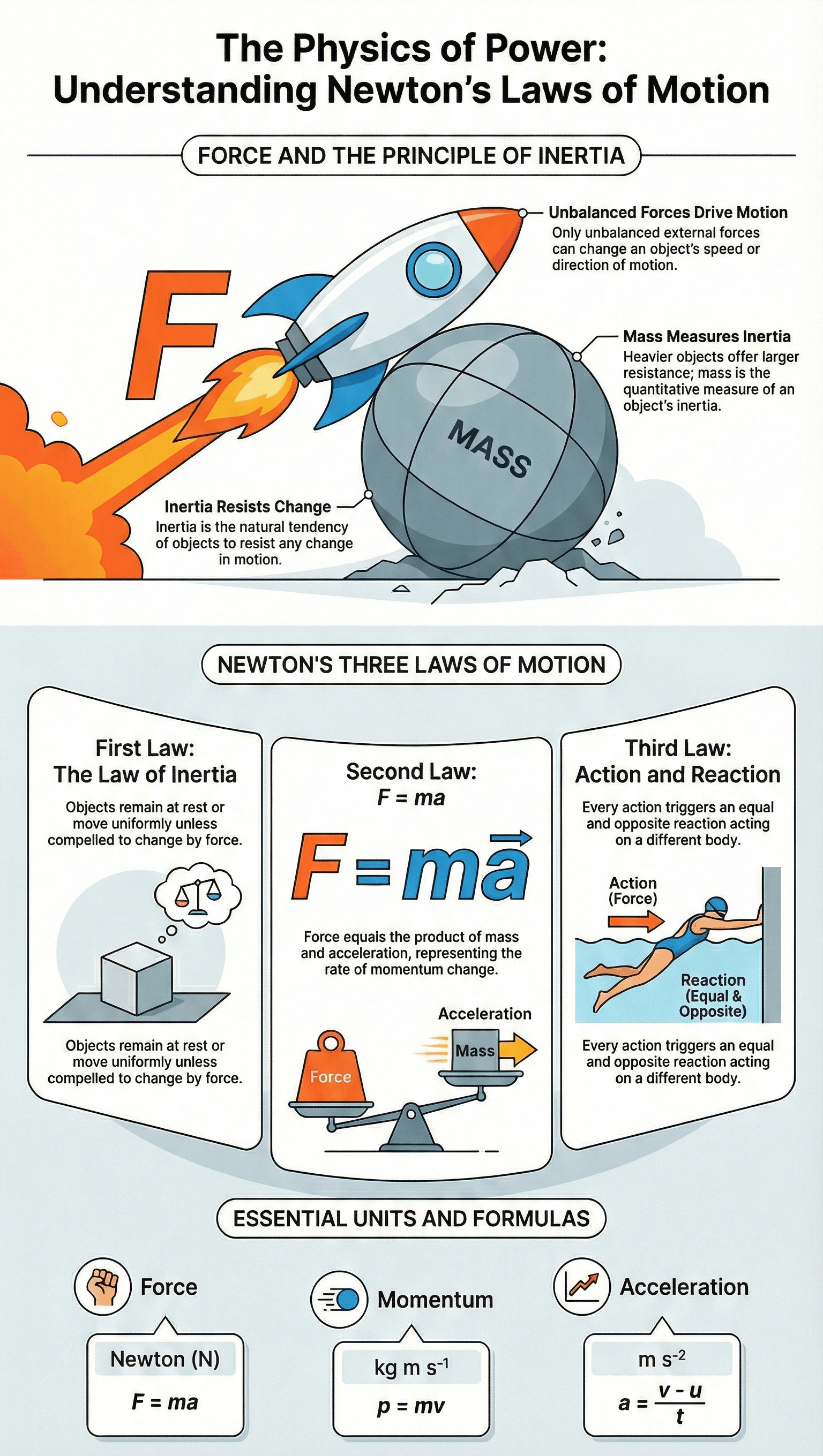
- The Law: An object remains in a state of rest or of uniform motion in a straight line unless compelled to change that state by an applied (unbalanced) force.
- Inertia: The natural tendency of undisturbed objects to resist a change in their state of motion.
- If an object is at rest, it tends to remain at rest.
- If an object is moving, it tends to keep moving.
- Inertia and Mass: Mass is the quantitative measure of inertia. Heavier objects (larger mass) have greater inertia than lighter objects.
- Real-life Examples:
- Passengers in a bus: When a bus starts suddenly, passengers fall backward due to inertia of rest. When it brakes, passengers fall forward due to inertia of motion.
- Carom coins: A fast-moving striker hits the bottom coin of a pile; only the bottom coin moves out while the rest fall vertically due to inertia.
3. Second Law of Motion
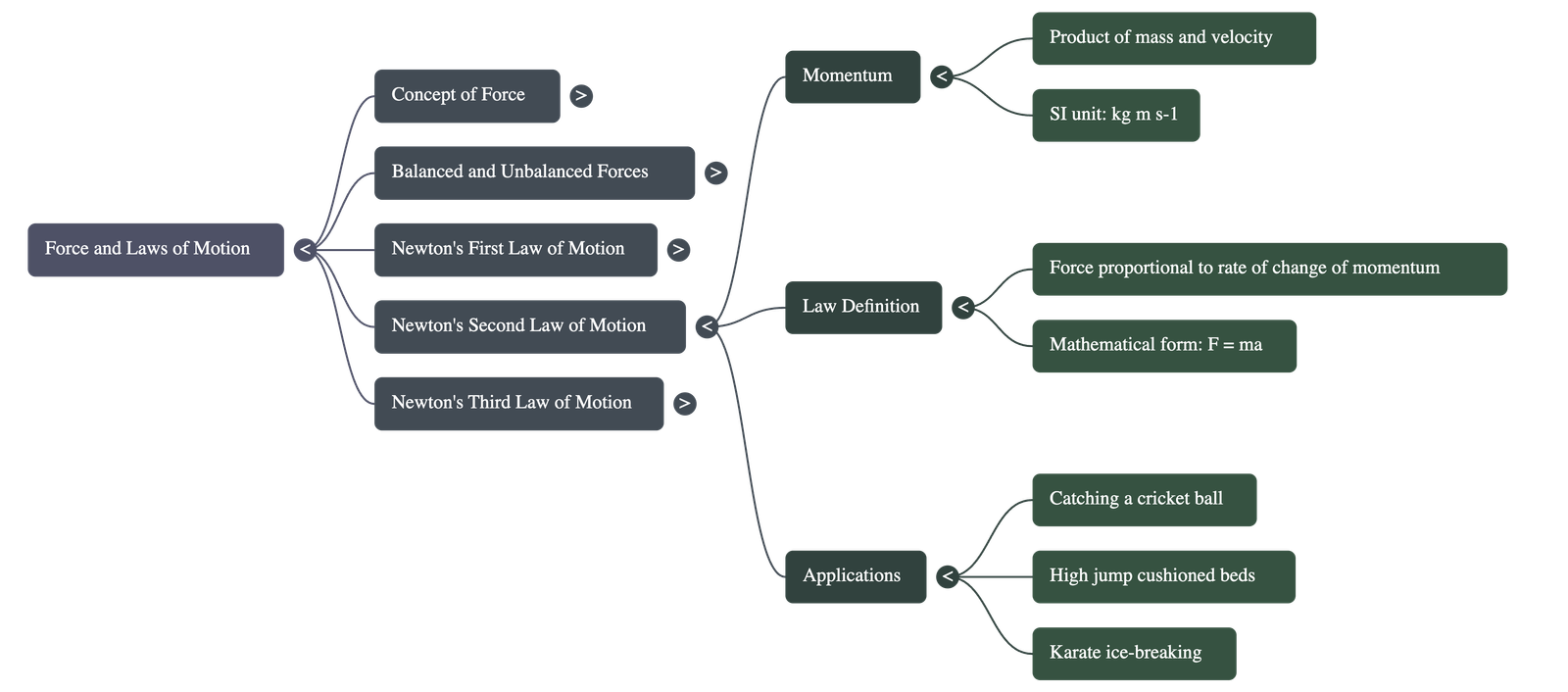
- Momentum (p): Defined as the product of an object's mass (m) and velocity (v).
Formula: p = mv
SI Unit: kilogram-metre per second (kg m s⁻¹). It has both direction and magnitude. - The Law: The rate of change of momentum of an object is proportional to the applied unbalanced force in the direction of the force.
- Mathematical Formulation:
Force (F) = mass (m) × acceleration (a)
Formula: F = ma - SI Unit of Force: The Newton (N). One Newton is the force that produces an acceleration of 1 m s⁻² on an object of mass 1 kg. (1 N = 1 kg m s⁻²).
- Application:
- Cricket Fielder: A fielder pulls his hands backward while catching a fast ball. This increases the time taken to stop the ball, thereby decreasing the rate of change of momentum and reducing the impact force on the hands.
- High Jump: Athletes fall on cushions or sand to increase the time of the fall's stop, reducing the force of impact.
4. Third Law of Motion
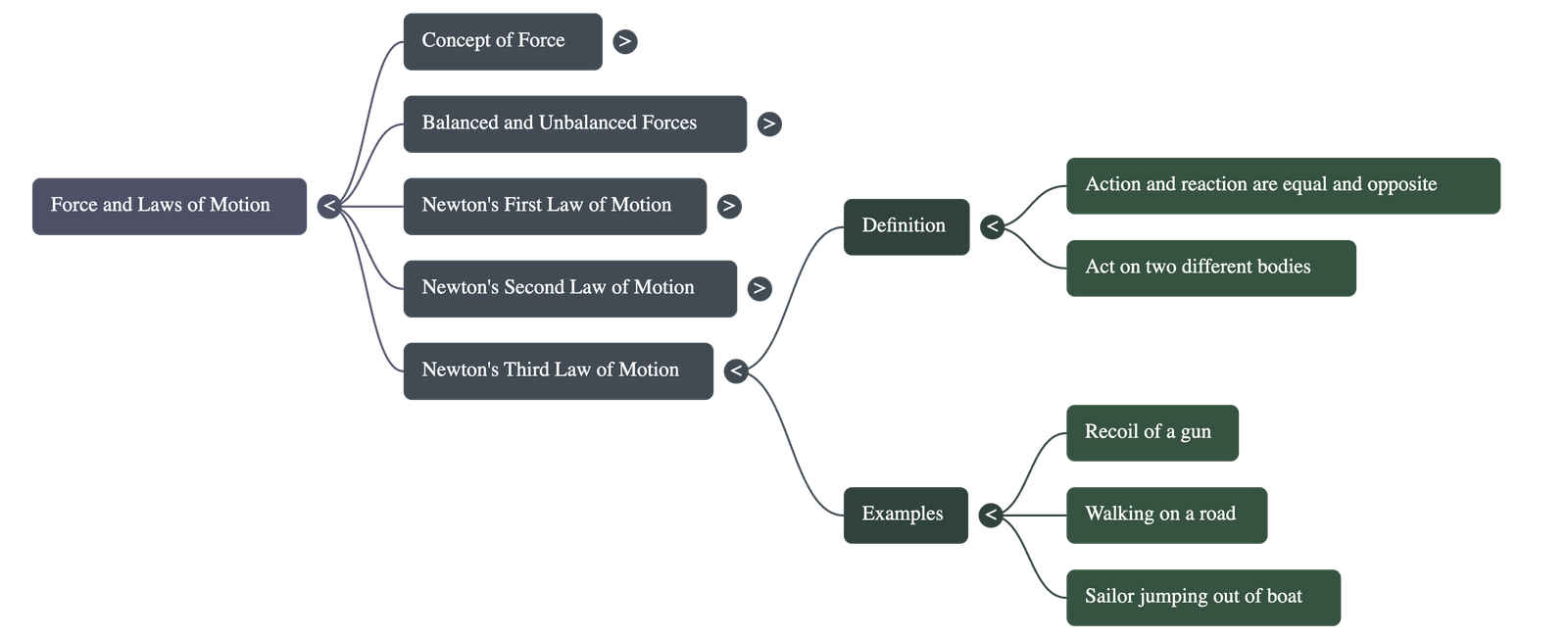
- The Law: To every action, there is an equal and opposite reaction.
- Key Characteristics:
- Action and reaction forces are always equal in magnitude.
- They are opposite in direction.
- They act on two different objects simultaneously (never on the same object).
- Accelerations: Although forces are equal, the resulting accelerations may differ if the masses of the two objects are different (since a = F/m).
- Examples:
- Walking: We push the road backward with our feet (action); the road exerts an equal forward force on our feet (reaction).
- Gun Recoil: When a bullet is fired forward, the gun experiences an equal backward force (recoil). The gun accelerates less than the bullet because of its much larger mass.
- Rowing Boat: When a sailor jumps forward out of a boat, the force exerted on the boat moves it backward.
Do checkout all questions & answers of this chapter.
Quick Navigation:
| | |
1 / 1
Quick Navigation:
| | |