Quick Navigation:
| | |
Chapter 7: Motion
1. Describing Motion
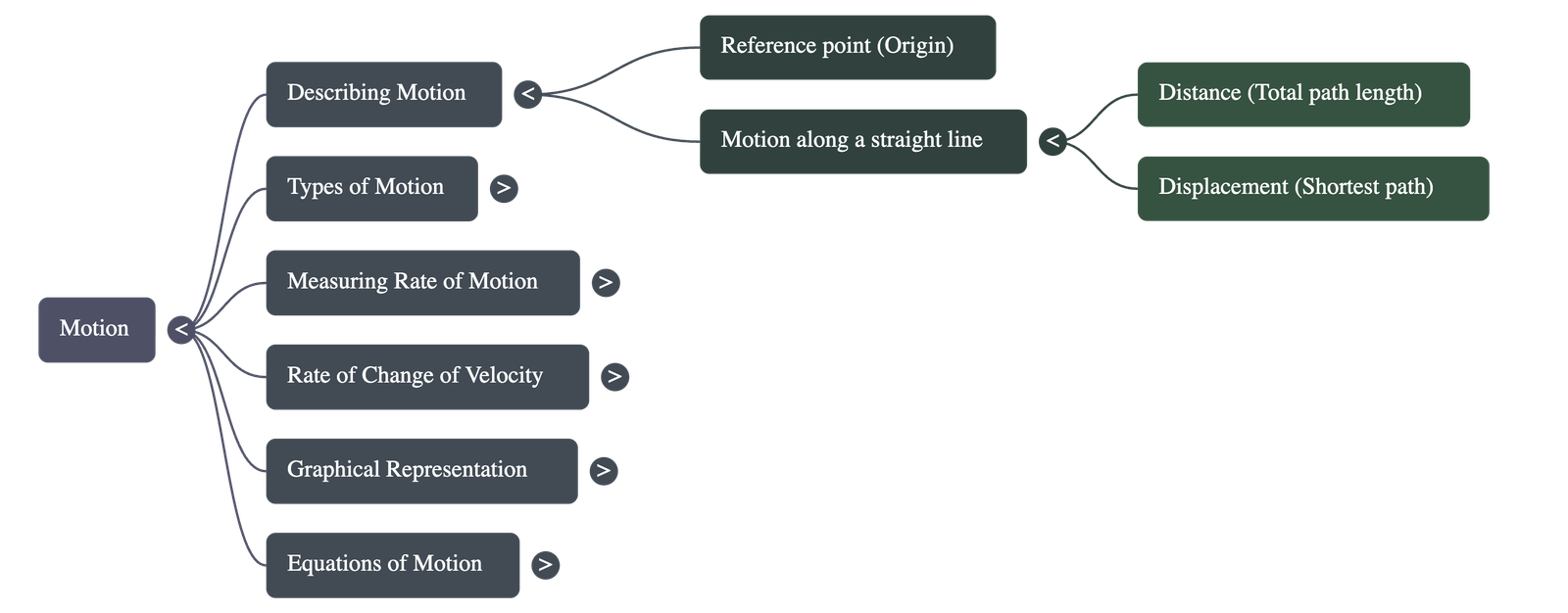
- Motion and Reference Points: Motion is a change in the position of an object over time. To describe the position of an object, we must specify a reference point, also known as the origin.
- Motion Along a Straight Line: This is the simplest type of motion.
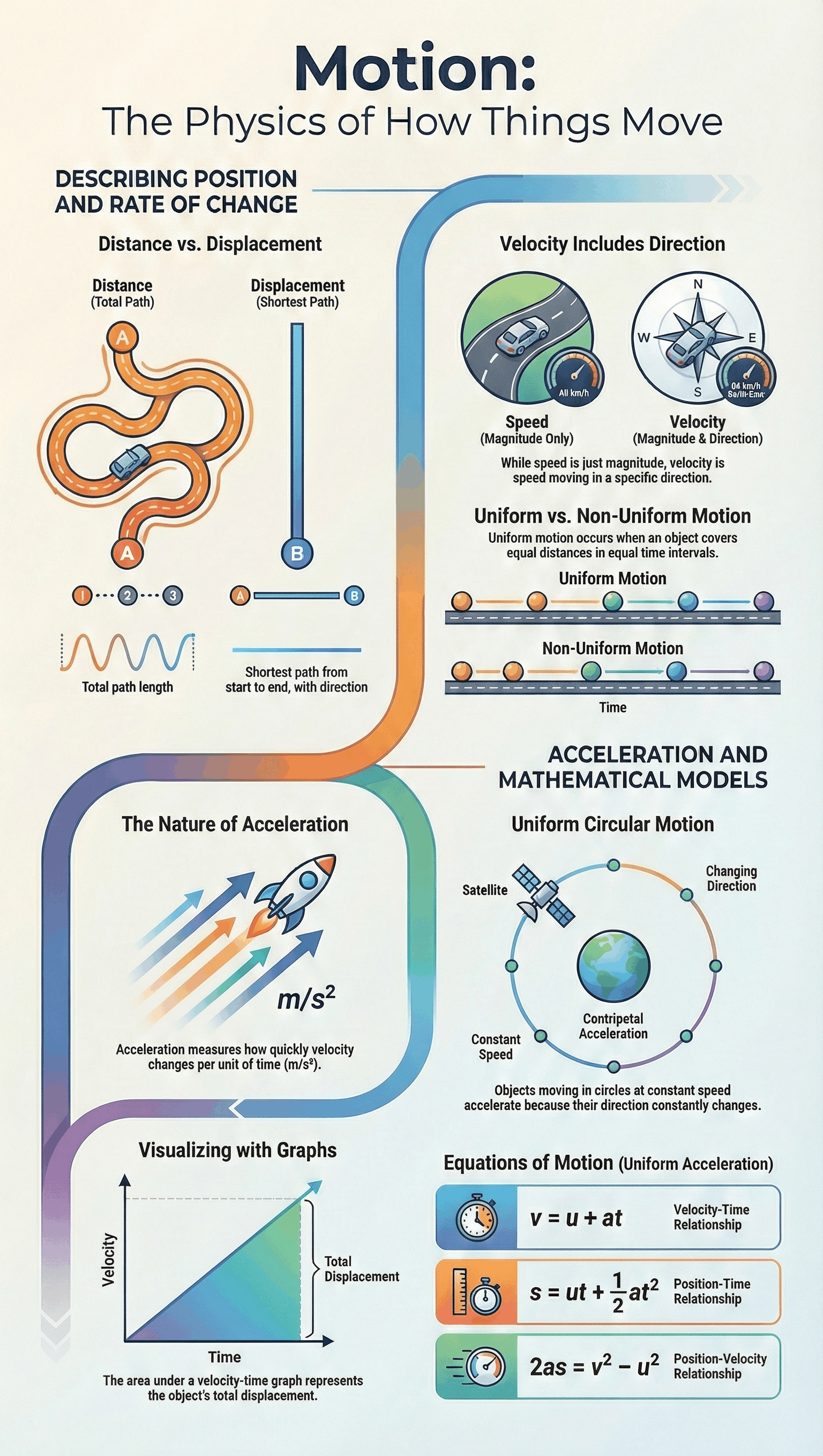
- Distance: The total path length covered by an object irrespective of direction. It is a physical quantity that has only magnitude (numerical value).
- Displacement: The shortest distance measured from the initial position to the final position of an object. It has both magnitude and direction.
- Zero Displacement: An object can have zero displacement even if the distance covered is not zero (e.g., if an object travels and returns to its starting point).
2. Types of Motion
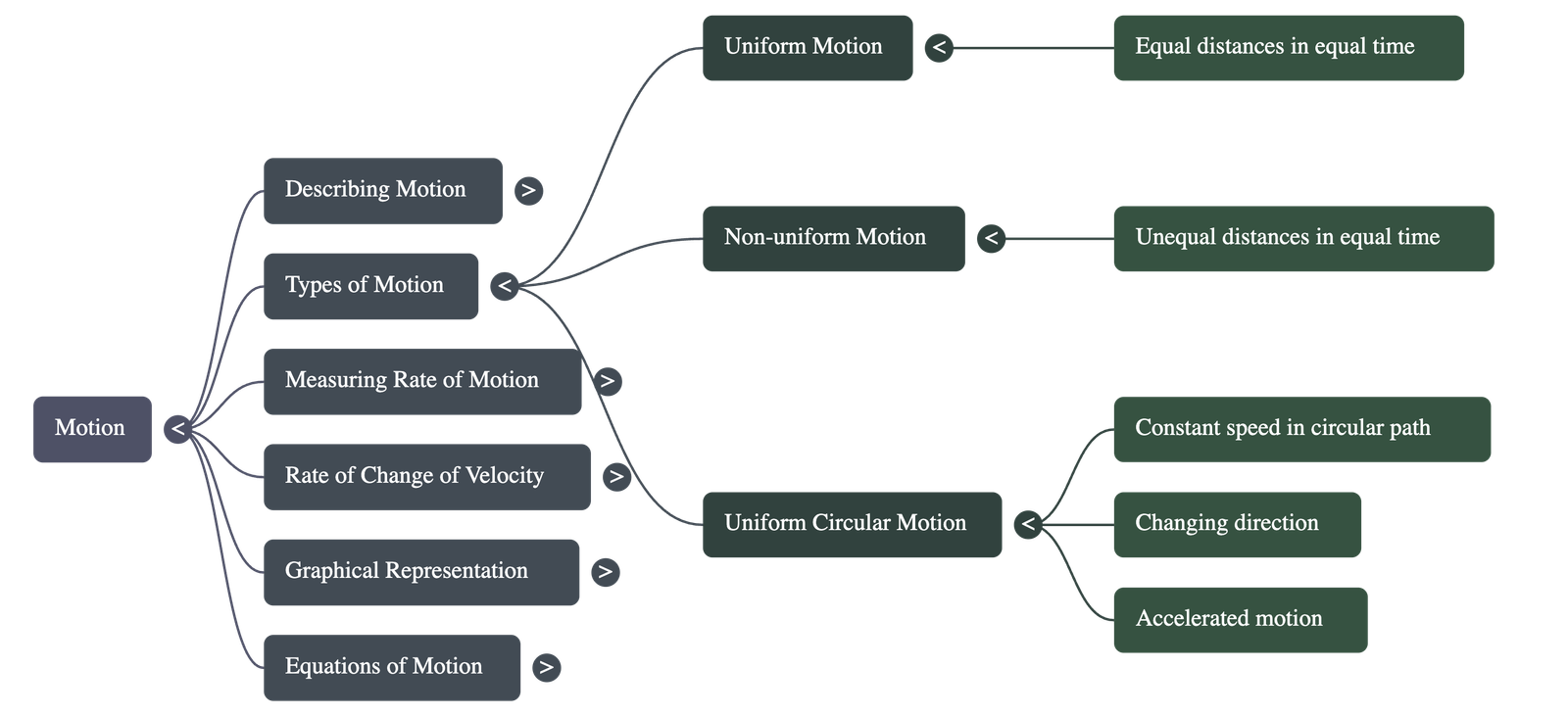
- Uniform Motion: When an object covers equal distances in equal intervals of time.
- Non-Uniform Motion: When an object covers unequal distances in equal intervals of time (e.g., a car moving in traffic).
3. Measuring the Rate of Motion
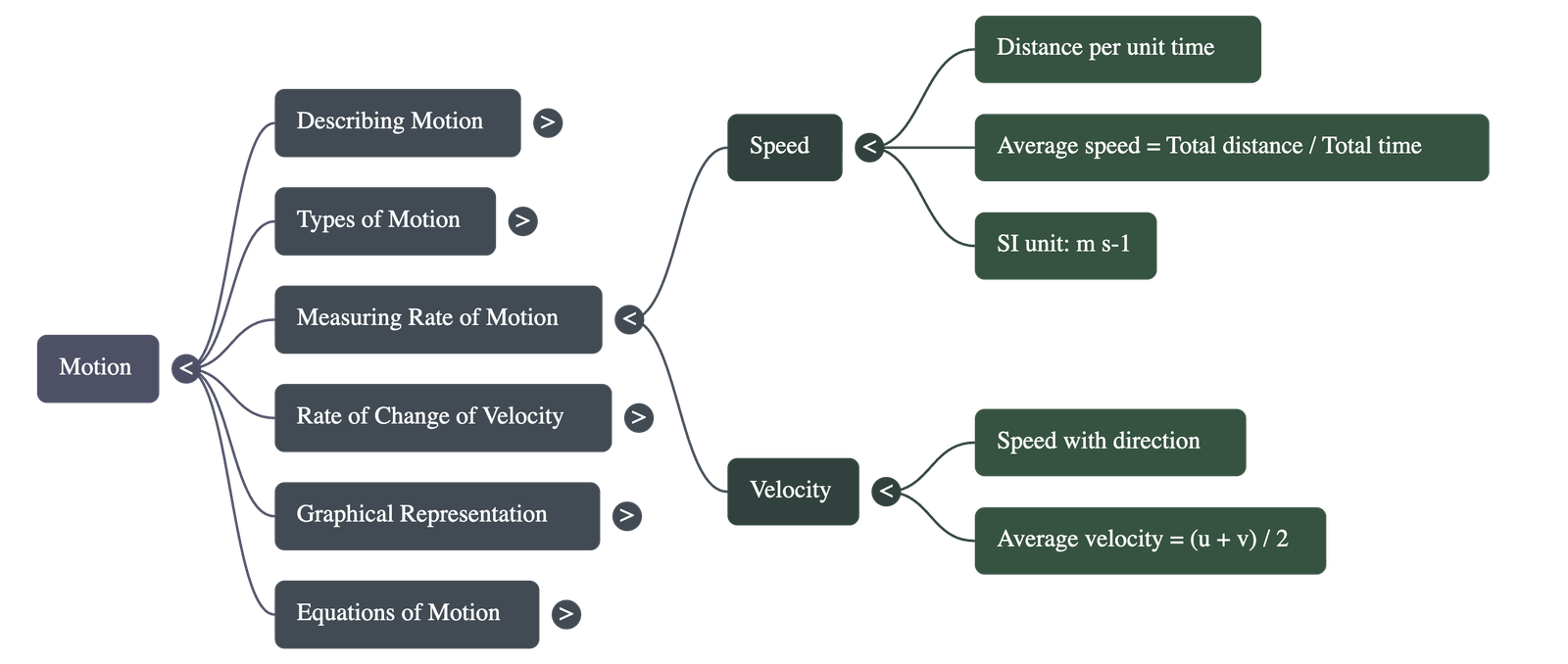
- Speed: The distance travelled by an object in unit time.
- SI Unit: Metre per second (m s⁻¹ or m/s).
- Average Speed: Since speed is often not constant, we calculate average speed as:
Average Speed = Total distance travelled / Total time taken
- Velocity (Speed with Direction): Velocity is the speed of an object moving in a definite direction.
- It changes if the object's speed, direction, or both change.
- Average Velocity: Can be calculated as the displacement divided by the total time. If velocity changes at a uniform rate, it is the arithmetic mean of initial and final velocity:
Average Velocity = (Initial velocity + Final velocity) / 2
4. Rate of Change of Velocity (Acceleration)
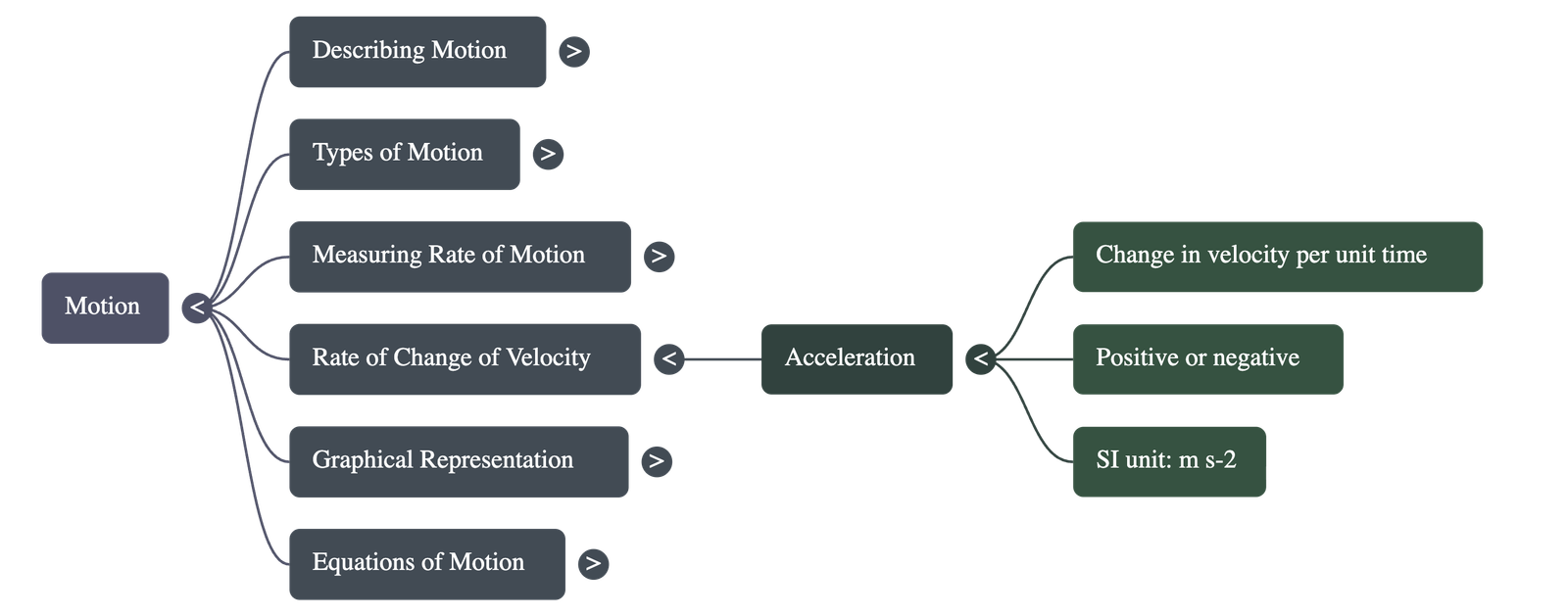
- Acceleration: A measure of the change in the velocity of an object per unit time.
- Formula:
a = (v - u) / tWhere a is acceleration, v is final velocity, u is initial velocity, and t is time.
- SI Unit: m s⁻² (meter per second squared).
- Types of Acceleration:
- Uniform Acceleration: Velocity changes by equal amounts in equal time intervals (e.g., a freely falling body).
- Non-Uniform Acceleration: Velocity changes by unequal amounts in equal time intervals.
- Acceleration is considered positive if it is in the direction of velocity and negative if it is opposite to the direction of velocity.
5. Graphical Representation of Motion
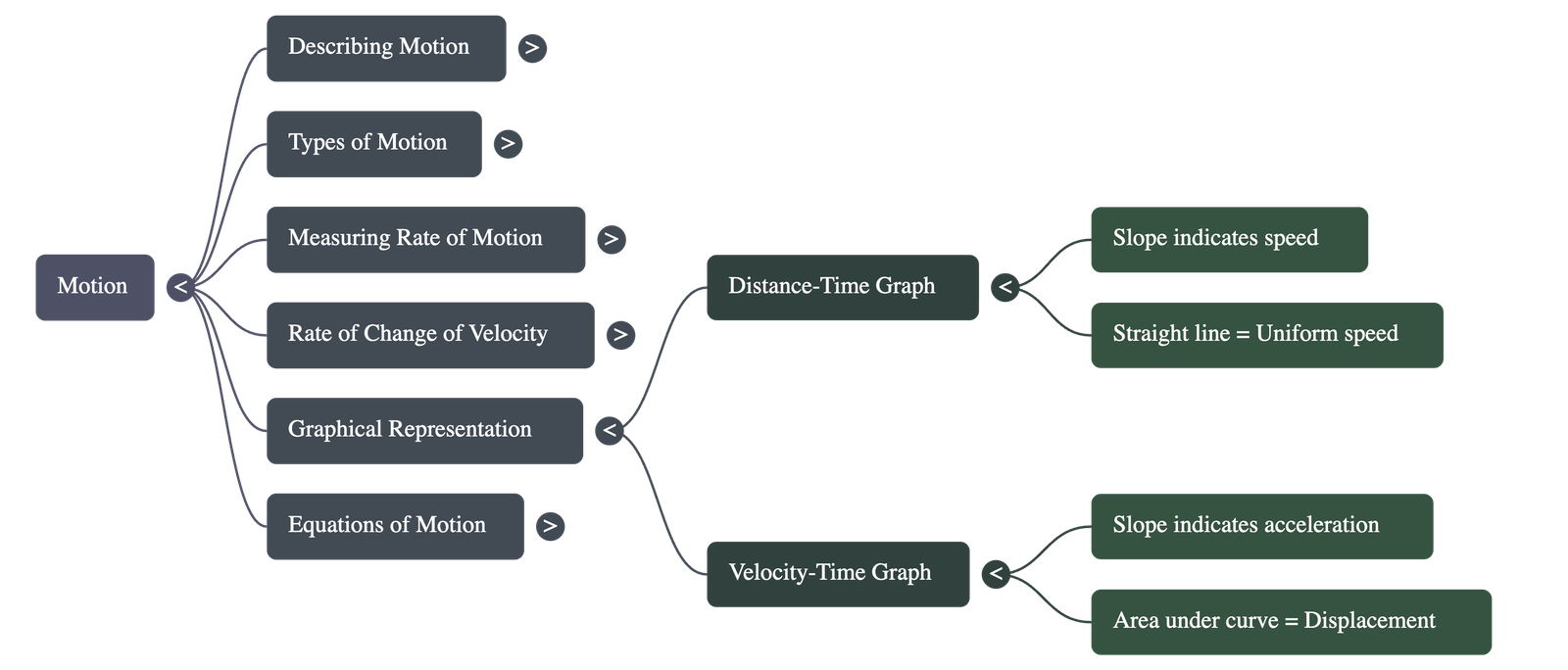
- Distance-Time Graphs:
- Show the change in position over time.
- Straight line: Indicates uniform speed.
- Curved line: Indicates non-uniform speed.
- The slope of a distance-time graph represents the speed of the object.
- Velocity-Time Graphs:
- Show the variation of velocity with time.
- Straight line parallel to time axis: Uniform motion (constant velocity).
- Straight line with a slope: Uniform acceleration.
- The area under the velocity-time graph represents the distance (magnitude of displacement) travelled by the object.
6. Equations of Motion
For objects moving along a straight line with uniform acceleration, three key equations relate velocity, acceleration, time, and distance:
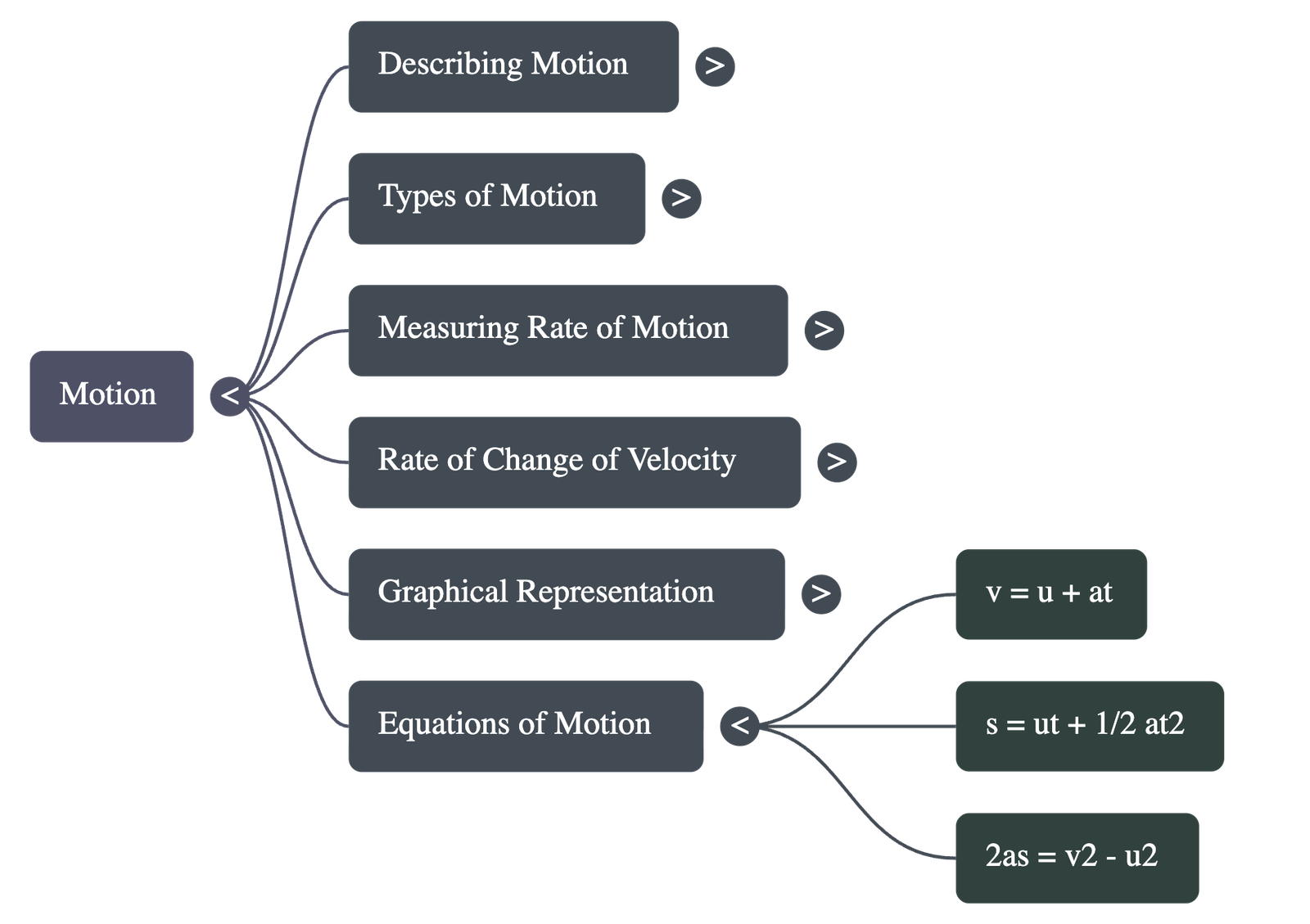
- v = u + at (Velocity-Time Relation)
- s = ut + ½ at² (Position-Time Relation)
- 2as = v² - u² (Position-Velocity Relation)
Where: u = initial velocity, v = final velocity, a = acceleration, t = time, s = distance.
7. Uniform Circular Motion
- Definition: When an object moves in a circular path with uniform speed.
- Accelerated Motion: Even though the speed is constant, the velocity changes continuously because the direction of motion changes at every point. Therefore, uniform circular motion is an accelerated motion.
- Formula: If an object takes time t to complete one round of a circular path of radius r, the velocity v is:
v = 2πr / t
- Examples: The motion of the moon around the earth, a satellite in orbit, or a cyclist on a circular track. The direction of motion at any instant is tangential to the circle.
Do checkout all questions & answers of this chapter.
Quick Navigation:
| | |
1 / 1
Quick Navigation:
| | |