Quick Navigation:
| | | |
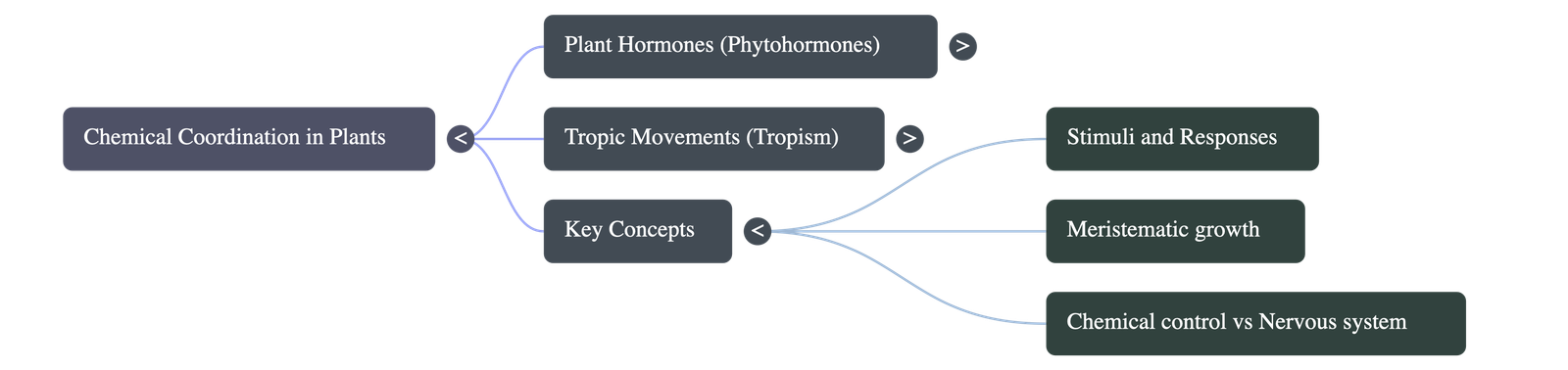
Chemical Coordination in Plants
Dear Students, here is your complete, exam-ready section-by-section summary. Use this for your quick revisions!
7.1 What are Plant Hormones?
- Movements in Plants: Unlike animals, plants do not show bodily movement but show bending, twisting, and elongation in certain parts.
- Stimuli and Responses: Changes in the external or internal environment are called stimuli, and the resulting movements are called responses.
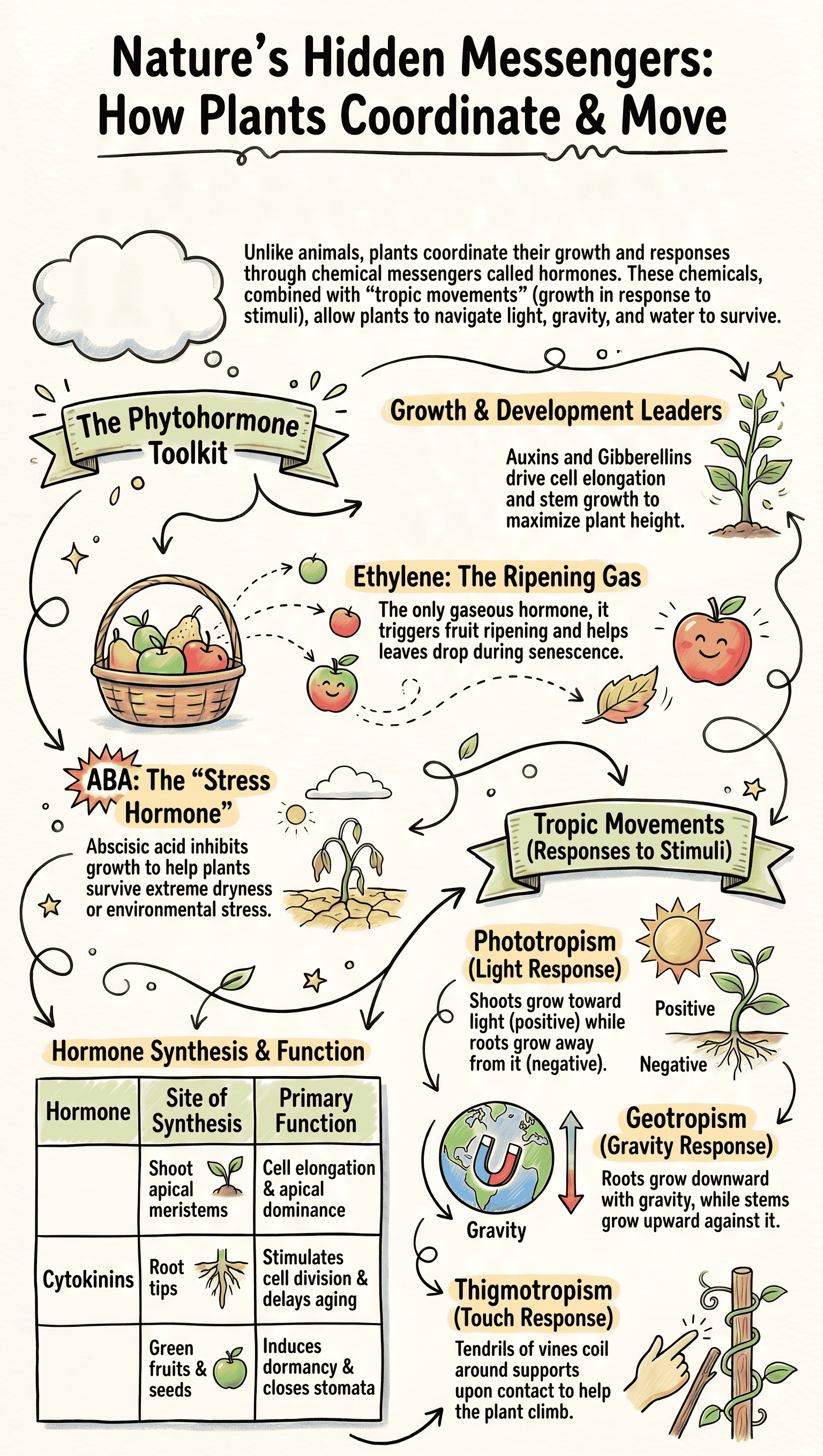
- Chemical Control: Plants lack a nervous system. They coordinate and respond to stimuli (like light, gravity, and water) using chemical messengers called hormones.
- Phytohormones: The term "hormone" was coined by Bayliss and Starling (1902). Plant hormones are specifically called phytohormones to distinguish them from animal hormones.
- Action Sites: Hormones are produced in one area (mainly meristems at shoot or root tips) and transported to other parts to stimulate or inhibit growth.
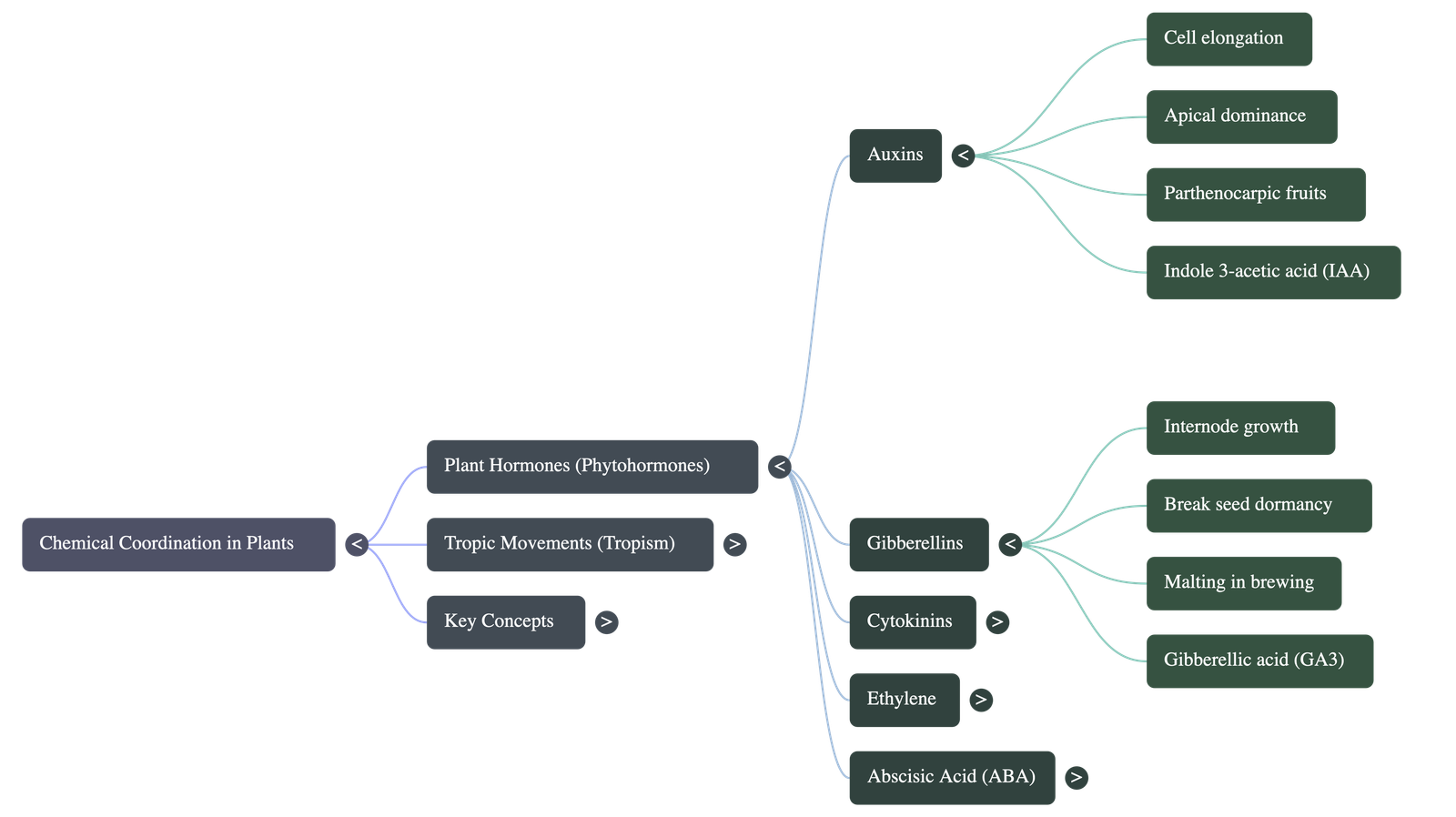
7.1.1 Auxins
- Coined by F.W. Went (1928), meaning 'to grow'. The main natural auxin is IAA (Indole 3-acetic acid).
- They are powerful growth stimulants effective at very low concentrations, primarily found in actively growing regions like shoot and root apices.
- Functions:
- Promote cell elongation in stems, roots, and fruits.
- Delay leaf senescence (ageing/falling of leaves).
- Promote Apical Dominance: They stimulate the growth of the apical bud while suppressing lateral buds.
- Induce rooting in plant cuttings (like rose, bougainvillea).
- Induce Parthenocarpy: Formation of seedless fruits without fertilization (e.g., apples, tomatoes, bananas).
7.1.2 Gibberellins
- Available in forms like GA₁, GA₂, and GA₃ (most studied). Mainly distributed in meristematic regions.
- Functions:
- Promote the growth of internodes through cell elongation, especially in dwarf plants.
- Break seed dormancy and initiate germination.
- Promote fruit growth and induce parthenocarpy.
- Delay senescence (ageing).
- Widely used in horticulture to lengthen grape stalks, elongate apples, and speed up malting in the brewing industry.
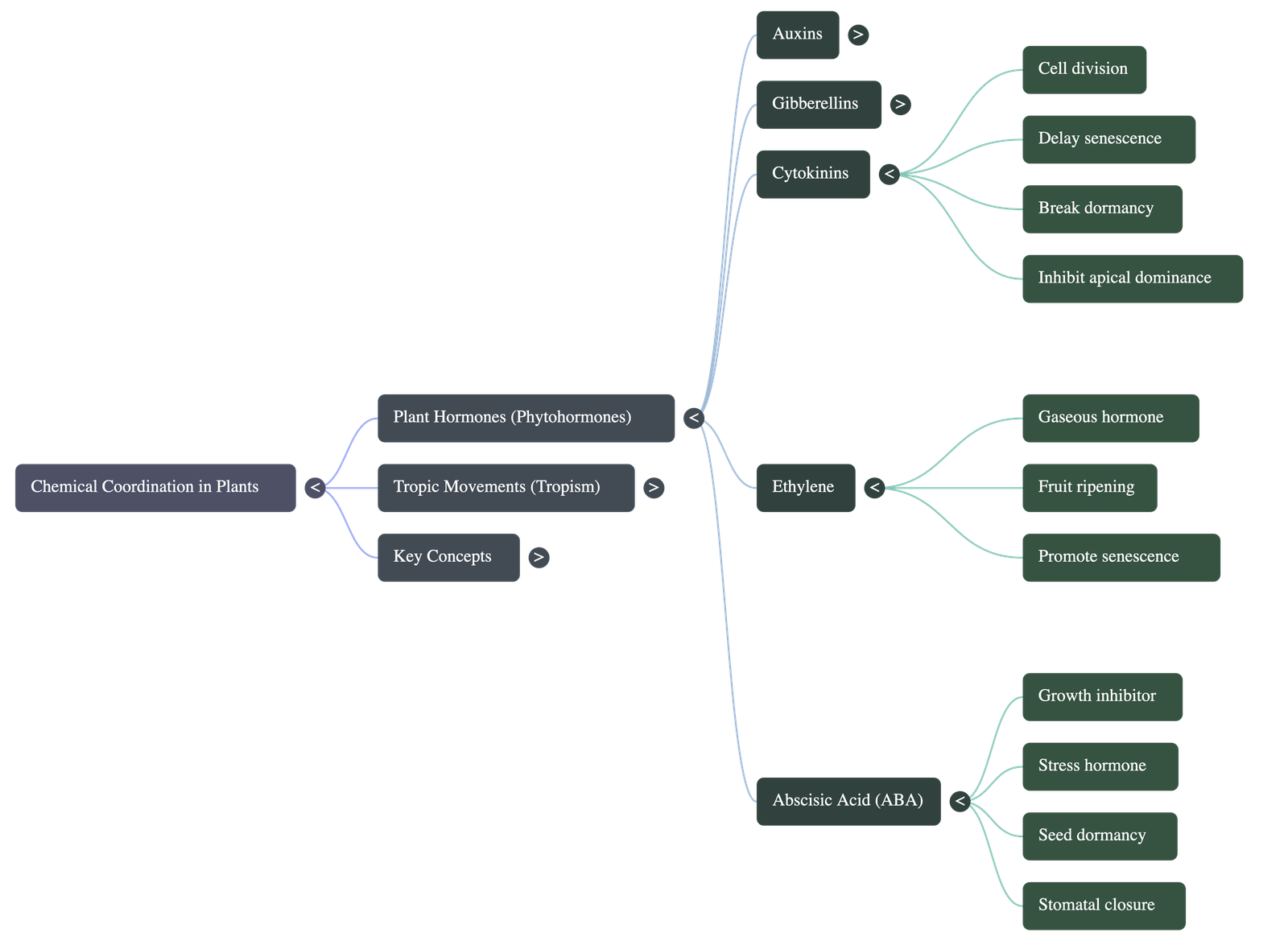
7.1.3 Cytokinins
- Discovered in the 1950s by Skoog and Miller. Produced mainly in root tips and transported via xylem. Found abundantly in germinating seeds and developing fruits.
- Functions:
- Strongly stimulate cell division (even in non-meristematic tissues).
- Cause expansion of cotyledons in seeds.
- Break seed dormancy and promote germination.
- Promote chlorophyll synthesis and delay leaf senescence.
- Inhibit apical dominance (acting opposite to auxins).
7.1.4 Ethylene
- The only plant hormone that is a gas at ordinary temperature. Discovered by R. Gane.
- Produced in higher plants and fungi, mainly in meristematic tissues and ripening fruits.
- Functions:
- Main function: Ripening of fruits (most widely used plant hormone in agriculture).
- Reduces stem elongation.
- Accelerates senescence.
- Initiates germination in peanut seeds and sprouting of potato tubers.
- Promotes root and root-hair formation.
- Induces flowering in mangoes.
7.1.5 Abscisic acid (ABA)
- Also known as the "stress hormone" because it increases plant tolerance to various stresses.
- Found in chloroplasts of leaves; fruits and seeds contain the highest amounts.
- Functions:
- Acts as a general plant growth inhibitor by slowing down metabolism.
- Inhibits seed germination and development (induces dormancy to help seeds survive extreme dryness).
- Accelerates senescence and abscission (falling) of leaves, buds, flowers, and fruits.
- Stimulates the closing of stomata in the epidermis.
7.2 Tropic Movements in Plants
- Tropism: Growth movements occurring in response to unidirectional external stimuli. The word comes from the Greek "tropos" meaning "to turn". The direction of response depends on the direction of the stimulus.
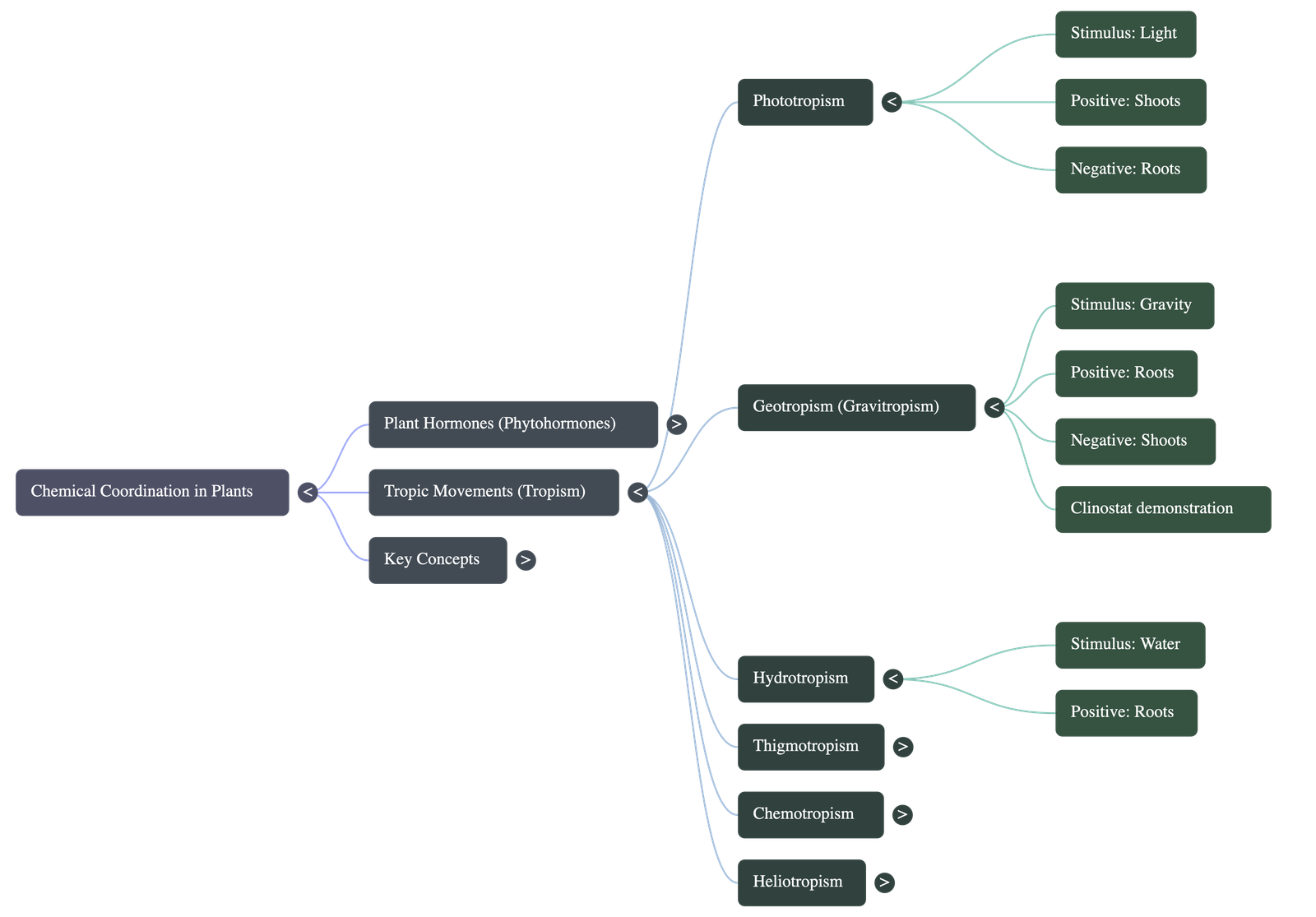
7.2.1 Phototropism
- Movement towards light.
- Shoots grow towards light (positively phototropic) ensuring maximum photosynthesis.
- Roots grow away from light (negatively phototropic).
- Role of Auxins: Auxins accumulate in the shaded region of the shoot. This causes rapid cell elongation on the shaded side, making the stem bend towards the source of light.
7.2.2 Geotropism (Gravitropism)
- Movement towards the earth's gravity.
- Roots grow downwards (positively geotropic) to anchor the plant and find water/minerals.
- Shoots grow upwards (negatively geotropic).
- Clinostat: An instrument used to demonstrate geotropism. It rotates a potted plant slowly, exposing all parts equally to gravity, neutralizing the bending effect.
7.2.3 Hydrotropism
- Movement in response to water or moisture.
- Roots are positively hydrotropic.
- Shoots are negatively hydrotropic.
- An experiment using moist sawdust shows that roots will grow towards water even if they have to grow upwards against gravity. This proves water is a more effective stimulus for roots than gravity.
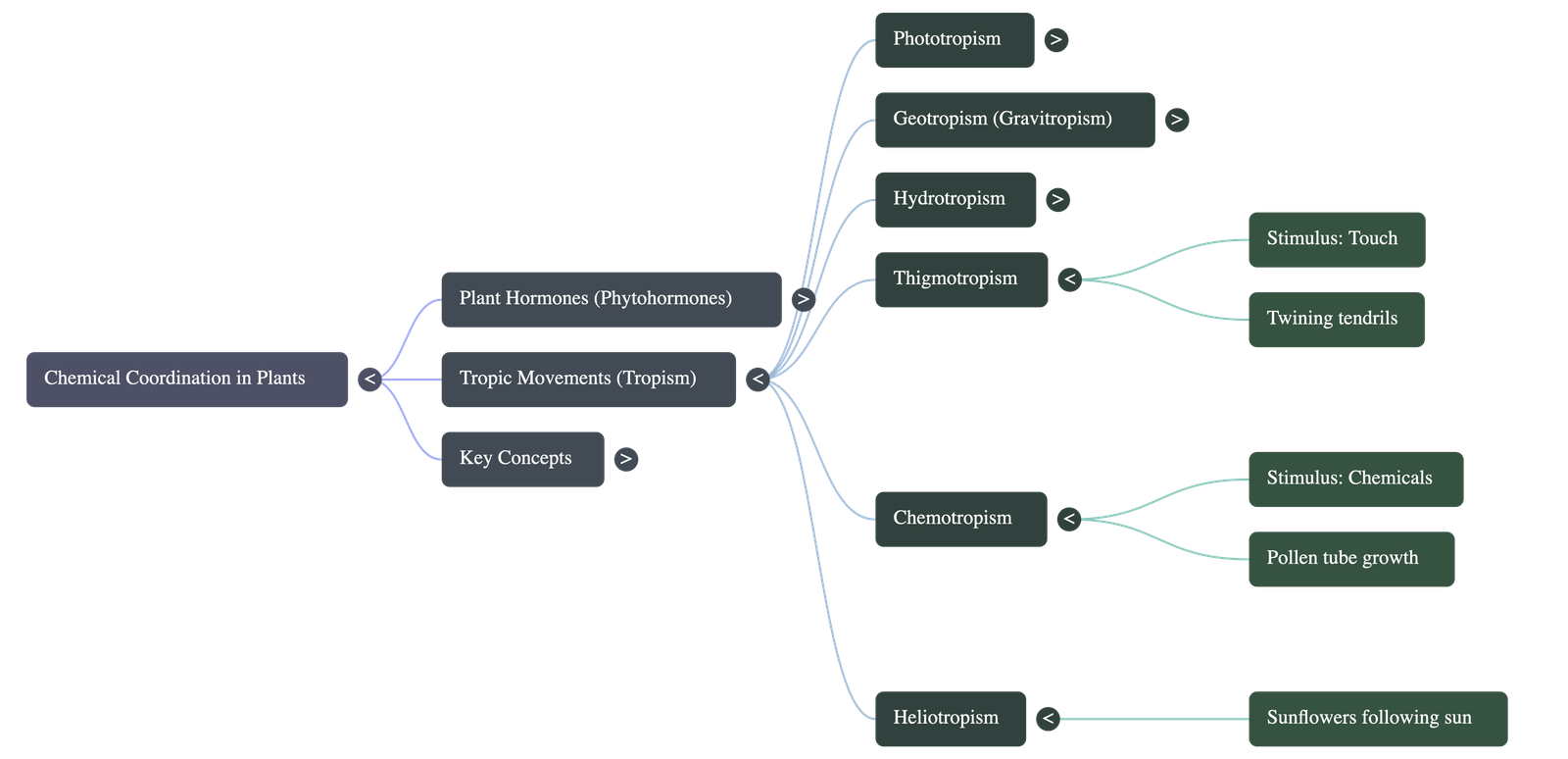
7.2.4 Thigmotropism
- Growth movement in response to a touch stimulus.
- Observed in plants like sweet peas, Cuscuta, and vines.
- These plants develop stem or leaf tendrils that twine around support structures upon contact. Stimulus is perceived at the contact point and transmitted to basal parts, causing the coiling.
7.2.5 Chemotropism
- Growth phenomenon of plant organs in response to chemicals.
- Examples:
- The downward movement of a pollen tube towards sugars and peptones secreted by the ovule/ovary.
- Movement of fungi towards food.
- Movement of tentacles in the Drosera plant towards a source of nutrition.
Additional Concept: Heliotropism
- Fascinating phenomenon where young sunflower heads follow the sun from east to west across the sky.
- This happens because auxins migrate from the sunlit part to the shaded region of the stem, stimulating growth on the shaded side and causing the flower to bend towards the sun.
Happy Studying! Remember, coordination in plants is slow, steady, and beautifully controlled by chemicals.
Do checkout all questions & answers of this chapter.
Quick Navigation:
| | | |
1 / 1
Quick Navigation:
| | | |