Quick Navigation:
| | | |
Absorption by Roots - The Processes Involved
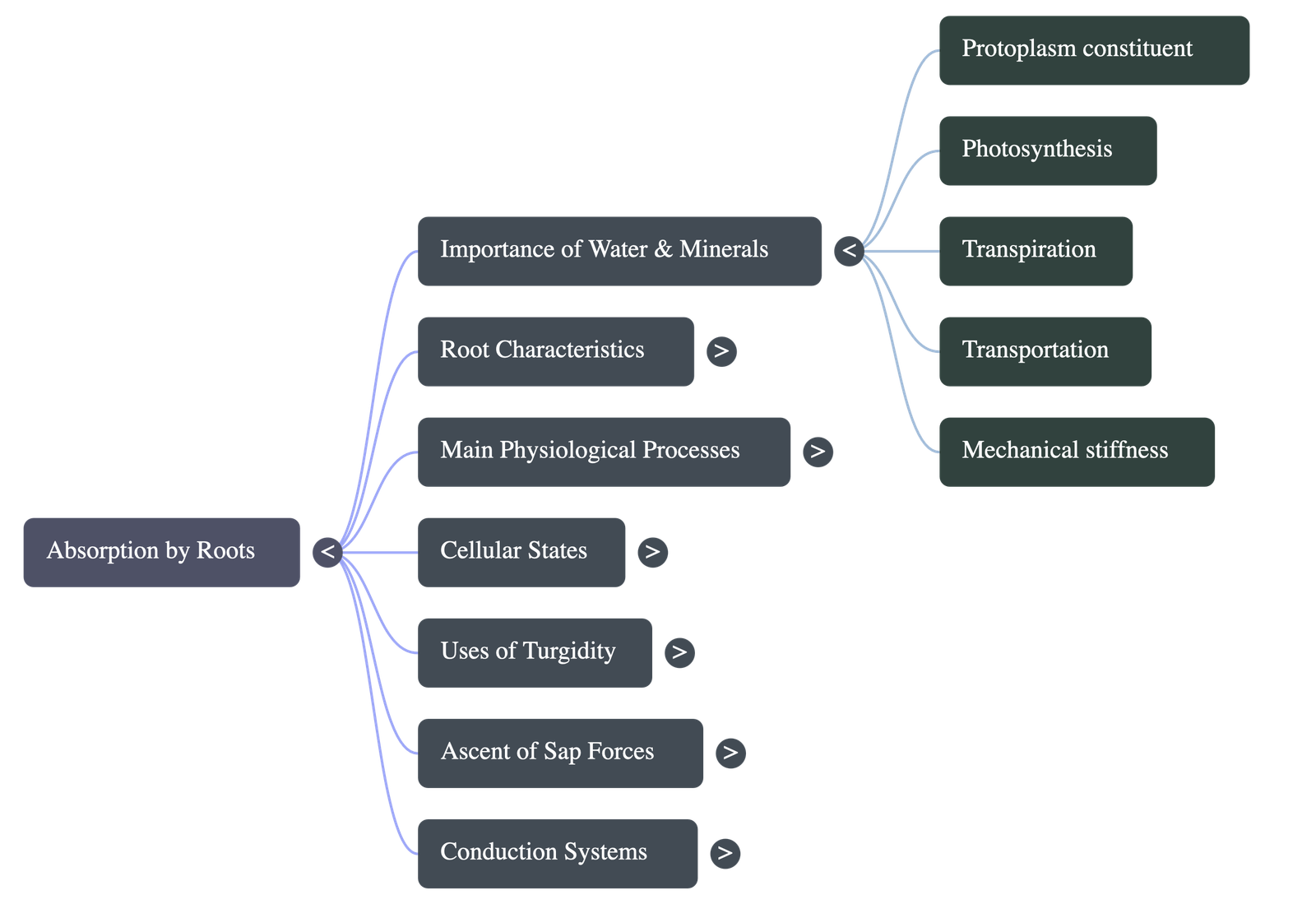
4.1 & 4.2 Need of Water and Minerals for Plants
- Fixation and Absorption: Roots anchor the plant in the soil and absorb essential water and mineral nutrients to conduct them to the stem, leaves, flowers, and fruits.
- Photosynthesis: Water is a crucial raw material used by green leaves to synthesize glucose.
- Transpiration: Large quantities of water evaporate as water vapour, which provides a cooling effect during hot weather and generates a suction force for upward conduction.
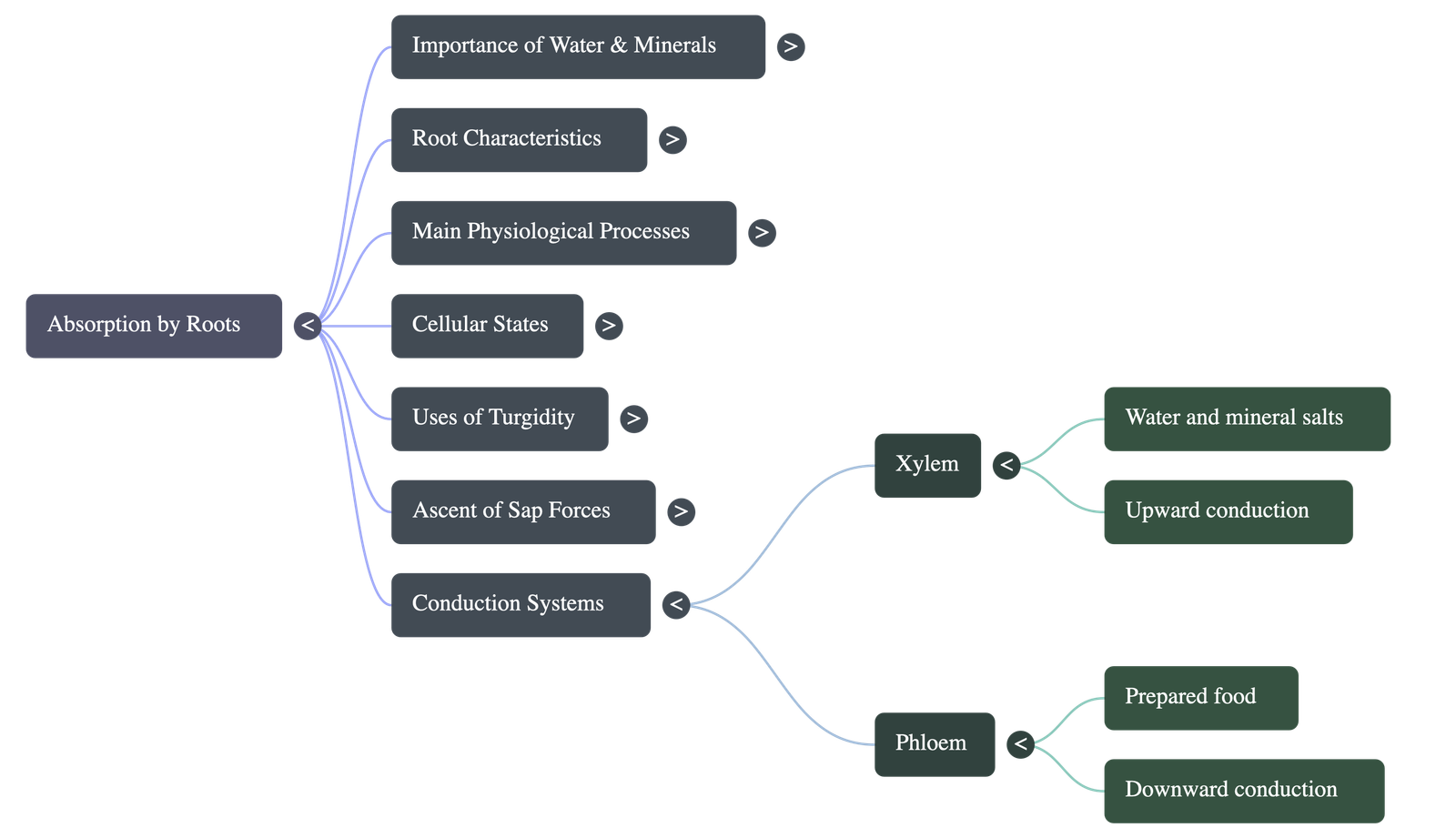
- Transportation: Mineral salts are transported upward in a water solution from roots to shoots, while synthesized food (sugar) moves from leaves to other parts.
- Mechanical Stiffness: Water provides turgidity (a fully distended condition) necessary to keep plant tissues stiff and upright.
- Mineral Nutrients: Absorbed as salts (nitrates, phosphates) or simply as ions (potassium, calcium) and are required as constituents of cells, organelles, and enzymes.
4.3 Characteristics of Roots for Absorbing Water
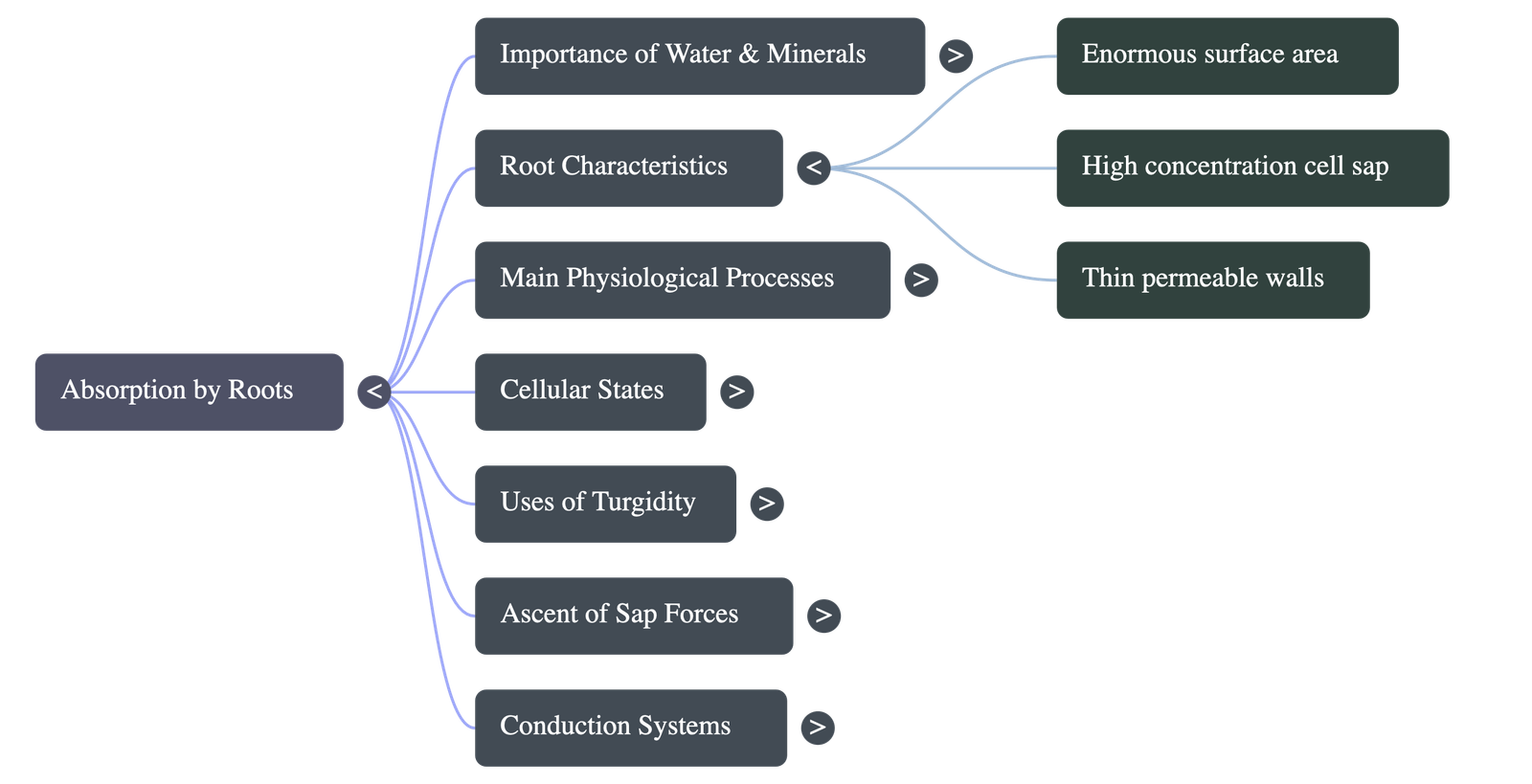
The root system's ability to draw water from the soil depends on three main characteristics:
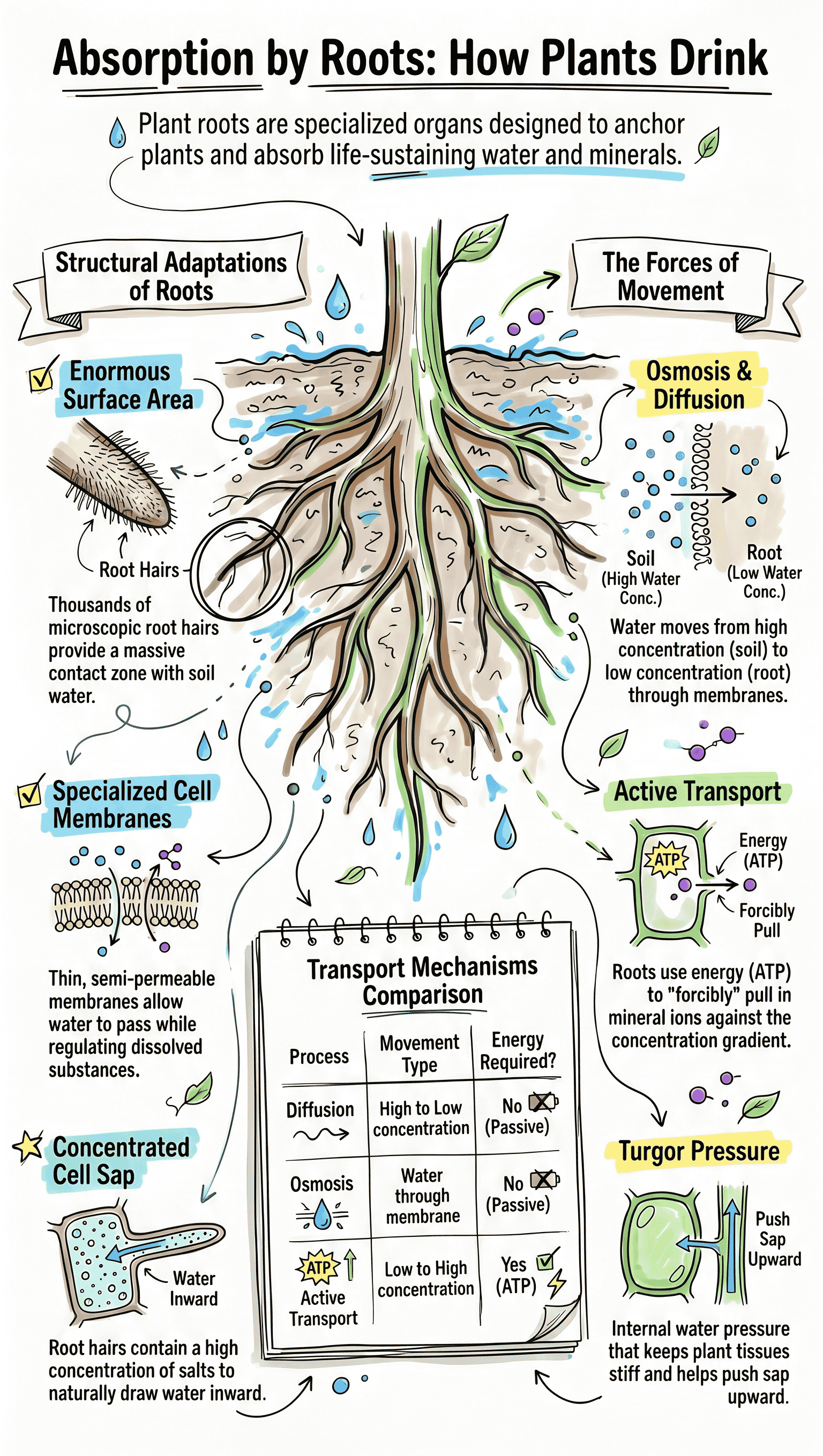
- Enormous Surface Area: Roots branch into hundreds of rootlets, which bear millions of microscopic root hairs. If laid end-to-end, they cover hundreds of kilometres, vastly increasing the area available for absorption.
- Highly Concentrated Cell Sap: Root hairs are extensions of the outer epidermal cells and contain a large vacuole filled with cell sap. The concentration of dissolved salts in the cell sap is higher than that of the surrounding soil water, creating the vital osmotic gradient needed to draw water inwards.
- Thin Walls: Root hairs possess two outer layers:
- Cell Wall: Thin and freely permeable, allowing water molecules and dissolved substances to pass easily.
- Cell Membrane: Very thin and semi-permeable, meaning it allows water molecules to pass but prevents larger solute molecules from escaping the cell.
4.4 Absorption and Conduction of Water and Minerals
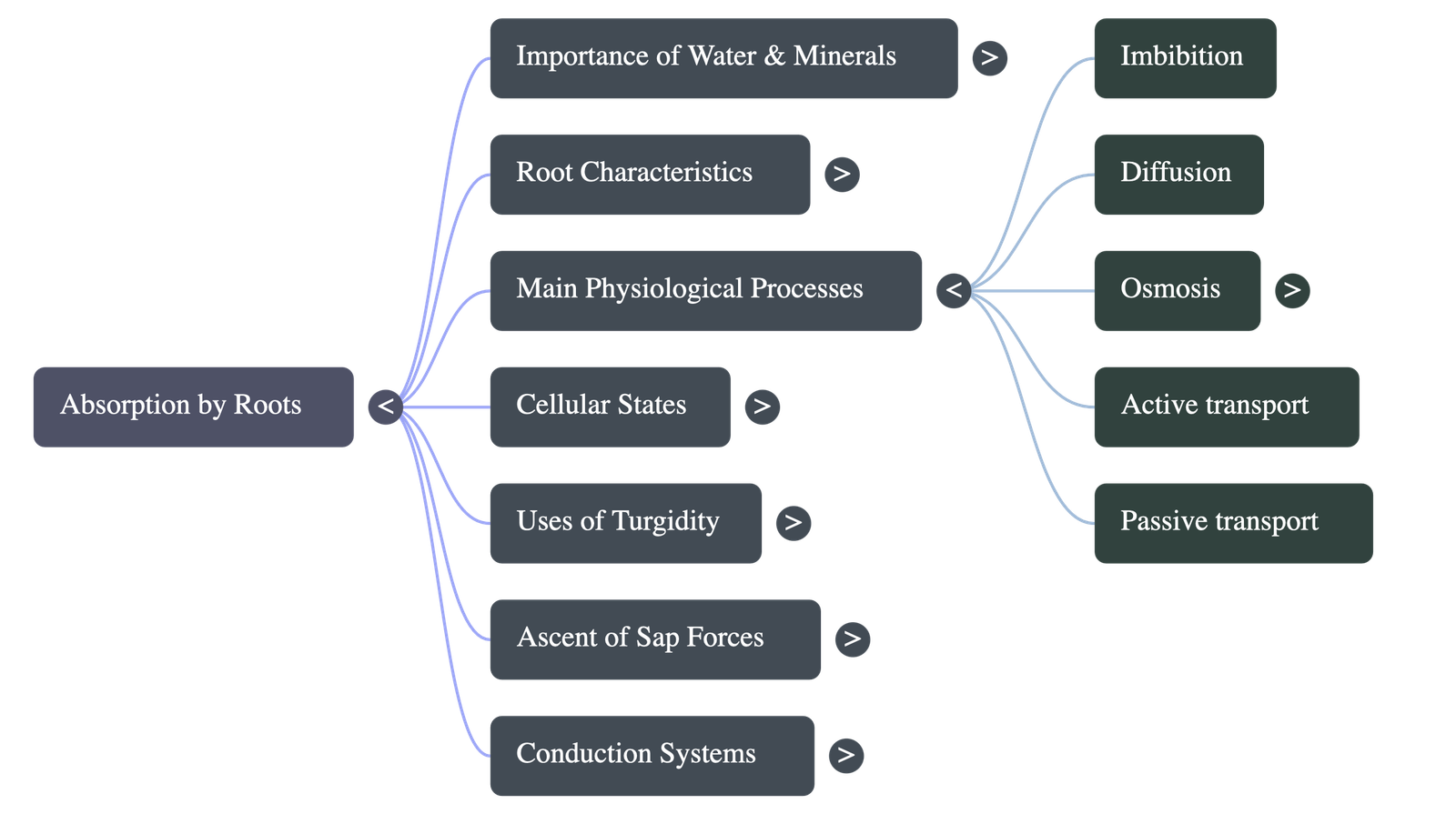
The mechanism of absorbing water and minerals upward through the stem involves five main phenomena:
4.4.1 Imbibition
- A phenomenon by which living or dead plant cells absorb water by surface attraction.
- Hydrophilic (water-loving) substances like cellulose and proteins imbibe water and swell up.
- Examples: Dry seeds or wooden doors swelling upon contact with moisture. It causes seed coats to rupture during germination and contributes to the ascent of sap.
4.4.2 Diffusion
- The free movement of molecules of a substance (solute or solvent, gas or liquid) from their region of higher concentration to the region of their lower concentration when the two are in direct contact.
- This continuous movement leads to a homogeneous, uniformly distributed solution (e.g., dissolving a sugar cube or dye in water).
4.4.3 Osmosis and Osmotic Pressure
- Osmosis: The movement of water molecules from a region of higher water concentration (dilute solution) to a region of lower water concentration (concentrated solution) through a semi-permeable membrane.
- Endosmosis: Inward diffusion of water when the surrounding solution is less concentrated, causing the cell to swell.
- Exosmosis: Outward diffusion of water when the surrounding solution is more concentrated, causing the cell to shrink.
- Osmotic Pressure: The minimum pressure that must be exerted to prevent the passage of pure solvent into the solution when separated by a semi-permeable membrane.
- Tonicity (Relative Concentration):
- Isotonic: Same concentration outside and inside; cell size remains unchanged (no net osmosis).
- Hypotonic: Lower solute concentration outside; water moves into the cell (endosmosis), cell swells or bursts (turgid).
- Hypertonic: Higher solute concentration outside; water moves out of the cell (exosmosis), cell shrinks (plasmolyzed).
4.4.4 Active Transport
- The passage of a substance (salts or ions) from its lower to higher concentration through a living cell membrane.
- Because it goes against the concentration gradient, this process requires energy supplied by the cell in the form of ATP.
- This is the exact opposite of passive transport (diffusion), which requires no energy input.
4.4.5 Turgidity and Flaccidity
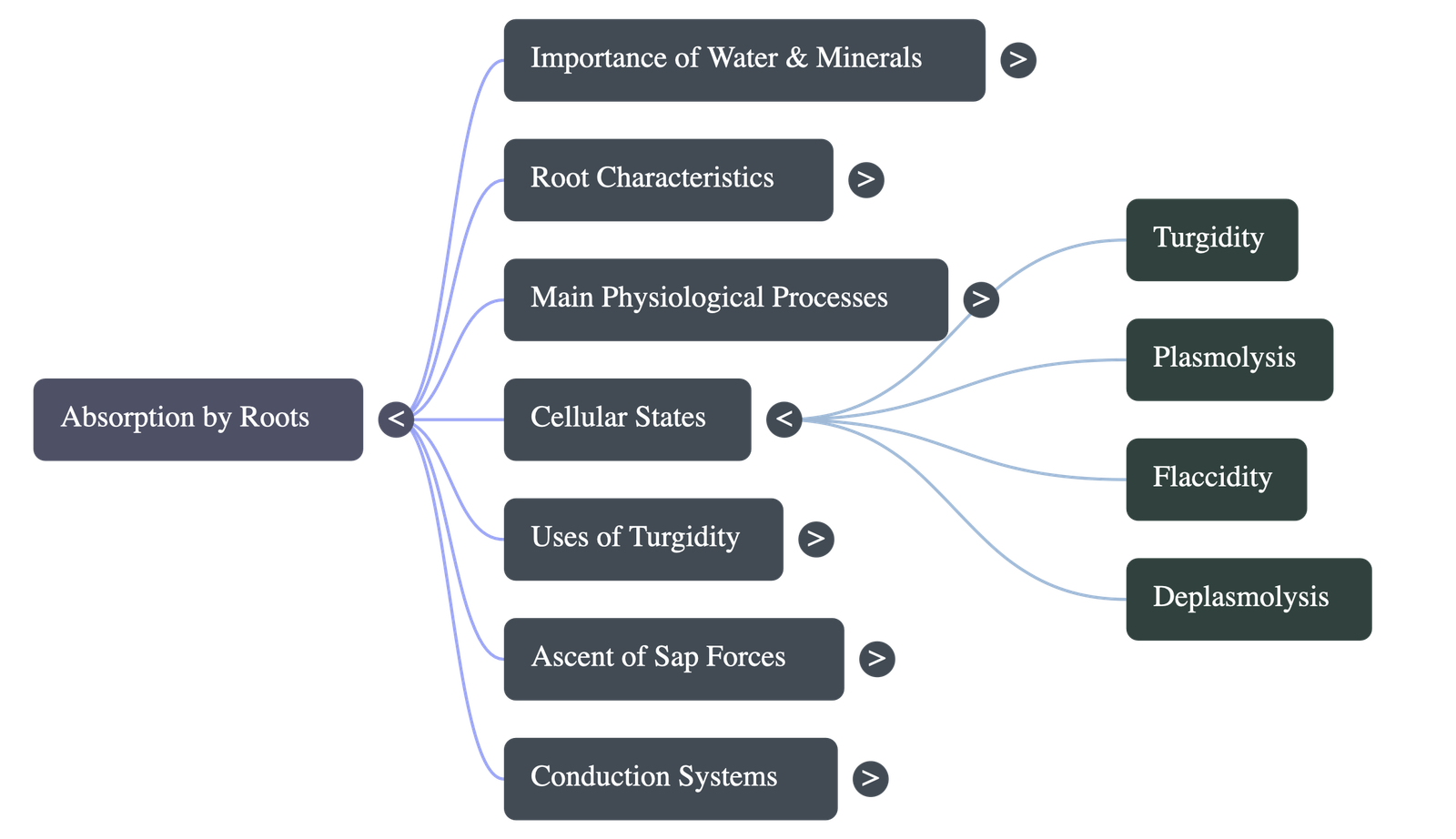
- Turgidity: The state of a cell when it is fully distended and cannot accommodate any more water.
- Turgor Pressure: The outward pressure exerted by the swollen cell contents against the cell wall.
- Wall Pressure: The inward resisting pressure exerted by the rigid cell wall to balance turgor pressure.
- Plasmolysis: The shrinkage and withdrawal of cytoplasm from the cell wall when a plant cell is placed in a strong hypertonic solution due to exosmosis.
- Flaccidity: The limp, shrunken condition of a plasmolyzed cell (the reverse of turgidity).
- Deplasmolysis: The recovery of a plasmolyzed cell when returned to plain water before it dies, allowing it to regain turgidity.
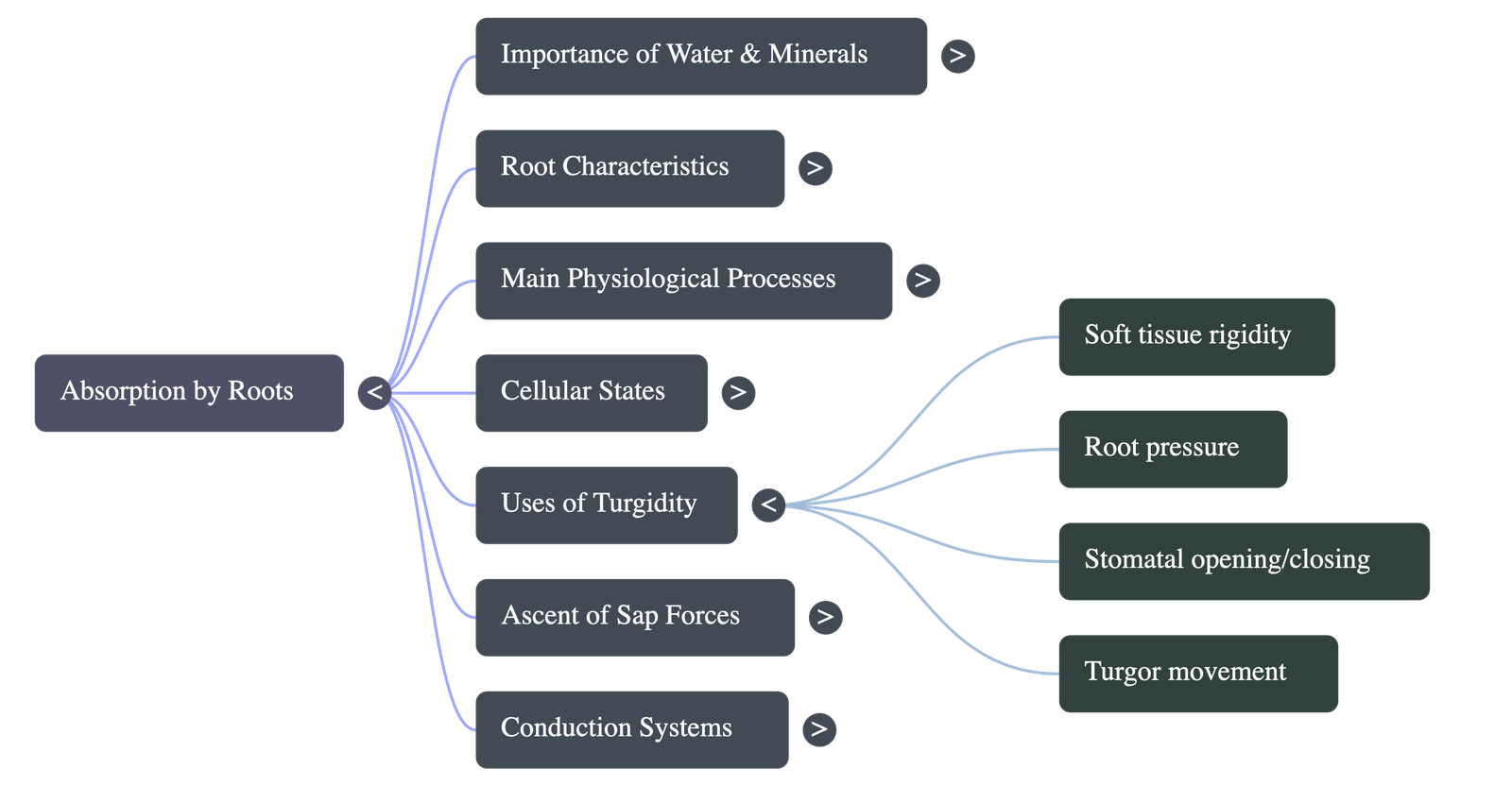
- Uses of Turgidity in Plants:
- Provides rigidity to soft tissues (e.g., leaves wilt when turgidity is lost).
- Helps roots and germinating seeds push through hard ground.
- Builds up root pressure to push sap upward.
- Regulates the opening and closing of stomata by changing the shape of guard cells.
- Drives turgor movements, such as the rapid drooping of leaves in the sensitive plant (Mimosa pudica) when touched.
4.5 Root Pressure
- Root pressure is the hydrostatic pressure developed in the roots due to continuous inward cell-to-cell osmosis.
- As each turgid cell presses on the next, it forces water inward until it reaches the centrally located xylem vessels.
- Bleeding: If a stem is cut, cell sap oozes out due to root pressure.
- Guttation: In some plants (tomato, grass), excessive root pressure forces water droplets out of leaf margins or tips, especially in the early mornings.
4.6 Importance of Root Hairs and Upward Movement of Absorbed Water
- Root hairs absorb water because their internal cell sap concentration is higher than the outside soil water.
- Water diffuses into the root hair, increasing its turgidity, and then passes continuously to adjoining cortical cells.
- Eventually, the water and absorbed dissolved minerals enter the xylem vessels, ready for upward conduction to be used in food manufacture in the leaves.
4.7 Some Experiments on Absorption and Conduction
- Exp 1 (Roots absorb water): Placing an intact rooted plant in a test tube of water covered with oil (to prevent evaporation) shows a drop in water level, proving root absorption.
- Exp 2 (Xylem conducts water upwards): A plant placed in an eosin (pink) dye solution will show red staining exclusively in its xylem tissues when the stem and leaves are cut transversely.
- Exp 3 & 4 (Ringing/Girdling Experiments):
- If the outer ring (phloem) is removed but the central part (xylem) remains intact, leaves remain turgid (proving xylem transports water upwards).
- If the xylem is removed and the phloem remains, leaves droop and wilt.
- Over time, cutting the phloem causes a swollen bulge above the cut, proving that synthesized food from leaves travels downwards through the phloem.
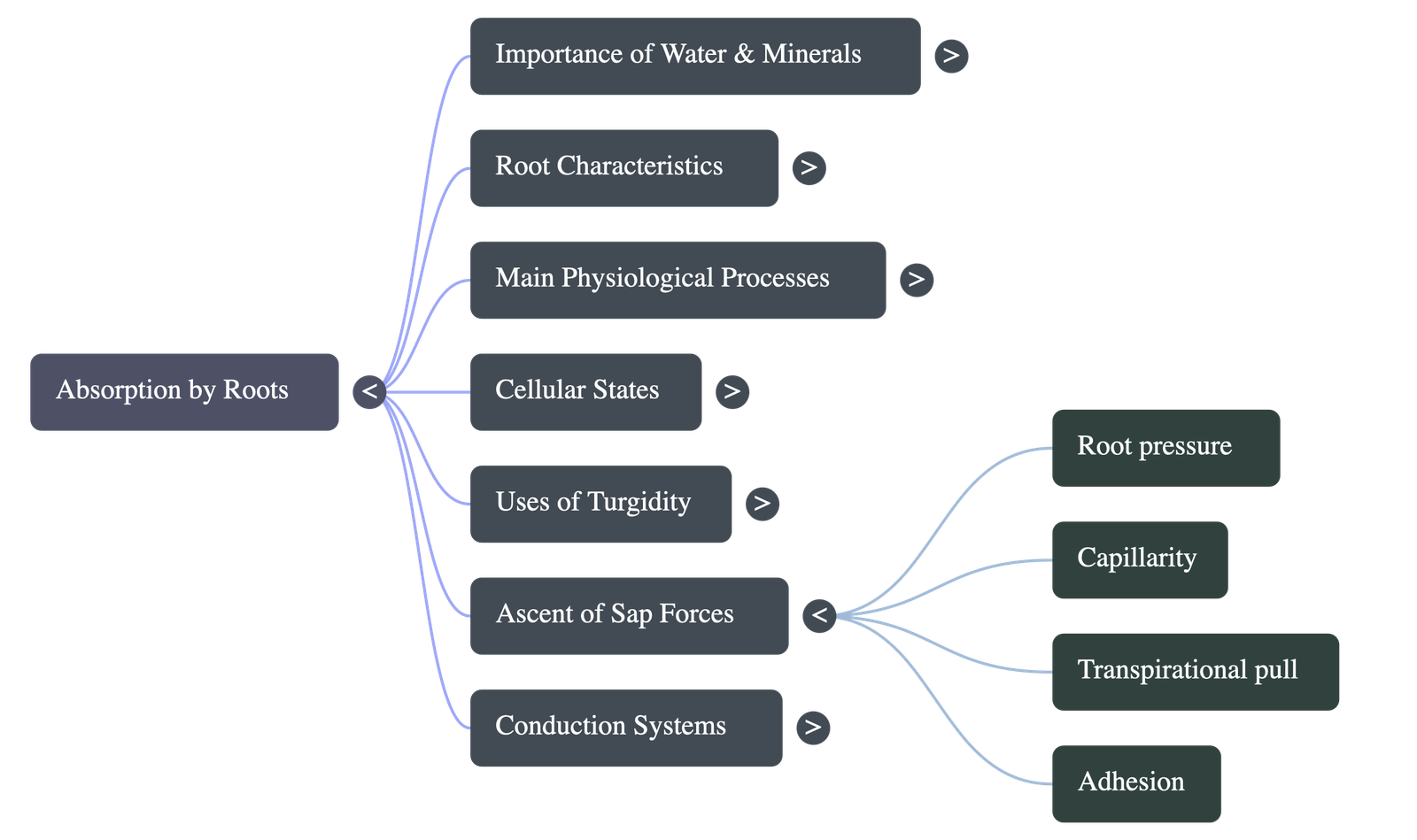
4.8 Forces Contributing to Ascent of Sap
The upward movement of sap against gravity is driven by four main forces:
- 1. Root Pressure: Builds up sufficient hydrostatic force in xylem vessels to push sap upwards (especially in herbaceous plants).
- 2. Capillarity: The narrow diameter of xylem vessels naturally causes liquid to rise and fill the vacuum left by water lost during transpiration.
- 3. Transpirational Pull: As water evaporates from leaf surfaces, it creates a powerful suction force that pulls more water molecules upwards.
- 4. Adhesion and Cohesion:
- Adhesion: Causes water molecules to stick to the surfaces of the xylem cells, pulling more water from below.
- Cohesion: The molecular attraction by which water molecules stick to each other, forming a solid, continuous column of water throughout the tall stem.
Do checkout all questions & answers of this chapter.
Quick Navigation:
| | | |
1 / 1
Quick Navigation:
| | | |