Quick Navigation:
| | |
LINEAR EQUATIONS IN TWO VARIABLES
"The principal use of the Analytic Art is to bring Mathematical Problems to Equations and to exhibit those Equations in the most simple terms that can be." — Edmund Halley
- Recall of One-Variable Equations In earlier studies, linear equations in one variable (e.g., x + 1 = 0) were introduced. These equations are characterized by having a unique (one and only one) solution that can be represented on a number line.
-
Fundamental Solving Principles
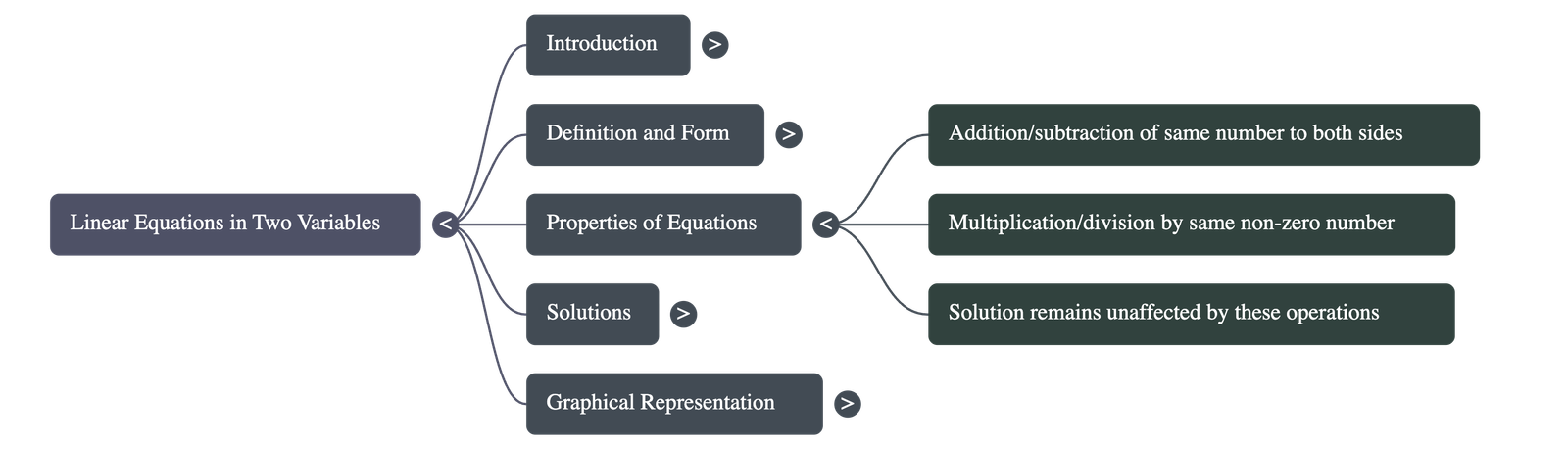
The solution of a linear equation remains unchanged when:
- The same number is added to or subtracted from both sides.
- Both sides are multiplied or divided by the same non-zero number.
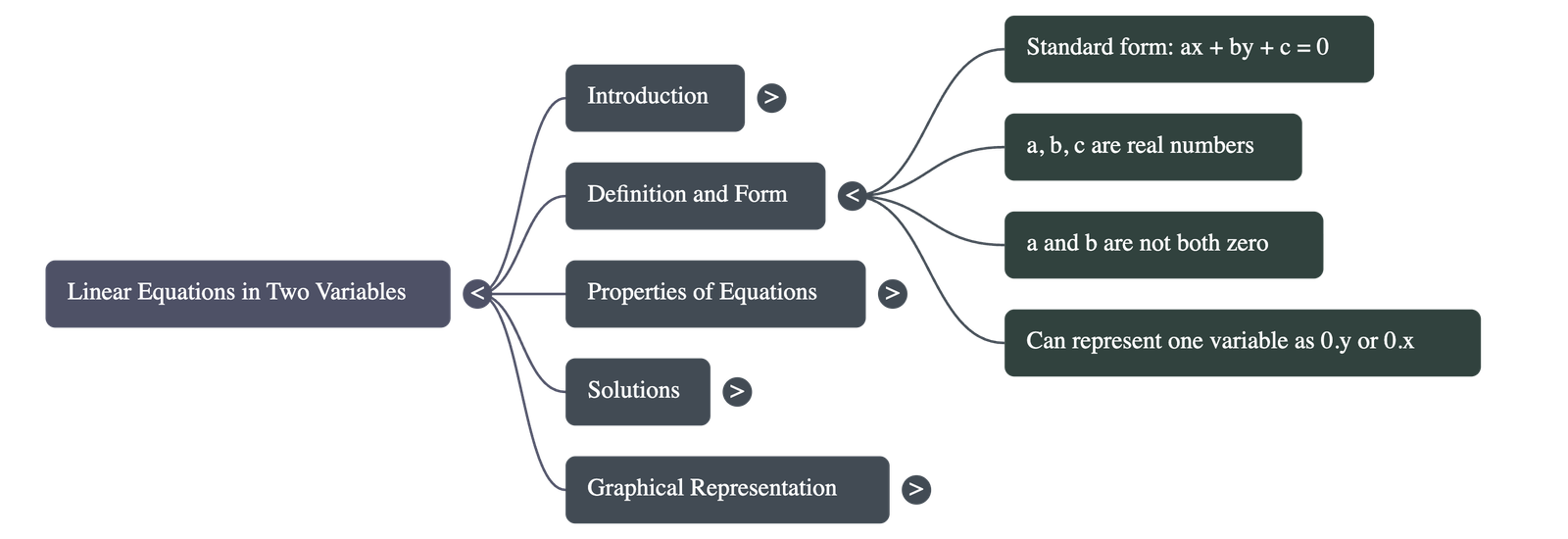
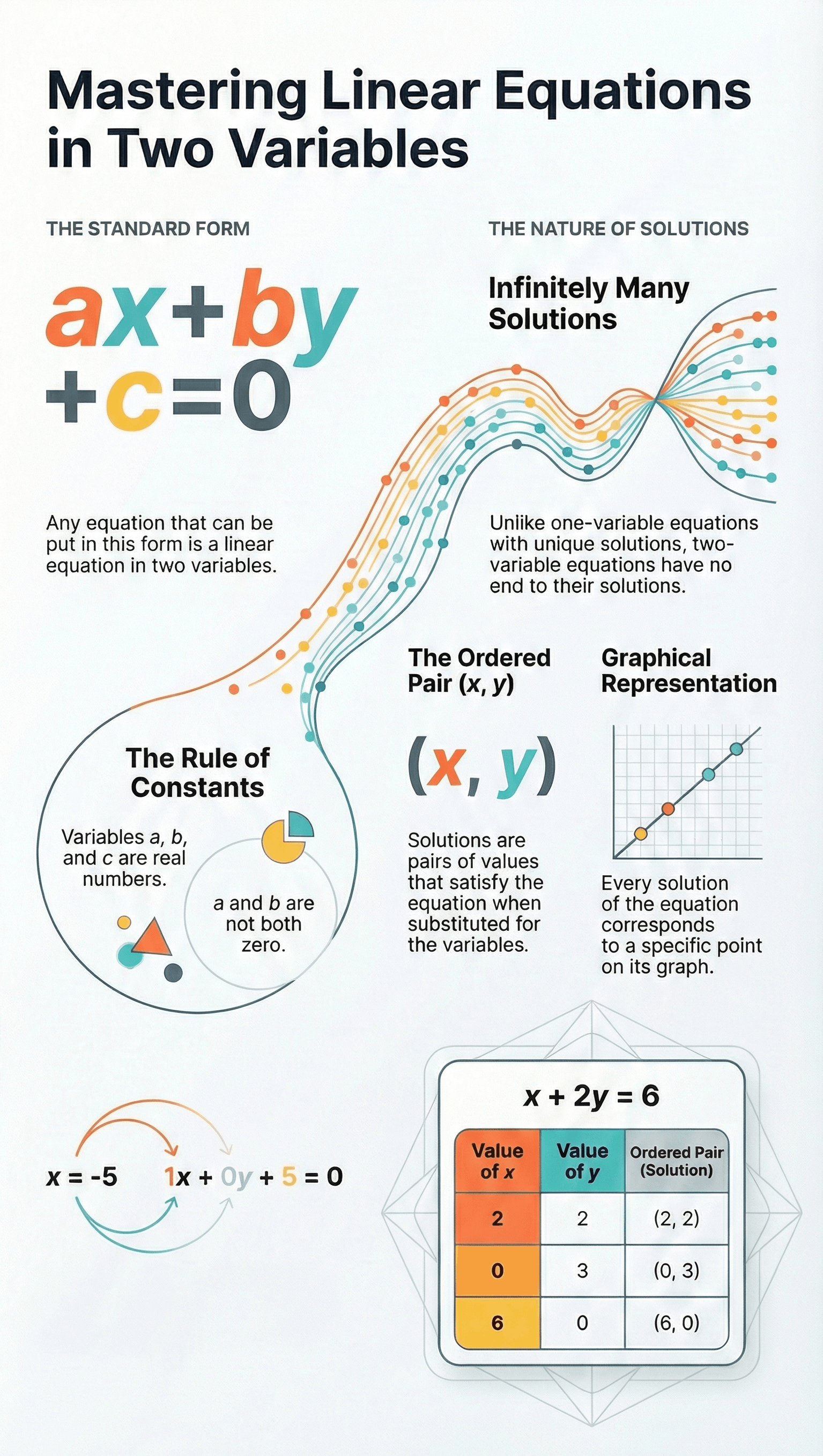
- Definition of Two-Variable Equations Any equation that can be expressed in the form ax + by + c = 0, where a, b, and c are real numbers and a and b are not both zero, is defined as a linear equation in two variables.
- Expressing One Variable as Two Equations typically seen as one-variable equations, such as x = -5 or y = 2, can also be expressed as linear equations in two variables. For instance, x = -5 can be written as 1x + 0y + 5 = 0.
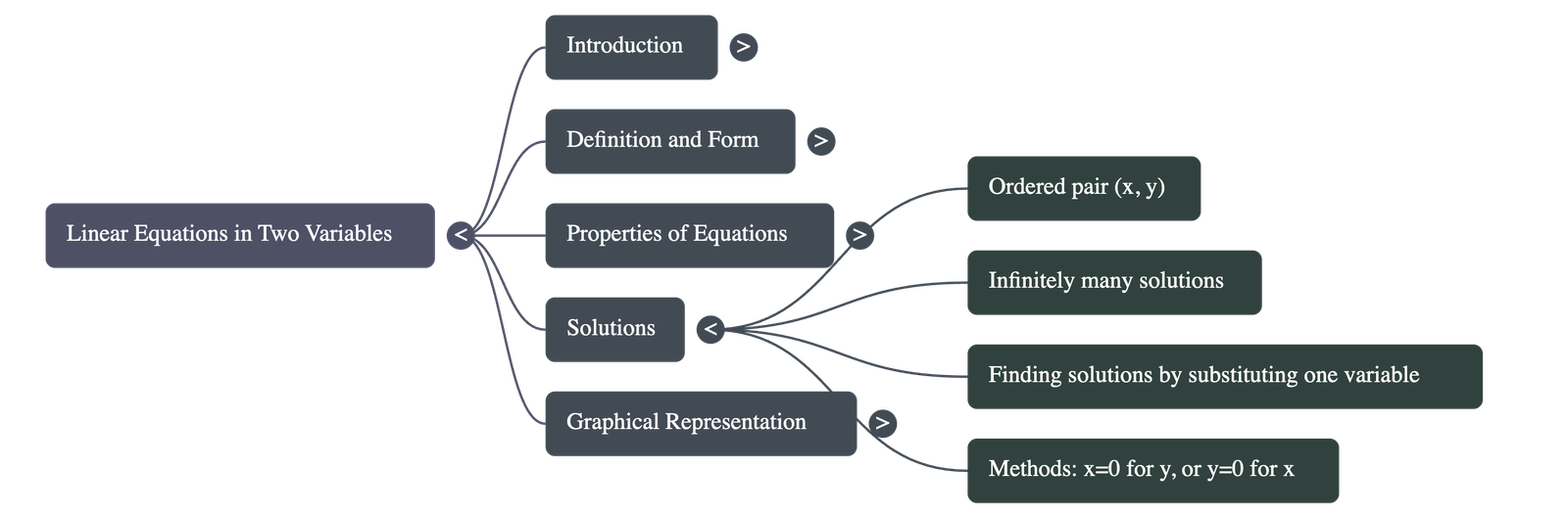
- Infinite Nature of Solutions Unlike equations in one variable, a linear equation in two variables has infinitely many solutions. Since there are two variables, a solution is represented as a pair of values—one for x and one for y—that satisfy the equation.
- Ordered Pairs Solutions are written as an ordered pair (x, y). For example, in the equation 2x + 3y = 12, the pair (3, 2) is a solution because substituting x=3 and y=2 makes the equation true. Note that the order matters: (0, 4) might be a solution while (4, 0) is not.
- Method for Finding Solutions A practical way to find solutions is to substitute a chosen value for one variable (e.g., let x = 0) and solve the resulting one-variable equation to find the corresponding value of the other variable (y).
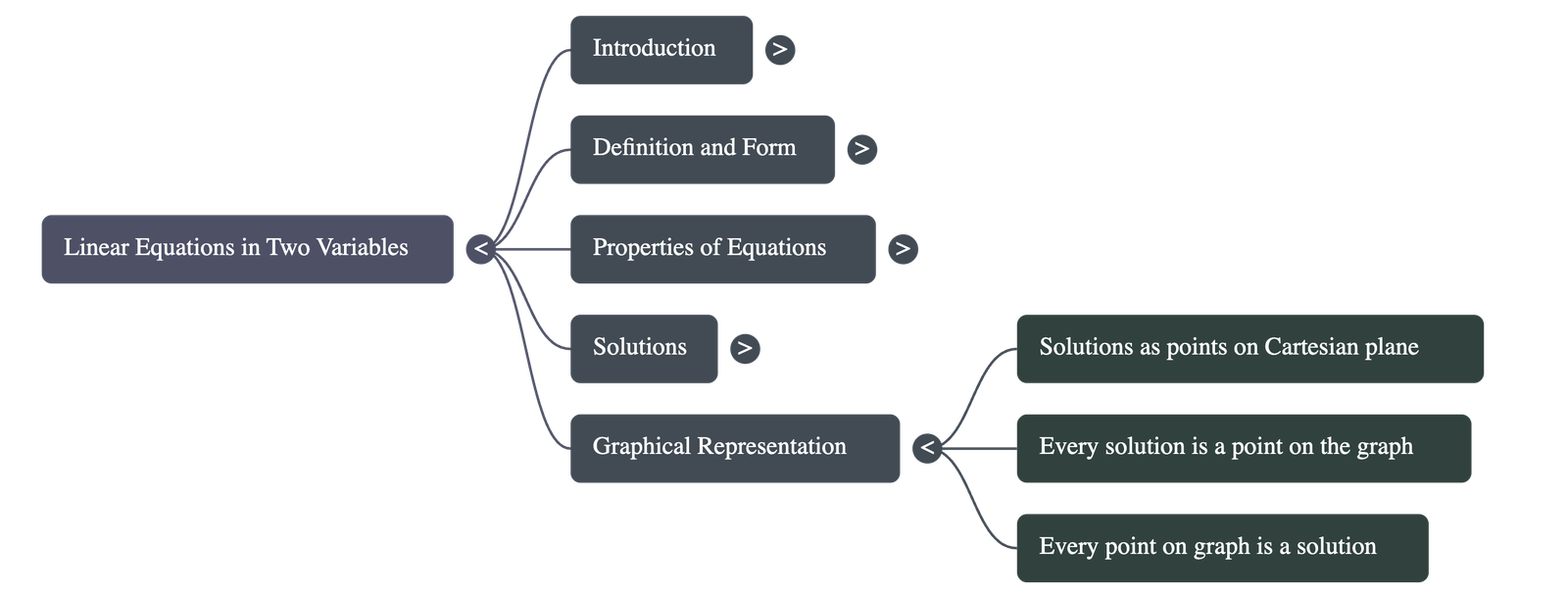
- Geometric Connection Every solution of a linear equation corresponds to a point on its graph in the Cartesian plane. Conversely, every point located on the graph of the equation is a valid solution for that equation.
Key Takeaway: A linear equation in two variables is a powerful tool for representing situations with two unknown quantities, offering a bridge between algebra and coordinate geometry.
Do checkout all questions & answers of this chapter.
Quick Navigation:
| | |
1 / 1
Quick Navigation:
| | |