Quick Navigation:
| | | |
A. The Sequence of Tenses
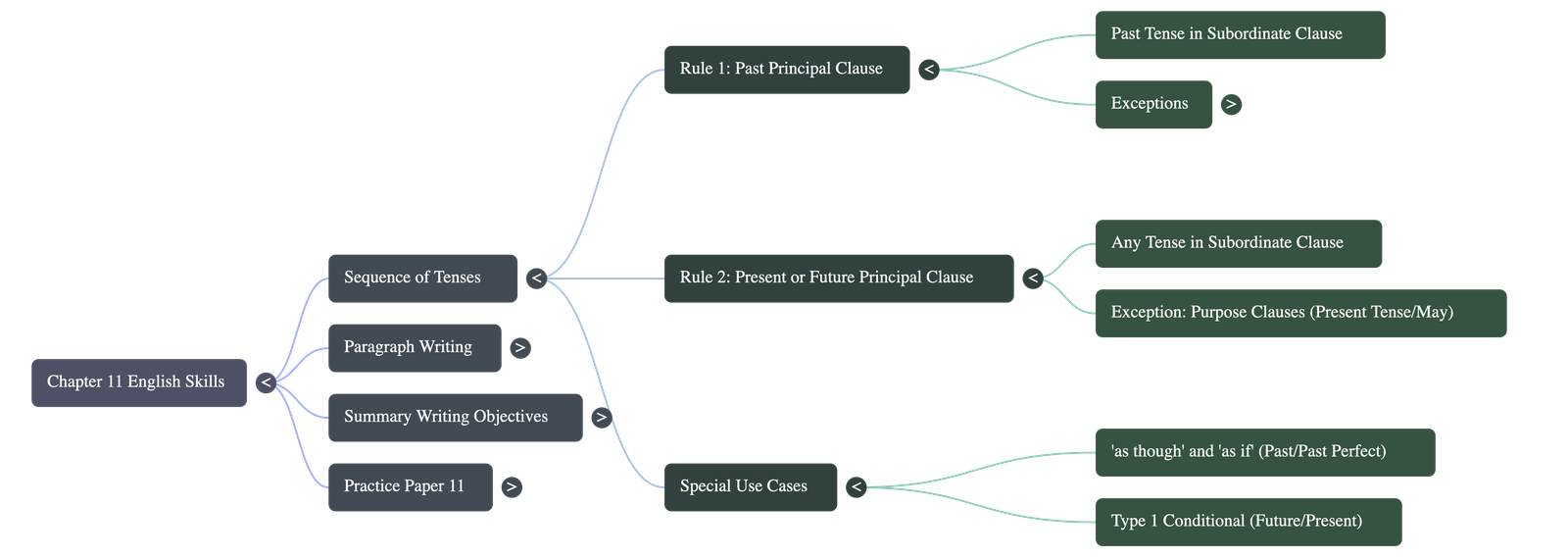
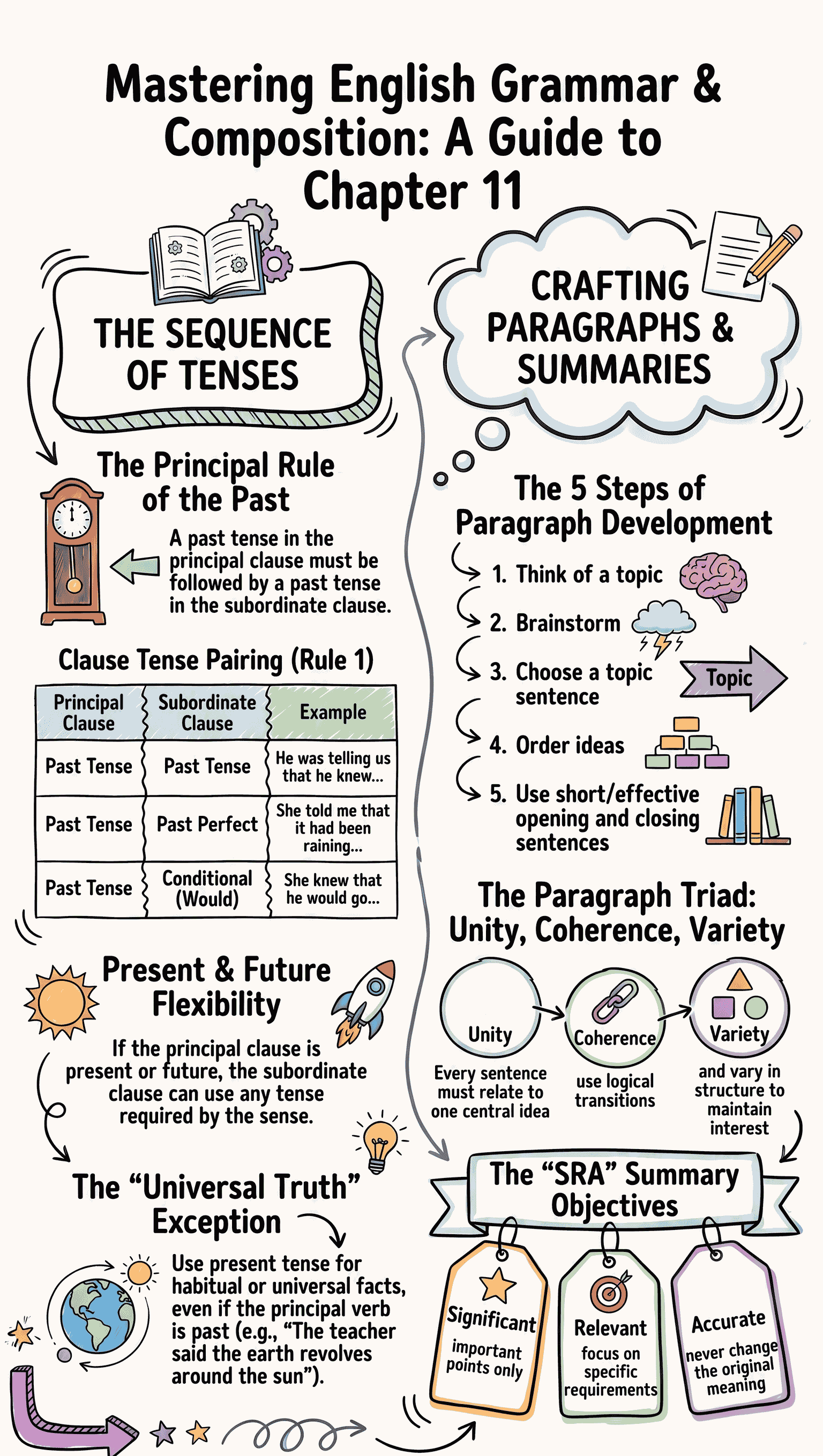
This section explains the principle that the tense of the verb in a subordinate (dependent) clause must logically follow the tense of the verb in the principal (main) clause.
- Rule 1 (Past Tense Rule): If the principal clause is in the past tense, the subordinate clause must also be in a past tense.
- Exception 1: Universal truths or habitual facts remain in the present tense (e.g., "The teacher said that the earth revolves around the sun.").
- Exception 2: If the subordinate clause uses a comparison word like than or as well as, any tense can be used depending on the meaning.
- Exception 3: Adverb clauses showing place, reason, or comparison can take any tense as required by the sense.
- Rule 2 (Present & Future Rule): If the principal clause is in the present or future tense, the subordinate clause can be in any tense that fits the logical meaning.
- Exception: If the subordinate clause expresses a purpose (e.g., "He eats well that he may live"), its verb is always in the present tense.
- Special Note on Conditional Sentences: In Type 1 conditional sentences, the principal clause takes the future tense, while the subordinate clause takes the present tense (e.g., "Unless she apologises, he will not meet her again.").
- Using "As if / As though": These phrases usually take the past tense to indicate present time, and the past perfect tense to indicate a past time.
B. Paragraph Writing
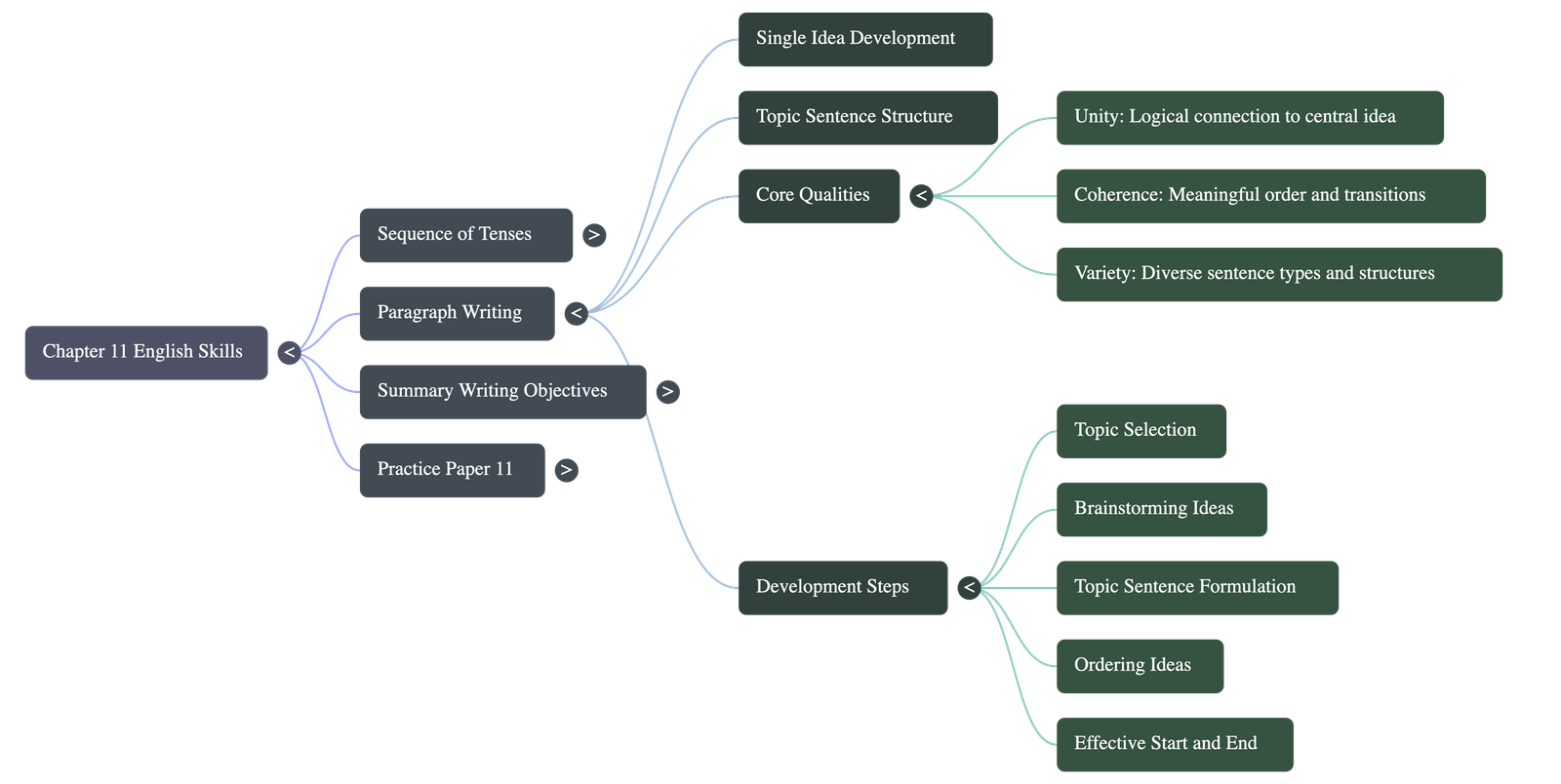
A paragraph is the complete and logical development of a single idea. It usually starts with a Topic Sentence that states the main theme.
Three Essentials of a Good Paragraph:
- Unity: The paragraph must deal with only one central idea. Every single sentence must logically connect to this main statement. Any irrelevant information ruins the unity.
- Coherence: Ideas must be arranged in a clear, logical order (either by how they occurred or by their importance). Coherence is achieved by using transitional words (however, therefore), repeating specific ideas, or using pronouns to link sentences.
- Variety: To keep the reader interested, avoid monotony. Use a mix of short and long sentences, different vocabulary, and various sentence structures.
Steps for Paragraph Development:
- Think of a specific topic.
- Brainstorm and collect ideas.
- Choose a strong topic sentence.
- Put your ideas in a logical order around the topic sentence.
- Ensure your first and last sentences are short, crisp, and effective.
C. Summary Writing – Objectives
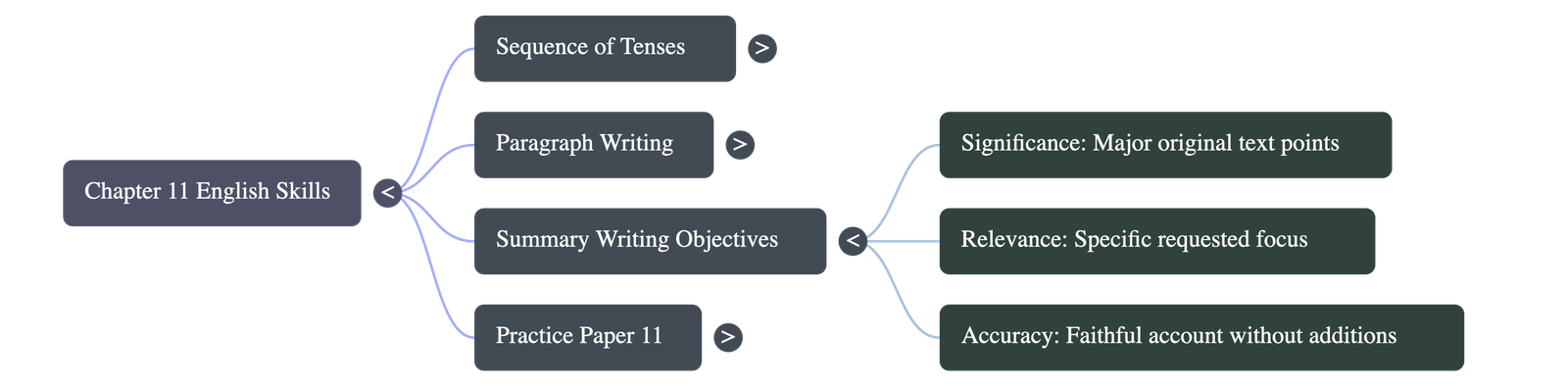
Writing a summary requires reducing a text to its core meaning without changing the original author's intent. A good summary must strictly follow three main objectives:
- Significance: Only the major, essential points of the original text should be included. Before finalizing, create a list of important points to ensure none are missed and no minor details are added.
- Relevance: You must focus strictly on what is asked. If the prompt asks for specific information from the passage, only summarize points related to that exact topic, ignoring the rest.
- Accuracy: The summary must be a completely true reflection of the original passage. You must resist the temptation to add outside knowledge, personal opinions, or extra facts to show off.
D. Practice Paper - 11
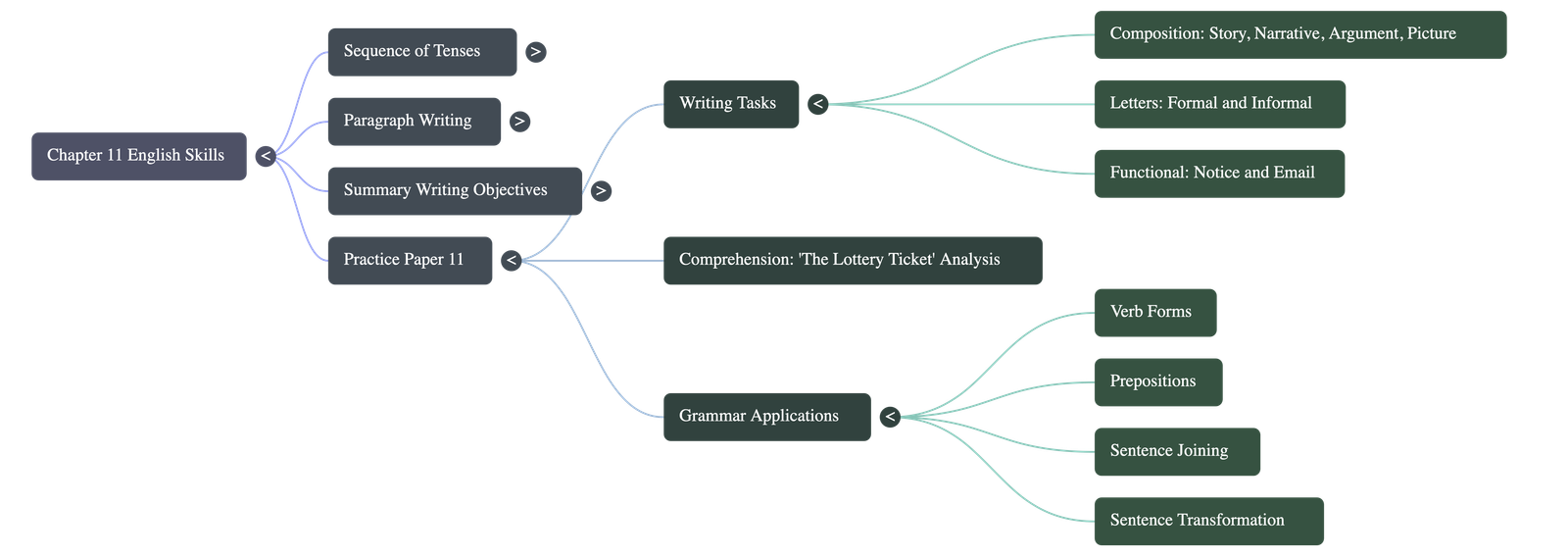
This section provides a complete mock examination paper to test writing and grammar skills, structured exactly like standard school exams.
-
Question 1: Long Composition (300-350 words)
Students are given a choice of essay formats, including writing a short story based on prompts, narrating a witnessed incident, expressing views on a debate topic (technology's impact on life), describing lifestyle changes, or writing a picture composition based on a provided photograph. -
Question 2: Letter Writing
Requires writing either a formal letter (e.g., requesting the school Principal to provide healthier food in the canteen) or an informal letter (e.g., advising a homesick younger sister on how to stay focused and set goals). -
Question 3: Notice and Email Writing
Tests practical communication skills by drafting a school notice for a Poster Making competition and writing a formal email inviting an environmental activist as a Guest of Honour. -
Question 4: Reading Comprehension
Features a story about a middle-class man named Ivan and his wife checking a lottery ticket. They imagine a life of luxury, quickly grow resentful and angry at each other over how the money might be spent, and finally discover they did not win. The section includes vocabulary questions, short-answer factual questions, and a summary writing task based on Ivan's feelings. -
Question 5: Applied Grammar
A comprehensive grammar test that includes:- Filling in blanks with the correct form of given verbs.
- Filling in blanks with appropriate prepositions or functional words.
- Joining pairs of sentences into a single sentence without using the words and, but, or so.
- Rewriting sentences according to strict grammatical instructions (transformation of sentences).
Do checkout all questions & answers of this chapter.
Quick Navigation:
| | | |
1 / 1
Quick Navigation:
| | | |