Quick Navigation:
| | | |
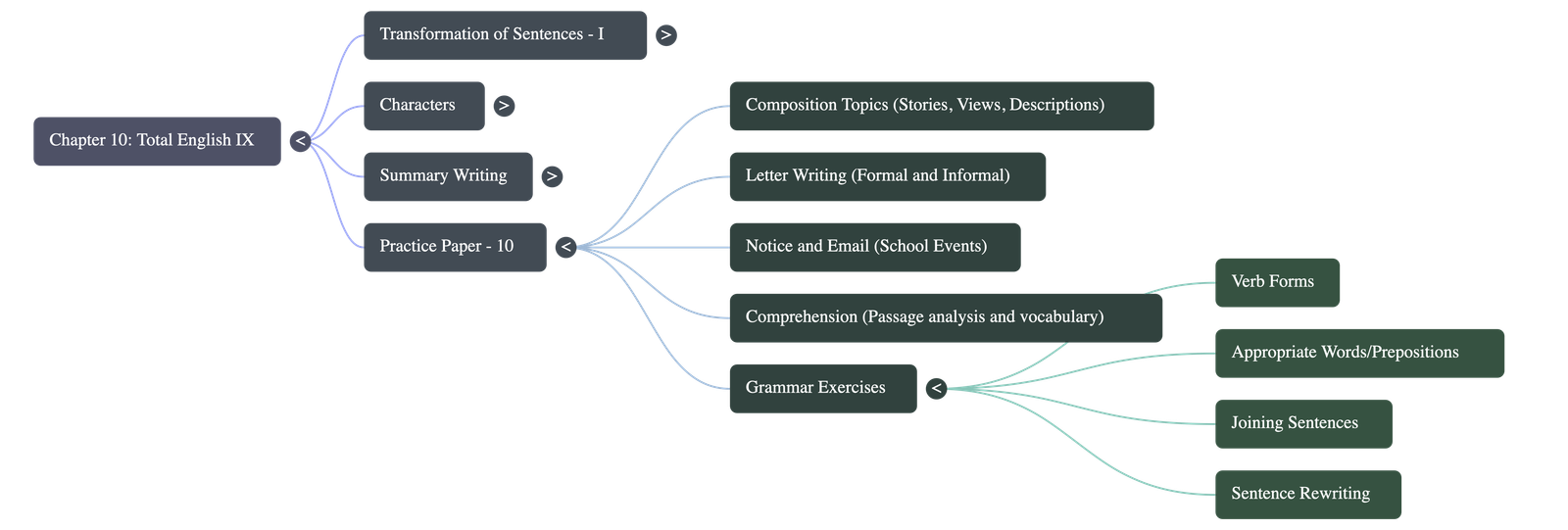
A. Transformation of Sentences - I
Overview: Transformation involves changing a sentence from one grammatical form to another without altering its original meaning.
- Substitution of Parts of Speech: Sentences can be transformed by changing a key word into a different part of speech (e.g., converting a verb into a noun, or an adjective into an adverb) while maintaining the core message.
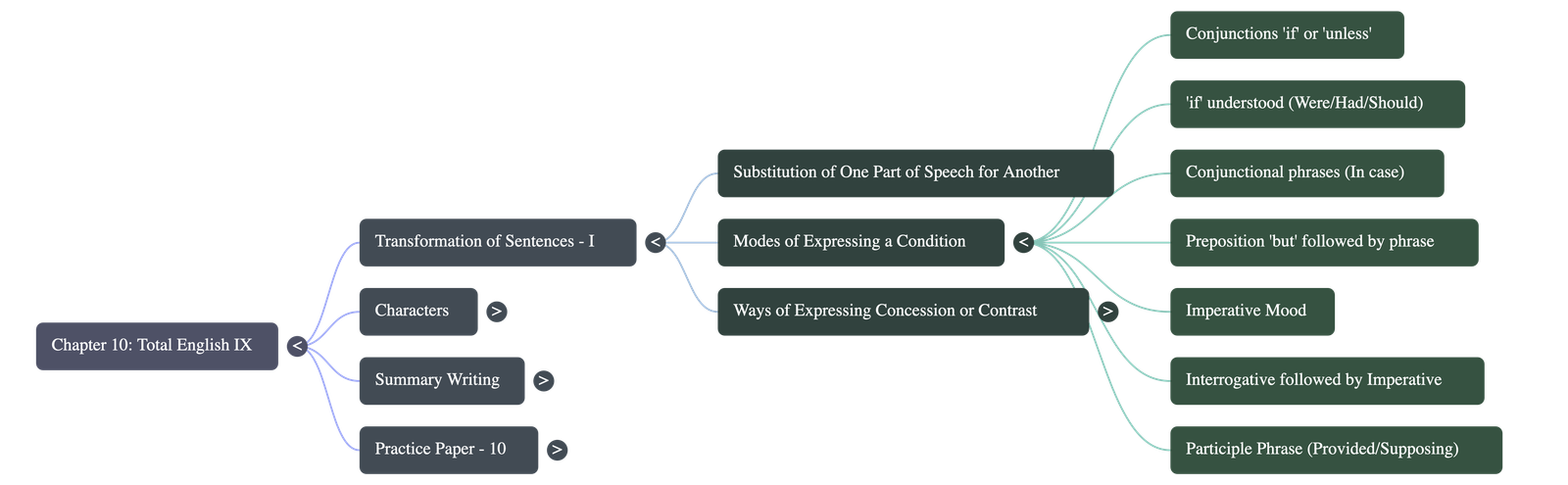
- Expressing a Condition: There are multiple ways to frame a conditional sentence:
- Using common conjunctions like 'if' or 'unless'.
- Using an implied 'if' (e.g., "Were I a powerful man...").
- Using conjunctional phrases (e.g., 'in case').
- Using the preposition 'but' followed by an object phrase.
- Using the Imperative Mood (e.g., "Work hard and you will succeed").
- Combining an Interrogative sentence with an Imperative one.
- Using Participle Phrases (e.g., 'provided that', 'supposing').
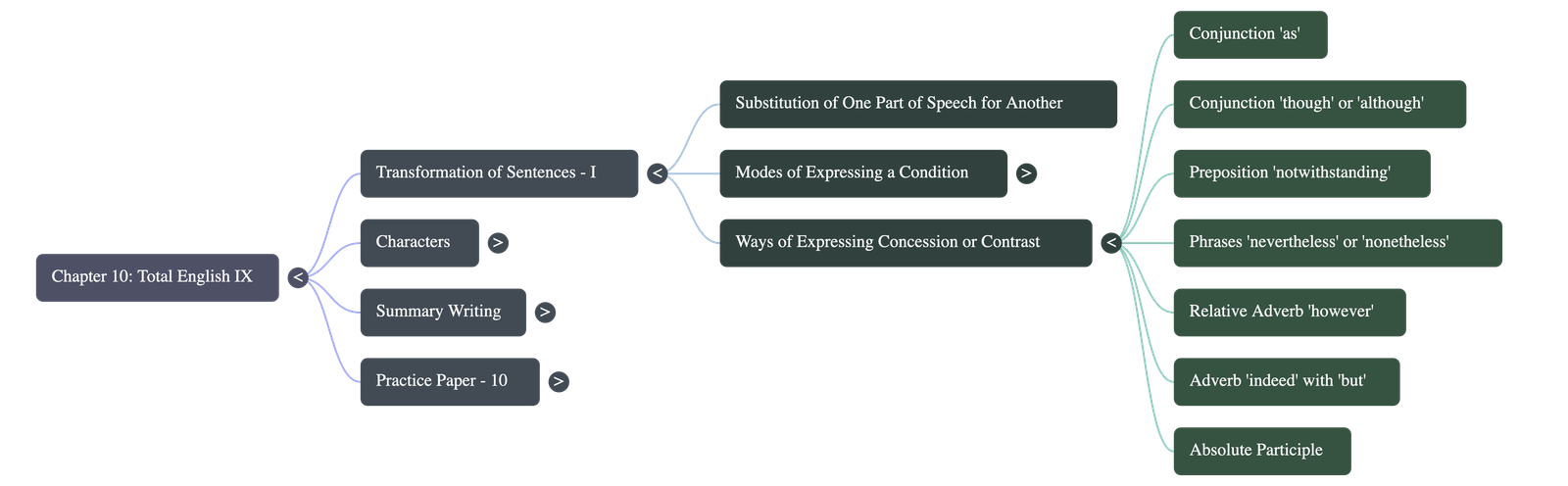
- Expressing Concession or Contrast: To highlight contrast between two ideas, you can use:
- Conjunctions such as 'as', 'though', or 'although'.
- The preposition 'notwithstanding' followed by a Noun Clause.
- Transitional phrases like 'nevertheless' or 'nonetheless'.
- The relative adverb 'however' paired with an adjective or adverb.
- The adverb 'indeed' followed later by the conjunction 'but'.
- An Absolute Participle (e.g., "Admitting that...") followed by a Noun Clause.
B. Characters
Overview: This section provides strategies for writing vivid, convincing, and realistic character sketches based on personal observation.
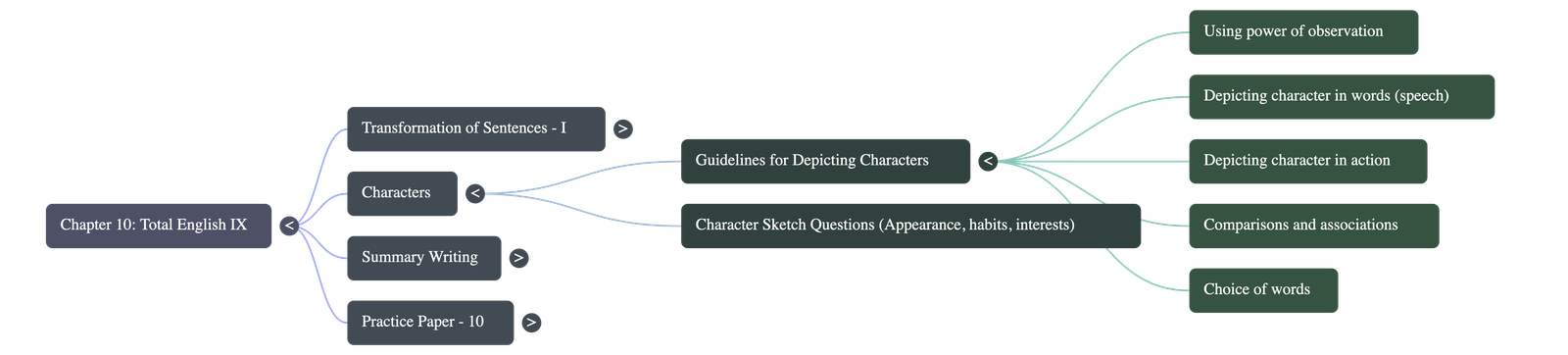
Guidelines for Depicting Characters:
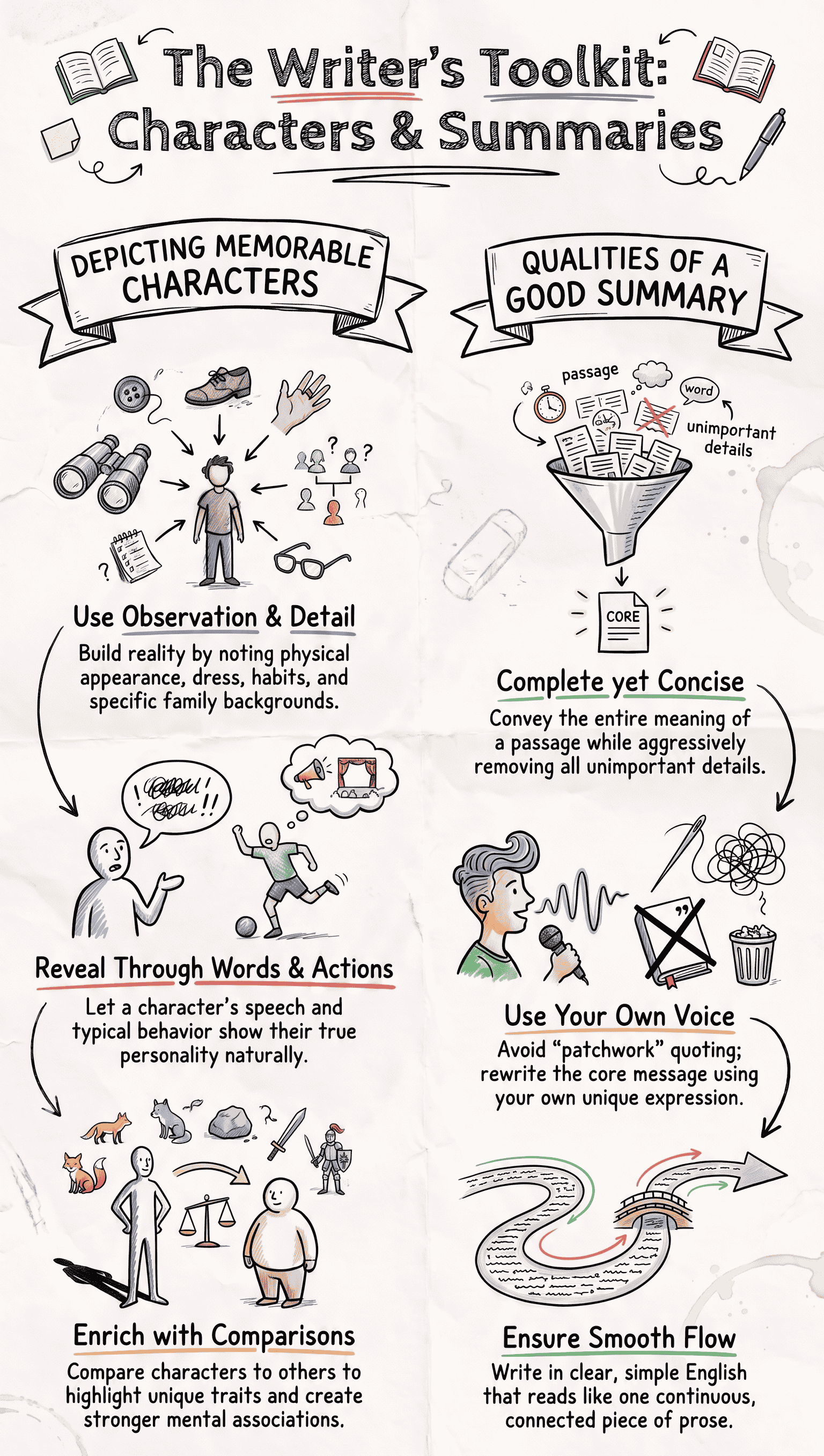
- Power of Observation: A good sketch details the character's physical appearance, dress style, habits, life history, interests, and how others perceive them.
- Depicting Character in Words: Incorporate the character’s direct speech. This breaks the monotony of narration and gives readers a direct sense of the person's true nature and personality.
- Depicting Character in Action: Describe actions and behaviors that are typical of the person. Showing what they do in their daily routine often reveals exactly what kind of person they are.
- Comparisons and Associations: Enrich your writing by comparing your character’s traits, behaviors, or speech to someone else, helping the reader draw mental parallels.
- Choice of Words: Carefully select adjectives and verbs. Like painting a picture, the right vocabulary helps illustrate the character's physical features and temperament clearly.
C. Summary Writing
Overview: Summarizing is a crucial daily skill in many professions. This section teaches how to extract core ideas and present them concisely.
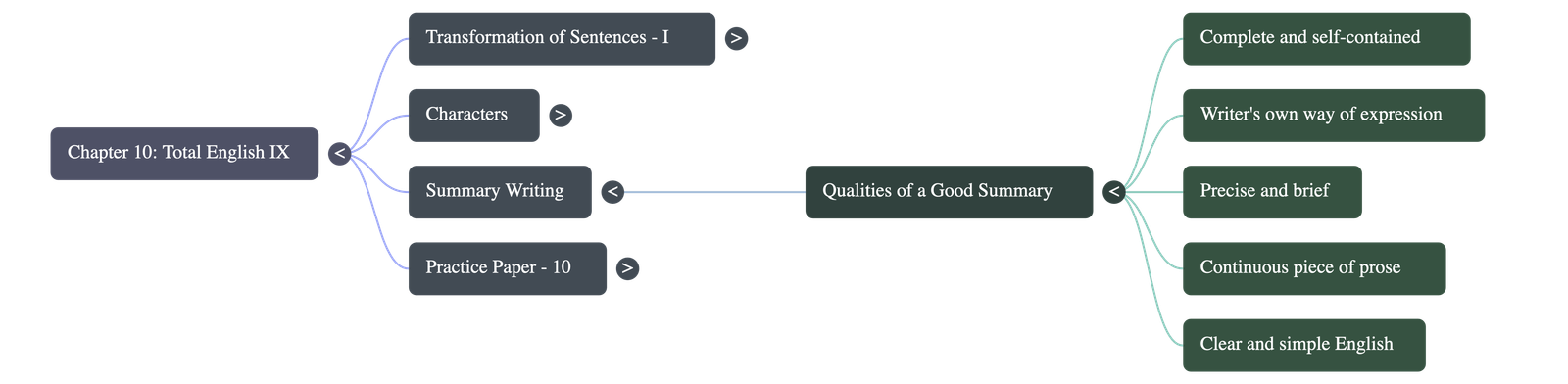
Qualities of a Good Summary:
- Complete and Self-Contained: The summary must independently convey the entire essence and meaning of the original passage.
- Original Expression: It must be written in your own words. It should never be a patchwork of phrases directly copied and pasted from the source text.
- Precise and Brief: Strictly eliminate all unimportant details, digressions, or irrelevant material. Keep only the essential facts.
- Continuous Flow: It must read like a continuous piece of prose. Avoid writing disjointed, fragmented, or jerky sentences.
- Clear Language: Ensure the summary is written in clear, simple, and grammatically correct English.
D. Practice Paper - 10
Overview: A full-length English practice paper meant to test composition, letter writing, comprehension, and grammar skills.
- Question 1 (Composition): Write a 300-350 word piece choosing from a story, a narrative highlighting a quality of success, an argumentative essay on capital punishment, a descriptive essay about a trip, or a picture composition (featuring a girl and a dog).
- Question 2 (Letter Writing): Offers a choice between a formal letter (requesting to volunteer for English Speaking Classes) and an informal letter (writing to a mother about academic disruptions due to heavy rainfall).
- Question 3 (Notice & Email): Draft a formal notice for a school board about a National Integration Trivia Quiz, and write a corresponding email to a neighboring principal inviting their students.
- Question 4 (Comprehension): Read a passage (a story about characters Amanda, Laura, and a discussion on reincarnation into an otter) and answer vocabulary questions, short analytical questions, and a 50-word summary task.
- Question 5 (Grammar): A comprehensive grammar check that includes:
- Filling in blanks with correct verb forms.
- Filling in blanks with appropriate prepositions or words.
- Joining sentences to make a complete sentence without using 'and', 'but', or 'so'.
- Rewriting sentences based on strict structural instructions without altering their core meaning.
Do checkout all questions & answers of this chapter.
Quick Navigation:
| | | |
1 / 1
Quick Navigation:
| | | |