Quick Navigation:
| | | |
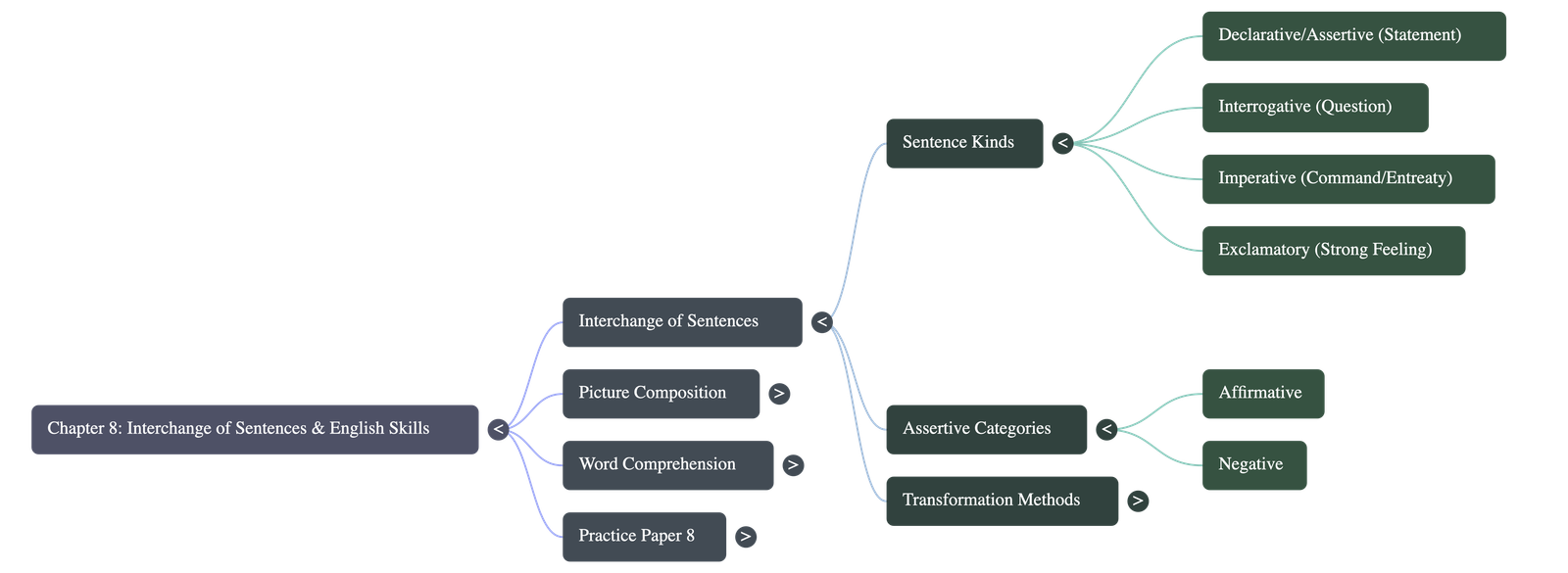
A. Interchange of Sentences
The chapter introduces the sentence as the basic unit of expression in English and explains how to transform sentences without changing their meaning.
-
•
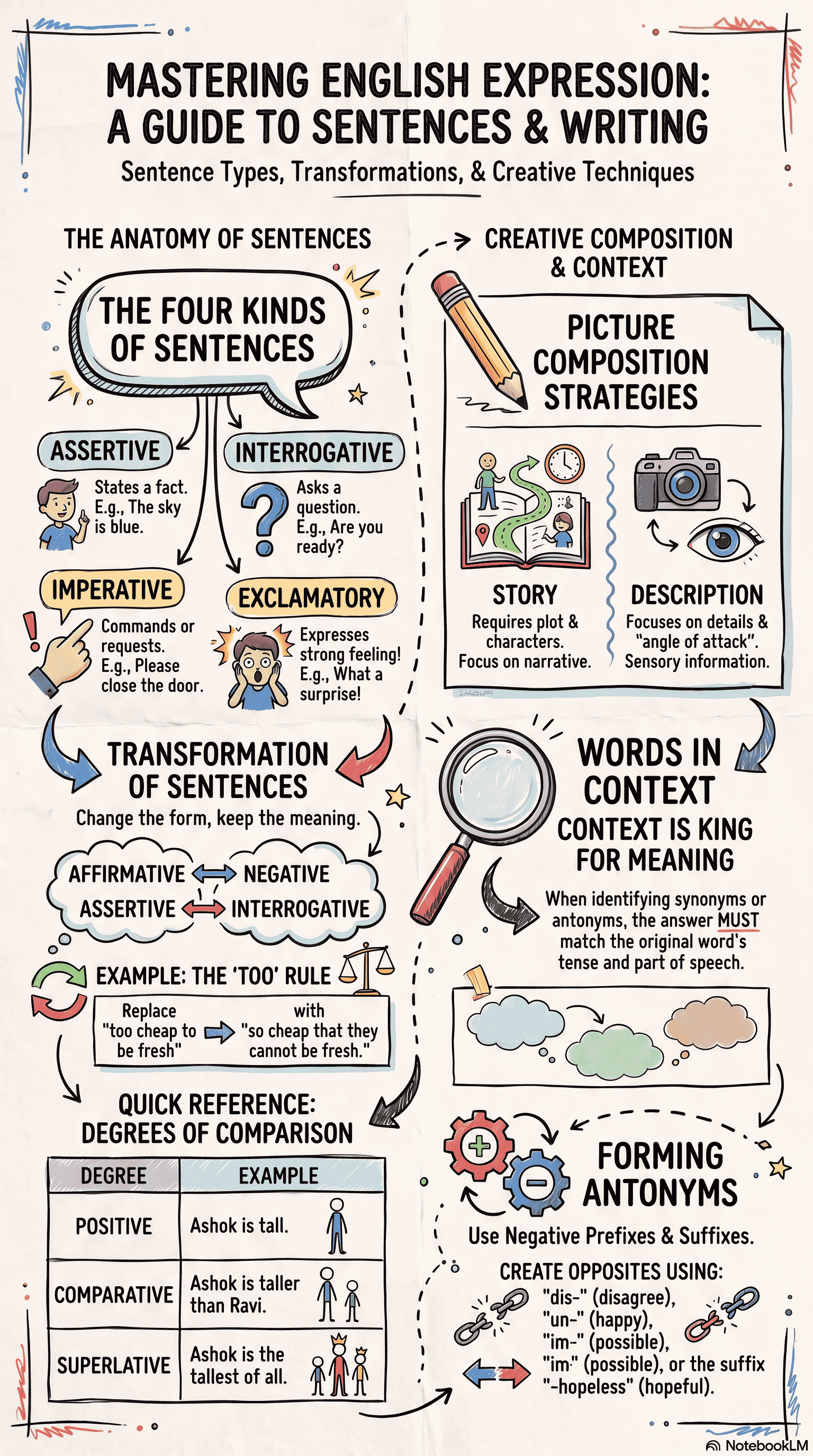
Four Kinds of Sentences:
- Declarative/Assertive: Makes a statement or assertion (can be affirmative or negative).
- Interrogative: Asks a question.
- Imperative: Expresses a command or a request.
- Exclamatory: Expresses a strong, sudden feeling. - • Using the Adverb "too": Learn how to rewrite sentences by replacing "too" with "so... that". For example, "These mangoes are too cheap to be fresh" becomes "These mangoes are so cheap that they cannot be fresh."
- • Degrees of Comparison: It is possible to change the degree (positive, comparative, superlative) of an adjective or adverb in a sentence without altering its core meaning (e.g., changing "Ashok is taller than Ravi" to "Ravi is not as tall as Ashok").
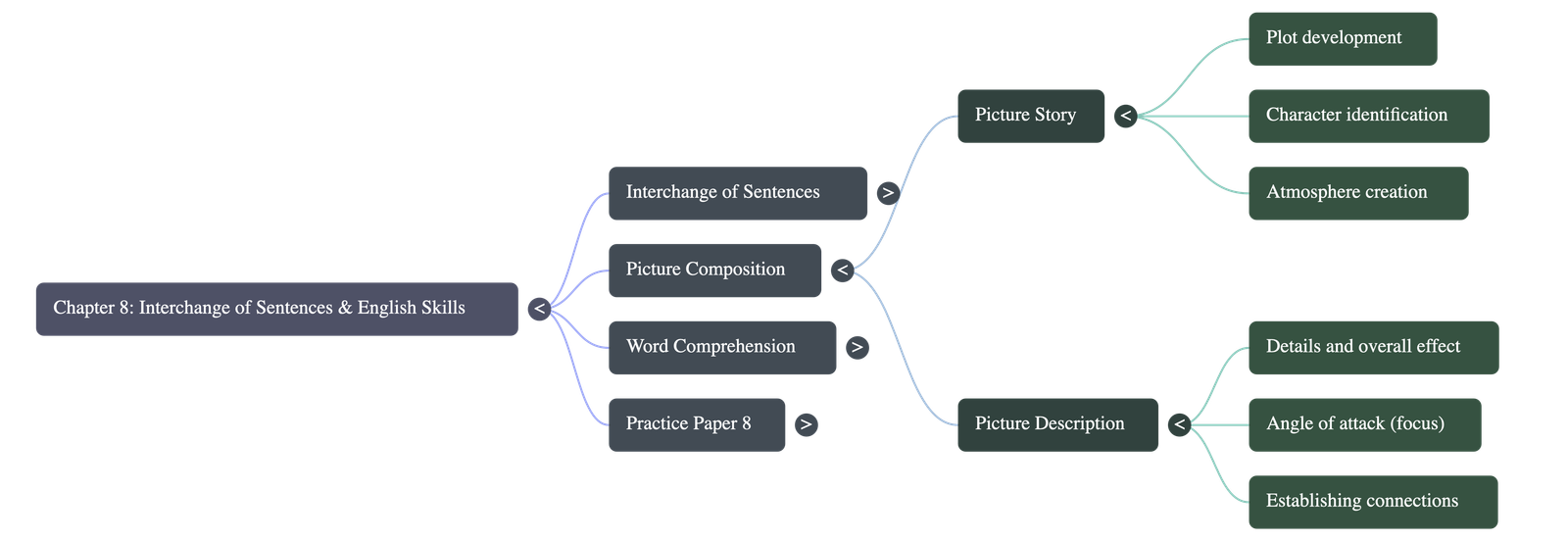
B. Picture Composition
This section provides strategies for writing a composition based on a visual stimulus, such as a picture, cartoon, or a series of pictures.
- • Writing a Picture Story: A story must have a defined plot, characters, and atmosphere. The book advises students to imagine themselves as a character in the scene to grab the reader's attention and to study facial expressions, gestures, and clothing to invent a logical sequence of events.
- • Writing a Picture Description: Focus on deciding the 'angle of attack'—either zooming in from the whole picture to a specific detail or starting with a small detail and widening the focus. Establish interesting connections between the details to build a strong descriptive essay.
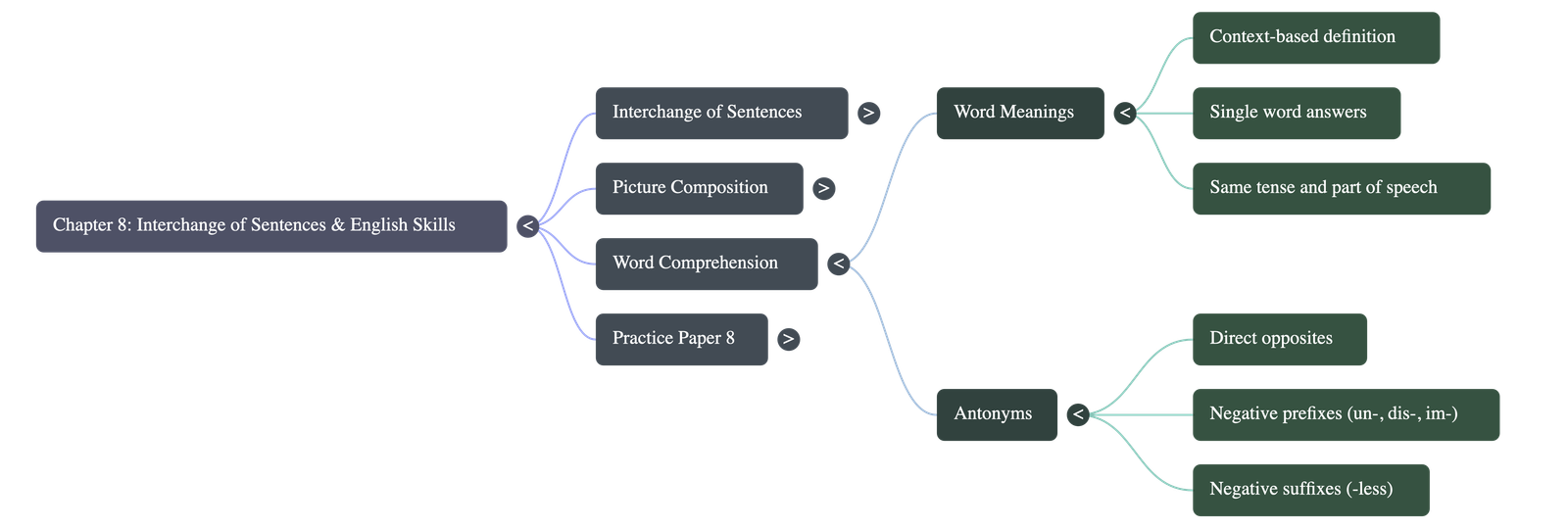
C. Comprehension - Words in Context
This section gives vital rules for answering vocabulary-based questions in comprehension passages, emphasizing that context is key.
- • Single Answers Only: Provide only one precise meaning when asked for a synonym; do not write multiple alternatives.
- • Forming Antonyms: Antonyms can be formed by using completely different words, adding negative prefixes (like dis-, il-, im-, in-, ir-, un-), or adding negative suffixes (like -less).
- • Grammatical Accuracy: A one-word substitution must fit perfectly into the sentence, which may sometimes require adding or changing a preposition.
- • Tense and Part of Speech matching: When defining a verb, the answer must be in the exact same tense as the passage. Similarly, adjectives must be answered with adjectives, not adverbs.
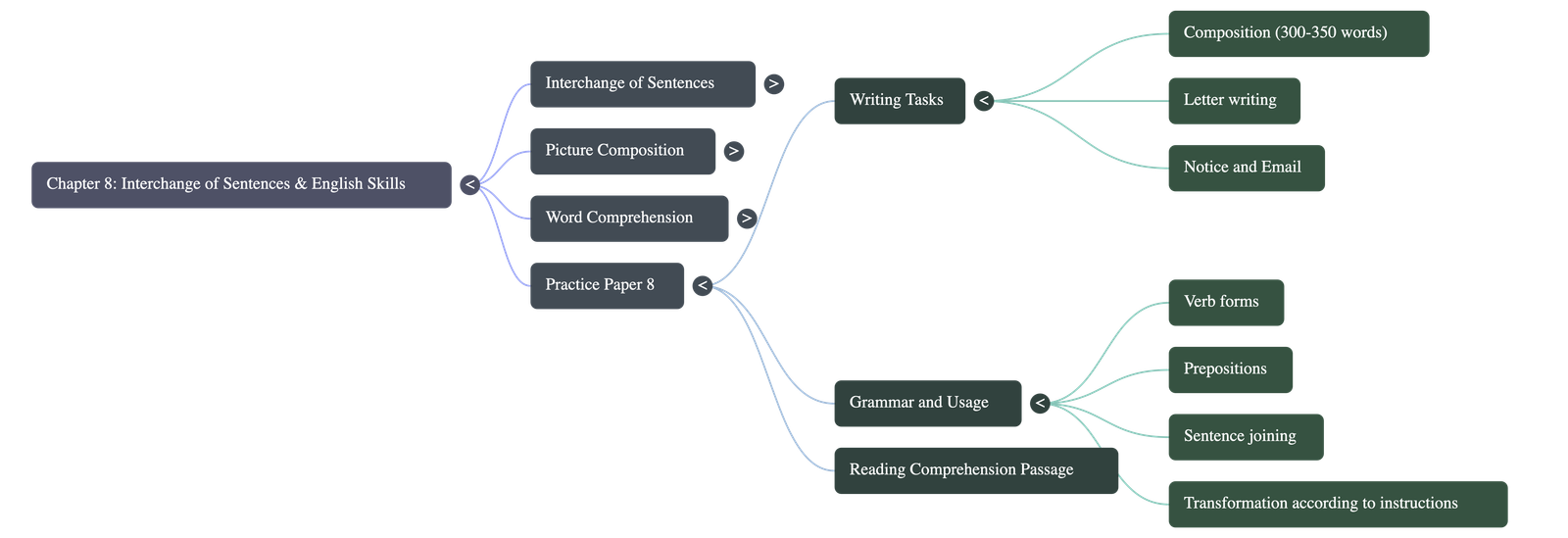
D. Practice Paper - 8
A full-length practice paper designed to test the student's writing, reading, and grammatical skills based on the ICSE exam pattern.
- • Question 1 (Composition): A 300-350 word essay writing task. Choices include an original short story, a personal narrative (waking up in a hospital), an argumentative essay on immigration, an account of an old-age home visit, and a picture composition featuring two children fishing.
- • Question 2 (Letter Writing): Options to write a formal letter to the Municipal Commissioner regarding open manholes or an informal letter to a penfriend describing a favorite family festival.
- • Question 3 (Notice and Email): Requires drafting a formal notice and an email as a Sports Secretary inviting participation and a Chief Guest for the Annual Sports Day.
- • Question 4 (Comprehension): An unseen prose passage about "Wilfrid, the Snatcher," a young man with kleptomania, and a humorous case of mistaken identity involving a silver cream jug. It includes vocabulary MCQs, short answer questions, and a 50-word summary writing task.
-
•
Question 5 (Applied Grammar): Exercises to test functional grammar, including:
- Filling in correct verb forms in a cloze passage (about an Indian Air Force comic book).
- Filling in exact prepositions/appropriate words.
- Joining pairs of sentences without using conjunctions like "and", "but", or "so".
- Rewriting sentences according to specific grammatical instructions without changing their original meaning.
Do checkout all questions & answers of this chapter.
Quick Navigation:
| | | |
1 / 1
Quick Navigation:
| | | |