Quick Navigation:
| | | |
Current Electricity
Concept of Free Electrons & Materials
- Atomic Structure: Every substance is made up of atoms containing protons, neutrons, and electrons. Inner electrons are strongly bound, while outermost electrons are weakly bound.
- Free Electrons: The weakly attracted outer electrons can detach easily. They move freely through the substance and act as charge carriers.
- Conductors: Materials like silver, copper, and aluminum have an abundance of free electrons, making them excellent conductors of electricity.
- Insulators: Materials like wood, glass, and rubber have virtually no free electrons. Charge remains localized, and they do not conduct electricity.
- Semiconductors: Materials like silicon and germanium have a moderate number of free electrons, leading to limited conductivity that can be enhanced by temperature increases or impurities.
- Superconductors: Certain materials at extremely low temperatures exhibit zero electrical resistance, allowing current to flow with no energy loss.
Electric Charge & Current
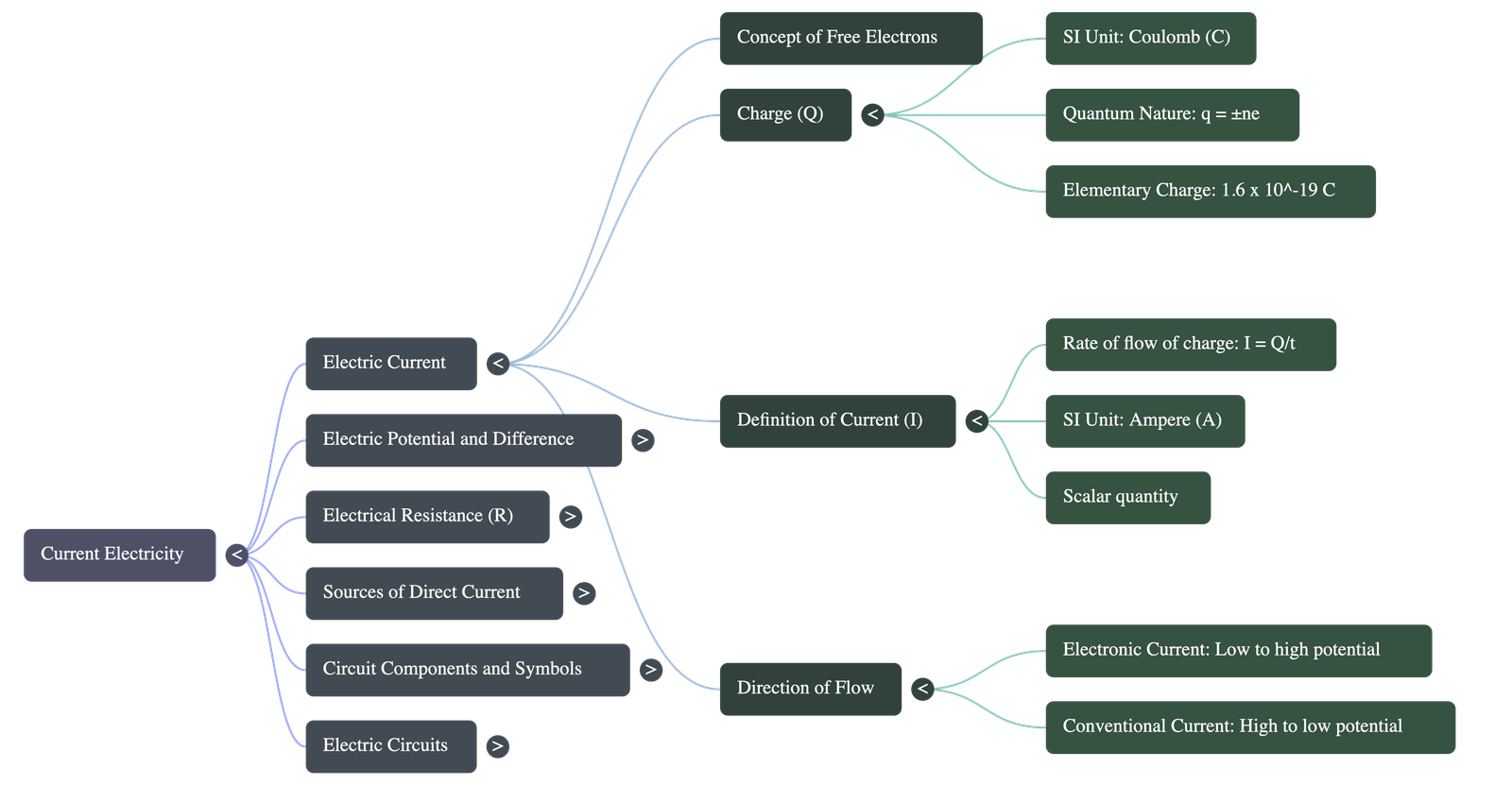
- Electric Charge: The fundamental unit is the electron's charge. Charge is measured in Coulombs (C) and is quantized, meaning it always exists as an integral multiple of the charge of an electron.
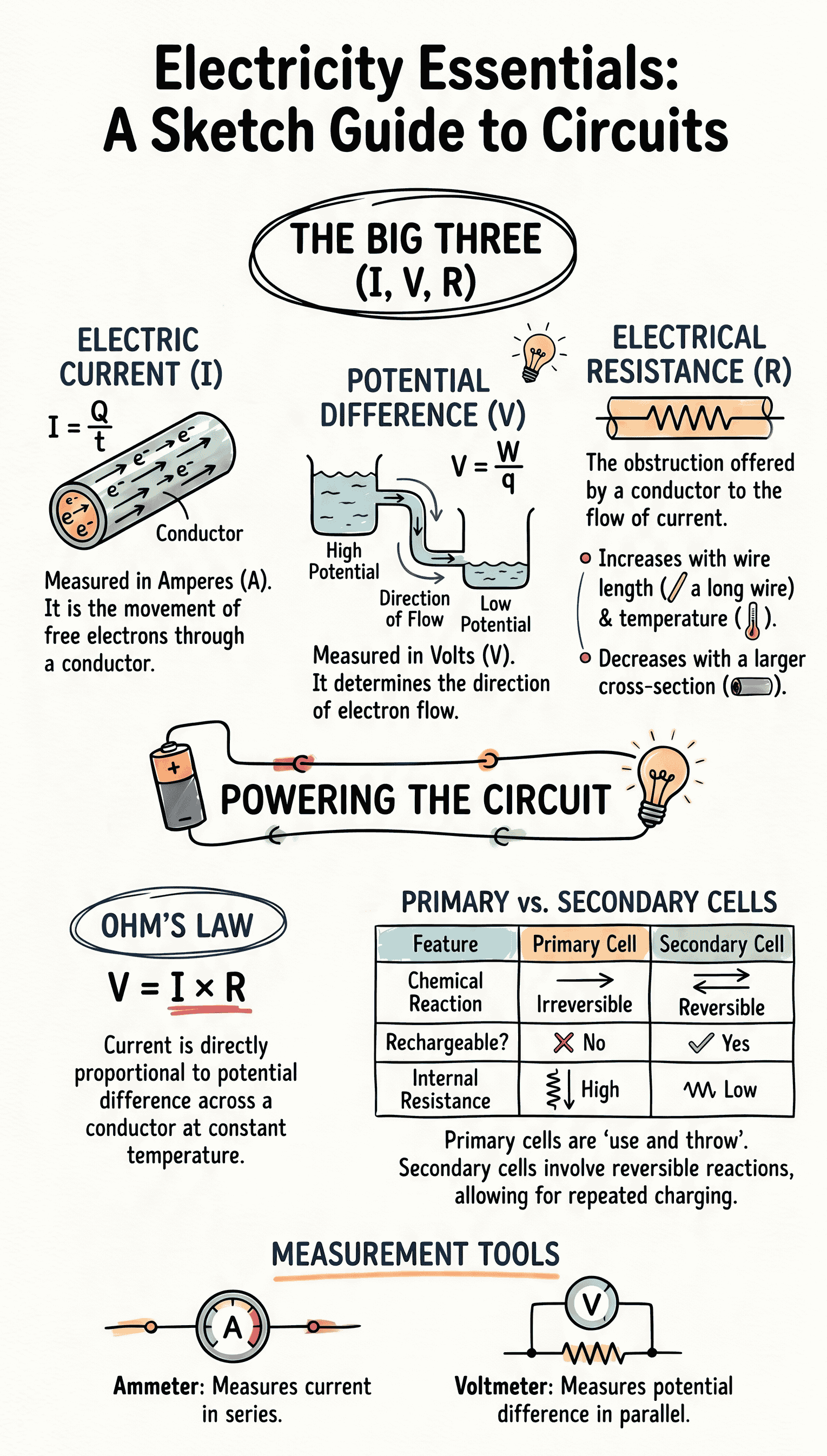
- Electric Current: Defined as the rate of flow of electric charge across a cross-section. The SI unit is the Ampere (A), which equals one Coulomb per second.
- Charge Carriers: In solid metals, current flows strictly due to the movement of electrons. In electrolytes, current flows due to the movement of both positive and negative ions.
- Direction of Flow: Electrons flow from areas of high electron concentration (negative potential) to lower concentration (positive potential).
- Conventional vs. Electronic Current: Electronic current follows the actual direction of electrons. Conventional current is taken to flow in the opposite direction, from positive to negative potential.
Potential Difference
- Concept: Just as water flows from higher to lower pressure, electric current flows due to a difference in electric potential.
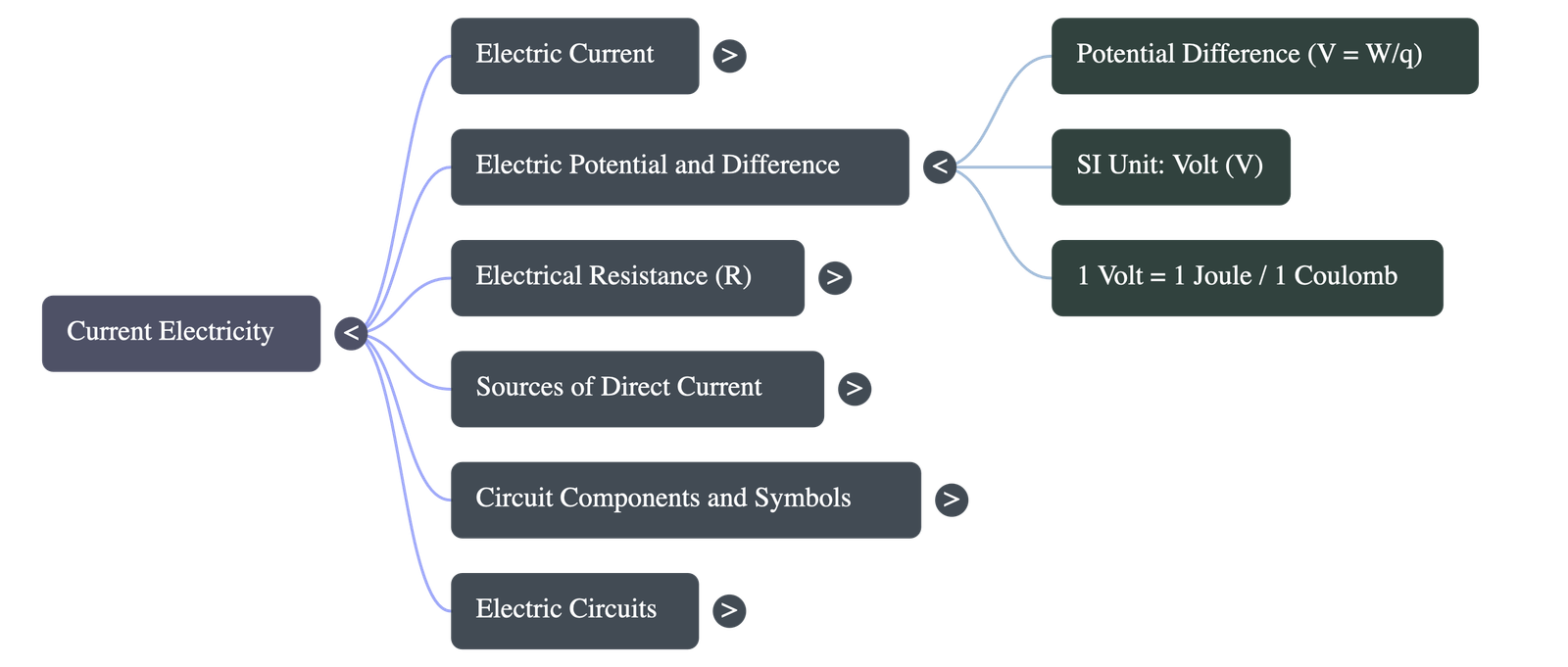
- Definition: Potential difference is the work done in transferring a unit positive charge from one conductor or point to another.
- Unit of Measurement: It is measured in Volts (V), which is equivalent to Joules per Coulomb. It is a scalar quantity.
Electrical Resistance
- Cause of Resistance: As free electrons drift through a conductor towards the positive terminal, they collide with fixed positive ions, losing speed and changing direction. This obstruction is called resistance.
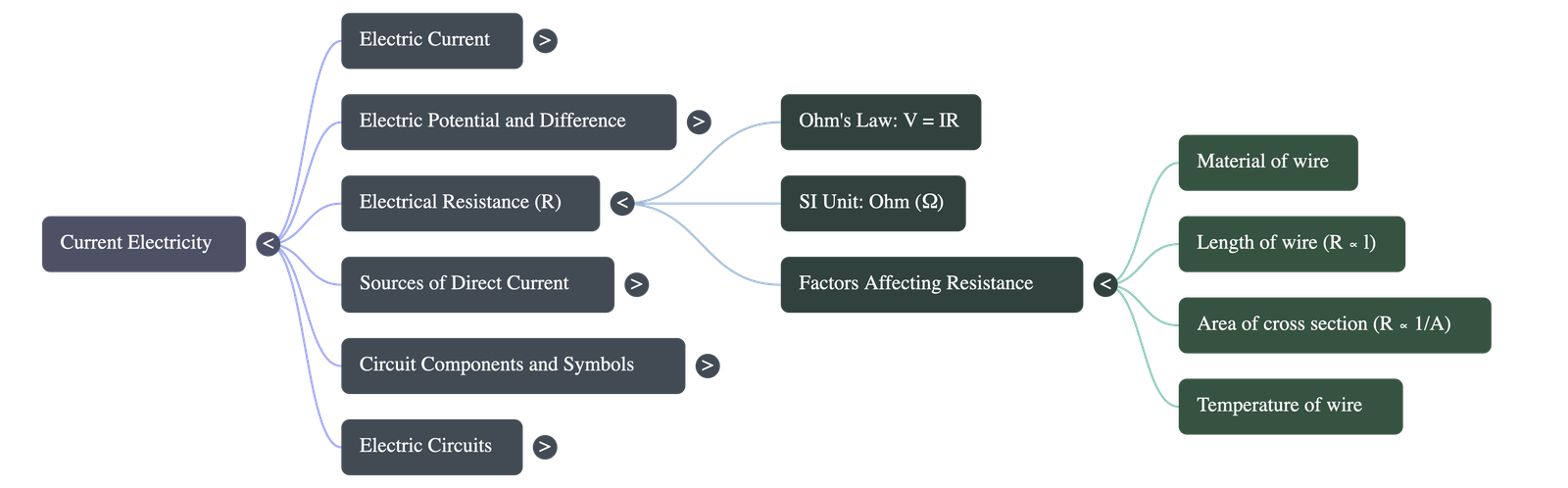
- Ohm's Law: Resistance is the ratio of potential difference across a wire to the current flowing through it. The SI unit is the Ohm.
- Factors Affecting Resistance:
- Material: Good conductors inherently offer less resistance.
- Length: Resistance is directly proportional to the length of the wire (longer wires have higher resistance).
- Cross-sectional Area: Resistance is inversely proportional to thickness (thicker wires have lower resistance).
- Temperature: In metals, an increase in temperature increases ionic vibrations, leading to more collisions and higher resistance.
Sources of Direct Current (Cells)
- Direct Current (d.c.): A current with a constant magnitude flowing in a single direction. Cells convert chemical energy into electrical energy.
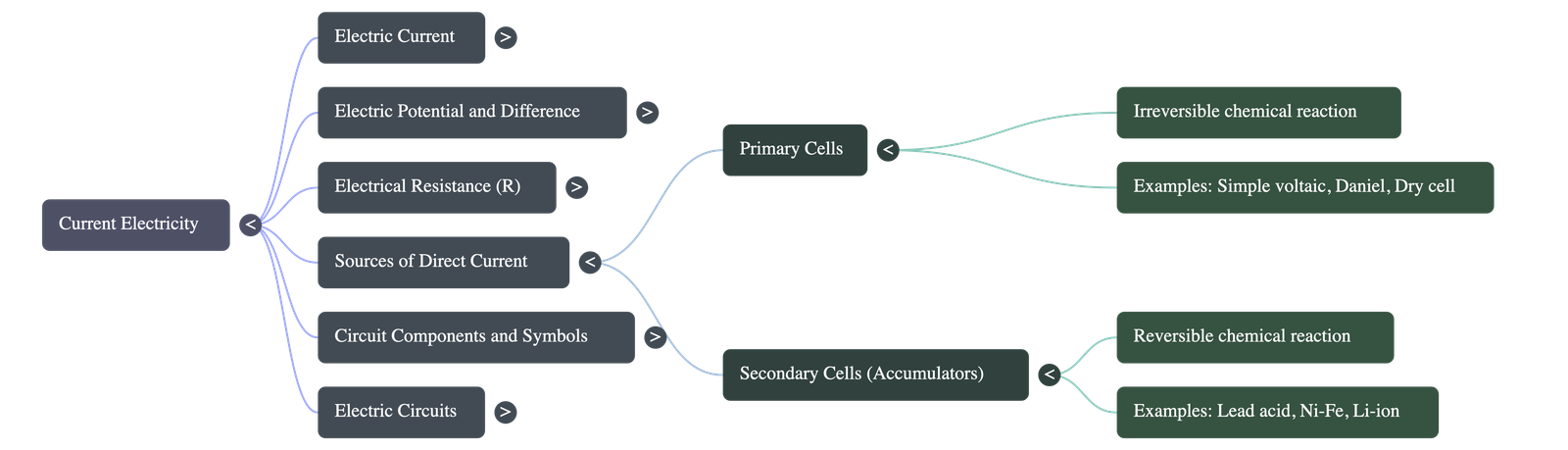
- Primary Cells: These produce current through an irreversible chemical reaction. They are "use and throw" and cannot be recharged (e.g., dry cell, simple voltaic cell).
- Secondary Cells: Also known as accumulators, these rely on a reversible chemical reaction. They can be recharged by passing a current through them and are used in vehicles, toys, and phones (e.g., lead accumulator, Ni-Fe battery).
Circuit Components and Diagrams
- Symbols: Standard symbols are used to map out circuits (e.g., long and short parallel lines for a cell, zig-zag lines for resistance).
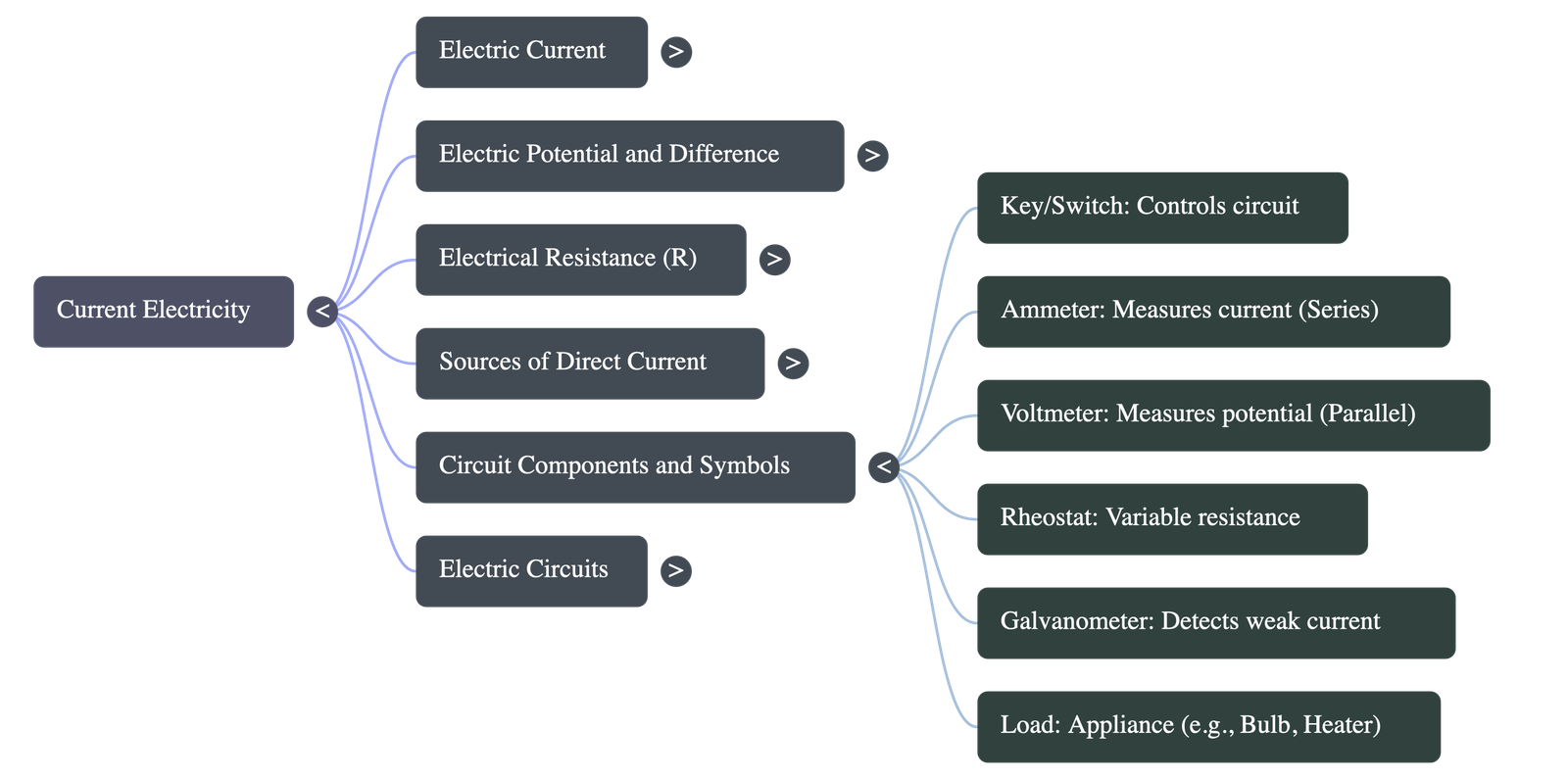
- Key/Switch: Used to start or stop the flow of current.
- Rheostat: A device providing continuously variable resistance to adjust the current magnitude in a circuit.
- Ammeter: An instrument with very low resistance used to measure the magnitude of current. It is always connected in series.
- Voltmeter: An instrument with very high resistance used to measure potential difference. It is always connected in parallel.
- Galvanometer: Detects the presence and direction of a weak current in a circuit.
Electric Circuits
- Simple Circuit: A basic setup comprising a source of current (cell), a load (like a bulb), and a key connected by conductive wires.
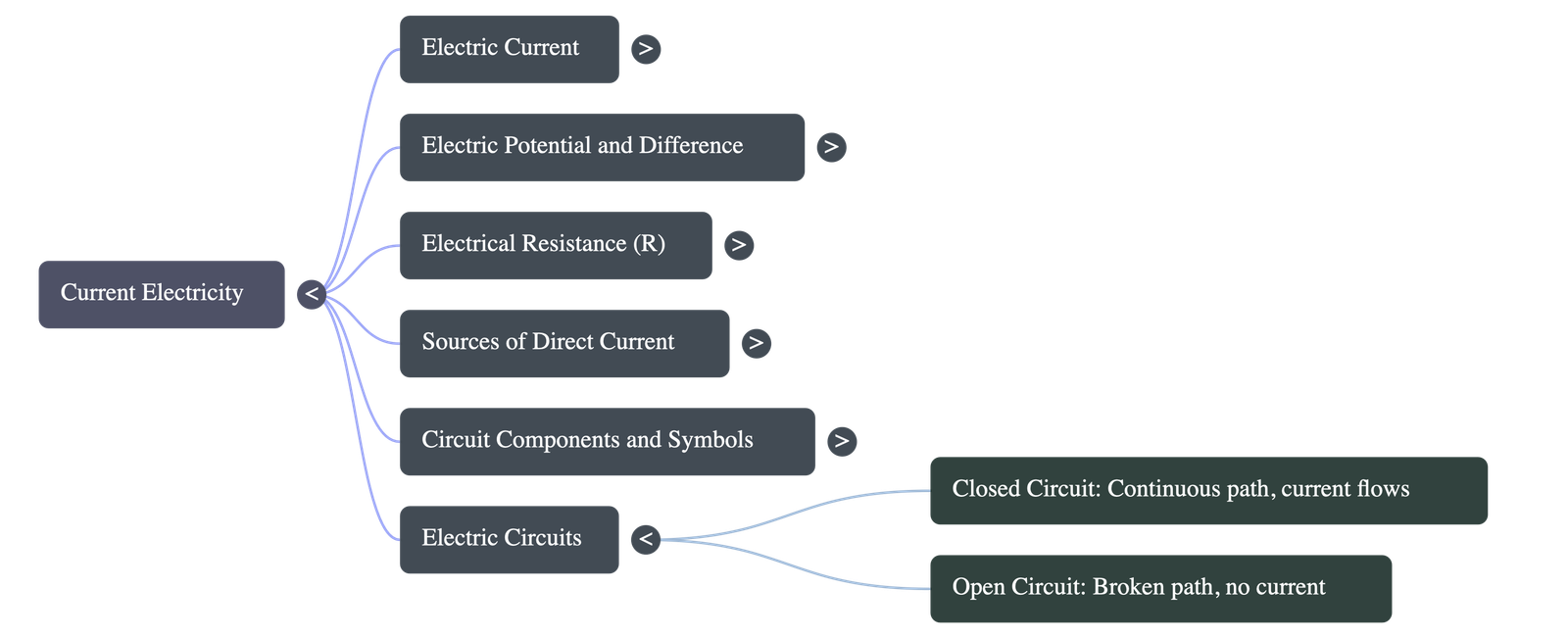
- Closed Circuit: When the path is continuous and the key is plugged in, the circuit is complete, and current flows successfully.
- Open Circuit: If the path is broken (due to an open switch or broken wire), it becomes an incomplete circuit, and current cannot flow.
Do checkout all questions & answers of this chapter.
Quick Navigation:
| | | |
1 / 1
Quick Navigation:
| | | |