Quick Navigation:
| | | |
Propagation of Sound Waves
1. Wave Motion and Its Characteristics
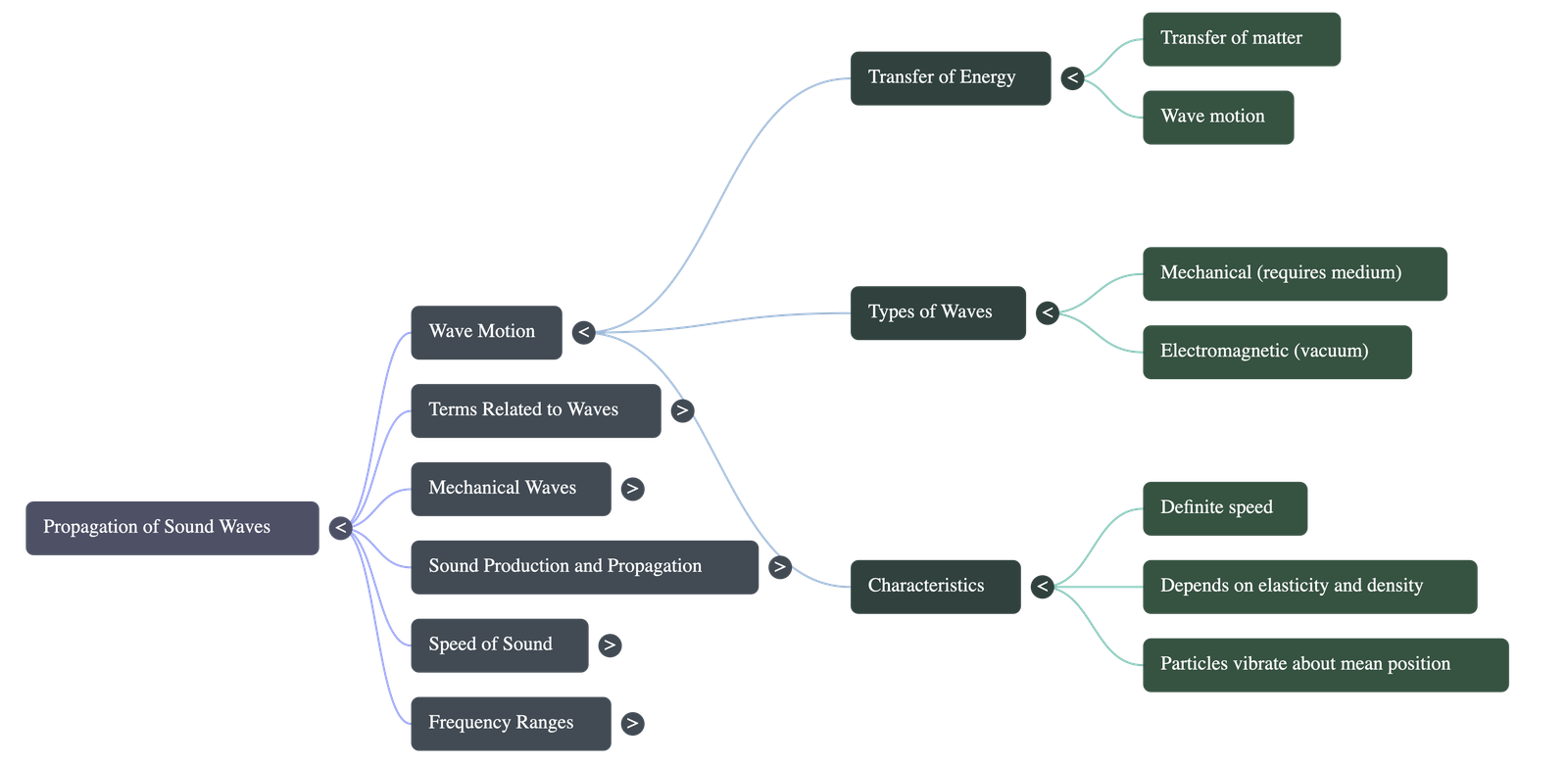
- Concept of Wave Motion: Energy is transferred from one place to another without the physical transfer of matter. The medium's particles simply vibrate around their mean positions.
- Mechanical vs. Electromagnetic Waves: Mechanical waves (like sound and water ripples) require a material medium to propagate. Electromagnetic waves (like light and X-rays) can travel through a vacuum.
- Key Characteristics: The disturbance travels at a constant speed determined by the medium's elasticity and density. Each particle performs simple harmonic motion with a specific time period, and energy is passed from one particle to the next.
2. Key Terminology
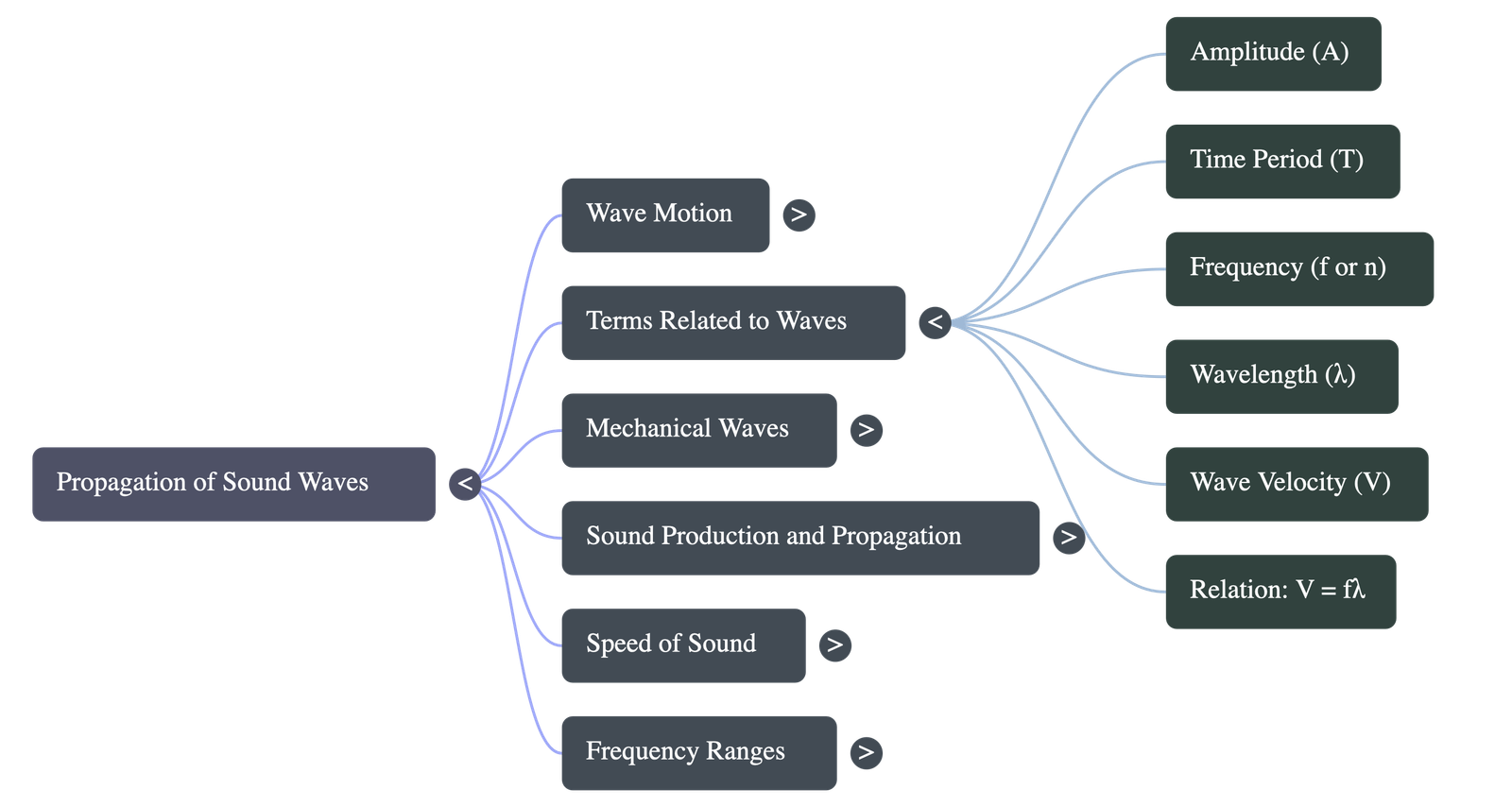
- Amplitude (a): The maximum displacement of a medium's particle from its mean position. S.I. unit is the metre (m).
- Time Period (T): The time taken by a particle to complete one full vibration. S.I. unit is the second (s).
- Frequency (f or ν): The number of vibrations made per second. S.I. unit is Hertz (Hz) or s⁻¹. Frequency and Time Period are related by the formula: f = 1 / T.
- Wavelength (λ): The distance travelled by a wave in the time it takes for one vibration. It is the distance between two consecutive crests/troughs or compressions/rarefactions.
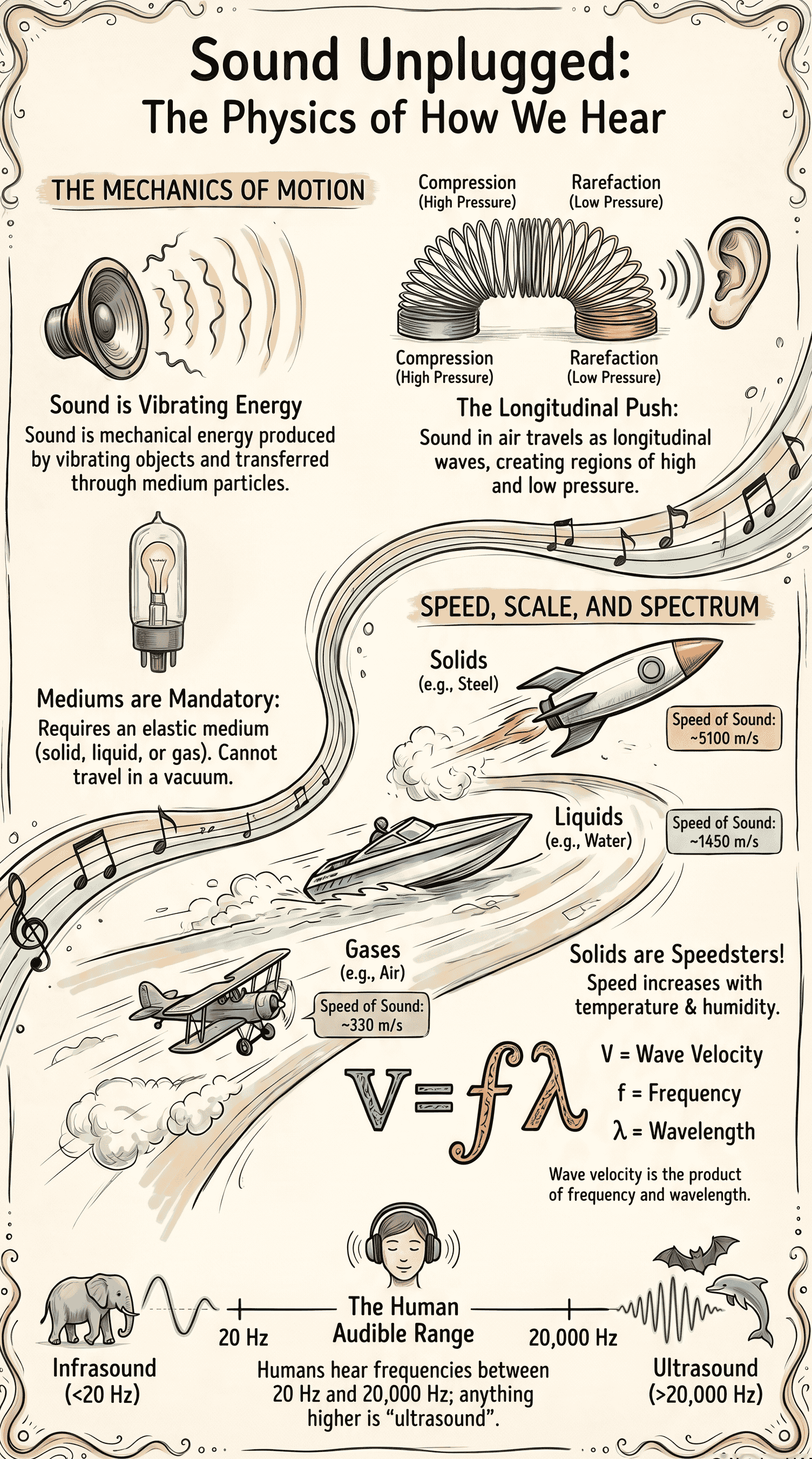
- Wave Velocity (V): The distance a wave travels in one second. It is given by the relation: V = f × λ.
3. Types of Mechanical Waves
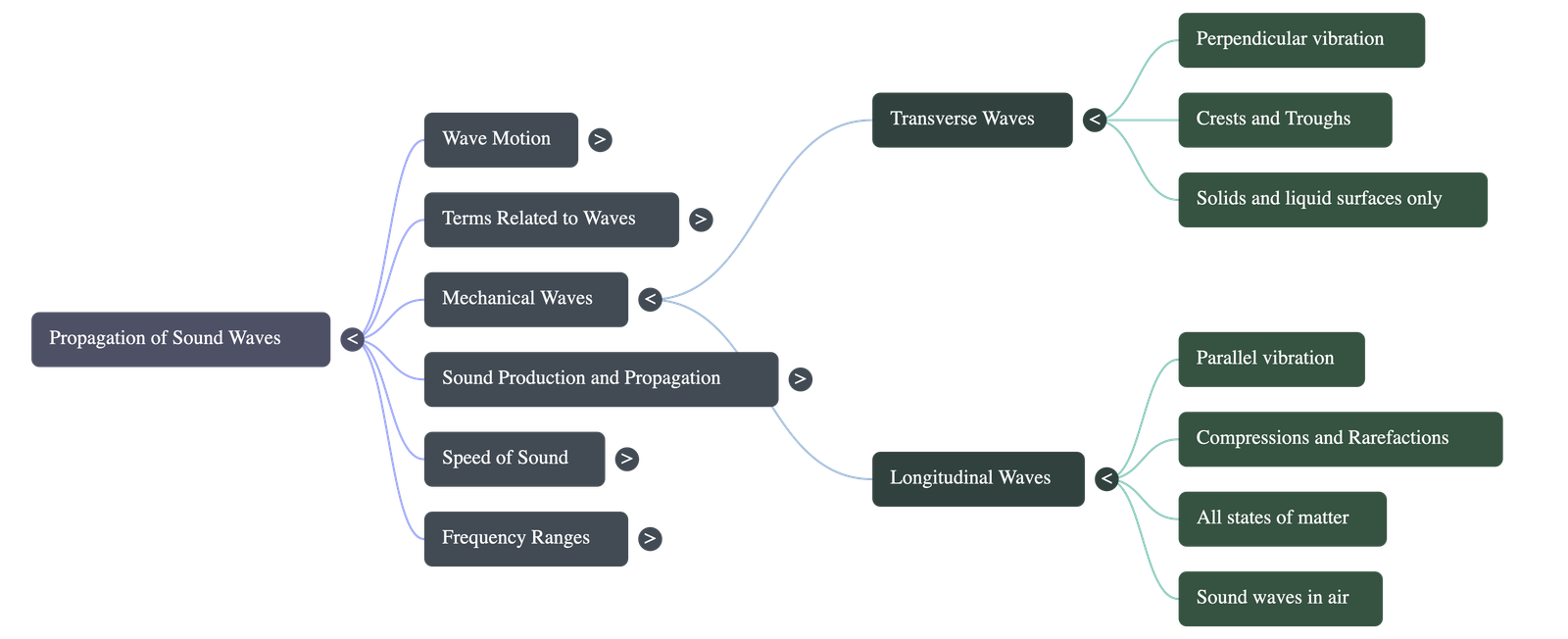
- Transverse Waves: Particles vibrate in a direction perpendicular to the wave's propagation. They form crests (maximum upward displacement) and troughs (maximum downward displacement). They can only travel through solids and on the surface of liquids.
- Longitudinal Waves: Particles vibrate in the same direction as the wave's propagation. They propagate via compressions (high pressure/density regions) and rarefactions (low pressure/density regions). Sound travels through air in this form. These waves can be produced in solids, liquids, and gases.
4. Production and Requisites for Sound
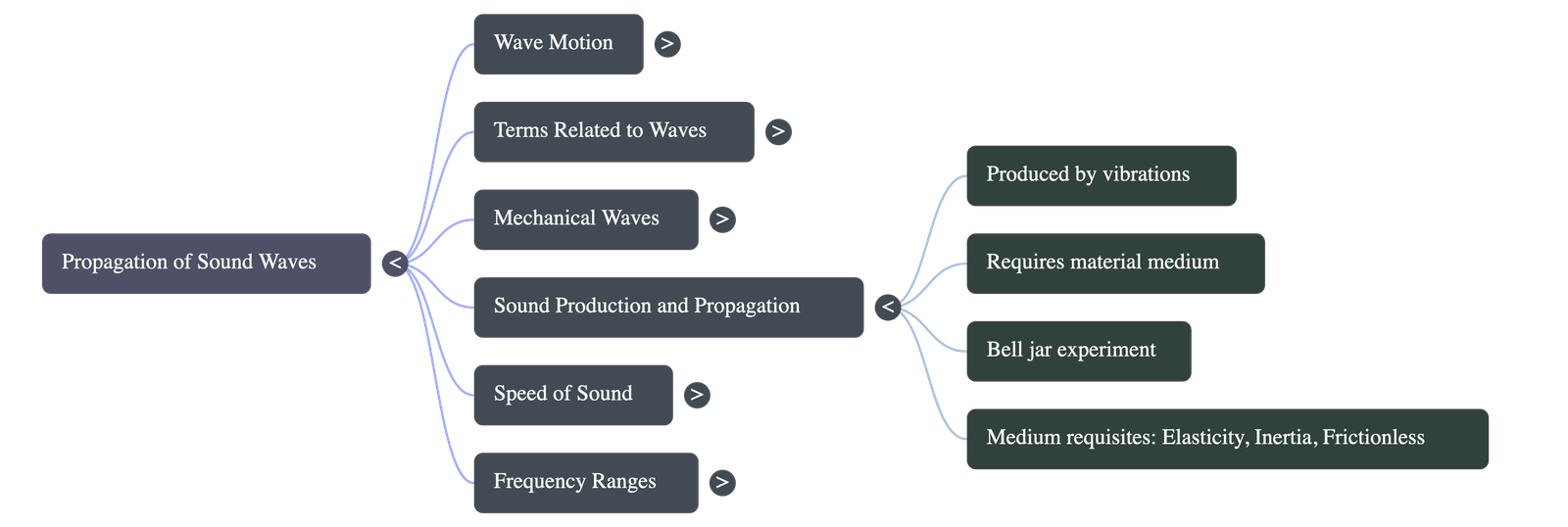
- Vibration: Sound is produced strictly by vibrating bodies (e.g., vocal cords, tuning forks, drums) and causes a sensation of hearing in our ears.
- Need for a Medium: Sound strictly requires a material medium to travel and cannot travel in a vacuum. This is proven by the Bell Jar experiment, where sound fades as air is pumped out of a sealed jar.
- Properties of the Medium: The propagation medium must be elastic (particles return to original positions), possess inertia (store mechanical energy), and be largely frictionless (so energy isn't easily lost).
5. Speed of Sound and Affecting Factors
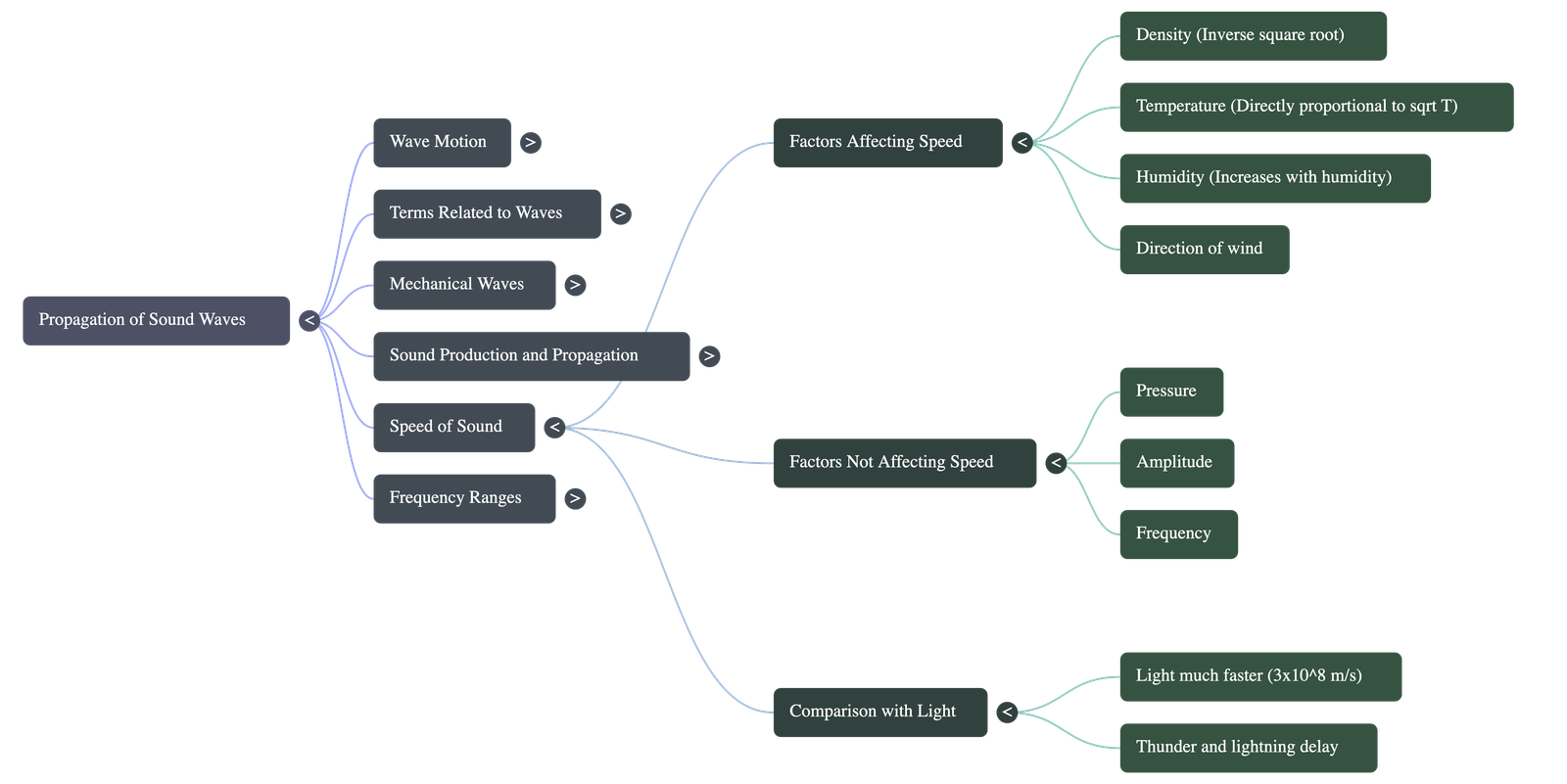
- Basic Speed Rules: Sound travels fastest in solids (e.g., steel ~5100 m/s), slower in liquids (e.g., water ~1450 m/s), and slowest in gases (e.g., air ~330 m/s at 0°C).
- Temperature Effect: Speed increases with temperature. In air, the speed of sound increases by roughly 0.61 m/s for every 1°C rise in temperature.
- Density Effect: Speed is inversely proportional to the square root of the gas's density. The lower the density, the faster the sound.
- Humidity Effect: Moist air is less dense than dry air, so sound travels faster in humid conditions.
- Wind Effect: Wind blowing in the direction of the sound increases its speed, while wind blowing in the opposite direction decreases it.
- Factors with NO Effect: Changes in gas pressure, the amplitude of the wave, and the wave's frequency/wavelength do not alter the speed of sound in a given gaseous medium.
6. Speed of Sound vs. Light
- Light travels at approximately 3 × 10⁸ m/s, which is about a million times faster than sound in air.
- Because of this massive difference, in phenomena like a thunderstorm, we see the lightning flash almost instantaneously, but hear the thunder a few seconds later. Similar effects are observed when viewing a distant starting gun or fireworks.
7. Audible, Infrasonic, and Ultrasonic Frequencies
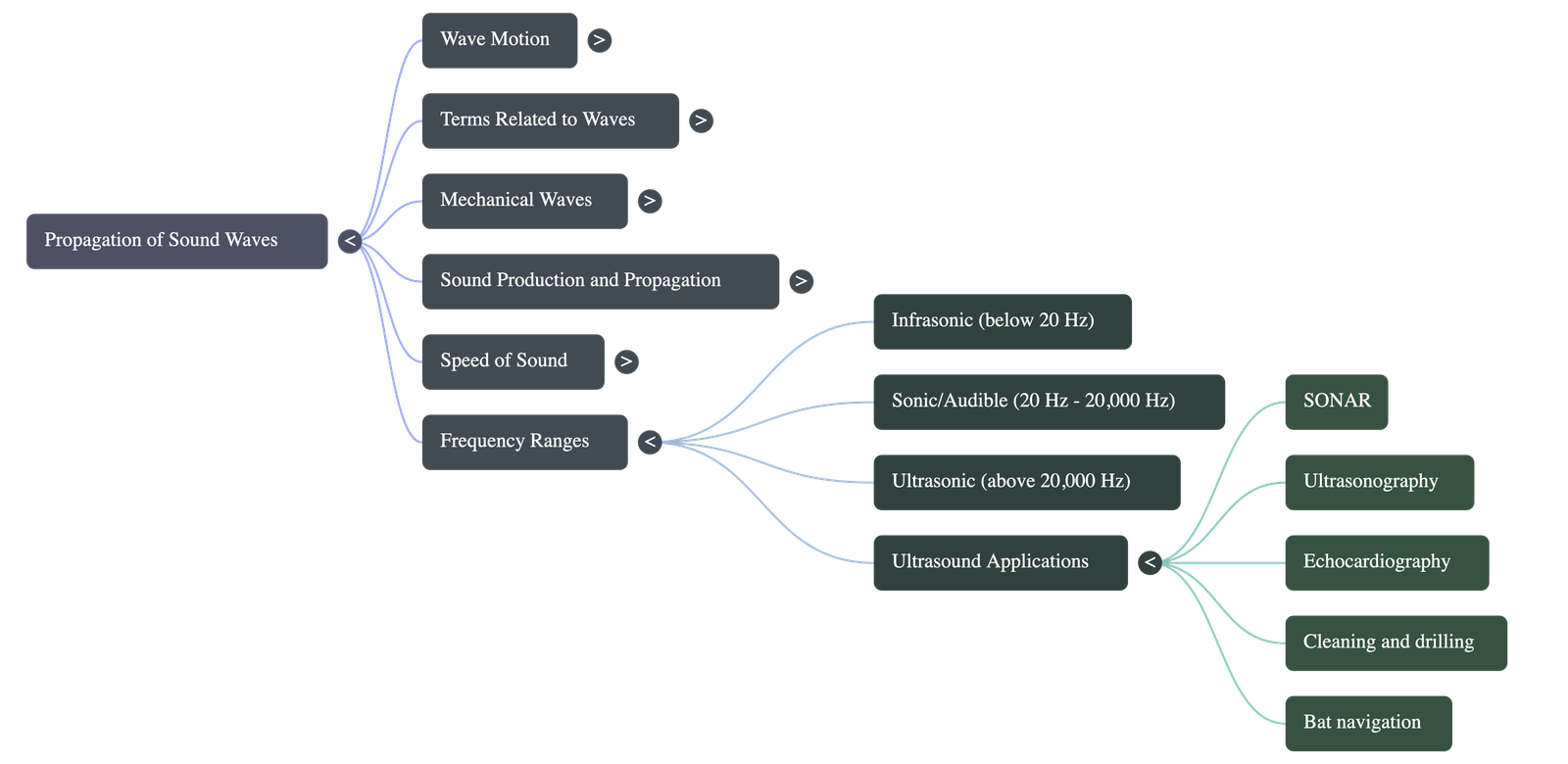
- Audible Range (Sonic): The human ear can typically hear frequencies between 20 Hz and 20,000 Hz (20 kHz). The highest sensitivity is in the 2000 Hz to 3000 Hz range.
- Infrasonic: Sound waves with frequencies below 20 Hz. These cannot be heard by humans but are produced and heard by animals like elephants, whales, and certain fish.
- Ultrasonic: Sound waves with frequencies above 20,000 Hz. Animals like bats, dolphins, and dogs can produce and detect these high frequencies.
- Terminology Check: 'Ultrasonic' and 'Infrasonic' refer to frequency. 'Supersonic' and 'Subsonic' refer to an object's speed compared to the speed of sound (e.g., Concorde jets are supersonic).
8. Applications of Ultrasound
- Properties: Ultrasound carries very high energy and travels along well-defined straight paths (high directivity) without bending around small obstacles.
- Echolocation: Bats use it to avoid obstacles and catch prey in the dark by interpreting reflected ultrasound waves.
- Industrial Uses: Used for drilling precise holes in glass, cleaning delicate electronic and watch components via high-frequency vibrations in a solution, and detecting hidden flaws/cracks in metal blocks.
- Medical Uses: Vital for non-invasive imaging like Ultrasonography (imaging liver, gallbladder, womb) and Echocardiography (heart imaging). It is also used surgically to break down kidney stones and cataracts into fine grains.
- SONAR: Utilizes ultrasound for Sound Navigation and Ranging to measure the depth of the sea and detect underwater objects.
Do checkout all questions & answers of this chapter.
Quick Navigation:
| | | |
1 / 1
Quick Navigation:
| | | |