Quick Navigation:
| | | |
Magnetism
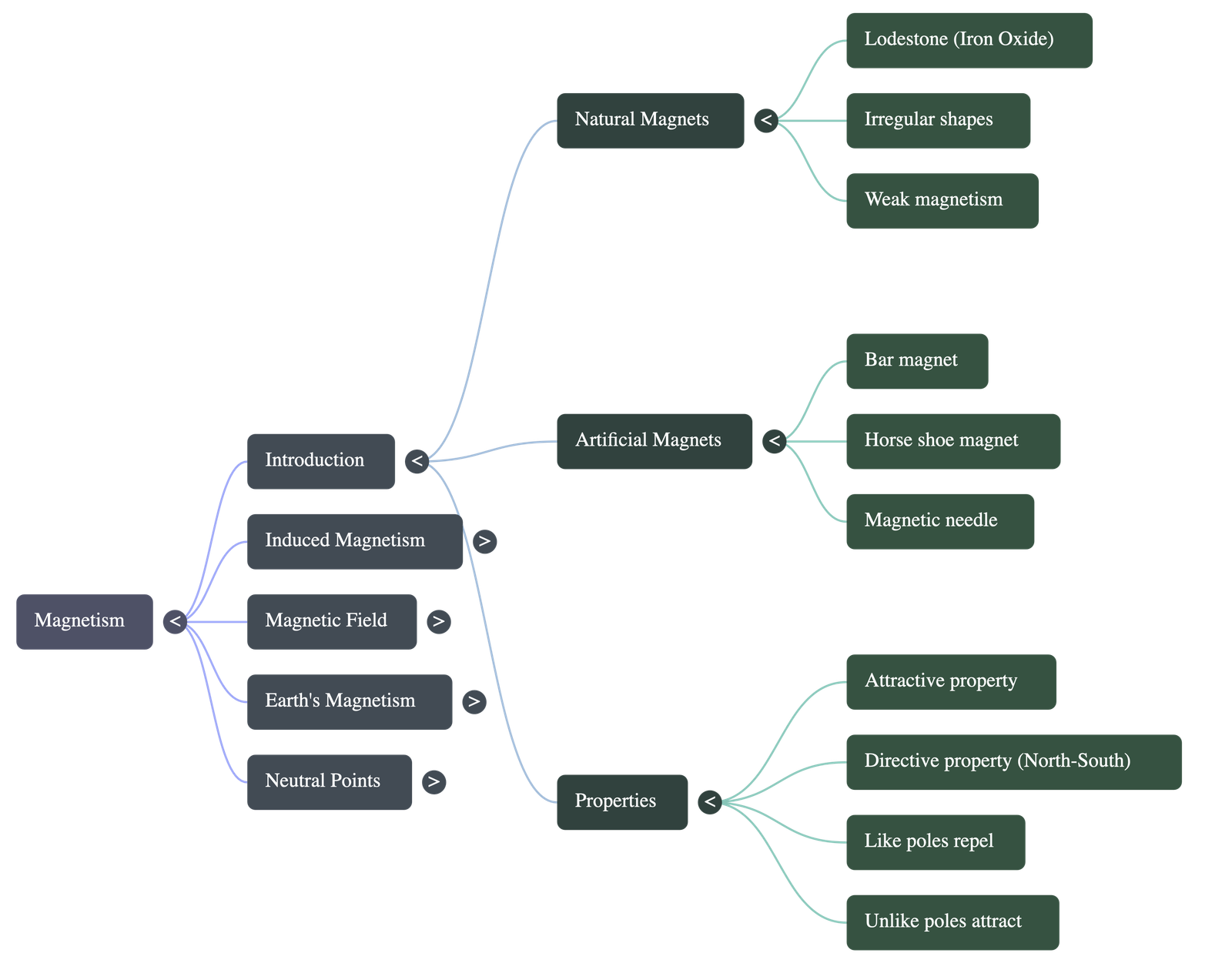
1. Introduction to Magnets
- The earliest known magnets were pieces of lodestone, an ore of iron oxide found naturally. These natural magnets are irregular in shape and possess weak magnetic strength.
- Artificial magnets (like bar magnets, horseshoe magnets, and magnetic needles) are manufactured from iron into various convenient shapes and sizes for practical applications.
- A freely suspended magnet aligns itself in the geographic north-south direction.
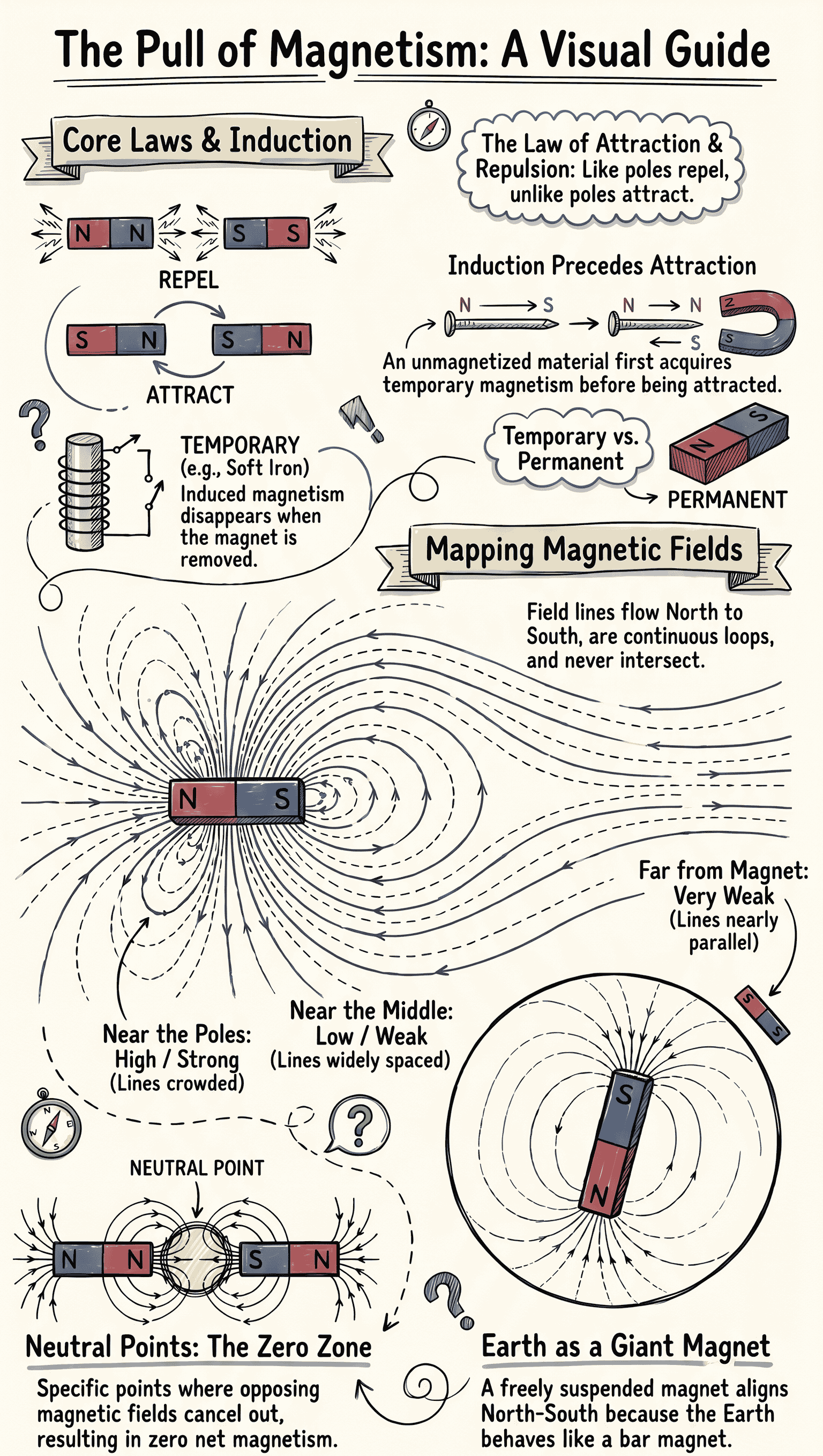
- Basic rule of magnetism: Like poles (North-North or South-South) repel each other, while unlike poles (North-South) attract each other.
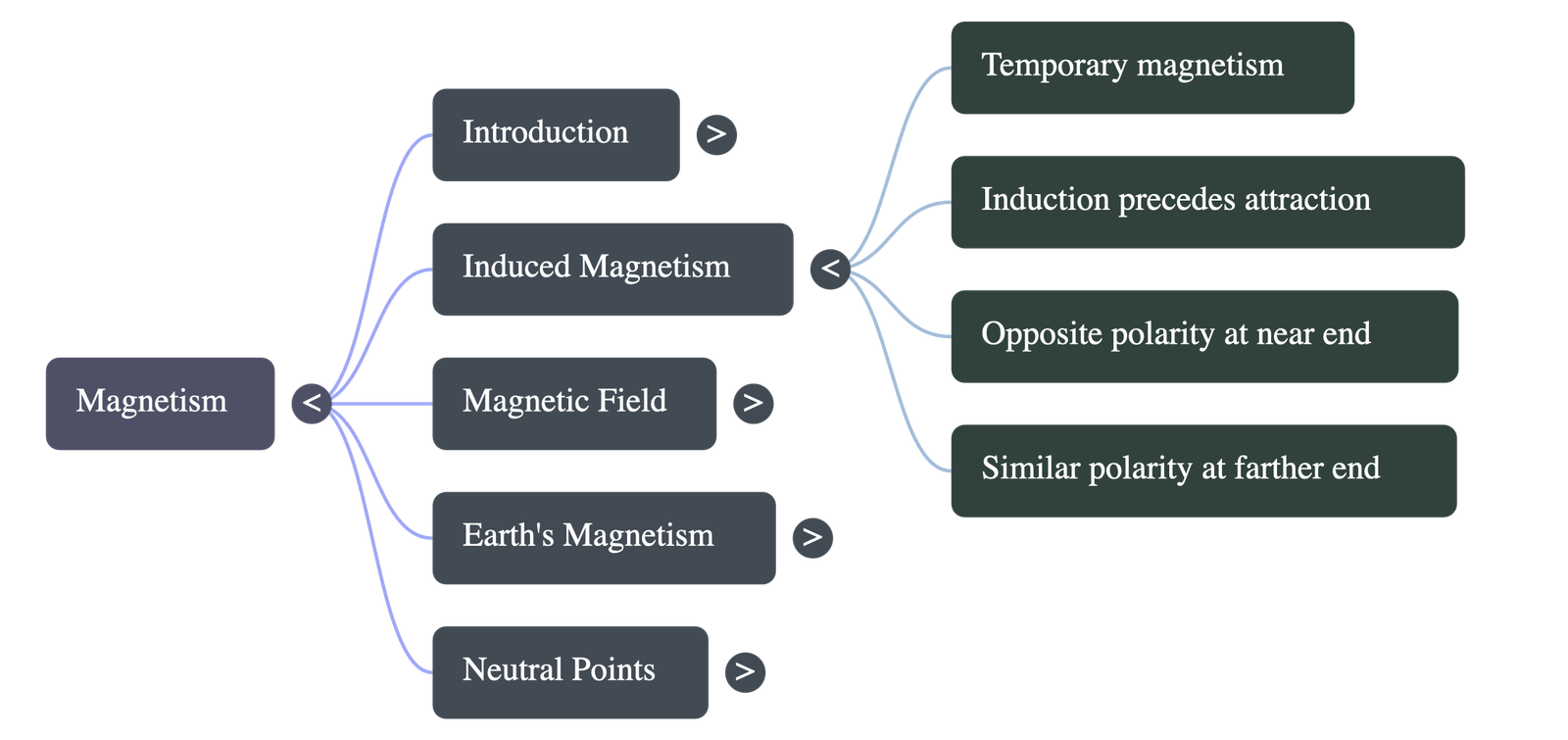
2. Induced Magnetism
- Magnetic Induction: The process by which an unmagnetised magnetic material (like soft iron or steel) temporarily acquires magnetic properties when placed near or in contact with a magnet.
- During induction, the inducing magnet creates an opposite polarity on the near end of the magnetic material and a similar polarity on the farther end.
- Induction precedes attraction: A piece of ordinary iron is first magnetized by induction (creating opposite poles that attract), which explains why magnets attract unmagnetised iron pieces.
- Induced magnetism is purely temporary. The material loses its magnetism as soon as the inducing magnet is removed.
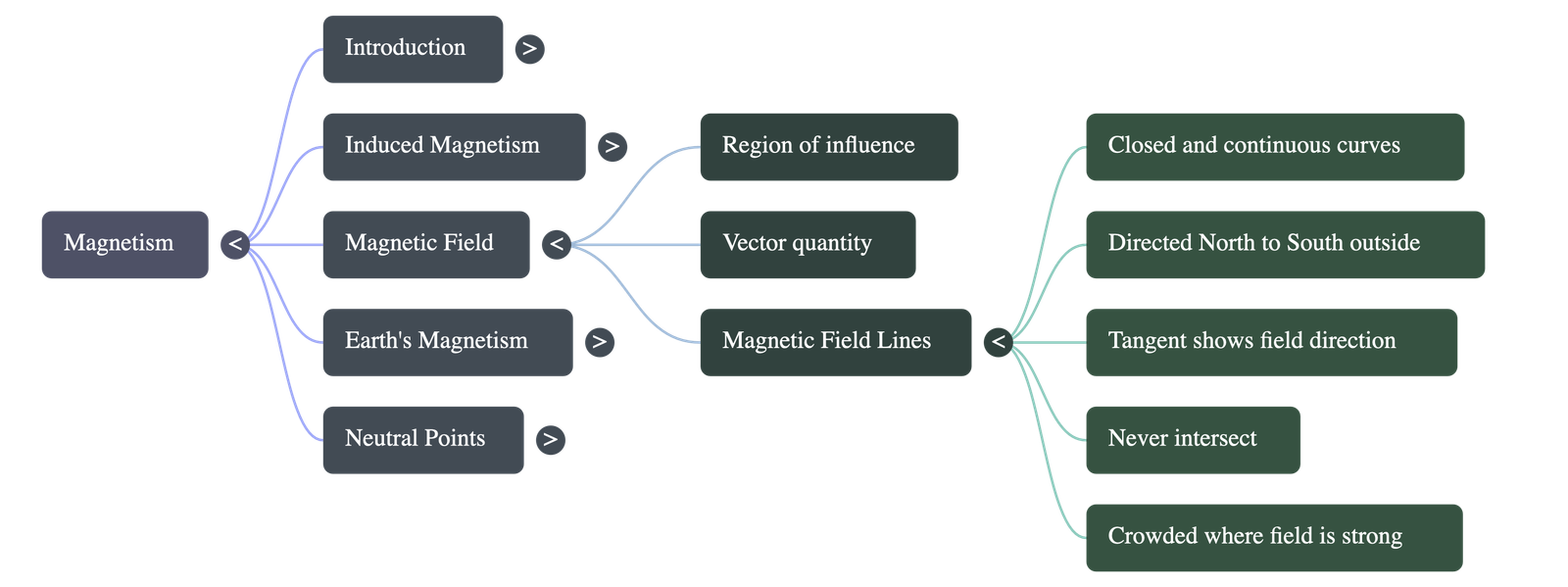
3. Magnetic Field and Field Lines
- The magnetic field is the space around a magnet in which a compass needle rests in a direction other than the standard geographic north-south. It is a vector quantity, meaning it has both magnitude and direction.
- A magnetic field line is a continuous curve showing the path along which a compass needle aligns. The tangent at any point on the curve gives the direction of the magnetic field at that point.
- Properties of Magnetic Field Lines:
- They form closed and continuous curves.
- Outside the magnet, they are directed from the North Pole towards the South Pole.
- Two field lines never intersect. If they did, it would imply two different directions of the magnetic field at a single point, which is impossible.
- Lines are crowded near the poles (indicating a strong magnetic field) and spread further apart near the middle (indicating a weaker field).
- Parallel and equidistant field lines represent a uniform magnetic field (e.g., Earth's magnetic field in a limited space).
- They behave like stretched elastic rubber strings.
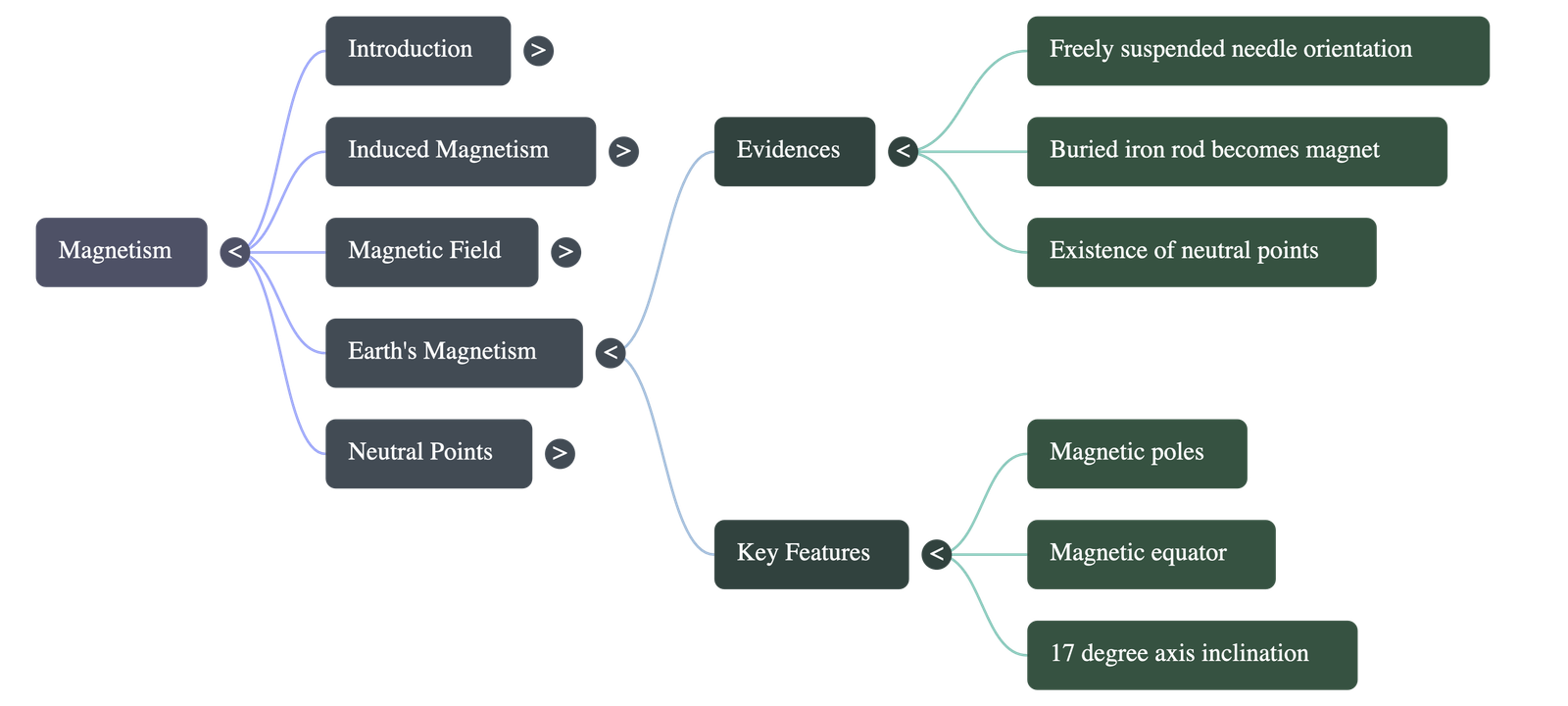
4. Magnetic Field of the Earth
- The Earth behaves like a giant bar magnet. Evidence for this includes: freely suspended magnets pointing north-south, buried iron rods becoming weak magnets over time, and the existence of neutral points.
- The Earth's magnetic South pole is located near the geographic North pole, and its magnetic North pole is near the geographic South pole.
- The Earth's magnetic axis is slightly tilted, making an angle of about 17° with its axis of rotation.
- A magnetic needle becomes completely vertical at the Earth's magnetic poles and horizontal at the magnetic equator.
- In a limited area, the Earth's magnetic field is uniform. The field lines are parallel, equidistant, and directed from geographic South to geographic North.
5. Plotting Fields and Neutral Points
- Magnetic fields around artificial magnets (like bar and horseshoe magnets) are non-uniform, featuring curved, converging, or diverging lines.
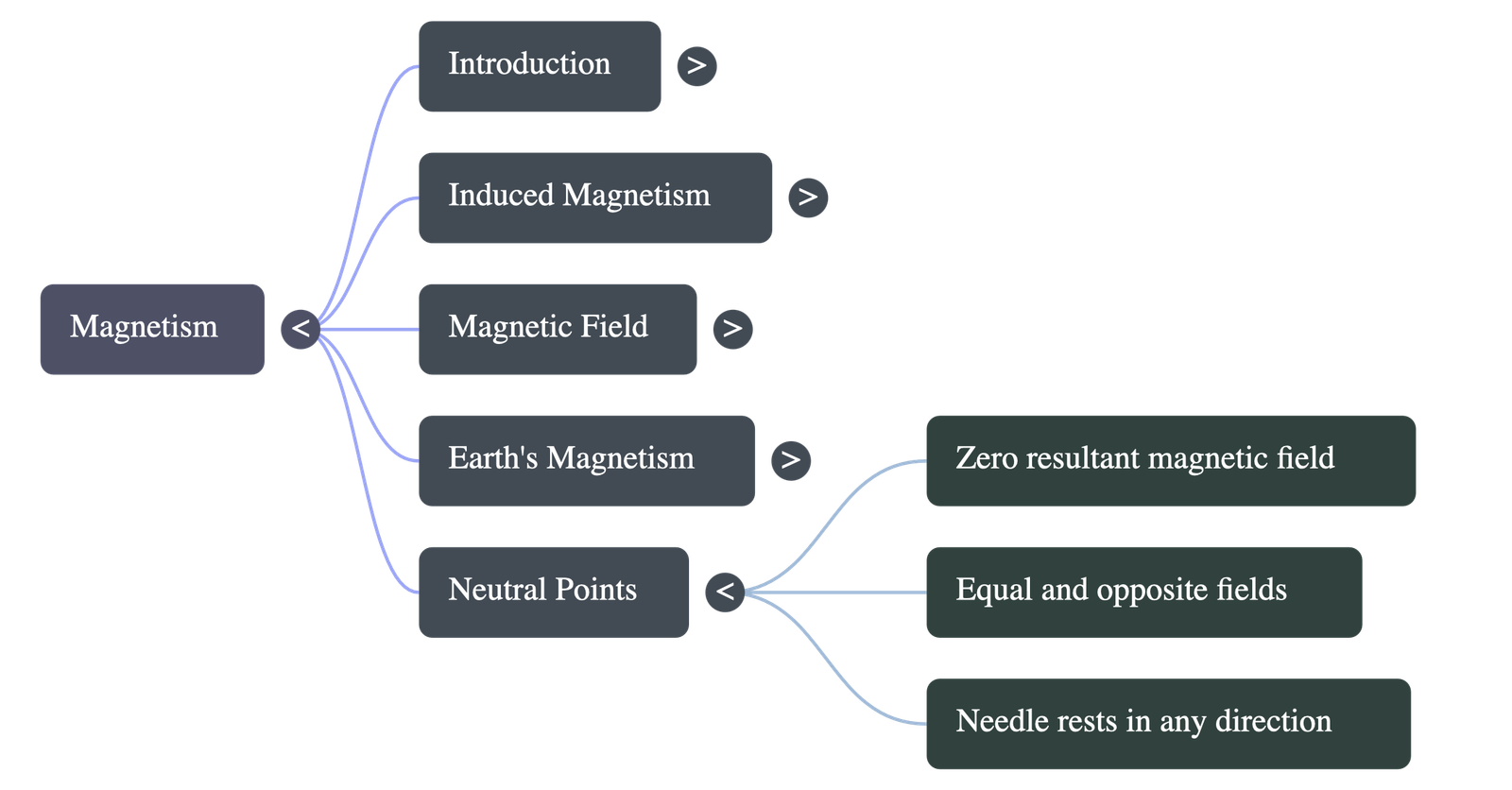
- Neutral Points are specific locations where two magnetic fields (usually the field of a magnet and the Earth's magnetic field) are equal in magnitude but opposite in direction. The net magnetic field at these points is zero.
- A compass placed at a neutral point remains unaffected and can rest in any direction.
- Positions of Neutral Points:
- When a bar magnet is placed with its North pole pointing towards geographic North, two neutral points are located on either side of the magnet in the east and west directions.
- When a bar magnet is placed with its South pole pointing towards geographic North, two neutral points are located along the axis of the magnet in the north and south directions.
Do checkout all questions & answers of this chapter.
Quick Navigation:
| | | |
1 / 1
Quick Navigation:
| | | |