Quick Navigation:
| | | |
Measurements and Experimentation
A. Systems of Unit and Units in S.I. System
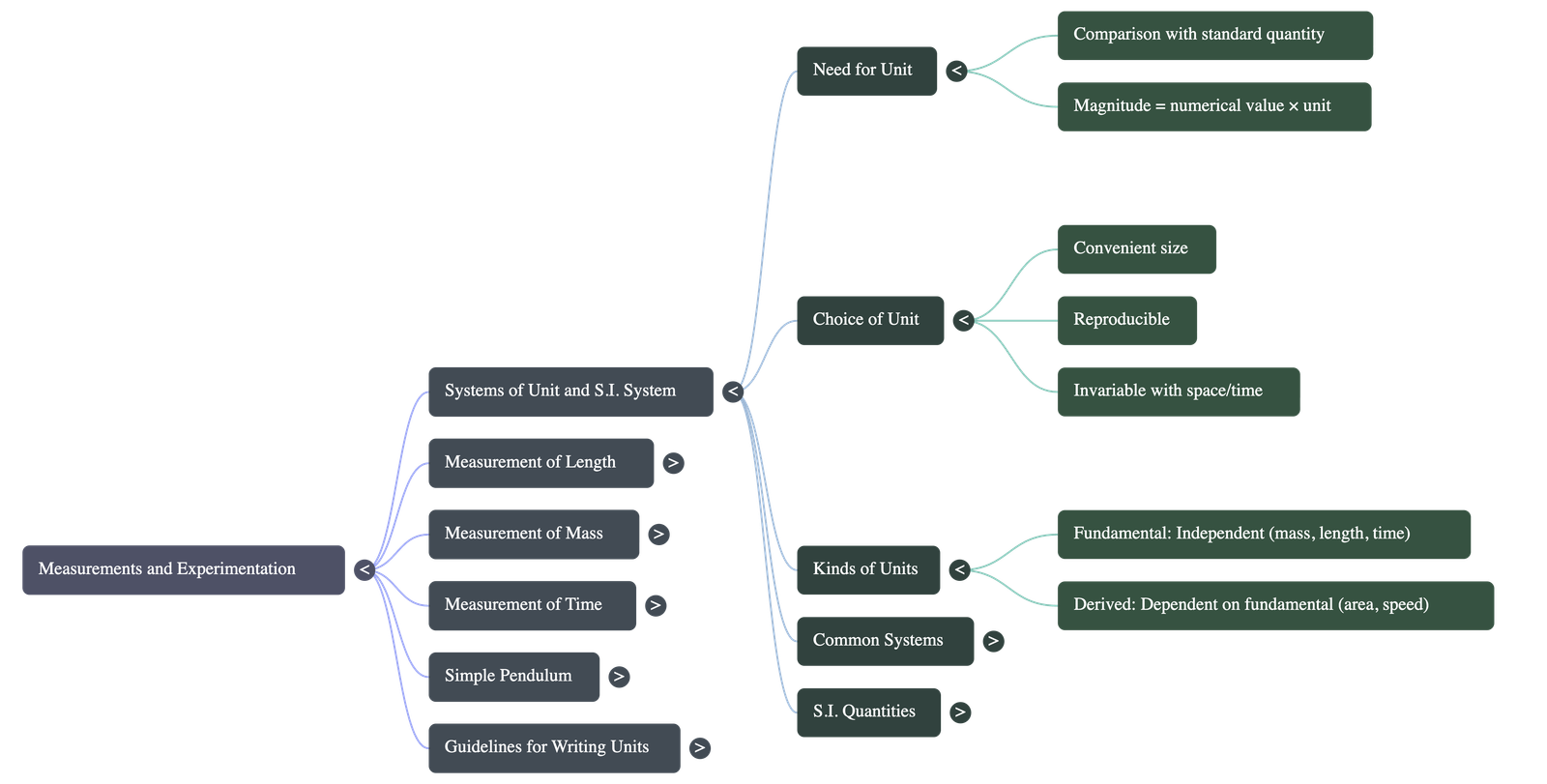
1. Need for Unit and Measurement
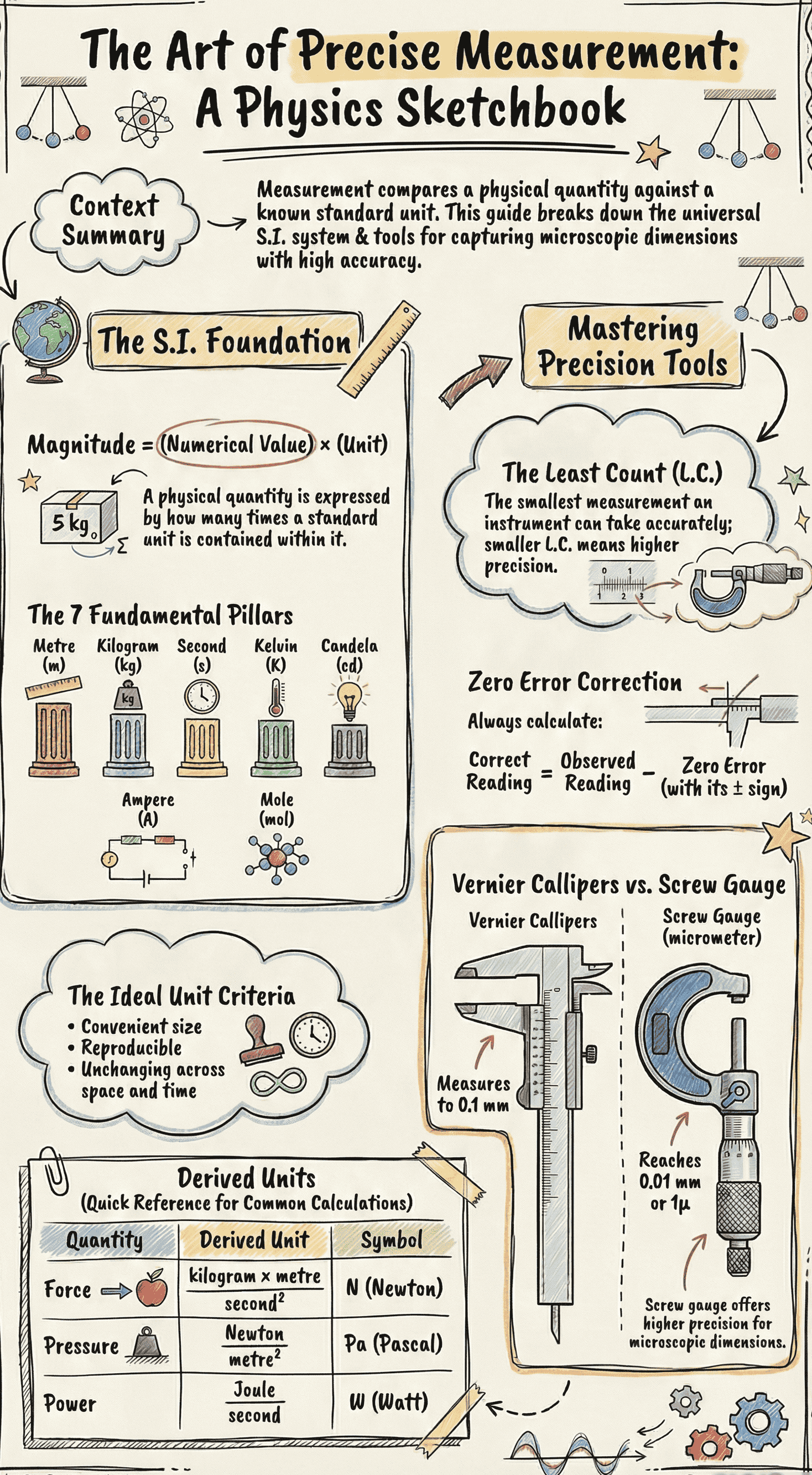
- Measurement: The process of comparing a given physical quantity with a known standard quantity of the same nature.
- Unit: A constant standard magnitude used to measure the magnitudes of other quantities of the same nature.
- The magnitude of a physical quantity is expressed as:
Physical quantity = (numerical value) × (unit) - Properties of a good unit: It must be of convenient size, definable without ambiguity, reproducible, and its value should not change with space and time.
2. Kinds of Units
- Fundamental (or basic) units: Units that are independent of any other unit and cannot be changed or related to one another (e.g., mass, length, time).
- Derived units: Units that depend on or can be expressed in terms of fundamental units (e.g., area, volume, speed, force).
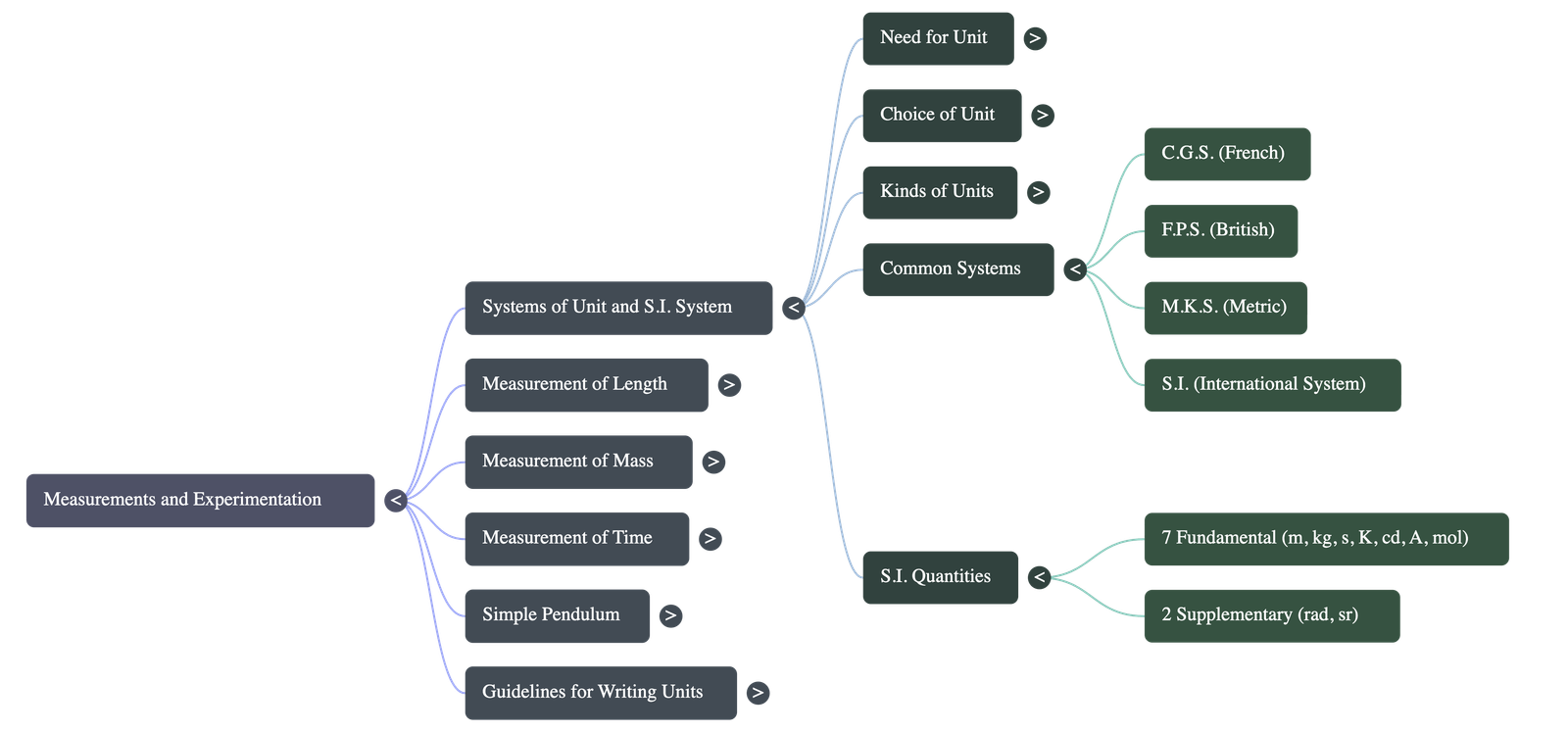
3. Systems of Unit
- Older Systems: C.G.S. system (centimetre, gram, second), F.P.S. system (foot, pound, second), and M.K.S. system (metre, kilogram, second).
- S.I. System (Systeme Internationale d'Unites): The universally adopted enlarged metric system. It contains seven fundamental units:
- Length (metre, m)
- Mass (kilogram, kg)
- Time (second, s)
- Temperature (kelvin, K)
- Luminous intensity (candela, cd)
- Electric current (ampere, A)
- Amount of substance (mole, mol)
- It also includes two complementary fundamental units: Angle (radian, rd) and Solid angle (steradian, st-rd).
4. Units of Length, Mass, and Time
- Length (S.I. unit = metre):
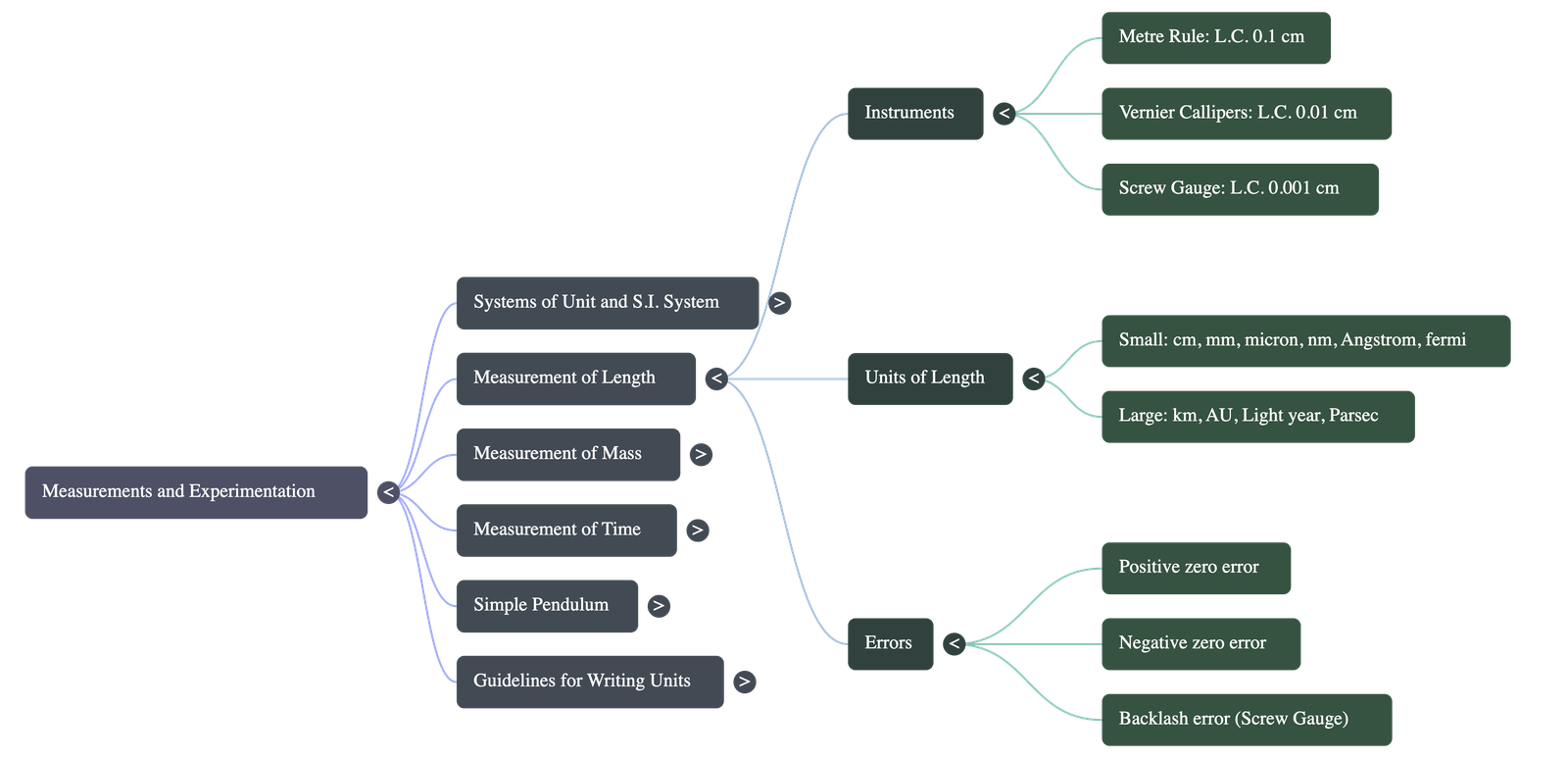
- Smaller units: centimetre (10-2 m), millimetre (10-3 m), micrometre/micron (10-6 m), nanometre (10-9 m), Angstrom (10-10 m), fermi (10-15 m).
- Bigger units: kilometre (103 m), Astronomical unit (A.U., distance between earth and sun), Light year (ly, distance light travels in vacuum in one year), Parsec (3.26 ly).
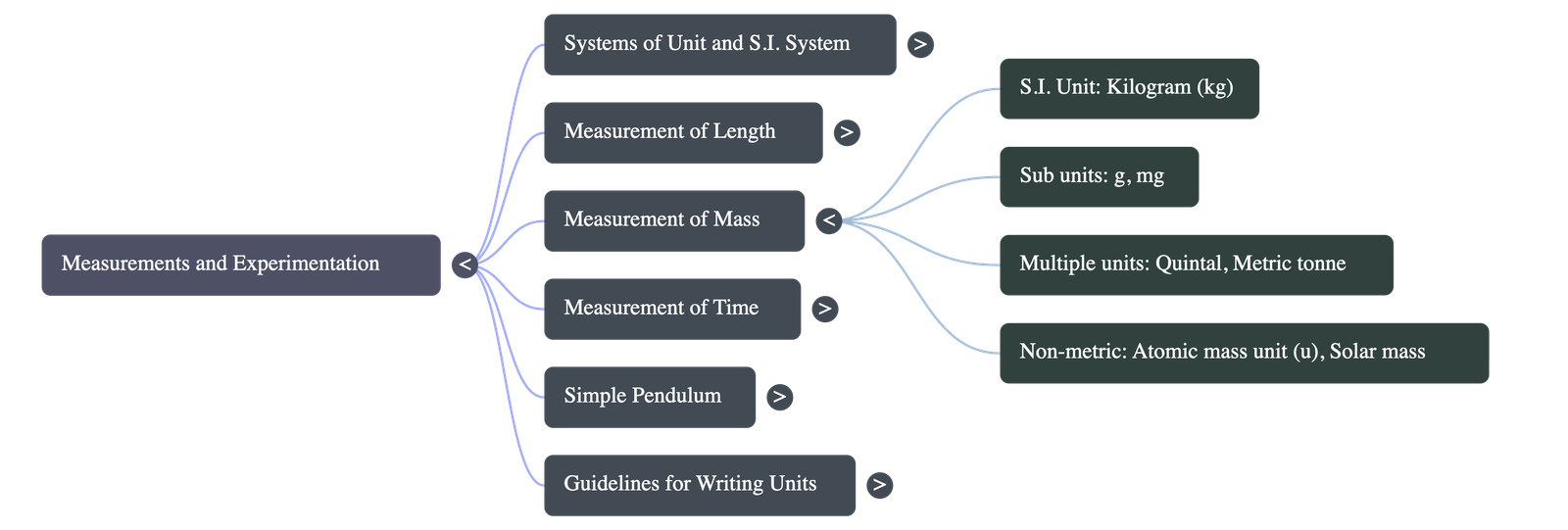
- Mass (S.I. unit = kilogram):
- Smaller units: gram (10-3 kg), milligram (10-6 kg).
- Bigger units: quintal (100 kg), metric tonne (1000 kg).
- Atomic units: atomic mass unit (a.m.u), used for particles like protons, neutrons, and electrons (1 a.m.u = 1.66 × 10⁻²⁷ kg).
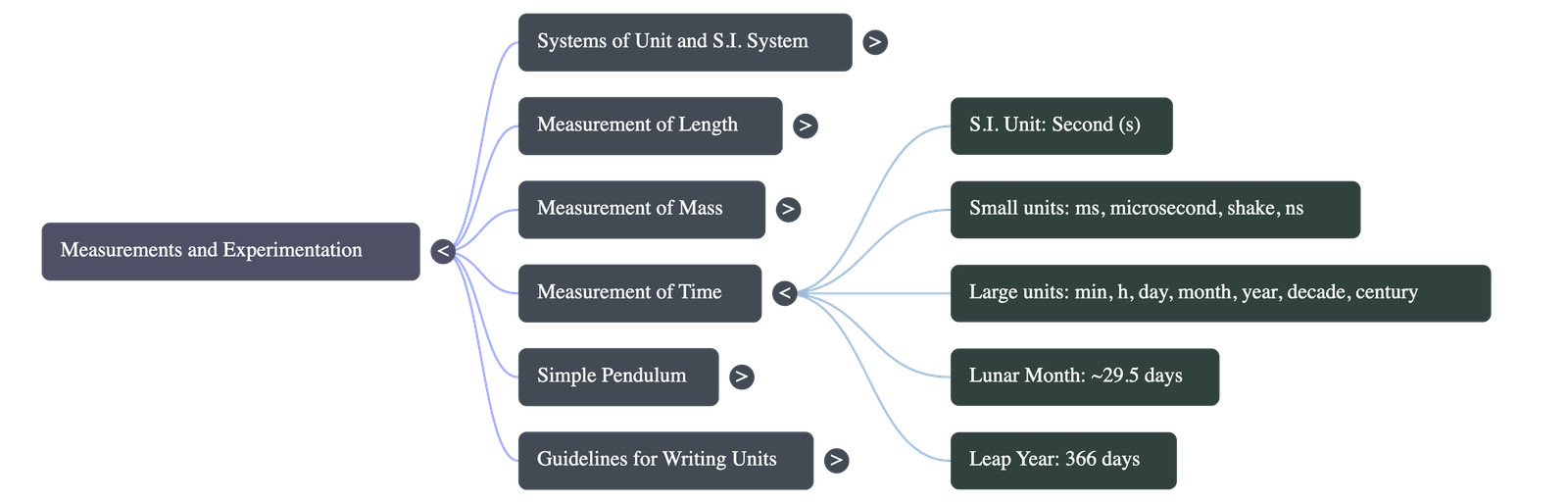
- Time (S.I. unit = second):
- Smaller units: millisecond, microsecond, shake (10-8 s), nanosecond.
- Bigger units: minute, hour, day, month, lunar month, year (365 days), leap year (366 days), decade (10 years), century (100 years), millennium (1000 years).
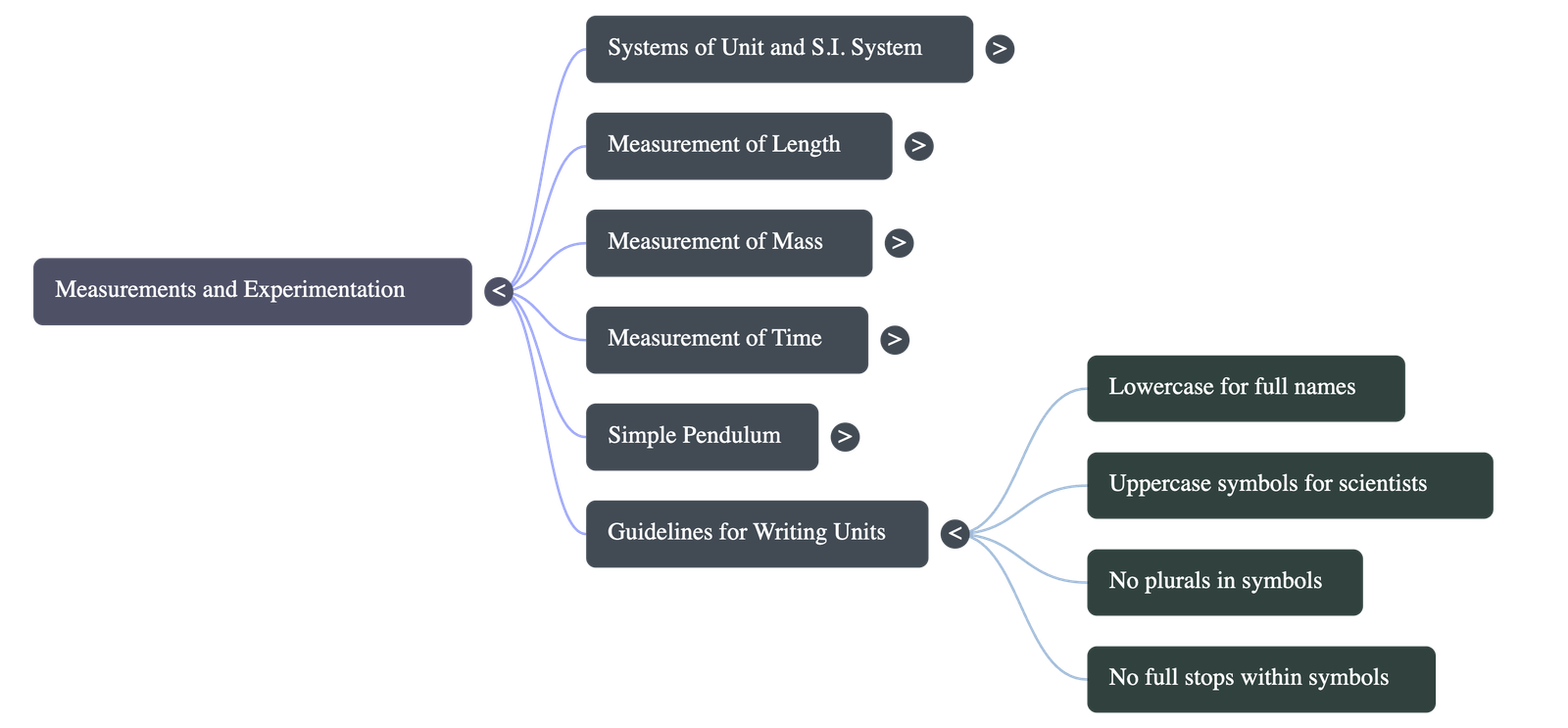
5. Guidelines for Writing Units
- Symbols named after scientists are written with a capital letter (e.g., N for newton, J for joule).
- Full names of units are always written with a small initial letter (e.g., newton, not Newton).
- Units in short forms are never written in plural (e.g., 10 m, not 10 ms).
- Negative powers are used for compound units formed by division (e.g., m s-1 instead of m/s).
B. Measurement of Length
1. Least Count
- The least count of an instrument is the smallest measurement that can be accurately taken with it. Smaller least count leads to a more precise measurement.
2. Principle of Vernier & Vernier Callipers
- Principle: Uses two scales (main scale and a sliding vernier scale) to measure up to the 2nd decimal place of a cm.
- Vernier Constant (Least Count): Equal to the difference between the values of one main scale division and one vernier scale division.
L.C. = Value of 1 main scale division / Total number of divisions on vernier - Vernier Callipers Parts:
- Outside Jaws: Measures length of rods, external diameter of spheres/cylinders.
- Inside Jaws: Measures internal diameter of hollow cylinders/pipes.
- Strip: Measures the depth of beakers or bottles.
- Zero Error: Occurs when the zero marks of both scales do not perfectly align when jaws are closed.
- Positive zero error: Vernier zero is to the right of main scale zero.
- Negative zero error: Vernier zero is to the left of main scale zero.
- Correction: Correct reading = Observed reading - Zero error (with sign)
3. Principle of Screw & Screw Gauge
- Principle: Based on linear movement when a screw is rotated. The distance moved in one complete rotation is called the pitch.
- Screw Gauge: Used to measure the diameter of a wire or thickness of paper to a high accuracy (up to 3rd decimal place of a cm).
- Least Count: L.C. = Pitch / Total number of divisions on its circular scale
- Ratchet: Prevents applying excessive pressure by gently holding the object between the stud and spindle.
- Zero Error in Screw Gauge:
- Positive error: Circular scale zero is below the base line.
- Negative error: Circular scale zero is above the base line.
- Backlash Error: A mechanical error observed when reversing the direction of rotation. The tip of the screw remains stationary for a part of the rotation due to wear and tear of threads. Avoided by rotating the screw in only one direction.
C. Measurement of Time and Simple Pendulum
1. The Simple Pendulum
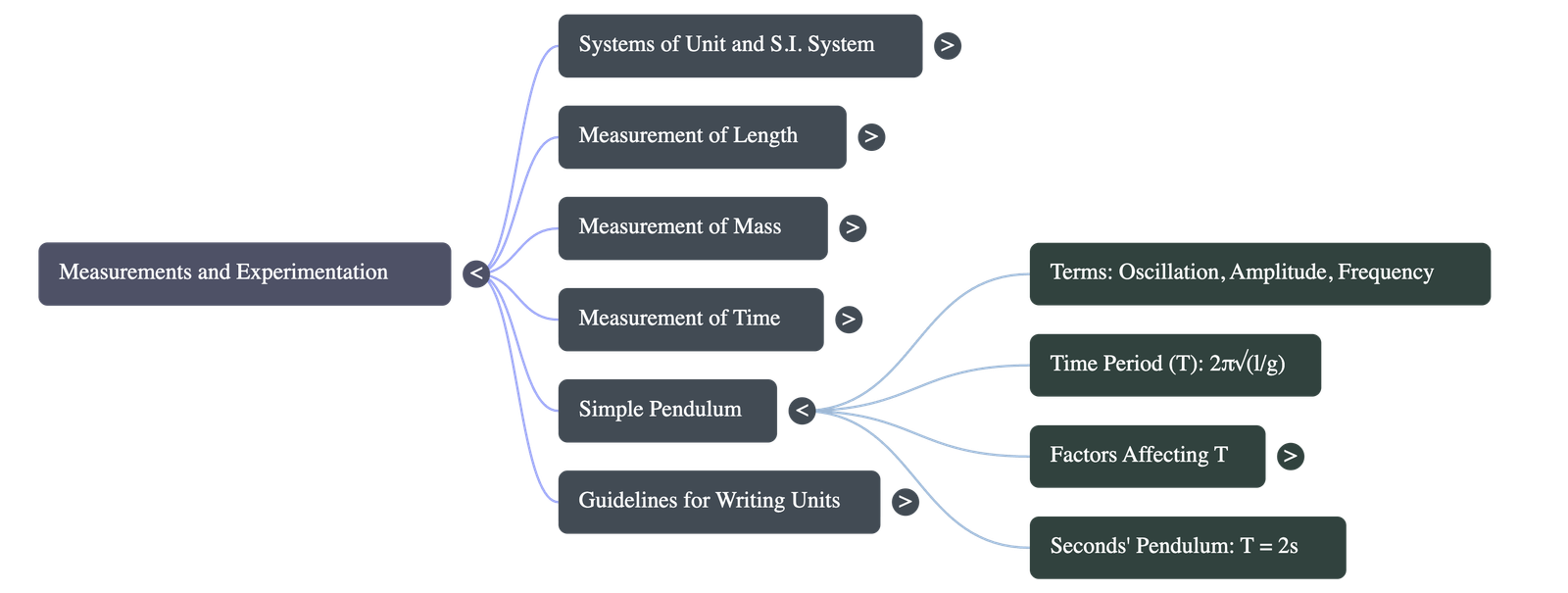
- A heavy point mass (known as a bob) suspended from a rigid support by a massless and inextensible string.
- Key Terms:
- Oscillation: One complete to and fro motion from its mean position.
- Time period (T): The time taken to complete one full oscillation (measured in seconds).
- Frequency (f): Number of oscillations made in one second (measured in hertz, Hz). Relation: f = 1 / T.
- Amplitude: The maximum displacement of the bob from its resting (mean) position.
- Effective length (l): The distance from the point of suspension to the center of gravity of the bob.
2. Time Period Dependency
- The time period expression is given by: T = 2π√(l/g)
- Factors affecting Time Period:
- It is directly proportional to the square root of its effective length (T ∝ √l). A graph of T2 vs l yields a straight line.
- It is inversely proportional to the square root of acceleration due to gravity (T ∝ 1/√g).
- Factors NOT affecting Time Period:
- Does not depend on the mass or material of the bob.
- Does not depend on the extent of swing (amplitude), provided the swing is not too large.
- Seconds' Pendulum: A pendulum with a time period of exactly two seconds (takes 1 second to travel from one extreme to the other). Its effective length is nearly 1 metre at the earth's surface.
Do checkout all questions & answers of this chapter.
Quick Navigation:
| | | |
1 / 1
Quick Navigation:
| | | |