Quick Navigation:
| | | |
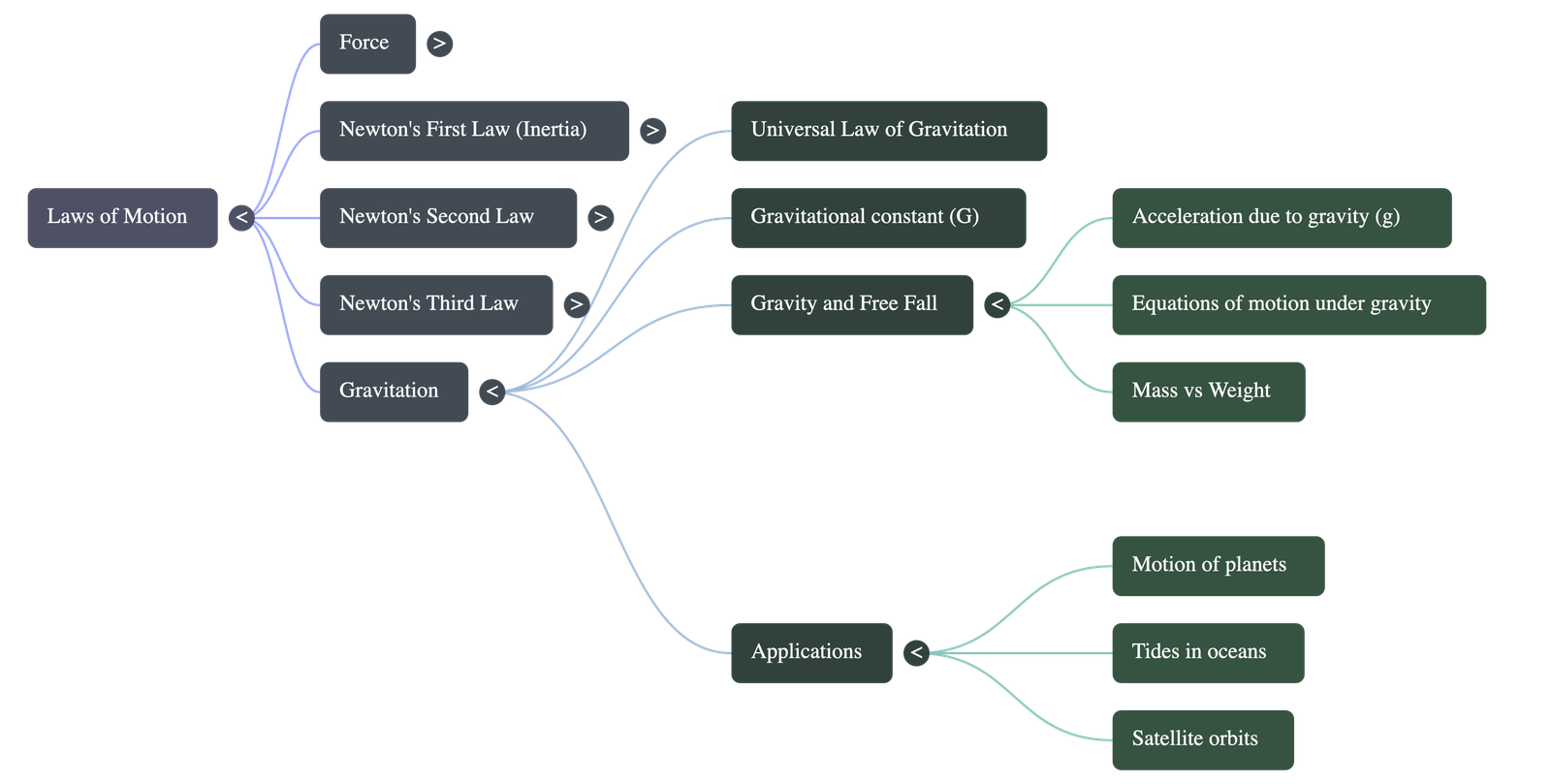
Laws of Motion
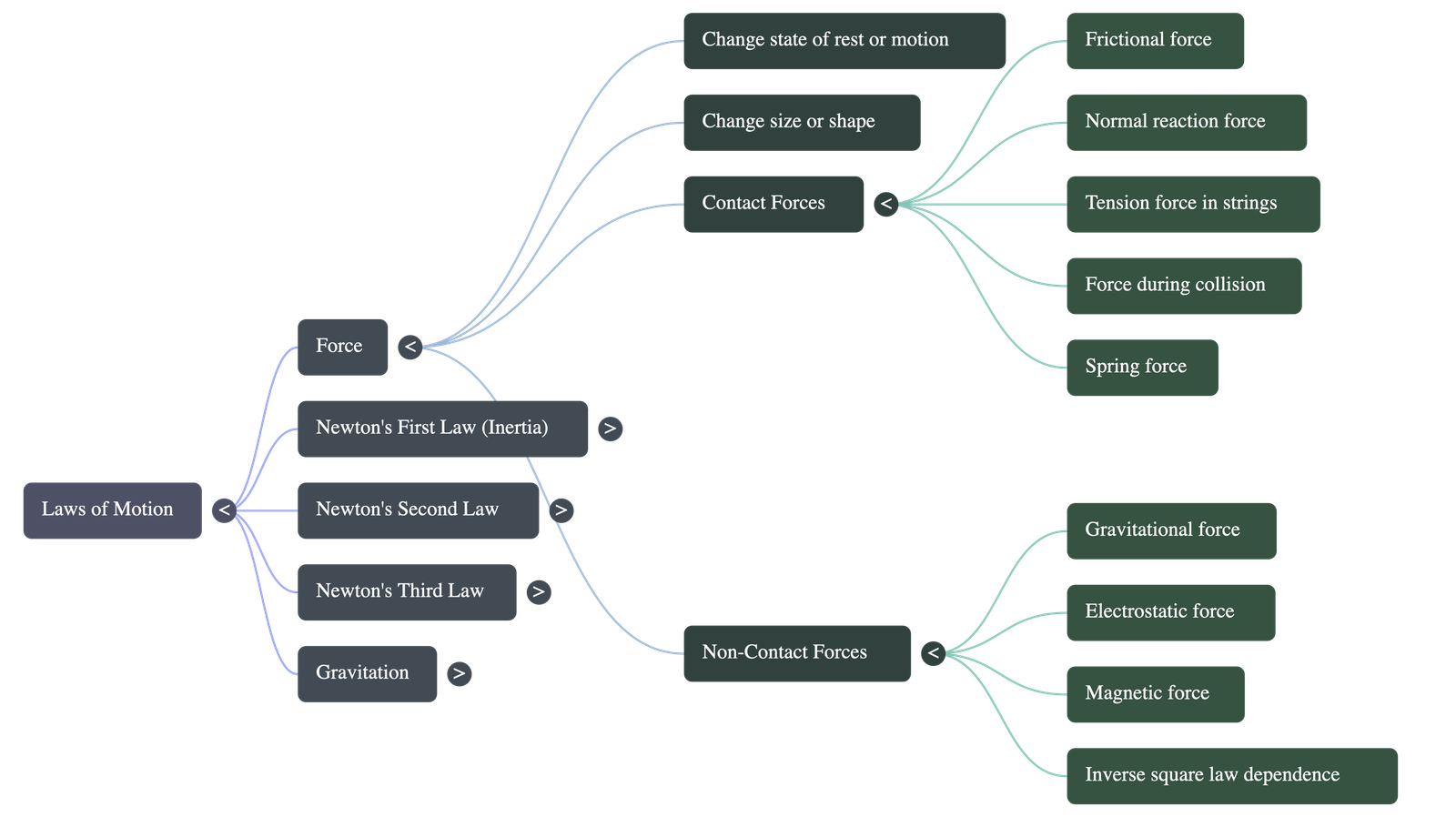
1. Effects and Types of Forces
- Effects of Force: A force can change the state of rest or motion of a body. It can also change the size or shape (dimensions) of a body.
- Contact Forces: Forces applied by making physical contact with a body. Examples include frictional force, normal reaction force, tension in a string, restoring force of a spring, and collision forces.
- Non-Contact Forces: Forces experienced by bodies without being physically touched, acting at a distance. Examples include gravitational, electrostatic, and magnetic forces.
- Properties of Non-Contact Forces: They can act through a vacuum, can be attractive or repulsive (though gravity is only attractive), and their magnitude varies inversely as the square of the distance between the objects.
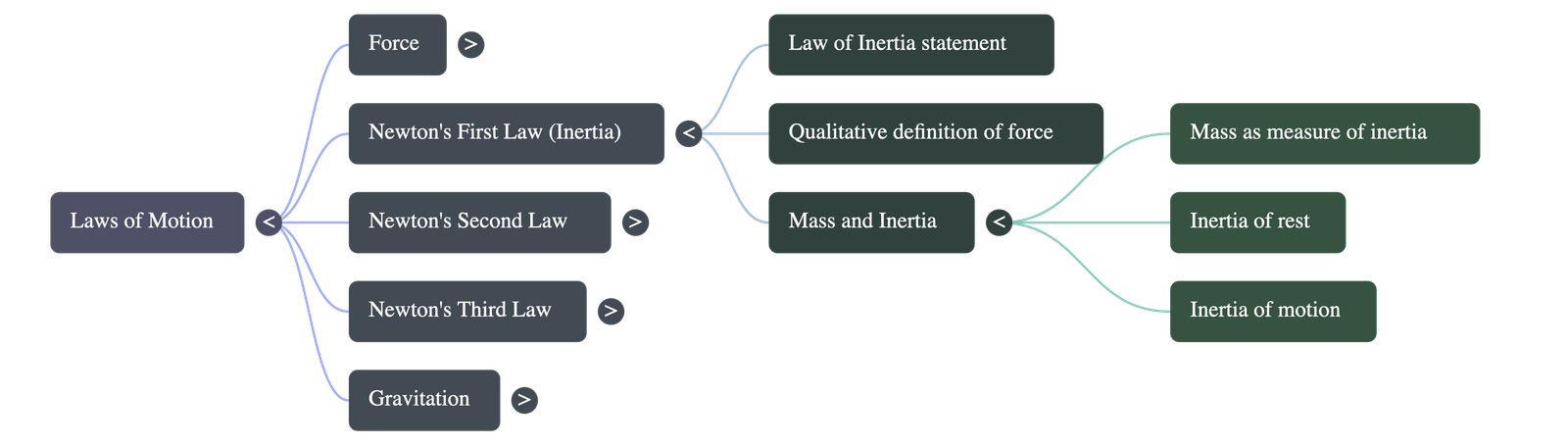
2. Newton's First Law of Motion and Inertia
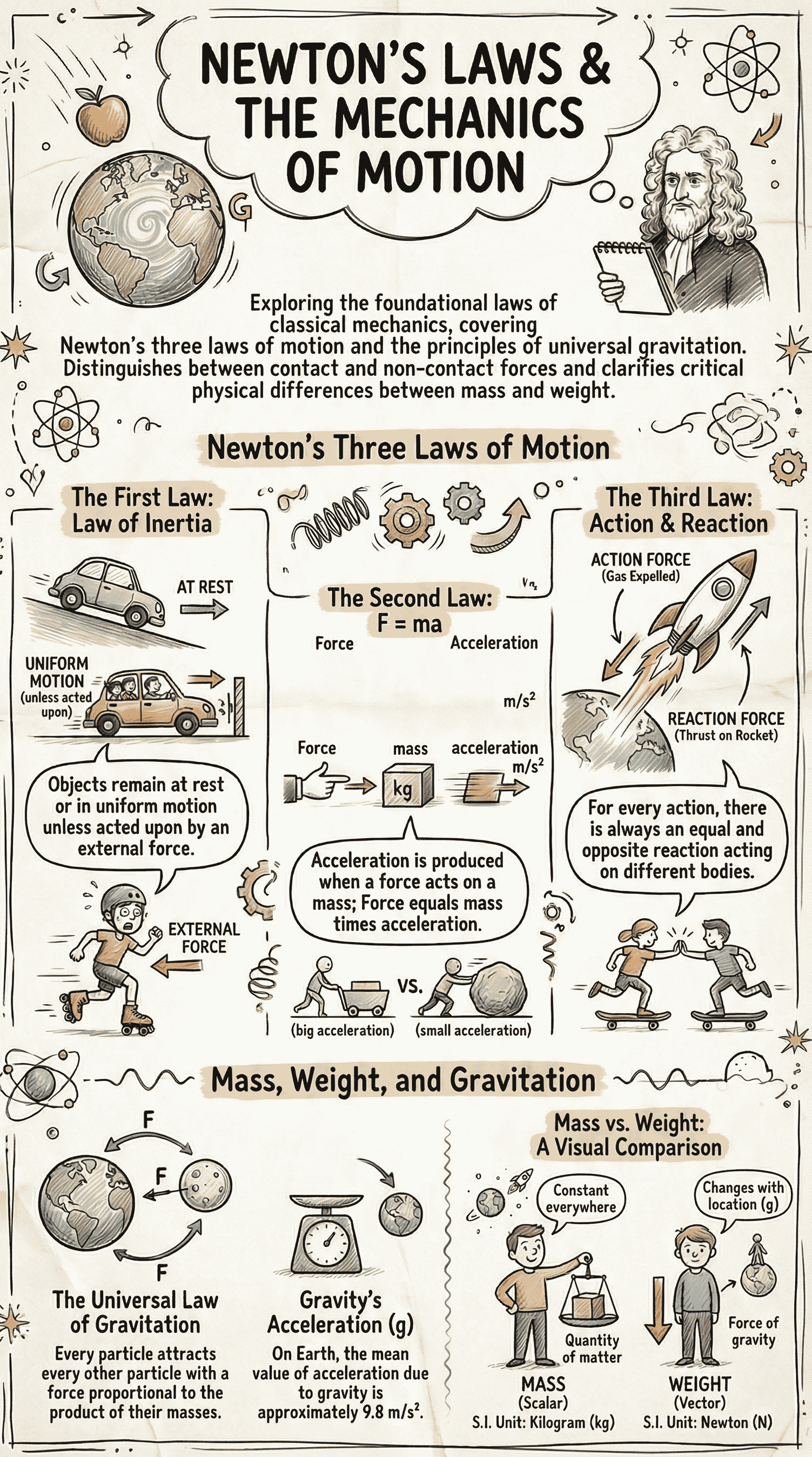
- Statement: If a body is at rest, it remains at rest, and if it is moving, it will continue to move in the same direction with the same speed unless an external force is applied on it.
- Inertia: The inherent property of a body by virtue of which it tends to retain its state of rest or of motion.
- Mass and Inertia: Mass is a measure of inertia. The greater the mass of a body, the greater its inertia.
- Inertia of Rest: The tendency of a body to remain at rest. For example, when a train suddenly starts, passengers tend to fall backwards.
- Inertia of Motion: The tendency of a body to continue in its state of motion. For example, a passenger jumping out of a moving train falls forward due to the inertia of motion of the upper body.
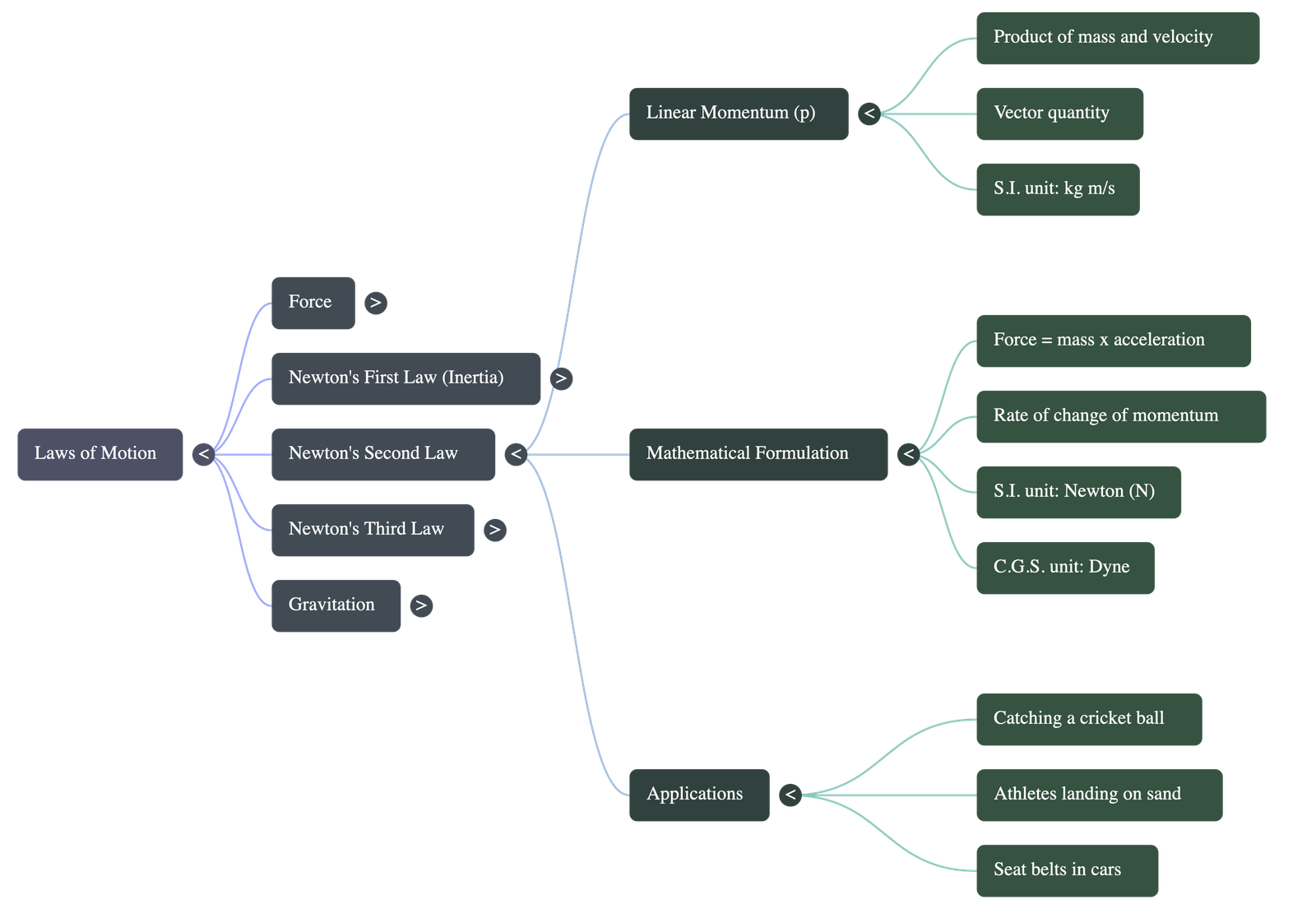
3. Linear Momentum and Newton's Second Law
- Linear Momentum: The product of an object's mass and its velocity. It is a vector quantity, and its SI unit is kilogram-meter per second.
- Statement of Second Law: The rate of change of momentum of a body is directly proportional to the applied force, and the change takes place in the direction of the force.
- Mathematical Form: Force equals mass multiplied by acceleration.
- Units of Force: The SI unit of force is the Newton. One Newton is the force that produces an acceleration of one meter per second squared in a body of one kilogram mass.
- Daily Life Applications: A cricketer withdraws his hands while catching a fast-moving ball. This increases the time to stop the ball, thereby reducing the rate of change of momentum and the force exerted on his hands.
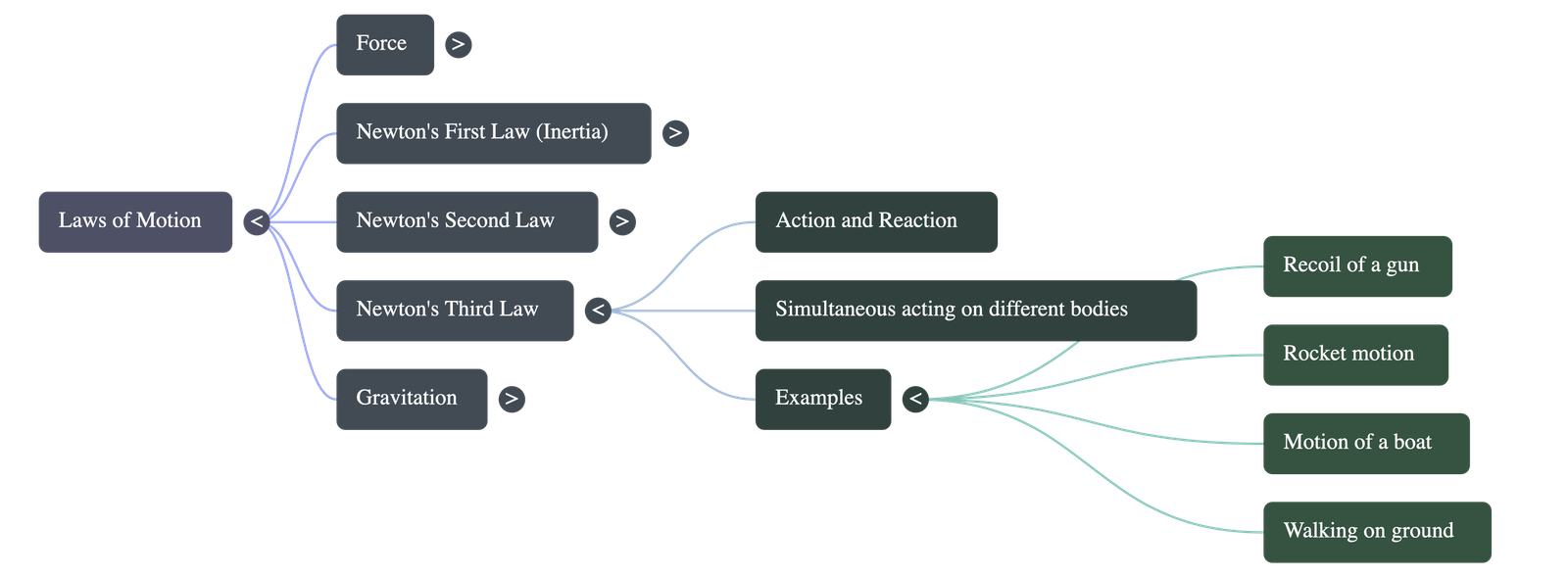
4. Newton's Third Law of Motion
- Statement: To every action, there is always an equal and opposite reaction.
- Key Principle: Action and reaction never act on the same body; they always act simultaneously on two different interacting bodies.
- Practical Examples: Firing a bullet from a gun causes an equal and opposite recoil on the gun. Similarly, a person walking pushes the ground backward (action), and the ground pushes the person forward (reaction). Rocket motion also relies on this principle by expelling gases downward to achieve upward thrust.
5. Gravitation
- Universal Law of Gravitation: Every particle in the universe attracts every other particle with a force directly proportional to the product of their masses and inversely proportional to the square of the distance between them.
- Acceleration Due to Gravity: The rate at which the velocity of a freely falling body increases due to the earth's gravitational pull. Its average value on earth is 9.8 meters per second squared.
- Mass vs. Weight: Mass is a constant scalar quantity representing the amount of matter in a body. Weight is a vector quantity representing the gravitational force exerted by the earth on that body. Weight varies depending on the local acceleration due to gravity.
- Free Fall: The motion of an object falling solely under the influence of gravity, independent of the mass of the falling object.
- Applications of Gravitation Law: Used in determining planetary masses, explaining the formation of ocean tides, and in the launching and orbital calculations of satellites and space stations.
Do checkout all questions & answers of this chapter.
Quick Navigation:
| | | |
1 / 1
Quick Navigation:
| | | |