Quick Navigation:
| | | |
Pressure in Fluids and its Transmission
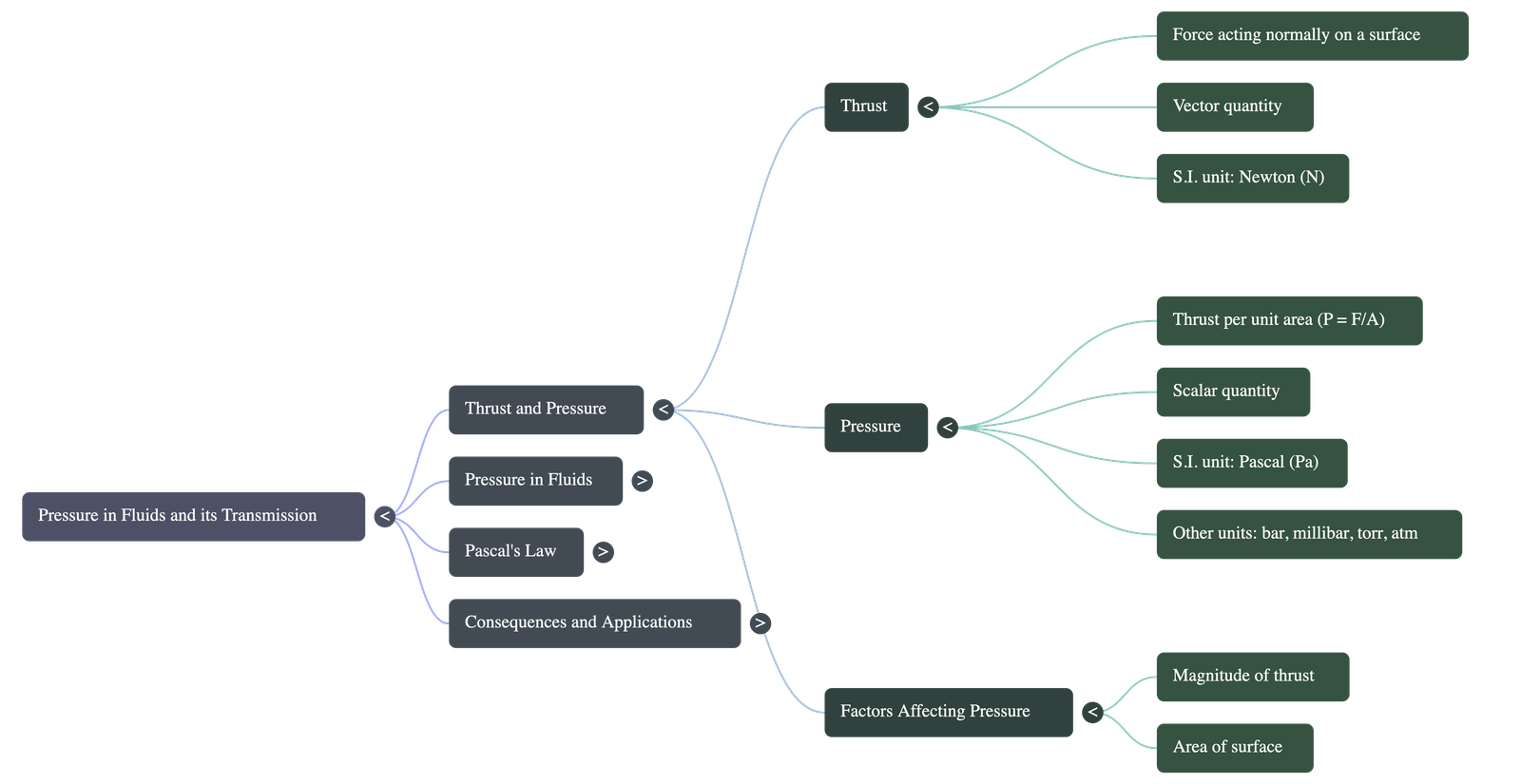
1. Thrust and Pressure
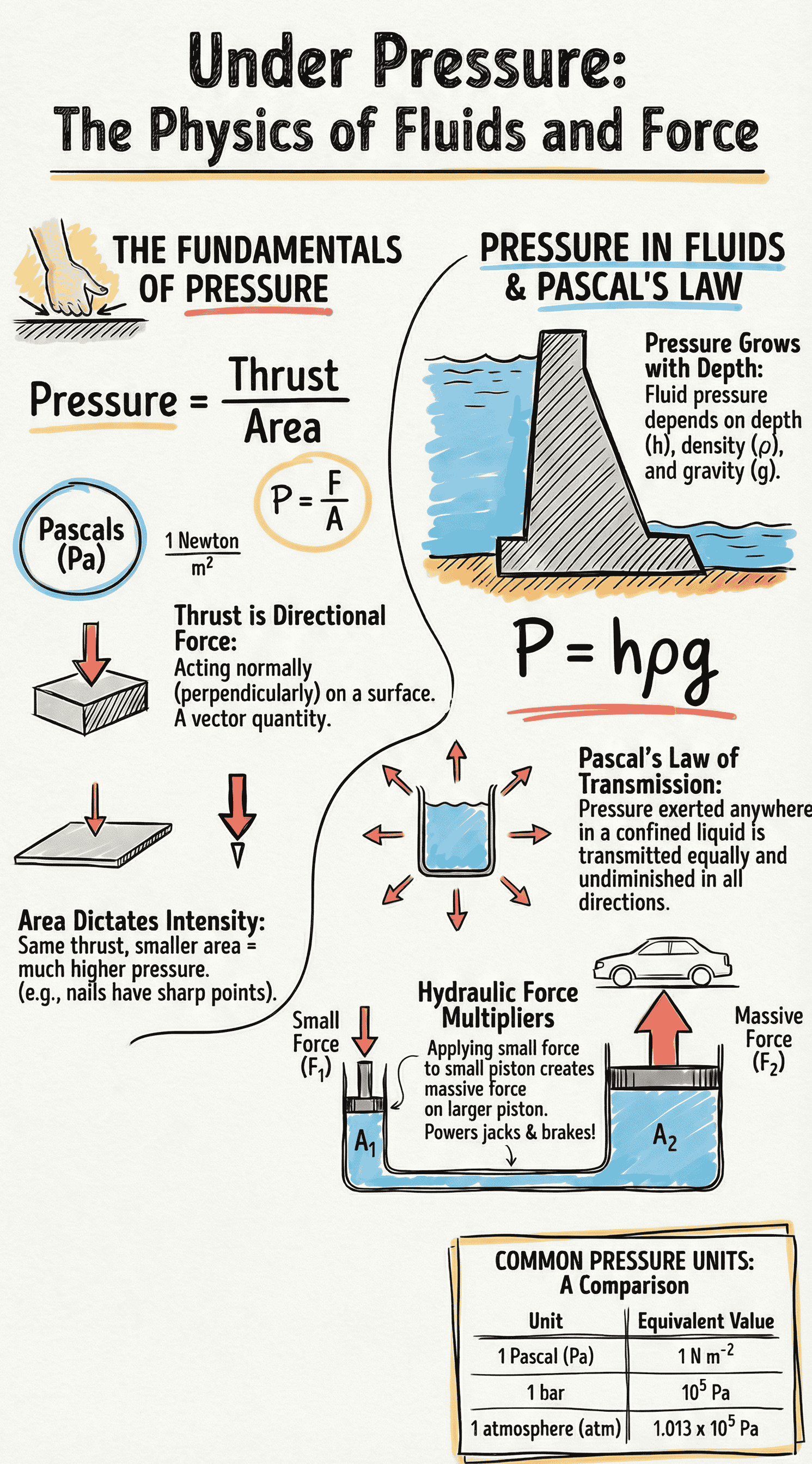
- Thrust: The force acting normally (perpendicularly) on a surface. It is a vector quantity.
- Units of Thrust: The S.I. unit is the Newton (N), and the C.G.S. unit is the dyne. Gravitational units are kilogram-force (kgf) and gram-force (gf).
- Pressure: The effect of thrust on a surface, defined as the thrust per unit area (Pressure = Thrust / Area). It is a scalar quantity.
- Units of Pressure: The S.I. unit is the Pascal (Pa), which is equal to 1 N m-2. Other common units include bar, millibar, atmosphere (atm), and torr.
- Factors Affecting Pressure: Pressure depends directly on the magnitude of the thrust and inversely on the area over which it acts.
- Modifying Pressure:
- Increasing Pressure: Decreasing the surface area increases pressure (e.g., pointed nails, sharp cutting tools).
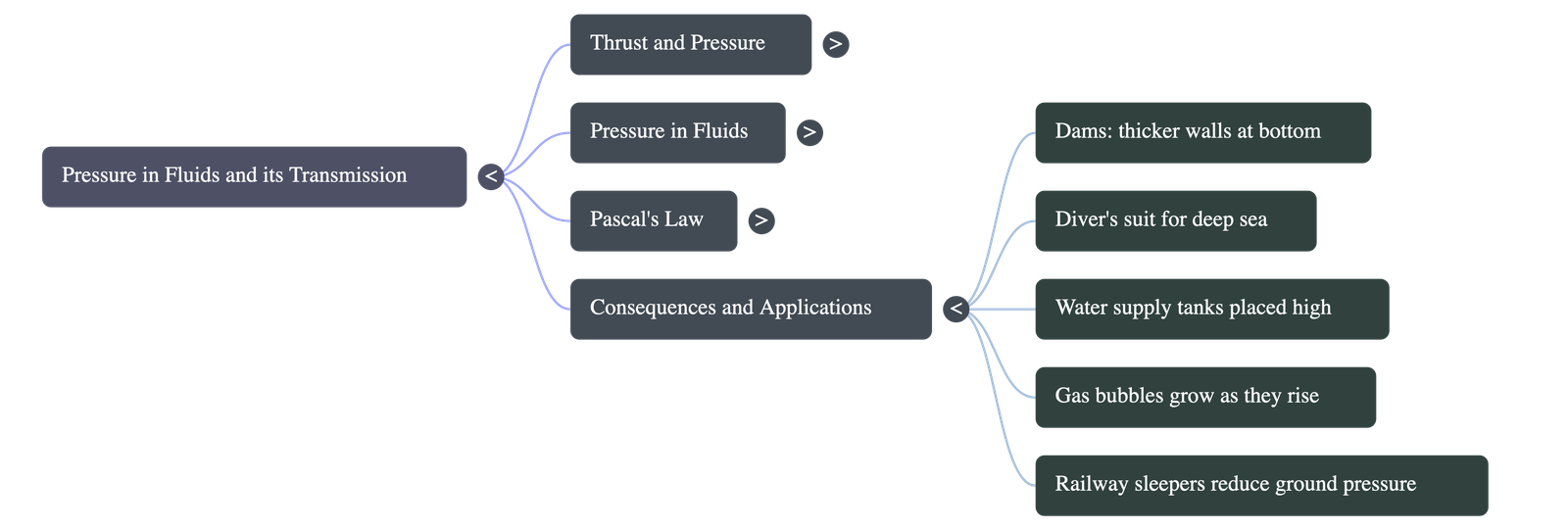
- Decreasing Pressure: Increasing the surface area decreases pressure (e.g., wide wooden sleepers under railway tracks, wider foundation walls for buildings).
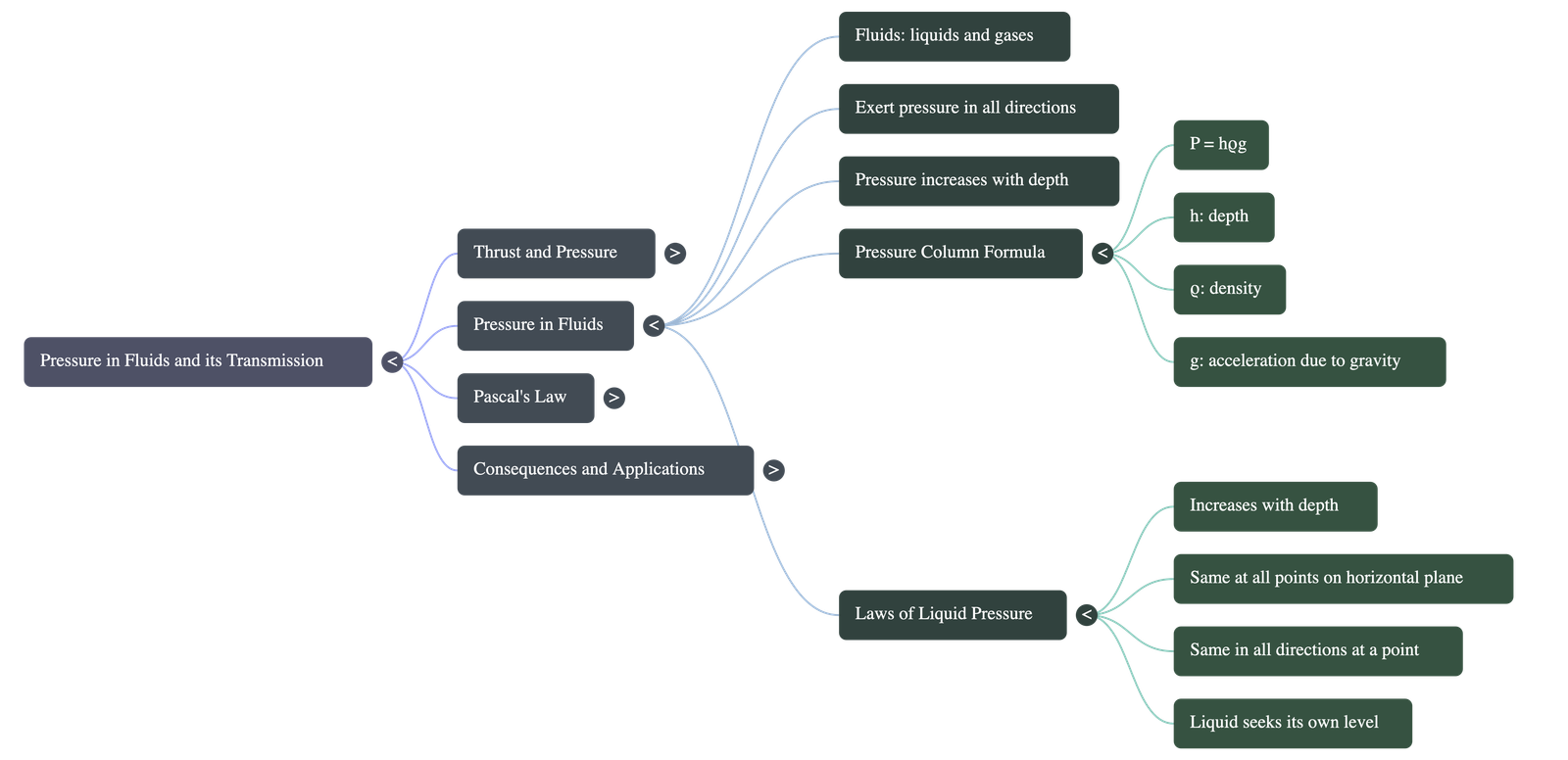
2. Pressure in Fluids
- Fluids: Substances that have the tendency to flow, which includes all liquids and gases.
- Unlike solids which only exert pressure downwards due to their weight, a fluid contained in a vessel exerts pressure at all points and in all directions (bottom and walls of the container).
3. Pressure Exerted by a Liquid Column
- Formula: The pressure exerted by a stationary liquid column is calculated as P = h × ρ × g (where h is depth, ρ is density of the liquid, and g is acceleration due to gravity).
- Total Pressure: At a certain depth inside a liquid, atmospheric pressure (P0) acting on the free surface must be added. Total Pressure = P0 + hρg.
- Influencing Factors: Liquid pressure depends solely on the depth, liquid density, and acceleration due to gravity.
- Non-Influencing Factors: Liquid pressure does not depend on the shape or size of the containing vessel, nor on the base area of the surface.
4. Laws of Liquid Pressure
- Pressure inside a liquid increases with an increase in depth from its free surface.
- In a stationary liquid, pressure is the same at all points on a horizontal plane.
- Pressure is the same in all directions about a specific point inside the liquid.
- Pressure at the same depth is different in different liquids; it increases with the increase in the density of the liquid.
- A liquid seeks its own level.
5. Consequences of Liquid Pressure
- Sea vs. River Water: Pressure at a certain depth in seawater is higher than in river water because seawater has a higher density.
- Dam Construction: The wall of a dam is made thicker at the bottom to withstand the significantly greater pressure exerted by water at greater depths.
- Water Supply: Water supply tanks are placed at high elevations so that the greater height creates sufficient pressure for water to flow vigorously into household taps.
- Diver's Suit: Deep-sea divers wear special protective suits (made of glass-reinforced plastic or cast aluminium) to withstand the massive crushing pressure of deep water, which far exceeds human blood pressure.
- Gas Bubbles: As a gas bubble rises from the bottom of a lake to the surface, the liquid pressure around it decreases, causing the volume of the bubble to increase (grow in size).
6. Transmission of Pressure (Pascal's Law)
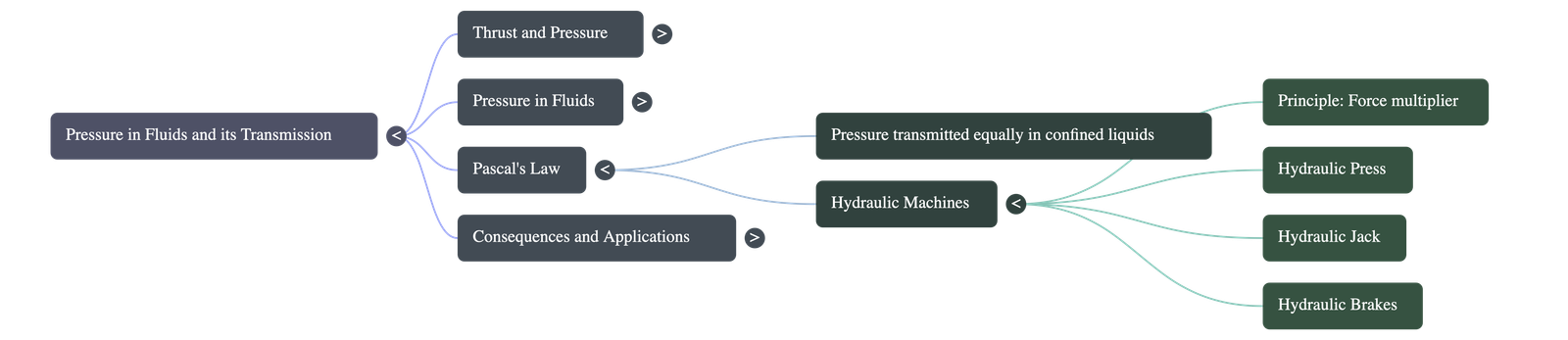
- Pascal's Law: States that the pressure exerted anywhere in a confined liquid is transmitted equally and undiminished in all directions throughout the liquid.
- This principle can be demonstrated using a fluid-filled flask equipped with narrow tubes and an air-tight piston. Pushing the piston down causes water to rise to the same height in all tubes equally.
7. Applications of Pascal's Law (Hydraulic Machines)
- Force Multipliers: Hydraulic machines rely on the principle that a small force applied to a smaller piston transmits pressure equally to produce a much larger force on a bigger piston.
- Hydraulic Press (Bramah Press): Consists of two interconnected hollow cylinders (pump and press plunger). Used for pressing heavy materials like cotton bales, extracting juice from sugarcane, and squeezing oil from seeds.
- Hydraulic Jack (Hydraulic Lift): Operates using a smaller pump cylinder and a larger lifting cylinder. Used in service stations for effortlessly lifting heavy vehicles like cars and trucks.
- Hydraulic Brakes: Found in automobiles, a foot pedal exerts a small force on a master cylinder, which transmits equal pressure through brake fluid to wheel cylinders, pressing brake shoes against the wheels to stop the vehicle.
Do checkout all questions & answers of this chapter.
Quick Navigation:
| | | |
1 / 1
Quick Navigation:
| | | |