Quick Navigation:
| | | |
Motion in One Dimension
1. Scalar and Vector Quantities
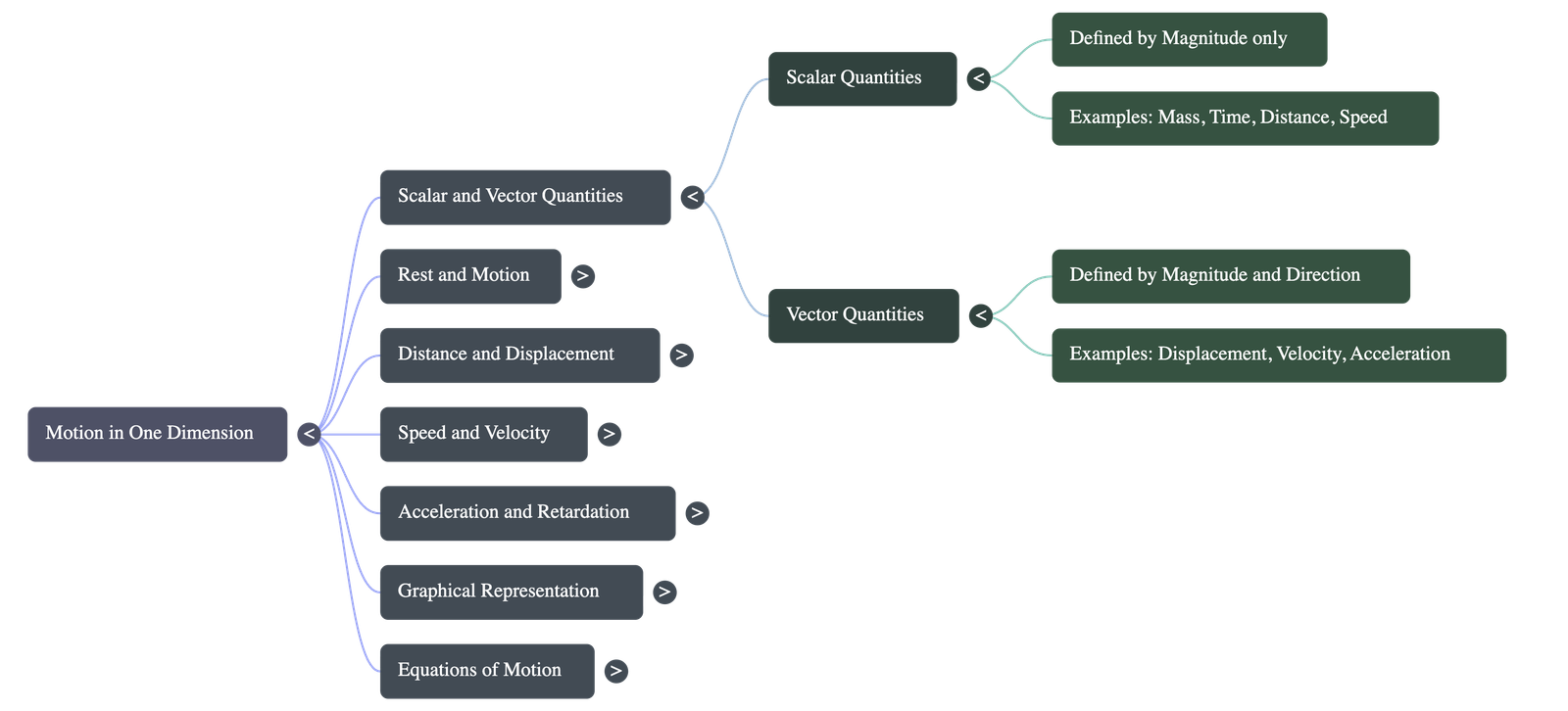
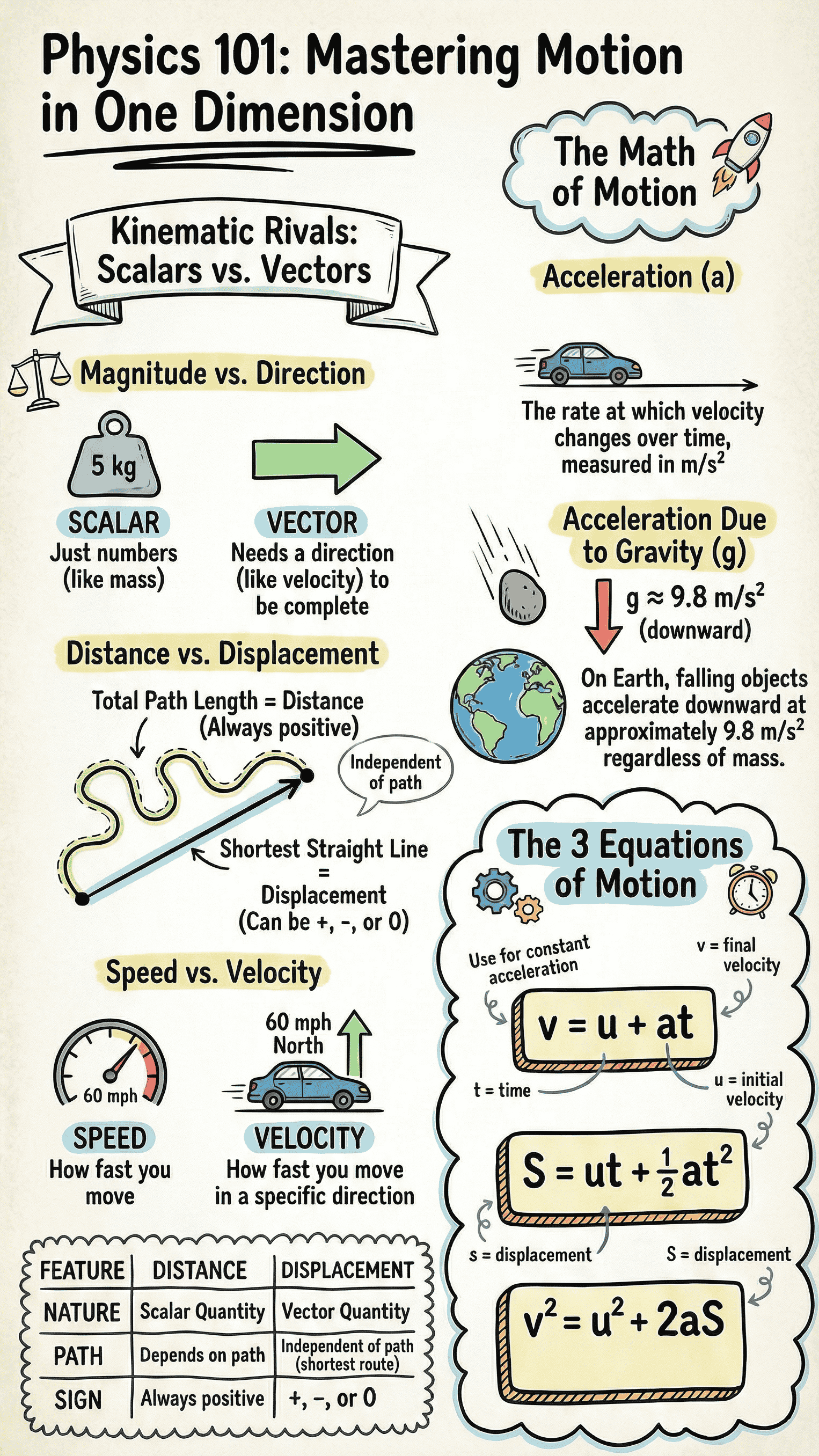
- Scalar Quantities: Physical quantities expressed only by their magnitude. They do not require a direction (e.g., mass, length, time, distance, speed). They can be added, subtracted, multiplied, and divided by simple arithmetic.
- Vector Quantities: Physical quantities that require both magnitude and direction to be completely expressed (e.g., displacement, velocity, acceleration, force). They follow vector algebra and are generally represented by letters with an arrow bearing on top.
2. Rest and Motion
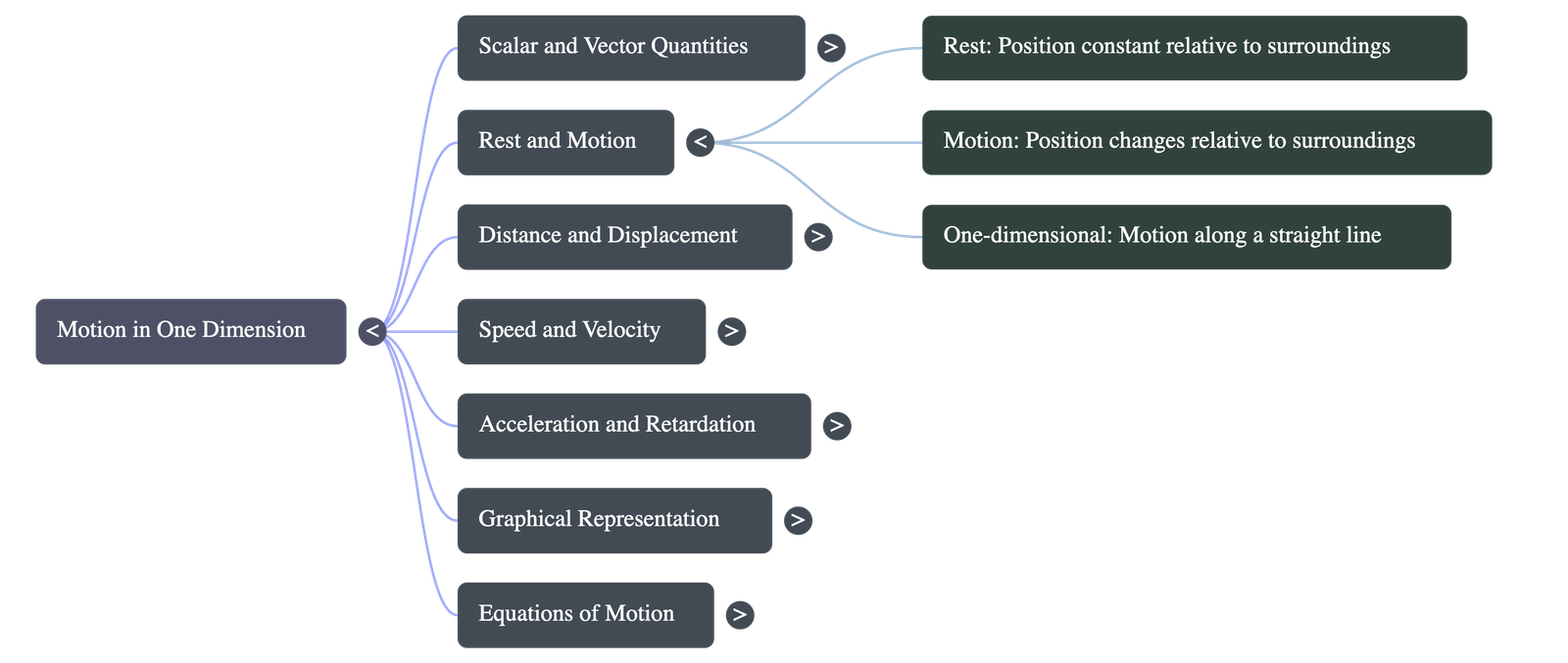
- Rest: A body is at rest if it does not change its position with respect to its immediate surroundings.
- Motion: A body is in motion if it changes its position with respect to its surroundings. Rest and motion are relative concepts.
- One-Dimensional Motion: When a body moves along a straight line path, its motion is called one-dimensional or rectilinear motion (e.g., a train moving on a straight track).
3. Distance and Displacement
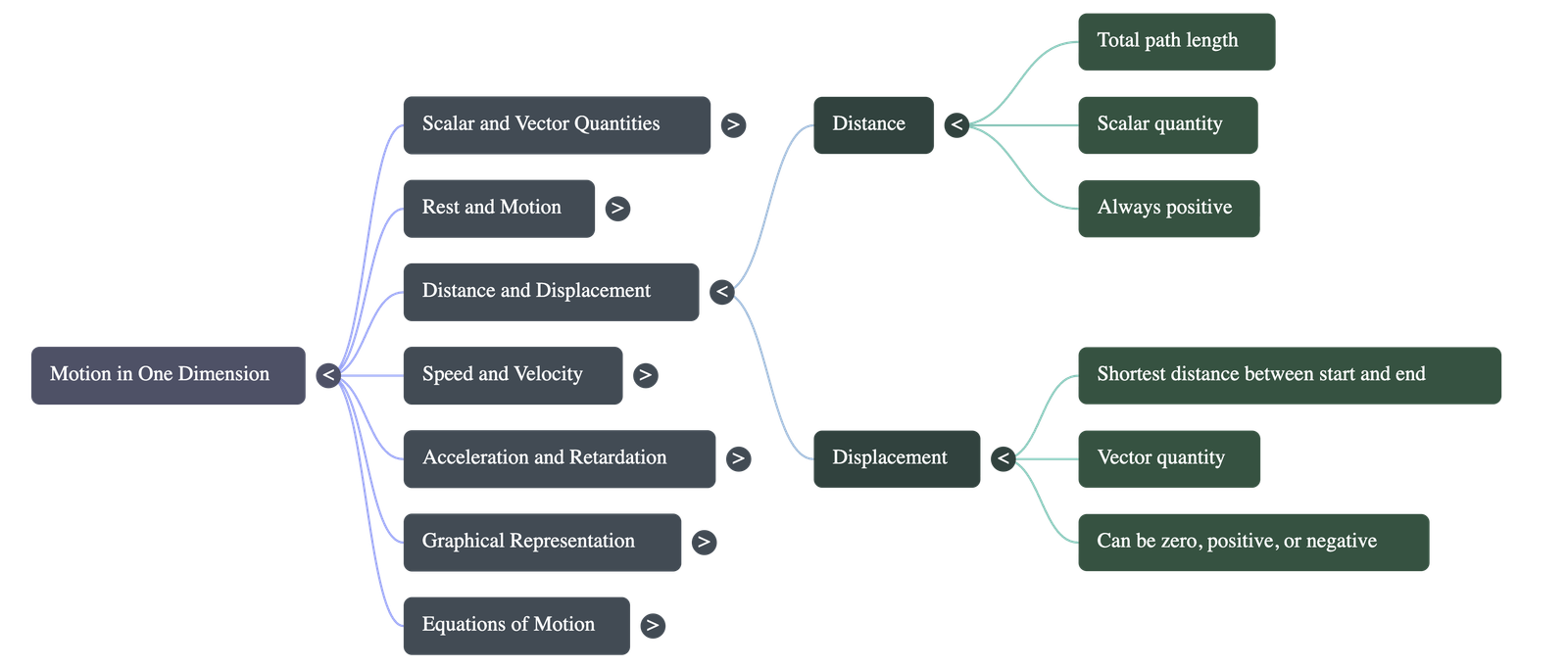
- Distance: The total length of the path travelled by a moving body. It is a scalar quantity, always positive, and depends on the path followed.
- Displacement: The shortest straight-line distance from the initial position to the final position in a specified direction. It is a vector quantity and can be positive, negative, or zero.
- Distinction: The magnitude of displacement is either equal to or less than the distance travelled. Displacement can be zero even if the distance travelled is not zero (e.g., returning to the starting point).
4. Speed and Velocity
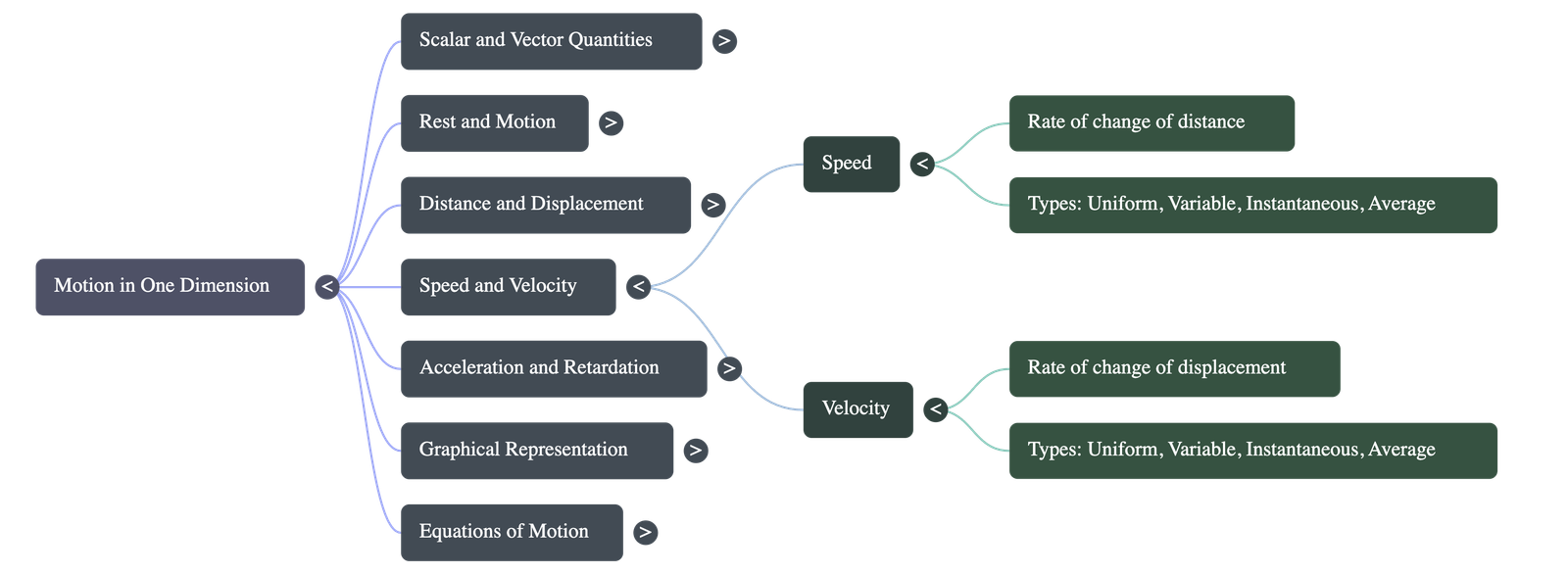
- Speed: The rate of change of distance with time (Distance/Time). It is a scalar quantity indicating how fast a body is moving.
- Velocity: The distance travelled per second in a specified direction, or the rate of change of displacement with time (Displacement/Time). It is a vector quantity.
- Uniform vs. Variable: A body has uniform speed/velocity if it covers equal distances/displacements in equal time intervals. If distances/displacements are unequal, it has variable (non-uniform) speed/velocity.
- Averages: Average speed is the total distance divided by the total time taken. Average velocity is total displacement divided by total time.
5. Acceleration and Retardation
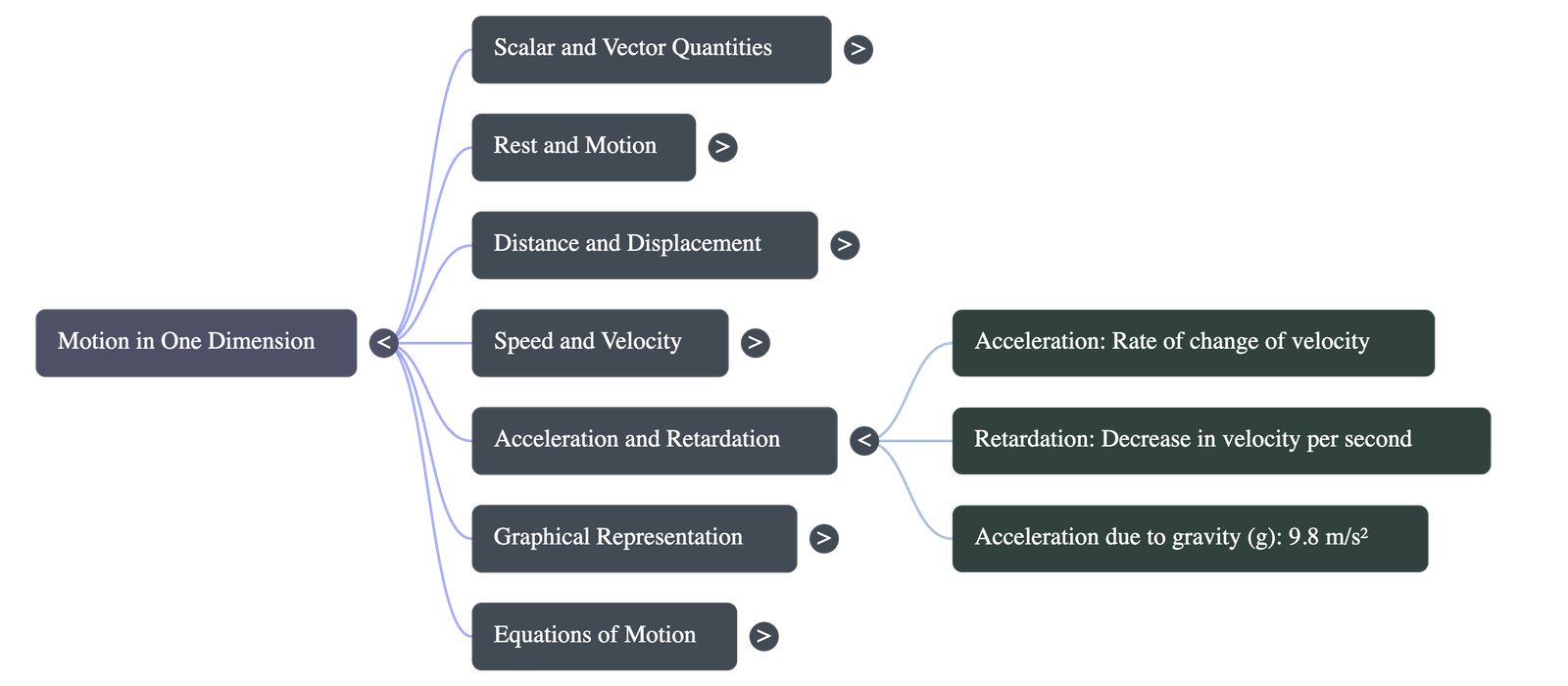
- Acceleration: The rate of change of velocity with time. It is a vector quantity. (Formula: a = (v - u) / t).
- Retardation: If the velocity of a body decreases with time, the acceleration is negative, which is called retardation or deceleration.
- Acceleration due to Gravity: When a body falls freely under gravity, the uniform acceleration produced is called acceleration due to gravity, denoted by 'g' (average value is approximately 9.8 m/s²).
6. Graphical Representation of Linear Motion
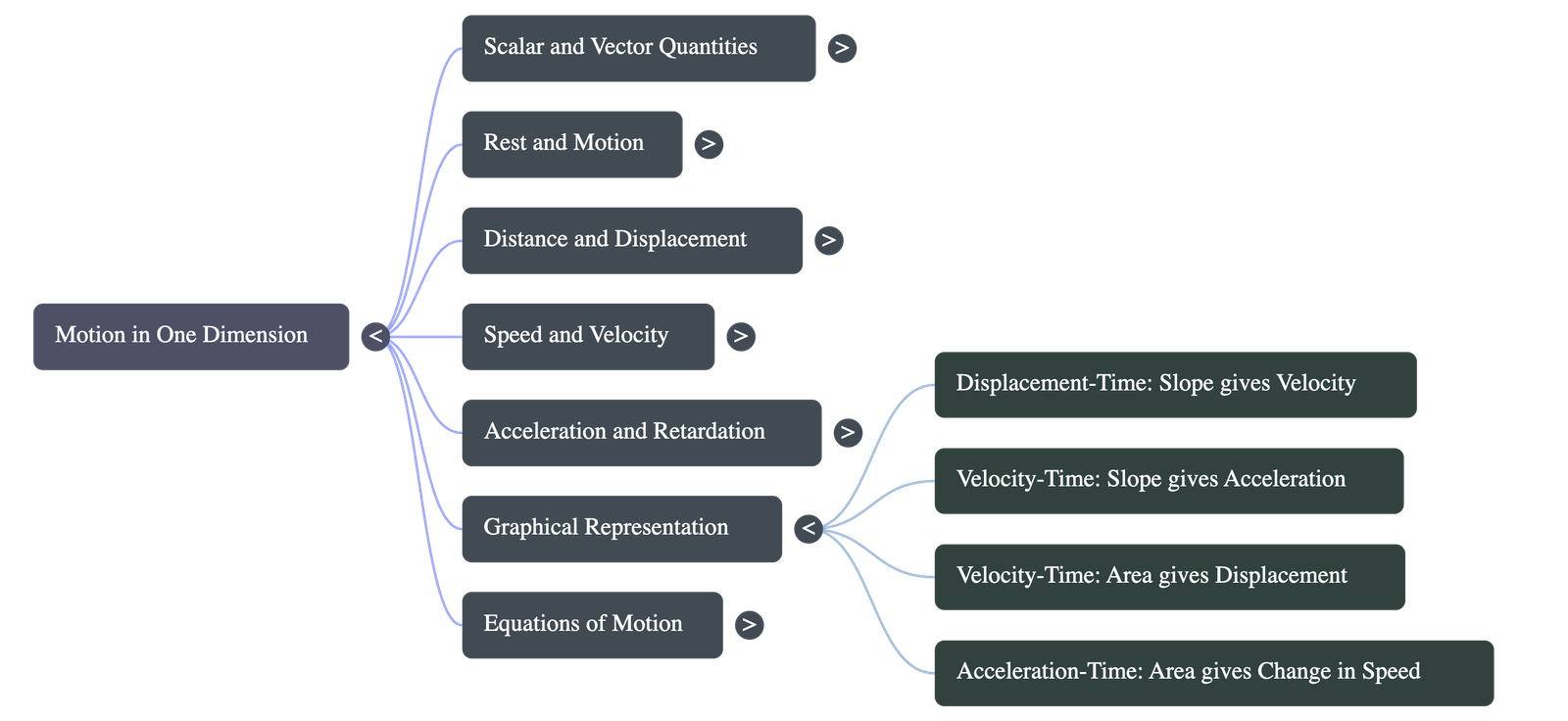
- Displacement-Time Graph: The slope of this graph gives the velocity of the body. A stationary body shows a straight line parallel to the time axis. A body moving with uniform velocity shows an inclined straight line. A curve represents variable velocity.
- Velocity-Time Graph: The slope of the velocity-time graph gives the acceleration. The area enclosed between the graph and the time axis calculates the total displacement. A straight line parallel to the time axis indicates zero acceleration (constant velocity).
- Acceleration-Time Graph: The area enclosed by the acceleration-time graph and the time axis provides the change in speed of the body over the given time interval.
7. Equations of Uniformly Accelerated Motion
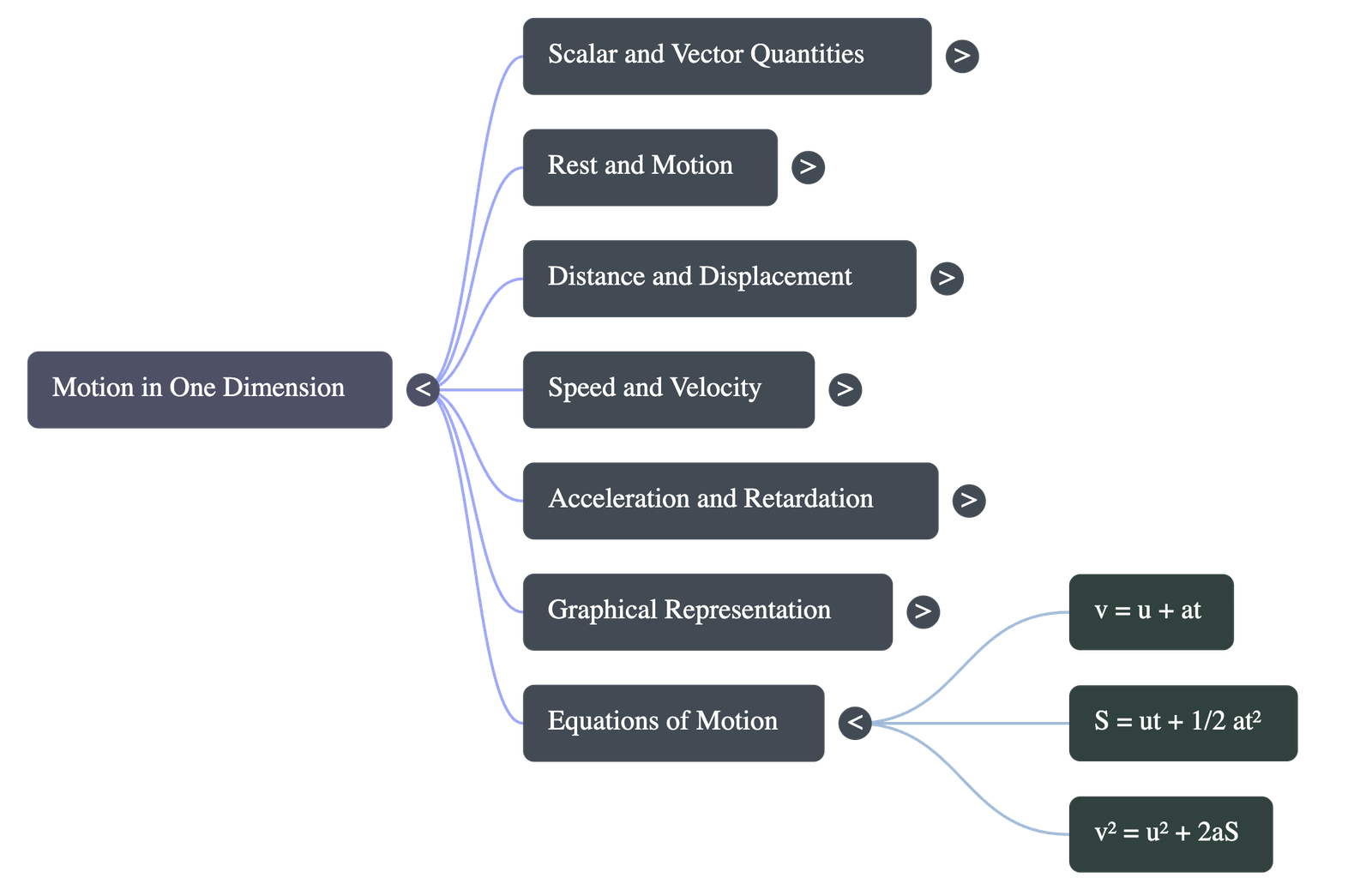
- For a body moving with uniform acceleration, the relationship between initial velocity (u), final velocity (v), acceleration (a), time (t), and distance (S) is defined by three main equations:
- First Equation: v = u + at
- Second Equation: S = ut + ½at²
- Third Equation: v² = u² + 2aS
- These equations can be derived both graphically (by evaluating the area and slope of a velocity-time graph) and algebraically.
- Special Cases: If a body starts from rest, initial velocity (u) is zero. If a body experiences retardation, acceleration (a) is taken as a negative value in the equations.
Do checkout all questions & answers of this chapter.
Quick Navigation:
| | | |
1 / 1
Quick Navigation:
| | | |