Quick Navigation:
| | | |
Reflection of Light
1. Fundamentals of Reflection
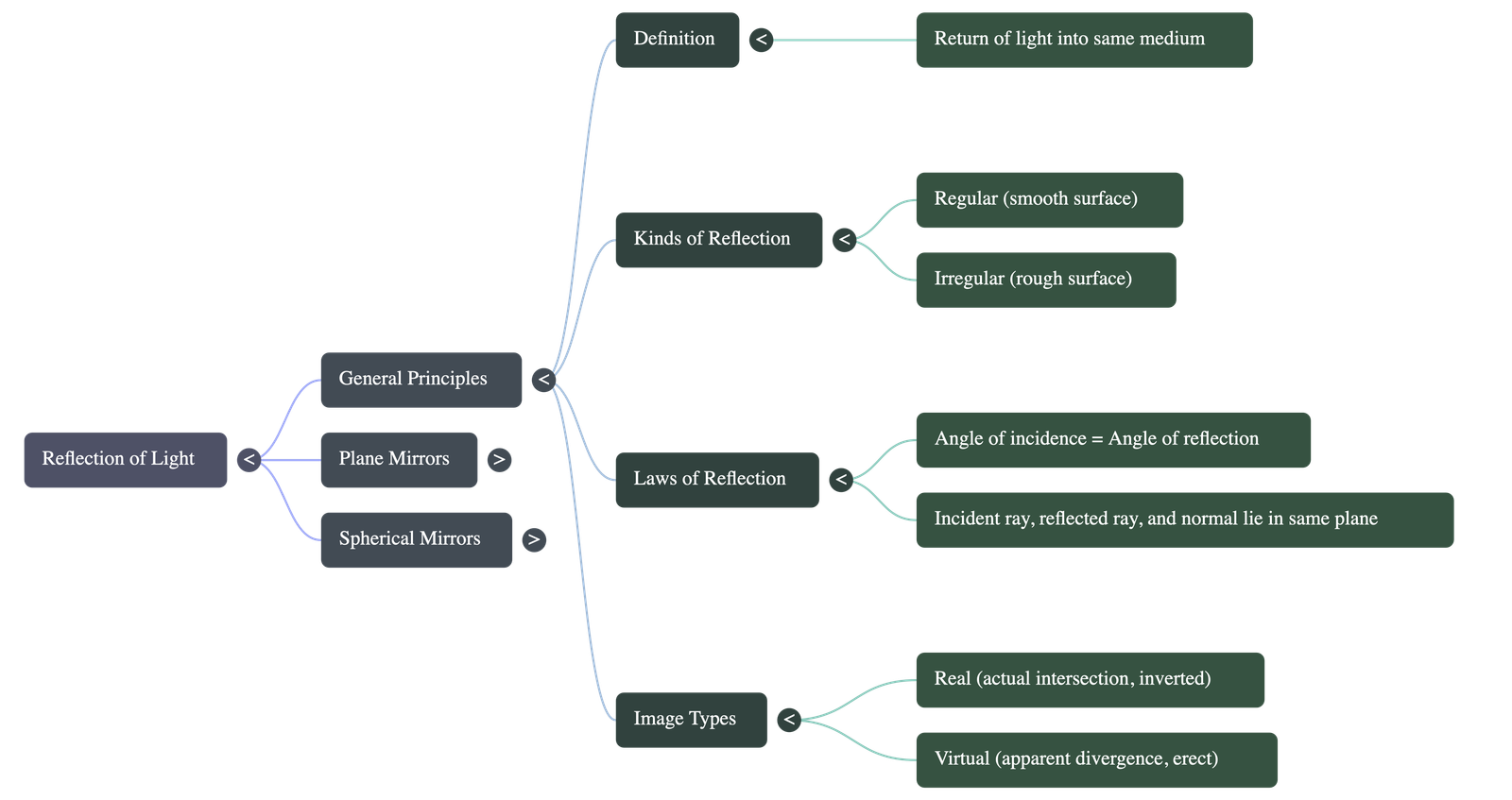
- Definition: The return of light into the same medium after striking a surface is called reflection.
- Kinds of Reflection:
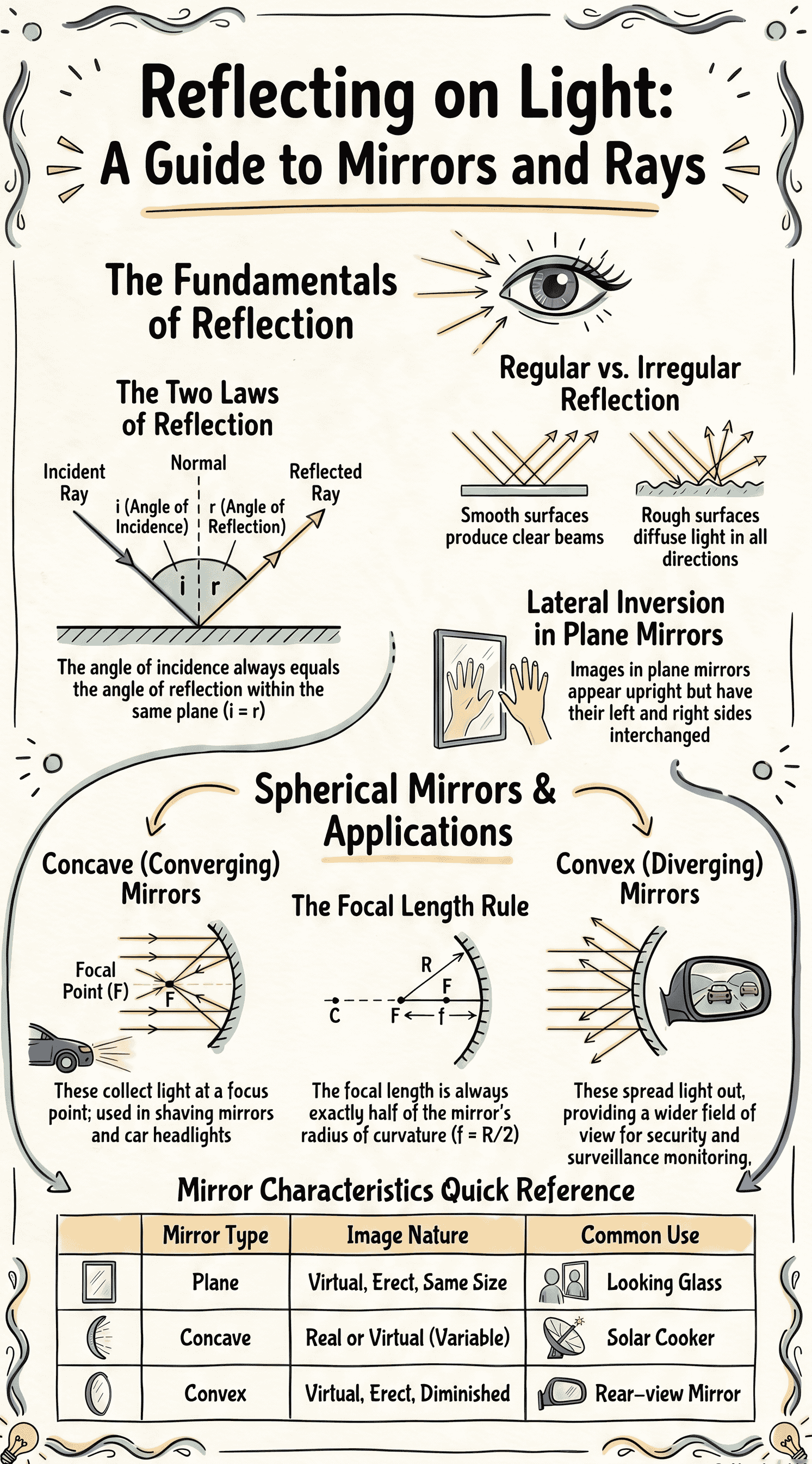
- Regular Reflection: Occurs when a parallel beam of light falls on a smooth, highly polished surface (like a plane mirror) and reflects as a parallel beam in a fixed direction.
- Irregular (Diffused) Reflection: Occurs when light falls on a rough surface. The rays reflect in different directions, enabling us to see everyday objects from any angle.
- Laws of Reflection:
- The angle of incidence is exactly equal to the angle of reflection.
- The incident ray, the reflected ray, and the normal at the point of incidence all lie in the same plane.
2. Real vs. Virtual Images
- Real Image: Formed by the actual intersection of reflected rays. It can be obtained on a screen and is always inverted with respect to the object.
- Virtual Image: Formed when reflected rays do not actually intersect but appear to meet when produced backwards. It cannot be obtained on a screen and is always erect.
3. Images Formed by a Plane Mirror
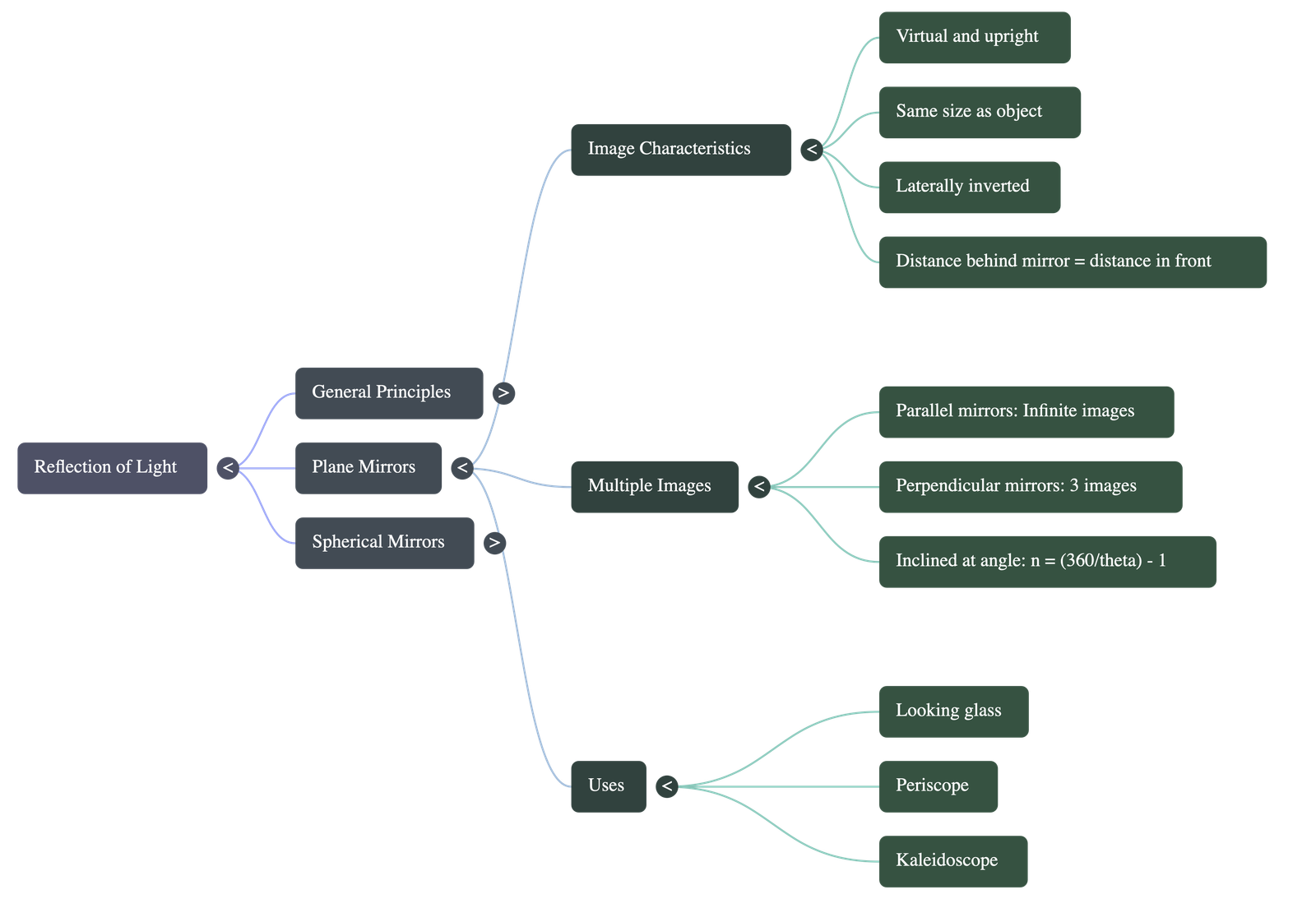
- Position: The image is situated at the same perpendicular distance behind the mirror as the object is in front of it.
- Characteristics of the Image: It is virtual, upright (erect), and exactly the same size as the object.
- Lateral Inversion: The interchange of the left and right sides in the image compared to the object. For example, the right hand appears as the left hand in the mirror, and words like "AMBULANCE" are written laterally inverted on vehicles so they read correctly in rear-view mirrors.
4. Multiple Images in Inclined Plane Mirrors
- The number of images formed depends on the angle between the two mirrors.
- Parallel Mirrors: Form an infinite number of images due to multiple reflections.
- Perpendicular Mirrors: Form exactly 3 images.
5. Spherical Mirrors
- Definition: A reflecting surface that is a part of a hollow glass sphere.
- Types:
- Concave Mirror: Silvered on the outer (bulging) surface; reflection takes place from the inner hollow surface.
- Convex Mirror: Silvered on the inner surface; reflection takes place from the outer bulging surface.
- Key Terms:
- Pole: The geometric centre of the spherical reflecting surface.
- Centre of Curvature: The centre of the sphere of which the mirror is a part.
- Principal Axis: The straight line joining the pole to the centre of curvature.
- Focus: The point on the principal axis where parallel rays actually converge (concave) or appear to diverge from (convex) after reflection.
- Relationship: For spherical mirrors, the focal length is exactly half of its radius of curvature.
6. Image Formation by Spherical Mirrors
- Concave Mirrors: Form different types of images based on object placement.
- Object at infinity: Real, inverted, highly diminished image at the focus.
- Object beyond the centre of curvature: Real, inverted, diminished image.
- Object at the centre of curvature: Real, inverted image of the exact same size.
- Object very close to the mirror (between focus and pole): Virtual, erect, and magnified image behind the mirror.
- Convex Mirrors: Regardless of where the object is placed in front of a convex mirror, the image is always virtual, upright (erect), and diminished, located behind the mirror between the pole and focus.
7. Rules and Formulae
Cartesian Sign Convention:
- All distances are measured from the pole (origin).
- Distances measured in the direction of incident light are positive; those measured opposite are negative.
- Distances above the principal axis are positive; those below are negative.
- The focal length of a concave mirror is negative, and for a convex mirror, it is positive.
- Mirror Formula: Relates object distance, image distance, and focal length.
- Linear Magnification: The ratio of the length of the image to the length of the object. It is negative for real (inverted) images and positive for virtual (erect) images.
8. Practical Uses of Mirrors
- Plane Mirrors: Used as looking glasses, in periscopes (two mirrors at 45°), kaleidoscopes (three mirrors at 60°), and in opticians' rooms to effectively double the length of the room.
- Concave Mirrors:
- Used as shaving/makeup mirrors because they produce a magnified, upright image when the face is held close.
- Used as reflectors in torches, searchlights, and vehicle headlights to obtain a powerful parallel beam of light.
- Used by doctors (head mirror) to concentrate light onto body parts like teeth, throat, and ears.
- Convex Mirrors:
- Used as rear-view mirrors in vehicles because they always form an erect image and provide a much wider field of view compared to plane mirrors.
- Used as reflectors in street lamps to diverge light over a larger area.
Do checkout all questions & answers of this chapter.
Quick Navigation:
| | | |
1 / 1
Quick Navigation:
| | | |