Quick Navigation:
| | | |
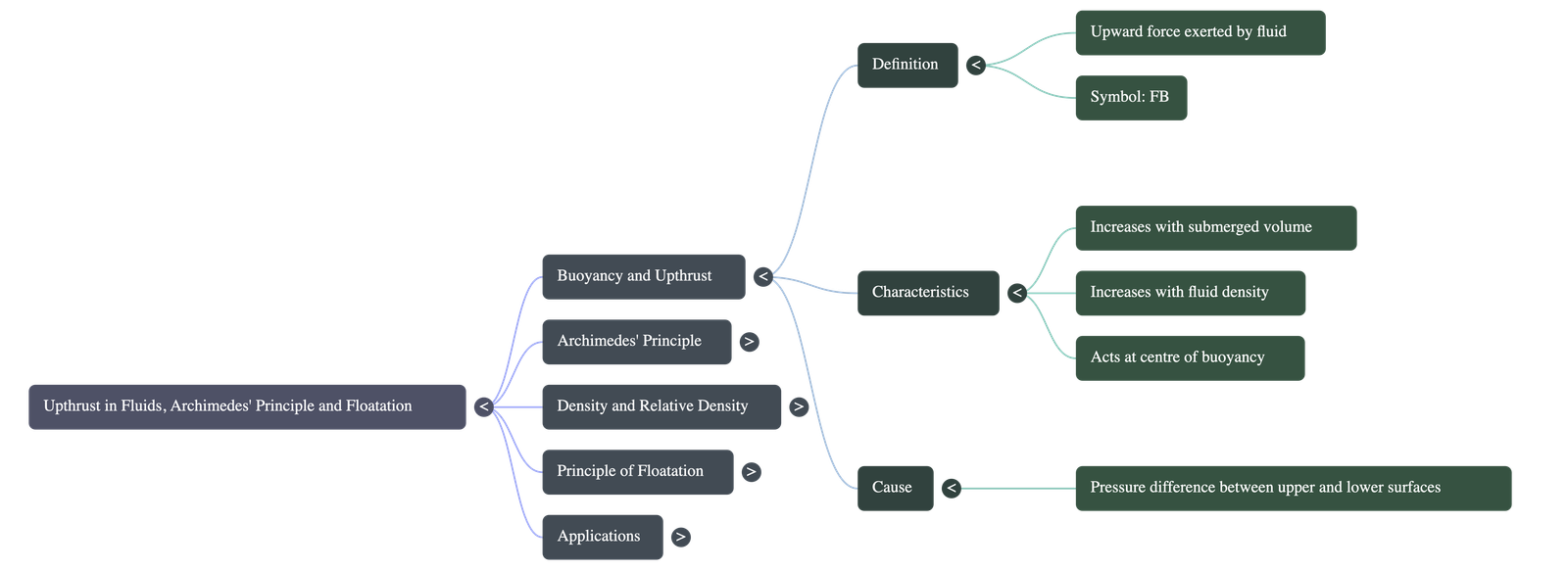
Upthrust in Fluids, Archimedes' Principle and Floatation
Part A: Upthrust and Archimedes' Principle
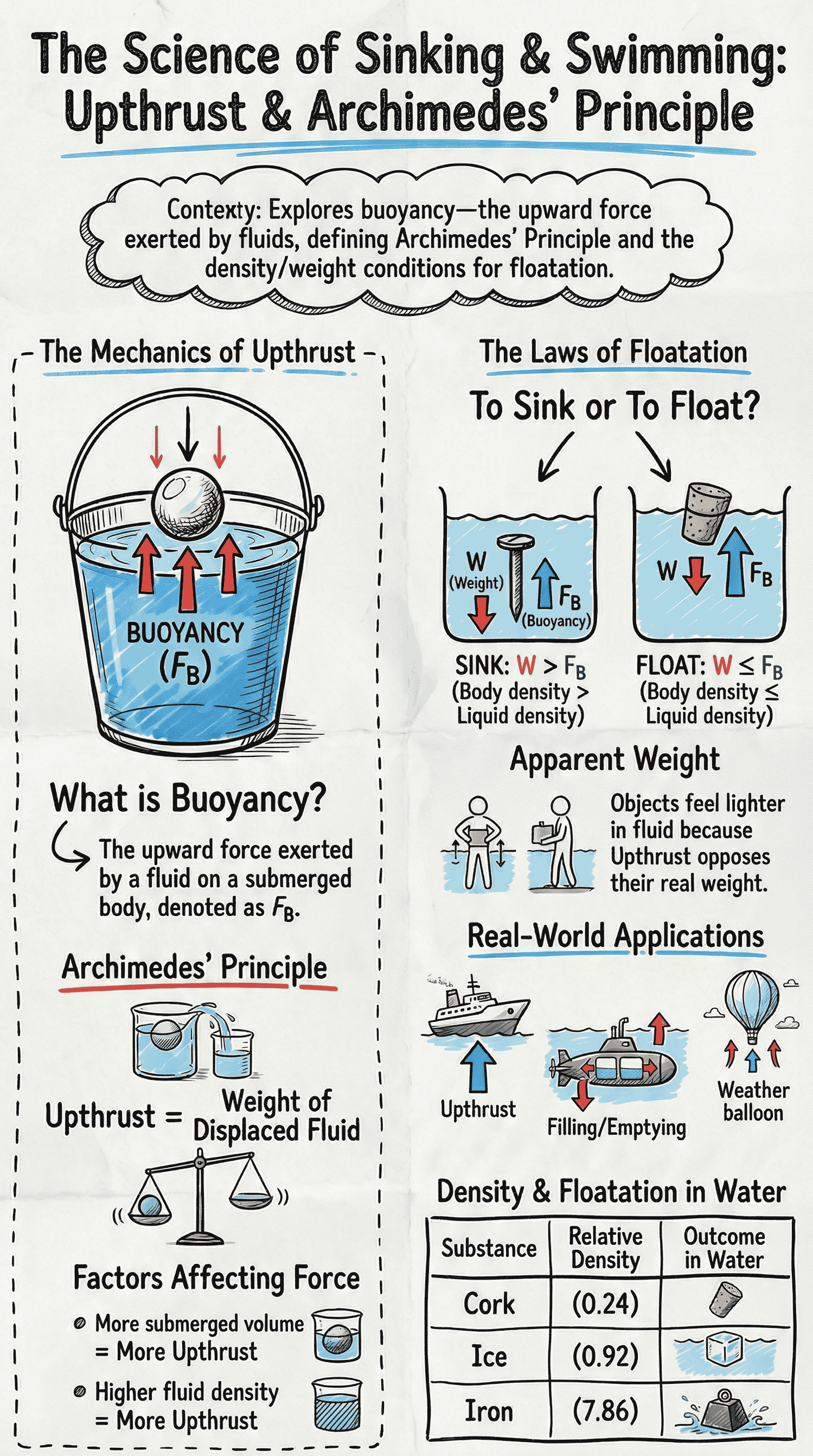
- Buoyancy and Upthrust: When a body is partially or wholly immersed in a fluid, it experiences an upward force known as upthrust or buoyant force. This upward force causes the object to feel lighter (apparent weight).
- Cause of Upthrust: It occurs due to the pressure difference between the lower and upper surfaces of an immersed body. The fluid pressure is higher at greater depths, creating a net upward force.
- Characteristics of Upthrust:
- It increases as the submerged volume of the body increases.
- It is directly proportional to the density of the fluid.
- It acts upward through the center of buoyancy, which is the center of gravity of the displaced fluid.
- Archimedes' Principle: States that when a body is partially or completely immersed in a fluid, it experiences an upthrust exactly equal to the weight of the fluid displaced by its submerged part.
- Sinking vs. Floating:
- If the weight of the body is greater than the maximum upthrust, the body sinks.
- If the weight is equal to the maximum upthrust, it floats fully immersed.
- If the weight is less than the maximum upthrust, it floats partially submerged.
Part B: Relative Density and its Measurement
- Density: Defined as mass per unit volume. The maximum density of water occurs at 4°C (1 g/cm³ or 1000 kg/m³). Most substances expand on heating, which causes their density to decrease.
- Relative Density (R.D.): The ratio of the density of a substance to the density of water at 4°C. Because it is a ratio of similar physical quantities, it is a pure scalar number and has no unit.
- Measurement using Archimedes' Principle:
- For Solids: R.D. is found by dividing the weight of the solid in air by its loss of weight in water.
- For Liquids: R.D. is measured by taking a solid reference object, calculating the weight it loses when submerged in the target liquid, and dividing that by the weight it loses when submerged in water.
Part C: Floatation
- Principle of Floatation: The weight of a floating body is exactly equal to the weight of the liquid displaced by its submerged part. Consequently, the apparent weight of any floating body is zero.
- Volume Relationship: When floating, the fraction of the body's volume that is immersed is equal to the ratio of the density of the body to the density of the liquid.
- Key Applications & Natural Phenomena:
- Ships: An iron ship floats because it is hollow, making its average density lower than water. An unloaded ship has a higher center of gravity, which is stabilized by adding ballast at the bottom.
- Density of Water Types: A ship submerges more when entering river water from the sea because river water is less dense than sea water. The Plimsoll line marks the safe loading limit for different waters.
- Swimming: It is easier to swim in sea water or the Dead Sea because the high salt concentration increases water density, providing much stronger upthrust.
- Submarines: Can dive by filling ballast tanks with water to increase average density. They rise by using compressed air to force the water out of the tanks.
- Icebergs: Ice is slightly less dense than water, meaning huge icebergs float with nearly 90% of their mass submerged, creating unseen dangers for passing ships.
- Melting Ice: When a piece of floating ice melts in a glass of water, it contracts by the exact volume it was displacing, so the water level remains unchanged.
- Balloons: Balloons filled with light gas (like helium or hydrogen) rise due to strong air upthrust. They stop rising once they reach an altitude where the thinner surrounding air balances their total weight.
- Fish: Many fish regulate buoyancy using a swim bladder. By inflating or deflating it, they alter their average density to float higher or dive deeper.
Do checkout all questions & answers of this chapter.
Quick Navigation:
| | | |
1 / 1
Quick Navigation:
| | | |