Quick Navigation:
| | | | |
Quick Navigation:
| | | | |
This is a point-wise summary of Chapter 7, "Nervous System":
1. Coordination in the Body
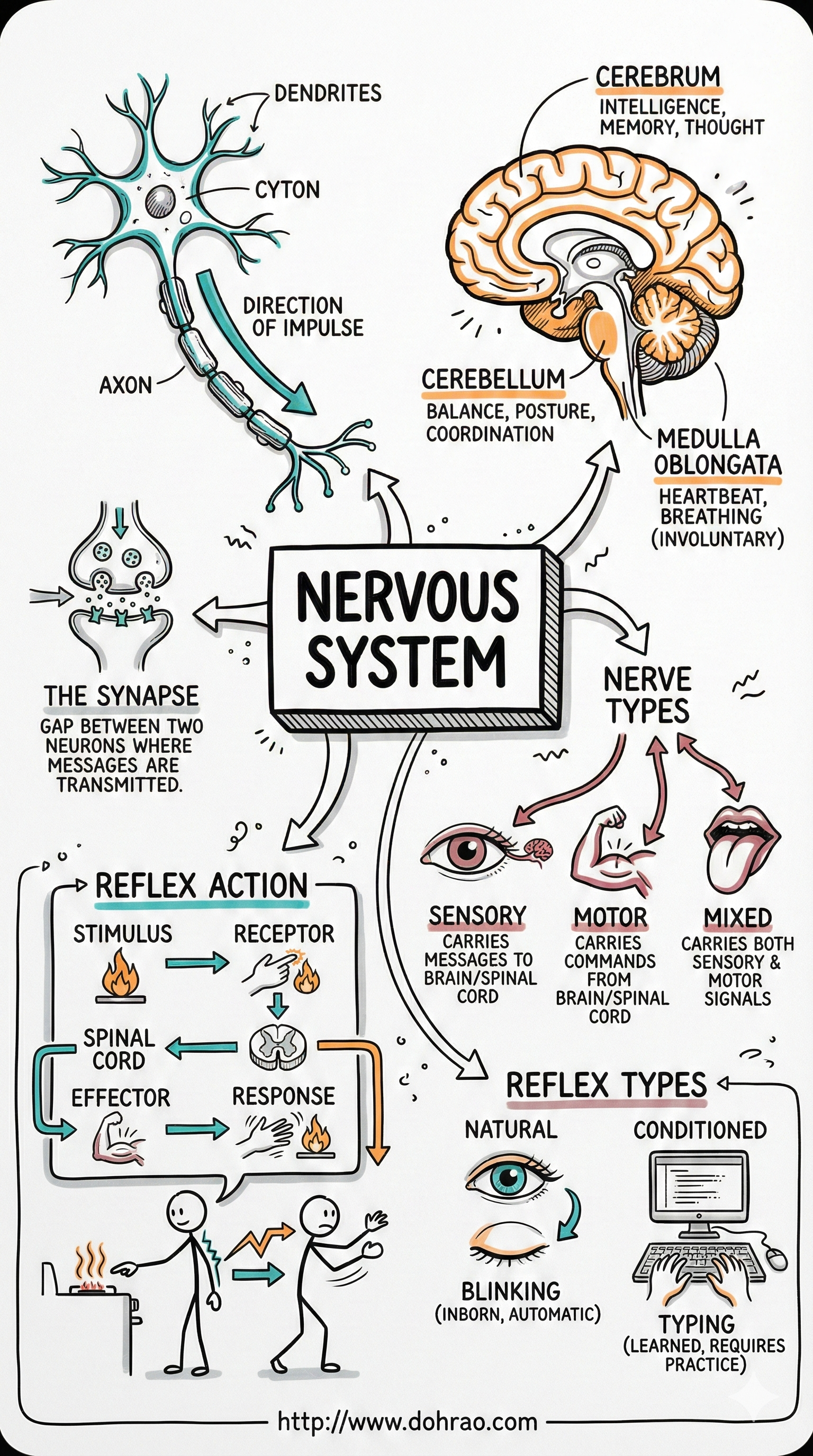
- Coordination is the interaction of various life processes to meet the body's internal and external needs.
- It is categorized into two types: Nervous coordination (brought about by the nervous system) and Chemical coordination (managed through hormones).
2. The Neuron: The Structural and Functional Unit
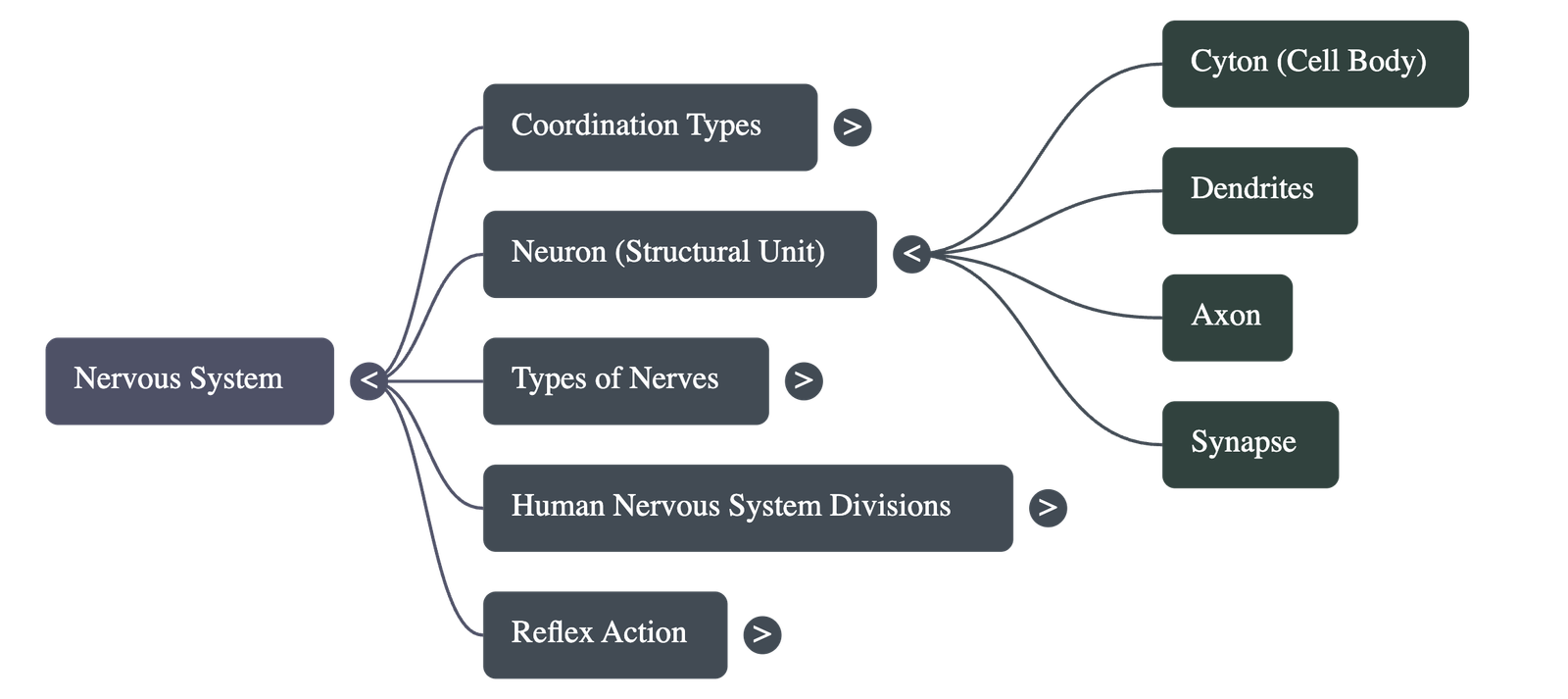
- The nervous system is composed of special cells called neurons or nerve cells.
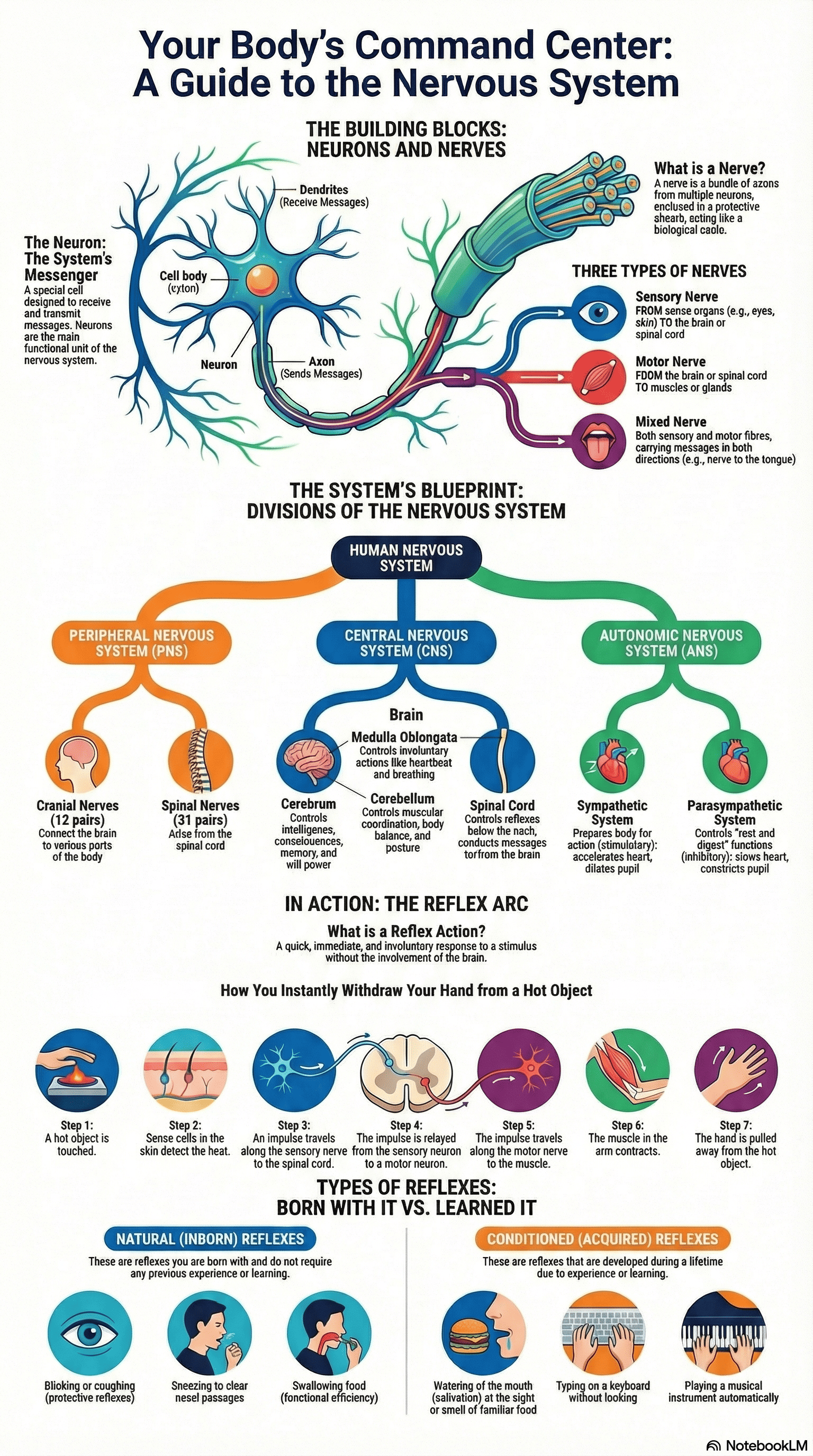
- A neuron has two main parts: the cyton (cell body), which contains the nucleus and dendrites, and the axon, a long process that transmits messages away from the cell body.
- The point of contact where a message is transmitted from the axon of one neuron to the dendrites of another is called a synapse.
3. Nerves and Basic Terminology
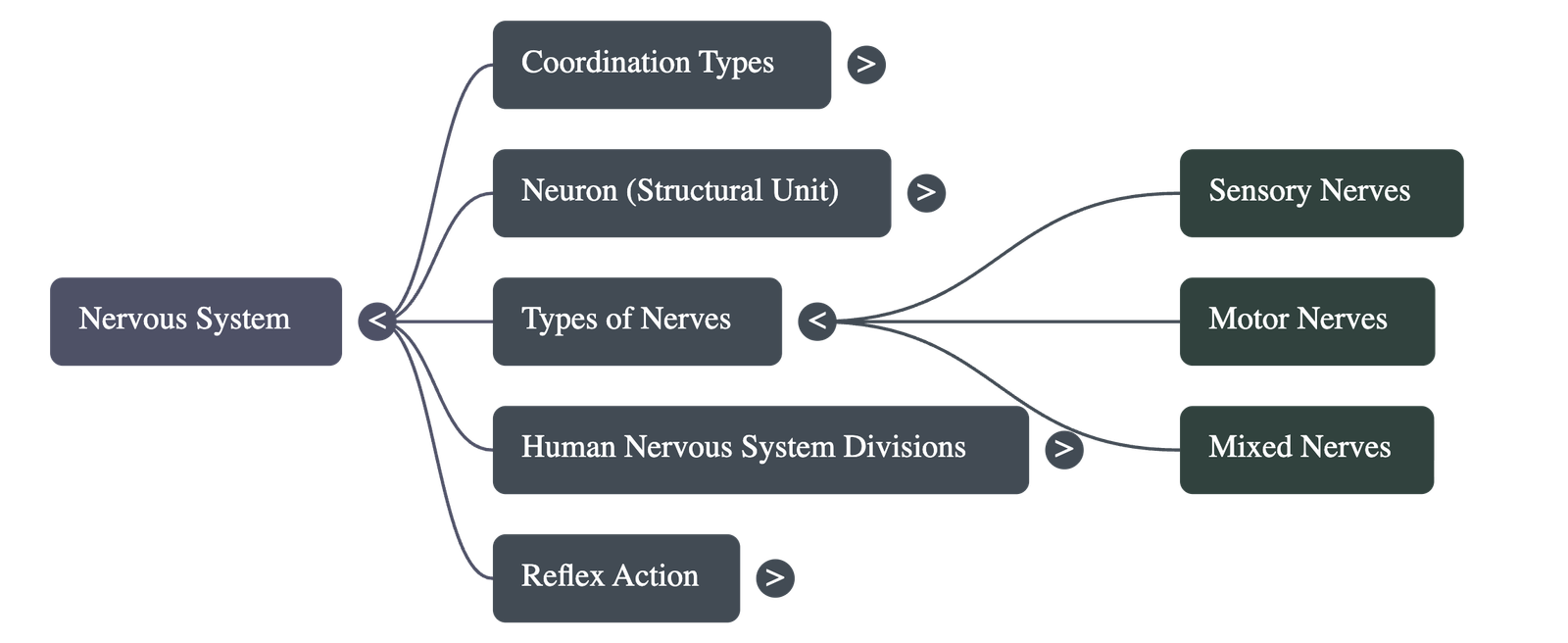
- Nerves are bundles of axons enclosed in a tubular medullary sheath. They are classified into three types:
- Sensory nerves: Bring impulses from sense organs to the brain or spinal cord.
- Motor nerves: Carry impulses from the brain or spinal cord to muscles or glands.
- Mixed nerves: Carry both sensory and motor fibers.
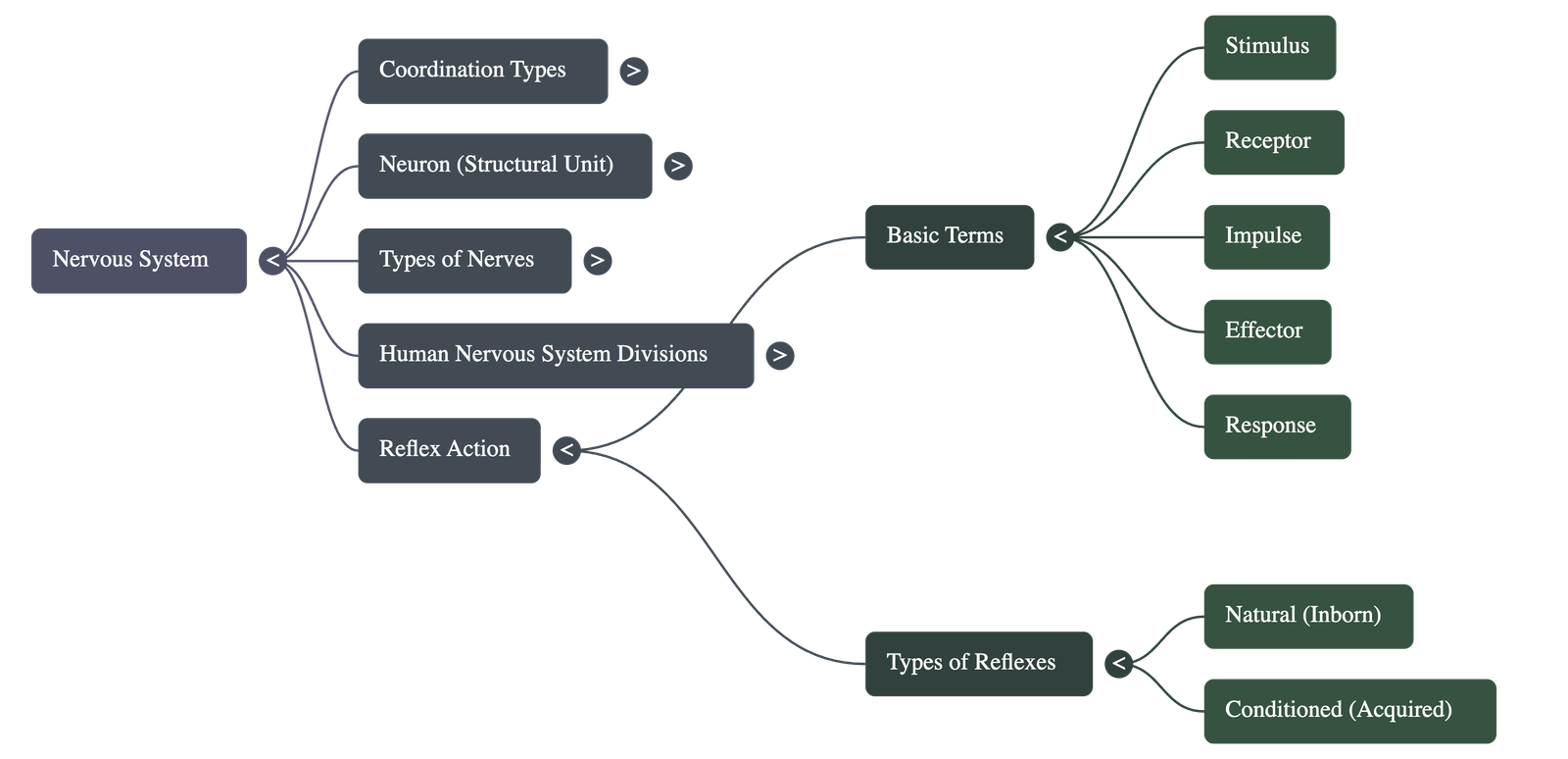
- Key functional terms include stimulus (environmental change), impulse (electrical disturbance), receptors (sense organs), and effectors (muscles or glands).
4. Divisions of the Nervous System
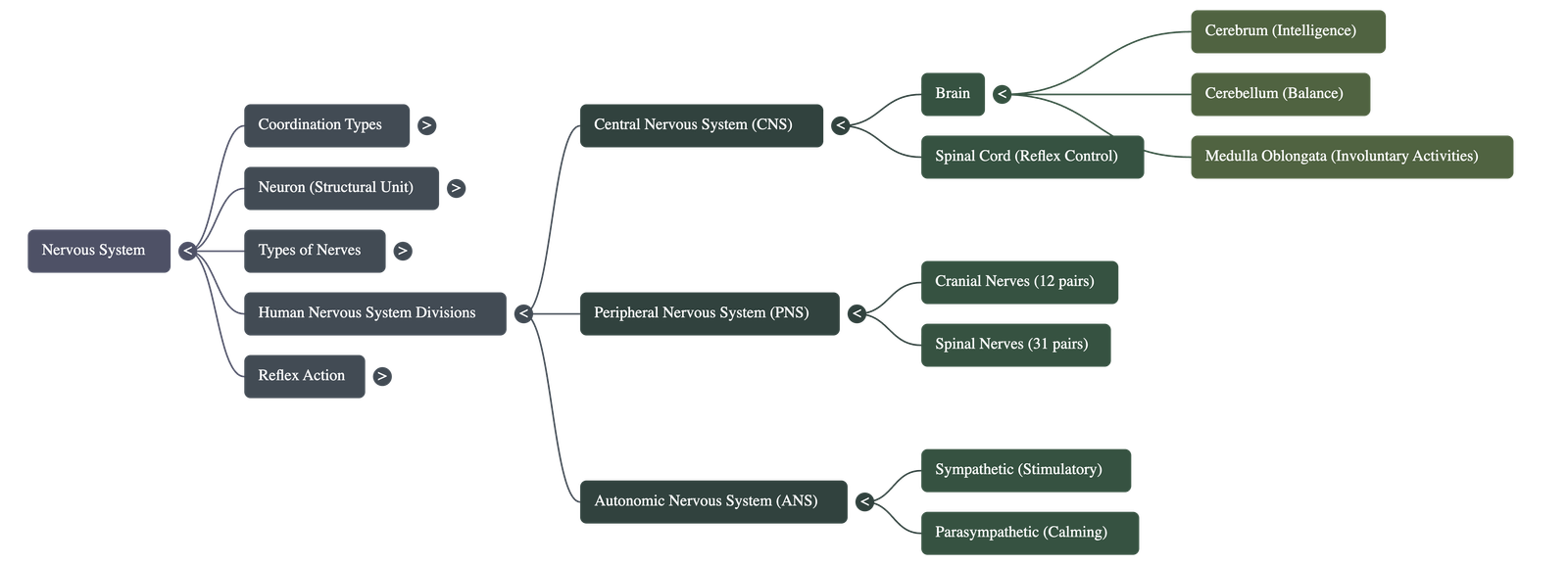
The human nervous system is divided into three main parts:
- Central Nervous System (CNS): Consists of the brain and spinal cord.
- Peripheral Nervous System (PNS): Consists of nerves passing to and from the CNS, including 12 pairs of cranial nerves and 31 pairs of spinal nerves.
- Autonomic Nervous System (ANS): Controls involuntary internal functions through the sympathetic (stimulatory) and parasympathetic (calming) systems.
5. The Brain and Spinal Cord
- The Brain: Divided into three major parts:
- Cerebrum: The largest part; the seat of intelligence, consciousness, and will power. It features an outer "grey matter" and inner "white matter".
- Cerebellum: Located under the cerebrum; it coordinates muscular activities and body balance.
- Medulla Oblongata: The lowest part; it controls involuntary activities like heartbeat and breathing.
- The Spinal Cord: Extends from the medulla; it conducts messages to and from the brain and controls reflexes below the neck.
6. Reflex Actions
- A reflex action is a quick, immediate response to a stimulus that does not involve the brain.
- The pathway of a reflex involves: Stimulus $\rightarrow$ Receptor $\rightarrow$ Sensory Neuron $\rightarrow$ Spinal Cord $\rightarrow$ Motor Neuron $\rightarrow$ Effector $\rightarrow$ Response.
- Reflexes are classified as:
- Natural (Inborn): No learning required (e.g., blinking, coughing, salivating when eating).
- Conditioned (Acquired): Developed through experience or learning (e.g., typing, playing an instrument, or salivating at the mere smell of familiar food).
Analogy for Understanding the Nervous System: To understand how the nervous system functions, imagine a large fiber-optic communication network. The brain acts as the main server (the CNS) that processes data and makes decisions. The nerves are the fiber-optic cables (the PNS) that carry data back and forth. Reflex actions are like local automated safety switches: if a circuit overheats, the power is cut instantly at the local box (the spinal cord) without needing to wait for instructions from the main server in another building.
Do checkout all questions & answers of this chapter.
Quick Navigation:
| | | | |
1 / 1
Quick Navigation:
| | | | |