Quick Navigation:
| | | | |
Quick Navigation:
| | | | |
This chapter provides a detailed overview of how plants reproduce through both asexual and sexual methods, as well as the mechanisms they use to spread their offspring.
Modes of Reproduction
- Reproduction is defined as the process by which living organisms produce individuals of their own kind to ensure the survival of their species.
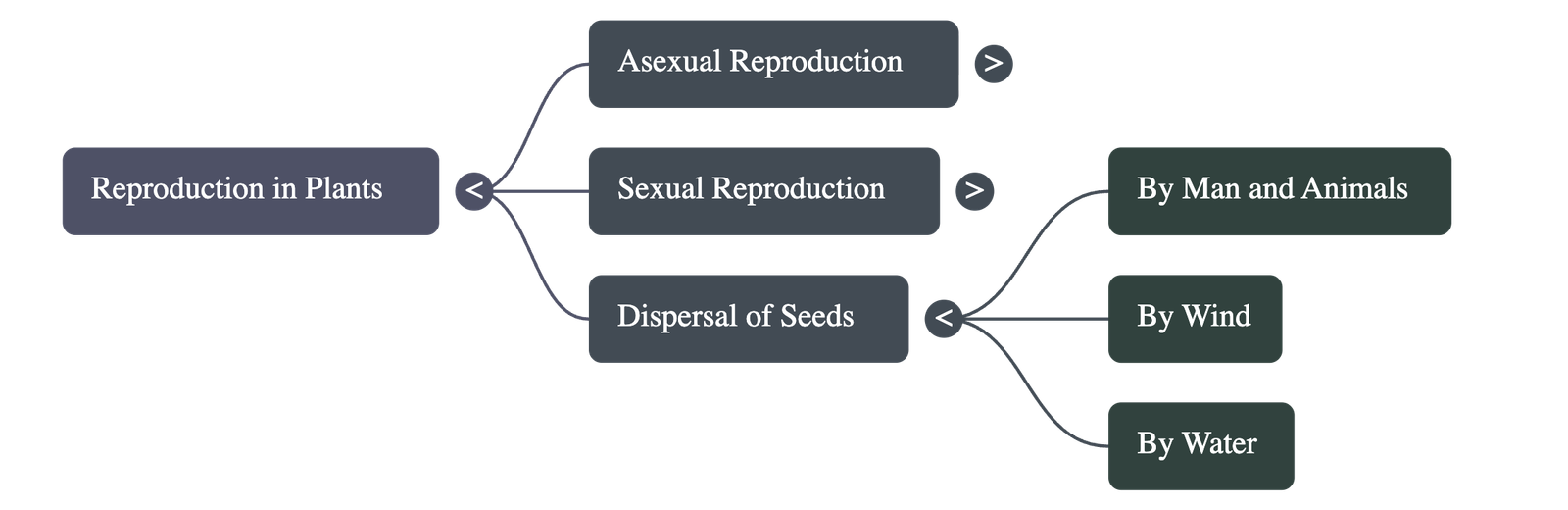
- There are two primary modes of reproduction in plants: Asexual (or Vegetative) and Sexual.
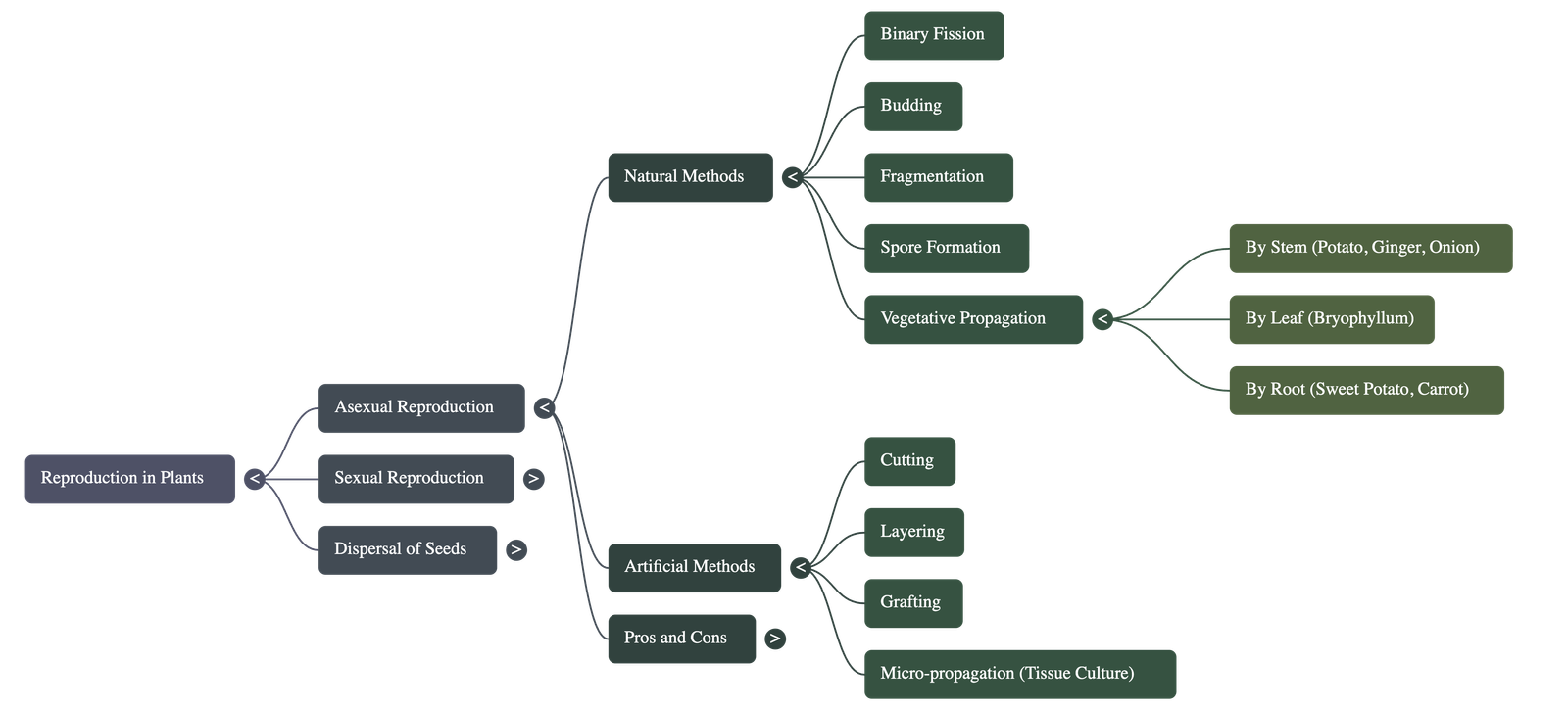
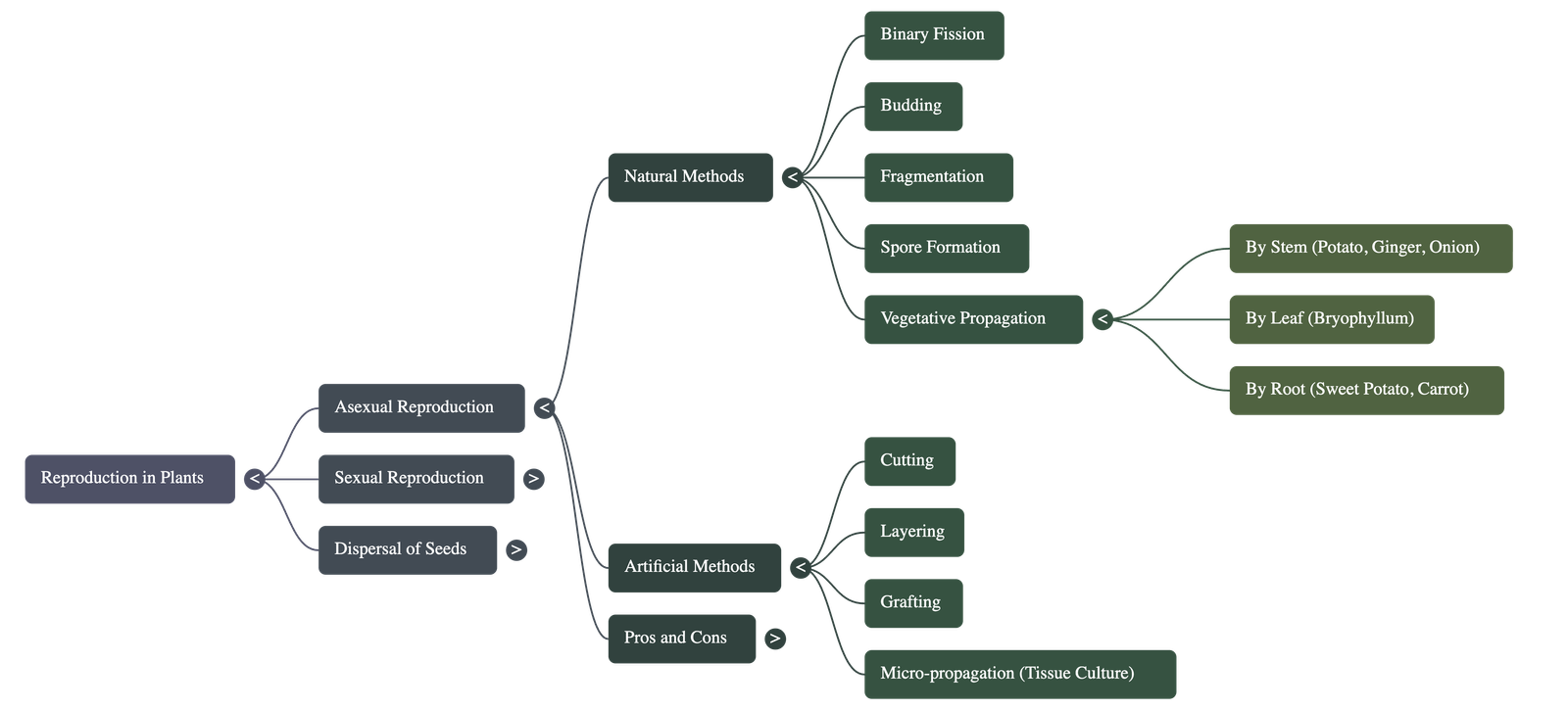
Asexual Reproduction Methods
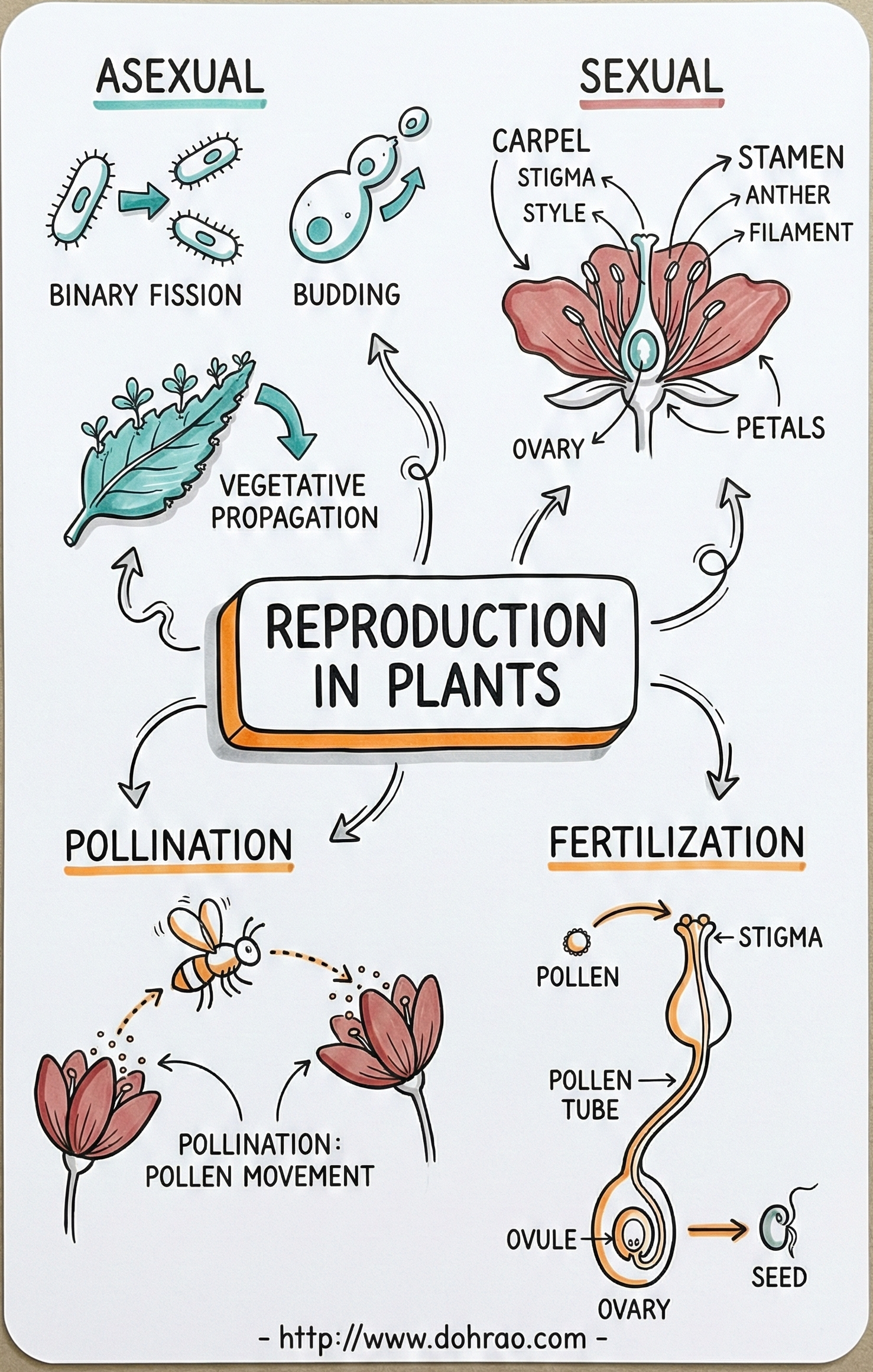
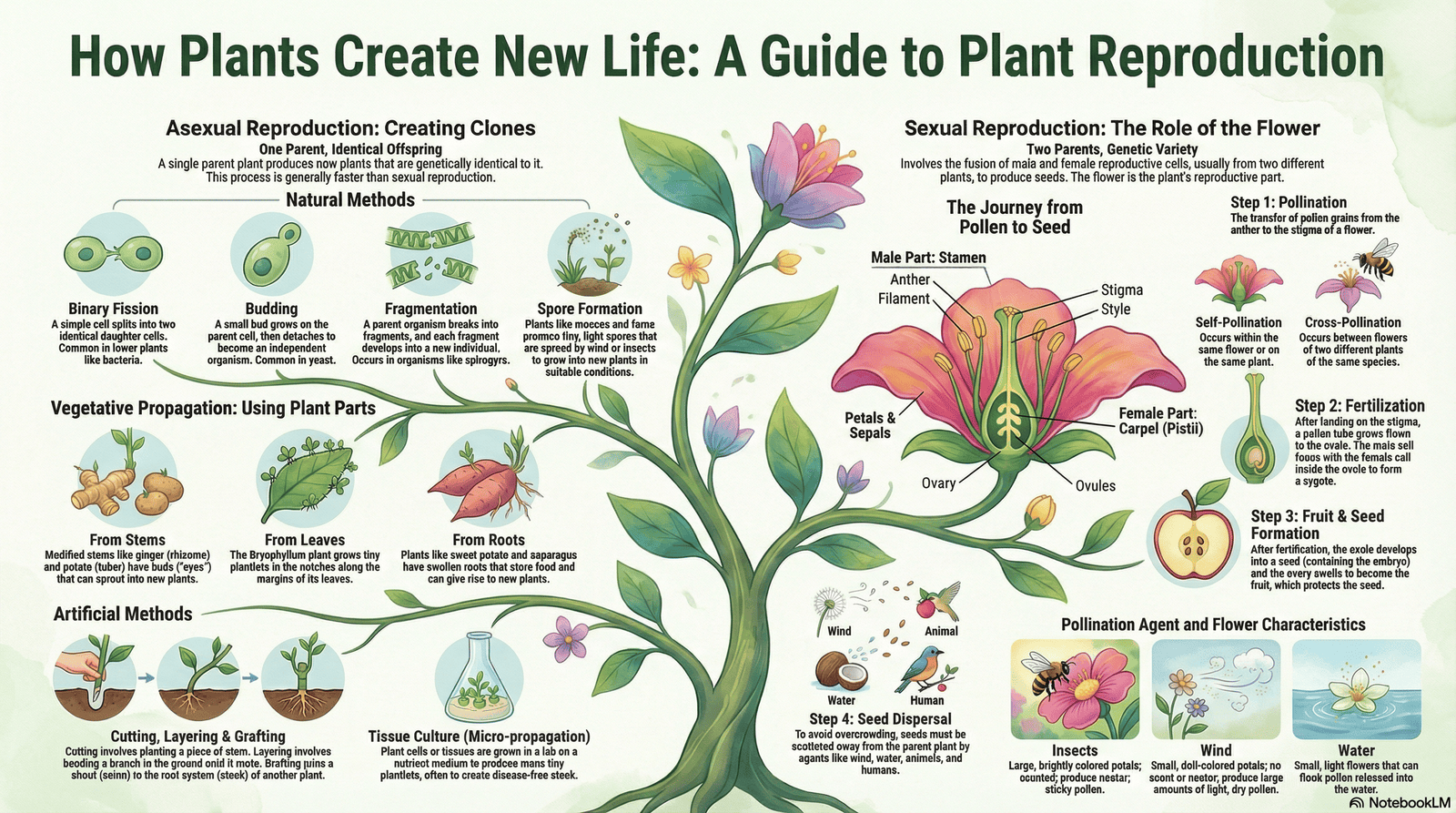
- Binary Fission: Common in lower plants like bacteria, where a single nucleus and cell split into two identical daughter cells.
- Multiple Fission: Occurs in organisms like Chlorella, where one cell divides into four daughter cells.
- Budding: In yeast, the parent cell produces an outgrowth called a bud that eventually detaches to lead an independent life.
- Fragmentation: Organisms like Spirogyra break into two or more parts, each of which grows into a new individual.
- Spore Formation: Mosses and ferns produce light spores on the underside of their leaves, which are carried by wind or insects to grow into new plants under suitable conditions.
Vegetative Propagation
- Natural Vegetative Reproduction: New plants are produced from vegetative parts called propagules, such as stems (potato, ginger, onion), roots (sweet potato, carrot), and leaves (Bryophyllum),,,.
- Artificial Propagation: Farmers and horticulturists use techniques like cutting (sugarcane), layering (jasmine, mint), grafting (mango, rose), and micro-propagation (tissue culture) to grow plants,.
- Micro-propagation: This involves growing plant cells or tissues in a nutrient medium to form a callus, which then differentiates into tiny plantlets; this method is used to multiply disease-free stock rapidly,.
- Advantages and Disadvantages: Vegetative reproduction is faster and produces identical offspring, but it can lead to overcrowding and makes the entire population susceptible to the same diseases.
Sexual Reproduction and Flower Structure
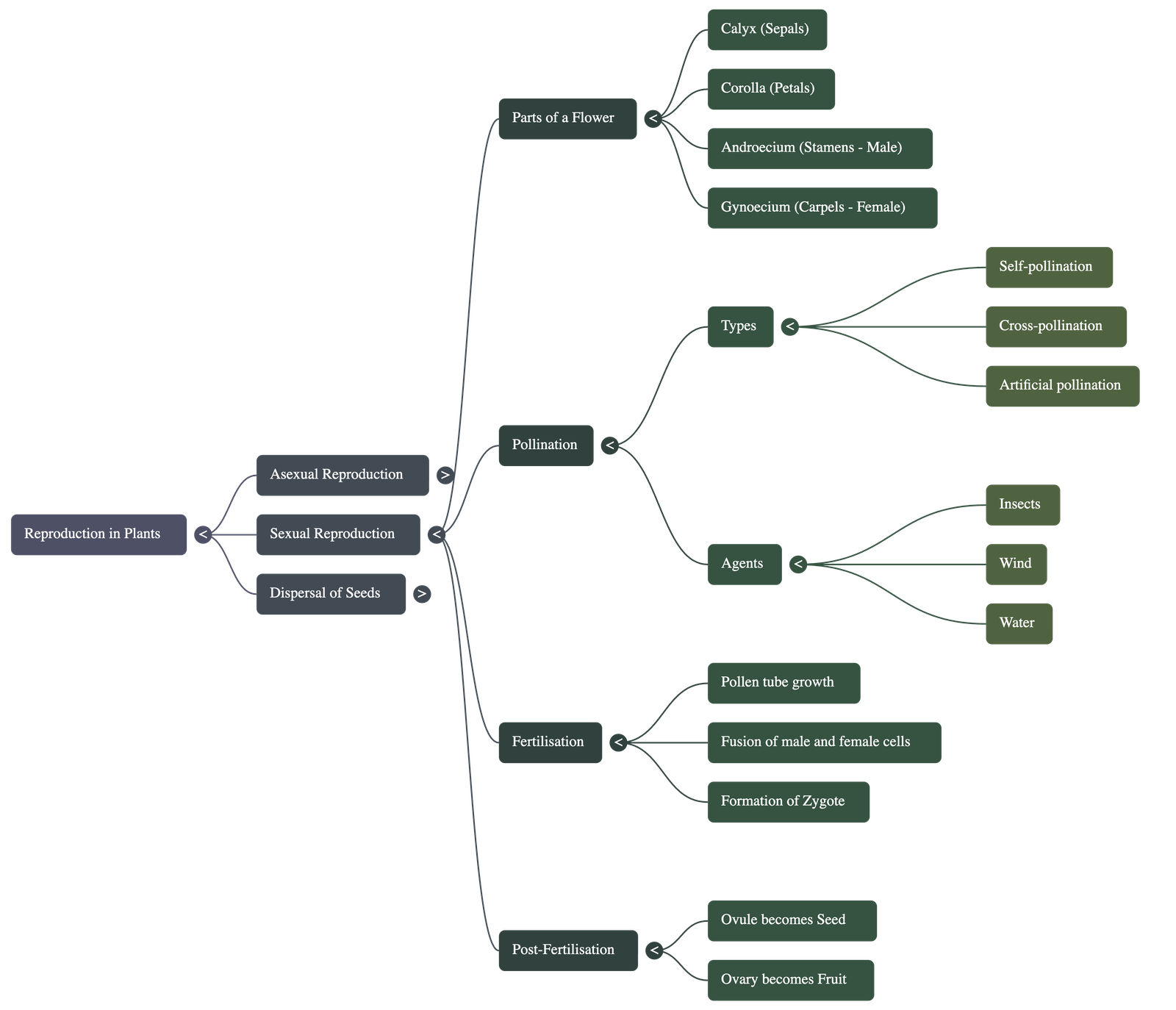
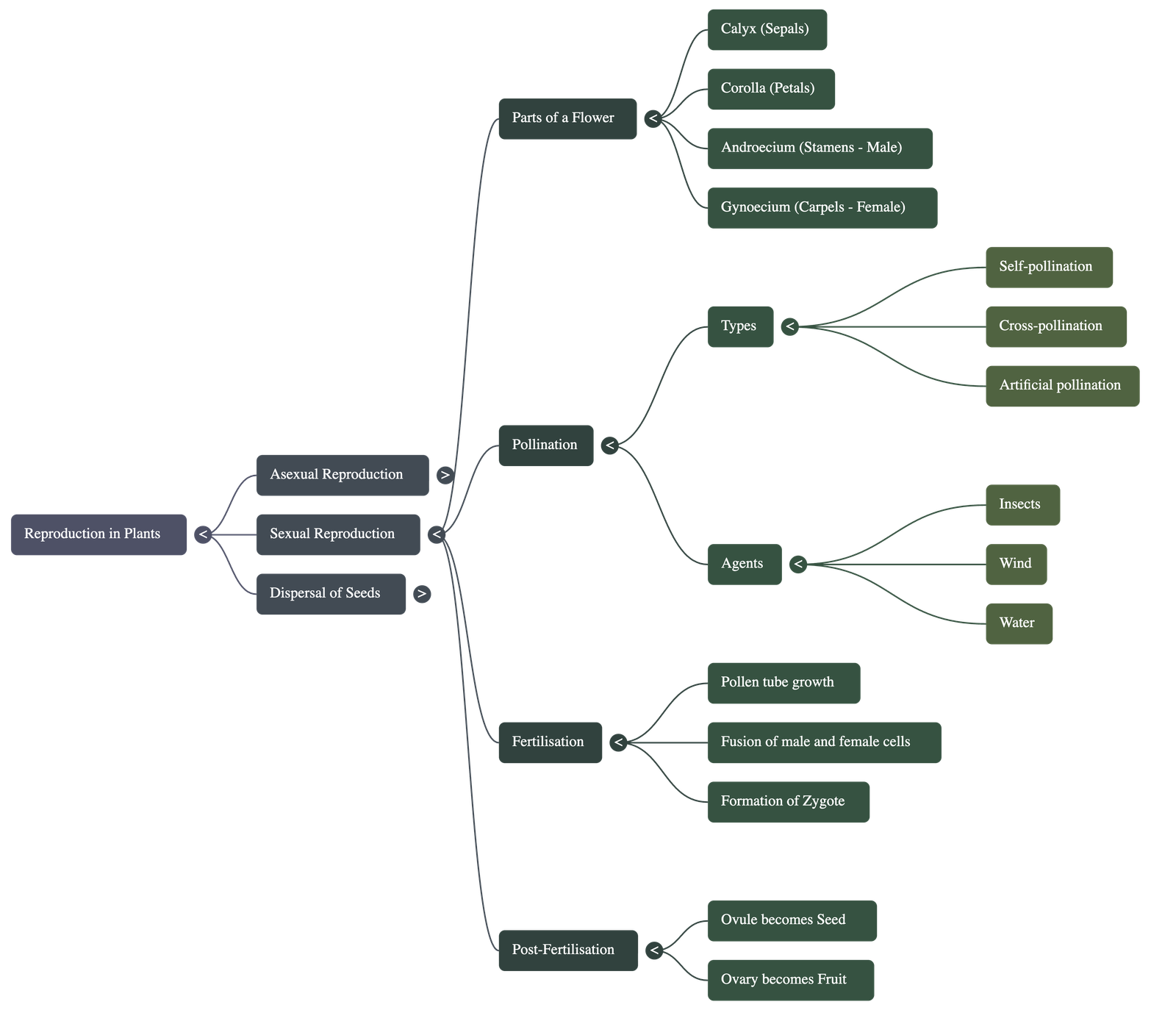
- The flower is the reproductive organ of the plant, typically consisting of four whorls: sepals (calyx), petals (corolla), stamens (male part), and carpels/pistils (female part),.
- Stamens consist of a filament and an anther, which produces pollen grains,.
- Carpels consist of the stigma (receptive tip), style (middle tube), and ovary (containing ovules).
- Flowers can be bisexual (containing both male and female parts) or unisexual (containing only one).
Pollination and Fertilisation
- Pollination is the transfer of pollen grains from the anther to the stigma, categorized as self-pollination (within the same plant) or cross-pollination (between different plants of the same species).
- Agents of pollination include insects (attracted by nectar, scent, and color), wind (carrying light, dry pollen), and water (for aquatic plants like Vallisneria),,.
- Fertilisation occurs when a pollen tube grows down the style and enters the ovary, allowing male cells to fuse with female cells to produce a zygote,.
- Post-fertilisation, the ovule becomes a seed and the ovary becomes a fruit.
Fruits, Seeds, and Dispersal
- True vs. False Fruits: While most fruits develop from the ovary, false fruits like apples and strawberries develop from other parts of the flower, such as the base.
- Seed Dispersal: To avoid competition for sunlight and minerals, seeds must be scattered away from the parent plant by wind, water, or animals,.
- Seeds of some fruits, like tomatoes, can even pass through the human digestive system and remain viable for germination later.
To understand pollination and fertilisation, imagine the flower as a busy airport: pollination is the arrival of a passenger (pollen) at the terminal gate (stigma), while fertilisation is that passenger finally boarding the plane (ovule) to begin a new journey as a seed.
Do checkout all questions & answers of this chapter.
Quick Navigation:
| | | | |
1 / 1
Quick Navigation:
| | | | |