Quick Navigation:
| | |
Population
The Significance of Population
- Human beings are the pivotal element in social studies, acting as both producers and consumers of Earth's resources.
- Resources, calamities, and disasters only gain meaning in relation to how they affect human populations.
- The Census of India is the primary source of demographic data, with the first complete census conducted in 1881 and held every ten years since.
Population Size and Distribution
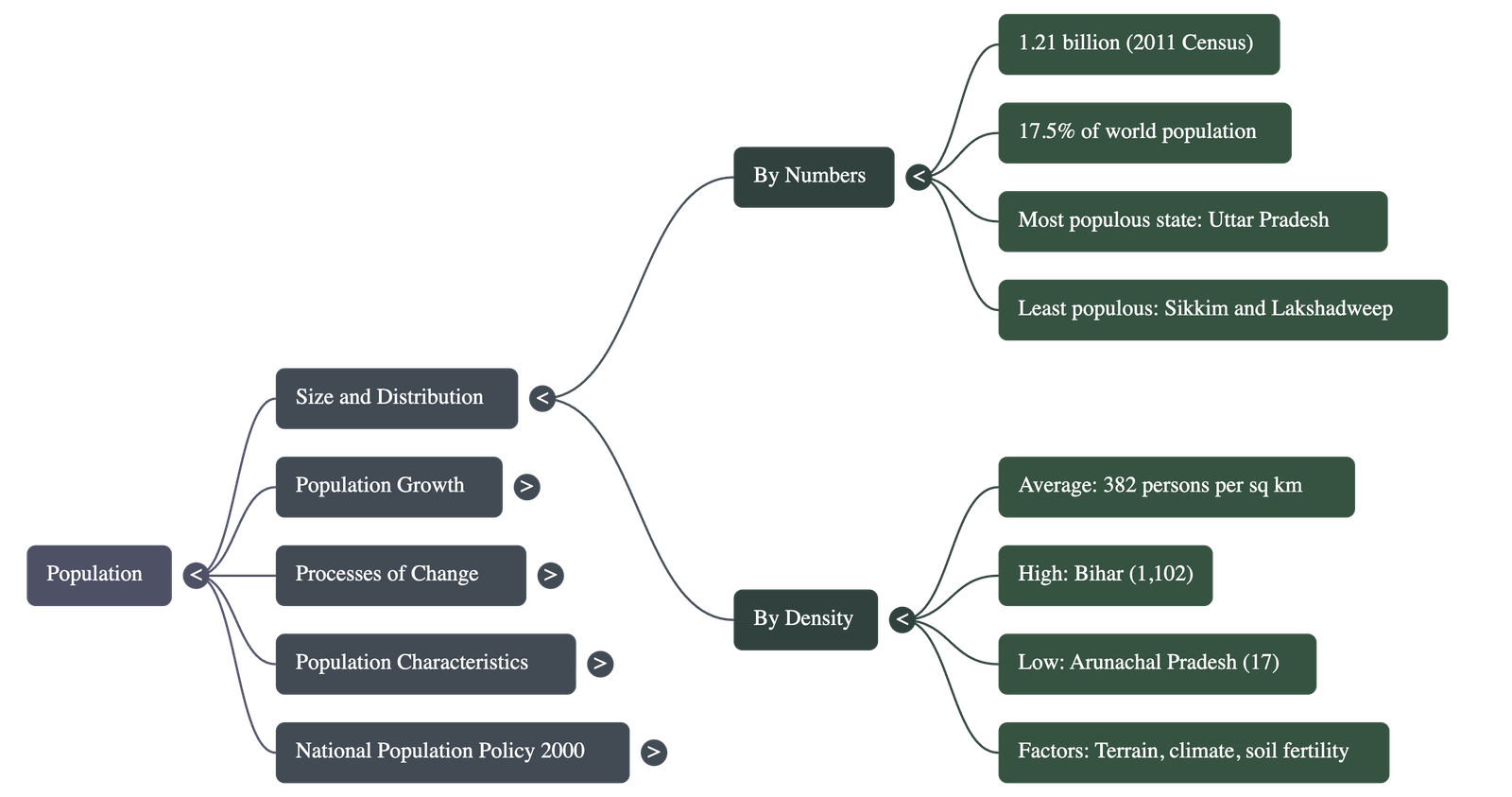
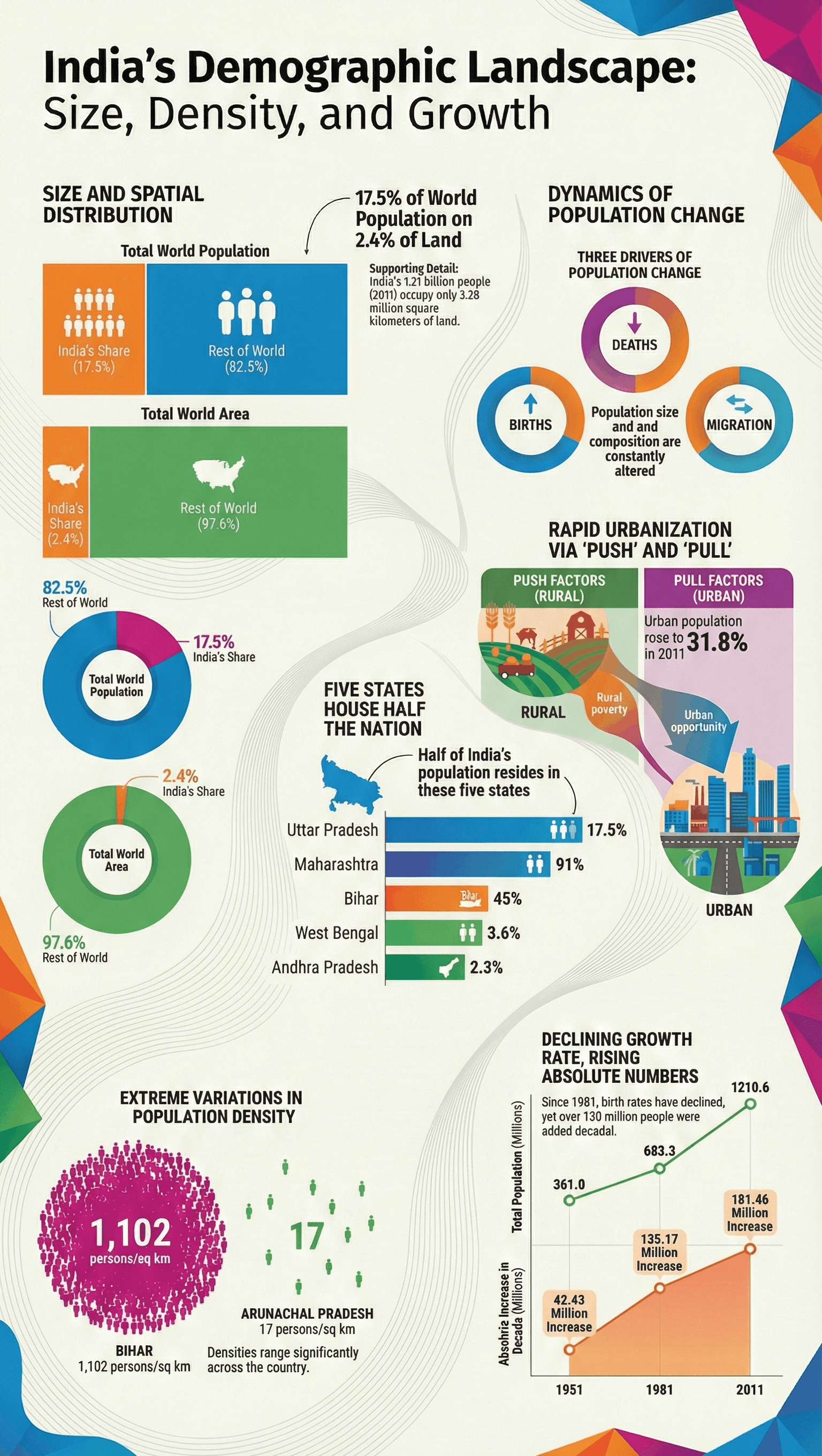
- As of the 2011 Census, India's population was 1,210.6 million, accounting for 17.5% of the world's population.
- India occupies only 2.4% of the world's total land area (3.28 million square km).
- Distribution is highly uneven: Uttar Pradesh is the most populous state (199 million), while Sikkim has only 0.6 million people.
- Nearly half of the country's population resides in just five states: Uttar Pradesh, Maharashtra, Bihar, West Bengal, and Andhra Pradesh.
Population Density
- The average population density of India in 2011 was 382 persons per sq km.
- Density varies drastically from 1,102 persons per sq km in Bihar to just 17 in Arunachal Pradesh.
- Environmental factors play a key role: rugged terrain and harsh climates lead to sparse populations, while flat, fertile plains with high rainfall (like the Northern Plains and Kerala) support high densities.
Processes of Population Change
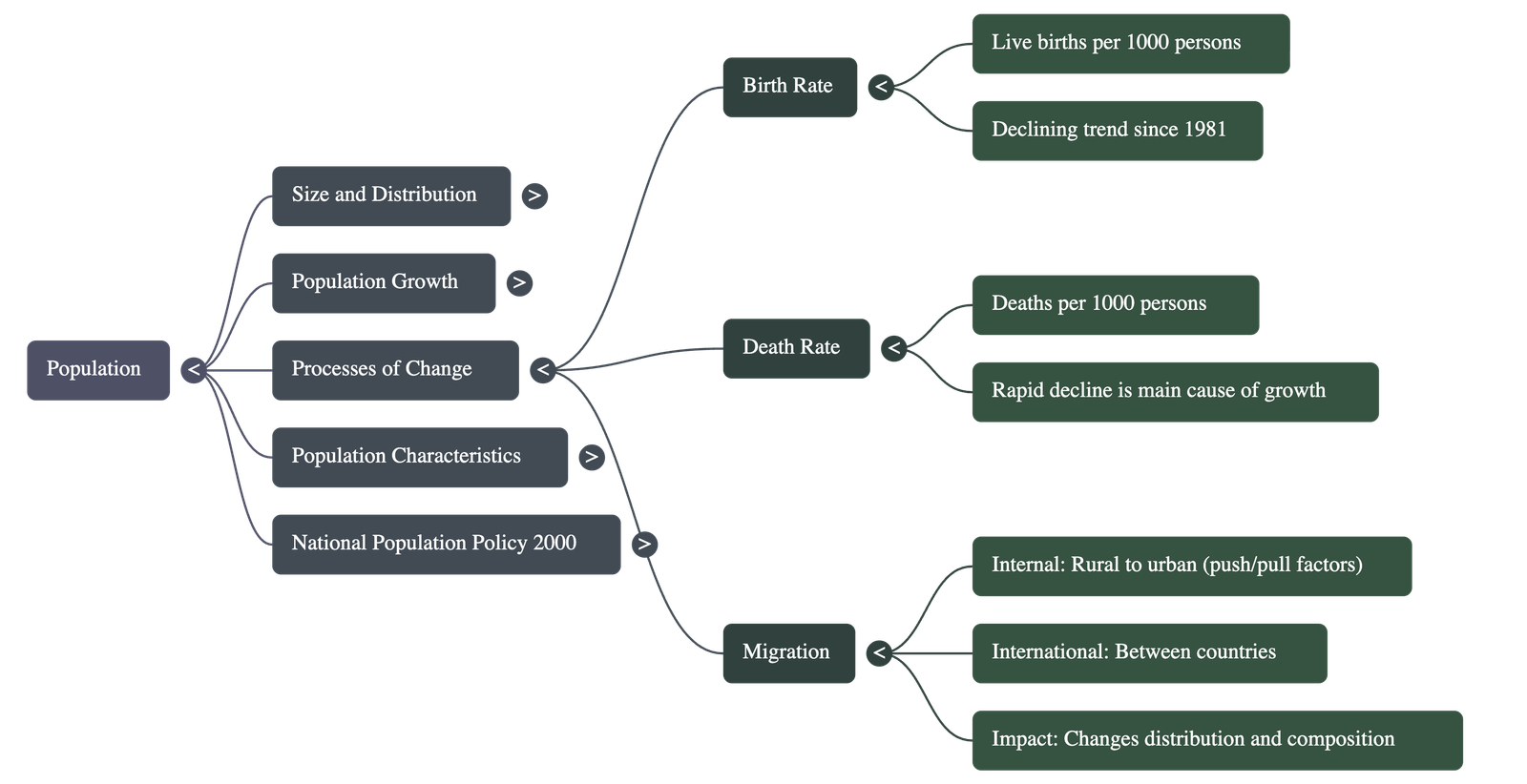
- Population is dynamic, changing through three main processes: Births, Deaths, and Migration.
- Natural Increase: The difference between birth rates and death rates. Historically, India’s high growth was due to rapidly declining death rates while birth rates remained high.
- Migration: Movement within the country (internal) does not change the total population size but significantly alters distribution and composition (age/sex) across regions.
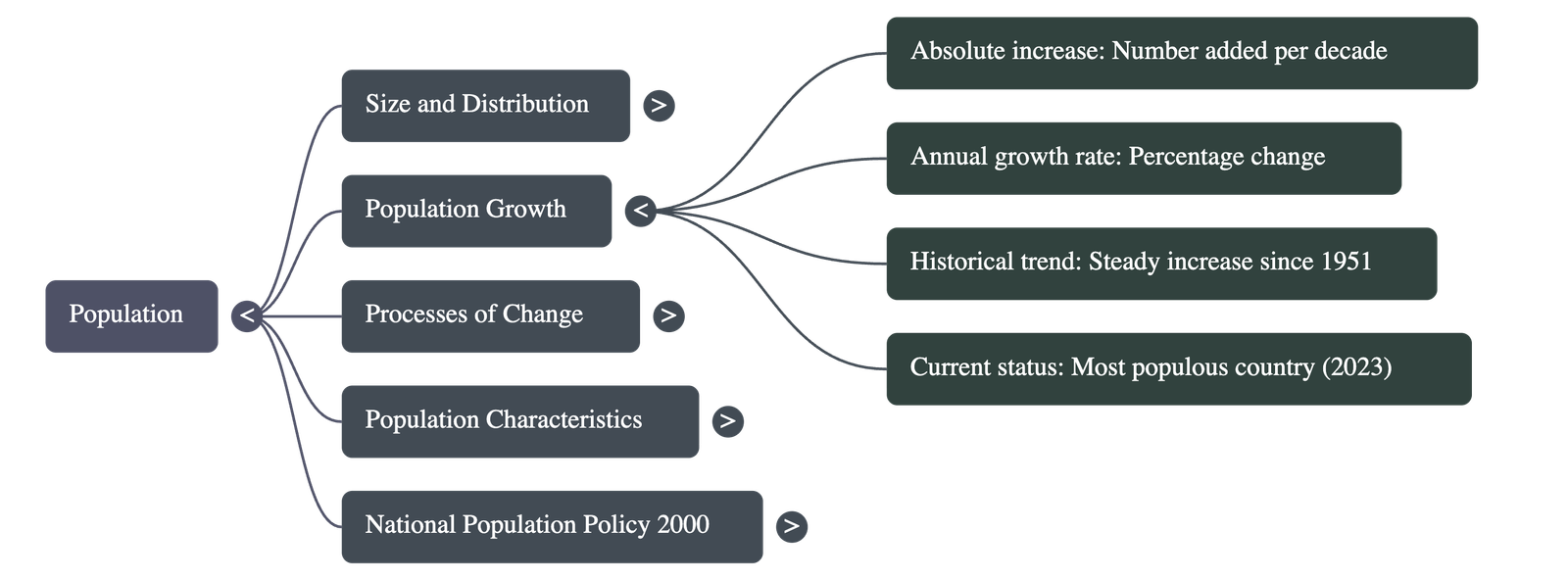
- Growth Trends: Since 1981, birth rates have started declining, leading to a gradual decline in the growth rate, though the absolute increase remains massive.
Adolescent Population and Health
- Adolescents (ages 10–19) constitute one-fifth of India’s population and are the most important resource for the future.
- Nutrition is a major concern; many adolescent girls suffer from anemia, and diets are often inadequate in essential nutrients.
National Population Policy (NPP) 2000
- The NPP 2000 aims to improve individual health and welfare through planned efforts.
- Key objectives include:
- Free and compulsory school education up to 14 years.
- Reducing infant mortality to below 30 per 1,000 live births.
- Achieving universal immunization of children.
- Promoting delayed marriage for girls and making family welfare a people-centered program.
Summary derived from Chapter 6: Population
Do checkout all questions & answers of this chapter.
Quick Navigation:
| | |
1 / 1
Quick Navigation:
| | |