Quick Navigation:
| | |
Natural Vegetation and Wildlife
Introduction to Biodiversity
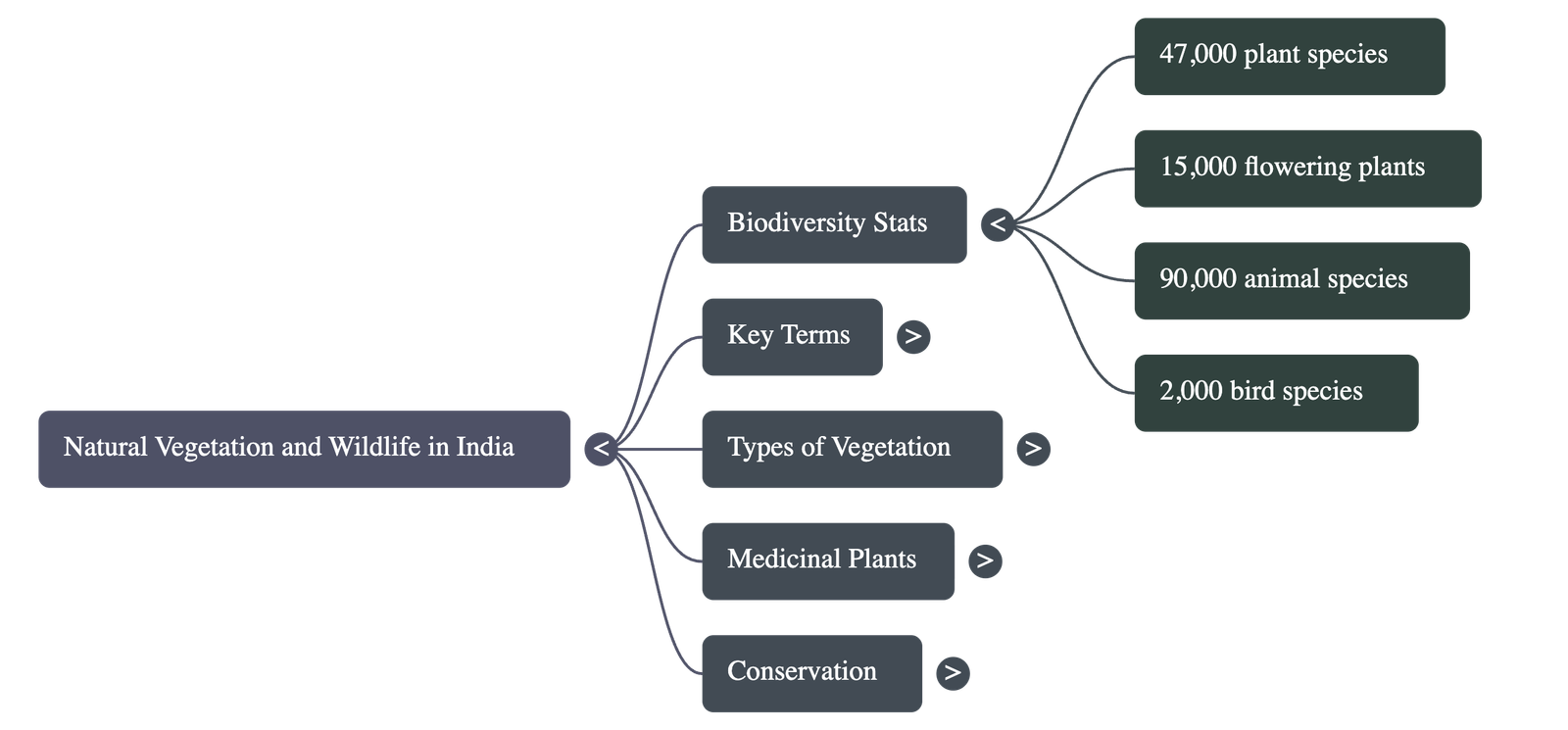
- India is one of the 12 mega bio-diversity countries of the world.
- It ranks tenth in the world and fourth in Asia for plant diversity, boasting about 47,000 plant species.
- The country is home to 15,000 flowering plants (6% of the world's total) and approximately 90,000 animal species.
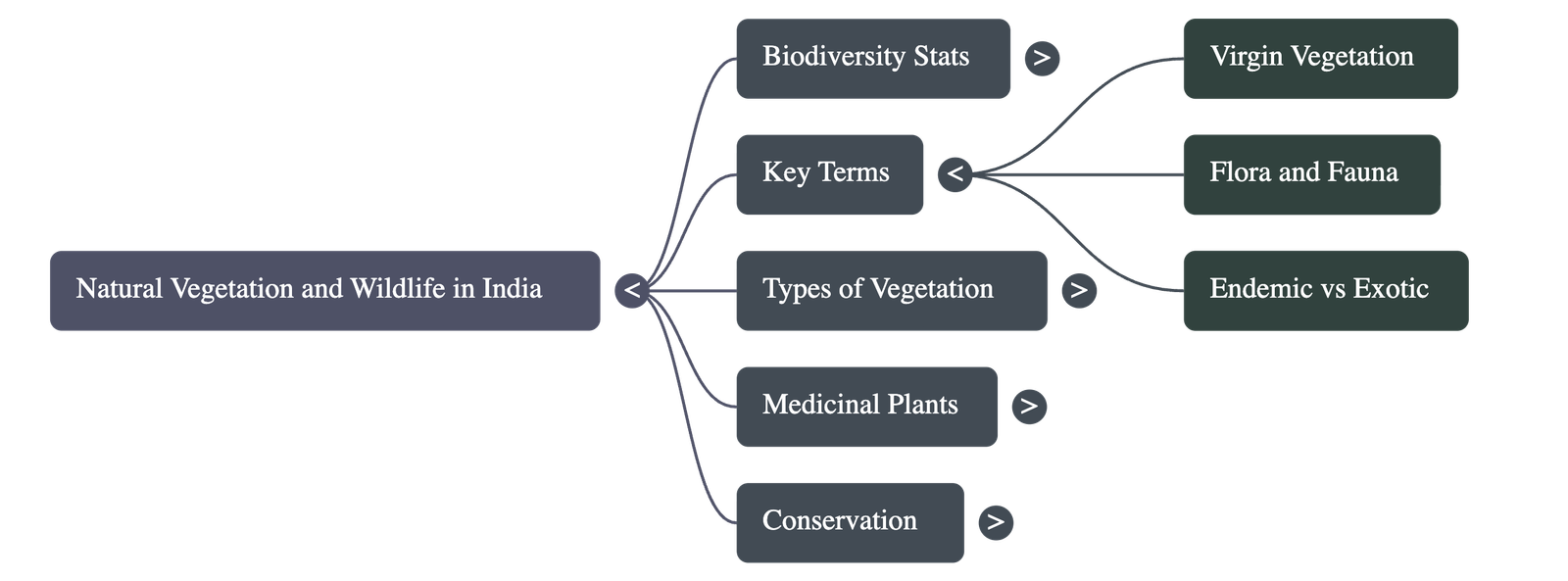
- Natural Vegetation (Virgin Vegetation): Refers to a plant community that has grown naturally without human aid and remained undisturbed for a long time.
- Endemic vs. Exotic: Purely Indian species are "endemic," while those from outside are "exotic."
Major Types of Vegetation
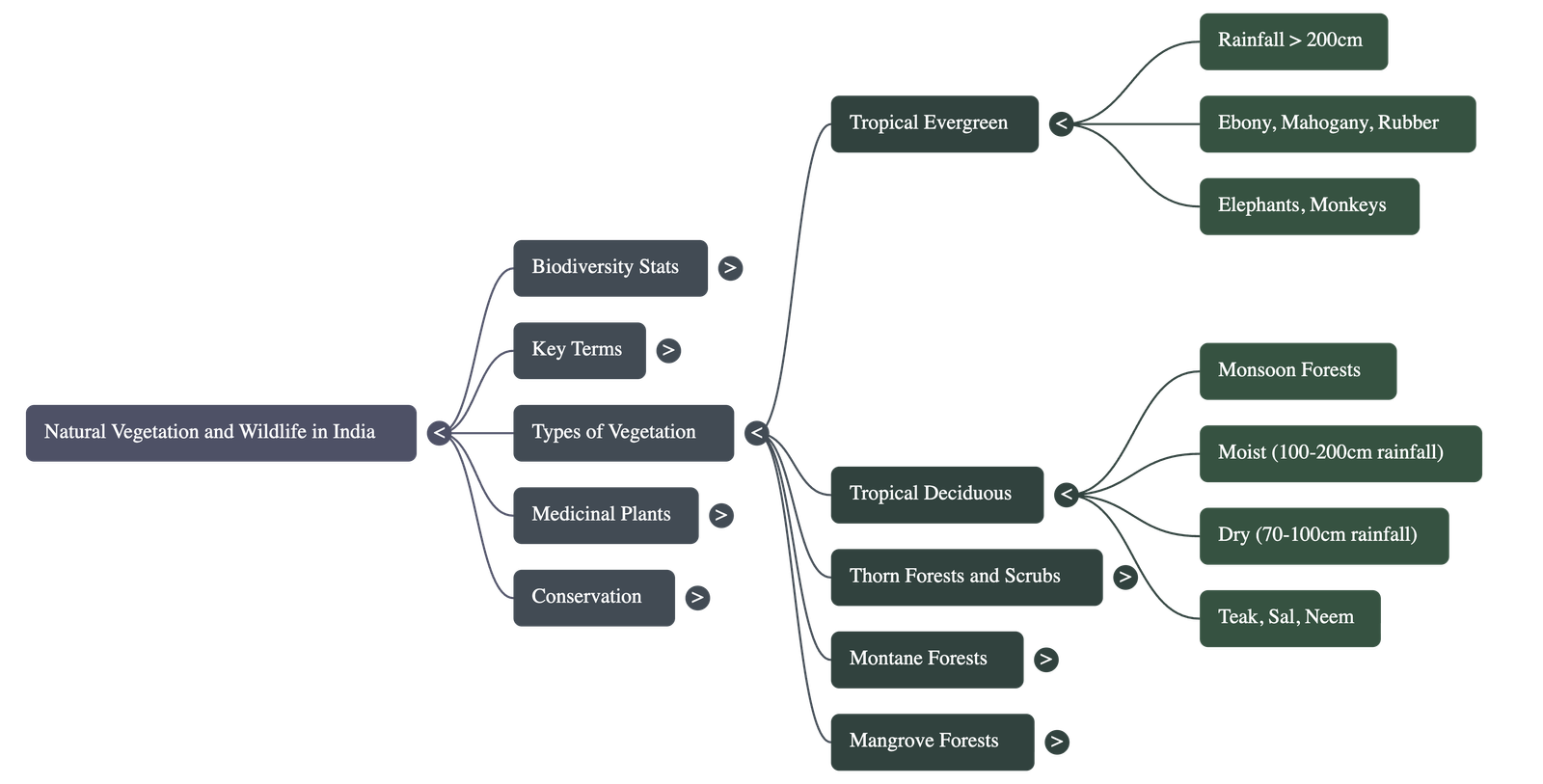
1. Tropical Evergreen Forests
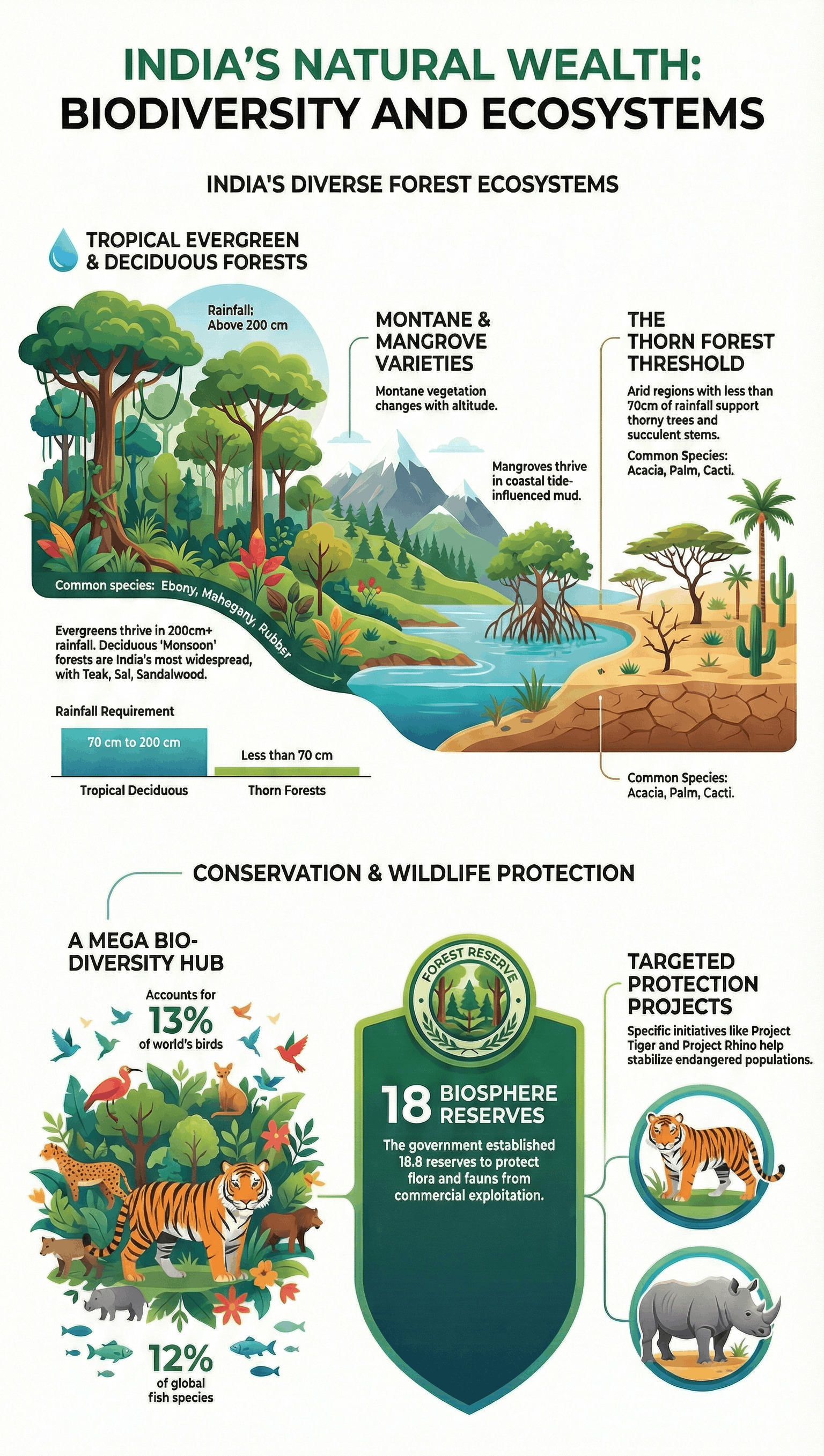
- Environment: Heavy rainfall areas (>200 cm) with a short dry season (Western Ghats, Island groups, Assam, Tamil Nadu coast).
- Features: Trees reach heights up to 60 meters; multilayered structure (trees, shrubs, creepers); appear green year-round as there is no definite time to shed leaves.
- Species: Ebony, mahogany, rosewood, rubber, and cinchona.
- Wildlife: Elephants, monkeys, lemurs, and the one-horned rhinoceros (in Assam and West Bengal).
2. Tropical Deciduous Forests
- Overview: The most widespread forests in India, also known as "Monsoon Forests."
- Moist Deciduous: Found in areas with 100-200 cm rainfall (Eastern India, Himalayan foothills, Jharkhand). Teak is the dominant species; others include bamboo, sal, and shisham.
- Dry Deciduous: Found in areas with 70-100 cm rainfall (Peninsular plateau, plains of Bihar and UP). Common trees are teak, sal, peepal, and neem.
- Behavior: Trees shed leaves for 6 to 8 weeks during the dry summer.
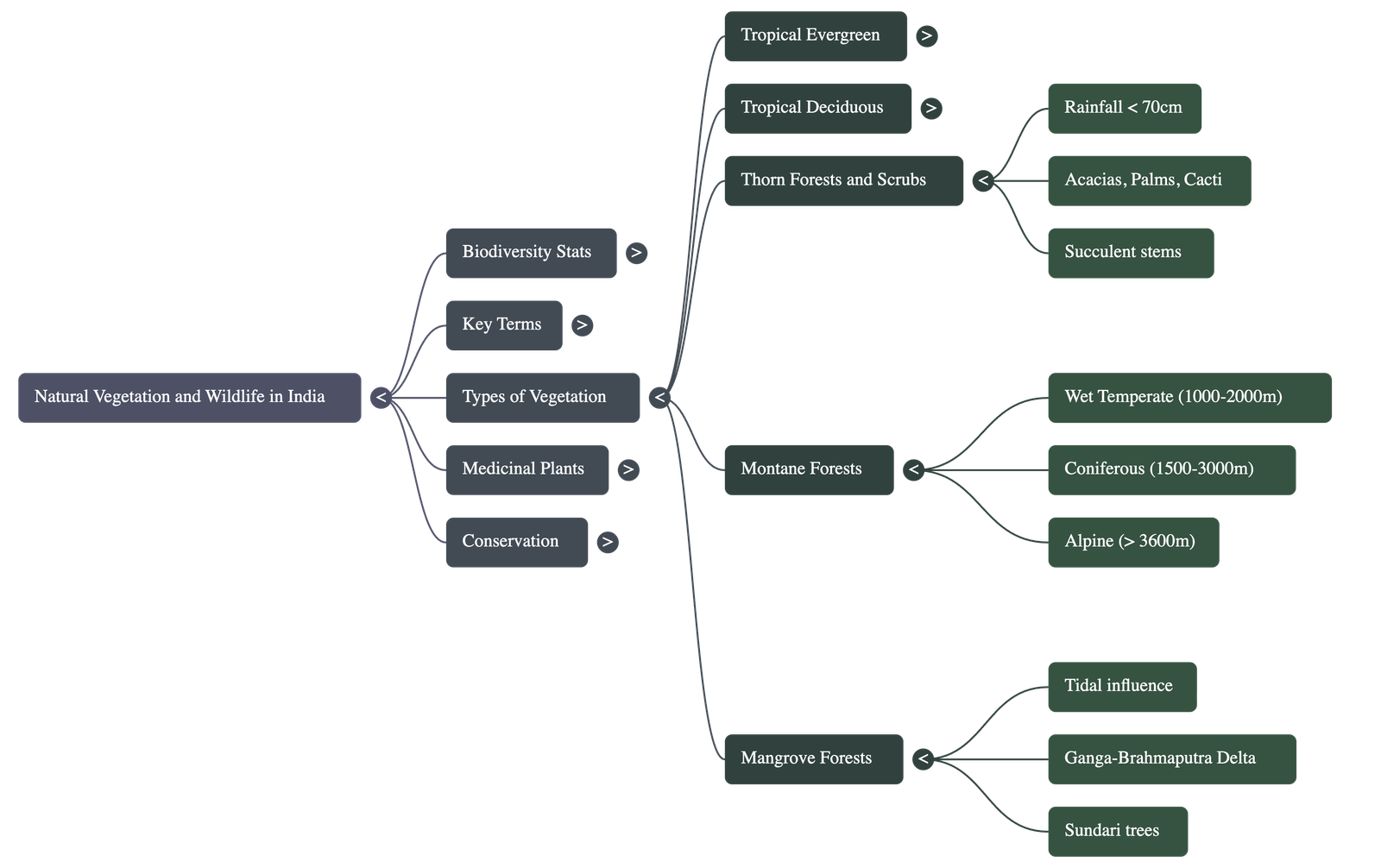
3. Tropical Thorn Forests and Scrubs
- Environment: Regions with less than 70 cm rainfall (North-western India like Gujarat, Rajasthan, Haryana).
- Adaptations: Trees have long roots to reach moisture; succulent stems to conserve water; thick, small leaves to minimize evaporation.
- Species: Acacias, palms, euphorbias, and cacti.
4. Montane Forests
- Altitudinal Change: Vegetation changes based on altitude:
- 1000–2000m: Wet temperate forests (Oaks and Chestnuts).
- 1500–3000m: Temperate coniferous forests (Pine, Deodar, Silver fir, Spruce).
- Above 3600m: Alpine vegetation (Silver fir, Junipers, Birches) and Tundra vegetation (Mosses and Lichens) at the highest peaks.
- Wildlife: Kashmir stag, snow leopard, yak, and rare red panda.
5. Mangrove Forests
- Location: Coastal areas influenced by tides (Deltas of Ganga, Mahanadi, Krishna).
- Features: Dense mangroves with roots submerged under water.
- Key Species: Sundari trees (Ganga-Brahmaputra delta) provide durable hard timber; also palm, coconut, and agar.
- Wildlife: Famous for the Royal Bengal Tiger.
Rich Wildlife of India
- Fauna Statistics: 2,000 bird species (13% of world total) and 2,546 fish species (12% of world stock).
- Major Animals:
- Elephants: Found in hot wet forests of Assam, Karnataka, and Kerala.
- Lions and Tigers: India is the only country with both. Lions are in the Gir Forest (Gujarat); Tigers in MP, Sundarbans, and Himalayas.
- Arid Zone: Wild ass (Rann of Kachchh) and Camels (Thar Desert).
Medicinal Plants
India has a long history of using herbs for healing, with about 2,000 plants described in Ayurveda:
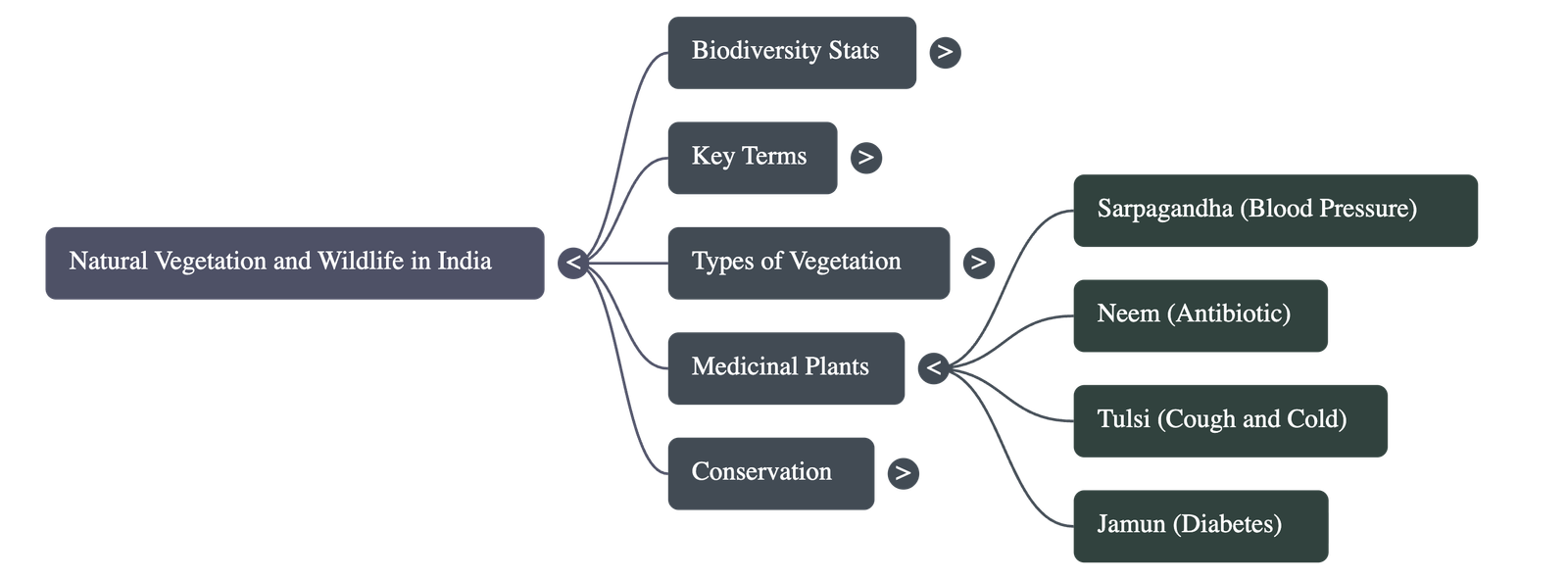
- Sarpagandha: Used to treat blood pressure (exclusive to India).
- Jamun: Used for vinegar and controlling diabetes.
- Arjun: Fresh juice for earaches; also regulates blood pressure.
- Neem: High antibiotic and antibacterial properties.
- Tulsi: Cures cough and cold.
Conservation Efforts
- Threats: Hunting for commercial gain, pollution, acid deposits, and deforestation for habitation/cultivation.
- Government Initiatives:
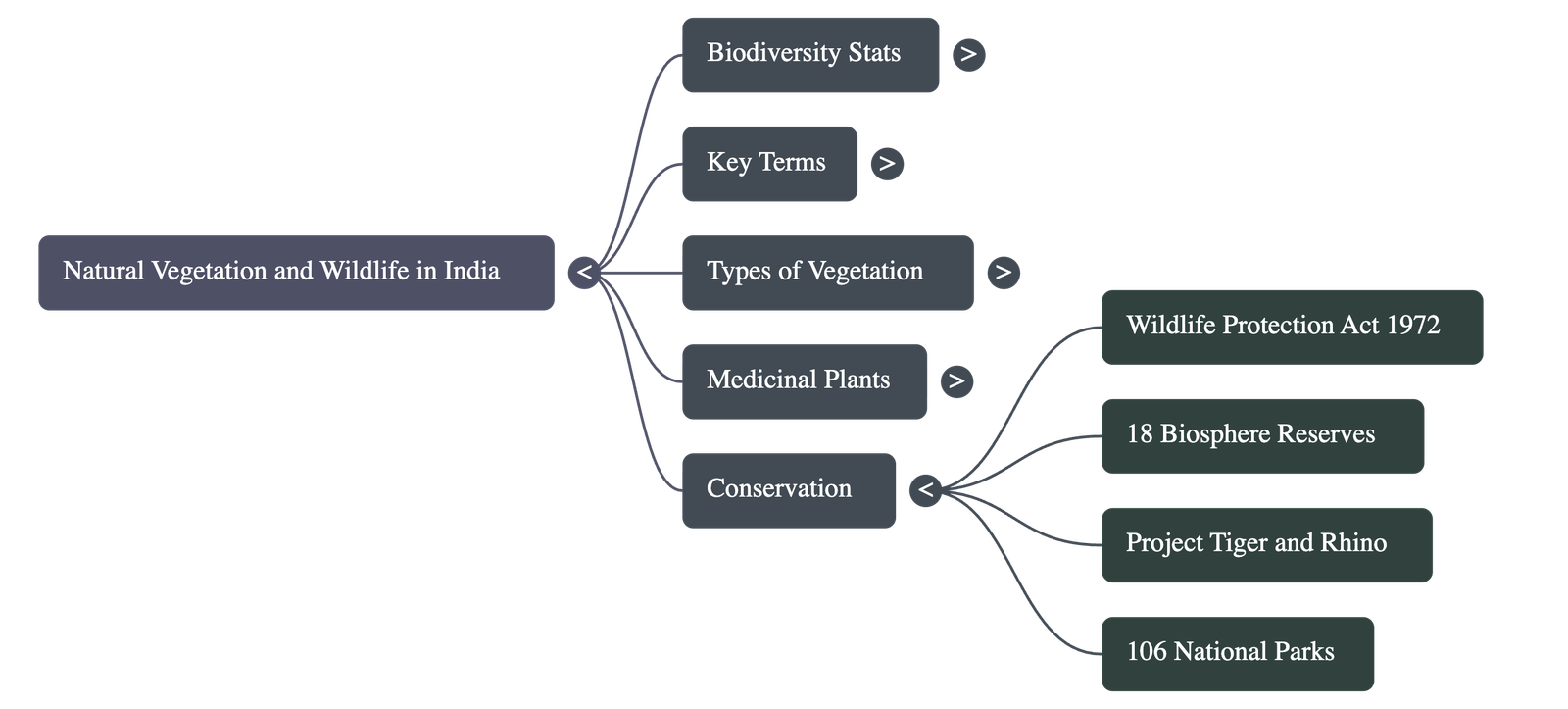
- Setup of 18 Biosphere Reserves (e.g., Sundarbans, Nanda Devi, Nilgiri).
- Financial and technical assistance to botanical gardens since 1992.
- Introduction of Project Tiger, Project Rhino, and Project Great Indian Bustard.
- Maintenance of 106 National Parks and 573 Wildlife Sanctuaries.
- Implementation of the Wildlife Protection Act in 1972.
Do checkout all questions & answers of this chapter.
Quick Navigation:
| | |
1 / 1
Quick Navigation:
| | |