Quick Navigation:
| | | |
Periodic Table: Periodic Properties & Variations of Properties
A. Introduction & Classification of Elements
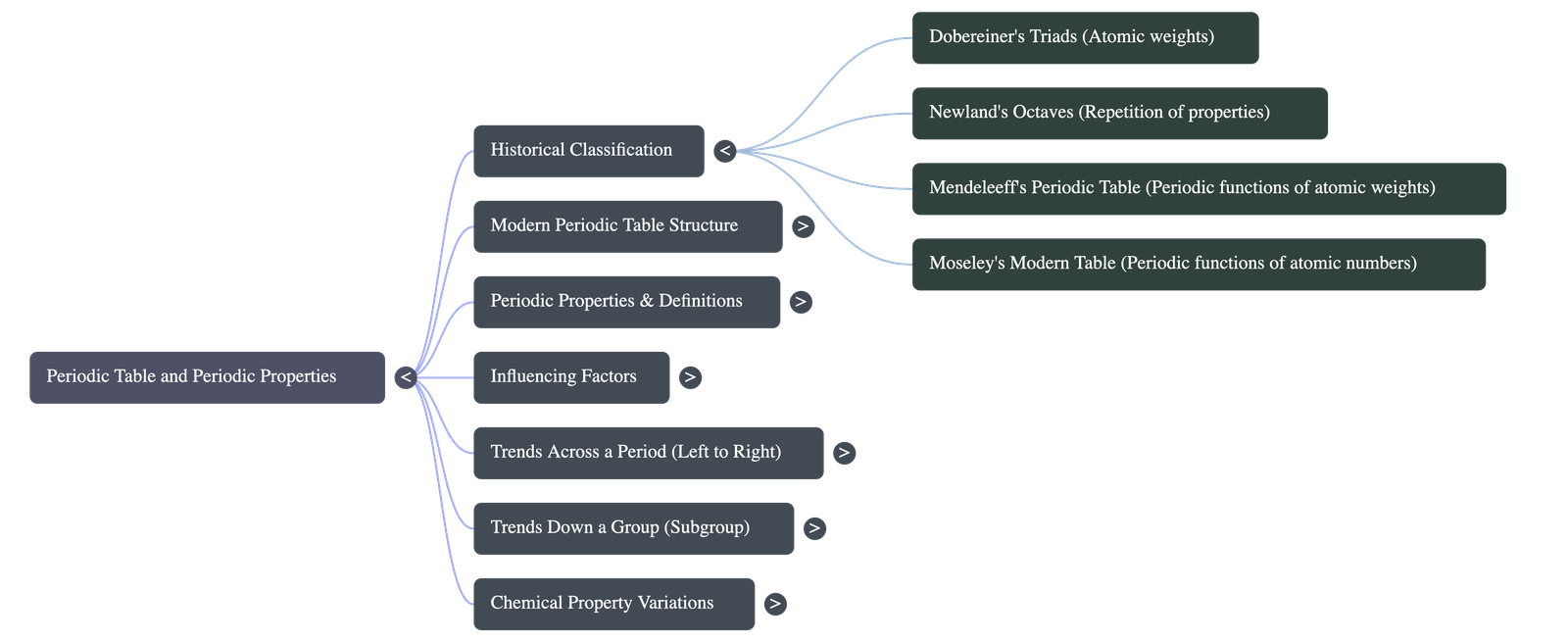
Elements needed to be grouped into families with similar properties so they could be studied methodically.
- Early Chemists: Grouped elements by valency, metallic, and non-metallic characters. Discarded because elements showed variable valency.
- Dobereiner (1815): Arranged elements in groups of three called "Triads" based on increasing atomic weights. Discarded because it didn't hold true for all elements.
- Newland (1864): Arranged elements in a series of eight (Octaves) by increasing atomic weights. Discarded because it failed to leave spaces for undiscovered elements.
- Mendeleeff (1869): Created Mendeleeff’s Periodic Table based on increasing atomic weights. He stated that properties of elements are periodic functions of atomic weights. Discarded as it couldn't justify the position of isotopes and certain elements.
- Moseley (1912): Modified the table based on increasing atomic numbers, resolving most defects of Mendeleeff's table.
B. Modern Periodic Table (Long Form)
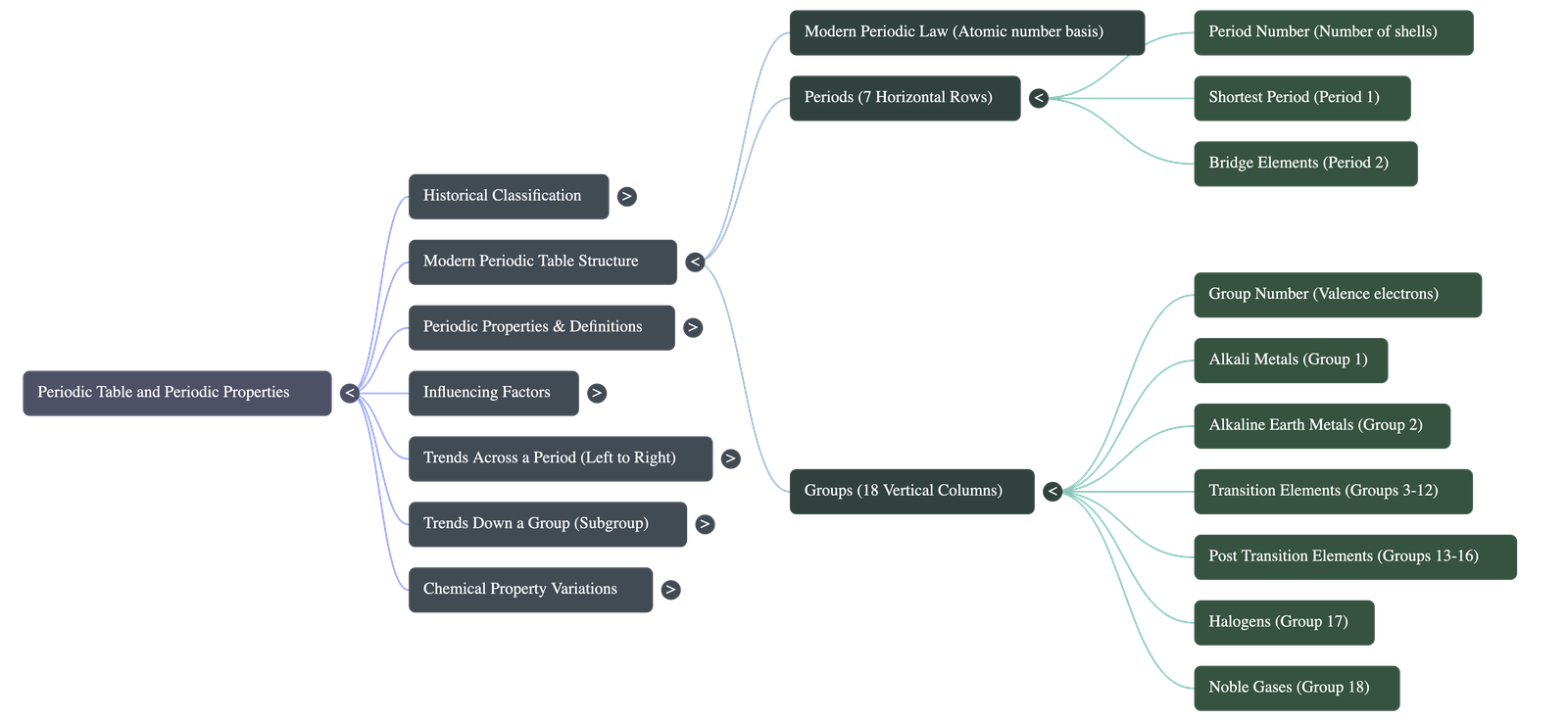
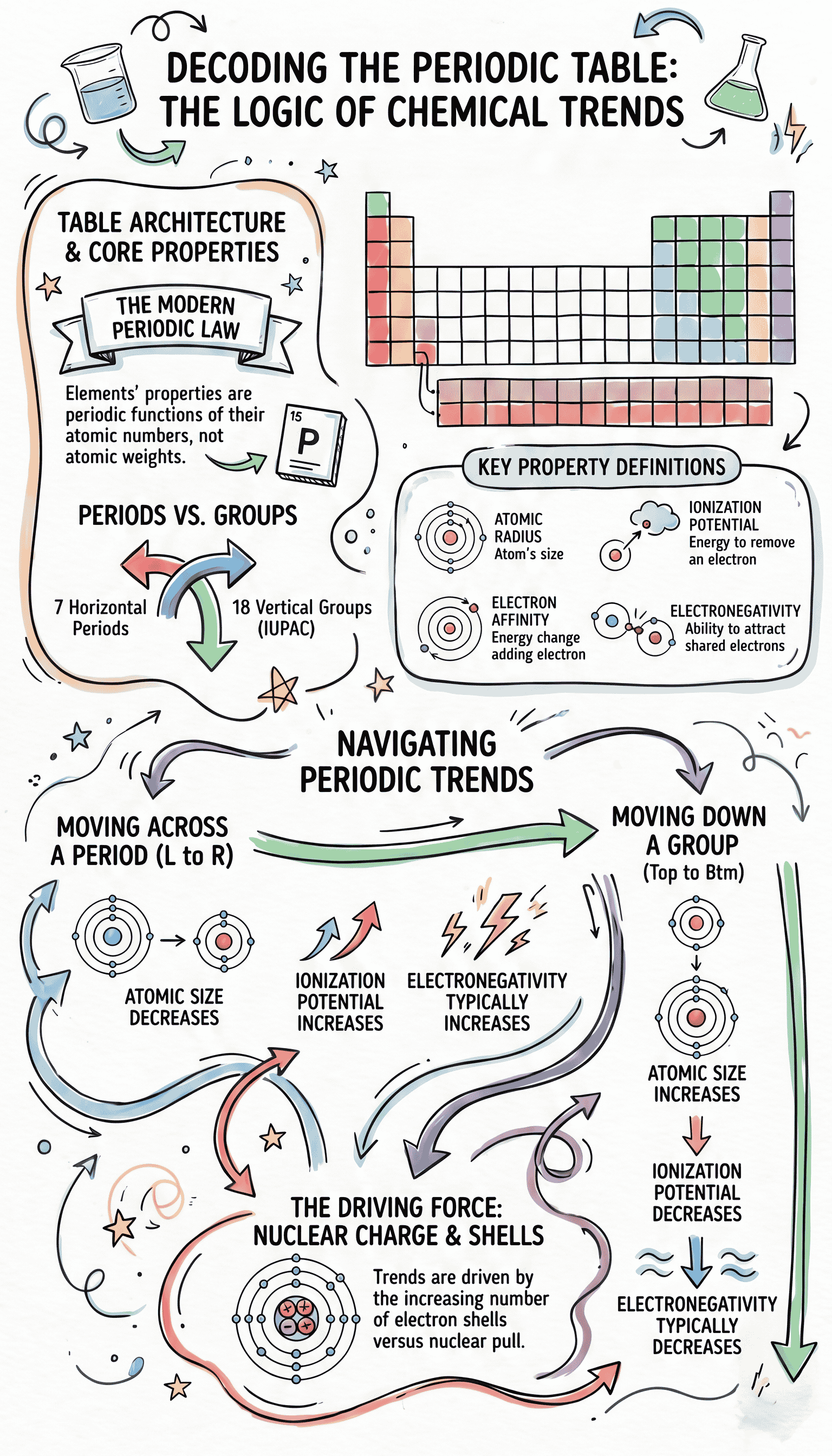
- Modern Periodic Law: Physical and chemical properties of elements are periodic functions of their atomic numbers.
- Atomic Number: The fundamental property of an element, equal to the number of electrons in its energy shells.
- Methodical Arrangement: Contains 7 horizontal rows called Periods and 18 vertical columns called Groups.
- Separation of Elements: Reactive metals are placed on the extreme left (Groups 1 and 2), Transition elements in the middle, Non-metals on the upper right, and Noble Gases on the extreme right (Group 18).
C. Periods in the Modern Periodic Table
- The period number signifies the number of electron shells an element has (e.g., Period 3 elements have 3 shells).
- Period 1 is the shortest (2 elements: H, He). Periods 2 and 3 are short (8 elements). Periods 4 and 5 are long (18 elements). Periods 6 and 7 are the longest (containing the Lanthanide and Actinide series).
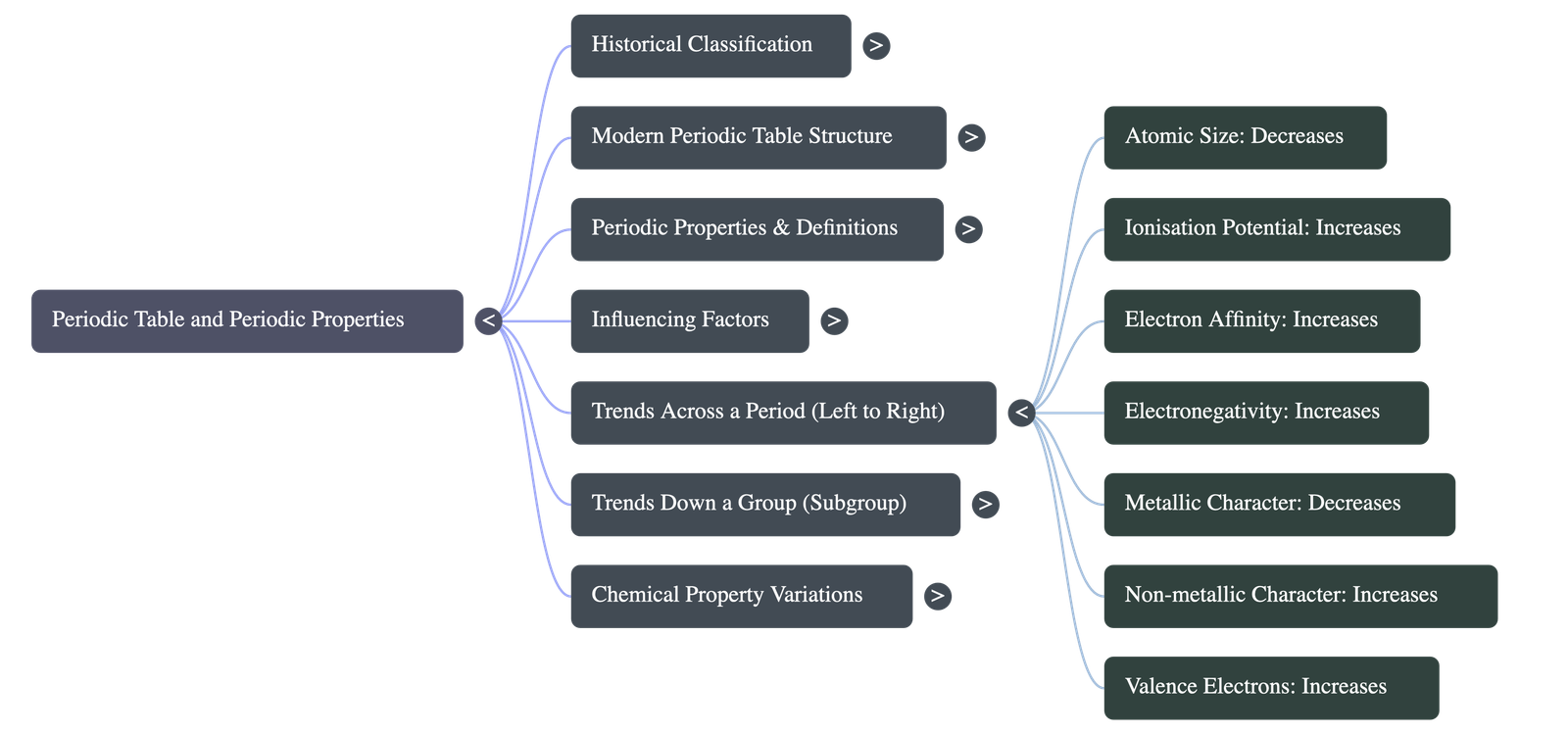
- Trends across a Period (Left to Right):
- The number of electron shells remains the same.
- Valence electrons increase by one.
- There is a transition from strongly metallic to strongly non-metallic character.
D. Groups in the Modern Periodic Table
- The group number signifies the number of valence electrons in the outermost shell. Elements in the same group have similar chemical properties.
- Key Groups:
- Group 1: Alkali Metals (Highly reactive, light, strong reducing agents, form electrovalent compounds).
- Group 2: Alkaline Earth Metals.
- Groups 3 to 12: Transition Elements (Heavy metals).
- Group 17: Halogens (Highly reactive non-metals, strong oxidizing agents, high electronegativity).
- Group 18: Noble/Inert Gases (Unreactive, stable electronic configuration).
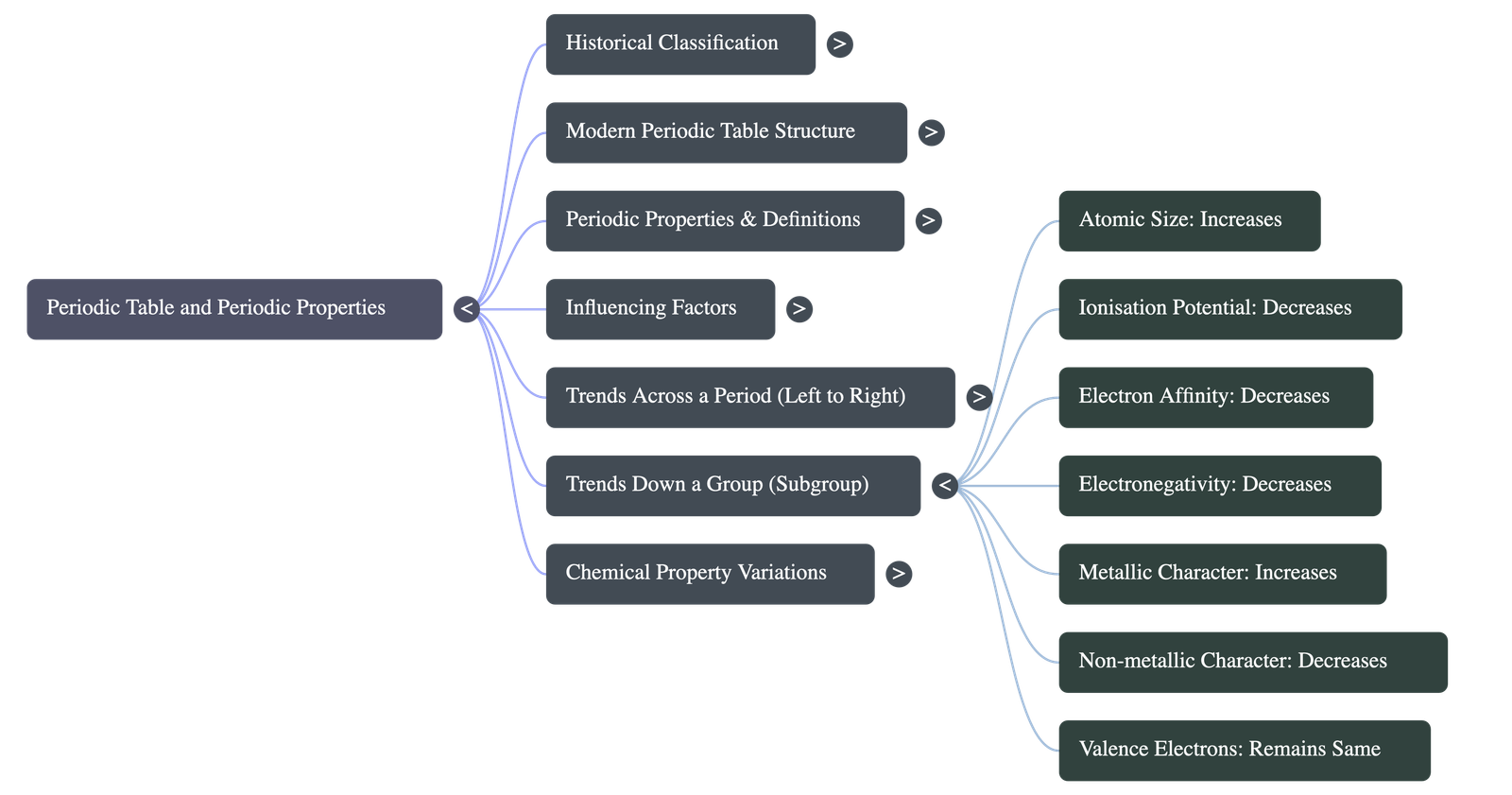
- Trends down a Group (Top to Bottom):
- Valence electrons remain the same.
- The number of electron shells increases by one at each step.
- Metallic (electropositive) character increases.
E. Periodic Properties
Periodicity is the recurrence of characteristic properties of elements at definite intervals in the table. This happens because elements at definite intervals have a similar valence shell electronic configuration.
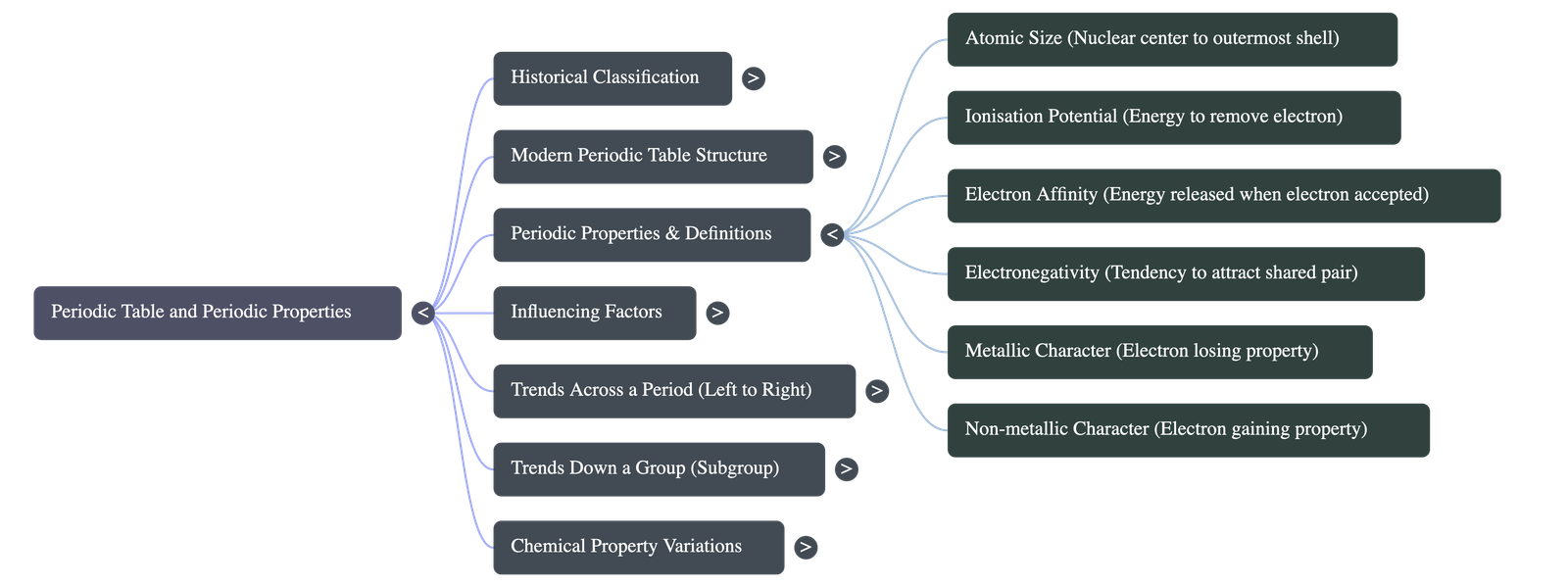
The main periodic properties to study are Atomic Radius, Ionisation Potential, Electron Affinity, Electronegativity, and Metallic/Non-metallic character.
F. Periodic Trends in Properties (Detailed Analysis)
1. Atomic Size (Atomic Radius)
- Definition: The distance between the centre of the nucleus and the outermost shell of an atom.
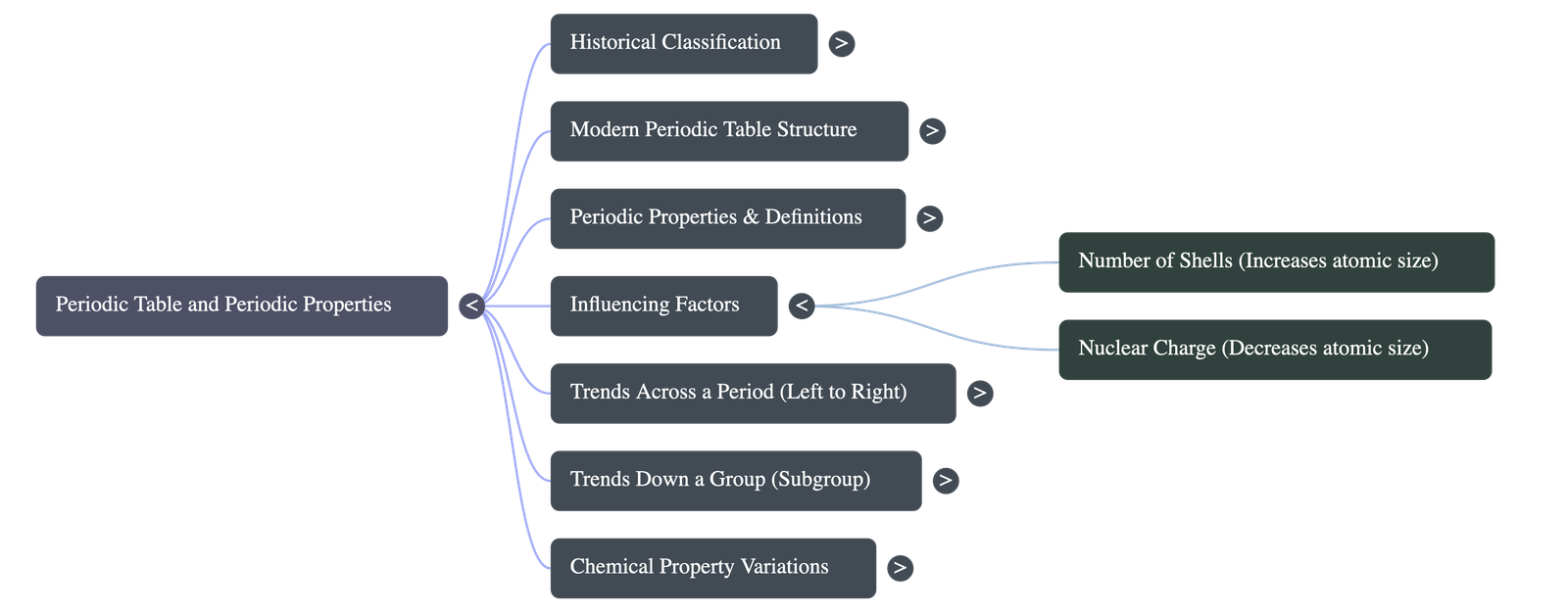
- Factors affecting it: Number of shells (increases size) and Nuclear charge (decreases size by pulling electrons closer).
- Trend across a Period: Decreases from left to right. (Because nuclear charge increases but shell number remains the same).
- Trend down a Group: Increases from top to bottom. (Because new shells are added, which dominates over the increased nuclear charge).
2. Ionisation Potential (I.P.) or Ionisation Energy
- Definition: The amount of energy required to remove a loosely bound electron from the outermost shell of an isolated gaseous atom.
- Factors affecting it: Atomic size (larger size = lower IP) and Nuclear charge (higher charge = higher IP).
- Trend across a Period: Increases from left to right. (Atomic radius decreases and nuclear charge increases, making it harder to remove an electron). Helium has the highest IP.
- Trend down a Group: Decreases from top to bottom. (Atomic size increases, meaning outer electrons are loosely held).
3. Electron Affinity (E.A.)
- Definition: The amount of energy released when an atom in the gaseous state accepts an electron to form an anion.
- Factors affecting it: Atomic size (smaller atoms take up electrons more readily) and Nuclear charge (greater charge = greater tendency to accept electrons).
- Trend across a Period: Increases from left to right. Halogens have the highest E.A. (Note: Inert gases have zero E.A. because their outermost shell is already full).
- Trend down a Group: Decreases from top to bottom.
4. Electronegativity (E.N.)
- Definition: The tendency of an atom to attract the shared pair of electrons towards itself when combined in a compound.
- Trend across a Period: Increases from left to right. Fluorine is the most electronegative element in the periodic table. Elements with high electronegativity are typically non-metals.
- Trend down a Group: Decreases from top to bottom.
5. Metallic and Non-Metallic Character
- Metallic Character: The tendency of an atom to lose electrons (electropositive).
- Non-Metallic Character: The tendency of an atom to gain electrons.
- Trend across a Period: Metallic character decreases and Non-metallic character increases from left to right.
- Trend down a Group: Metallic character increases and Non-metallic character decreases from top to bottom.
6. Other Physical & Chemical Properties
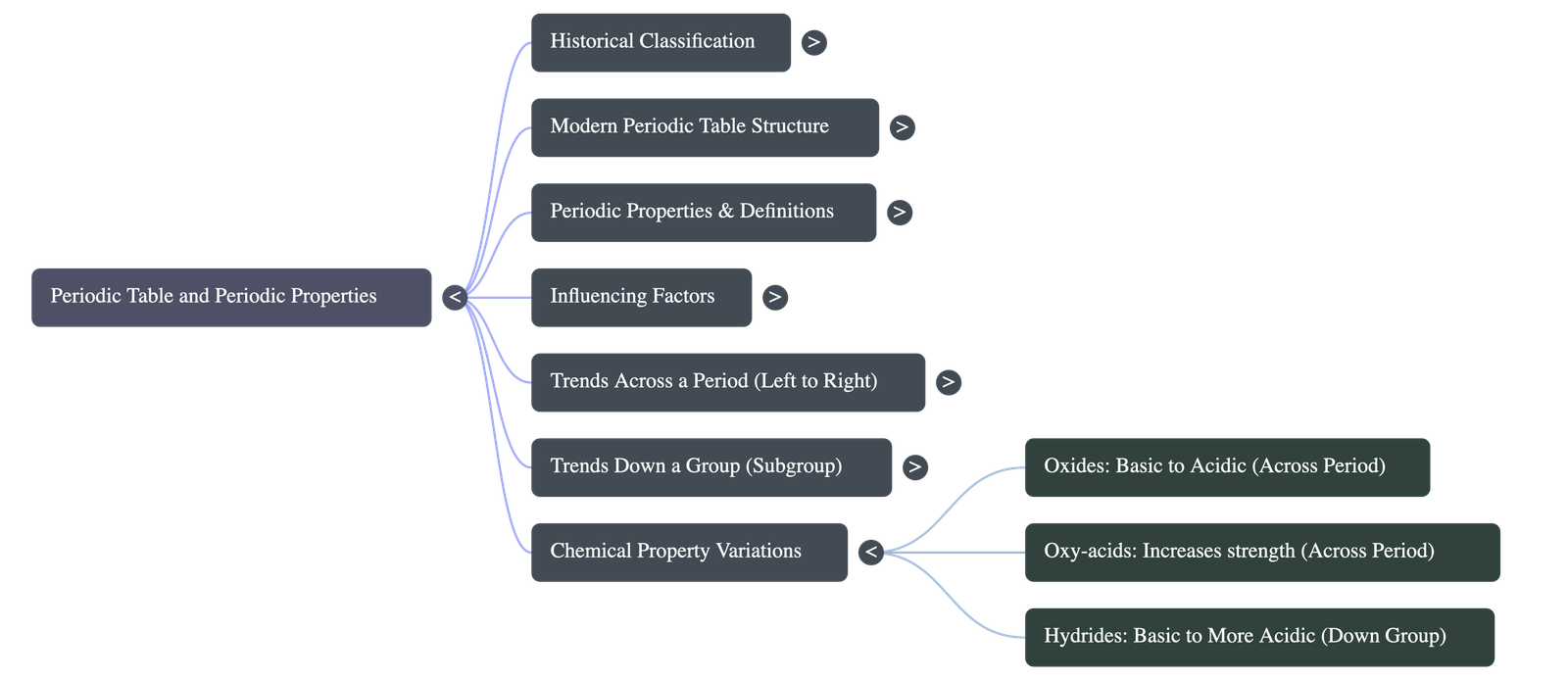
- Physical Properties (Density, Melting & Boiling Points): Across a period, these gradually increase initially and then show a slight decrease. Down a group, they generally decrease gradually.
- Chemical Properties (Nature of Oxides): Across a period, oxides transition from strongly basic to strongly acidic. Down a group, basic character increases while acidic character decreases.
Do checkout all questions & answers of this chapter.
Quick Navigation:
| | | |
1 / 1
Quick Navigation:
| | | |