Quick Navigation:
| | | |
Chemical Bonding
A. Introduction
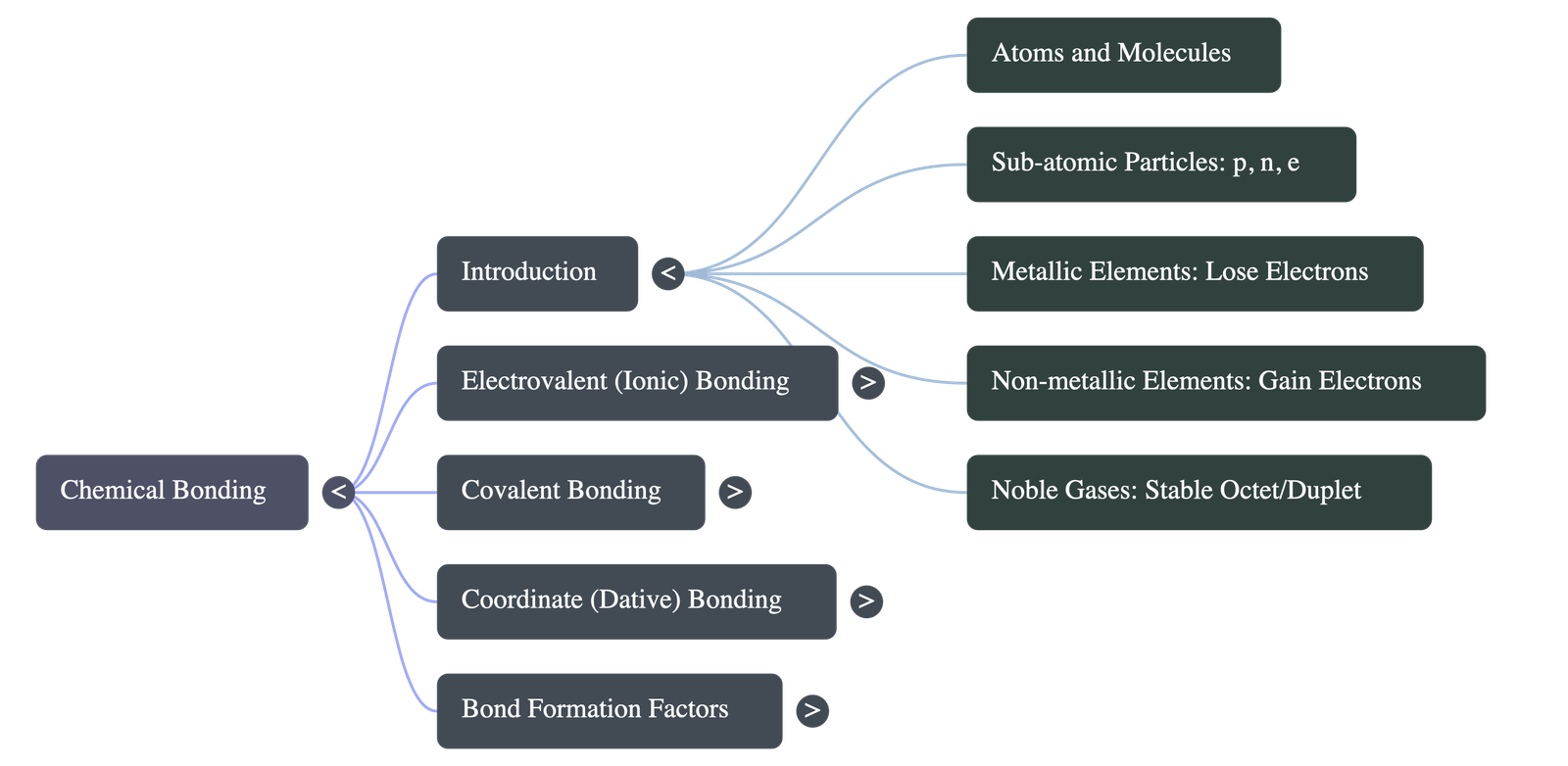
- Chemical Bond: It is the force that holds two or more atoms together to form a stable molecule.
- Atoms: The smallest unit taking part in a chemical reaction, consisting of protons (+ charge), neutrons (no charge), and electrons (- charge).
- Metallic Elements: Have 1, 2, or 3 valence electrons. They tend to lose these electrons to become positively charged ions called cations.
- Non-Metallic Elements: Have 4, 5, 6, or 7 valence electrons. They tend to gain electrons to become negatively charged ions called anions.
- Chemical Combination: Occurs in two ways:
- Transfer of valence electrons (metallic to non-metallic atom).
- Sharing of valence electrons (between two non-metallic atoms).
B. Chemical Bond & Types of Bonding
- Noble Gases: Inherently stable, chemically inert, and unreactive because their outermost shell is complete (2 electrons for Helium, 8 for others).
- Reason for Bonding: Atoms combine to achieve a stable electronic configuration matching their nearest noble gas.
- Duplet Rule: Having two electrons in the outermost shell (like Helium).
- Octet Rule: Having eight electrons in the outermost shell.
- Methods of Bonding:
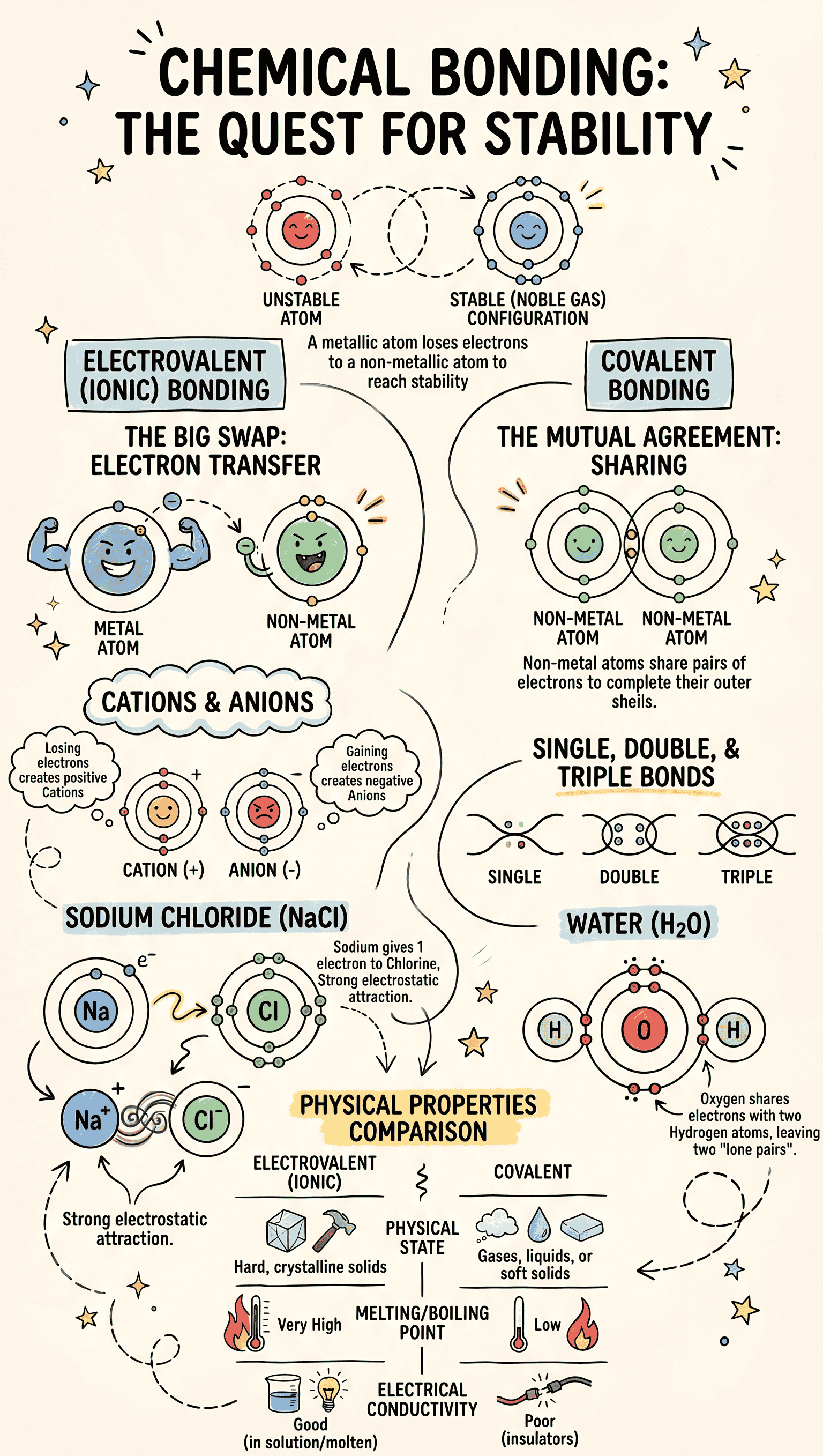
- Electrovalent/Ionic Bonding: By transfer of electrons.
- Covalent Bonding: By sharing of electron pairs.
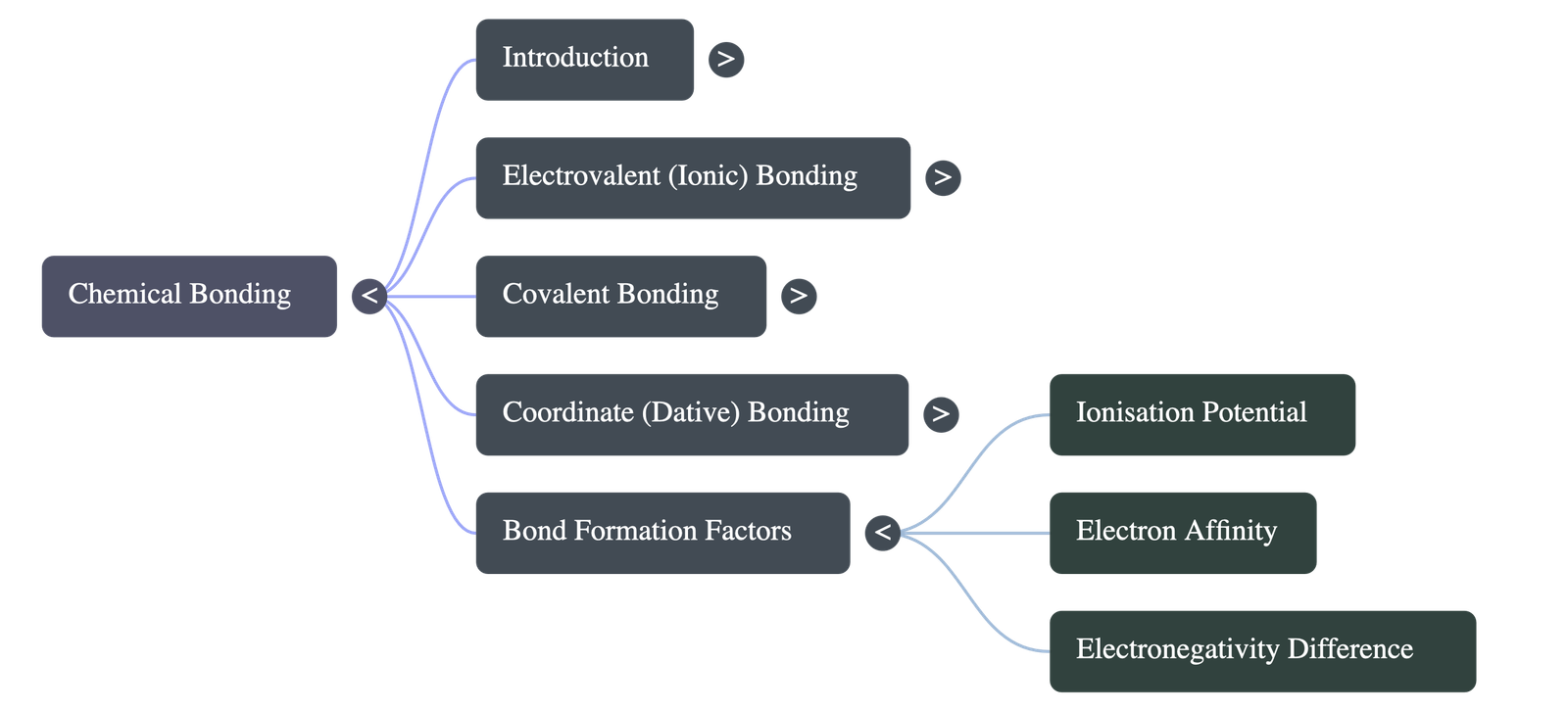
- Periodic Properties Affecting Bonding:
- Ionic Bonds form easily when there is a large difference in electronegativity (low ionization potential for metals, high electron affinity for non-metals).
- Covalent Bonds form easily when both atoms have high ionization potential and electron affinity, with a negligible electronegativity difference.
C. Electrovalent Bonding
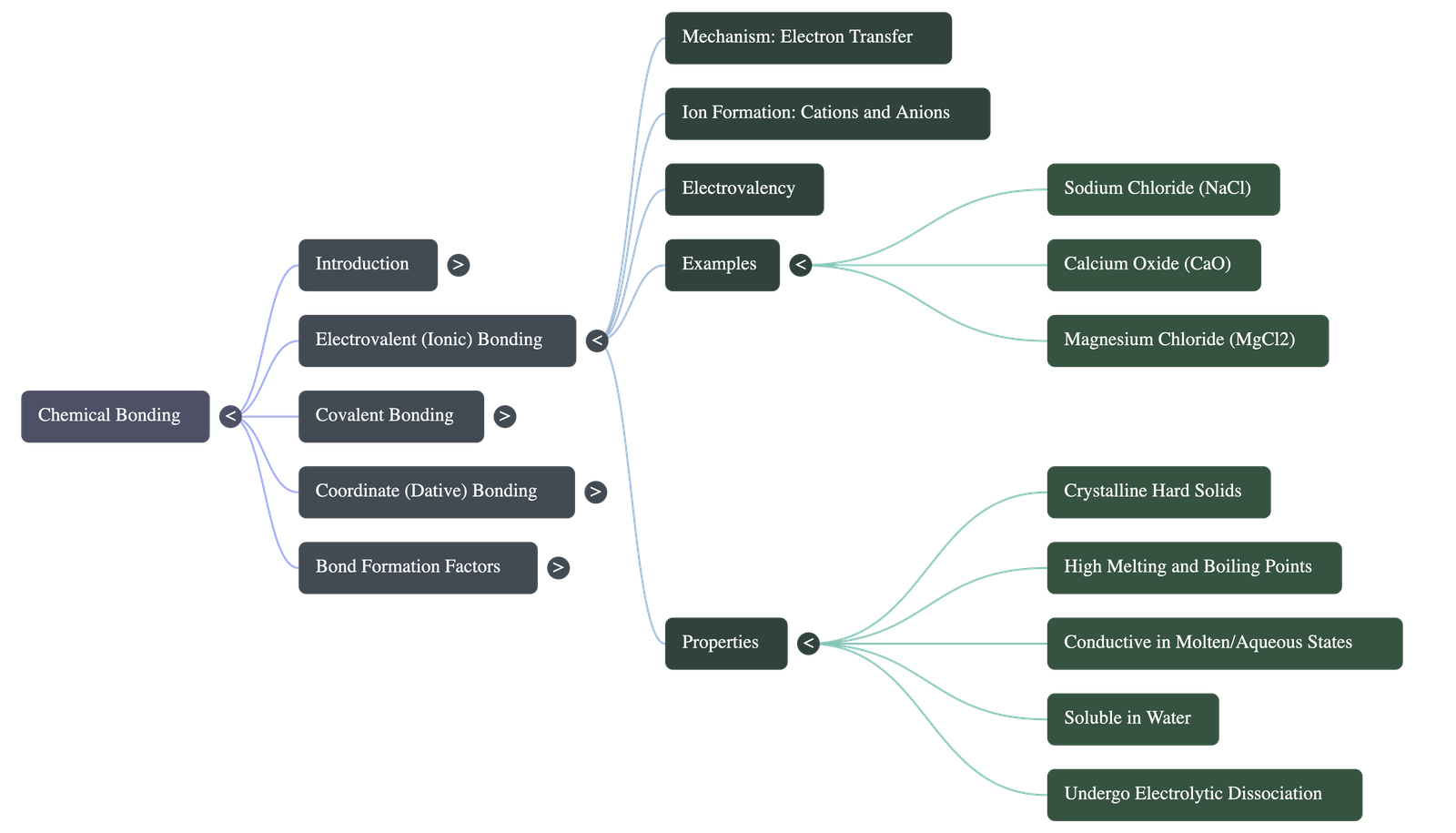
- Formation: Involves the complete transfer of valence electrons from a metallic electropositive atom to a non-metallic electronegative atom.
- Electrostatic Force: The strong attraction between the resulting positively charged cation and negatively charged anion forms the electrovalent (ionic) bond.
- Electrovalency: The exact number of electrons donated or accepted by an atom to achieve a stable configuration.
- Redox Reactions in Bonding:
- Oxidation: The process where an atom or ion loses electrons (e.g., Na loses 1e⁻ to become Na⁺).
- Reduction: The process where an atom or ion gains electrons (e.g., Cl gains 1e⁻ to become Cl⁻).
D. Structure of Electrovalent Compounds
- Sodium Chloride (NaCl):
- Sodium (2, 8, 1) loses 1 electron to achieve Neon's stability, becoming Na⁺.
- Chlorine (2, 8, 7) gains 1 electron to achieve Argon's stability, becoming Cl⁻.
- The oppositely charged ions attract to form NaCl.
- Calcium Oxide (CaO):
- Calcium (2, 8, 8, 2) loses 2 electrons to become Ca²⁺.
- Oxygen (2, 6) gains 2 electrons to become O²⁻.
- Magnesium Chloride (MgCl₂):
- Magnesium (2, 8, 2) loses 2 electrons (becoming Mg²⁺).
- Since one Chlorine atom only needs 1 electron, two Chlorine atoms each accept one electron to form two Cl⁻ ions.
E. Covalent Bonding
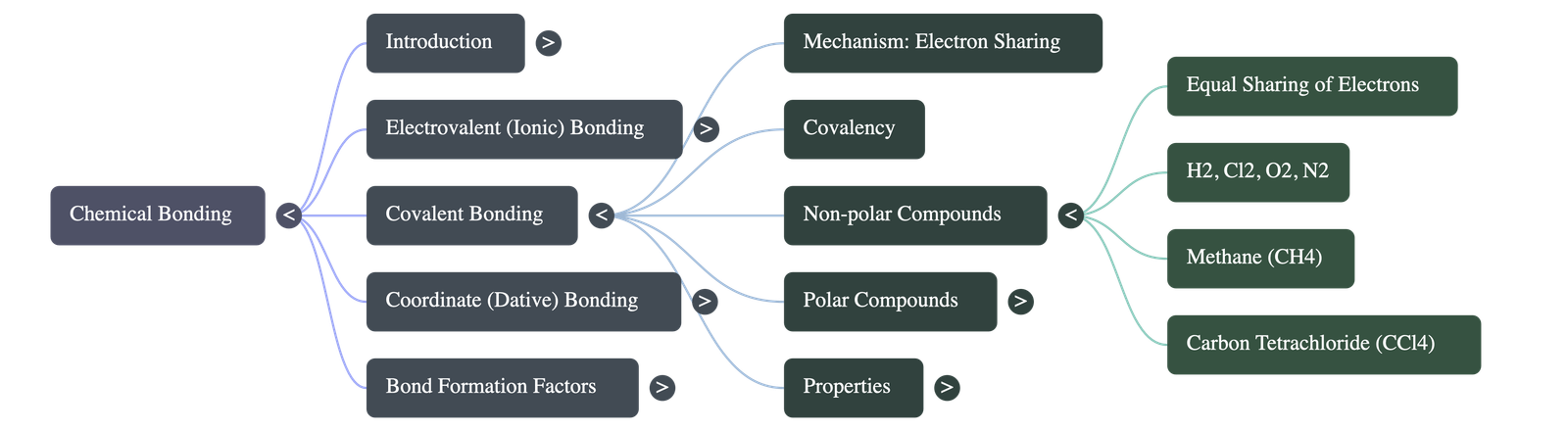
- Formation: Formed by the mutual sharing of electron pairs between two generally non-metallic atoms.
- Types of Covalent Bonds:
- Single Bond (-): Sharing of one electron pair.
- Double Bond (=): Sharing of two electron pairs.
- Triple Bond (≡): Sharing of three electron pairs.
- Covalency: The number of electron pairs an atom shares to achieve a stable electronic configuration.
- Non-Polar vs. Polar Covalent Compounds:
- Non-Polar: The shared pair of electrons is equally distributed (e.g., H₂, Cl₂, O₂, N₂, CH₄). Molecules are symmetrical and electrically neutral.
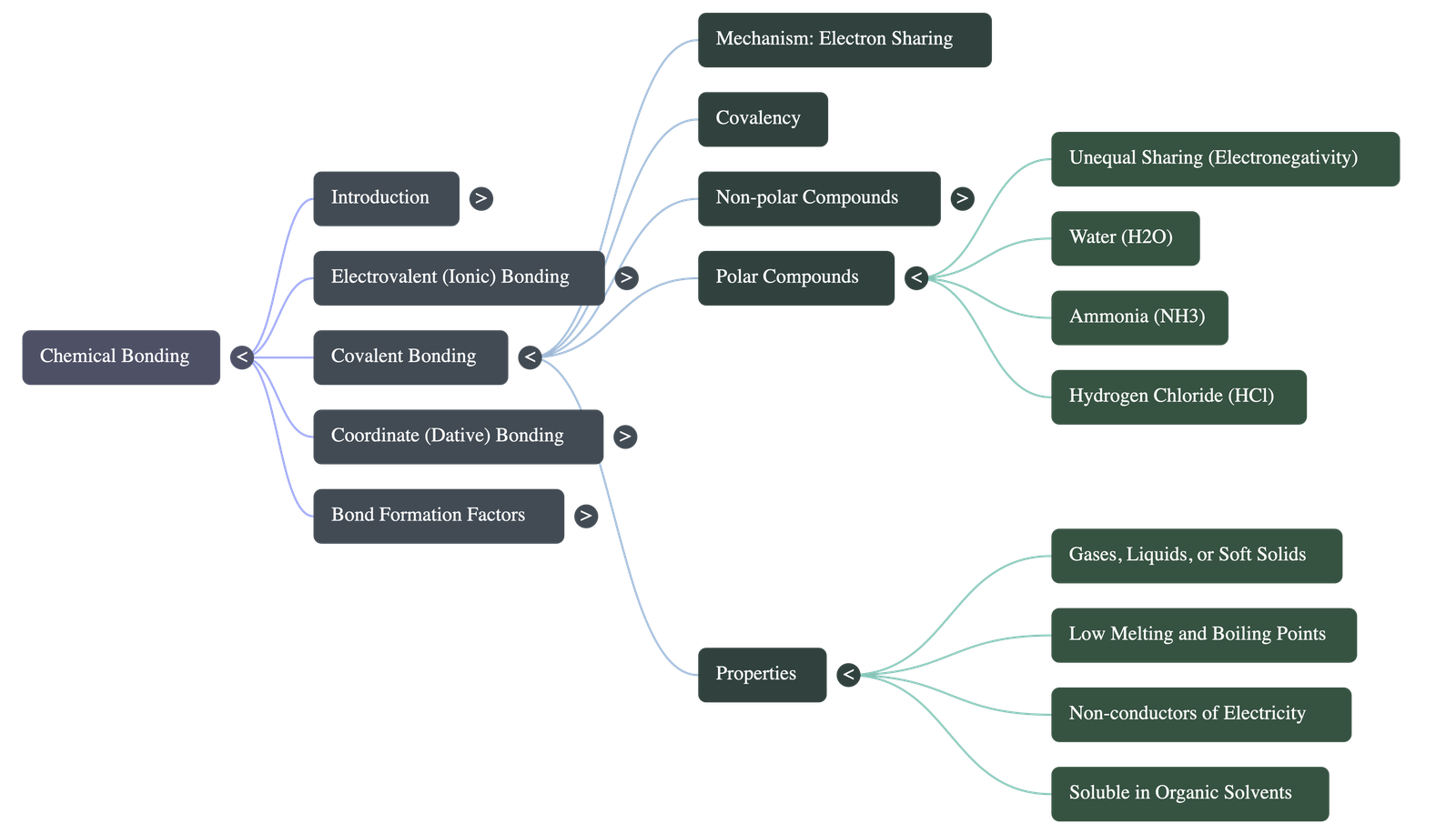
- Polar: The shared pair is unequally distributed because one atom strongly attracts electrons, creating a slight charge separation or poles (e.g., H₂O, NH₃, HCl).
F. Structure of Covalent Compounds
- Hydrogen (H₂): Shares one electron pair (single bond) to achieve a stable duplet.
- Chlorine (Cl₂): Shares one electron pair (single bond) to achieve a stable octet.
- Oxygen (O₂): Shares two electron pairs (double bond) for stable octets.
- Nitrogen (N₂): Shares three electron pairs (triple bond) for stable octets.
- Carbon Tetrachloride (CCl₄): Carbon shares its 4 valence electrons with 4 Chlorine atoms, forming 4 single bonds.
- Methane (CH₄): Carbon shares its 4 valence electrons with 4 Hydrogen atoms, forming 4 single bonds.
- Water (H₂O) - Polar: Oxygen shares single bonds with two Hydrogens, leaving two lone pairs of unshared electrons.
- Ammonia (NH₃) - Polar: Nitrogen shares single bonds with three Hydrogens, leaving one lone pair of unshared electrons.
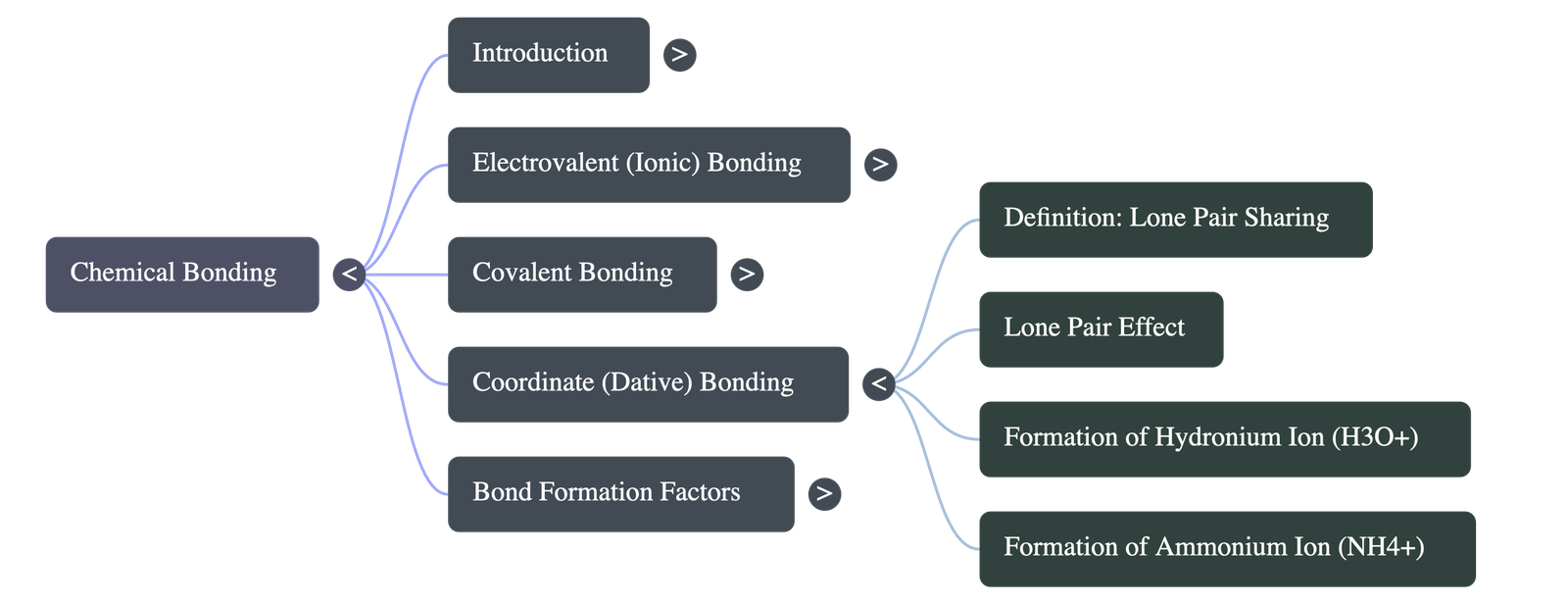
G. Coordinate Bond
- Coordinate Bond Definition: A special type of covalent bonding where the shared pair of electrons is contributed by only one of the combining atoms.
- Lone Pair: A pair of electrons in the valence shell that is not shared with any other atom (e.g., the oxygen in water has two, the nitrogen in ammonia has one).
- Formation of Hydronium Ion (H₃O⁺): A water molecule uses one of oxygen's lone pairs to bond with a hydrogen ion (H⁺), creating H₃O⁺.
- Formation of Ammonium Ion (NH₄⁺): An ammonia molecule uses nitrogen's lone pair to bond with a hydrogen ion (H⁺) from an acid or water, creating NH₄⁺.
H. Properties & Comparison
Electrovalent Compounds
- State: Hard crystalline solids (strong electrostatic force between packed ions).
- Volatility: Non-volatile.
- Melting & Boiling Points: Very high (large energy needed to break electrostatic bonds).
- Conduction of Heat: Good conductors.
- Conduction of Electricity: Non-conductors in solid state. Good conductors in molten state or aqueous solution (ions are free to move).
- Electrolysis: Can be electrolyzed.
- Solubility: Soluble in water (polar solvents break forces), insoluble in organic (non-polar) solvents.
- Reactions: Undergo high-speed ionic reactions.
- Dissociation: Separate into already existing ions upon the passage of an electric current.
Covalent Compounds
- State: Gases, liquids, or soft solids (weak Van der Waal's forces between molecules).
- Volatility: Volatile.
- Melting & Boiling Points: Low (less energy needed to break weak intermolecular forces).
- Conduction of Heat: Bad or non-conductors.
- Conduction of Electricity: Generally non-conductors (contain molecules, not free ions). Exception: Polar covalent compounds (like HCl, NH₃) conduct in a polar solvent like water.
- Electrolysis: Cannot be electrolyzed in a normal state.
- Solubility: Insoluble in water, soluble in organic solvents (like dissolves like). Polar covalent compounds dissolve in polar water.
- Reactions: Undergo slow speed molecular reactions.
- Ionisation: Undergo ionization in a solution state (forming ions from molecules that were not originally in an ionic state).
Do checkout all questions & answers of this chapter.
Quick Navigation:
| | | |
1 / 1
Quick Navigation:
| | | |