Quick Navigation:
| | | |
3-B: Analytical Chemistry - Use of Ammonium & Sodium Hydroxide
A. Introduction – Analytical Chemistry
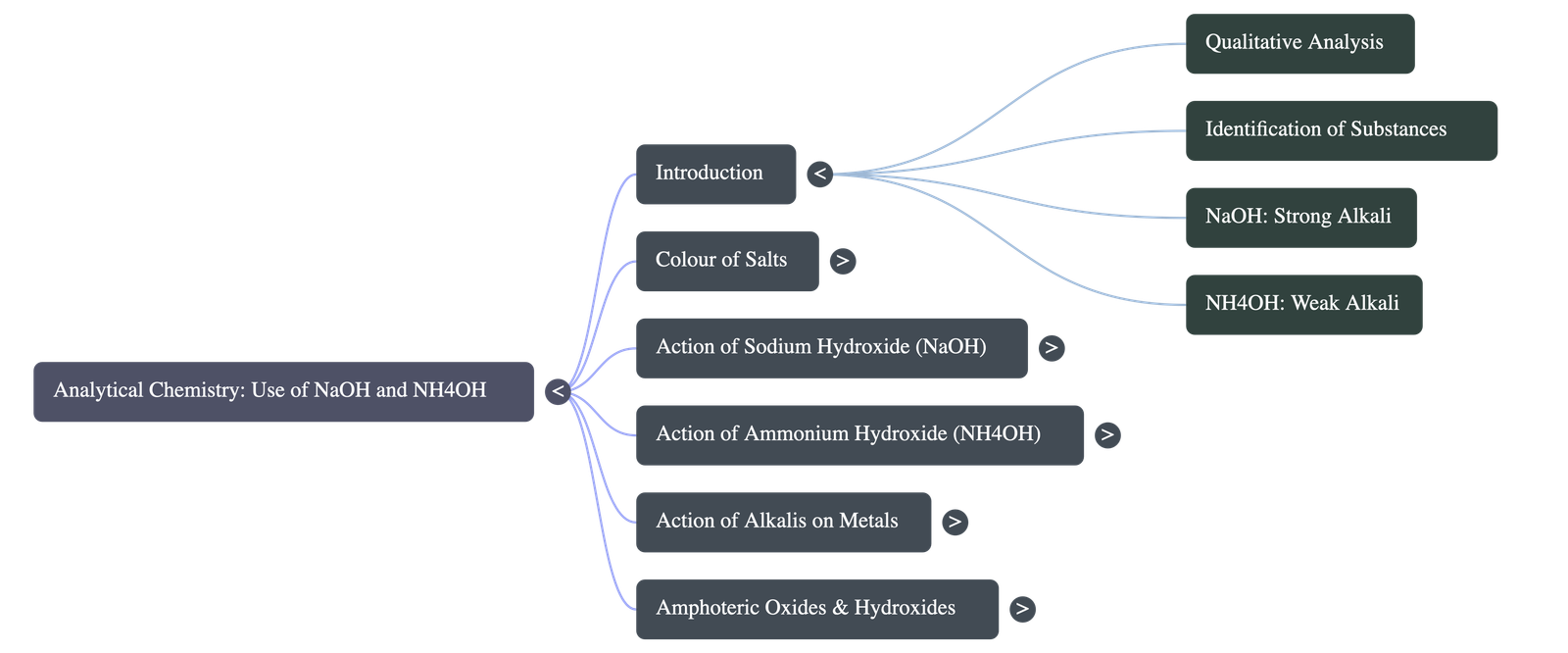
- Analytical Chemistry deals with the experimental study of substances, using both qualitative and quantitative methods.
- Qualitative Analysis involves identifying an unknown substance by performing specific chemical tests.
- These chemical tests primarily involve adding Sodium Hydroxide (NaOH) and Ammonium Hydroxide (NH₄OH) to salt solutions to observe the colour and solubility of the resulting precipitates.
- Sodium Hydroxide is a strong alkali. It completely dissociates in water, providing a high concentration of hydroxyl (OH⁻) ions.
- Ammonium Hydroxide is a weak alkali. It partially dissociates, but still furnishes enough OH⁻ ions to precipitate insoluble metal hydroxides.
B. Colour of Salts
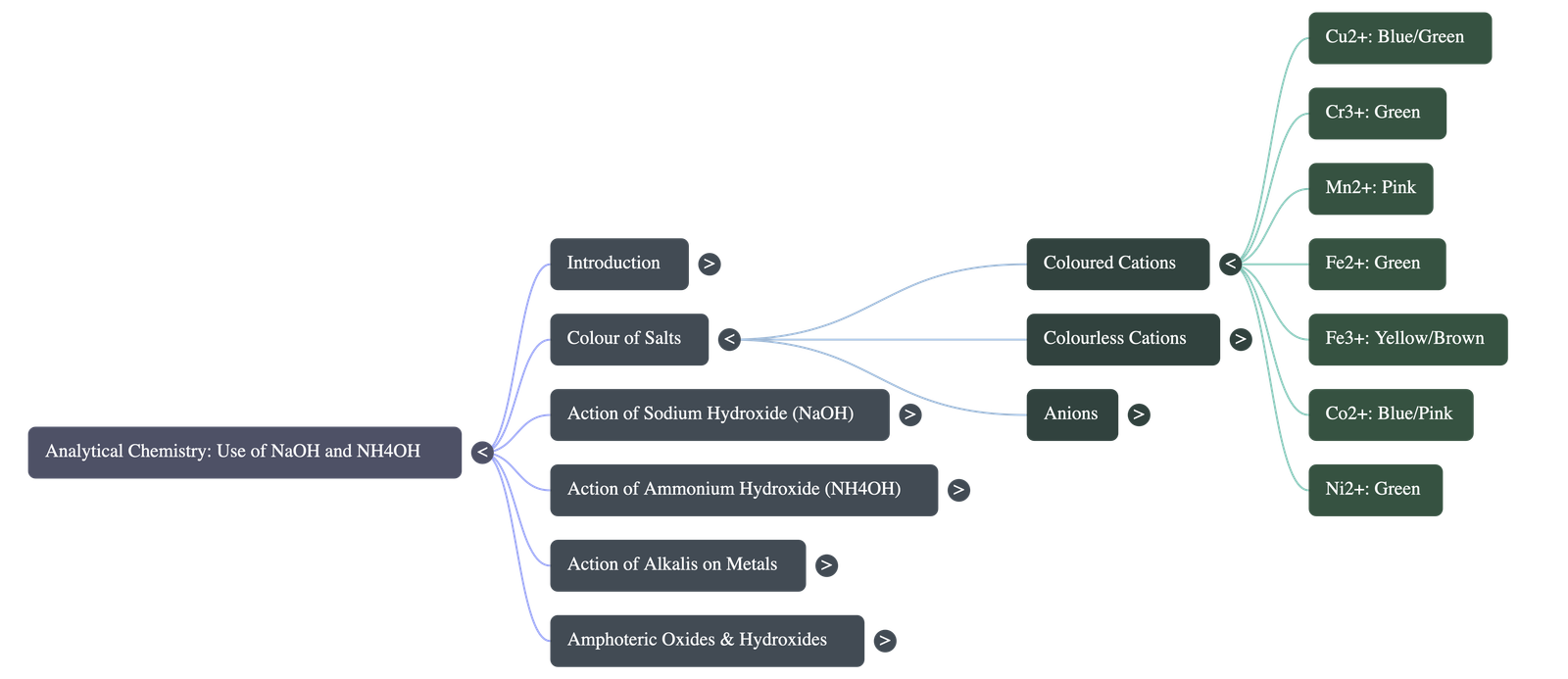
- A salt exhibits colour if either its cation (positive ion) or anion (negative ion) is coloured.
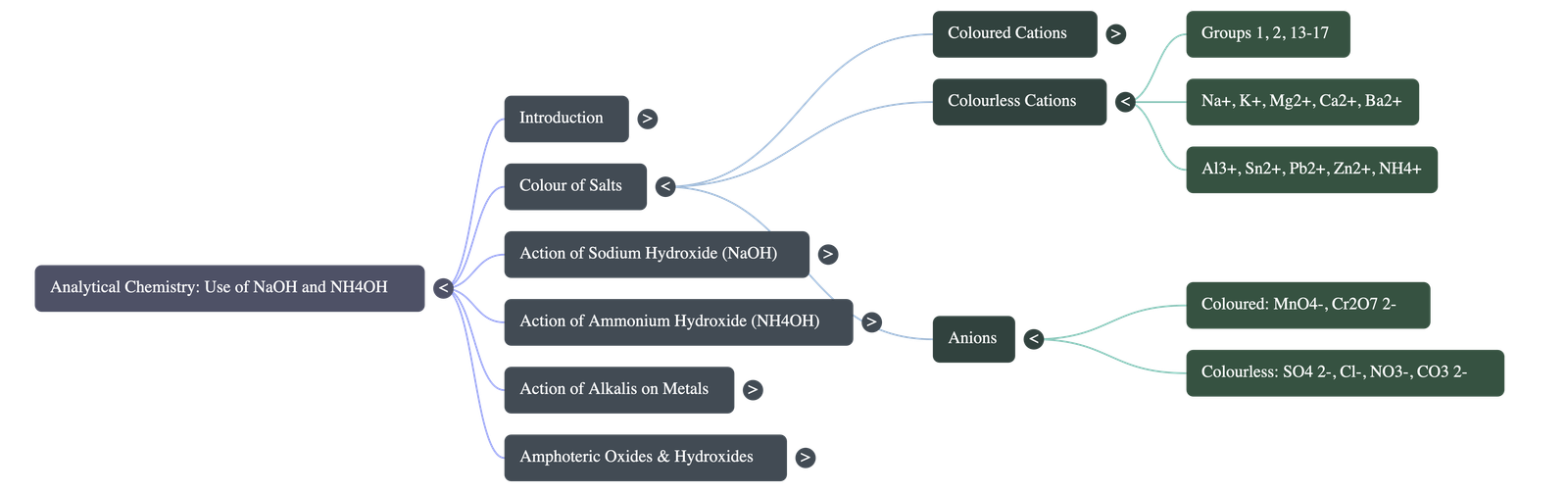
- Normal Elements (Groups 1, 2, and 13 to 17) generally form colourless salts.
- Transition Elements (Groups 3 to 12) generally form coloured salts.
Key Coloured Ions to Remember:
- Cu²⁺ (Copper): Blue / Green
- Fe²⁺ (Iron II): Green
- Fe³⁺ (Iron III): Yellow / Brown
- Cr³⁺ (Chromium): Green
- Mn²⁺ (Manganese): Pink
- MnO₄⁻ (Permanganate): Pink / Purple
- Cr₂O₇²⁻ (Dichromate): Orange
Common Colourless Ions:
- Cations: Na⁺, K⁺, Ca²⁺, Mg²⁺, Al³⁺, Pb²⁺, Zn²⁺, NH₄⁺
- Anions: SO₄²⁻, Cl⁻, CO₃²⁻, NO₃⁻, S²⁻, PO₄³⁻
C. Action of Sodium & Ammonium Hydroxide on Salt Solutions
This section covers the precipitation reactions and the solubility of these precipitates when excess alkali is added.
I. Reactions with Sodium Hydroxide (NaOH)
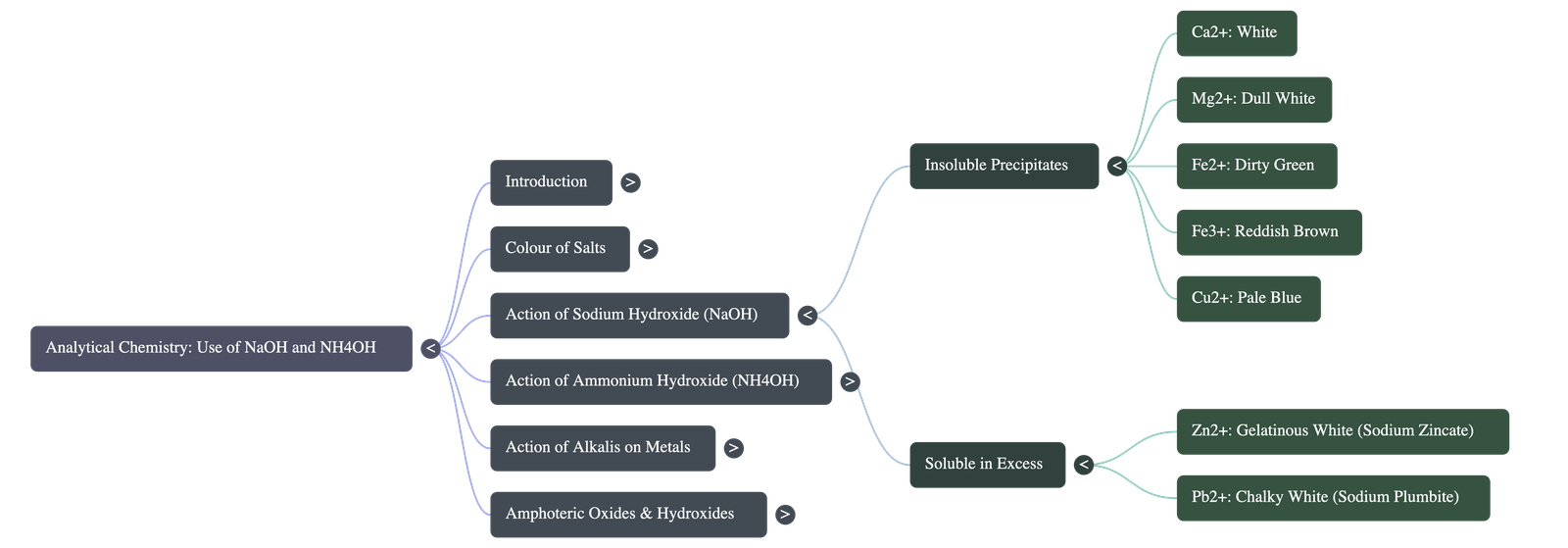
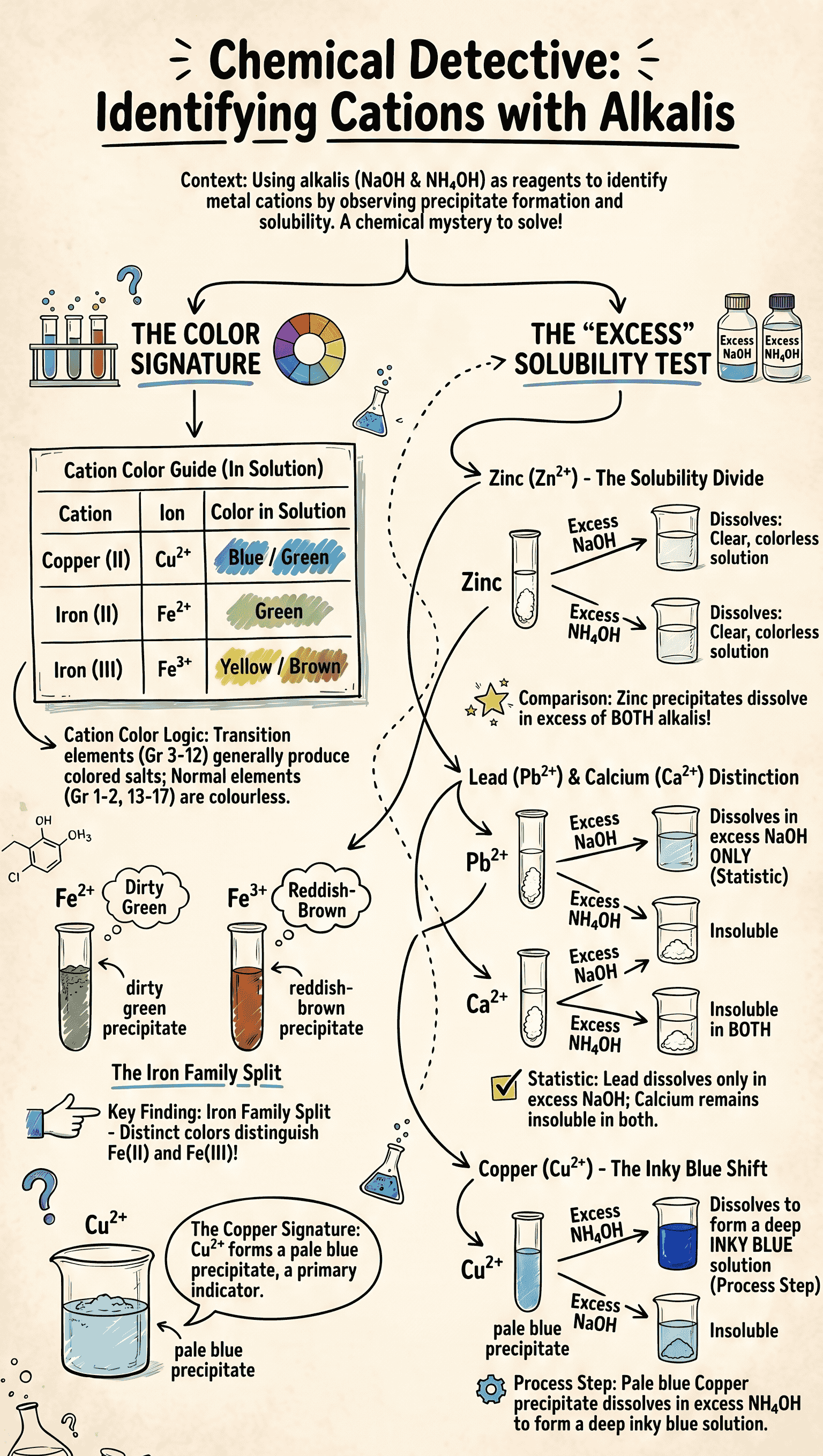
- Calcium (Ca²⁺): Forms a White precipitate (Calcium hydroxide) — Insoluble in excess NaOH.
- Magnesium (Mg²⁺): Forms a Dull white precipitate — Insoluble in excess NaOH.
- Iron [II] (Fe²⁺): Forms a Dirty green precipitate — Insoluble in excess NaOH.
- Iron [III] (Fe³⁺): Forms a Reddish brown precipitate — Insoluble in excess NaOH.
- Copper [II] (Cu²⁺): Forms a Pale blue precipitate — Insoluble in excess NaOH.
- Zinc (Zn²⁺): Forms a Gelatinous white precipitate — SOLUBLE in excess NaOH to form a colourless solution (Sodium zincate).
- Lead [II] (Pb²⁺): Forms a Chalky white precipitate — SOLUBLE in excess NaOH to form a colourless solution (Sodium plumbite).
II. Reactions with Ammonium Hydroxide (NH₄OH)
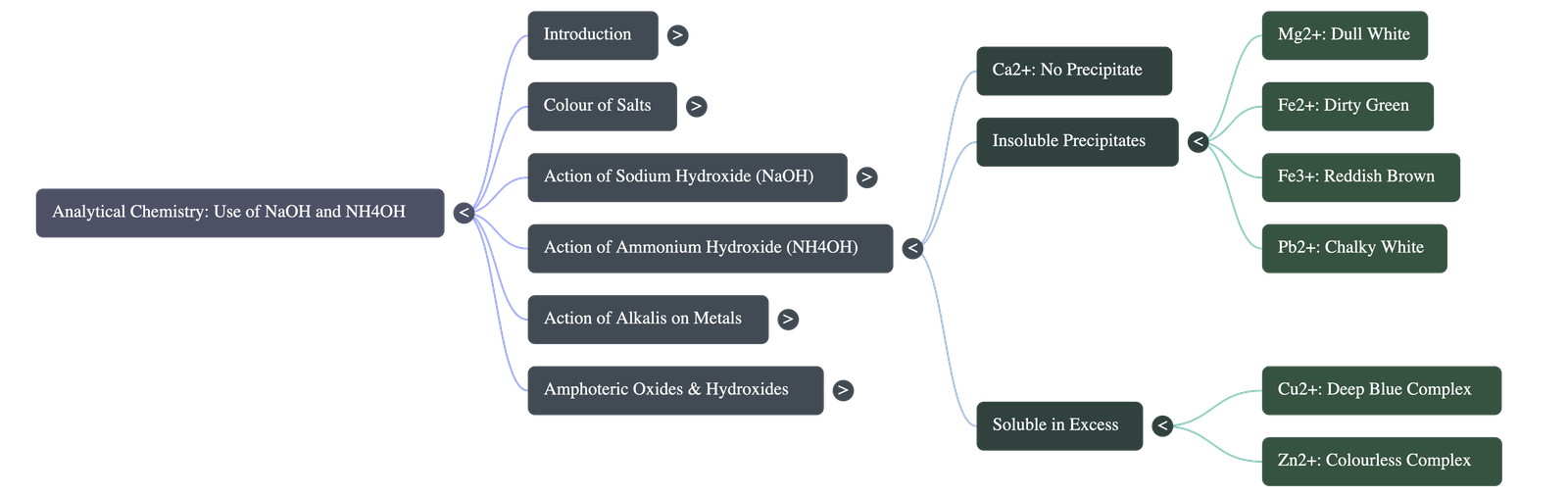
- Calcium (Ca²⁺): NO PRECIPITATE FORMED. The concentration of OH⁻ ions in weak NH₄OH is too low to precipitate Calcium hydroxide.
- Magnesium (Mg²⁺): Forms a Dull white precipitate — Insoluble in excess NH₄OH.
- Iron [II] (Fe²⁺): Forms a Dirty green precipitate — Insoluble in excess NH₄OH.
- Iron [III] (Fe³⁺): Forms a Reddish brown precipitate — Insoluble in excess NH₄OH.
- Lead [II] (Pb²⁺): Forms a Chalky white precipitate — Insoluble in excess NH₄OH.
- Copper [II] (Cu²⁺): Forms a Pale blue precipitate — SOLUBLE in excess NH₄OH, forming a Deep blue or Inky blue complex salt solution (Tetrammine copper sulphate).
- Zinc (Zn²⁺): Forms a White gelatinous precipitate — SOLUBLE in excess NH₄OH, forming a colourless complex salt solution (Tetrammine zinc sulphate).
D. Action of Alkalis on Certain Metals & their Oxides
I. Action on Certain Metals
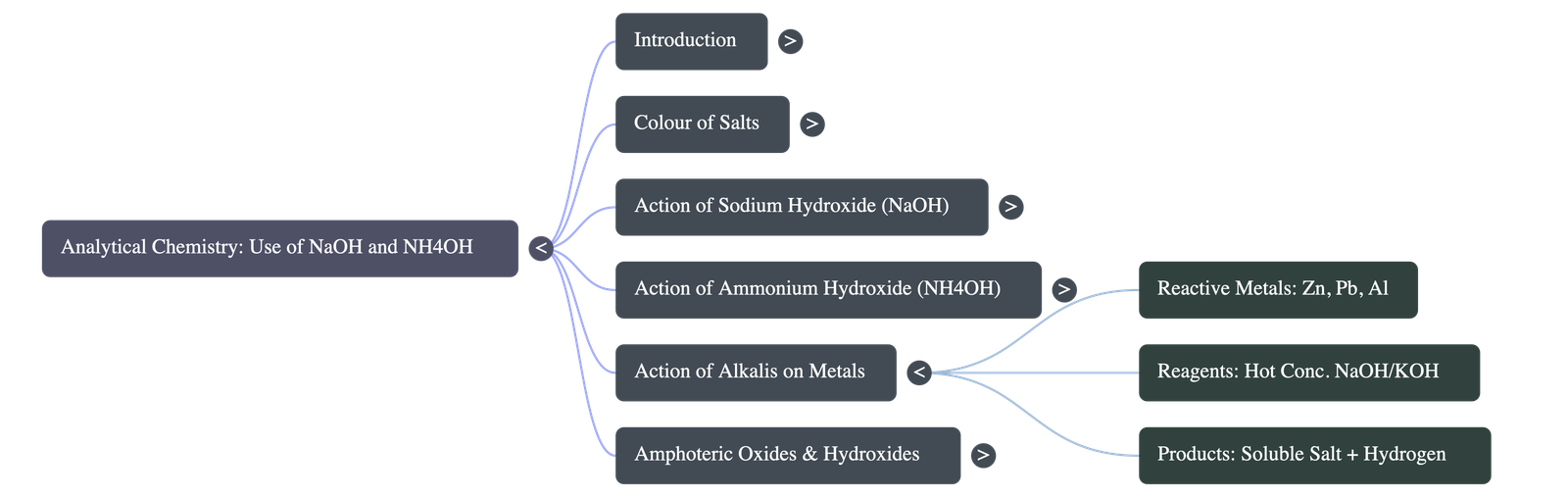
- Certain metals like Zinc (Zn), Aluminium (Al), and Lead (Pb) have a unique property: they react with hot concentrated caustic alkalis (like NaOH and KOH).
- During this reaction, they give off a corresponding soluble salt and liberate Hydrogen gas (H₂).
- Zinc reacts to form Sodium Zincate (Na₂ZnO₂) or Potassium Zincate.
- Lead reacts to form Sodium Plumbite (Na₂PbO₂) or Potassium Plumbite.
- Aluminium reacts (along with water) to form Sodium Aluminate (NaAlO₂) or Potassium Aluminate.
II. Action on Oxides & Hydroxides of Certain Metals (Amphoteric Nature)
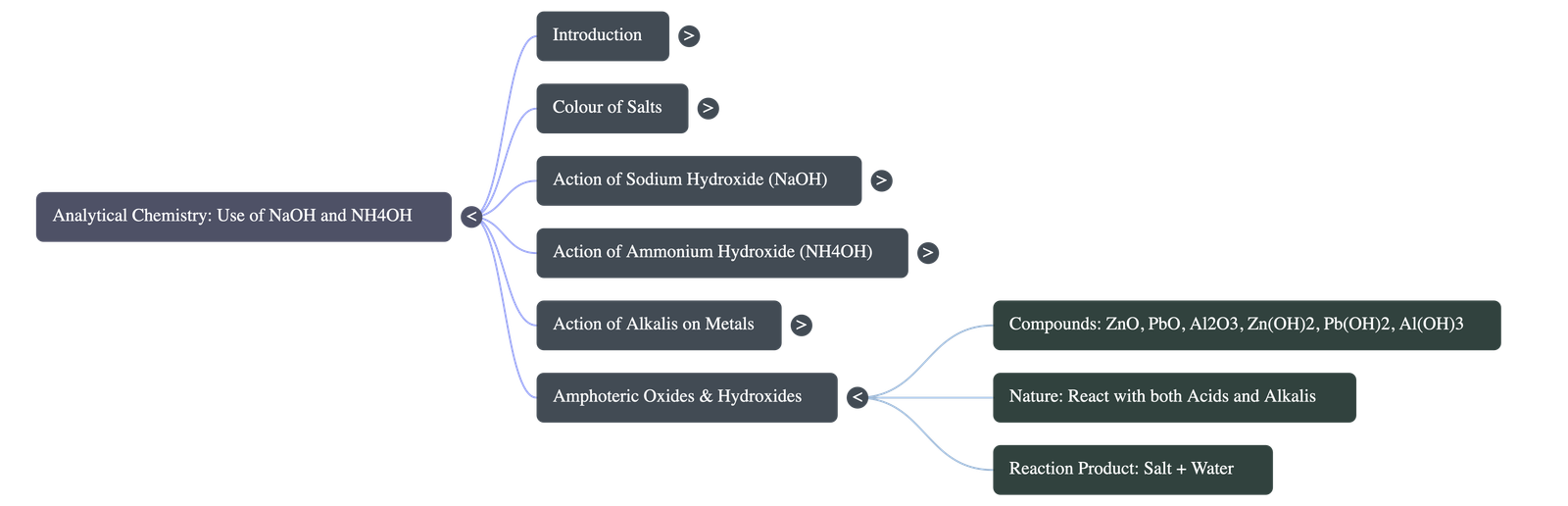
- The oxides and hydroxides of Zn, Al, and Pb (e.g., ZnO, PbO, Al₂O₃, Zn(OH)₂, Pb(OH)₂, Al(OH)₃) are Amphoteric in nature.
- Amphoteric definition: These substances possess both acidic and basic properties. They react with both acids and alkalis to produce salt and water only.
- When reacted with a strong alkali like NaOH, they form complex soluble salts (Zincate, Plumbite, Aluminate) along with water molecules.
Summary of Equations & Examination Practice
- Equation Worksheet: The chapter concludes with a comprehensive "Equation Bank" allowing students to practice and complete the balanced chemical equations for all reactions involving salt solutions and alkalis, ensuring mastery of molecular formulas and stoichiometry.
- Previous Years' Questions (2018-2025): Emphasizes practical observation skills. Typical board questions ask students to:
- Identify unknown cations based on the color of the precipitate formed.
- State specific observations when excess NaOH or NH₄OH is added (e.g., observing a precipitate dissolve to form a clear or deep blue solution).
- Differentiate between salts using given reagents.
- Multiple Choice & High Order Thinking: Tests conceptual clarity, specifically focusing on the amphoteric nature of specific metals/oxides and assertion-reasoning logic regarding the partial dissociation of weak alkalis.
Do checkout all questions & answers of this chapter.
Quick Navigation:
| | | |
1 / 1
Quick Navigation:
| | | |